Tag Archives: writing

Making Effective Revisions: Power Words part one #writing

The events we imagine as we begin to write a story have the power to move us because we see each scene fully formed in our minds. We are under the illusion that what we have written conveys to a reader the same power that moved us. Once we’ve written “the end” it requires no further effort, right?

I don’t know about your work, but usually, at that stage my manuscript reads like it was written by one-hundred monkeys at a writers’ workshop.  

The trick is to understand that, while the first draft has passages that shine, most of what we have written is still in the proto-stage. It contains the seeds of what we believe we have written.

Like Michaelangelo sculpting David, we must work to shave away the detritus and reveal the truth of the narrative.

One way we do this is by injecting subtly descriptive prose into our narrative. Properly deployed, power words can serve as modifiers and descriptors, yet don’t tell the reader what to feel.

Think of these commonly reviled words like falling leaves in autumn. A sentence made of a noun and a verb weighs nothing, feels like nothing: She runs.

Put those leaves in a pile, add a day or two of October rain, and they have weight. She runs through the leaves.

Our words gain weight when we incorporate descriptors into the narrative. If we are careful, our modifiers and descriptors add to the prose, coming together to convey a sense of depth.

And yes, modifiers and descriptors are also known as adjectives and adverbs.

Modifiers are like any other medicine: a small dose can cure illnesses. A large dose will kill the patient. The best use of them is to find words that convey the most information with the most force.

Let’s consider a story where we want to convey a sense of danger, without saying “it was dangerous.” What we must do is find words that shade the atmosphere toward fear.

Power words can be found beginning with every letter of the alphabet, but words that begin with consonants convey strength. What are some “B” words that convey a hint of danger, but aren’t “telling” words?

  • Backlash
  • Blinded
  • Blood
  • Blunder

When you incorporate any of the above “B” words into your prose, you are posting a road sign for the reader, a notice that “ahead lies danger.” Mingle them with other power words, and you have an air of danger.

As authors, it is our job to convey a picture of events.

But words sometimes fail us. I look at each instance of a modifier and see how it fits into that context. If a word or phrase weakens the narrative, I rewrite the sentence. I either change it to a more straightforward form or remove it. For example, bare is an adjective, as is its sibling, barely. Both can be used to form a strong image depending on context.

Revising your manuscript seems like an overwhelming task, but it isn’t. The best resource you can have in your personal library is a dictionary of synonyms and antonyms. Your word processing program may offer you some synonyms when you right-click on a word to open the thesaurus.

For most genre work, I suggest you don’t use “highfalutin” words or use acronyms and technical jargon.

But don’t dumb it down. Readers like it when you assume they are intelligent and aren’t afraid to use a variety of words. Yes, sometimes one must use technical terms, but I appreciate authors who assume the reader is new to the terminology and offer us a meaning.

The book of synonyms and antonyms is full of words we’re familiar with and which we often forget are available for our use when we want to convey an overall mood.

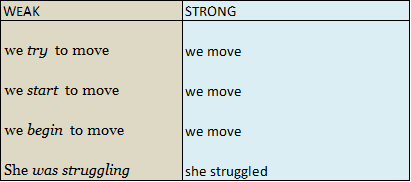
Let’s look at the emotion of discontent and how we can shape the overall mood of a scene and reinforce a character’s growing dissatisfaction without saying “they were discontented.”. The following words can serve as descriptors. If you are sparing about adding suffixes [ly or ing], they’re not fluffy. But you must work harder to compose showing sentences when you avoid mushy suffixes.

  • Aggression [noun] aggressive [adjective]
  • Awkward [adjective]
  • Disgust [verb or noun, depending on context]
  • Denigrate [verb}
  • Disparage [verb]

How we incorporate words into our prose is up to each of us. We all sound different when we speak aloud even when we speak the same language and the same dialect. The same is true for our writing voice.

We can tell the story using any mode or narrative tense we choose but the opening lines on page one must hook the reader, must hint at what they are in for if they stick with the story.

I meant to run away today.

If that were the opening line of a short story or novel, I would continue reading. Two words, run away, hit hard in this context, feel a little surprising as an opener. The protagonist is the narrator and is speaking directly to us, which is a bold choice. Right away, you hope you are in for something out of the ordinary.

That single sentence comprised of five words indicates intention, implies a situation that is unbearable, and offers us a hint of the personality of the narrator.

Some lines from a different type of story, one told from a third person point of view:

The battered chair creaked as Angus sat back. “So, what’s your plan then? Are we going to walk up to his front door and say, ‘Hello. We’re here to kill you’?”

This is a conversation, but it shows intention, environment, and personality in thirty-one words. Battered is a power word and so is creaked.

And here is one final scene, one told from a close third person point of view and uses a form of free indirect speech. This is a style of third-person narration which uses some of the characteristics of third-person along with the essence of first-person direct speech; it is also referred to as free indirect discourse, or free indirect style. The paragraph ends a scene, showing yet another way to incorporate world building along with subtle power words into the prose:

Sara saw the vine-covered ruins of Marlow as an allegory of herself. The core of her, the essence of her that was Josh had been burned away. She’d been destroyed but was coming back to life in ways she’d never foreseen.

The power words are ruinsburned awaydestroyed.

When we are consumed with just getting the story down, we often lean too heavily on one word that says what we mean. This is hard for us to spot in our own work, but a friend of mine uses word clouds to show her crutch words.

When we turn a document into a word cloud, the words we use most frequently show up as the largest. Word clouds are a great way to discover where we need to consult the thesaurus and expand our word choices. Free Word Cloud Generator.

6 Comments

Filed under writing

Motivating our Heroes and Villains #writing


WritingCraftSeries_character-arc

In any narrative, the shadow provides opportunities for the plot. Whether it is a person, a creature, or a natural disaster, the antagonist represents darkness (evil), against which light (good) is shown more clearly.

Best of all, the shadow, whether a person, place, or thing, provides the roadblocks, the cause to hang a plot on.

When the antagonist is a person, I ask myself, what drives them to create the roadblocks they do? Why do they feel justified in doing so?

If you are writing a memoir, who or what is the antagonist? Memoirs are written to shed light on the difficulties the author has overcome, so who or what frustrated your efforts? (Hint: for some autobiographies, it is a parent or guardian. Other times it is society, the standards and values we impose on those who don’t fit into the slots designated for them.)

In a character-driven novel, there may be two enemies, one of which is the protagonist’s inhibitions and self-doubt.


Many times, two main characters have a sharply defined good versus evil chemistry—like Sherlock Holmes and Professor Moriarty. (Trust me, the antagonist is a main character, or the hero has nothing to struggle against.)

The characters on both sides of the battle must recognize and confront the darkness within themselves. They must choose their own path—will they fight to uphold the light? Or will they turn toward the shadow?

When the protagonist must face and overcome the shadow on a profoundly personal level, they are placed in true danger. The reader knows that if the hero strays from the light, they will become the enemy’s tool.

The best shadow characters have many layers, and not all of them are bad. They are charismatic because we can relate to their struggle. We might hope events will change them for the better but know in our hearts they won’t.

Antagonists must be fleshed out. Characters portrayed as evil for the sake of drama can be cartoonish. Their actions must be rational, or the reader won’t be able to suspend their disbelief.

The most fearsome villains have deep stories. Yes, they may have begun life as unpleasant children and may even be sociopaths. Something started them down that path, reinforcing their logic and reasoning.

When the plot centers around the pursuit of a desired object, authors will spend enormous amounts of time working on the hero’s reasons for the quest. They know there must be a serious need driving their struggle to acquire the Golden McGuffin.

Where we sometimes fail is in how we depict the enemy. The villain’s actions must also be plausible. There must be a kind of logic, twisted though it may be, for going to the lengths they do to thwart our heroes.

A mere desire for power is NOT a good or logical reason unless it has roots in the enemy’s past. Why does Voldemort desire that power? What fundamental void drives them to demand absolute control over every aspect of their life and to exert control over the lives of their minions?

The characters in our stories don’t go through their events and trials alone. Authors drag the reader along for the ride the moment they begin writing the story. So, readers want to know why they’ve been put in that handbasket, and they want to know where the enemy believes they’re going. Otherwise, the narrative makes no sense and we lose the reader.

Most of us know what motivates our protagonist. But our antagonist is frequently a mystery, and the place where the two characters’ desires converge is a muddle. We know the what, but the why eludes us.

This can make the antagonist less important to the plot than the protagonist. When we lose track of the antagonist, we are on the road to the dreaded “mushy middle,” the place where the characters wander around aimlessly until an event happens out of nowhere.

The reader must grasp the reasoning behind the enemy’s actions, or they won’t be able to suspend their disbelief.

Ask yourself a few questions:

  • What is their void? What made our antagonist turn to the darkness?
  • What events gave our antagonist the strength and courage to rise above the past, twisted though they are?
  • What desire drives our antagonist’s agenda?
  • What does our antagonist hope to achieve?
  • Why does our antagonist believe achieving their goal will resolve the wrongs they’ve suffered?

None of this backstory needs to be dumped into the narrative. It should be written out and saved as a separate document and brought out when it is needed. The past must emerge in tantalizing bits and hints as the plot progresses and conversations happen.

The hero’s ultimate victory must evoke emotion in the reader. We want them to think about the dilemmas and roadblocks that all the characters have faced, and we want them to wish the story hadn’t ended.

The villains we write into our stories represent humanity’s darker side, whether they are a person, a dangerous animal, or a natural disaster. They bring ethical and moral quandaries to the story, offering food for thought long after the story has ended.

Ideas slip away unless I get them on paper first, so I create a separate document that is for my use only, and I label it appropriately:

BookTitle_Plot_CoreConflict.docx

CharacterVoidVerbNoun01052025LIRF

It’s a synopsis of the conflict boiled down to a few paragraphs. Whenever I find myself wondering what the hell we’re supposed to be doing, I refer back to it.

In my current unfinished work-in-progress, Character A, my protagonist, represents teamwork succeeding over great odds. Character B, my villain, represents the quest for supremacy at all costs.

  • Each must see themselves as the hero.
  • Each must risk everything to succeed.
  • Each must believe or hope that they will ultimately win.

When I create a personnel file for my characters, I assign them verbs, nouns, and adjectives that best show the traits they embody. Verbs are action words that show a character’s gut reactions. Nouns describe personalities best when they are combined with strong verbs.

They must also have a void – an emotional emptiness, a wound of some sort. In my current WIP, Character B fell victim to a mage-trap. He knows he has lost something important, something that was central to him. But he refuses to believe he is under a spell of compelling, a pawn in the Gods’ Great Game. He must believe he has agency—this is his void.

This void is vital because characters must overcome fear to face it. As a reader, one characteristic I’ve noticed in my favorite characters is they each have a hint of self-deception. All the characters – the antagonists and the protagonists – deceive themselves in some way about their own motives.

My task is to ensure that the stories of Characters A and B intersect seamlessly. Motivations must be clearly defined so the reader knows what their moral boundaries are. I like to know their limits because even cartoon supervillains draw the line somewhere.

For me, plots tend to evolve once I begin picturing the characters’ growth arcs. How do I see them at the beginning? How do I see them at the end?

As I write the narrative, they will evolve and change the course of what I thought the original plot was. Sometimes it will change radically. But at some point, the plot must settle into its final form.

I love a novel with a plot arc that explores the protagonist’s struggle against a fully developed, believable adversary, one we almost regret having to defeat.

If you are currently working on a manuscript that feels stuck, I hope this discussion helps you in some way. Good luck and happy writing!

Plot-exists-to-reveal-character

3 Comments

Filed under writing

The business side of the business: a secondlook at budgeting for in-person sales events #writing

January is approaching, and this is a good time to consider the business side of writing. Looking forward in the year ahead, some things must be budgeted and planned ahead for. This post, which first appeared here in June, covers some but not all of them. If you are doing in-person sales events, it’s a good idea to go to your city and state licensing agencies to be sure you are operating within the law.

If you have already seen this post, feel free to move on, and I sincerely thank you for stopping by! Otherwise, without further ado, here is the Business Side of the Business.


Regardless of your publishing path, indie or traditional, you must budget for certain things. You can’t expect your royalties to pay for them early in your career. And just so you know, many award-winning authors must still work their day jobs to pay their bills long after becoming bestsellers.

Its a BusinessNowadays, I am rarely able to do in-person events due to family constraints, but I used to do four events a year. However, I have some tips to help ease the path for you.

At first, getting your books in front of readers is a challenge. The in-person sales event is one way to get eyes on your books. This could be at a venue as small as a local bookstore allowing you to set up a table on their premises.

Or it could be as large as a table at a regional conference or convention. Regardless, if you are traditionally published, your publisher won’t provide you with free copies of your book to sell at the signing event. You will pay for them at a reduced cost. If not up front, then you will pay out of any future royalties. You will also have to be your own publicist and getting the word out about your event will be your responsibility. On the good side, you will keep the monies earned by your in-person sales.

Signings at writers’ conferences are usually a bit pricy for the number of books you might sell, but they are great ways to network.

What are the minimum costs for working a table at a signing event? The bare minimum expenses are as follows:

  1. You must have a stock of books on hand. You can’t sell books that you haven’t ordered. I order well in advance, as it can take three weeks for an order to arrive via the least expensive shipping method. Paying for overnight shipping of fifteen to twenty books is well out of my price range.
  2. We must consider the table fee. A bookstore might not charge you anything for the table, but they may take a small cut if they run your sales through their cash registers.

However, large conferences and conventions will charge table fees ranging from $70.00 to as high as $300.00 or more. This varies with the size and type of conference, the venue where the convention is being held, and the vendors you will be competing with.

Sci-fi and Fantasy fan conventions can be quite pricy. You will be in an immense, crowded room, competing with big-name RPG game franchises and movie franchises, plus all the vendors of memorabilia and collectibles that are available in the vendors’ alley.

  1. If you are able to get a table at a major fan convention, you must pay for transportation, food, and lodging. These costs could be gas, parking, airfare, hotel, etc., if you don’t have friends or family in that area. If you are planning to stay in a hotel, take simple foods that can be prepared without a stove. Being vegan, I tend to be an accomplished hotel-room chef, as most coffee bars don’t offer many plant-based options. While that bias is changing, I still go prepared.
  2. Bring at least one pen for signing your books. I bring four or five because sometimes the pens don’t work as advertised.
  3. cashbox 3The final thing you will need is a way of accepting money. I have a metal cash box, but you only need something to hold cash and some bills to make change with. A way to accept credit cards, something like Square, is a good option. You will find a lot of vendors use Square, but there are other options out there.

These things are the bare minimum you will need to provide. At many shows, you’ll be given a table with skirting and a sign attached to the front with your name in block letters. You can get by with this if you’re on a tight budget. New vendors manage with this minimal setup all the time. This option lets you squeak by on little more than the cost of your books. Your setup and teardown time will be short, and you’ll have little to transport—always a positive, in my opinion.

My good friend, Lee French, is a best-selling YA author and a pro at successfully working conventions. She co-wrote the book Working the Table: An Indie Author’s Guide to Conventions with the late Jeffrey Cook. She tells us that to really succeed, you’ll need to invest a bit more.

It helps to have some kind of promotional handout. I find bookmarks and business cards are the most affordable option. I know a few authors who order all sorts of little buttons and promotional trinkets advertising their books. They give them out to everyone who passes their table, buyers or not.

Trinkets are nice, but if you are cash-strapped, business cards and bookmarks offer the best return on your cost outlay for promotional material. They are less expensive when purchased in bulk, so I get as many as my budget allows.

You will need a business license to sell books at most conventions. Each state in the US has different requirements for getting these, so do the research and get whatever business license your local government requires. This allows you to get a reseller’s permit, enabling you to buy copies of your own books without paying sales tax. If your state doesn’t assess sales tax, you don’t need this, but you’ll still need the business license.

If you live in a state like Washington State, be smart and set aside the money collected as sales tax. It is not yours and shouldn’t be considered part of your income.

the _book_signing_eventInvesting in some large promotional graphics, such as a retractable banner, is a good idea. A large banner is a great visual to put behind your chair. A second banner for the front of the table looks professional but requires some fiddling with pins.

Lee French suggests getting a custom-printed tablecloth that drops over the front of the table, acting as a banner. It looks more professional, and the books will hold it down, so you don’t have to mess with pins. You can find a wide variety of sizes and shapes of banners and graphic promotional props on the internet.

I have an inexpensive black tablecloth for under my books, but you can get one in the color of your choice. Venues will often provide a white tablecloth, so buying one isn’t necessary, but it makes your display look more professional. Many shows offer a 6’x3′ table, but, as with the tablecloth, check first to be sure you don’t need to bring your own.

I suggest buying book stands of some sort. Recipe stands work, and so do plate and picture stands. Whether they’re fancy or cheap, be sure you know how to set them up so they don’t fall over when someone bumps the table. I use folding plate stands as they store well in the rolling suitcase I use for my supplies.

This brings us to storage and shifting goods. We must move our gear between the table and our vehicle, and sometimes, we’re forced to park in inconvenient places. Many people use wheeled bins or fold-up handcarts. Folding luggage carts are a great, lightweight option when you only have a few bins and boxes. I use a large, wheeled suitcase for my books, as I travel pretty light.

I also use a plastic container with a good lid for storing pens, bookmarks/cards, book stands, and other whatnot.

HTB Bookmark side A copyMake your display attractive, but I suggest you keep it simple. People will be able to see what you are selling, and the more fiddly things you add to your display, the longer setup and teardown will take. The shows and conferences I have attended offered plenty of time for this, but I’ve heard that some of the big-name conventions require you to be in or out in two hours or less.

Aside from the table fee and transportation, Lee French says it will cost about $400 for your initial stock of books, banners, bookmarks, and odds & ends. The way inflation is going, it may take more than that, but you can make it less painful by purchasing one thing at a time in advance as your budget allows.

Shop the internet for sales on banners and similar items. You will need to replace bookmarks, business cards, and book stock after each event, but most larger promotional items won’t need to be repurchased or updated for a year or two.

If you plan to get a table at a large conference this year, I highly recommend Working the Table: An Indie Author’s Guide to Conventions. This book has all the information you will need to successfully navigate the wild seas of selling your books at conventions.

And if you choose to embark on the in-person event circuit, I wish you good luck and many happy sales.

working_the_table_French_and_Cook

3 Comments

Filed under writing

A Christmas Carol by Charles Dickens, a master class in structure and my favorite audiobook as read by Aaron Volner

Our post today explores my favorite Christmas story of all time, A Christmas Carol, by Charles Dickens.

My dear friend (and one of my favorite indie authors) Aaron Volner is an amazing narrator. Last year, he posted his incredible reading of the original manuscript of A Christmas Carol on YouTube. It is read exactly as written by Charles Dickens.

My Sister's Ornament, cjjaspAaron’s interpretation of this classic is spot on. He has gotten all the voices just right, from kindly Fred down to Tiny Tim.

I think this is by far my favorite version of A Christmas Carol as it is the original manuscript and is one I will be listening to every year. The original version, as it fell out of Dicken’s pen and onto the paper, is far scarier than most modern versions, and Volner’s interpretation expresses that eeriness perfectly.

Scrooge’s horror is visceral, and his redemption is profound.

Charles Dickens would have greatly approved of this reading. I give Volner’s performance five stars—something I rarely do. You can find this wonderful reading via this link: “A Christmas Carol” by Charles Dickens – YouTube.

It is divided into staves (chapters) so that you can listen to one a day or binge them the way I do.

Last year, Aaron’s rendition of this wonderful story prompted me to revisit a post on what modern writers can learn from Dickens, one posted several years ago.

Each time I read this tale or listen to Aaron’s narration, I learn something new about story and structure. The opening act of this tale hooks the reader and keeps them hooked. It is a masterclass in how to structure a story.

Let’s have a look at the first lines of this tale:

Christmascarol1843_--_040“Marley was dead, to begin with. There is no doubt whatever about that. The register of his burial was signed by the clergyman, the clerk, the undertaker, and the chief mourner. Scrooge signed it. And Scrooge’s name was good upon ‘Change for anything he chose to put his hand to. Old Marley was as dead as a doornail.”

In that first paragraph, Dickens offers us the bait. He sinks the hook and reels in the fish (the reader) by foreshadowing the story’s first plot point–the visitation by Marley’s ghost. We want to know why Marley’s unquestionable state of decay was so crucial that the conversation between us, the readers, and Dickens, the author, was launched with that topic.

Dickens doesn’t talk down to his readers. He uses the common phrasing of his time as if he were speaking to us over tea — “dead as a doornail,” a phrase that is repeated for emphasis. This places him on our level, a friend we feel comfortable gossiping with.

He returns to the thread of Marley several pages later, with the little scene involving the doorknocker. This is where Scrooge sees the face of his late business partner superimposed over the knocker and believes he is hallucinating. This is more foreshadowing, more bait to keep us reading.

At this point, we’ve followed Scrooge through several scenes, each introducing the subplots. We have met the man who, as yet, is named only as ‘the clerk’ in the original manuscript but whom we will later know to be Bob Cratchit. We’ve also met Scrooge’s nephew, Fred, who is a pleasant, likeable man.

These subplots are critical, as Scrooge’s redemption revolves around the ultimate resolution of those two separate mini stories. He must witness the joy and love in Cratchit’s family, who are suffering but happy despite living in grinding poverty (for which Scrooge bears a responsibility).

We see that his nephew, Fred, though orphaned, has his own business to run and is well off in his own right. Fred craves a relationship with his uncle and doesn’t care what he might gain from it financially.

By the end of the first act, all the characters are in place, and the setting is solidly in the reader’s mind. We’ve seen the city, cold and dark, with danger lurking in the shadows. We’ve observed how Scrooge interacts with everyone around him, strangers and acquaintances alike.

Now we come to the first plot point in Dickens’ story arc–Marley’s visitation. This moment in a story is also called “the inciting incident,” as this is the point of no return. Here is where the set-up ends, and the story takes off.

Dickens understood how to keep a reader enthralled. No words are wasted. Every scene is important, every scene leads to the ultimate redemption of the protagonist, Ebenezer Scrooge.

This is a short tale, a novella rather than a novel. But it is a profoundly moving allegory, a parable of redemption that remains pertinent in modern society.

In this tale, Dickens asks you to recognize the plight of those whom the Industrial Revolution has displaced and driven into poverty and the obligation of society to provide for them humanely.

This is a concept our society continues to struggle with and perhaps will for a long time to come. Cities everywhere struggle with the problem of homelessness and a lack of empathy for those unable to afford decent housing. Everyone is aware of this problem, but we can’t come to an agreement for resolving it.

A Christmas Carol remains relevant even in today’s hyper-connected world. It resonates with us because of that deep, underlying call for compassion that resounds through the centuries and is, unfortunately, timeless.

Ghost_of_Christmas_Present_John_Leech_1843As I mentioned before, this book is only a novella. It was comprised of 66 handwritten pages. Some people think they aren’t “a real author” if they don’t write a 900-page doorstop, but Dickens proves them wrong.

One doesn’t have to write a novel to be an author. Whether you write blog posts, poems, short stories, novellas, or 700-page epic fantasies, you are an author. Diarists are authors. Playwrights are authors. Authors write—the act of creative writing makes one an author.

And that brings us to the featured images. The two illustrations are by John Leech from the first edition of the novella published in book form in 1843.  We’re fortunate that the original art of John Leech, which Dickens himself chose to include in the book, has been uploaded to Wikimedia Commons. Thanks to the good people at Wikimedia, these prints are available for us all to enjoy.

From Wikipedia: John Leech (August 29, 1817 – October 29, 1864, in London) was a British caricaturist and illustrator. He is best known for his work for Punch, a humorous magazine for a broad middle-class audience, combining verbal and graphic political satire with light social comedy. Leech catered to contemporary prejudices, such as anti-Americanism and antisemitism, and supported acceptable social reforms. Leech’s critical yet humorous cartoons on the Crimean War help shape public attitudes toward heroism, warfare, and Britain’s role in the world. [1]

I love stories of redemption–and A Christmas Carol by Charles Dickens remains one of the most beloved tales of redemption in the Western canon. Written in 1843 as a serialized novella, A Christmas Carol has inspired a landslide of adaptations in both movies and books.

Dickens was an indie, as all writers were at that time. He struggled to support his family with his writing. But we remember his works today. His great talent for storytelling gives us permission to write what we are inspired to.

May the holiday season and New Year find you and your loved ones happy and healthy, and may you have many opportunities to tell your stories.


CREDITS AND ATTRIBUTIONS:

[1] Wikipedia contributors, “John Leech (caricaturist),” Wikipedia, The Free Encyclopedia, https://en.wikipedia.org/w/index.php?title=John_Leech_(caricaturist)&oldid=871947694 (accessed December 25, 2022).

Wikimedia Commons contributors, “File:Christmascarol1843 — 040.jpg,” Wikimedia Commons, the free media repository, https://commons.wikimedia.org/w/index.php?title=File:Christmascarol1843_–_040.jpg&oldid=329166198 (accessed December 25, 2022)

A colourised edit of an engraving of Charles Dickens’ “Ghost of Christmas Present” character, by John Leech in 1843. Wikimedia Commons contributors, “File:Ghost of Christmas Present John Leech 1843.jpg,” Wikimedia Commons, the free media repository, https://commons.wikimedia.org/w/index.php?title=File:Ghost_of_Christmas_Present_John_Leech_1843.jpg&oldid=329172654 (accessed December 25, 2022).

10 Comments

Filed under writing

#DecemberWriter – Scene Composition and Transitions #writing

When I sit down to write a scene, my mind sees it as if through a camera, as if my narrative were a movie. The character and their actions are framed by the setting and environment. In so many ways, a writer’s imagination is like a camera, and as they write that first draft, the narrative unfolds like a movie.

writing craft functions of the sceneDirectors will tell you they focus the scenery (set dressing) so it frames the action. The composition of props in that scene is finely focused world-building, and it draws the viewer’s attention to the subtext the director wants to convey.

Subtext is what lies below the surface. It is the hidden story, the secret reasoning that shapes the narrative. It’s conveyed by the composition of the images we place in the environment and how they affect our perception of the mood and atmosphere.

Book- onstruction-sign copyAs I work my way through revisions, I struggle to find the right set dressing to underscore the drama. Each item mentioned in the scene must emphasize the characters’ moods and the overall atmosphere of that part of the story.

Subtext supports the dialogue and gives purpose to the personal events. What furnishings, sounds, and odors are the visual necessities to support that scene? How can I best frame the interactions so that the most information is conveyed with the fewest words? And how do we chain our scenes together to create a smooth flow to our narrative?

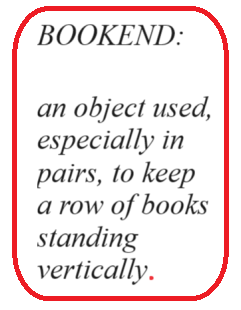
We all struggle with transitions, and one helpful tool is this: we can bookend our scenes. But how does bookending work?

Last week, we talked about transitions and how they affect pacing, but we didn’t have time to expand on the mechanics. We want the events to unfold naturally so the plot flows logically.

Perhaps we have the plot all laid out in the right order. We know what must happen in this event so that the next event makes sense. But how do we move from this event to the next in such a way that the reader doesn’t notice the transitions?

bookendWe can bookend the event with “doorway” scenes. These scenes determine the narrative’s pacing, which is created by the rise and fall of action.

Pacing consists of doing and showing linked together with a little telling. An example of an opening paragraph (from a short story) that conveys visual information is this:

Olin Erikson gazed at the remains of his barn. He turned back to Aeril, his nine-year-old son. “I know you didn’t shake our barn down intentionally, but it happened. I sense that you have a strong earth-gift, and you’ve been trying to hide it.”

In that particular short story, the opening paragraph consists of 44 words. It introduces the characters and tells you they have the ability to use magic. It also introduces the inciting incident. But bookends come in pairs, so what does a final paragraph do?

Another example is one I have used before. This next scene is the last paragraph of an opening chapter. Page one of the narrative opens with a short paragraph introducing the character—the hook. This is followed by a confrontation scene that introduces the inciting incident. Finally, we need to keep the reader hooked. The paragraph that follows here is the final paragraph of that introductory chapter:

I picked up my kit and looked around. No wife to kiss goodbye, no real home to leave behind, nothing of value to pack. Only the need to bid Aeoven and my failures goodbye. The quiet snick of the door closing behind me sounded like deliverance. I’d hit bottom, so things could only get better. Right?

While that particular narrative is told from the first-person point of view, any POV would work.

Orange_Door_with_Hydrangeas_©_Connie_Jasperson_2019The opening paragraph of a chapter and the ending paragraph are miniature scenes that bookend the central action scene. They are doors that lead us into the event and guide us on to the next hurdle the character must overcome.

The objects my protagonists observe in each mini-scene allow the reader to infer a great deal of information about them and their actions. This is world-building and is crucial to how the reader visualizes the events.

Transition scenes are your opportunity to convey a lot of information with only a few words.

The character in the above transition scene performs an action and moves on to the next event. It reveals his mood and some of his history in 56 words of free indirect speech and propels him into the next chapter.

He does somethingI picked up my kit and looked around. He performs an action in only 8 words, and that action gives us a great deal of information. It tells us that he is preparing to leave on an extended journey.

He shows us something: No wife to kiss goodbye, no real home to leave behind, nothing of value to pack. Only the need to bid Aeoven and my failures goodbye. In 26 words, he shows us a barren existence and offers us his self-evaluation as a failure.

He tells us somethingThe quiet snick of the door closing behind me sounded like deliverance. I’d hit bottom, so things could only get better. Right?  22 words show us his state of mind. The door has closed on an episode in his life, and he has no intention of going back.

This paragraph ends the chapter.

APPROACHING HELLWhen the next chapter opens, he steps into an opening paragraph that leads into the next action sequence. We find out who and what new misery is waiting for him on the other side of that door.

Small bookend scenes should reveal something and push us toward something unknown. They don’t take up a lot of space, and they lay the groundwork for what comes next, subtly moving us forward.

One way to ensure the events of your story occur in a plausible way is to open a new document and list the sequence of events in the order in which they have to happen. That way, you can view the story as a whole and move events forward or back along the timeline to ensure a logical sequence.

The brief transition scene does the heavy lifting when it comes to conveying information. It is the best opportunity for clues about the characters and their history to emerge without an info dump.

A “thinking scene” opens a window for the reader to see how the characters see themselves.

The road to hell Phillip Roth QuoteWhen you begin making revisions, take a look at the opening paragraph of each chapter. Ask yourself how it could be rewritten to convey information and lead the reader into the action. Then, look at the final paragraph and ask yourself the same question.

Finding the right words to hook a reader, land them, and keep them hooked is a lot of work, but it will be worth it.

2 Comments

Filed under writing

#DecemberWriter – Dialogue and smooth transitions #writing

The best stories have an arc of rising action flowing smoothly from scene to scene. The changes from scene to scene should feel organic to the narrative and not jar the reader.

MyWritingLife2021These transitions are often small moments of conversation, italicized thoughts (internal dialogues), or contemplations written as free indirect speech. These moments are a form of action that can work well when a hard break, such as a new chapter, doesn’t feel right. The reader and the characters receive information simultaneously, but only when they need it.

Pacing has a scientific equation that can be described in two ways:

Action + reaction +action +reaction = pacing.

Push + glide + push +glide = pacing.

Usually, the overall pacing isn’t apparent while the reader is involved in the story. However, if the pacing is off, a narrative can quickly become jarring or boring, and readers will notice that.

Dialogue is an excellent tool for the reaction part of the pacing equation, but it must have a purpose and move toward a conclusion of some sort. This means conversations or ruminations should offer information of some kind to keep moving the story forward.

What can be revealed in conversations or free indirect speech? Necessary information is the obvious answer, but what else? We use it as a component of world-building to convey the atmosphere and show the scene. We also use it to expand on our theme.

ConversationsA character’s personal mood can be shown in many ways. A moment of gallows humor lightens and shows certain characters as human. Exchanging information about the backstory in a bantering way when characters are under great stress is more entertaining than a blunt dump.

Whether humor comes into it or not, moments of regrouping and processing what just occurred are necessary for the reader as well as for the pacing.

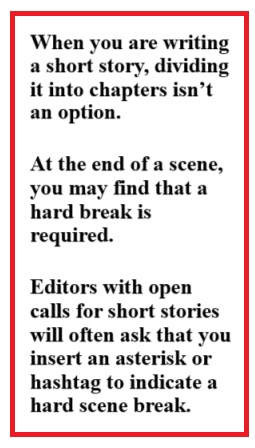
Sometimes, a writer comes to the end of a scene and doesn’t know how to transition to the next. We have a choice to either end it with a hard break or write a short transition scene.

I always look at the overall length of what has gone before. If it’s too short, say 500 or so words, I look for a way to expand the action without slowing it, or I write a brief transition scene.

For the transition conversation, whether it’s an internal monologue or spoken aloud, I ask myself three questions:

  1. Who needs to know what?
  2. Why must they know it?
  3. How many words do I intend to devote to it?

Once I know what must be conveyed and why, I find myself walking through the Minefield of Too Much Exposition.

It is easy to write long paragraphs with lines and lines and lines of uninterrupted dialogue.

carrotTrim that back to “Just the facts, ma’am,” and add a little guesswork to show the characters don’t know everything. We have to keep the carrot (information) dangling just out of reach, or we’ll lose the reader.

We want to avoid bloated exposition because readers will skip over walls of words, hoping to “get to the good part,” and they could miss the information they need, lending confusion to the narrative.

A certain amount of information from the protagonist’s point of view can be dispersed via indirect speech. The point of view character is an unreliable narrator, so their thoughts and conversations are suspect. It’s a good way to misdirect the reader and add an element of surprise when their suppositions are proven wrong.

Let’s look at a scene that opens upon a place where the reader and the protagonists must receive information. The way the characters speak to us can take several forms:

  • Direct dialogue: Nattan said, “I was going to give it to Benn in Fell Creek, but he wasn’t home, and I had to get on the road.”
  • Italicized thoughts: Nattan stood looking out the window. Benn’s not home. What now?
  • Free indirect speech: Nattan stood looking out the window. Benn wasn’t home, so who should he give it to?

Wikipedia describes free indirect speech as a style of third-person narration that uses some of the characteristics of a third-person point of view along with the essence of a first-person direct speech.

The following is an example of sentences using direct, indirect and free indirect speech:

Quoted or direct speech: He laid down his bundle and thought of his misfortune. “And just what pleasure have I found, since I came into this world?” he asked.

Reported or normal indirect speech: He laid down his bundle and thought of his misfortune. He asked himself what pleasure he had found since he came into the world.

Free indirect speech: He laid down his bundle and thought of his misfortune. And just what pleasure had he found, since he came into this world?

According to British philologist Roy Pascal, Goethe and Jane Austen were the first novelists to use this style consistently and nineteenth century French novelist Flaubert was the first to be consciously aware of it as a style. [1]

When I began writing seriously, I was in the habit of using italicized thoughts and characters talking to themselves to express what was happening inside them.

That wasn’t wrong, but I used italics too freely. When used sparingly, italicized thoughts and internal dialogue have their place. We have to be careful with them because a wall of italicized words is difficult for people with compromised vision (like me) to read.

In the years since I first began writing seriously, I’ve evolved in my writing habits. Nowadays, I am increasingly drawn to using the various forms of free indirect speech to show who my characters think they are and how they see their world, and I rarely use italics.

strange thoughtsThe main thing to watch for when employing indirect speech in a scene is to stay only in one person’s head. You can show different characters’ internal workings, provided you have a hard scene or chapter break between each character’s dialogue.

If you aren’t careful, you can slip into “head-hopping,” which is incredibly confusing for the reader. First, you’re in one person’s thoughts, and then another—like watching a tennis match.

Readers like it when we find ways to get the story across with a minimum of words.

Writing conversations and showing a character’s critical thoughts as an organic part of the unfolding plot make good transition scenes. They’re a good means of giving information and revealing hidden aspects of a character.

I hope your writing has continued now that November and the month of writing quests has passed. Keep writing new words every day, even if it’s only a paragraph or two. This will keep you in the habit and bring your novel closer to completion.

Credits and Attributions:

[1] Wikipedia contributors, “Free indirect speech,” Wikipedia, The Free Encyclopedia, https://en.wikipedia.org/w/index.php?title=Free_indirect_speech&oldid=817276599 (accessed Dec 7, 2024).

Comments Off on #DecemberWriter – Dialogue and smooth transitions #writing

Filed under writing

#DecemberWriter – delving deeper into character #writing

November is over, and I did achieve my goal of writing a chapter a day for all 30 days. However, the story is not finished, and a great deal of work still remains to be done. In between working on other projects, I will spend several months doing three things:

  • Delving deeper into character arcs.
  • Firming up the plot
  • Identifying and cutting the chapters that don’t advance the main character’s story and turn them into short stories.

I always start with the characters.

MyWritingLife2021BAs stories unfold on paper, new characters enter. They bring their dramas and the story goes in a different direction than was planned. When I meet these imaginary people, I assign their personalities a verb and a noun.

As an example of how I work, let’s look at four characters from my novel, Julian Lackland, which was published in 2020. Each side character impacts Julian’s life for good or ill.

This novel had a rough beginning, and an even harder path to final product. I nearly shelved it forever, but I had the good fortune to attend a seminar given by romance author, Damon Suede. THAT high-energy seminar changed how I approached the story.

I took the story back to its foundations and in the final rewrite, I made a point of looking for the two words that best describe how each point-of-view character sees themselves. It changed everything, allowing the story to be shown the way I saw it in my mind.

Julian_Lackland Cover 2019 for BowkersJulian’s noun is chivalry (Gallantry, Bravery, Daring, Courtliness, Valor, Love). He sees himself as a good knight and puts all his effort into being that person. He is in love with both Mags and Beau.

Beau’s noun is bravery (Courage, Loyalty, Daring, Gallantry, Passion). Golden Beau is also a good knight, but his view of himself is more pragmatic. He is Julian’s protector and is in love with both Mags and Julian.

Lady Mags’s noun is audacity (Daring, Courage). Mags defied her noble father and ran away from an arranged marriage to a duke in order to swing her sword as a mercenary. She will win at any cost and is not above lying or cheating to do so. She is in love with both Beau and Julian.

Bold Lora’s noun is bravado (Boldness, Brashness). Lora is in it for the fame. She doesn’t care about the people she is hired to protect, and makes enemies among every crew she is hired to serve in. As one unimpressed side character puts it, “If Lora rescues a cat from a tree, she wants songs of the amazing deed sung in every tavern.”

The way we see ourselves is the face we present to the world. These self-conceptions color how my characters react at the outset. By the end of the story, how they see themselves has changed because their experiences will both break and remake them.

Verbalize_Damon_SuedeNext, we assign a verb that describes their gut reactions, which will guide how they react to every situation. They might think one thing about themselves, but this verb is the truth. Again, we also look at sub-verbs and synonyms:

Julian has 2 Verbs. They are: DefendFight, (Preserve, Uphold, Protect)

Beau’s 2 Verbs are: Protect, Fight (Defend, Shield, Combat, Dare)

Lady Mags’s 2 Verbs are: Fight, Defy (Compete, Combat, Resist)

Bold Lora’s 2 Verbs are: Desire, Acquire (Want, Gain, Own)

A character’s preconceptions color their experience of events—and they are unreliable witnesses. The way they tell us the story will gloss over their own failings. As always, the real story happens when they are forced to rise above their weaknesses and face what they fear.

As readers we see the story through the protagonist’s eyes, which shades how we perceive the incidents.

When I write my characters, I know how they believe they will react in a given situation. Why? Because I have drawn their portraits using words:

Julian must Fight for and Defend Chivalry. Julian’s commitment to defending innocents against inhumanity is his void, and ultimately it breaks his mind.

Golden Beau must Fight for and Protect Bravery. Beau’s deep love and commitment to protecting and concealing Julian’s madness is his void. Ultimately, it breaks Beau’s health.

Lady Mags must Fight for and Defy Audacity. She’s at war with herself in regard to her desire for a life with Julian and Beau. Despite the two knights’ often-expressed wish to have her with them, a triangular marriage goes against society’s conventions more than even a rebel like Mags is willing to do. That war destroys her chance at happiness and is her void.

Bold Lora must Fight for and Acquire Fame. She believes that to be famous is to be loved. Orphaned at a young age and raised by various indifferent guardians, she just wants to be loved by everyone. Julian’s fame has made him the object of her obsession. If she can own him, she will be famous, adored by all. This desperate striving for fame is Lora’s void.

The verb (action word) that drives them and the noun (object of the action) are the character traits that hold them back. It is their void, the emptiness they must fill.

activateHave you thought about the two words that describe the primary weaknesses of your characters, the thing that could be their ultimate ruin? In the case of Julian’s story, it was:

Julian Lackland: Obsession and Honor

Golden Beau Baker: Love and Loyalty

Lady Mags De Leon: Stubbornness and Fear (of Entrapment)

Bold Lora: Fear (of Being) Forgotten

So, in the novel, Julian Lackland, a girl who was ignored by everyone, a child who’d lived on the outside looking in and who was fostered by indifferent relatives, decides that the one person who had ever shown her kindness should become her lover. If she could have Julian, fame would follow.

The way she goes about it changes everything and is the core of Julian’s character arc.

BNF_HTB_ 225_banner_boxJulian Lackland took ten years to get from the 2010 NaNoWriMo novel to the finished product. He spawned the books Huw the Bard and Billy Ninefingers, both of which were written and published before the final version of Julian’s story was completed. Billy and Huw play a huge role in shaping Julian’s life.

Placing a verb phrase (Fight for and Acquire) before a noun (Fame) in a personality description illuminates their core conflict. It lays bare their flaws and opens the way to building new strengths as they progress through the events.

Or it will be their destruction.

By the end of the book, the characters must have changed. Some have been made stronger and others weaker – but all must have an arc to their development.

Sometimes, as in the case of Julian Lackland, the path to publication is fraught with misery. Other times, the book writes itself and flies out the door. Who knows how my current unfinished novel will end? It’s in the final stretch, but nothing is certain.

I am a step ahead in this process, though. I already know my characters’ weaknesses, their verbs and nouns. As I learned from my experience writing Julian’s novel, I just need to know who they think they are, and then I must write the situations they believe they can’t handle.

character arc 2

Comments Off on #DecemberWriter – delving deeper into character #writing

Filed under writing

When the Plot Loses Its Way #writing

We have arrived at the final week of November. Storms here in the Pacific Northwest have created havoc for some, and despite that, the season of parties has begun. My neighborhood escaped the storm damage, but many others are still without power. Also, Thanksgiving is upon us and cooking abounds. I carve out my writing time in the early morning and sometimes in the evening. Sometimes, the writing flows well, and other times it’s like trying to give the dog a pill.

MyWritingLife2021For the last few weeks, many writers have been pouring the words onto paper, trying to get 50,000 words in 30 days. Some have written themselves into a corner and have discovered there is no graceful way out.

This happened to me in 2019 and again in 2023. In 2019, I took one of my works in progress back from 90,000 words to 12,000. I did pretty much the same thing in 2023.

Everything I cut was saved into a separate file, as those scenes weren’t terrible and could be the seeds of a new novel. They just didn’t work in the story I was attempting to write at that time.

Epic Fails meme2I hate it when I find myself at the point where I am fighting the story, forcing it onto paper. It feels like admitting defeat to confess that my story has taken a wrong turn so early on, and I hate that feeling. Fortunately, I knew by the 40,000-word point that last year’s story arc had gone so far off the rails that there was no rescuing it.

I’m crazy, but I’m no quitter. So, in 2019 I wasted several weeks writing more words and refusing to admit the story was no longer enjoyable. On the good side, I had accomplished many important things with the 3 months of work I had cut from that novel.

  1. The world was solidly built, so the first part of the rewrite went quickly.
  2. The characters were firmly in my head, so their interactions made sense in the new context.
  3. Some sections that had been cut were recycled back into the new version.

800px-Singapore_Road_Signs_-_Temporary_Sign_-_Detour.svgThe sections I cut weren’t a waste, they were a detour. In so many ways, that sort of thing is why it takes me so long to write a book—each story contains the seeds of more stories.

If this happens to you, I suggest taking a month or so away from this project. When I return to a manuscript that was set aside, I will spend several days visualizing the goal, the final scene, mind-wandering on paper until I have a concrete objective for my characters. Then I will write a synopsis of what needs to happen, and each paragraph of that synopsis will contain the seeds of a chapter.

Beginning a novel with half an outline and only a vague idea of the ending is why I sometimes lose my way in a first draft.

Author-thoughtsSometimes, something different happens. In 2019, I realized the novel I was writing is actually two books worth of story. The first half is the protagonist’s personal quest and is finished. The second half resolves the unfinished thread of what happened to the antagonist and is what I am currently working on. Both halves of the story have finite endings, so for the paperback version, I will break it into two novels. That will keep my costs down.

2019 and 2023 were not the only times when my plots went off the rails. While I no longer have anything to do with NaNoWriMo.org, I do participate in writing quests each November. In 2020, I was 4 days into NaNoWriMo when things got bad, and I switched to writing a completely different novel.

If you are a regular visitor here, you know what happened. In trying to resolve a twist of logic, I accidentally wrote an entirely different novel with a completely different cast of characters and plot. That manuscript is in the final stages of prepublication.

squirrelFor those of you who are curious—I have the attention span of a sack full of squirrels. Proof of that can be found in the 4 novels currently in progress that are set in that world, each at different eras of the 3000-year timeline, each in various stages of completion.

And all of this happened because I had to write history in order to avoid contradicting myself in the modern story. In the process of writing that history, historical characters and their stories grabbed my attention.

All writing is good writing. The work I cut out of my failed manuscripts has generated several short stories and novellas, so nothing is wasted.

There are going to be times when writing is work. Sometimes, we must accept that we are forcing something and it’s not succeeding. That is when I take the storyline back to where it got out of hand.

The sections you cut might be the seeds of something wonderful, a short story or a novella that you can submit elsewhere for publication.

ITheNameoftheWind_cover think of Patrick Rothfuss and his struggle to write the books in his series, the Kingkiller Chronicle. The first two books, The Name of the Wind (2007) and The Wise Man’s Fear (2011), have sold over 10 million copies. Yet he is still struggling to turn out the third book in the trilogy.

Rothfuss’s work is original and powerful, but though it is highly regarded, he fights to put it on paper just as the rest of us do. His battle with mental health issues affects his ability to write the book he believes in. The fact that an author of his caliber also struggles to get the story down gives me permission to keep at it.

I believe in the joy of writing, in the joy of creating something powerful. If you lose your fire for a story because another has captured your imagination, set the first one aside and go for it.

We who are indies have the freedom to write what we have a passion for and take as long as we need to do it.

True inspiration is not an everlasting firehose of ideas. Sometimes, we experience dry spells. When I come back to the original work, I’ll see it with fresh eyes, and the passion will be reignited.

7 Comments

Filed under writing

Speculative Fiction—Genre and the Liberation of Ideas #writing

Speculative fiction … it’s a subcategory of fiction, a genre. But what is a genre, exactly?

MyWritingLife2021In this case, genre is a category of literature that features similarities in form, style, or subject matter, or tropes. Speculative fiction is an overarching term for a genre that bookstores break into two main subcategories: science fiction and fantasy. Each category is subdivided into many smaller sub-genres.

We should consider the meaning of those two words, “speculative fiction.

Speculative = conjectural, suppositional, theoretical, hypothetical, academic, abstract, risky, hazardousunsafe.

Fiction = novels, stories, creative writing, prose literature, narration, storytelling, romance, fable, imaginative writing, works of the imagination.

Speculative fiction takes risky, often theoretical ideas and expresses them through storytelling.

The two words, speculative fiction, give an author permission to leave the boundaries of our known world. It frees authors and philosophers to examine deep and profound concepts by exploring them in a fictional environment.

The-caves-of-steel-doubleday-coverIn 1953’s The Caves of Steel, Isaac Asimov took us into the future, a time when humanity had divided into two factions—spacers and earthmen. The Blurb:

Like most people left behind on an over-populated Earth, New York City police detective Elijah Baley had little love for either the arrogant Spacers or their robotic companions. But when a prominent Spacer is murdered under mysterious circumstances, Baley is ordered to the Outer Worlds to help track down the killer. 

The relationship between Baley and his Spacer superiors, who distrusted all Earthmen, was strained from the start. Then he learned that they had assigned him a partner: R. Daneel Olivaw.  Worst of all was that the “R” stood for robot—and his positronic partner was made in the image and likeness of the murder victim!

In 1953, racism was endemic, institutionalized. When Asimov wrote this novel, he took on bigotry and equality in a palatable way by showing us a civilization where androids are denied equality. To murder a human is a crime, but in this society, many otherwise good people refuse to believe that androids are sentient beings with a right to life. Yet, in R. Daneel Olivaw, we meet a sentient being and feel compassion for him.

Isaac Asimov trusted his readers.

Does the above example mean that speculative fiction only meant to point out our society’s shortcomings?

Not at all.

StardustGaimanbookcoverNeil Gaiman’s Stardust qualifies as a speculative fiction novel, even though it’s a literary fantasy. It is a fairytale that explores the core theme of transformation and is told with beautiful prose in an unhurried fashion. A story can be told leisurely, poetically, and still pack a punch.

In my opinion, good writing conveys a story in a crafted style. Words are chosen for their impact, and the prose is delivered with a voice that is uniquely that of the author.

Fairytales are often dark, scary stories, and always offer us morals. In Stardust, Gaiman shows us truth. He lays bare the lies we tell ourselves through the simple fairytale motif that real love is not gained through prodigious deeds. All through the narrative, Gaiman explores the difference between desiring a person and loving them. By the end of the tale, we know that love requires truth if it is to survive.

Neil Gaiman trusts his readers. That is something we all need to do. Sometimes a story needs to emerge slowly and be told with beautiful, immersive prose, and we need to trust that our readers will enjoy it if we craft it well.

There is room in the bookstore for books with a less urgent story to tell, as well as those that ambush the reader and beat them bloody with non-stop action.

Asimov showed us that tight, straightforward prose works.

Gaiman shows us that sometimes you can just have a little fun with it.

The genre of speculative fiction grew out of the repression of the 1940s and 1950s and has always been the literary field in which ideas that challenge society’s norms were sown. Radical concepts could be conveyed when couched fantasy and set in fictional worlds.

Editors_bookself_25May2018Dedicated authors are driven to learn the craft of writing, and it is a quest that can take a lifetime. It is a journey that involves more than just reading “How to Write This or That Aspect of a Novel” manuals. Those are important and my library is full of them. But how-to manuals only offer up a part of the picture. The rest of the education is within each of us, an amalgamation of our life experiences and what we have learned along the way.

I’ve said this before, but whenever I come across an author whose work resonates with me, I go back and reread it. The second time, I take notes. I study how they crafted their work, look at their word choices. Then I ask myself why it moved me.

I do the same with the books that left me feeling robbed—where did the author go wrong? What can I do to avoid this in my work?

I always learn something new from looking at how other authors combine and use words to form the moods and emotions that drive the plot. For me, writing is a journey with no finite destination other than the satisfaction of making small steps toward improvement.

Sometimes my work is good, other times Aunt Maudine’s budgie wouldn’t want the bottom of its cage lined with it. But when I look back at my early work, I can see improvement over time, which is all we can ever hope for.

the fellowship of the ringAuthors write because we have a story to tell, one that might also embrace morality and the meaning of life. To that end, every word we put to the final product must count if our ideas are to be conveyed.

Don’t lose heart, and don’t give up just because you think you can’t write like your favorite author. Write for yourself and write because you have something that needs to be said.

And don’t quit until you arrive at the place where you write “the end” on the last page.

8 Comments

Filed under writing

#NovemberWriter: the Zen writing experience #writing

Every writer is different, with a unique approach to getting their work on paper. There is no one-size-fits-all method for taking a story from an idea, a “what if” moment, to a finished piece. Each of us has to find our own way.

MyWritingLife2021BI’m like everyone else. I can’t write creatively when life is too stressful. But I can always write a blog post, which is how I keep my writing muscles in “fighting form.”

However, I have a few tools in my writer’s toolbox that jar things loose, help me organize my ideas, and help me make a coherent, logical arc out of a story.

When I reach a point in a manuscript where I’ve run out of ideas, I stop forcing it. I’m an indie and my deadlines are self-imposed, so my production timelines aren’t as finite as a writer who is under contract. I begin a different project and come back to the other one when inspiration returns.

Sometimes a project begins well and despite that great beginning, it goes unfinished. This happens when I run out of ideas for that story, which leads to me loosing enthusiasm. I set that project aside and work on something else. Maybe it’s a short story or a poem, but it’s something I can finish. That way, I can relax and enjoy the act of creating something from idea to completion.

As an indie, my goals are for me, not for anyone else. I choose to embrace a Zen writing life.

monkey_computer_via_microsoft

courtesy Office360 graphics

One manuscript has sat unfinished for several years for a variety of reasons. The story was stalled at the halfway point and I had only a vague idea of how it must end. This year I managed to write a synopsis of the final half of the story arc and that has become invaluable as an outline. Writing is now moving ahead as I had hoped.

One important thing I have come to accept is this: my work is written for a niche market of those few readers who seek out the kind of work that I do. I write what I want to read, and I am an odd duck when it comes to literature.

Despite how much I love the stories that fall out of my head, my work doesn’t appeal to readers of action adventure. My stories are internal. The characters and the arc of their personal journeys are the central elements of their stories. While I love the action and the setting, those elements are only the frame within which the characters live and grow.

In the old days, I didn’t understand that. I marketed it to the wrong audience. Readers of action and adventure aren’t interested in slower-paced work. Even worse, I rushed to publish my work when it wasn’t ready.

So, the first hard-earned snippet of wisdom I have to share today is this: Write your stories for yourself and don’t stop trying.

My Coffee Cup © cjjasp 2013The second piece of wisdom is a little more challenging but is a continuation of the first point: Write something new every day, even if it is only one line. Your aptitude for writing grows in strength and skill when you exercise it daily. This is where blogging comes in for me—it’s my daily exercise. If you only have ten minutes free, use them to write whatever enters your head, stream-of-consciousness.

The third thought is a fun thing: learn the meaning of a new word every day. You don’t have to use every word you know, but it never hurts to learn new things. Authors should have broad vocabularies.

The fourth thing: is don’t sweat the small stuff when you are just laying down the first draft. I know it’s a cliché, but it is also a truism. Let the words fall out of your head, passive phrasing and all, because the important thing is to finish the story.

The fifth thing to remember is this: every author begins as someone who wants to write but feels like an imposter. The authors who succeed in finishing a poem, a short story, or a novel are those who are brave enough to just do it. They find the time to sit down and put their ideas on paper.

800px-Singapore_Road_Signs_-_Temporary_Sign_-_Detour.svgAuthors must overcome roadblocks in their personal life. Everyone has times of trouble, and they affect our ability to be creative. During the years I was raising my children, I had three failed marriages, worked three part-time jobs as a single mother, and struggled to find time and the energy to write.

Life got better financially once we survived the trickle-down economics experiment of the 1980s, and I found better jobs. In 2003, I met the love of my life but two of my children developed adult-onset epilepsy. We learned to cope with the tribulations of the dreaded “E” word, and we had many good years. And now my husband is in the later stages of Parkinson’s.

This makes life a little too interesting at times. Writing enables me to make sense of the twists and turns of our human experience.

It helps me process life’s complications in a non-threatening way.

I don’t write to win awards, and I don’t earn a lot from it. I have the time to write and not feel guilty about any arbitrary goals I don’t achieve.

virtually golden medallion of mayhem copyThe story is the goal; everything else is a bonus.

In real life, nothing is certain. Adversity in life forges strength and if you are a person blessed with empathy, it forges an understanding of other people’s challenges. Having the opportunity to make daily notes in a journal, to write poetry, blog posts, short stories, or novels is a luxury, one I am grateful for.

The first draft of your manuscript is the thinking draft. Don’t worry too much about self-editing when you are laying down what you think might be the story. Just get those thoughts down and enjoy the feeling of writing the story you need to write.

3 Comments

Filed under writing