Monthly Archives: June 2017

#amblogging: How to use WordPress to Publicize your blog posts

Blogging is one thing writers need to do regularly, even if it is only once or twice a month. However, it’s hard to gain readers when you first begin to blog. After all, blogging requires writing, and many writers feel it takes them away from their ‘real’ work.

But what is our real work? We write, hoping people will read our work, and our blog is the way to connect with those readers. For the Indie Author, your blog is your store, and is where your books are sold.

However, if we have a limited audience, we feel defeated in our efforts to gain readers, and many authors let their blogs languish for that reason.

All blogs begin with a small readership. Because we all begin small and want to gain readers, it’s necessary to use every platform available to get the word out and WordPress offers us many opportunities to do just that.

I’m taking you through the WP Admin menu, because some WordPress.org users don’t have the universally dreaded “New and Better” way to post via the “improved editor” menu, but they still need to publicize their blogs. The options and steps are pretty much the same on the WordPress.com “improved editor” menus.

On the dropdown menu to the left of your Blog title, under the words “My Sites,” click the dropdown menu. Scroll all the way to the bottom and open the WP ADMIN menu.

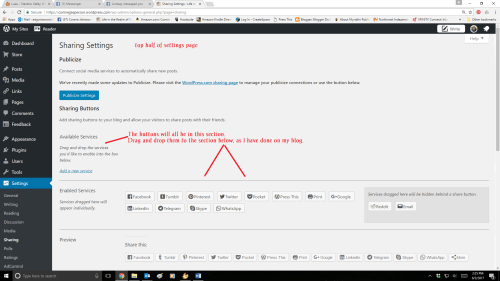
Step One: In that menu, scroll down to “Settings” and open that menu.

Step Two: In the Settings menu, open “sharing” and click on it. that will take you to the “Sharing Settings” page. Click on the button that says, “Publicize Settings.”

That will open a list of what I think of as blog warehouses, places that collect blogs and offer them to their regular readers.

Step Three: You want to activate as many of them as you can.

Follow these Screenshots, in this order:
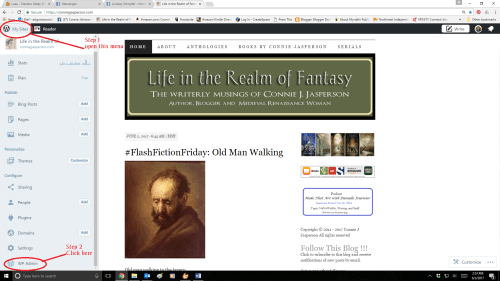
Step Four is an important step especially for those who use twitter to promote their posts to the world. Because I have my blog set to automatically post to twitter, I use a hashtag in the title of every blogpost. If you don’t make twitter your tool, you are missing out on an important and simple “publicizing” opportunity:

I highly recommend blogging regularly, at a minimum two posts a month. Writing blog posts develops your writing craft. Also, your blog is where you talk about your interests, your writing, and is where potential readers can find your books.

If you really want your work to be visible, use the options and tools WordPress offers you.

25 Comments

Filed under writing

#amwriting: Literature and Language: Gormenghast and Lyonesse

Two series of fantasy novels that had a profound effect on me as a reader are the Gormenghast series of novels, written by Mervyn Peake, and The Lyonesse Trilogy by Jack Vance. Both series are literary, yet still fantastic,

They are both considered a fantasy of manners, yet they are wildly different from each other. Both combine the comedy of manners with the hero’s journey of traditional high fantasy. Gormenghast is dark and gothic, while Lyonesse is set in an alternate Arthurian world.

The Washington Post Book World had this to say about the Gormenghast series:  “This extravagant epic about a labyrinthine castle populated with conniving Dickensian grotesques is the true fantasy classic of our time.”

The immense, labyrinthine Hayholt, featured in Tad Williams’ epic masterpiece, Memory, Sorrow, and Thorn, seemed reminiscent of castle Gormenghast to a certain extent when I first read that series. I don’t know if Williams is a Gormenghast fan–I’ve never asked him, although I should. I do know he is not afraid to write great literary fantasy.

Vance’s vision of Lyonesse has influenced fantasy literature in the most subtle of ways, creating a canon for those who write alternate Arthurian history that is nearly set in stone.

Wikipedia says, Vance builds the history of his world using layers of facts, names and religions taken from various European cultures — Greeks, Romans, Celts, pre-Carolingian French and Spanish “kingdoms” etc., and adding in places and peoples imagined by those same cultures — Atlantis, Ys, Avalon, Formor and so on. This fantastical/factual mix is used to ground his tale in “history.” It also seems to give some of the same depth that a longer series of books might develop where place, relationships, and plot are built up over time (as in Thomas Hardy’s “Wessex” or Trollope’s “Barsetshire”). It seems to provide the believability that develops where a story is set in a well-known, well-defined historical setting as if the reader holds merely a hitherto untold story.

These complicated, convoluted books are not for everyone. They are beautifully written, but the less perceptive, more impatient type of reader will find Gormenghast confusing and plot-less. Despite being a dark, Gothic fantasy, the prose is literary.

For some casual readers, both Gormenghast and Lyonesse will be considered too heavy on the descriptions.

But for those readers like me, readers who adore beautiful prose, deep, involving books, and darkly baroque settings peopled with unforgettable characters, these two watershed works strike a chord deep within the soul.

These books must be savored, experienced in the fullest sense of the word. The focus is on the breathtaking visual descriptions, and while I am thrilled by it, the verbal beauty of Mervyn Peake and Jack Vance’s prose is what will leave many impatient modern readers cold.

When you are reading these novels, the journey itself is more important than the destination. While Gormenghast is often compared to Tolkien’s work, there is little similarity between the two, other than they are both extremely well written fantasy, written by authors with a good command of the English language and all its nuances.

Literature drives changes in language and is in turn driven by changes in language. For me, Gormenghast is a surreal, visual painting, created of beautifully crafted words.  The prose of Jack Vance’s Lyonesse is equally beautiful, describing a time and place that never was but could have been.


Sources and Attributions:

Wikipedia contributors, “Lyonesse Trilogy,” Wikipedia, The Free Encyclopedia, https://en.wikipedia.org/w/index.php?title=Lyonesse_Trilogy&oldid=782651719 (accessed June 4, 2017).

Wikipedia contributors, “Titus Groan,” Wikipedia, The Free Encyclopedia, https://en.wikipedia.org/w/index.php?title=Titus_Groan&oldid=769262142 (accessedJune 4, 2017).

Cover illustration of the 1983 trade paperback edition of Lyonesse by Jack Vance. Low-res scan for fair use purpose. Illustration by James C. Christensen. via Wikimedia Commons https://en.wikipedia.org/wiki/File:Vance-Lyonesse.jpg

Titus Groan, by Mervyn Peake, cover art also by Mervyn Peake, published by Eyre & Spottiswoode 1946 https://en.wikipedia.org/w/index.php?title=Titus_Groan&oldid=769262142 (accessed June 4, 2017).

2 Comments

Filed under writing

#FlashFictionFriday: Old Man Walking

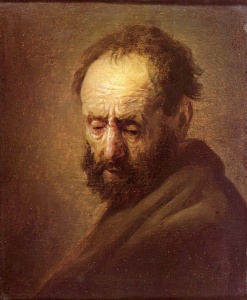
Rembrandt_Harmensz._van_Rijn_070

Old man walking to the tavern

No license, mumbling.

Saw too many things

Knows too many things

War is one of those things.

Old man riding to the tavern

A young boy’s bike.

Lost his license

Lost his mind

Lost his self-respect.

Old man walking to the tavern

No license, mumbling.


Old Man Walking, by Connie J. Jasperson, © 2017 All Rights Reserved.

Head of a Bearded Man (Manner of Rembrandt) after circa 1630 [Public domain or Public domain], via Wikimedia Commons

If you or a loved one are a wounded veteran and are struggling with PTSD, call Vet to Vet Assistance 888-777-4443 or log onto the National Veterans Foundation https://nvf.org/about-national-veterans-foundation/

1 Comment

Filed under #FlashFictionFriday, Poetry, writing