Monthly Archives: June 2017

#FlashFictionFriday: Tomorrow will be better

Morning came

Along with the bandages and healing,

Along with your frustration and helplessness.

Morning came

And I, as your mother, tended your wounds.

You didn’t ask for this burden.

You didn’t do anything wrong.

You didn’t cause epilepsy.

Tomorrow will be better.

Tomorrow your wounds will be healed

Even if your ego isn’t.


Tomorrow Will Be Better, © Connie J. Jasperson 2017, All Rights Reserved

Photo credit: After a great sun rise, Photographer: Simon Eugster, SSA CCA 3.0 Licence: {{GFDL}} via Wikimedia Commons

If you or a loved one are suffering from a seizure disorder, the Epilepsy Foundation has resources for you http://www.epilepsy.com/

Comments Off on #FlashFictionFriday: Tomorrow will be better

Filed under #FlashFictionFriday, Epilepsy, Poetry

#amwriting: choosing a writing group

Every writer needs honest, constructive feedback to grow in their craft. Many will join critique or beta reading groups. These groups come in all sorts and sizes, some specializing in general fiction and some in genres like mystery, science fiction, fantasy, or romance.

Most communities have clusters of authors. In your community, you will find groups for beginning writers and some that cater to more advanced crowds. I guarantee there will be one to fit your needs.

We’ve all heard the horror stories regarding critique groups, and perhaps even experienced one. Making a poor choice can be devastating—it can undermine an author’s self-confidence and destroy their joy in the craft.

The seas are rough out there, but most writing groups are really good, supportive gatherings of authors who stay for years and welcome new authors into their group with open arms.

You may stumble upon groups who seem cliquish, unwelcoming, and daunting to new arrivals. Authors just beginning to explore this necessary part of the craft are not required to return to one of these groups if they were given the cold-shoulder the first time.

There is a difference in types of writing groups. Some are traditional critique groups, people who usually read a few pages aloud at their sessions and the others discuss it in detail in a round-table fashion, while the author listens. Often, these groups are large and because they are pressed for time, they don’t allow the author to ask questions or clarify points of confusion. Despite that flaw, this sort of focus on your work can be just right for some authors.

A group like that can tell you if you have made editing errors, and point out errors within the few pages they have sampled. For authors strapped for cash and unable to afford to hire an editor, this sort of group is an invaluable resource. What you learn about your writing habits in those pages will carry over into the larger manuscript.

However, because traditional critique groups focus only on 3 or 4 pages at a time they lack the context to be able to discern inconsistencies and flaws in the overall story arc. They don’t see enough of the work to tell if your protagonist is developed sufficiently by the first 1/4 of the tale, or if you have flattened your arc by placing your inciting incident too far from the beginning.

Unless you have submitted your entire novel over a period of time, formal critique groups usually can’t see subtle problems with

  • pacing
  • the overall story arc
  • worldbuilding
  • character development

They can’t see these things because these larger elements can only be judged by sampling more than three or four pages of a novel. One way around that is to seek input privately from one of the members if you have found someone who reads the genre in which you write, and feel comfortable enough to share that much with them.

If you are looking for input on large issues, my advice is to find a beta reading group.

But how do you select a group? Before you join a critique or beta reading group, you have the right to know what that group focuses on. Attend one of their meetings as an observer.

What do I want from this group? How do they treat each other’s work? When you get home, ask yourself these questions:

  • Did they address places where the submitted chapter bogged down?
  • What did the group think about the characters?
  • Did they address places where they became confused?
  • Did the group point out spots they had to read twice?
  • How did the group address places where the story become unbelievable or too convenient?
  • Did the readers care enough to wonder what would happen to the characters next?
  • How did the group phrase their comments? Was it supportive as well as instructional?
  • Did they encourage conversation about the chosen work?
  • Is discussion discouraged? If the author was not allowed to discuss their work or ask questions, it is a red flag that should be noted.

Ask yourself, “What vibes did I get from this group of people? Will I benefit from sharing my work with this group? Did the comments they made to each other sound helpful?” Hopefully, the answer to those questions will be a resounding “yes.”

If not, run now. Run far, far away.

If you are considering joining the group, ask the leader/chairperson these questions:

  • If the group is a beta reading group focused on first drafts, what do they consider a first draft? Do you have to hire an editor and have it thoroughly edited before you submit it to this group? Because that is not a first draft, and that group would be a waste of your time.
  • Will you receive insights into your manuscript on points you hadn’t considered, or will the focus of the discussion center on minor editing issues that you are already aware of?
  • Ask the leader to define for you the specific areas that readers will be looking at: Character development, pacing the arc of the scene, pacing the arc of the conversation, worldbuilding.

When you think have found a group you feel comfortable sharing your work with, and you trust them enough to submit your first piece to them, take notes on the experience. When you are home, ask yourself:

  • Do I still feel positive about my work or do I feel like my work was treated as being less than important?
  • Did I gain anything from the experience that would advance the plot or did I just hear a rehash of armchair editing from a wannabe guru?
  • When I was discussing the direction I wanted to take the tale in, did I sense that they were interested in my story?

If the answers are anything other than a resounding “yes” you have the right to leave the group.

The answers to these questions have to be that you feel good about your work, that you saw through their eyes the weaknesses, and you now know what you need to do to make your story great. You must be filled with the conviction that you know what needs to be done, and you must still have passion for the story.

Authors attend their first meeting with a new writing group hoping to find likeminded people. We are filled with uncertainty and fear the first time we meet these people. At the end of the day, you have to feel as if you have gained something from the experience.

Hopefully, you will be as fortunate as I have been, and find a group of authors who will support and nurture you in the craft of writing. The way to repay them for their help is to support them and their efforts wholeheartedly.

9 Comments

Filed under writing

#amwriting: compound words and hyphens

Compound words are frequently a source of grief when I receive my manuscript back from my editor. Despite my best efforts, unless I am on my toes in the writing process I habitually hyphenate words that should not be hyphenated.

Most people know that a compound word is a combination of two or more words that function as a single unit of meaning.

Most people also know that there are two types of compounds:

  • those written as single words, with no hyphenation and which are called “closed compounds”– such as the word “bedspread,”
  • “hyphenated compounds,” such as “jack-in-the-box” and “self-worth.”

But there is a third group, and they are the bane of my writing life–those mysterious, ephemeral denizens of the deepest corner of writer’s hell, called open compounds. These seemingly innocent instruments of torture are written as separate words–the nouns “school bus” and “decision making,” for example.

Fortunately, the English language has rules to guide us when deciding if it’s one word, two separate words, or a hyphenated word:  

Do not use a hyphen unless it serves a purpose. If a compound adjective cannot be misread or, as with many psychological terms, its meaning is established, a hyphen is not necessary.

The American Psychological Association  style guide gives of these examples:

covert learning techniques, health care reform, day treatment program, sex role differences, grade point average

Use a hyphen in a temporary compound that is used as an adjective before a noun

Use a hyphen if the term can be misread or if the term expresses a single thought.

  • “the children resided in two parent homes” means that two homes served as residences, whereas if the children resided in “two-parent homes,” they each would live in a household headed by two parents.  In that case, a properly placed hyphen helps the reader understand the intended meaning.

We also use hyphens for compound words that fall into these categories:

  • if the base word is capitalized: pro-African
  • when writing numbers: post-1910, twenty-two
  • an abbreviation: pre-ABNA manuscript
  • more than one word: non-achievement-oriented students
  • All “self-” compounds whether they are adjectives or nouns such as self-respect, self-esteem, self-paced.

We hyphenate words that could be misunderstood when there are diverse meanings if they’re unhyphenated:

  • re-pair (to pair again) as opposed to repair (to mend)
  • re-form (to form again) as opposed to reform (to improve)

We hyphenate words in which the prefix ends, and the base word begins with the same vowel:

  • metaanalysis
  • antiintellectual

The problem is unless you are a technical writer, how often are we going to use those terms? Hence, the confusion when we DO use them.

Get It Write online says, “One way to decide if a hyphen is necessary is to see if the phrase might be ambiguous without it. For example, “large-print paper” might be unclear written as “large print paper” because the reader might combine “print” and “paper” as a single idea rather than combining “large” and “print.” Another such example is “English-language learners.” Without the hyphen, a reader might think we are talking about English people who are learning any language rather than people who are learners of the English language.”

A good rule to remember is most words formed with prefixes and suffixes are written as one word with NO hyphen.

Prefixes: Afterglow, extracurricular, multiphase, socioeconomic

Sufixes: Arachnophobia, wavelike, angiogram

When I am laying down prose in the first draft, my natural inclination when writing these words would be to hyphenate them, but that is wrong, and my editor always kindly reminds me of this.

When in doubt, it is wisest to look the word up in an online dictionary to see the various different ways it can be combined. Just go to:

http://www.merriam-webster.com

What it all comes down to is this—when editing for another author I am able to see these things clearly. In my own work–it’s like my finger has a twitch that absolutely MUST add a hyphen to compound words that should remain separate, and separates words that should be joined.

This is why the editor has an editor for her own work.


Credits and Attributions:

When do you need to use a hyphen for compound words? The American Psychological Association, http://www.apastyle.org/learn/faqs/when-use-hyphen.aspx accessd June 25, 2017

Compound Words: When to Hyphenate, Get It Write, Nancy Tuten and Gayle Swanson  http://www.getitwriteonline.com/archive/042703compwdshyph.htm, 2017

Parts of this post were originally posted March 4, 2014, as Hyphen Help Us, by Connie J. Jasperson, © 2014-2017.

13 Comments

Filed under writing

#FlashFictionFriday: Quiet of an Early Summer Morning

Passer_insularis_Smit

The quiet of

An early summer

Morning

Sinks into my soul,

Warming my spirit like coffee.


At twelve past five

The birds are present,

Singing,

Songs of love, poems of war

While I appreciate my coffee.


Feathered beings

Living swift and fierce,

Passionately,

As summer waxes into fall

And I enjoy my coffee.


Quiet of an Early Summer Morning, by Connie J. Jasperson © 2017 Connie J. Jasperson, All Rights Reserved.

Depiction of the Socotra Sparrow, from its description in the Proceedings of the Scientific Meetings of the Zoological Society of London. Female above, male below. Joseph Smit 1881 [Public domain], via Wikimedia Commons

Comments Off on #FlashFictionFriday: Quiet of an Early Summer Morning

Filed under #FlashFictionFriday, Poetry, writing

#amwriting: Writing a Short Story to a Theme

Writing short stories is both difficult and easy. They are easy because you can keep it simple, just a few characters, one problem, and an overarching theme that runs through the whole thing.

However, they are difficult because of those same constraints.

What are the main considerations when writing a short story?

Plot Structure, or the way the story is arranged:

  1. the setup
  2. the obstacle
  3. the turning point
  4. the resolution/outcome

The Set-up: You must have a good hook. In some cases, the first line is the clincher, but especially in a short story, by the end of the first page, you must have your reader hooked and ready to be enthralled.

The theme, or the core of the plot, an idea-thread that runs through a story from the opening pages to the end. Theme binds the four primary elements of characters, conversations, actions, and reactions. Theme is independent of the setting or genre.

Word Count: Many times, publications and anthologies will have strict limits on the wordcount, such as no more than 4,000 or less than 2,000.

When you are new to writing short stories, limiting the background information and sticking to the theme and is the most difficult part of the task. In my own early drafts, I often have a lot of information that doesn’t advance the story. Background information on the sidekicks is not needed, nor is any background on the setting unless the setting is a core plot point.

In a short story, you must take one idea and riff on it until you reach the end, and if you are offered a theme to write to, you at least have a framework on which to hang your plot.

Wikipedia, the fount of all knowledge, describes theme as:

The most common contemporary understanding of theme is an idea or point that is central to a story, which can often be summed in a single word (e.g. love, death, betrayal). Typical examples of themes of this type are: conflict between the individual and society; coming of age; humans in conflict with technology; nostalgia; and the dangers of unchecked ambition. A theme may be exemplified by the actions, utterances, or thoughts of a character in a novel. An example of this would be the theme loneliness in John Steinbeck‘s Of Mice and Men, wherein many of the characters seem to be lonely. It may differ from the thesis—the text’s or author’s implied worldview.

Often we can visualize a complex theme, but we can’t explain it. If we can’t explain it, how do we show it? Consider the theme of “grief.” It is a common emotion that can play out against any backdrop, sci-fi or reality based, where there are humans interacting on an emotional level.

Perhaps you have an idea for a story about a woman who has just lost her husband to a preventable accident. Her grief is the main theme. When you learn the accident that killed him was preventable, you know the subtheme: anger. The protagonist’s goal in this story is to prevent such accidents from happening again–perhaps she must battle a corporation or take on a government agency. Rage is the motivator that forces her to wake up each day and take on the Goliaths, but at the root of the story, it is her grief that is the driving force behind her subsequent actions.

Grief is an extremely complex experience, as anyone who has ever suffered the loss of a loved one will tell you. It is a fundamental emotion, chaotic and weighing heavy in the heart of one who grieves. It is experienced in many identifiable stages with elements of loneliness, anger, guilt, and deep suffering. It is sometimes accompanied by thoughts of suicide.

Everything your character sees and experiences in the opening scenes underscores and represents her sense of loss and inspires the accompanying emotions of anger, futility, and depression. As her story progresses and she begins live despite her loss, she will still be affected on many levels and to a certain extent, driven by those complex emotions. While she is interacting with others who are happy and who believe she has gotten past her pain, you can employ subtle allegories and symbolism to paint the deeper picture of her mental state to show how she is deeply depressed and possibly suicidal.

Once your protagonist has beaten the enemy, what is her reaction? Without the battle to sustain her rage, does she learn to accept her loss begin to find happiness? Or does she allow herself to spiral into ever worsening depression?

When writing short stories,

  • we keep the cast of characters to a minimum
  • we keep the setting narrow: one place, one environment, be it a cruise ship, a restaurant, or a gas station—the setting cannot be epic in scale.
  • We introduce no side quests.

Let’s say you want to write a story that can be no longer than 2,000 words. You know have an idea, but when you sit down and begin writing, you find you have too much story for only 2,000 words.

You need to map it out.

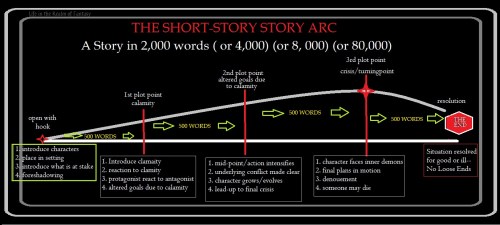
Short-stories are just like novels, in that they follow the story arc. If you know what theme you must write to and you have an idea for a plot, you can make the story arc work for you.  The following illustration is a visual guide to help you when mapping out your short story:


Credits:

Wikipedia contributors, “Theme (narrative),” Wikipedia, The Free Encyclopedia, https://en.wikipedia.org/w/index.php?title=Theme_(narrative)&oldid=765573400 (accessed June 20, 2017).

11 Comments

Filed under writing

#amwriting: creating a strong novella

A little over three years ago, I discovered that one of my works in progress was not really a novel after all.

The first draft was at 85,000 words, but it occurred to me that it was a novella. In the first half of the book, 4 chapters didn’t advance the protagonist’s story. When I finished weeding it out, the manuscript length was slightly over 50,000 words.  In YA and some romance 50,000 words is a novel-length book, but in fantasy, it is only half a book.

So, I  shelved that manuscript, as I had other, more pressing, work to get finished and had nothing of value to add to the tale. I said at the time that I would much rather be known for having written a strong novella than a weak novel.

Those four cut chapters totaled about 16,000 words. Added to that were the words I weeded out in the second draft. They totaled 8,000 to 10,000 more words.

But why did I do this?

  1. Besides the four chapters that didn’t belong there anymore, 3 more chapters were mostly background that didn’t need to be in the finished product. When I removed large chunks of exposition, I was able to condense those 3 chapters into 1 that actually moved the story forward.
  2. Also, in the rough draft we always find words we can cut or find alternatives for, words and phrases that weaken our narrative such as:
  • There was
  • To be

Also, we look for places where we can make contractions: ‘was not’ becomes ‘wasn’t,’ ‘has not’ becomes ‘hasn’t,’ etc.

Many times we can simply cut some words out, and find the prose is better without them. Most times, those words need no replacement.

I have mentioned the overuse of what I think of as “crutch” words. You can lower your word count when you look at each instance of these words. These words  fall out of our heads along with the good stuff as we are sailing along:

  • so,
  • very,
  • that,
  • just,
  • so,
  • literally
  • very

But back to the novella: why did I cut an 85,000 word MS down to 50,000 or so words?

A lot of what I had written was good work, but as I said, several long passages didn’t advance my protagonist’s tale. They pertained to a different character’s story set in that world–so they were a rabbit-trail to nowhere in the context of that story.

I didn’t discard those chapters, though. Those passages will come in handy later if I choose to write that character’s story, so I saved them in a separate file, under the character’s name.

The fact is, you must be willing to be ruthless. Yes, you may well have spent three days or even weeks writing that chapter. But sometimes, when you see it in the context of the overall story arc, you realize it bogs things down, and there is no fixing it.

Just because we wrote it does not mean we must keep it in that story.

At some point I will finish that novella, but the lesson I learned was this: no matter how much you like your prose, there are times when it must go.

12 Comments

Filed under writing

#FlashFictionFriday: Ballad of Jennet Adair (reprise)

Jennet, she lies

‘Neath the white rose tree

And never again will she

Play false to me


T’was not my hands

Round her lily-white throat

But would that I could

Drown her deep in the moat


Her hair was as dark

As summer is fair

Her lips were for kissing

Sweet Rose of Adair


Jennet, she lies

‘Neath the rose tree white

My brother will hang

For her murder tonight


Jennet, she lies

‘Neath the white rose tree

Never again will

Those lips lie to me


T’was not my hands

Round her lily-white throat

She ruined my brother

She ruined us both


Played us like pawns

In the age-old game

Until she did misstep

To her sorrow and shame


My brother will hang

‘Neath the town hall light

And who will tell mother

What happened tonight?


Jennet, she lies

‘Neath the white rose tree

And never again will she

Play false to me.


Ballad of Jennet Adair © Connie J. Jasperson 2016-2017, All Rights Reserved

The Ballad of Jennet Adair by Connie J. Jasperson was first published July 31, 2015 on Edgewise Words Inn, as a song her character, Huw the Bard, might have written. It is a story poem, written in a traditional, bardic style, and was inspired by the Child Ballads collected in the 19th century by Francis James Child.

Bouquet of Roses at the Window, Ferdinand Georg Waldmüller 1892 [Public domain], via Wikimedia Commons

Comments Off on #FlashFictionFriday: Ballad of Jennet Adair (reprise)

Filed under #FlashFictionFriday, Poetry, writing

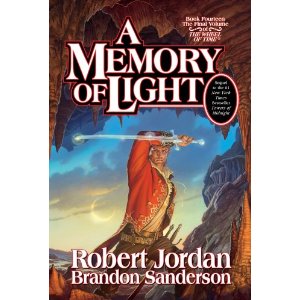
#amreading: The Wheel of Time, series by Robert Jordan and Brandon Sanderson

Once again, epilepsy has reared its ugly head in my family, and travel to and from hospital the hospital 70 miles north of my home has interfered with my ability to write. So, for today’s post I’ve chosen to reprise my review of a hearty 14-book trilogy. I’ve warned you that many of the books I love and turn to when I need a good book are NOT comforting in any way, and for many people the incredibly long, epic series, The Wheel of Time, definitely falls into the UNcomfortable category. This is for a variety of reasons.

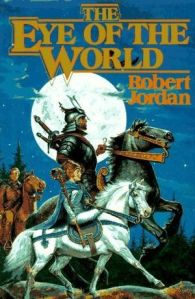
The Eye of the World was the opening volley in what would ultimately become one of the most controversial series in epic fantasy. Written by Robert Jordan and first published in 1990, this series of books has polarized the most dedicated fans of true fantasy into two groups: the lovers and the haters.  No reader walks away from this series unscathed.

The story begins in the exceedingly rural village of  Emond’s Field. They are so rural that they have no concept that they are still considered to be a part of a larger country. The village is suddenly attacked by Trollocs (the antagonist’s soldiers) and a Myrddraal (the undead-like officer commanding the Trollocs).  These creatures are intent on capturing the three protagonists, Rand al’Thor, Matrim (Mat) Cauthon, Perrin Aybara, although why they are being hunted is not revealed at first. To save their village from further attacks, Rand, Mat, Perrin, and Egwene (Rand’s first love interest) flee the village, accompanied by the Aes Sedai Moiraine Damodred, her Warder, Al’Lan Mandragoran, and gleeman, Thom Merrilin.They are later joined by Nynaeve al’Meara, who is their village’s medicine woman.

This huge range of characters and the many, many threads that weave an incredibly tangled plot are what polarizes the reading community over this series of books. Originally intended to be a trilogy, it eventually expanded to encompass fourteen LARGE, long books.

Robert Jordan passed away in 2007 while working on the final book, leaving the series uncompleted, but he left the rough draft and enough notes behind that Brandon Sanderson was able to finish the series, eventually breaking that final volume into three very large  books, and bringing the story to a satisfying conclusion.

So what is the basis for the plot’s tension, what conflict could possibly draw the reader in and keep them reading for such a long, drawn out process? It’s Robert Jordan, folks–the eternal quest for power, and dominance through violence, religion and politics is the core of this tale.

According to Wikipedia, the Fount of All Knowledge: The series draws on numerous elements of both European and Asian mythology, most notably the cyclical nature of time found in Buddhism and Hinduism, the metaphysical concepts of balance and duality, and a respect for nature found in Daoism. Additionally, its creation story has similarities to Christianity’s “Creator” (Light) and Shai’tan, “The Dark One” (Shaytan is an Arabic word which in religious contexts is used as a name for the Devil). It was also partly inspired by Leo Tolstoy’s War and Peace (1869).”

I loved the first three books in this series. I both enjoyed and endured the next three, hoping Robert Jordan would get to the point and finish the damned series. I had become a little irritated with book eight, Path of Daggers, but by the time Winter’s Heart came out, I was resigned to never seeing an end to it, and was back to simply enjoying each strange plot twist and new random thread for what it was–just a great tale.

When Robert Jordan died, I was thrilled that Brandon Sanderson was the author tapped to finally bring that unwieldy mess together. There were so many different stories within the greater story that the task of winding up each thread must have been incredibly daunting, and he did it magnificently.

The reason so many devoted fans abandoned the series somewhere around book six , Lord of Chaos, was that Rand al’Thor’s story ( and Mat’s and Perrin’s) stalled, and Jordan was sent way off track by the stories of Egwene, Nynaeve, and Elaine Trakand. In fantasy, there is a large contingent of readers who want instant gratification are not going to wait around for eight more books. They proved it by jumping ship and trash-talking his work.

Throughout the series, the quality of the writing never faltered. The depth of story and the intensely alive characters whose stories graced those pages never failed to intrigue me. The fact that it felt like the conflict would never be resolved was, at times, upsetting to me as a reader, and is a lesson authors should take to heart with their own work.

To write a story that is so compelling that readers become so violently polarized over it is quite an accomplishment.  I see this happening with George R.R. Martin‘s fans right now. Although I adore him as a person, I’ve never cared much for his style of writing, as he jumps around too much even for me. Have patience, people! It looks like George has a large story there too, so it may take him a while.

For Brandon Sanderson to step into the wasps’ nest of controversy that was The Wheel of Time and complete the series with such grace and finesse is nothing short of amazing, and I am glad I stuck with it to the end. Brandon Sanderson has become one of my favorite authors because of what he did to wind up this epic series.

In the end, the final resolution was satisfying, and was well worth the journey.  I have gotten rid of most of my hard copies, and am down to only one room’s worth of hardbound books at our house. I don’t buy too many hard copies of books, being a fan of the Kindle, and  but I did make an exception for this book.   For me, some books need to be in hard copy form and the Wheel of Time Series is one of them, as are the Harry Potter books. There was a large contingent of people who were upset that the epub edition wasn’t released until 4 months after the paper book, but this was a choice made by Robert Jordan’s widow and her publisher, TOR. It was a strange one in my opinion, but it was their choice.

Amazon’s early reviews of the later books in this series were rife with trolls and naysayers who couldn’t wait to emerge from the woodwork and have their say. Apparently very few of these people purchased the book, much less read it. That is the price of success and these days it’s almost an honor to have so many haters just spoiling to knock you down. But their strident caws and self-important rants should have no effect on the true fans of WoT. In my humble opinion these works are masterpieces and Brandon Sanderson’s three books are a triumphant finish to the series.

I love Brandon Sanderson’s handling of this series finale, and feel I more than got my money’s worth from this series of book, as I will definitely read it again and again–in my opinion it’s that good. If you love this series, you will love the way it ends!

The original cover artist for these amazing books was none other than the late Darrell K. Sweet, who was just as amazing a fantasy artist as is Michael Whelan. The newer covers are nice, but for me they lack the power of Sweet’s brilliant paintings.

And as we all know, I buy most books for their covers, even epubs, and then fall in love with the tale.


This post has been recycled and was previously posted as Comfort Books, the main course: The Wheel of Time, by Robert Jordan and Brandon Sanderson  in February of 2015 here on Life in the Realm of Fantasy, Copyright 2015-2017  Connie J. Jasperson, All Rights Reserved.

1 Comment

Filed under Book Reviews, writing

#amwriting: Identifying Genre

When you write a lot of different short stories, you really get to explore all aspects of your creative mind. You never know what will fall out of your head, so you find yourself writing in a wide variety of genres, things you never thought you would find interesting.

But they consume you, and you can’t stop writing.

So now you have this wonderful backlog of short and novella-length stories to enter in contests and submit to various publications–but now you find that this contest wants general fiction, and this one is fantasy. And this one is sci-fi only!

Dude–how do I know what tale to send to who?

If your work is nonfiction, it’s no problem because your work is targeted to a magazine with a specific readership, so the sub-genre will be clear and where you should submit it was likely evident the day you decided to write it.

Where this gets dicey is when you write short fiction with no specific contest or magazine in mind. When you sit down to write a short story with an open mind, random ideas flow, and because you are working within the limits of 3000 to 7000 words, your stories are creative and stretch you. But they will be widely different from your normal work, and will not always be in a genre you can easily identify. You have all this work, but no idea where to submit it.

Mainstream (general) fiction–Mainstream fiction is a general term publishers and booksellers use to describe works that may appeal to the broadest range of readers and have some likelihood of commercial success. Mainstream authors often blend genre fiction practices with techniques considered unique to literary fiction. It will be both plot- and character-driven and may have a style of narrative that is not as lean as modern genre fiction but is not too stylistic either. The prose of the novel will at times delve into a more literary vein than genre fiction, but the story will be driven by the events and action that force the characters to grow.

Science fiction–Wikipedia says:  “Science Fiction is fiction dealing with imaginative content such as futuristic settings, futuristic science and technology, space travel, time travel, faster than light travel, parallel universes and extraterrestrial life.” BE WARNED: the internet is rife with purists and impurists in the sci-fi field, snobs and folks with their heads up their anachronisms. Anyway, if you use magic for any reason you are NOT writing any form of sci-fi.

Hard Sci-fi is characterized by rigorous attention to accurate detail in the physics, chemistry, and astrophysics. Emphasis is placed on accurately depicting worlds that more advanced technology may make possible. Soft Sci-fi is characterized by works based on social sciences such as psychology, economics, political science, sociology, and anthropology.

Other main sub-genres of Sci-fi include Space-operasCyberpunk, Time Travel, Steampunk, Alternate history, Military, Superhuman, Apocalyptic and Post-Apocalyptic.

The main thing to remember is this–Science and Magic cannot coexist in the Genre of Science Fiction. The minute you add magic to the story, you have Fantasy.
Fantasy: Wikipedia says: “Fantasy is a genre of fiction that commonly uses magic and other supernatural phenomena as a primary plot element, theme, or setting. Many works within the genre take place in imaginary worlds where magic and magical creatures are common. Fantasy is generally distinguished from the genres of science fiction and horror by the expectation that it steers clear of scientific and macabre themes, respectively, though there is a great deal of overlap between the three, all of which are sub-genres of speculative fiction.” 

I’ll be truthful–fantasy has its share of snobs and damn fools when it comes to defining the sub-genres:

High fantasy–High fantasy is defined as fantasy fiction set in an alternative, fictional world, rather than the real, or “primary” world, with elves, fairies, dwarves, dragons, demons, magic or sorcery, wizards or magicians, constructed languages, quests, coming-of-age themes, and multi-volume narrative. Often the prose is more literary, and the primary plot is slowed by many side quests. Think William Morris and J.R.R. Tolkien.

Epic Fantasy–These stories are often serious in tone and epic in scope, dealing with themes of grand struggle against supernatural, evil forces. Epic fantasy shares some typical characteristics of high fantasy includes fantastical elements such as elves, fairies, dwarves, dragons, demons, magic or sorcery, wizards or magicians, constructed languages, quests, coming-of-age themes, and multi-volume narratives. Tad Williams’s Memory Sorrow and Thorn is classic Epic Fantasy.

Paranormal Fantasy–Paranormal fantasy often focuses on romantic love and includes elements beyond the range of scientific explanation, blending together themes from all the speculative fiction genres. Think ghosts, vampires, and supernatural.

Urban Fantasy– can take place in historical, modern, or futuristic periods, and the settings may include fictional elements. The prerequisite is that they must be primarily set in a city.

Horror–Wikipedia says “Horror fiction, horror literature and also horror fantasy are genres of literature, which are intended to, or have the capacity to frighten, scare, or startle their readers by inducing feelings of horror and terror. Literary historian J. A. Cuddon has defined the horror story as “a piece of fiction in prose of variable length… which shocks or even frightens the reader, or perhaps induces a feeling of repulsion or loathing.

Romance– Novels of this type of genre fiction place their primary focus on the relationship and romantic love between two people, and must have an “emotionally satisfying and optimistic ending.”

I’m discussing Literary Fiction last because it is the most complicated and least understood genre of all. Literary fiction tends to be more adventurous with the narrative, with the style of the prose taking a prominent place. Stylistic writing and the exploration of themes and ideas form the substance of the piece. Writer’s Relief Author’s Submission Service defines literary fiction as “…fiction of ideas. While the story must be good, emphasis on action is not often as important as emphasis on the ideas, themes, and concerns of the book. Literary fiction tackles “big” issues that are often controversial, difficult, and complex.”  (end quoted text)

One of the problems in the perception of what constitutes Literary Fiction is this: A book like Alexander Chee’s Queen of the Night is a historical fantasy–BUT it is the style and VOICE with which it is written that makes it a powerful literary work. The same goes for much of George Sanders work. The Tenth of December is technically scifi, but it is the style and voice that makes George Sanders literary. The same with Neil Gaiman’s lovely work on the book, Stardust, which is a lightning rod for the “that’s not literary–yes it is” debate.

But think about this: an editor at Harpercollins once told me (at a conference) that literary fiction is anything that is well written with intentional prose, is character driven, has a compelling story, and doesn’t quite fit into any other category. A friend of mine in an online writer’s community said in a thread, “Intention, approach, the way resolutions happen, and the ideas explored help create these distinctions.”

Now that you know what the genre of your story is, you can seek out magazines and contest looking for that sort of work. Choose carefully who you submit your work to, carefully follow their submission guidelines, and only submit the work you have that best fits what they publish.

Never submit anything that is not your best work, and do not assume they will edit it because they won’t. And let’s be real–no one will even consider publishing work that is poorly written, sloppily formatted, and generally unreadable.


Parts of Identifying Genre were first published here on Life in the Realm of Fantasy under the title, What did I just write? Labeling short fiction, by Connie J. Jasperson © 2015-2017 All Rights Reserved.

How Do You Know If Your Novel Is Literary Or Mainstream Fiction? How Long Is A General Fiction Book? Posted on July 22, 2009 by Writer’s Relief Staff, accessed 11 June, 2017.


4 Comments

Filed under Publishing, writing

#FlashFictionFriday: Rain Falling on a Young Girl’s Face

Here_comes_rain_again

Rain falling on a young girl’s face,

Falling down, down,

Rolling down, down.

Went where she shouldn’t.

Broke the rules,

Broke their trust,

Broke her dreams,

And all because he seemed so nice.

Too young to drink, but drank too much,

Said no, she wouldn’t,

Said, no, he couldn’t,

Said no, he shouldn’t,

When he pressed her,

When he forced her,

When he mocked her.

Rain falling on a young girl’s face,

Falling down, down,

Rolling down, down.

Punished her for breaking the rules.

Can’t bear the shame,

Can’t bear the guilt,

Can’t face her family.

Rain falling down, down her face.

Who will raise her up?

Who will sooth her pain?

Who will say “It’s not your fault?

“He had no right.

“He had no right.

“You broke the rules, but He had no right.”

Rain falling on a young girl’s face,

Falling down, down,

Rolling down, down.


Sources and Attributions

Rain Falling on a Young Girl’s Face © 2017 Connie J. Jasperson

National Sexual Assault Hotline (No matter who you are–woman, man, or child–you are not alone: click https://www.rainn.org/ or call 800-656-HOPE)

Image: Here Comes the Rain Again, By Juni from Kyoto, Japan (Flickr) [CC BY 2.0 (http://creativecommons.org/licenses/by/2.0)%5D, via Wikimedia Commons

Comments Off on #FlashFictionFriday: Rain Falling on a Young Girl’s Face

Filed under #FlashFictionFriday, Poetry, writing