
Mark Twain famously said, “If it’s your job to eat a frog, it’s best to do it first thing in the morning. And if it’s your job to eat two frogs, it’s best to eat the biggest one first.”
 Many authors are just beginning their careers and trying to self-edit their NaNoWriMo manuscript. The problem is, they don’t know how to write a readable sentence or what constitutes a paragraph. If they are hoping to find an agent or self-publish, they have a big, ugly job ahead of them.
Most public schools in the US don’t go into depth in teaching creative writing, so the majority of students leave school with only a cursory understanding of basic mechanics.
We know good writing when we read it, but when we are just starting out, getting our thoughts onto paper so others enjoy it eludes us.
Learning to write in your native language involves work and means you must educate yourself. As Twain would say, this is a multi-frog task.
The biggest frog to swallow is gaining an understanding of basic punctuation.
Punctuation is the traffic signal that keeps the words flowing and the intersection manageable.
Trying to learn from a grammar manual can be complicated, but I learned by reading the Chicago Manual of Style, which is the rule book for American English. Most editors refer to this book when they have questions.
However, you don’t need to know everything that is in that book, because the basic rules are simple. If you know these seven laws, your writing will pass most editors’ tests.
What follows is a quick guide, a “How-To Guide for Basic Punctuation.”
Punctuation seems difficult because some advanced usages are open to interpretation. In those cases, how you habitually use them is your voice. Nevertheless, the foundational laws of comma use are not open to interpretation.
If you consistently follow these rules, your work will look professional.
First: Let’s get two newbie mistakes out of the way:
-
Never insert commas “where you take a breath” because everyone breathes differently.
-
Do not insert commas where you think it should pause because every reader sees the pauses differently.
Commas and the fundamental rules for their use exist for a reason. If we want the reading public to understand our work, we need to follow them.
Second: Commas join two independent but related clauses.
The independent clause is a complete standalone sentence.
-
Edward worships the ground I walk on, but his adoration tires me.
Dependent clauses are unfinished and can’t stand on their own. Join them to the sentence with a conjunction.
-
Edward worships the ground I walk on and brings me my coffee. (And is a conjunction, a joining word.)
You do not join unrelated independent clauses (clauses that can stand alone as separate sentences) with commas as that creates a rift in the space/time continuum: the Dreaded Comma Splice:
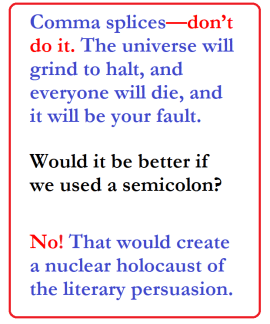 Comma Splice:
Boris kissed the hem of my garment, the dog likes to ride shotgun.
The dog has little to do with Boris, other than the fact they both worship me. The same thought, written correctly:
Boris kissed the hem of my garment.
The dog likes to ride shotgun.
The dog riding shotgun is an independent clause and does not relate at all to Boris and his adoration of me and should be in a separate paragraph. If you want Boris and the dog in the same sentence, you must rewrite it: Boris and the dog worship me, and both like to ride shotgun.
Third: A semicolon in an untrained hand is a needle to the eye of the reader. Use them only when two standalone sentences or clauses are short and relate directly to each other.
Some people (and Microsoft Word) think they signify an extra-long pause but not a hard ending. The Chicago Manual of Style says that belief is wrong. DON’T blindly accept what Spellcheck tells you!
Semicolons join short independent clauses, which can stand alone but which relate to each other. These are short sentences that would be too choppy if left separate.
- The door swung open at a touch. Light spilled into the room.
- The door swung open at a touch; light spilled into the room.
- The door swung open at a touch, and light spilled into the room.
All three of the above sentences are technically correct. The usage you habitually choose is your voice. I usually suggest avoiding semicolons except under those circumstances, as they’re the gateway to run-on sentences.
When do we use semicolons? Only when two clauses are short and are complete sentences that relate to each other.
If the independent clauses don’t relate to each other, revise that passage. Use common sense and rewrite them, so they aren’t choppy. An example of a semicolon done wrong:
Boris attempted to kiss the hem of my garment; my boot was in his face.
The first clause is one whole idea: Boris adores me. The second clause is an entirely different idea: my boot was someplace inconvenient.
Two separate standalone clauses done right, assuming the mention of my boot is essential:
Boris attempted to kiss the hem of my garment, but my boot was in his face.
I don’t dislike semicolons as some editors do, but I generally try to find alternatives to them. I think they are too easily abused because Microsoft Word and most people don’t know how to use them.
Fourth: Colons. These head lists but are more appropriate for technical writing and are rarely needed in narrative prose.
Fifth: Oxford commas, also known as serial commas. This is the one war authors will never win or find common ground, a true civil war. When listing a string of things in a narrative, we separate them with commas to prevent confusion. I like people to understand what I mean, so I always use the Oxford Comma/Serial Comma.
If there are only two things (or ideas) in a list, they do not need to be separated by a comma. If there are more than two ideas, the comma should be used as it would be used in a list.
We sell dogs, cats, rabbits, and birds.
Why we need clarity:
I accept this Nebula award and thank my parents Ralf and Maggie Jasperson and Poseidon.
Rumors abound regarding my demigoddess-like beauty and possibly heroic background. Could Poseidon be my father? Mother refused to talk about it, so the mystery remains unsolved. However, a comma after Jasperson would eliminate confusion.
I accept this Nebula award and thank my parents, Ralf and Maggie Jasperson, and Poseidon.
Sixth: We use a comma after common introductory clauses.
After dark, Boris would change into his bat form and go hunting for insects.
Seventh: Punctuating dialogue: All punctuation goes inside the quote marks.
- A comma follows the spoken words, separating the dialogue from the speech tag.
- The clause containing the dialogue is enclosed, punctuation and all, within quotes.
- The speech tag is the second half of the sentence, and a period ends the entire sentence.
“I agree with those statements,” said the editor.
The editor said, “I agree with those statements.”
What do these seven rules mean? Punctuation tames the chaos that our words can become. It is the universally acknowledged traffic signal, signifying a pause or a joining to the reader.
If you follow these seven simple rules, your work will be readable. If your story is stellar, it will be acceptable to acquisitions editors.
 Prose, plot, transitions, pacing, theme, characterization, dialogue, and mechanics (grammar/punctuation).
 I use this function rather than reading it aloud myself, as I tend to see and read aloud what I think should be there rather than what is.
 This phase is where I find my punctuation errors most often. I look for and correct punctuation and make notes for any other improvements that must be made. Usually, I cut entire sections, as they are riffs on ideas that have been presented before. Sometimes they are outright repetitions, which don’t leap out when viewed on the computer screen.
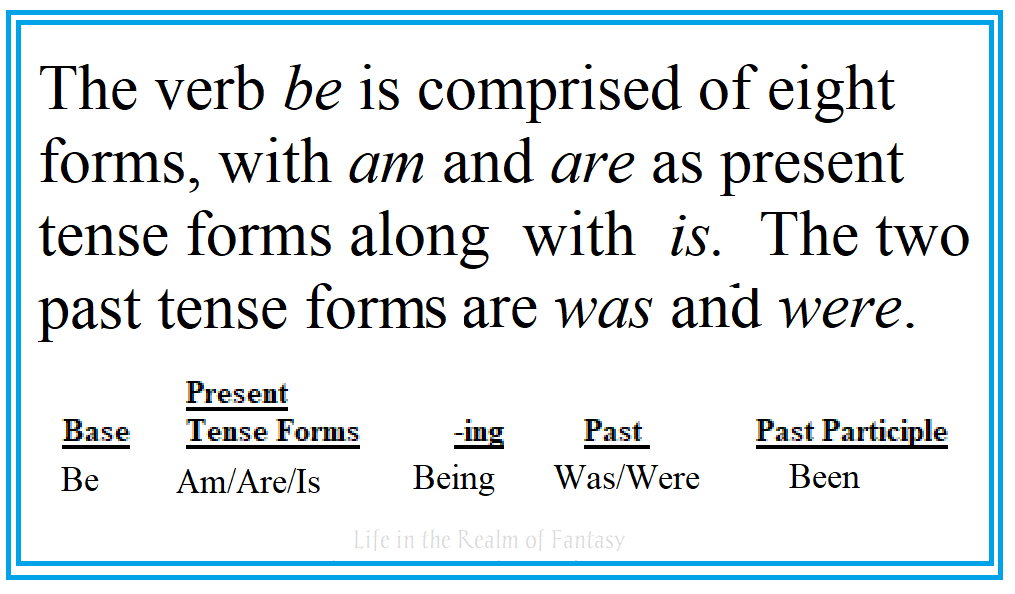 Passive phrasing does the job with little effort on the part of the author, which is why the first drafts of my work are littered with it. Active phrasing takes more effort because it involves visualizing a scene and showing it to the reader.
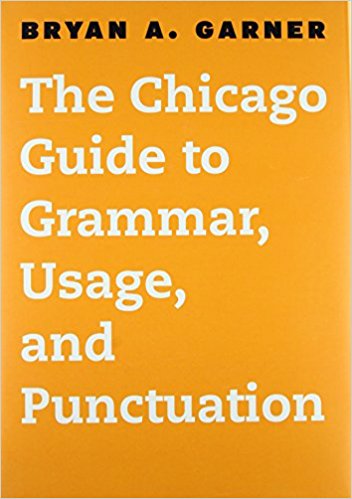 Use that money to invest in a book like the


 Life in the Realm of Fantasy