
I have developed mad skills at carving out time for writing because I participate in NaNoWriMo every November. As a municipal liaison for the Olympia area, I must get a minimum of 1,667 new words written each day.
 I usually do this with a little advance preparation. Then on November 1st, I sit in front of my computer, and using the ideas I have outlined as my prompts, I wing it for at least two hours.
So, where am I in this process? I’m now listing prompts for the middle of my novel, book 2 of a fantasy series.
However, for this series of posts I’m using an exercise from a past seminar on plotting to illustrate how my method works. This is a plot that can be set in any contemporary, paranormal fantasy, or sci-fi world. Change the vehicles from cars to horses and carriages, and it can be placed in a historical world.
Depending on your personal inclination, this could be written as a political thriller or a romance, or a combination of both.
In my last post, we met our protagonist, Dave, an unmarried accountant. We saw him in his usual surroundings, a café he regularly has lunch at. An event occurred, which is the inciting incident. What could possibly have enticed Dave out of his comfort zone? What did he do that was out of character for him? He “paid it forward” and bought a stranger lunch.
- This act changes his life. It’s the first point of no return, leading to the first crisis.
Dave didn’t know it, but that was the moment he was thrown out of his comfort zone and into the situation, which is the core of the plot.
- Dave walked toward his office, only a few blocks away, but as he waited for the light to change so he could cross the street, a limousine pulled up alongside him. Four large men in black suits hustled him into the backseat.
- He was forced at gunpoint onto a plane bound for a foreign nation, handcuffed to a suitcase with no explanation.
Those are the circumstances in which Dave found himself in my last post.
 How will the next phase of Dave’s story start? That will begin the middle section of the story, and this is what we are going to give a brief outline of.
As I’ve mentioned before, everything that occurs from here until the final page happens because Dave has an objective: he wants to go home.
I suggest we give ourselves a few prompts, all of which center around Dave achieving his objective: to get rid of the suitcase and go back to his job. He wants that desperately. Desire drives the story. Objectives + Risk = Story
- A silent guard accompanies Dave.
- Dave has been left in possession of his cell phone, but mysteriously, it has no signal.
- They arrive at the embassy.
- Dave is taken to an interrogation room and questioned about his relationship with the woman he bought lunch for.
- Dave discovers that the only key that can remove the handcuffs is in the custody of the mysterious woman who is interrogating him.
- The woman leaves the room. While she is out, Dave’s phone lights up with a text message from his boss in Seattle. Because he hasn’t been to work for two days and didn’t call in, he has been fired.
- He can’t seem to call out or reply to the message, another mysterious thing.
- The interrogator returns, having verified that Dave is who he claims he is. She also seems to know he’s now unemployed.
- She offers him a job. All he has to do is babysit the suitcase for two months until a certain agent who is otherwise occupied can claim it.
- Dave wants to go home, but he can’t. He’s unemployed and homeless in a foreign country with no luggage, and no money other than his credit cards, which have limits. If he accepts the job, he will be given a work visa, a flat to live in, and a salary.
- He needs these things to achieve his deepest desire: to go back to Seattle and get another accounting job, which he can do after fulfilling his part of the bargain.
- The wage he is offered is good, significantly so, which makes him nervous. Still, he can see no choice but to accept the job. (The second point of no return, leading to the next crisis.) After all, he’s always wanted to visit (Stockholm? Insert foreign capital here).
- Anyway, how hard can it be to babysit a locked suitcase?
That question must come back to haunt him for the next 40,000 words, and if you list a few prompts, you will take Dave to his ultimate meeting with fate.
Hindrances matter. Add to the list of obstacles as you think of them, as those difficulties are what will force change on the protagonist, keeping him and his story moving forward.
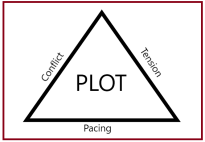 In any story, the crucial underpinnings of conflict, tension, and pacing are bound together. Go too heavily on one aspect of the triangle, and the story fails to engage the reader. By outlining a few important events now, we can add trouble and hitches during the writing process and increase the tension. Pacing will be something to worry about in the second draft—at this point, we just want to get the bones of his adventure down on paper.
Scenes involving conflict are controlled chaos—controlled on the part of the author. Stories that lack conflict are character studies. And perhaps, a character study is what you wish to write, and that is okay too. It’s just a different kind of story, more literary in its approach. Regardless, it will need an arc of some sort to bring change and growth to the protagonist.
The middle is often easiest to write because that is where the action happens. But it can easily be messed up, again with too much detail inserted in dumps. Several more events will follow, all of them leading toward one or more confrontations with the enemy. Without a loose outline, some of these events will be “desperation events.”
- Killing off random characters
- Random explosions
- Yet another gratuitous sex scene
Next week we will plot the conclusion of Dave’s adventure. We’ll also examine the way writing the ending first can inspire beginnings. My 2010 NaNoWriMo novel grew out of what was really the final chapter.
#NANOPREP SERIES TO DATE:
#NaNoPrep: part 1: What’s the Story? (the storyboard)
#NaNoPrep, Setting: Creating the Big Picture
#NaNoPrep, Building Characters
#NaNoPrep, More Character Building
#NaNoPrep, Designing Science, Magic, and the Paranormal
#NaNoPrep, Terrain and Geography
#NaNoPrep, Connections and Interconnections
#NaNoPrep, Construction and Deconstruction
#NaNoPrep, The Story Arc Part 1
This Post: #NaNoPrep, The Story Arc Part 2
 We know our genre and have written a few paragraphs that describe our characters and who they are the day before the story opens. Also, we know where the story takes place. (To catch up on earlier posts, the list is at the bottom of this article.)
 Every reader knows that stories have a beginning, a middle, and an end. They start in a place of relative comfort, and through rising action, they follow the characters through events that change them for better or worse.
 In your musings, on what day does the serious event occur, the one that changes everything? THAT day is where the story begins, and everything that happens before that moment is backstory and isn’t necessary. A plot outline I have used before as an example is set as a political thriller, but it could easily be a paranormal fantasy, a sci-fi thriller, or a romance.
 If you work at a day job and using the note-taking app on your cellphone to take notes during work hours is frowned on, you can still capture your ideas for the storyboard.
 Painting:


 Life in the Realm of Fantasy
