Monthly Archives: January 2022

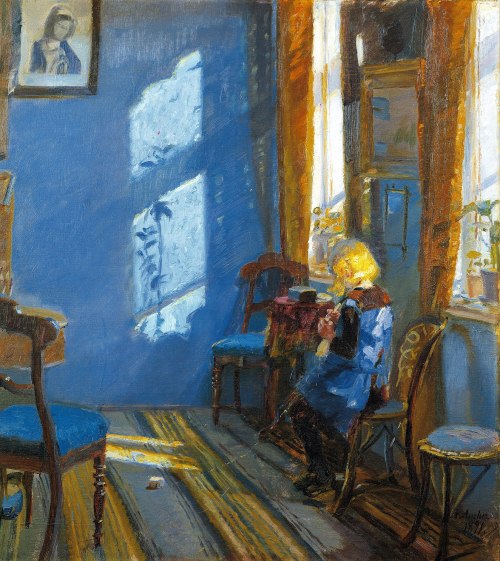
#FineArtFriday: Sunshine in the Blue Room. Helga Ancher Knitting in Grandmother’s Parlour by Anna Ancher 1891

Anna_Ancher_-_Sunlight_in_the_blue_room_-_Google_Art_ProjectArtist: Anna Ancher:

Title: Sunshine in the Blue Room. Helga Ancher Knitting in Grandmother’s Parlour

Alternate TitleSunlight in the Blue Room

Date: 1891

Medium: oil on canvas

Dimensions: w58.8 x h65.2 cm (Without frame)

Collection: Skagens Museum

Inscriptions: A. Ancher 1891

What I love about this painting:

It is a painting that must be viewed from a distance, as only then does it come into focus. I love the way the light falls on the wall, the shadow of a plant silhouetted there. Helga’s golden hair stands out in contrast to the blue of the walls and matching blue of her dress. Who is the woman in the image on the wall? Is it a picture of grandmother?

This is definitely a blue room, a shade of blue with a kind of depth and boldness to it. It must have been a colorful home.

I love all of Anna Ancher’s work. She painted the humanity in the small everyday things, such a daughter sitting near a window, crocheting. She melded art with homemaking, proving that even in an era of oppression women could be artists to be reckoned with.

About this painting, via Wikipedia:

As indicated by its full title: Sunshine in the Blue Room. Helga Ancher Knitting in Grandmother’s Parlour (Solskin i den blå stue. Helga Ancher ved strikketøjet i bedstemoders stue), the painting depicts Anna’s daughter Helga knitting in her grandmother’s room. With her back to the observer, the child is busy crocheting. Despite its everyday subject, the painting is one of Anna Ancher’s most captivating masterpieces with its many shades of blue and the sense of tranquility it conveys. Devoid of action, the theme is essentially the play of light in the room. The only indication of the outside world is the light streaming through the window. Mette Bøgh Jensen, curator of Skagens Museum, explains that Anna Ancher’s interior paintings are “more about the colour and light than anything else”. The artist’s main interest is “not in replicating the reality of the room or wall, or even the light, but rather what is left when these things are stripped away and all that remains are colour and form”. Bøgh Jensen continues, “Anna Ancher’s art is unlike that of anyone else. In its essence it is tied to the special world of motifs in Skagen: the fishermen’s families, the harvesters, the heathers, the special colours, and the brilliant summer light.”

In her Concise Dictionary of Women Artists, Delia Gaze assesses Anna Ancher’s achievements as remarkable “in the modernity of her idiom, with its reduced, abstracting forms and bold expressive colours, singling her out as one of the most innovative painters of her generation, exceeding most of her male colleagues, including her husband” [1]

About the artist, via Wikipedia:

Anna Ancher (18 August 1859 – 15 April 1935) was a Danish artist associated with the Skagen Painters, an artist colony on the northern point of Jylland, Denmark. She is considered to be one of Denmark’s greatest visual artists.

Anna Kirstine Brøndum was born in Skagen, Denmark, the daughter of Ane Hedvig Møller (1826–1916) and Erik Andersen Brøndum (1820–1890). She was the only one of the Skagen Painters who was born and grew up in Skagen, where her father owned the Brøndums Hotel. The artistic talent of Anna Ancher became obvious at an early age and she became acquainted with pictorial art via the many artists who settled to paint in Skagen, in the north of Jylland.

While she studied drawing for three years at the Vilhelm Kyhn College of Painting in Copenhagen, she developed her own style and was a pioneer in observing the interplay of different colors in natural light. She also studied drawing in Paris at the atelier of Pierre Puvis de Chavannes along with Marie Triepcke, who would marry Peder Severin Krøyer, another Skagen painter.

In 1880 she married fellow painter Michael Ancher, whom she met in Skagen. They had one child, daughter Helga Ancher. Despite pressure from society that married women should devote themselves to household duties, she continued painting after marriage. [2]


Credits and Attributions:

Image: Sunlight in the Blue Room by Anna Ancher, Public domain, via Wikimedia Commons

[1] Wikipedia contributors, “Sunlight in the Blue Room,” Wikipedia, The Free Encyclopedia, https://en.wikipedia.org/w/index.php?title=Sunlight_in_the_Blue_Room&oldid=1047381792 (accessed January 6, 2022).

[2] Wikipedia contributors, “Anna Ancher,” Wikipedia, The Free Encyclopedia, https://en.wikipedia.org/w/index.php?title=Anna_Ancher&oldid=1041257716 (accessed January 6, 2022).
Comments Off on #FineArtFriday: Sunshine in the Blue Room. Helga Ancher Knitting in Grandmother’s Parlour by Anna Ancher 1891

Filed under #FineArtFriday, writing

Identifying Tropes and Subgenres part 2 – Crime, Thrillers, Historical, and Westerns #amwriting

Last week, we began discussing how to identify tropes and subgenres when you are trying to sell a short story (or novel). We need to know what our product is if we want to find a buyer. Identifying the Tropes of Genre and Subgenre #amwriting

Tropes-writing-craft-seriesToday, we continue that discussion with four more genres, each with many subgenres. First up is westerns. This is a popular genre with several common tropes and can be tricky to write respectfully and find a publisher for.
I grew up reading my grandmother’s Louis L’Amour novels, so westerns are in my blood. The common topes of the classic western are evolving, but they still follow this pattern:

The setting will be the frontier of the old American West, set in the years after the Civil War and before WWI.

Our protagonist is likely to be the lone cowboy – who doesn’t love the handsome loner who rides into town and saves the day? In many stories, his trusty steed is also a character, as a good pony is critical to the hero’s ability to go places. At times, the horse is his only companion.

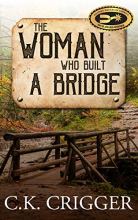
the-woman-who-built-a-bridgeHowever, more and more, we are finding stories with female protagonists. An excellent example of this is the novel, The Woman who Built a Bridge by C.K. Crigger. I found this novel on the Wolfpack website and loved it. Wolfpack Publishing offers a great article on the tropes that have historically characterized the genre of classic westerns.
The conflict between cowboys and Indians. This particular trope must be handled with care and an awareness of stereotyping and glorifying cultural oppression. Westerns are historical, so accuracy and research are required.

Also, one must avoid committing cultural appropriation. Cultural appropriation is the unacknowledged or inappropriate adoption of the customs, practices, ideas, etc., of one people or society by members of another and typically more dominant people or culture. Talk to the tribes in your area if possible. They will help you find ways to portray your indigenous people with respect.

Romance – enter the beautiful woman/handsome ranch hand. Often these characters will have a mysterious and tragic past.

Revenge – the redressing of wrongs is often a significant plot driver. The need to avenge a wrong becomes a character’s obsession, and murder frequently ensues.

A Sheriff becomes involved when a murder happens, and this lawman/woman is frequently the protagonist or love interest.

And finally, when the law catches up to the criminals, a shootout ensues.

Two subgenres of Westerns are Alternate World Westerns and Sci-fi Westerns. The setting may be a different kind of Old West, but just as in a classic Western, there is always a moral for the reader to take away. The action and mystery are sometimes accompanied by a star-crossed romance. The emotional stakes make these stories popular.

Next up, we will look at the genres of Crime Fiction and Thrillers.

The Crime genre is comprised of two main categories, true crime and fictional crime. Crime fiction has several subgenres, but I’m going to talk about only a few of them here.

The Crime Noir is set in dark, gritty urban environments. It often features hardboiled men with anger issues and alcohol problems who work as private detectives. Women are often portrayed as repressed sex objects. The protagonists are usually divorced ex-cops with a nasty reputation. Female protagonists have been making inroads in this genre, with some success.

A modern subgenre is a cyber-punk crime noir. These stories are set in a dystopian high-tech society but with all the tropes of a traditional crime noir.

True Crime sheds light on the sensational crimes that made headlines in real life. These are meticulously researched, and the authors work closely with law enforcement as they detail the events and personalities of the people involved.

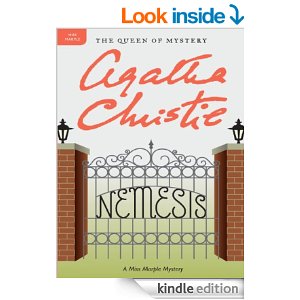
nemesis agatha christieThe Agatha Christie / Sherlock Holmes style of novel is the classic whodunnit. They feature a private detective with close ties to law enforcement but who is still an outsider. The detective sometimes has a sidekick who chronicles their cases. At times, the detectives butt heads with the police as resentment of the protagonist’s stepping on their turf crops up. This jealousy hinders the investigation. Clues are always inserted so that the reader doesn’t notice them until the denouement, and the sidekick never guesses right either.
An excellent analysis of Agatha Christie’s writing style and work can be found here: Analysis of Agatha Christie’s Novels.

Thrillers are a complex group of subgenres. Wikipedia says:

Thrillers generally keep the audience on the “edge of their seats” as the plot builds towards a climax. The cover-up of important information is a common element. Literary devices such as red herrings, plot twistsunreliable narrators, and cliffhangers are used extensively. A thriller is often a villain-driven plot, whereby they present obstacles that the protagonist must overcome. [1]

  • Political thrillers
  • Legal thrillers
  • Medical Thrillers

Then, there are Supernatural Mysteries, stories dealing with the paranormal. They may be gothic and dark.

One of my favorite genres is Romantic Mystery. I love a good mystery and a happy ending.

All crime novels and mysteries have common tropes: they involve a puzzle that the protagonist must solve, usually placing themselves in great danger in the process. Good mysteries have small clues embedded along the way for the reader. They also include many false clues that keep the reader on the wrong track. Mystery readers want to solve the puzzle—that’s why they buy these books.

Finally, we must look at Historical Fiction, which I don’t write. However, I can quote from the fount of all knowledge, Wikipedia:

An essential element of historical fiction is that it is set in the past and pays attention to the manners, social conditions and other details of the depicted period. Authors also frequently choose to explore notable historical figures in these settings, allowing readers to better understand how these individuals might have responded to their environments. Some subgenres such as alternate history and historical fantasy insert speculative or ahistorical elements into a novel.

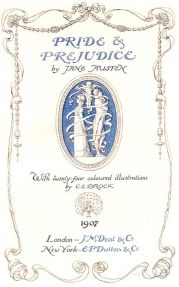
440px-Brock_Pride_and_PrejudiceDefinitions differ as to what constitutes a historical novel. On the one hand, the Historical Novel Society defines the genre as works “written at least fifty years after the events described,” while critic Sarah Johnson delineates such novels as “set before the middle of the last [20th] century … in which the author is writing from research rather than personal experience.” Then again, Lynda Adamson, in her preface to the bibliographic reference work World Historical Fiction, states that while a “generally accepted definition” for the historical novel is a novel “about a time period at least 25 years before it was written,” she also suggests that some people read novels written in the past, like those of Jane Austen (1775–1817), as if they were historical novels. [2]
When you know your story’s genre, you know what publication might be interested in it.

More importantly, you know where NOT to submit it.


Credits and Attributions:

[1] Wikipedia contributors, “Thriller (genre),” Wikipedia, The Free Encyclopedia, https://en.wikipedia.org/w/index.php?title=Thriller_(genre)&oldid=1061575069 (accessed January 4, 2022).

[2] Wikipedia contributors, “Historical fiction,” Wikipedia, The Free Encyclopedia, https://en.wikipedia.org/w/index.php?title=Historical_fiction&oldid=1063618945 (accessed January 5, 2022).

10 Comments

Filed under writing

How to find a writing group that fits your needs #amwriting

I’m in the middle of preparing a submission to a literary contest, and as part of this, I must turn my 95,000-word manuscript into 600-word synopsis that tells the whole story.

Which is a lot harder than it sounds.

MyWritingLife2021The rules of the category I am entering (Genre Fantasy/Sci-Fi) are clear: submissions must be of new, never-before-published novels. You can include only the first 25 pages of the manuscript, which will follow the synopsis.
In other words, the synopsis first, sample of the novel second.

The rules are:

  • Must be no more than 27 pages, including the synopsis. If the entry is longer than 27 pages, it will be disqualified from the contest and only receive one critique.
  • Must be single-sided.
  • Page one must begin with a synopsis (no cover page, please.)
  • The synopsis must be 1 to 2 pages.
  • It must be in 12-point font.
  • The entire document must be double-spaced.
  • Separate scenes with marks, ie. * * * or # # #.
  • Must be in Times New Roman or Times font.
  • Have one-inch margins.
  • Indent the first line of each paragraph.
  • No illustrations or images of any kind can be on the entry.
  • The title, category, and page number must be on every page on the top right-hand side of the header. (Does not need to fit in the 1-inch margins.)

So, what is a synopsis? It is an entire novel boiled down to its barebones and laid out in two pages, double-spaced. That totals about 630 words.

With the help of my writing group, I have managed to write the first two drafts of my synopsis. I will have the whole thing ready for submission by Wednesday.

One of my fellow writers had a bullet list for writing a synopsis, and she was kind enough to share it with me. Having an organized list to follow was invaluable when I crammed the entire novel, including the ending, into 600 words.

  1. An opening image/setting/concept that sets the stage (a tag line of sorts.)
  2. Protagonist intro
  3. Inciting incident
  4. Plot point 1
  5. Conflicts, Character encounters
  6. Go easy on names. Use job titles instead of multiple character names (“the daughter,” etc.).
  7. No going back point.
  8. Winning seems possible but . . .
  9. Black moment
  10. Climax – the fight is on
  11. Resolution
  12. Final Image

When I started, I knew that I wasn’t writing a blurb and that I had to include all the spoilers. So, I wracked my brain and managed a 2-page breakdown of the book that read like a laundry list.

Several writers in my group pointed out that I had named too many characters in the first draft of the synopsis. That was easily fixed. Another mentioned that I had three characters that begin with K—something I hadn’t noticed, nor had my beta readers or my editor. That was also easily fixed: Kai became Cai. Same name and pronunciation, just with the Saxon spelling instead of Norse.

My Coffee Cup © cjjasp 2013This is a task I would have found far more daunting without the support of my Tuesday morning writing group.
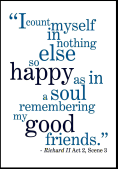
As a group, we have brainstormed every aspect of writing with the aim of helping each other along the publishing path. From plots to covers, to maps, to making your advertising work for you—we help each other find the way through the challenging world of indie publishing. Adversities and successes have forged strong bonds among us, and we’ve become close friends over the years.

So how do you find your group, the safe place where you can grow as a writer and develop confidence in yourself?

My group formed about ten years ago as a regular NaNoWriMo write-in that somehow morphed into a weekly “writers’ therapy” group. With the pandemic, we continue to work and meet on Tuesdays via Zoom.

We have all maintained connections with other writing groups too. I am familiar with and have participated in a formal critique group, which I needed at that point in my development. In this sort of group, one has rules to follow. It’s a large group, and each member submits a sample of their work-in-progress. Two are selected to be read aloud. A roundtable discussion follows, dismantling the work and pointing out each area of concern.

In any writing group, rules are necessary. Authors should be aware that their manuscript’s flaws will be pointed out, which can be painful but essential to a publishable novel. An excellent article on forming a critique group can be found here: Rocky Mountain Fiction Writers.

Your area may have established writers’ groups, and some may be able to accept new members. In a meeting, more than twenty-five people can be tricky to manage. Most groups will close to new members if the number of members reaches a certain amount. The best way to find out is to google writer’s groups in your town and make inquiries.

ICountMyself-FriendsAttend a few meetings as an observer to see if this group is a good fit for you.

If you don’t find any group meeting in person or via Zoom, see what online writers’ forums might fit your needs. For several years, I participated in an excellent online group, Critters Workshop.

So now a new year has begun, and possibly this will be the year we get back some sense of normalcy. I wish you a productive pen, witty words, and may all your words find readers who appreciate your style.

10 Comments

Filed under writing