
We as writers must resonate with the stories we tell. They have to mean something to us or they won’t mean anything to a reader.
 Lately, life has been a little hectic, and I’ve been unable to focus on my longer work. But I have been able to write and complete short stories in a variety of genres and lengths.
While my longer work is “resting” and going nowhere, there is an upside to this: I’ve had a chance to experiment with writing and delve more deeply into how my favorite authors construct their work.
I am a wordy writer. To counteract that problem, I set myself a wordcount goal and do my best to stay within it.
In microfiction, the author must build a world in fewer than 100 words, show mood and atmosphere, and give the reader a story with a complete arc.
 This sharpens my skills in writing longer pieces because I must convey as much information as possible in as few words as I can. No matter the story’s length, my chosen words must be powerful and visual, showing the setting, combined with a strong theme, and conveying the intended atmosphere and mood.
My ideas usually fall out of my head in an outline form. This skeleton becomes the first draft. Other times, I write the story as it unfolds in my mind. Then, I make an outline and rewrite it so that it makes sense.
I’ve written several stories lately that have a “circular arc.” This kind of story takes us through an experience and returns us to where we began. For better or worse, we are changed by the events we have undergone.
Most of these pieces are essays on my real-life experiences and may someday end up in a published collection, but may just be put into a book for my grandchildren. They began as handwritten entries in my notebook. I put them into a Word Document and saved them in a file labeled Essays 2026.
My personal essays usually have a circular narrative arc and rarely run more than 500 words. The story begins at point A, takes the reader through an occurrence, and brings them back to where it started.
 In this type of story, the characters return to where they began but are fundamentally changed by the story’s events.
- The Hobbit is a novel with a circular story arc. Many tales that follow the Hero’s Journey have a circular arc.
The infinity arc is similar to the circular arc but presents one story from two different viewpoints: a double-circular arc.
The story begins with Character One, takes them through an occurrence, and brings them back. At that point, the story shifts to Character Two and retells the events from their perspective, returning them to where they began. (Two circular story arcs joined by one event.) If we graphed it out, it would look something like an infinity sign, a figure-eight lying on its side: ∞
The story I’m using for today’s example is one I wrote about ten years ago. It features two protagonists, and I had intended to tell both stories in only 1,000 words. I was not entirely successful, but managed to keep it down to 1,025 words.
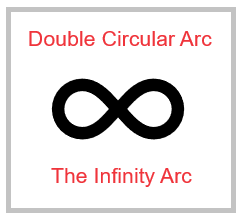 As I mentioned above, in the infinity or double-circular arc, two stories begin at the same place: the center of the infinity symbol. They experience the event simultaneously. Both characters are tested and changed by what they have lived through.
The characters in this story do not meet. In many stories with this kind of story arc, the two characters do meet and interact. Relationships across time are a popular romance trope.
But they don’t have to, and I think that makes a more interesting story.
In this tale, my characters briefly occupy the same patch of ground during a glitch in time. It ends where it began, but with two sets of characters having seemingly experienced two different events. Their perception of the meeting is colored by the knowledge and superstitions of their respective eras.
How is the story constructed?
- It opens in the center of the infinity sign. In this tale, the antagonist is the catalyst, the place and moment where two realities meet.
- The opening sentences establish the world, set the scene, and introduce the first protagonist.
- The following three paragraphs show the situation and establish the mood. They also introduce the antagonist.
- At this point, our first protagonist knows he must resolve the problem and protect his people, and he does so.
But the infinity arc presents us with a story from two viewpoints.
- Again, I had to set the scene and establish the mood and
 characters. Here, we meet the second protagonist. He has the same needs as our first and must also resolve the problem.
Neither character would have understood the strange physics of what they experienced had Brian Cox been around to explain it.
- The final paragraphs of the first half contribute to the overall atmosphere and setting of the story’s second part.
- Each character’s understanding of what they saw and experienced is firmly grounded in the beliefs and lore of their era, and both do what they must to protect their people.
As a practice piece, the story had good bones. However, it’s not the right kind of story for submission to a magazine or contest, as it’s not commercially viable. In fact, much of what I write isn’t commercially viable, but I love writing it.
The act of writing something different, a little outside my comfort zone, forces me to be more imaginative in how I tell my stories. We should all have a little fun with writing. Give that double circular arc a shot and see what you come up with.
Credits and Attributions:
IMAGE: The Hero’s Journey, Public Domain. Wikimedia Commons contributors, “File:Heroesjourney.svg,” Wikimedia Commons, https://commons.wikimedia.org/w/index.php?title=File:Heroesjourney.svg&oldid=1013027507 (accessed June 14, 2026).


I’ve not tried writing an infinity arc story. It sounds fun. I must try it.
LikeLiked by 1 person
Hello, Vivienne. I think you would enjoy it.
LikeLike