
 It’s always good to see things from a different point of view. I think and work in a linear fashion, and I talk (too often) about my process. My dear friend, author Stephen Swartz, thinks and works very differently from me, and he has kindly agreed to share some of his wisdom with us.
Stephen is a fellow co-founder of Myrddin Publishing Group and is the author of twenty-one novels (and counting). He writes in whatever genre suits his mood, and his work is always original and bold. I especially enjoy his unique voice and dense, literary style. So, without further yak-yak on my part, I bring you Stephen Swartz’s guest post:
 Somehow I have created a series. I confess it wasn’t planned, just worked out that way. You see, I began with a single idea: a boy and his mom – and her tuba – escaping a city in chaos in the sixth year of a pandemic much like the worst days of the pandemic we experienced. A journey with things happening. But what about when they get to their destination? That becomes almost a different story. And from that realization, I was off and running. If the destination is like another story, what else would happen? Before the end of this first book, The Book of Mom, I knew there would be another book. I had to know what would happen next. I already had some ideas.
For Book 2, The Way of the Son, I envisioned another adventure for the son, Sandy, leading him to what would be his young family’s survival home in the woods of a national park. I knew with the start of Book 2 that there had to be a Book 3 to make it a trilogy. Then, for Book 3, Dawn of the Daughters, I switched narrators: having Isla, the daughter, growing up and telling the story of her parents and herself, then of her own children. I found it easy to keep going with characters who were already familiar to me and had gained my trust. I knew them well and wanted to give them more.
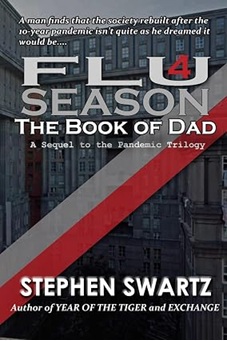 I had to choose a good character to tell what happens next. Whose perspective works best for the story? And what things will be familiar in the newly developing world of the story: a pandemic and survival years, then civil war and reconstruction. What level of development would they have by then? It is a new history unfolding and I can bend it in ways that make the next story interesting but also move it in ways that reveal a plausible direction for the new society. A lot, I will admit, came to be according to how my immediate interest shifted while writing the books. That is one reason the location shifted from the dirty capital in Book 4, The Book of Dad, to the western territory for Books 5 and 6.
In Book 1 I wanted to portray the immediate danger of the situation my characters, then bring them to a place of refuge which turns out to have its own dangers. But with Book 2 I had to invent more: what situations could they run into, both the bad and the less bad. I decided where they would eventually go, but I had to get them there – as well as wrap up some loose ends. Once settled, I could switch narrators for Book 3. Again, deciding what events would happen and how the main character is effected by them is a major thought-experiment. This might be where another writer may pause to do some planning but for me, it was all in my head although I may jot down notes to keep things in order or so I don’t forget to add them. It is all about feeling what the main character feels in the situation.
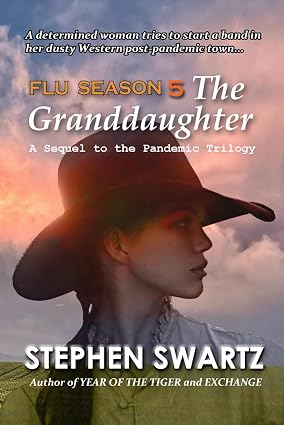 I took a pause after finishing the trilogy. But I had nagging thoughts of what would happen next – again. I imagined a rebuilt society mirroring that in Orwell’s 1984 and chose the right narrator – Isla’s youngest child, Frank – to tell the story of his struggle to exist in this “Ideal Society” then escape from it. In this way I could write a dystopian story but also link it to the trilogy as a sequel. But unexpectedly I had to go on. At the end of Book 4, The Book of Dad, Frank’s wife and children flee to the western territory. That was a bold decision, but it fit the end of the book. What could I do with that for another book? In Book 5, The Granddaughter (i.e., Isla’s), Maggie, Frank’s 10-year old daughter in Book 4, is now an adult and gets her own turn as narrator. While Book 1 was full of Sandy’s mother’s musical references, Book 5 is a chance to return to the musical side of the series with Maggie paying homage to her great-grandmother.
With two sequels crying out to be another trilogy, I felt the need for a sweeping epic to conclude the series. I saw a post-apocalyptic Western with gunslingers. Maggie, the granddaughter of Isla, has a son who gets lost in the wilderness. His adventures form the centerpiece of Book 6, The Grandsons. The frame story is what happens when this son of Maggie comes home. That seemed a fitting conclusion to the series.
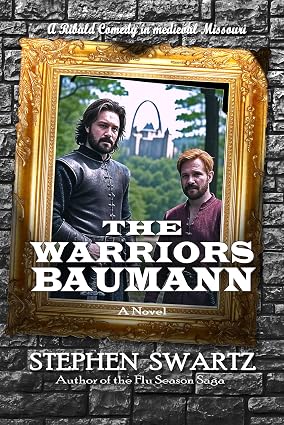 But wait a minute – or a few weeks! A new idea had been boiling under my mind while I was writing The Grandsons (Book 6). I conceived of a ridiculous story set in a future medieval Missouri. Two brothers, descendants of the same family as the Flu Season Saga, are on a mission. It would be full of comedy, puns and jokes, lively wordplay, farce, and plot twists nobody could guess were coming. And thus The Warriors Baumann was born. I had thoughts of it standing on its own yet it still had ties to the Flu Season Saga. Ironically, the characters attend a play based on the opera composed by Maggie which was based on the notebooks written by Sandy (Books 1-3) about their experiences going to the island sanctuary and then having to leave it.
 Meantime, I had been planning to write my magnum opus, A Time of Kings, all of my life and I finally felt ready for it. Considering how I linked The Warriors Baumann to the series by making the brothers Baumann descendants, I chose to do the same for my latest novel. The Prologue mentions a Baumann character and his son. The son is given the name Jack and uses it for most of the book even though he knows he is a Baumann. Jack observes the medieval world of this future America – like in The Warriors Baumann. He becomes part of the Royal family and interacts with them as a side character. Later, after accomplishing much, he stands out as the protagonist in the final third of the book.
Each book developed from the preceding book. Always the same question prompted me forward: What happens next? I let the developing world unfold in each book but the family remained, generation after generation. Therefore, I can say I did not sit down one day and make a grand plan for eight books to be a series – or even the first three as a trilogy. It just happened. The pros and cons are obvious. Continuity issues come to the fore. Might want to keep notes. But having characters cross from one book to the next, seeing them at different ages, in different situations, is a bonus feature. Different characters, different views of the changing world. Wishing to experience that change myself is what drives me.
Thank you, Stephen! About the Author:
Stephen Swartz is the author of literary fiction, science fiction, fantasy, romance, and contemporary horror novels. While growing up in Kansas City, he dreamed of traveling the world. His novels feature exotic locations, foreign characters, and smatterings of other languages–strangers in strange lands. You get the idea: life imitating art.
After studying music and even composing a symphony, Stephen planned to be a music teacher before turning to fiction writing, and taught writing at a university in Oklahoma. Stephen Swartz has published poetry, stories, essays, and articles for scholarly journals in the U.S. and Japan.
You can find him blogging at: DeConstruction of the Sekuatean Empire
You can find his books at: Amazon.com: Stephen Swartz: books, biography, latest update


