
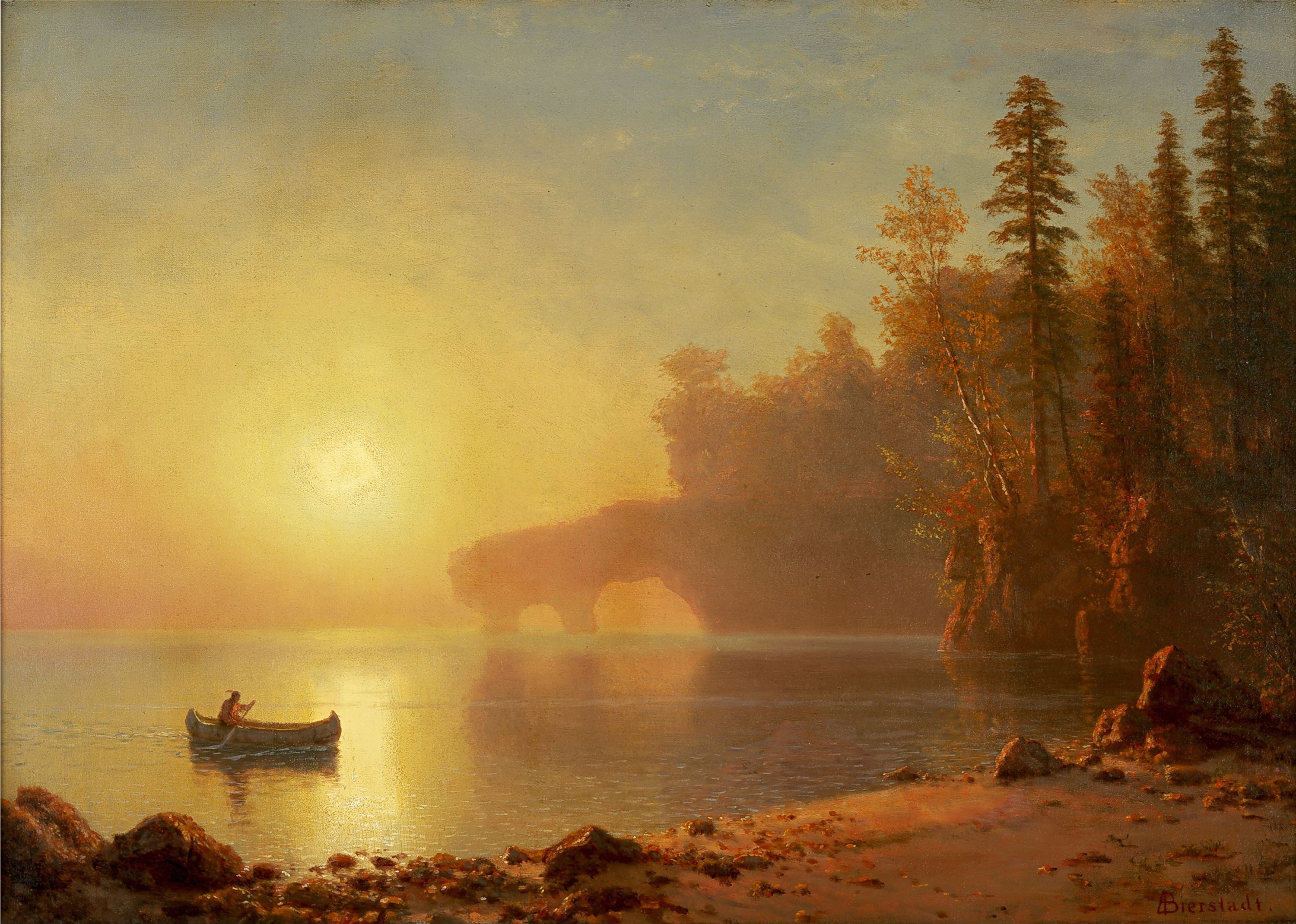
 Artist: Albert Bierstadt (1830–1902)
Title: Indian Canoe
Date: circa 1886
Medium: oil on canvas
Dimensions: height: 69.2 cm (27.2 in); width: 90.8 cm (35.7 in)
Collection: Blanton Museum of Art
What I love about this painting:
I love the quiet beauty of this faithful and respectful representation of a Native American paddling a canoe. It shows a scene from the times just before the native peoples were taken from their lands and forced onto reservations.
A time when the land was theirs, and future troubles seemed far away. Bierstadt was criticized in his time for portraying the native peoples with dignity and respect. It was a different time, and as most people now believe, that criticism was only a hint of the terrible prejudices that destroyed an entire culture’s way of life.
The landscape itself is reminiscent of the coastal landscape of the Pacific Northwest and is beautifully done. I especially like the way Bierstadt portrays the late afternoon sun as it slides into dusk. The evening mist rises, lending a mystic quality to the scene.
This is a moment of quiet serenity, and I am fortunate to be able to share it with you!
About the author, via Wikipedia:
Albert Bierstadt (January 7, 1830 – February 18, 1902) was a German American painter best known for his lavish, sweeping landscapes of the American West. He joined several journeys of the Westward Expansion to paint the scenes. He was not the first artist to record the sites, but he was the foremost painter of them for the remainder of the 19th century.
Despite his popular success, Bierstadt was criticized by some contemporaries for the romanticism evident in his choice of subjects and for his use of light, which they found excessive. Some critics objected to Bierstadt’s paintings of Native Americans, believing that including Indigenous Americans “marred” the “impression of solitary grandeur.”
Bierstadt was born in Prussia, but his family moved to the United States when he was one year old. He returned to study painting for several years in Düsseldorf. He became part of the second generation of the Hudson River School in New York, an informal group of like-minded painters who started painting along the Hudson River. Their style was based on carefully detailed paintings with romantic, almost glowing lighting, sometimes called luminism. Bierstadt was an important interpreter of the western landscape, and he is also grouped with the Rocky Mountain School. [1]
Credits and Attributions:
IMAGE: Wikimedia Commons contributors, “File:Albert Bierstadt – Indian Canoe.jpg,” Wikimedia Commons, https://commons.wikimedia.org/w/index.php?title=File:Albert_Bierstadt_-_Indian_Canoe.jpg&oldid=1059522793 (accessed August 20, 2026).
[1] Wikipedia contributors, “Albert Bierstadt,” Wikipedia, The Free Encyclopedia, https://en.wikipedia.org/w/index.php?title=Albert_Bierstadt&oldid=1365544126 (accessed August 20, 2026).


