
A few years ago, I attended a seminar offered by Lindsay Schopfer, From Body Language to Brawls. While I have a method for describing fight scenes, I liked the way he pointed out that action is about so much more than merely brawling. The concepts he presented were in line with my theory that every scene is an action scene, even the quieter moments.
 Lindsay is also a screenwriter. He offered five thought-provoking questions about planning the action in each scene.
First, he pointed out that thinking is an action scene, as are conversations. In his own writing, he asks himself, “What does this character do while thinking?” He explained that a side character with a certain amount of screen time, but who isn’t the POV character, can feel real when they have a small personal habit that appears from time to time.
However, this is one area where visuals are important, a moment when new writers should be careful. If we give one or two side characters an occasional personal habit, we won’t muck up the visuals with a barrage of personal tics. They are like salt and garlic seasoning: some is good, but too much is disgusting.
Another question he asks of his characters is this: “What does their body language show about them when they are worried?”
That is a good question. At some point in every plot, if our characters aren’t worried, they should be. So, how do we show our characters’ individual ways of handling worry? We all exhibit signs of anxiety in different ways, and writing it in a coherent way takes some thinking and planning.
Lindsay asks three more questions of his characters:
- How do our characters look when they’re happy or excited?
- How do they look when they’re angry?
- How do they look when they’re depressed?
I’ve talked at length about how we can show these emotions through facial expressions or physical reactions, combined with internal dialogue or conversations. But for me, the hardest part of writing is balancing visual indicators of emotion with exposition that shows the deeper, internal clues.
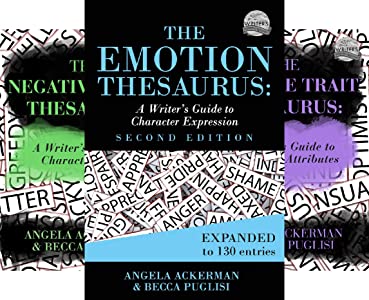 An excellent resource that I regularly recommend is the Emotion Thesaurus by Angela Ackerman and Becca Puglisi. This guide offers helpful hints for showing what a character is feeling when you know what you need to say but not how to phrase it.
However, I must emphasize that discretion is crucial when showing emotions. I say this because when a character’s facial expressions take over the scene, they become cartoonish, two-dimensional displays of emotion with no substance.
A story is like a pond full of words. The words are the surface, and below the surface are several layers. The inferential layer is the layer in which readers draw conclusions from the clues we offer them.
We want to hint at the reasons for the physical reactions. We do this with small bits of exposition. It takes work and practice to write a narrative without telling the reader what to experience.
We must use words that offer the most information in the least amount of space so the words we choose make the narrative worth reading.
I’m still trying to master this.
I do put a book down unfinished when an author leans too heavily on slowly painting visual descriptions of the characters’ internal struggles. Eyebrows regularly going up and down as if they operate independently on every page could be trimmed back to only when necessary.
Another thing came up in this seminar, something I firmly believe: word count matters in a fight scene.
Detailing a war will involve page after page of discussion because that conflict drives the story. But when a fistfight or sword fight takes up three pages of description, I can’t suspend my disbelief as a reader. I say this because physical fights in real life are fast, violent, and over in a space of ten, fifteen, or twenty minutes. It’s not humanly possible to go on and on with no rest. That is why matches between professional boxers are broken into rounds. They fight a while, rest a while, and so on for 15 rounds.
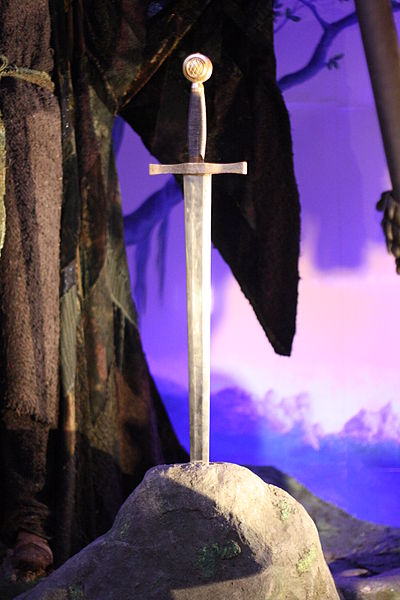
Excalibur London_Film_Museum_ via Wikipedia
Also, if you are writing about sword fights, remember this: they are physically exhausting. At the Olympic level, competitive fencing matches have rest breaks: each bout continues until one fencer scores 15 hits, or until the 9-minute total fencing time is reached. Those 9 minutes are split into three 3-minute periods with a 1-minute break separating each period. That amounts to 12 minutes total, and at the end, both combatants are exhausted.
Mob violence is different. It can go on and on for hours or days. Mob violence is war on a smaller, local level.
So, when a fight scene that should be over in twenty minutes at most runs on for more pages than my patience can handle, I will skip forward, or worse, set the book aside.
Every November, I use those thirty days to write at least 50,000 new words as quickly as possible. In the process, I lean too heavily on my crutch words, relying on a lot of smiling and shrugging.
During revisions, I look for my crutch words. They’re markers for the second draft, words signifying scenes where more effort is needed to flesh them out. This is where writing becomes work.
If you haven’t seen this before, here is a list of telling words that often find their way into a first draft, and sometimes into the final:
- Admiration: Her admiration was clear. (How was it clear? Did someone notice it?)
The rest of my “code words” show up in sentences and paragraphs the same blunt way in that first draft and inspire the same kind of questions:
- Affection
- Anger
- Anguish
- Anticipation
- Anxiety
- Awe
- Confidence
- Contempt
- Defeat
- Defensiveness
- Denial
- Depression
- Desire
- Desperation
- Determination
- Disappointment
- Disbelief
- Disgust
- Elation
- Embarrassment
- Ethical Quandary
- Fear
- Friendship
- Grief
- Happiness
- Hate
- Inadequacy
- Indecision
- Interest
- Jealousy
- Love
- Lust
- Powerlessness
- Pride
- Regret
- Resistance
- Revulsion
- Sadness
- Shock
- Surprise
- Temptation
- Trust
- Unease
- Weakness


Yeah individual fights should definitely be fairly short imo, or it gets silly. A dynamic, fast-reacting back-and-forth until someone gets the edge is better.
I’ve been writing a lot of long complex battles lately and switching through short fights between a few well-known people, commanders planning the bigger picture, soldiers away from the front line preparing for the order to go in, character stuff. Varying tones and types of action. But I expect to have to trim a fair deal when editing it all.
LikeLike
Wow, Alex! That sounds complicated and awesome. It seems to me that the war is the main plot point, so kudos to you that you are giving it the attention it deserves. And you are right. In my own work, revisions and then editing always trim the fat away. Good work!
LikeLiked by 1 person