
Here in the US, Thanksgiving falls on the 4th Thursday of November, which is this week. This year, I will not be cooking the family’s Thanksgiving feast, although I will make two of my specialties. This is the first holiday for our family since my husband passed away. I will go to my youngest daughter’s house for several days and enjoy the new and evolving traditions as our family continues to grow and change.
 The family I grew up in is large, loud, and eager to say what is on their minds. My husband always said we were an all-talk-at-once kind of a family, and that is true. Holidays tend to be chaos. The dinner is loud. The table is laden with mass quantities of great food, and conversations continue as everyone’s news is shared.
Quiet only falls when the last grandchild carries her children out to her car.
Sometimes, a grandchild will bring a girlfriend or boyfriend. Most are shocked by the general din. However, the strong survive, eventually getting into the swing of things and contributing to the noise as if they were born to it.
 It can be like living in a blender, but it’s wonderful and I wouldn’t change it for anything.
When I first left home, I was surprised to discover that, unlike my family, most people carry on conversations in which one person speaks, and the other one answers. Apparently, most conversations flow without people interrupting and talking over each other.
Who knew?
So now we get to the nitty-gritty of writing a conversation, or punctuation. We all know that proper punctuation is important because readers expect it. It acts as traffic signals, regulating the flow of words in such a way that the reader doesn’t realize it’s there. Instead, it allows us to be completely involved in the narrative.
It is important to follow the rules in the narrative but in dialogue we can get a little creative. When people talk, they rarely follow grammatical rules. Many times when we’re upset, our emotions cause us to speak in broken sentences, with pauses. And, in normal conversations, we speak in our regional dialects and sometimes mangle our grammar.
I, of course, am never guilty of that, I’m sure.
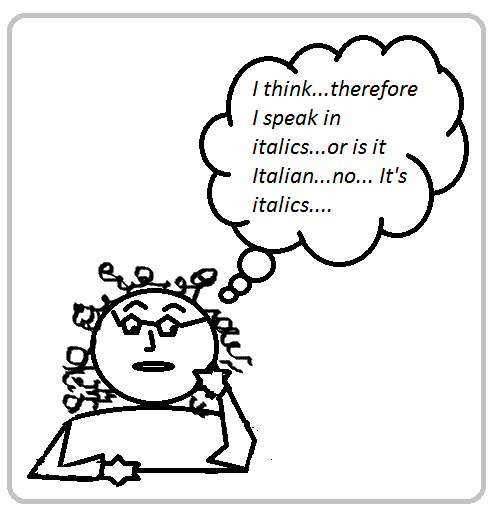 I’ve found that small moments of conversation make good transitions. Also, sometimes italicized thoughts (internal dialogues), or contemplations written as free indirect speech work as scene breaks and transitions. These moments can work well when a hard break, such as starting a new chapter, doesn’t feel right. The reader and the characters receive information when they need it.
Pacing has a scientific equation that can be described in two ways:
Action + reaction +action +reaction = pacing.
Push + glide + push +glide = pacing.
Most readers hope authors will avoid conveying accents by altering spelling. It gets tiresome to read an author’s attempt to write an accent. I enjoy the work of authors who choose one word that conveys the accent, a colloquialism for that character to habitually use instead of mucking up the prose. It’s a way to give the reader the feeling of knowing who a character is without resorting to an info dump.
Feel free to break the rules of grammar if your character shows a blatant disregard for what’s correct. If he wants to say, “I seen that movie last week. It was a real dud,” let him. It shows a side character or walk-on as having a history.
Pacing counts. Miss a few beats. Beats are little bits of physical action inserted into dialogue: James fell quiet and stared out the window. Martha turned and walked out the door.
 Used sparingly, pauses punctuate the dialogue and give the scene movement. They’re best placed where there is a natural break in the dialogue, because they allow the reader to experience the same pause as the characters. Pauses are essential at some places, but don’t overdo it. If your characters are rattling pans, slicing apples or staring out the window between every line of dialogue, the scene becomes about the action and not the dialogue. The impact of the conversation can be lost entirely.
Once in a while, it is okay to have your characters tell a story within the story but do it as naturally as possible. Speaking as an older person, I admit that some grampa will be just dying to tell the younger ones how it really was.
If our protagonist has been kidnapped and tied up in a back room at Bob’s Fish Cannery and Gramps gave her partner the information to help her escape, she doesn’t care about what Grampa also told him about the good old days. Not even if old Richard Jones did lose a finger that was never found and didn’t notice it until his shift was over. What she wants and needs to know is where her weapons might be stashed.
We want our written conversations to sound normal, and people don’t always use perfect grammar in their speech. Sometimes we want to create pauses in dialogue where one wouldn’t ordinarily be.
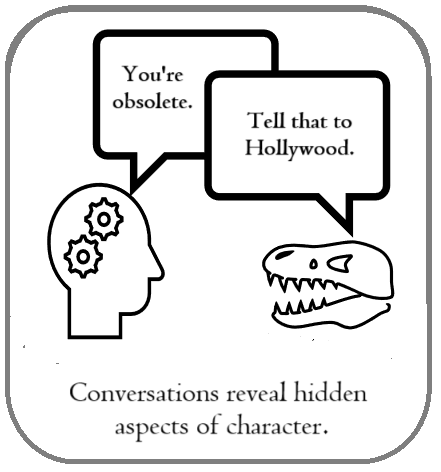 But feel free to properly punctuate your dialogue to your heart’s content. It’s your book, and your style, so you make the decision.
Research how to write natural dialogue by observing the people around you. See how they talk, what they do with their bodies, and where they pause. Watch their expressions.
We get to know people by observing the visual cues and picking up the stresses and flows of their habitual speech. We want our dialogue to give the reader a clear visual of the scene, the characters and their environment.
A great scene featuring memorable characters will be clearly visualized in the mind of the reader. So, give those clues and hints, but don’t forget that good dialogue must feel natural. It shouldn’t read like my family’s holiday dinners, no matter how much I enjoy the chaos.


