Tag Archives: writing dialects

Pacing, Thanksgiving, and #writing dialogue

Here in the US, Thanksgiving falls on the 4th Thursday of November, which is this week. This year, I will not be cooking the family’s Thanksgiving feast, although I will make two of my specialties. This is the first holiday for our family since my husband passed away. I will go to my youngest daughter’s house for several days and enjoy the new and evolving traditions as our family continues to grow and change.

The family I grew up in is large, loud, and eager to say what is on their minds.  My husband always said we were an all-talk-at-once kind of a family, and that is true. Holidays tend to be chaos. The dinner is loud. The table is laden with mass quantities of great food, and conversations continue as everyone’s news is shared.

Quiet only falls when the last grandchild carries her children out to her car.

Sometimes, a grandchild will bring a girlfriend or boyfriend. Most are shocked by the general din. However, the strong survive, eventually getting into the swing of things and contributing to the noise as if they were born to it.

It can be like living in a blender, but it’s wonderful and I wouldn’t change it for anything.

When I first left home, I was surprised to discover that, unlike my family, most people carry on conversations in which one person speaks, and the other one answers. Apparently, most conversations flow without people interrupting and talking over each other.

Who knew?

So now we get to the nitty-gritty of writing a conversation, or punctuation. We all know that proper punctuation is important because readers expect it. It acts as traffic signals, regulating the flow of words in such a way that the reader doesn’t realize it’s there. Instead, it allows us to be completely involved in the narrative.

It is important to follow the rules in the narrative but in dialogue we can get a little creative. When people talk, they rarely follow grammatical rules. Many times when we’re upset, our emotions cause us to speak in broken sentences, with pauses. And, in normal conversations, we speak in our regional dialects and sometimes mangle our grammar.

I, of course, am never guilty of that, I’m sure.
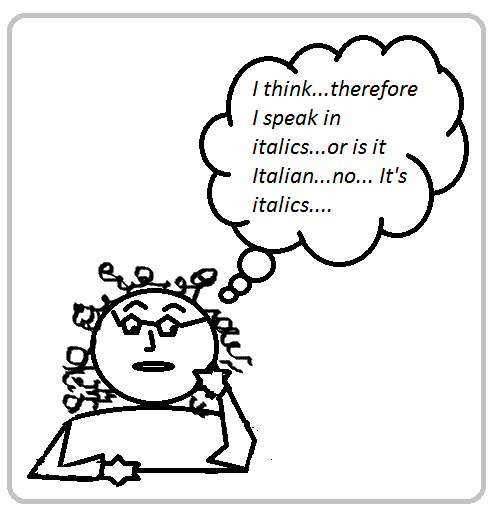
I’ve found that small moments of conversation make good transitions. Also, sometimes italicized thoughts (internal dialogues), or contemplations written as free indirect speech work as scene breaks and transitions. These moments can work well when a hard break, such as starting a new chapter, doesn’t feel right. The reader and the characters receive information when they need it.

Pacing has a scientific equation that can be described in two ways:

Action + reaction +action +reaction = pacing.

Push + glide + push +glide = pacing.

Most readers hope authors will avoid conveying accents by altering spelling. It gets tiresome to read an author’s attempt to write an accent. I enjoy the work of authors who choose one word that conveys the accent, a colloquialism for that character to habitually use instead of mucking up the prose. It’s a way to give the reader the feeling of knowing who a character is without resorting to an info dump.

Feel free to break the rules of grammar if your character shows a blatant disregard for what’s correct. If he wants to say, “I seen that movie last week. It was a real dud,” let him.  It shows a side character or walk-on as having a history.

Pacing counts. Miss a few beats. Beats are little bits of physical action inserted into dialogue: James fell quiet and stared out the window. Martha turned and walked out the door. 

Used sparingly, pauses punctuate the dialogue and give the scene movement. They’re best placed where there is a natural break in the dialogue, because they allow the reader to experience the same pause as the characters. Pauses are essential at some places, but don’t overdo it. If your characters are rattling pans, slicing apples or staring out the window between every line of dialogue, the scene becomes about the action and not the dialogue. The impact of the conversation can be lost entirely.

Once in a while, it is okay to have your characters tell a story within the story but do it as naturally as possible. Speaking as an older person, I admit that some grampa will be just dying to tell the younger ones how it really was.

If our protagonist has been kidnapped and tied up in a back room at Bob’s Fish Cannery and Gramps gave her partner the information to help her escape, she doesn’t care about what Grampa also told him about the good old days. Not even if old Richard Jones did lose a finger that was never found and didn’t notice it until his shift was over. What she wants and needs to know is where her weapons might be stashed.

We want our written conversations to sound normal, and people don’t always use perfect grammar in their speech. Sometimes we want to create pauses in dialogue where one wouldn’t ordinarily be.
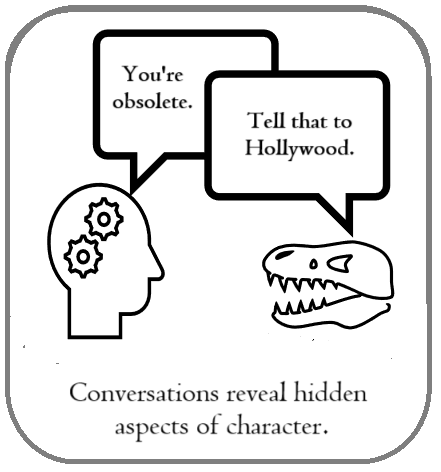
But feel free to properly punctuate your dialogue to your heart’s content.  It’s your book, and your style, so you make the decision.

Research how to write natural dialogue by observing the people around you. See how they talk, what they do with their bodies, and where they pause. Watch their expressions.

We get to know people by observing the visual cues and picking up the stresses and flows of their habitual speech. We want our dialogue to give the reader a clear visual of the scene, the characters and their environment.

A great scene featuring memorable characters will be clearly visualized in the mind of the reader. So, give those clues and hints, but don’t forget that good dialogue must feel natural. It shouldn’t read like my family’s holiday dinners, no matter how much I enjoy the chaos.

 

2 Comments

Filed under writing

Dialogue tags, verbal tics, and accents #writing

We who write love our characters and want our written dialogue to sound as natural as a conversation with our best friend. We meet on the street, in the bar, or at a coffee shop.

And we talk, talk, talk.

And so do my characters. Sometimes they won’t be quiet, and it drives me nuts.

Other times, my characters behave like a fourteen-year-old forced to go camping with the family. She owns the backseat with the glowering disapproval only a teenager can bring to it, sitting in stony silence and staring at her signal-less phone. Hell will freeze before she interacts with these strangers who claim to be her parents, kidnappers who dragged her out to the wilderness for something called “family time.”

Eww.

But when my characters DO choose to participate in the conversation, how do I make them sound natural? I go back to the works of established writers whose dialogue is crafted so well that I don’t feel like I’m reading it. Instead, I feel like I am living it.

If you visit many writers’ forums, you’ll find a wide variety of opinions on this subject. I don’t worry about the gurus who want you to know how important they are. Instead, I consider the reader.

How can I write dialogue that is the easiest for the reader to follow?

My favorite authors don’t get too fancy or uber creative. Their written dialogue tags are simple and show the conversation.

I try to stick to said, replied, answered, and asked. Most readers won’t even notice the attributions are there.

This is especially true when writing genre fiction. I stick to simple tags, such as John said.

At times, we may need an attribution like “screamed,” “uttered,” or “retorted.” Most of the time, fancy synonyms for ‘said’ are distracting.

I agree that you can skip using dialog tags altogether for a back-and-forth or two, but never if there are more than two speakers in the scene. I never do that for more than one exchange. Readers want to be able to track who is saying what.

Beats are what screenwriters call the little bits of physical action that are inserted into dialogue:

Junior unbraided his hair and pulled it back into his customary long ponytail. Off came the sarape, which he told Pap smelled musty. “Tell Johnny thanks for the loan of his buckskins,” he said.

Some writers will leave the ending attribution, and some will move it to the front of the dialogue. As an editor, I would suggest removing it entirely, since the words “he told” already appear in that paragraph. But again, the author’s choice is final.

Beats or actions not only punctuate the dialogue, they also give the scene movement. Actions present a strong mental picture, eliminating the need for a description dump.

Character moods can be shown by actions and are often best placed where there is a natural break in the dialogue. This allows the reader to experience the same pause as the characters. Beats are an effective tool and are essential to good dialogue.

But don’t overdo it, or the scene becomes about the action rather than the dialogue, and the impact is diluted or lost entirely. When we add gestures and actions to the conversation, we want the information that is conveyed to be meaningful, and the visual actions to be subliminal.

This is why we don’t make the mistake of eliminating attributions in our entire manuscript. We must insert clues as to who is speaking, or the reader will be confused.

Worse, the action takes over, and the dialogue fades into the background, obscured by the visual noise of foot shuffling and paper rattling.

But what about exclamations and verbal tics?

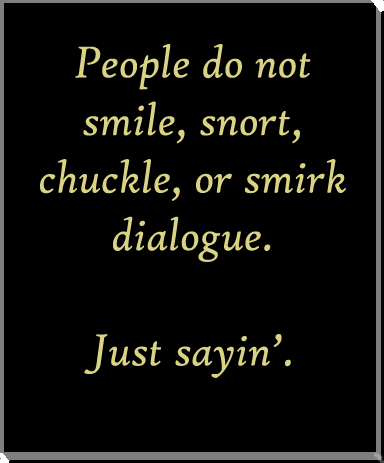
“Um … ah ….” We frequently speak this way in real life, but I recommend being sparing with them. When a character overuses thinking sounds and exclamations, it is exhausting for the reader.

Another conversation stopper is the “filler sound.” Have you ever met a person who drones on with a long “A-ahhhhhhhhh….” effectively holding conversations hostage with meaningless syllables?

These are ‘thinking syllables.’ This is known as a ‘verbal tic’ or a “filler sound” and is usually such an ingrained habit that the offending party is unaware they are doing it. I warn you, their feelings could be hurt if you try to hurry them along, so I ignore the habit when I come across an acquaintance who suffers from it. They are just gathering their thoughts.

However, if there is a habit you don’t enjoy in conversation and don’t want to read in a novel, don’t write it into your characters’ dialogue.

As a reader, I’ve come to feel your best bet when dealing with verbal tics is to give a brief example of a character’s speech pattern, and, if it is important, occasionally mention how their habits annoy other characters.

What about accents? Please, don’t overdo spelling them out. You have no idea how hard it is for readers to wade through heavy accents.

“My feet hurt, and I’m feeling dead tired. I need to sit and rest a while.” A writer could get away with using knackered and kip to convey the general idea of a regional accent without losing the reader’s interest.

I recommend going light and limiting the use of misspellings, bad grammar, and vulgar accents, especially if you are trying to point out that the character is uneducated or from a rural background.

Fun fact: negative experience is a harsh, but thorough, teacher.

So, nowadays I use only a few well-chosen words to convey the idea of the accent and am consistent in how I do so. I don’t want my dialogue to be incomprehensible. It’s too easy to go over the top with it, and then the character becomes a parody, a cartoon of a person, instead of someone who feels real.

This winds up my rant on annoying habits we don’t want to inject into our dialogue. Accents, dialects, and verbal tics are all things we need to convey, but we must be mindful of our readers’ supply of patience. Show what is necessary and let the reader’s imagination do the rest.

5 Comments

Filed under writing