Category Archives: Literature

#TalesFromBlackFriday : The Marriage Counselor

Digital Clock FaceI shook my head to get rid of the sudden, loud buzzing sound in my ears. Feeling a little disoriented, I looked at the calendar, which said Thursday, the day I dreaded most. Sometimes I felt like it was always Thursday. It was nearly time for my regular two o’clock appointment…the couple from hell, pardon my cursing. After my heart attack about six months before, they had begun coming to me, and were likely to give me another one. They never missed an appointment no matter how I wished they would.

I watched the clock tick from one fifty-nine to two o’clock.

My receptionist opened the door. “Mr. and Mrs. Haydes are here. Shall I show them in?”

 ***

I lifted my pen from the notepad and regarded the couple seated across from me. “Would you listen to yourselves? You make marriage sound like hell. It doesn’t have to be that way. You both sabotage it every chance you get.”

“Of course marriage is hell,” said the husband across from me, dressed in a double-breasted, blue suit, giving him an almost nautical appearance. Add a captain’s hat and he’d look like a cast member on The Love Boat. “It’s the absolute worst thing that could possibly have happened to a once-studly man like myself. But just like the moth flying into the flame, I had to do it. ‘Don’t go toward the light,’ my friends all said. But did I listen? Hell, no!”

His wife snorted. “Luke always does the exact opposite of what anyone advises him to do. That’s what he gets for being a devil-may-care, I’m-gonna-do-it-my-way sort of a guy. He’s Satan. That makes me Satan’s wife. Of course it’s hell—it comes with the territory. If I can put up with him, he can put up with me.” This week she wore little makeup and was neatly coiffed, with not a hair out of place. In a counterpoint to Luke’s dashing attire, she wore a beige wool suit, cut to just below her modestly crossed knees, with low-heeled pumps. Mrs. Haydes could have been a proper matron from any Protestant congregation, right down to her puritanical sense of morality.

This forty-five minute session of misery began promptly at two o’clock every Thursday. They booked their appointments under the pseudonyms, Lucifer and Persephone Haydes. He preferred to be called Luke, and she preferred to be called Mrs. Haydes. After six months of working with this pair of nut cases, I was beginning to suspect they were playing a game of mess-with-the-counselor.

Last week she’d been dressed like a teenaged skateboarder, and he as an English literature professor. The week before that, she was a hippie, complete with headband and love beads, and he was a cricket player.

Every week it was something different but always opposites. Mrs. Haydes seemed to choose her wardrobe based on what she thought would annoy him most, and he went with the opposite because he really couldn’t do anything else. He had the worst case of oppositional defiant disorder I had ever seen.

“Why are you here?” I had to ask, despite knowing I wouldn’t get an answer. “I no longer understand what you are trying to save here. You never take my advice. And you’ve been aware since the outset that I am a pastor, not a magician. What do you hope to gain from this?” I tapped my foot and looked at the clock. We were only fifteen minutes into this session, and I was already exhausted. “What you really need is a good divorce lawyer, not a counselor. I can tell you every reason why you should stay married, and if you are looking for religious affirmation, I can give you chapter and verse on the apostle Paul’s views regarding marriage. Over the last six months, I have done so repeatedly.  We’ve discussed what you originally saw in each other and what you each want from your relationship, but you’re still at this impasse.  I think that at this stage divorce is the only answer for the two of you.”

Luke snorted. “Don’t bother telling me anything the apostle Paul said—I wrote that book. I was delusional.”

“I think the pastor is right,” said Mrs. Haydes, primly folding her hands. “Divorce is the only option. I’m sure no one would blame me for leaving a devil like you.”

“I’m not giving up half of everything I own,” said Luke, clearly aghast at the notion. “Do you know how many divorce lawyers she has access to? No way am I going to let her off so easily.”

“I come from a broken family,” said Mrs. Haydes, discreetly wiping a tear. “I don’t want our children to grow up in a broken home. But it would be better than Anaheim. It’s a bad environment to raise children in. I want to move back to our palace in Hell. All it needs is a little remodeling.”

I couldn’t stop myself. I had to ask it. “And you think Hell is a good environment to raise kids in?”

“Well, at least there’s no crime in hell. We have the finest law enforcement professionals in the universe.” She glared at me defensively. “Where should I be raising them? Seattle? I’m not exposing my children to a bunch of pot-smoking vegans who ride bicycles and wear socks with sandals.”

Luke brightened up. “I love Seattle—perhaps we should move there. I could get some goats or raise alpacas. They have the best coffee in the world!”

Mrs. Haydes sniffed. “The place is full of vulgar vegetarians. They’re always taking their children to yoga and soccer, where everyone gets a trophy whether they win or lose—it’s just wrong. We will most certainly not be moving to Seattle.”

“Enough,” said Luke. “I’m going vegan and we’re moving to Seattle and that’s final.” He turned to me, missing her small, satisfied smile. “What I really want to talk about is the stint we did on ‘Home Hunters.’ She destroyed me in front of millions of people, and I have to watch it every time they rerun that episode, which they seem to do three times a week.”

“Well dear, it airs on one of your networks, and you make the rules. You’re the one who decides why the television viewing public has 999 channels available to them, and all but three of them at any given time are showing the same reruns of Pawn Shop Heroes, Home Hunters, or Gator Boys.”

From the look on Luke’s face, I could see that Mrs. Haydes had the knife and was twisting it for all she was worth.

“Besides, I said very clearly that I wanted the extremely modern condo, with all the sleek furnishings and the gorgeous, terrazzo floors. I said it at least six times. It’s on the videotape of the show.” She smiled at him smugly. “You just had your heart set on that cozy, little pink bungalow with the seventies’ décor and the orange shag carpet. You insisted, and so, of course, I gave in. Once you make up your mind, it’s impossible to change it.”

“See?” Luke exploded. “See how she manipulates me? How could I not go for the house she said she didn’t want? It was like asking the dog not to eat the chocolate you left on the coffee table. I’m Satan! I’m not really an agreeable sort of guy, and she knows exactly how to manipulate me, so now, twice a week, everyone in America gets to watch me buying grandma’s overpriced, decorating nightmare. It’s been voted the most popular episode of all time! She embarrassed me in front of God and the world.” He dropped his head into his hands. “We’re moving to Seattle now, and it’s going to be hell trying to sell that dump in Anaheim. I won’t even be able to rent it out for enough to cover the carrying costs. What a life!”

I knew this session was going nowhere. Their sessions never went anywhere positive because they were masters at circular reasoning. “What is it you want from me? You must have some reason for putting me through this agony every week.”

“I despise him, so I want a divorce, of course,” said Mrs. Haydes, with a smug, little smile. “I’ll be happy with my half of everything, and, of course, alimony. I gave up my career to raise our children, you know, and of course, they will need child support.” She aimed her tight, fundamentalist smirk  at me. “We won’t waste your time any further.”

“No. No. No!” Luke’s eyes popped out of his head. “No divorce. I adore you, Persey—you’re the love of my life!” He kissed her hand.  “I would be lost without you. Think of the children.”

“I love you too, Luke—I just hate being around you. And now you’re going to be forcing all your hippy, vegetarian food on me.” She turned away from him, primly pursing her lips. “You know how I love steak.”

“No dear, not vegetarian. Vegan. It’s good for you, you’ll love it. Why, I’ve a recipe for smoked tofu that will put a smile on that pretty face in no time.” Luke smiled his most charming smile. “If there is one thing I understand, it’s how to barbecue. You’ll adore my smoked tofu salad.”

“If you say so, dear. I’ll likely throw up.”

The two rose and left my office. I sighed.

Luke might claim to be Satan, and yes, it was even possible given how contrary he was, but if that was case, Mrs. Haydes ruled in Hell. There was no mistake about that.

I heard my receptionist speaking in the anteroom. Yes, Mrs. Haydes was scheduling another appointment…two o’clock next Thursday.

Satan might move to Seattle, or he might not. Somehow, I knew his new penchant for tofu and coffee wouldn’t get me off the hook.

I shook my head to get rid of the sudden, loud buzzing sound in my ears. Feeling a little disoriented, I looked at the calendar, which said Thursday, the day I dreaded most. Sometimes I felt like it was always Thursday. It was nearly time for my regular two o’clock appointment…the couple from hell, pardon my cursing. After my heart attack about six months before, they had begun coming to me, and were likely to give me another one. They never missed an appointment no matter how I wished they would.

I watched the clock tick from one fifty-nine to two o’clock.

My receptionist opened the door. “Mr. and Mrs. Haydes are here. Shall I show them in?”


The Marriage Counselor © Connie J. Jasperson 2015

“The Marriage Counselor” was first published March 6, 2015  on Edgewise Words Inn
2 Comments

Filed under Fantasy, Humor, Literature, writing

#Flashfic: Metamorphosis

MetaMorphosis cover for WattPad copyYrena Rozhenko ran, not knowing if she was headed into something worse.  It didn’t matter—the transformation had begun and she couldn’t seem to halt it. One way or the other she had to get away from Benton.

The sounds of distant pursuit penetrated to her newly-altered hearing, spurring her on.

She took to the foliage. The shade and mottled light of the strange underbrush eased the pain in her eyes, dimming the glare. She raised her hand to her face, wondering why it felt so bruised. Hard nobs had begun to form above her eyebrows, turning them in ridges. Her heart nearly stopped when she saw the scales forming on her hands and long, deadly-looking talons where neatly manicured fingernails once had been.

What’s happening to me? We ate nothing and drank no water from this world. We touched nothing ungloved. Could it be the air?

Their mission was over. In the UFA records, they would be officially listed as MIA, something that happened frequently on first exploration missions. Benton had murdered Jackson. Jenner was either dead or in hiding, and she…she was changing into some…thing.

Was she going to die next? Benton’s fear and loathing of anything different made him…the only word she could think of was evil.

Why had he not begun to change? The answer came from all around her, from the forest. I was waiting for you. He is not worthy.

She heard Benton softly call her name, a sing-song taunt. “Rozhenko…come out, come out, wherever you are….”

What could she do? With those talons on her hands she wouldn’t be able to return to the ship, even if she could make it to the lander. Besides, she couldn’t leave without knowing if Jenner was alive, and if he was, she wouldn’t leave him behind.

And even if she made to the ship, what then? She knew the change was happening to her on a genetic level, as if this planet had claimed her. Something told her it was irreversible.

Gods, her back ached.  Her shoulder blades, her tailbone were like points of…gah! Whatever. She had to ignore it and get deeper into the brush.

Jackson had begun to change the first night. By dawn he’d transitioned into something…else.

The others had discussed his condition, deciding to take him back to Lodestar Station where the medical team was, despite it being a ten-day journey and meaning the end of their mission. They would have to declare Sirius C a class N Biohazard planet, meaning the established ecology was too dangerous for human settlement.

Benton had been the lone holdout, shouting they had to destroy Jackson before he destroyed them. “He’s a killer. Look at those claws—he’s not human anymore!”

When Yrena and Jenner shouted him down, he had walked up behind Jackson and shot him in cold blood, with no further conversation or discussion, murdering the man who’d been their commander with no qualm or shame.

He’d been proud that he’d done so and now claimed Jackson’s position as expedition leader.

Jenner had begun to change right after Benton murdered their commander, but he’d vanished while Yrena was in the shuttle sending the message detailing the hazard and Benton’s mutiny.

Yrena feared that Benton had killed Jenner while she was busy, but if he had, the body was nowhere to be found.

Benton had shown his true colors. He’d always bragged that he had what it took to rise to the top. He was a capable enough navigator and a solid geologist, but he’d never understood finesse or compassion. How he’d been put on their team in the first place, she didn’t know, but he’d been nothing but a sour pain in the…ass.

She suppressed a groan. Even her ass ached. She was afraid to reach back there and see why.

Some new instinct told her to get off the ground, that safety was in the tree-tops. Yrena’s new talons made excellent assists for rapid tree climbing. Perched high in the canopy and hidden by the triangular, golden leaves, she watched as Benton combed the forest floor, not even thinking to look up.

She had burst out of her shipsuit, which was now nothing but shreds. Carefully she balled it up and hid it in the hollow of the tree. She could nest there if she had to.

What was she thinking? She had to get back to…what was that? A glint of gold caught her eye. A gold-mottled form was perched on a branch near her, one sharp-taloned finger held to his scaly lips for silence. Relief swept through her—Jenner had completed the transformation.

She was not alone.

Benton passed under their tree. Yrena clung tightly to the trunk, remaining perfectly still. She needed a few more hours to complete the transformation, but if he looked up, she would never know what she was transforming into, never again know love or laughter or….

A flash of golden wings…Benton’s sudden strangled cry….

Yrena looked down and saw Benton’s bloody form lying in several pieces.

Jenner flew back up to perch beside her.  She let go of the trunk and went to sit beside him, their arms going around each other.

They had been colleagues but she’d not really known him well. He was all she had now.

The setting sun cast a ray that glanced off the abandoned shuttle. Above the forest, stars began to come out and a tiny star passed overhead. Once it had been a research vessel, but now it was an abandoned hulk ending its days as a small star in a new sky.


Metamorphosis © Connie J. Jasperson 2015  All Rights Reserved

Metamorphosis was first published July 10, 2015 on Edgewise Words Inn under the title “Transfiguration”

It was republished on Oct. 18, 2015 on WattPad under the title “Metamorphosis”

Comments Off on #Flashfic: Metamorphosis

Filed under Literature, Publishing, Uncategorized, writer, writing

#FlashficFriday: Silence and Love #FreeVerse

Paul Cornoyer Winter twilight along Central Park

Silence and Love

There was a time when we talked,

A time when words connected us the way kisses join lovers.

You mind amazed me as much as your body did

And I knew them both better than I knew my own.

You still amaze me but years have wedged silence between us.

Not the stony silence of anger or hurt—thank god, not that.


It is the silence of comfortableness,

The soundless speech of two old people

who sometimes read each other’s minds.

The quiet sharing of a back porch in the summer.

Side-by-side on a second-hand settee with a blue cushion,

You reach for my hand, and I am swept away.


Now when we speak, it is a more cerebral sharing,

Mind to mind, heart to heart,

Two old people still in love, but with little to say.

Did we say it all in the young wild days?

Did we spend our words the way we spent our kisses?

If so, then many more remain, waiting to pass between us.


No. We were learning each other, discovering truths

and facing our self-deceptions.

Now it is a calm sharing.

I still know your mind and your body

and love them better than my own.

I still love it when you hold my hand.


And when we speak it means something.

And when we kiss it means something.

And when we hold hands in the silence

Of an evening on a back porch,

Side-by-side on a second-hand settee with a blue cushion,

It means everything.


“Silence and Love” © Connie J. Jasperson 2015, All Rights Reserved

6 Comments

Filed under Literature, Uncategorized, writing

#amwriting: King Arthur: where history and fantasy merge

473px-Boys_King_Arthur_-_N._C._Wyeth_-_p214 Public Domain via WikimediaA few years ago I was challenged to write an Arthurian tale with a steampunk twist. I accepted the task, but immediately wished I hadn’t.

The first question I asked myself was: Where do Arthurian and steampunk connect well enough to make a story? The answer was–they don’t. I felt that block we all feel when the story will not reveal itself.

But, sitting on my back porch and letting my mind wander, I found myself wondering what Galahad and Gawain would have really been like. The people those characters were based on were men of the 5th or 6th century, ordinary men, and despite the heroic legends, they were made of flesh and blood.

And what if somehow Galahad got separated from Gawain through a door in time? How would Galahad get back to Gawain?  What if he was marooned in Edwardian England, with Merlin – can you say steampunk?

The title of that tale is Galahad HawkeThe original working title was I, Galahad. For every story, the title is a moot point for me, because any title I give it at the beginning will likely be changed when I rewrite it anyway.

The main character is Galahad Du Lac, son of Lancelot Du Lac, illegitimate, some have said, but is he really? If he is, it implies the fifth century was a lot less concerned about the proprieties than we give them credit for. His line of work–nobleman and hero. Thus, he goes on quests to find strange and magical objects such as Holy Grail.

The story was told from Galahad’s point of view. I opened the story just after the Grail was found.

What is the original story of Galahad that is bandied about most often?

Nowadays Galahad is a minor knight, but he figures prominently in Sir Thomas Malory’s 1485 work, Le Morte d’Arthura reworking of traditional tales that were hundreds of years old in his day.

480px-Schmalz_galahadTraditionally, Galahad finds the grail and immediately goes to heaven, raptured as a virgin – but was he? I mean raptured OR a virgin?  If he was not raptured, what could have happened to make medieval chroniclers think he was?

And why was this notion of a virgin knight and being taken to heaven before death so important to the medieval chroniclers that they would write it as though it was true history?

Well, they were writing some 300 to 400 years after the supposed event, during the final decades of the Crusades. Religion and belief in the Christian truths espoused by the Church was in the very air the people of the time breathed. All things of this world were bound up and explained in ways relating to the Christian traditions of the day.

Literature in those days was filled with religious allegories, the most popular of which were the virginity and holiness of the Saints–especially those Saints deemed holy enough to be raptured. These people did not have to experience death, but instead were raised while still alive to heaven where they spent eternity in Gods presence.

Death was to be feared–a constant companion, and if possible, one to be avoided.

The concept of a knight pure enough in God’s sight to be raised to heaven was a popular centerpiece of medieval tales.

According to the fount of all knowledge, Wikipedia: “Medieval literature is a broad subject…the literature of this time was composed of religious writings as well as secular works. Just as in modern literature, it is a complex and rich field of study, from the utterly sacred to the exuberantly profane, touching all points in-between.”

SO, lets talk about Geoffrey of Monmouth. He was a Welsh cleric whose work was the foundation for the development of British historiography and the popularity of tales of King Arthur. He is best known for his chronicle Historia Regum Britanniae (“History of the Kings of Britain”), which was wildly popular in its day and was uncritically accepted as true history well into the 16th century. It has been translated into various other languages from its original Latin, but is now considered historically unreliable.

220px-Sir_Galahad_(Watts)The High Middle Ages were a golden period for historical writing in England, but the craft of history was not an academic subject taught in school. It was something enjoyed by well-educated men of learning who were all men of the Church, but  was not subjected to the process of verification and research that we attempt to apply to academic subjects today. The gathering of historical tales was a hobby for educated men who had the time, social position, and the talents to pursue it.

As a result, the histories from this period are highly questionable–but are quite entertaining and are great fantasy reads. I always think that if J.R.R. Tolkien had been writing history in a monastery during the 7th and 8th century, The Lord of the Rings would have the same place in our historical narrative that the Arthurian Cycle has now, and Aragorn would have been the king who united all of Britain.

Galahad_grail_detailKnowing that history and fantasy merges in the Middle Ages, I approached my story by asking these questions:

  1. What does Galahad have to say about his story?
  2. How does he end up separated from Gawain
  3. How does he end up in Merlin’s company
  4. Why are they unable to get back to Gawain? What is the reason the magic no longer works?
  5. What do they do to resolve the situation?
  6. How does the tale end – does Galahad get Gawain back or is he permanently adrift in time? I wrote it two ways and picked the one that moved me the most.

This short-story appears in the novella, Tales From the Dreamtime.  However–for the last few days, the idea of what happened next has been percolating in my mind. I think Galahad may have another tale in his future.

6 Comments

Filed under Fantasy, Literature, Publishing, writing

#flashficfriday: TED (a drabble)

large dragon courtesy www.wallpaperfreehd.com

large dragon courtesy http://www.wallpaperfreehd.com

Drabbles are little short stories of 100 words in length, and writing them is good exercise.

Each time you write a drabble, you create possibilities that could evolve into larger stories. In 2013 I participated in a challenge to write a drabble every day for the month of May. The original prompt went as follows:

Write A 100 Word Story (“Drabble”) . . . although a 100 word story will probably take longer than expected, it can be done in a manageable amount of time.

To make a drabble work,
-Choose one or two characters
-Take one single moment/action/choice and show us how it unfolds
-Give one or two vibrant details in as few words as possible
-Hint at how this moment/action/choice is more significant than the characters probably realize in the moment

 Here is my first drabble, written May 1st, 2013:

TED

Edna stirred her coffee and looked out the window toward the shed.

“Did you feed the chickens?” Marion always asked, despite knowing Edna had.

Edna tore her gaze from the shed. “Of course.” Her eyes turned back to the small building. “We won’t be able to keep him in there much longer. He’s growing too big. We should have a barn built for him.”

“Ted was always a greedy boy.” Marion stirred her coffee. “I warned him he behaved like a beast, and now look.”

A rumbling bellow shook the shed. A long green tail snaked out of the door.

Garden Shed, Albatross Cottages, San Diego Public Domain Via Wikimedia

>><<<

I love that scene. I keep wondering about the two ladies, and also Ted. Who is he in relation to them, who are they in relation to each other, and what is their life like, apart from the secret in the shed?

Ted will become a longer short story in November, as part of my NaNoWriMo project. I will be writing a book of short stories this year, as I need to build my repertoire. I hope to have fifteen or twenty new short tales of 2000 to 5000 words in length by November 30.

Comments Off on #flashficfriday: TED (a drabble)

Filed under #FlashFictionFriday, Humor, Literature, Uncategorized, writing

#GraceUnderFire: Mary Shelley

Mary Shelley Meme copyThe commonly publicized stories of famous men and women are generally focused on their great victories and glorious successes, and rarely touch for long on the less-than-glorious moments in their careers.

And, while I am always inspired by great successes, I am far more intrigued by how the heroes and heroines of history handled the most crushing, personal defeats.

One woman I deeply admire as much for the way she handled disgrace and loss as for her literary success, is Mary Shelley.

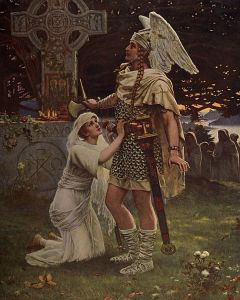
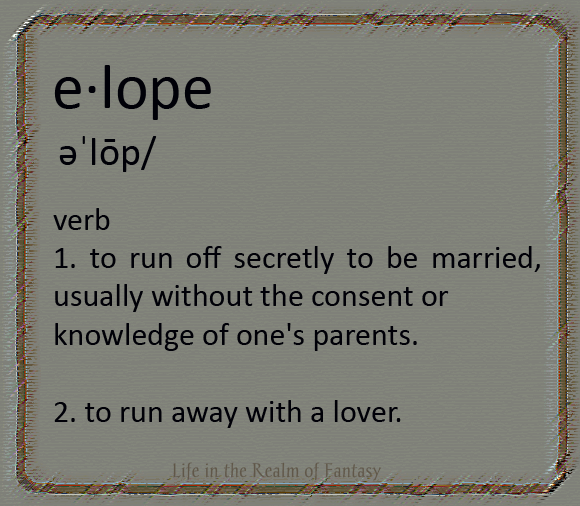
elopement memeThe year was 1814, and Mary Wollstonecraft Godwin was 17–young, even by the standards of the day–when she ran away with a married man. That man was Percy Bysshe Shelley, who was (until he eloped with Mary) a close friend of her father.

Mary was the daughter of the famous political philosopher William Godwin, and her mother was the pioneering philosopher and feminist, Mary Wollstonecraft.  Her father was the first modern proponent of anarchism, and (until recently) her late mother’s tempestuous history overshadowed her brilliant work as a writer, philosopher, and advocate of women’s rights. Her parents were Free Thinkers, and were notorious in their own rights.

Percy was the eldest legitimate son of Sir Timothy Shelley, 2nd Baronet of Castle Goring. Sir Timothy had himself produced an illegitimate child, which (in Percy’s eyes) made his  pious horror at his son’s transgressions seem rather hypocritical.

William Godwin was frequently in danger of going to debtors’ prison as his businesses regularly failed.  Good friends always rescued him, and long before beginning his relationship with Mary, Percy Shelley had agreed to bail the man he admired out of debt.

After their elopement, the enraged William Godwin refused to see them, but still demanded money to be given to him under another name, to avoid scandal. Their assertions that marriage was a matter of mind and God rather than the law fell on primly deaf ears.

640px-RothwellMaryShelleyMary viewed her father’s reaction to their elopement as both sanctimonious and motivated by greed. It does appear that way, in view of his past and his political views, and also in view of the liberal way in which he had raised her after her mother’s death.

But beyond Sir Timothy Shelley and William Godwin’s hypocrisy, the couple faced intense censure from society at large, and paid a heavy price for the choices they had made.

After the suicide of Percy’s 1st wife, Harriet, and his subsequent marriage to Mary, the Chancery Court ruled Percy Shelley morally unfit to have custody of his children, despite Mary’s desire to raise them. In what was a well-publicized case, Percy’s children were placed with a clergyman’s family.

Mary ShelleyDespite having her personal business widely discussed and being snubbed by people she had believed to be her friends, Mary refused to behave as an outcast, writing and living as normal a life as she was able. Forced to live abroad to escape creditors, Mary and Percy found their exile from England hard to bear, despite their famous (and infamous) circle of friends who were exiled for much the same reasons.

When faced with the suicide of her sister Fanny and the deaths of three of her children, Mary suffered a deep depression. She retreated into her writing, and her husband retreated into confusion. Nevertheless, in public she carried herself with grace and dignity, no matter what was said or implied about her. During that time, Percy wrote:

My dearest Mary, wherefore hast thou gone, And left me in this dreary world alone? Thy form is here indeed—a lovely one—But thou art fled, gone down a dreary road That leads to Sorrow’s most obscure abode. For thine own sake I cannot follow thee. Do thou return for mine.

frankenstein (1)At the age of twenty-two she found herself a widow, and spent the rest of her life raising her only living son, writing, and getting Percy’s works published. Her life with Percy had been a struggle in many ways, far beyond the obvious, but no man ever captivated her more than he had. The wild passion she felt for him was as much spiritual as it was carnal, a true meeting of minds.

They were young, and although he loved her body and soul, he was not entirely faithful to her, and didn’t hide his infidelity from her. They lived beyond their means and were hounded by creditors, which could have meant debtor’s prison. In Mary’s eyes, that lack of security was far more difficult to endure than sly comments about her perceived bad behavior.

Mary Shelley was brave in what she published, and wrote her political thoughts into her novels and essays boldly, despite women having no right to voice their ideas. She believed in the Enlightenment idea that “People can improve society through the responsible exercise of political power,” but she also feared that the reckless exercise of power would lead to chaos, and her works reflect this belief.

the last man, shelleyHer works reveal her as much less optimistic than her radical parents, Godwin and Wollstonecraft. She doubted her father’s theory that humanity could eventually be perfected.

Even her early works are critical of the way in which 18th-century thinkers, such as her parents, believed radical political changes could be brought about. It has been pointed out that the creature in Frankenstein reads books associated with radical ideals, but the education he gains from them is ultimately useless.

Mary supported her son with her writing, and a small stipend she managed to squeeze from Sir Timothy, who wrote into his will that she should pay it back when her son inherited the title and estate. She was never accepted or acknowledged by her father-in-law, although her son did live to inherit his title and estate.

How people find the strength to hold their heads up in the face of public humiliation, personal tragedy, and intense social ostracism is, to me, a far more intriguing story than their successes. Anyone can ride the wave of glory–it takes a person of great character to surf the shoals of public disaster with grace and step on shore with confidence and their dignity intact.

6 Comments

Filed under Literature, Uncategorized, writing

#amwriting: the external eye

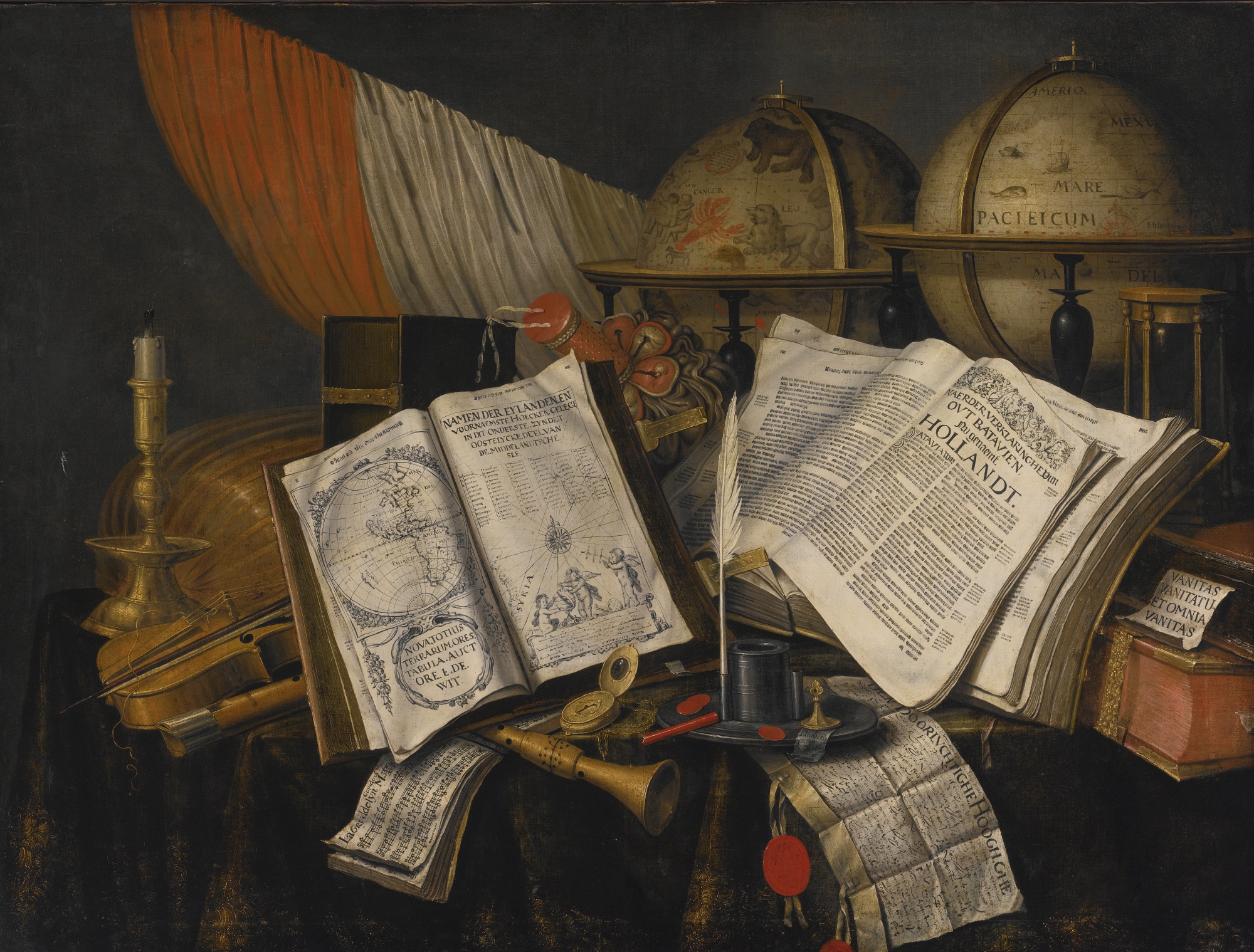
EDWAERT_COLLIER_VANITAS_STILL_LIFEMore people than ever are writing books. In today’s marketplace, every author must find ways to get his/her manuscript in as perfect shape as they can before they begin shopping for agents and publishers.  At every seminar I attend this one fact is stressed most firmly.

What this tells me is that agents and editors at the large publishing houses see so many submissions on a daily basis that they don’t have time to do more than look at the first page or two before deciding to look further. If it is not formatted to industry standard, or if it is a rough draft, it goes into the trash, based on that quick glance. (See my post, How to Format Your Manuscript for Submission.)

Therefore, we make our manuscript as good as we can before we send it off to an agent or a large publishing house, or take the plunge and self publish. To this end, during the second or third draft we may consult what has become known as the beta-reader, volunteers who read our work, knowing it is in its infancy.

You can find many good freelance editors who offer this service, but I do recommend you ask them what it involves and what kind of report you will get back before you commit your funds to it. I can also recommend Critters Writers Workshop, a free author-driven service. Or you may have a spouse or good friends who will help you with this.

A word to the wise: Editors and other authors make terrible beta readers, because it is their nature to dismantle the manuscript and tell you how to fix it.

But what if you don’t have the luxury of a reader who both likes the kind of work you write and who also is willing to spend the time reading your work?  Consider asking them to read a selected chapter, instead of asking them to read the whole thing.

I suggest this, because reading the rough-draft of an entire novel is a huge commitment to ask of someone. It is not reading for pleasure, although we hope they enjoy it.

Give your reader this list of questions, and ask him/her to please answer them, explaining that you can’t continue until you hear back from them:

  1. Were the characters likable?
  2. Where did the plot bog down and get boring?
  3. Were there any places that were confusing?
  4. What did the reader like? What did they dislike?
  5. What do they think will happen next?

You need a reader who reads your genre, reads fairly quickly, and won’t devolve into an editor.  Questions two and three are the most important: Where is it boring, and where is it confusing? Having it read in small chunks will give you a good idea of what you need to do with the ms as a whole.

I usually send my  manuscripts  in short pieces to my trusted crew when I need to know if I am on the right track. But the final ms in the Tower of Bones series is different. I hope to have it ready for publication by spring, so I have taken the plunge and sent Valley of Sorrows to David Cantrell for a structural edit. Dave and I have worked together on many projects.

Structural editing is digging deep. This is a tricky novel, because it tells two separate but entwined story-lines, Edwin’s and Lourdan’s, so I need an interested, but surgical, eye on it before I begin the final revisions. Dave has read Tower of Bones, and knows the world, the magic system, and the characters.

I hear you asking, what if he asks me to cut something I think is an integral part of the piece? I will have to decide what to do after I:

  • Re-read the section in question: Is it garbled? Was my intention not clear when I wrote it?
  • Look at the section in the context of the entire manuscript: Will losing this section change the story in a way that I don’t want? Or will cutting that section allow a more important point to shine?
  • Decide how married I am to that plot point. Sometimes divorce is the only answer.

In my own work I have discovered that if a passage seems flawed, but I can’t identify what is wrong with it, my eye wants to skip it.

But another person will see the flaw, and they will show me what is wrong there. That is why I rely on the external eye, and work with a structural editor.

4 Comments

Filed under Literature, Publishing, Uncategorized, writer, writing

#amwriting: Rothfuss and Gaiman, crafting good prose

Stardust, Neil GaimanSome fantasy qualifies as literary fiction because of the way in which the story is delivered.

One example of what I think of as literary fantasy is Neil Gaiman’s Stardust. In the very first sentence of chapter one, Gaiman commits the most heinous crime an author can commit, according to those critique groups armed with a little dangerous knowledge:

Quote: There once was a young man who wished to gain his hearts desire. 

And then, to make matters worse, he throws out a bit of background:

  1. Our story starts in the village of Wall, a tiny town about a night’s drive from London. A giant wall stands next to the town, giving it its name.
  2. There’s only one spot to pass through this huge grey rock wall, and it’s always guarded by two villagers at a time, and they are vigilant at their task.
  3. This is peculiar, because all one can see through the break in the wall is meadows and trees. It looks as if nothing frightening or strange could be happening there, but no one is allowed to go through the break in the wall.
  4. The guards only take a break from the wall once every nine years, on May Day, when a fair comes to the meadow

omg! Did he really do that? What was he thinking, starting a fantasy novel with a TELLING, PASSIVE sentence followed by an info dump?  To answer your question, he thought he was offering up a good story, and guess what? HE WAS!

And he did it with beautiful, immersive prose.

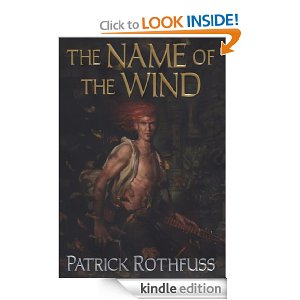
name of the wind -patrick rothfussWho else writes great prose? Patrick Rothfuss, for one. Take the first lines of The Name of the Wind. 

Quote:  It was night again. The Waystone Inn lay in silence, and it was a silence of three parts.

Rothfuss then goes on to commit what some purists (aka trolls) consider a heinous crime–he DESCRIBES THE SILENCE. He does this on the first page and guess what–the reader is sucked into the story and has no desire to leave.  To compound that crime, the story is a story within a story, told to a chronicler, and what most would use as the prologue actually comes after the first chapter, in chapter eight:

(quote) If this story is to be something resembling my book of deeds, we must begin at the beginning. At the heart of who I truly am. To do this, you must remember that before I was anything else, I was one of the Edema Ruh.

When we write, we are writing because we have a story to tell. (Yes, I said tell). To that end, every word must count, every idea must be conveyed with meaningful words, and sometimes you can just have a little fun with it.

In the opening lines of Gaiman’s Stardust, nothing unimportant is mentioned although the prose meanders in a literary way. Yes, he takes the long way, but the attitudes, mores, and personalities of Tristam’s village are conveyed with humor and the journey is the best part of this fairytale. He never devolves into purple prose.

The Elements of Style calls “Purple Prose” “hard to digest, generally unwholesome, and sometimes nauseating.”  To be fair, purple prose is subjective and each reader has a different level of tolerance for it, but it is something we definitely don’t want. What do you want to convey? Choose your words based on what you want the reader to see and feel:

  • Plain: He set the mug down. (conveys action–what’s going to happen next?)
  • Somewhere in the middle: He eased the tankard onto the table. (conveys a medieval atmosphere–what’s going to happen next?)
  • Bleah: Without haste, the tall, blond barbarian set the immense, pewter, ale-filled cup with a wooden handle onto the stained surface of the rough, wooden table. (conveys nausea–don’t care what happens next.)

Of course you are not going to devolve into sticky-sweet goo in your attempts to show the mood and atmosphere. But please, if I may use a cliché here, don’t “throw  the baby out with the bathwater.” Lean prose with well chosen imagery will express your ideas in such a way that the reader can hang their imagination on your words.

In direct contrast to Gaiman’s lighthearted opening prose in Stardust, the opening lines of Rothfuss’ The Name of the Wind, are dark and heavy with portent.  Rothfuss sets the mood, and conveys the subtle power kept restrained by Kote/Kvote, and he uses this atmosphere to drive the tale.

Both Rothfuss and Gaiman use words chosen for their imagery. Gaiman’s story is told with sardonic humor, which makes it all the darker, and Rothfuss’ prose evokes the dark of nightmares. They write with widely different styles, but both books are dark, both books are fantasy, and both books moved me.

Both authors write so well that the internet is rife with haters and trolls who can’t wait to trash their next book. THAT, sadly, is the mark of success, or genius, in today’s world of fanatics in dark rooms, armed with a rigid idea of what fantasy should be, and waging war via the internet on authors who dare to write outside those boundaries .

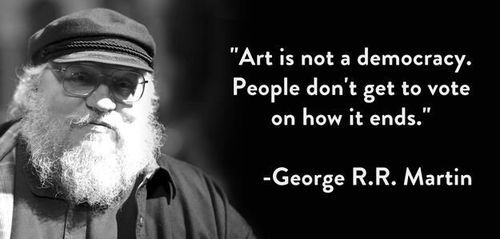
GRRM Meme 3Write from your heart, and dare to write what moves you. Think about the rush of “yeah, this is it!” that you get when you read a piece that takes you out of this world and changes your life for a few brief moments. That author knows something about the craft, or you would not have been so moved by it.

Study the prose of those whose work shocks, rocks, and shakes you. See how they craft the sentences, and form the moods and emotions that drive the plot. Learn from them how to show the true character of a protagonist, or the smell of an alley by the wharves. Read, and then apply what you’ve learned from the masters to your own work.

4 Comments

Filed under Fantasy, Humor, Literature, Publishing, writer, writing

5 Books: Society’s Mirror

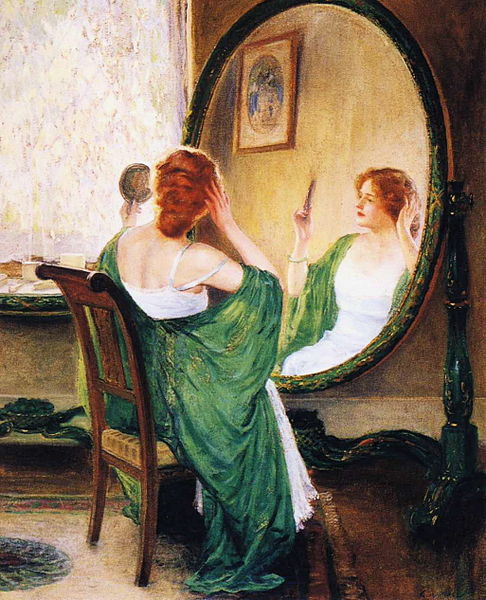
The Green Mirror, by Guy Rose PD|80 via Wikimedia Commons

The Green Mirror, by Guy Rose PD|80 via Wikimedia Commons

Most authors do not sit down and say “I am going to write a novel and this will be the message.” However, as we progress in writing a given work, certain social themes that are important to us at that moment will emerge.

Most of the time social themes will emerge as a natural outgrowth of the creative process. That particular story may have begun as a a “what if” moment, which, during the process of writing, becomes a powerful story.

We don’t sit down to write with a particular moral or political agenda in mind, but our own values will come out in who the characters we create are, how they perceive their world, and in the society we create as the backdrop for them.

Some of the most gripping works of modern literature occurred when an author was particularly moved by a situation presented by the society in which he lived:

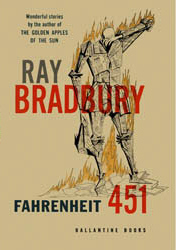
Fahrenheit_451_1st_ed_coverFahrenheit 451 is a dystopian novel by Ray Bradbury published in 1953, the year I was born. It is regarded as one of his best works. The novel presents a future American society where books are outlawed and any that are found are confiscated and burned. The title refers to the temperature that Bradbury believed was the ignition point of paper.

Besides having an incredible cast of characters set in compelling situations, the novel discusses and exposes the role of book burning in suppressing dissenting ideas. In a 1956 radio interview, Bradbury stated that he wrote Fahrenheit 451 because of his concerns at the time (during the McCarthy era) about the threat of book burning in the United States.

Fahrenheit 451 remains a classic, because the societal pressures and fringe threats that inspired Bradbury to write this novel still exist, perhaps even more so than during the McCarthy era.

Germinal_first_edition_coverGerminal  (1885) is the thirteenth novel in Émile Zola‘s twenty-volume series Les Rougon-Macquart. (From Wikipedia:) Often considered Zola’s masterpiece and one of the most significant novels in the French tradition, this novel is an uncompromisingly harsh and realistic story of a coal miners’ strike in northern France in the 1860s. It has been published and translated in over one hundred countries and has additionally inspired five film adaptations and two television productions.

Germinal is a brutal depiction of the poverty and wretchedness of a mining community in northern France under the second empire. At the center of the novel is Etienne Lantier, a handsome 21 year-old mechanic, intelligent but with little education and a dangerous predisposition to murderous, alcoholic rage. Germinal tells the parallel story of Etienne’s refusal to accept what he appears destined to become, and of the miners’ difficult decision to strike in order to fight for a better standard of life.

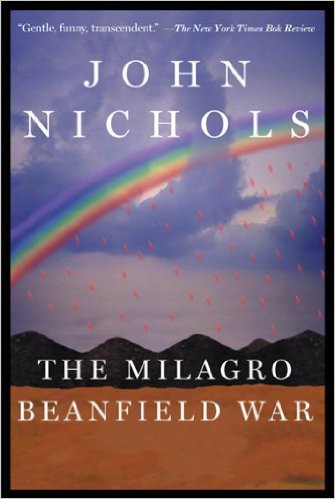
milagro beanfield warThe Milagro Beanfield War, 1974, is the first book in John Nichols New Mexico Trilogy. The book opens when Joe Mondragon, a feisty hustler with a talent for trouble, slammed his battered pickup to a stop, tugged on his gumboots, and marched into the arid patch of ground. Carefully (and also illegally), he tapped into the main irrigation channel. And so began-though few knew it at the time-the Milagro beanfield war.

But like everything else in the dirt-poor town of Milagro, it would be a patchwork war, fought more by tactical retreats than by battlefield victories. Gradually, the small farmers and sheep-men begin to rally to Joe’s beanfield as the symbol of their lost rights and their lost lands. And downstate in the capital, the Anglo water barons and power brokers huddle in urgent conference, intent on destroying that symbol before it destroys their multi-million-dollar land-development schemes. The tale of Milagro’s rising is wildly comic and lovingly tender, a vivid portrayal of a town that, half-stumbling and partly prodded, gropes its way toward its own stubborn salvation.

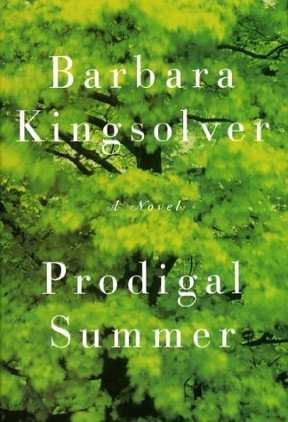
ProdigalSummerProdigal Summer (2000) is the fifth novel by American author, Barbara Kingsolver. It is a hymn to wildness that celebrates the prodigal spirit of human nature, and of nature itself. It weaves together three stories of human love within a larger tapestry of lives amid the mountains and farms of southern Appalachia. Over the course of one humid summer, this novel’s intriguing protagonists face disparate predicaments but find connections to one another and to the flora and fauna with which they necessarily share a place.

The narrative follows Deanna, a solitary woman working as a park ranger, Lusa, a widowed farmwife at odds with her late husband’s tight-knit family, and Garnett, an old man who dreams of restoring the lineage of the extinct American Chestnut tree.

Kingsolver’s extensive education in biology is on display in this book, laden with ecological concepts and biological facts. Her writing also exhibits her knowledge of rural Virginia, where she grew up.

The_Idiot_(book_cover)The Idiotfirst published serially in The Russian Messenger between 1868 and 1869. is a novel written by Fyodor Dostoyevsky. (From Wikipedia:) The 26-year-old Prince Lev Nikolayevich Myshkin returns to Russia after spending several years at a Swiss sanatorium. Scorned by the society of Saint Petersburg for his trusting nature and naiveté, he finds himself at the center of a struggle between a beautiful kept woman and a virtuous and pretty young girl, both of whom win his affection. Unfortunately, Myshkin’s very goodness precipitates disaster, leaving the impression that, in a world obsessed with money, power, and sexual conquest, a sanatorium may be the only place for a saint.

Elizabeth Dalton wrote that in The Idiot, more than in any other of Dostoevsky’s works, we are shown the actual experience itself of one mind wrestling with the various tensions of life – rather than simply dwelling on intellectual speculation, as we see in Crime and Punishment and Notes from Underground.

HouseofthesprirtsThe House of the Spirits (Spanish: La casa de los espíritus, 1982) is the debut novel of Isabel Allende. In one of the most important and beloved Latin American works of the twentieth century, Isabel Allende weaves a luminous tapestry of three generations of the Trueba family, revealing both triumphs and tragedies. Here is patriarch Esteban, whose wild desires and political machinations are tempered only by his love for his ethereal wife, Clara, a woman touched by an otherworldly hand. Their daughter, Blanca, whose forbidden love for a man Esteban has deemed unworthy infuriates her father, yet will produce his greatest joy: his granddaughter Alba, a beautiful, ambitious girl who will lead the family and their country into a revolutionary future.

The House of the Spirits is an enthralling saga that spans decades and lives, twining the personal and the political into an epic novel of love, magic, and fate.

>>><<<

These stories are powerful because of the characters that were created when that “what if” moment occurred, and because of the societal pressure under which their stories unfold. They are considered among  the greatest works in modern literature, and all of them are gripping, moving works of fiction, heavily laced with the social reality of the authors’ times.

All of these books are considered masterpieces, and each one struck a chord one way or another with me, although I confess, although each made a large impression on me, I have not reread most of them in recent years.

All of these books are available at your local library, or very reasonably priced at Amazon.com.

2 Comments

Filed under Books, Literature, Publishing, writer, writing

The clock, groceries, and a new thesaurus

Jetsonslogo640x480At times the world seems to be conspiring against me.  I have to drop what I’m doing, load up the van, and head up to town for something as mundane as groceries. Food should order itself, deliver itself, and put itself away.

But no. Where is my android butler and why is he not doing the shopping? Just like the flying car I was promised when I was child, my android butler is in the Jetsons‘ style garage of my imagination.

But sometimes I get two or three pages of writing done in the 20 or 30 minutes before I have to leave the house for an appointment. There is something about the pressure of knowing I will have to quit at a certain time that forces me to be more productive than I would ordinarily be.

Why is this? When I am pressed for time I use every second to get those ideas out of my head. I don’t stop and research on the good, old, time-wasting internet, and I don’t worry about whether or not I am overusing a word in the narrative. This is a rough draft–all of that can be ironed out when I have more leisure–the next day usually.

clockSome of my best ideas have come about under a time crunch.  Normally when I am writing on a stream-of-consciousness level, I can key about fifty words a minute–paltry compared to today’s young-uns who grew up keying their homework rather than writing it in cursive.

I do admit that just because I can key those words does not mean they will all make sense, or be worth reading. But that again is why we are driven to look at what we just wrote the day after we wrote it–did it say what I meant? How many times did I use the word “noose” in that particular chapter and where am I going to find six different alternatives for such a unique word?

Apricot poodle puppy portrait. Isolated on a white background (studio shoot), via Google Images

A little rephrasing here, cutting there, and voila! It looks like a poodle!

It’s a jungle in my head sometimes, and my ancient  student edition of Roget’s Thesaurus is my friend. But neither the old student version of the thesaurus from 40 years ago, nor the modern, online version is cutting it for me right now.

I need more synonyms. Lots, and lots more!

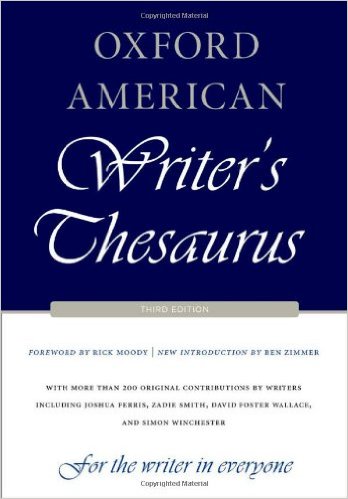
I have just now invested in a bigger, better, hardcover thesaurus. Thus I now have the Oxford American Writers’ Thesaurus winging it’s way to my doorstep. I expect the drone to drop it on Saturday.

ozford american writers thesaurusSome references have to be in hard-copy–such as The Chicago Manual of Style, which is the most comprehensive style guide geared for writers of essays, fiction, and nonfiction. Strunk and White’s Elements of Style is a good beginner style guide, but I found it hard to navigate and couldn’t always find what I wanted. The Chicago Manual of Style is written specifically for writers, editors and publishers and is the industry standard.

Just as a side note–if you are using AP style you are writing for the newspaper, not for literature–two widely different styles with radically different requirements. AP style was developed for expediency in the newspaper industry and is not suitable for novels or for business correspondence. For business, you want to use the Gregg Reference Manual.

Eternal_clock

Eternal Clock, Robbert van der Steeg CC|2.0 via Wikimedia Commons

All in all, I like the way being forced to produce words in a short time helps me lay down a rough draft. But being short on time is big pain when I am trying to revise and iron out stubborn, repetitive wrinkles in a narrative.

Summer is nearly over, and with that comes the long, dark days of the northern winter. I won’t be going as many places (I hope). But with the advent of September I will be spending longer hours editing for clients. My personal productivity will drop in regard to my own work, but I will still find time to write.

And I will also find time to revise. I am nearly at the end of two books written for the World of Neveyah series. Valley of Sorrows will wind up the Tower of Bones series–it is completed and is in revisions. The Wayward Son is nearly complete. While The Wayward Son is not actually a part of the Tower of Bones series, much of it does run concurrently with Forbidden Road, as it is the story of John Farmer’s redemption.

Today will be busy–groceries can wait until tomorrow. Today I am working as hard as I can, trying to get Valley of Sorrows ready to be edited, so that the ToB series will be complete, and also to get John’s story out there too.

2 Comments

Filed under Books, Humor, Literature, Publishing, writer, writing