Category Archives: #FineArtFriday

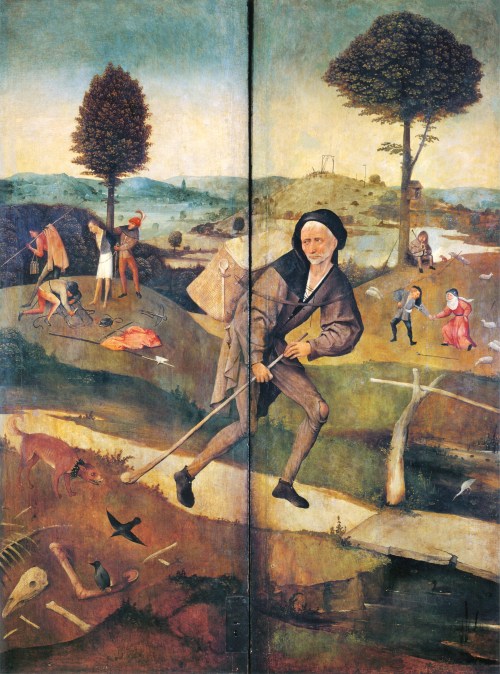
#FineArtFriday: The Pedlar, closed state of The Hay Wain by Hieronymus Bosch ca. 1500

The_Pedlar,_closed_state_of_The_Hay_Wain_by_Hieronymus_BoschArtist: Hieronymus Bosch  (circa 1450–1516)

Title: The Pedlar, Part of The Haywain Tryptich

Genre: religious art Edit this at Wikidata

Date: circa 1500

Medium: oil on panel

Dimensions: height: 147.1 cm (57.9 in)

Collection: Museo del Prado

What I like about this painting:

Hieronymus Bosch tells a story in this scene that is the cover of an altar piece. We see a wayfarer walking a path that winds through dangerous territory. Thieves and murderers and carnal temptations tempt him to stop a while, but he keeps walking.

The hound of hell snaps at his heels as he keeps to the path and he shoves it behind him as he passes the bones of the fallen.

Bosch’s most famous altar pieces were quite graphic, gory even, depicting the prevailing 15th century idea of Hell. He painted his vision of what a sinner would face if one didn’t keep to the straight and narrow path of morality and righteousness.

About this painting, via Wikipedia:

The Haywain Triptych is a panel painting by Hieronymus Bosch, now in the Museo del Prado, Madrid, Spain. A date of around 1516 has been established by means of dendrochronological research. The central panel, signed “Jheronimus Bosch”, measures 135 cm × 200 cm (53 in × 79 in) and the wings measure 147 cm × 66 cm (58 in × 26 in). The outside shutters feature a version of Bosch’s The Wayfarer.

The exterior of the shutters, like most contemporary Netherlandish triptychs, was also painted, although in this case Bosch used full colors instead of the usual grisaille. When closed, they form a single scene depicting a wayfarer. Around him is a series of miniatures including the robbery of another wayfarer and a hanged man. The man uses a stick to repel a dog.

According to the most recent interpretations, this figure may represent the man who follows his road in spite of the temptation of sins (such as lust, perhaps symbolized by the two dancing shepherds) and the evil acts occurring around him.[1]

About the Artist, via Wikipedia:

Little is known of Bosch’s life, though there are some records. He spent most of it in the town of ‘s-Hertogenbosch, where he was born in his grandfather’s house. The roots of his forefathers are in Nijmegen and Aachen (which is visible in his surname: Van Aken). His pessimistic fantastical style cast a wide influence on northern art of the 16th century, with Pieter Bruegel the Elder being his best-known follower.

Today, Bosch is seen as a highly individualistic painter with deep insight into humanity’s desires and deepest fears. Attribution has been especially difficult; today only about 25 paintings are confidently given to his hand along with eight drawings. About another half-dozen paintings are confidently attributed to his workshop. His most acclaimed works consist of a few triptych altarpieces, including The Garden of Earthly Delights. [2]


Credits and Attributions:

IMAGE: Wikimedia Commons contributors, “File:The Pedlar, closed state of The Hay Wain by Hieronymus Bosch.jpg,” Wikimedia Commons, https://commons.wikimedia.org/w/index.php?title=File:The_Pedlar,_closed_state_of_The_Hay_Wain_by_Hieronymus_Bosch.jpg&oldid=618864212 (accessed May 4, 2024).

[1] Wikipedia contributors, “The Haywain Triptych,” Wikipedia, The Free Encyclopedia, https://en.wikipedia.org/w/index.php?title=The_Haywain_Triptych&oldid=1221796985 (accessed May 4, 2024).

[2] Wikipedia contributors, “Hieronymus Bosch,” Wikipedia, The Free Encyclopedia, https://en.wikipedia.org/w/index.php?title=Hieronymus_Bosch&oldid=1215179336 (accessed May 4, 2024).

2 Comments

Filed under #FineArtFriday

#FineArtFriday: Bavarian Landscape by Albert Bierstadt

Bierstadt_Albert_Bavarian_LandscapeArtist: Albert Bierstadt  (1830–1902)

Title: Bavarian Landscape

Genre: landscape art

Date: possibly between 1853 and 1857

What I love about this painting:

Albert Bierstadt is one of my favorite artists. He loved the power of nature. His colors are strong, and he employs contrast to good effect. In this painting of cattle in a field, he manages to make even the simplest scene feel epic.

This is one of his earlier works, but the sky is pure Bierstadt—immense, powerful, the vaults of heaven reigning over the world below.

We see a lush, fertile farm with healthy cattle in the foreground. The dark clouds in the distance tell us a summer storm looms, but for us, the sun still shines overhead.

About the artist, via Wikipedia:

Albert Bierstadt (January 7, 1830 – February 18, 1902) was a German American painter best known for his lavish, sweeping landscapes of the American West. He joined several journeys of the Westward Expansion to paint the scenes. He was not the first artist to record the sites, but he was the foremost painter of them for the remainder of the 19th century.

Bierstadt was born in Prussia, but his family moved to the United States when he was one year old. He returned to study painting for several years in Düsseldorf. He became part of the second generation of the Hudson River School in New York, an informal group of like-minded painters who started painting along the Hudson River. Their style was based on carefully detailed paintings with romantic, almost glowing lighting, sometimes called luminism. Bierstadt was an important interpreter of the western landscape, and he is also grouped with the Rocky Mountain School.

In 1851, Bierstadt began to paint in oils. He returned to Germany in 1853 and studied painting for several years in Düsseldorf with members of its informal school of painting. After returning to New Bedford in 1857, he taught drawing and painting briefly before devoting himself full-time to painting.

Bierstadt’s popularity in the U.S. remained strong during his European tour. The publicity generated by his Yosemite Valley paintings in 1868 led a number of explorers to request his presence as part of their westward expeditions. The Atchison, Topeka, and Santa Fe Railroad also commissioned him to visit and paint the Grand Canyon and surrounding region.

Despite his popular success, Bierstadt was criticized by some contemporaries for the romanticism evident in his choice of subjects and for his use of light, which they found excessive.

Some critics objected to Bierstadt’s paintings of Native Americans based on their belief that including Indigenous Americans “marred” the “impression of solitary grandeur.”


Credits and Attributions:

IMAGE: Wikimedia Commons contributors, “File:Bierstadt Albert Bavarian Landscape.jpg,” Wikimedia Commons, https://commons.wikimedia.org/w/index.php?title=File:Bierstadt_Albert_Bavarian_Landscape.jpg&oldid=823443562 (accessed May 2, 2024).

Comments Off on #FineArtFriday: Bavarian Landscape by Albert Bierstadt

Filed under #FineArtFriday

#FineArtFriday – Children’s Games by Pieter Bruegel the Elder

Pieter_Bruegel_the_Elder_-_Children’s_Games_-_Google_Art_ProjectTitle: Children’s Games

Artist: Pieter Bruegel the Elder

Year: 1560

Type: Oil on panel

Dimensions: 118 cm × 161 cm (46 in × 63 in)

Location: Kunsthistorisches Museum, Vienna

What I love about this image:

Pieter Brugel the Elder was one of my first influences in the world of art appreciation. I love the chaos, the raucous jumble of humanity that Brugel always brought to a scene. It is as wild and noisy as his more famous composition, The Wedding Dance. Children have taken over the city and everything is fair game. Brugel’s depiction of village children and their play offered him an opportunity to shine a small light on the hubris and arrogance of mankind, using allegory and misdirection.

About this painting via Wikipedia:

The entire composition is full of children playing a wide variety of games. Over 90 different games that were played by children at the time have been identified.

The artist’s intention for this work is more serious than simply to compile an illustrated encyclopaedia of children’s games, though some eighty particular games have been identified. Bruegel shows the children absorbed in their games with the seriousness displayed by adults in their apparently more important pursuits. His moral is that in the mind of God, children’s games possess as much significance as the activities of their parents. This idea was a familiar one in contemporary literature: in an anonymous Flemish poem published in Antwerp in 1530 by Jan van Doesborch, mankind is compared to children who are entirely absorbed in their foolish games and concerns. [1]

About the Artist, via Wikipedia:

Pieter Bruegel (also Brueghel or Breughelthe Elder c. 1525–1530 – 9 September 1569) was the most significant artist of Dutch and Flemish Renaissance painting, a painter and printmaker from Brabant, known for his landscapes and peasant scenes (so-called genre painting); he was a pioneer in making both types of subject the focus in large paintings.

He was a formative influence on Dutch Golden Age painting and later painting in general in his innovative choices of subject matter, as one of the first generation of artists to grow up when religious subjects had ceased to be the natural subject matter of painting. He also painted no portraits, the other mainstay of Netherlandish art. After his training and travels to Italy, he returned in 1555 to settle in Antwerp, where he worked mainly as a prolific designer of prints for the leading publisher of the day. Only towards the end of the decade did he switch to make painting his main medium, and all his famous paintings come from the following period of little more than a decade before his early death, when he was probably in his early forties, and at the height of his powers.

Around 1563, Bruegel moved from Antwerp to Brussels, where he married Mayken Coecke, the daughter of the painter Pieter Coecke van Aelst and Mayken Verhulst. As registered in the archives of the Cathedral of Antwerp, their deposition for marriage was registered 25 July 1563. The marriage itself was concluded in the Chapel Church, Brussels in 1563. 

Pieter the Elder had two sons: Pieter Brueghel the Younger and Jan Brueghel the Elder (both kept their name as Brueghel). Their grandmother, Mayken Verhulst, trained the sons because “the Elder” died when both were very small children. The older brother, Pieter Brueghel copied his father’s style and compositions with competence and considerable commercial success. Jan was much more original, and very versatile. He was an important figure in the transition to the Baroque style in Flemish Baroque painting and Dutch Golden Age painting in a number of its genres. He was often a collaborator with other leading artists, including with Peter Paul Rubens on many works including the Allegory of Sight.

Other members of the family include Jan van Kessel the Elder (grandson of Jan Brueghel the Elder) and Jan van Kessel the Younger. Through David Teniers the Younger, son-in-law of Jan Brueghel the Elder, the family is also related to the whole Teniers family of painters and the Quellinus family of painters and sculptors, through the marriage of Jan-Erasmus Quellinus to Cornelia, daughter of David Teniers the Younger. [2]


Credits and Attributions:

IMAGE:  Children’s Games, Wikimedia Commons contributors, “File:Pieter Bruegel the Elder – Children’s Games – Google Art Project.jpg,” Wikimedia Commons, https://commons.wikimedia.org/w/index.php?title=File:Pieter_Bruegel_the_Elder_-_Children%E2%80%99s_Games_-_Google_Art_Project.jpg&oldid=725602746 (accessed April 26, 2024).

[1] Wikipedia contributors, “Children’s Games (Bruegel),” Wikipedia, The Free Encyclopedia, https://en.wikipedia.org/w/index.php?title=Children%27s_Games_(Bruegel)&oldid=1198935116 (accessed April 26, 2024).

[2] Wikipedia contributors, “Pieter Bruegel the Elder,” Wikipedia, The Free Encyclopedia, https://en.wikipedia.org/w/index.php?title=Pieter_Bruegel_the_Elder&oldid=1218696694 (accessed April 26, 2024).

1 Comment

Filed under #FineArtFriday

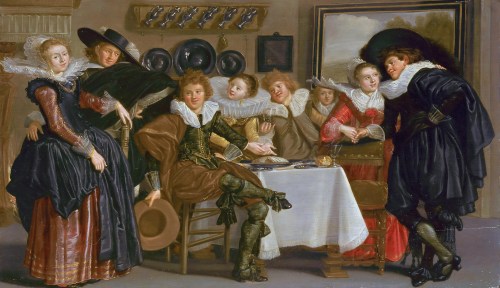
#FineArtFriday: a second look at Merry Company by Dirck Hals 1635

Vrolijke gezelschap

Merry company *oil on panel *30 x 51 cm *signed : D Hals 1635

Artist: Dirck Hals (1591–1656)

Title: Merry Company

Date: 1635

Medium: oil on panel

Dimensions: height: 30 cm (11.8 in); width: 51.1 cm (20.1 in)

Collection: Mauritshuis

What I love about this painting:

This group portrait tells us a story. Perhaps we are celebrating the engagement of the young couple on the far right—a fashionably, yet modestly, dressed young woman and a gallant young man holding hands and gazing at each other.

The hostess, in the center, looks up and greets her guests who have entered to the left of us. She gestures to the food on the table, inviting them to sit. Are they the future in-laws?

The host looks directly at us, the viewer. He greets us as his guests and he too gestures to the table—join us! Sit, eat, and we’ll have an evening to remember. A single crystal wine glass shows us that wine is being served but companionship and food are what the party is really about. We are here to meet and get to know each other.

An engagement is a reason to gather and celebrate—so let us join this merry company and spend an evening with friends, partying like it’s 1635.

About the setting of this painting:

Dirck Hals has given us the image of friends partying in someone’s home. This is clearly not set in a tavern, as the walls are clean, freshly plastered and painted, and the fireplace at the far left has an ornate mantel. It is for heating the room only, not for cooking. The mantel’s aesthetics are part of the room’s decor.

The scene is set in a dining room. We see six pewter tankards proudly displayed on the wall above a sideboard, along with large pewter platters, signs that this is an intimate family room. We know they are pewter because of the dark bluish color of the metal. These are serving vessels every home needed in the 17th century, but only the wealthier middle-class could afford pewter.

And if you could afford to have a separate room just for dining, you would have your drinking vessels and platters displayed above a sideboard in the manner we see here.

In the background to the right, a fine, large landscape painting also indicates a prosperous home.

Everyone is dressed in their best clothes. The modest yet stylish dress of the guests also point to a domestic scene rather than a tavern. Their garments are made from expensive fabrics, silks and satins, and they wear the immense ruffs of crisp white lace that only the upper classes could afford. These are prosperous people, traders in cloth perhaps—but no matter what they trade, they are gathered to celebrate something, and we have been invited to join them.

Taverns and the poorer classes had either wooden tankards and bowls or fired clay mugs and platters. If they had an object made of pewter, it would be put away for safekeeping. The innkeepers and owners of public houses wouldn’t keep tankards where they could be knocked down or stolen.

About the Artist, Via Wikipedia:

Dirck Hals (19 March 1591 – 17 May 1656), born at Haarlem, was a Dutch Golden Age painter of merry company scenes, festivals and ballroom scenes. He played a role in the development of these types of genre painting. He was somewhat influenced by his elder brother Frans Hals but painted few portraits.

The Haarlem writer Samuel Ampzing mentions both brothers in his Praise of Haarlem with a poem stating that both brothers were exceptional; Frans painting his portraits “awake”, and Dirck painting his figures “purely”. [1]

About pewter, via Wikipedia:

Lidless mugs and lidded tankards may be the most familiar pewter artifacts from the late 17th and 18th centuries, although the metal was also used for many other items including porringers (shallow bowls), plates, dishes, basins, spoons, measures, flagons, communion cups, teapots, sugar bowls, beer steins (tankards), and cream jugs. In the early 19th century, changes in fashion caused a decline in the use of pewter flatware. At the same time, production increased of both cast and spun pewter tea sets, whale-oil lamps, candlesticks, and so on. Later in the century, pewter alloys were often used as a base metal for silver-plated objects. [2]


Credits and Attributions:

IMAGE: Merry Company by Dirck Hals, Public domain, via Wikimedia Commons (accessed December 29, 2022).

[1] Wikipedia contributors, “Dirck Hals,” Wikipedia, The Free Encyclopedia, Dirck Hals  (accessed December 29, 2022).

[2] Wikipedia contributors, “Pewter,” Wikipedia, The Free Encyclopedia, https://en.wikipedia.org/w/index.php?title=Pewter&oldid=1129247091 (accessed December 29, 2022).

Comments Off on #FineArtFriday: a second look at Merry Company by Dirck Hals 1635

Filed under #FineArtFriday, writing

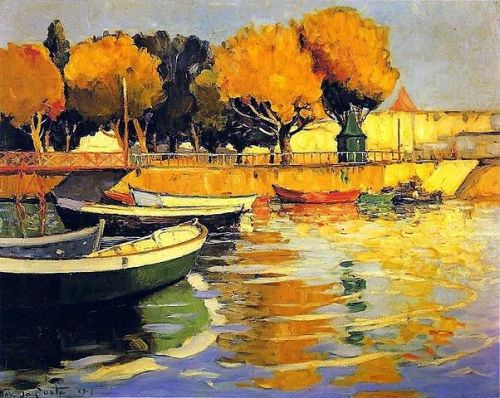
#FineArtFriday:Porto de Leixões by Mário Navarro da Costa 1901

602px-Mário_Navarro_da_Costa_-_Porto_de_Leixões,_1901Artist: Mário Navarro da Costa (1883-1931)

Description: Português: Porto de Leixões (English: Port of Leixões)

Dimensions: 81 x 100 cm

Date: 1901

Source/Photographer: Collection of the Pinacoteca do Estado de São Paulo

What I love about this painting:

I love the intensity of this scene. One can feel the heat of a Portuguese day at the end of summer, a moment lingering on the edge of autumn. He brings his native Brazilian passion for color to the composition, with vibrant hues and strong visual texture.

More than a century after da Costa painted these humble fishing boats, Porto de Leixões is the largest port city in northern Portugal handling giant cargo vessels. The port boasts a 21st century  cruise ship terminal that is a visually stunning structure.

About the artist, via CoPilot GPT (source links included):

Mário Navarro da Costa (1883–1931) was a Brazilian painter and diplomat. He dedicated himself primarily to marine art and received private lessons from José Maria de Medeiros (1849–1925) and Rodolfo Amoedo (1857–1941) 1. His work falls within the realm of Impressionist and Modern painting. Over the years, his pieces have been offered at auction multiple times, with realized prices ranging from $596 to $2,630, depending on the size and medium of the artwork 2One notable work is “Barreiro Old Mills”, which achieved a record price of $2,630 at auction in 2019 2.


Credits and Attributions:

IMAGE: Wikimedia Commons contributors, “File:Mário Navarro da Costa – Porto de Leixões, 1901.jpg,” Wikimedia Commons, https://commons.wikimedia.org/w/index.php?title=File:M%C3%A1rio_Navarro_da_Costa_-_Porto_de_Leix%C3%B5es,_1901.jpg&oldid=841285378 (accessed April 11, 2024).

Comments Off on #FineArtFriday:Porto de Leixões by Mário Navarro da Costa 1901

Filed under #FineArtFriday

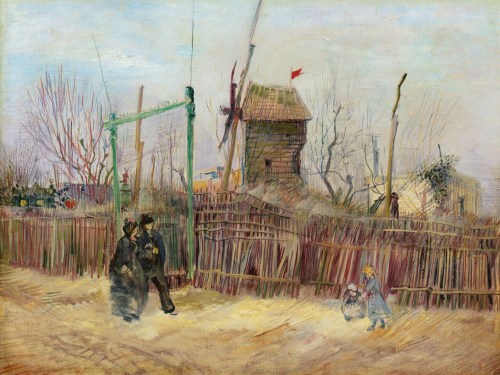
#FineArtFriday: Street Scene in Montmartre Vincent van Gogh 1887 (a second look)

Scène_de_Rue_à_MontmartreArtist: Vincent van Gogh (1853–1890)

Title: Street Scene in Montmartre

Genre: landscape art

Date: 1887

Medium: oil on canvas

Dimensions: height: 46.1 cm (18.1 in); width: 61.3 cm (24.1 in)

Collection: Private collection

What I love about this painting:

Street Scene in Montmartre is a relatively unknown painting by Vincent van Gogh, unknown because it has been held in private collections and not exhibited to the public. It was auctioned by Sotheby’s in 2021, and the image was posted to Wikimedia Commons courtesy of that auction.

The scene feels like an afternoon scene in winter, with a man and woman walking, and two children playing.

I wanted to take a second look at this painting because I’ve been reading a great deal about Vincent’s life. His art was an attempt to show the beauty he saw everywhere, especially in the most ordinary of things.

He paid particular attention to the visual construction and texture of the fence, and also to the tangle of garden behind. This is the smaller of two windmills featured in several more well-known paintings in the subset of paintings from Van Gogh’s Montmartre series.

While there are people walking down the dirt lane in this scene, they aren’t the focus. Instead, our eye is directed to the way the windmill rises over the ramshackle fence, neglected garden, and above it all, the flag bravely flying.

The dirt lane, the fence, the winter-barren garden, and the windmill falling to ruin beneath the cold sky offer us a glimpse into Vincent’s mood. He finds beauty in the textures of life, both visual and metaphysical – in the cycle of life, of youth growing old and aging to ruin. The flag flying in the breeze and the children playing offer us the hope of brighter days and new possibilities.

About this painting, via Wikipedia:

The Montmartre paintings are a group of works that Vincent van Gogh created in 1886 and 1887 of the Paris district of Montmartre while living there, at 54 Rue Lepic, with his brother Theo. Rather than capture urban settings in Paris, van Gogh preferred pastoral scenes, such as Montmartre and Asnières in the northwest suburbs. Of the two years in Paris, the work from 1886 often has the dark, somber tones of his early works from the Netherlands and Brussels. By the spring of 1887, van Gogh embraced use of color and light and created his own brushstroke techniques based upon Impressionism and Pointillism. The works in the series provide examples of his work during that period of time and the progression he made as an artist.

In van Gogh’s first year in Paris he painted rural areas around Montmartre, such as the butte and its windmills. The colors are somber and evoke a sense of his anxiety and loneliness.

The landscape and windmills around Montmartre were the source of inspiration for a number of van Gogh’s paintings. The Moulin de la Galette, still standing, is located near the apartment he shared with his brother. Built in 1622, it was originally called Blute-Fin and belonged to the Debray family in the 19th century. Van Gogh met artists such as Toulouse-Lautrec, Paul Signac and Paul Gauguin who inspired him to incorporate Impressionism into his artwork resulting in lighter, more colorful paintings.

Windmills also featured in some of van Gogh’s landscape paintings of Montmartre.

Montmartre, sitting on a butte overlooking Paris, was known for its bars, cafes, and dance-hall. It was also located on the edge of countryside that afforded Van Gogh the opportunity to work on paintings of rural settings while living in Paris.

When Van Gogh painted he intended not just to capture the subject, but to express a message or meaning. It was through his paintings of nature that he was most successful at accomplishing his goal. It also created a great challenge: how to portray the subject and create a work that would resonate with the audience. [1]

About the Artist, via Wikipedia:

Vincent Willem van Gogh, 30 March 1853 – 29 July 1890) was a Dutch Post-Impressionist painter who posthumously became one of the most famous and influential figures in Western art history. In a decade, he created about 2,100 artworks, including around 860 oil paintings, most of which date from the last two years of his life. They include landscapes, still lifes, portraits, and self-portraits, and are characterised by bold colours and dramatic, impulsive and expressive brushwork that contributed to the foundations of modern art. He was not commercially successful, struggled with severe depression and poverty, and committed suicide at the age of 37.

Van Gogh was born into an upper-middle-class family, While a child he drew and was serious, quiet and thoughtful. As a young man he worked as an art dealer, often traveling, but became depressed after he was transferred to London. He turned to religion and spent time as a Protestant missionary in southern Belgium. He drifted in ill health and solitude before taking up painting in 1881, having moved back home with his parents. His younger brother Theo supported him financially; the two kept a long correspondence by letter. His early works, mostly still lifes and depictions of peasant labourers, contain few signs of the vivid colour that distinguished his later work. In 1886, he moved to Paris, where he met members of the avant-garde, including Émile Bernard and Paul Gauguin, who were reacting against the Impressionist sensibility. As his work developed he created a new approach to still lifes and local landscapes. His paintings grew brighter as he developed a style that became fully realised during his stay in Arles in the South of France in 1888. During this period he broadened his subject matter to include series of olive trees, wheat fields and sunflowers.

Van Gogh suffered from psychotic episodes and delusions, and though he worried about his mental stability, he often neglected his physical health, did not eat properly and drank heavily. His friendship with Gauguin ended after a confrontation between the two when, in a rage, Van Gogh severed a part of his own left ear with a razor. He spent time in psychiatric hospitals, including a period at Saint-Rémy. After he discharged himself and moved to the Auberge Ravoux in Auvers-sur-Oise near Paris, he came under the care of the homeopathic doctor Paul Gachet. His depression persisted, and on 27 July 1890, Van Gogh is believed to have shot himself in the chest with a revolver, dying from his injuries two days later. [2]


Credits and Attributions:

Image: Scène de Rue à Montmartre, Vincent van Gogh PD|100, Wikimedia Commons contributors, “File:Scène de Rue à Montmartre.jpg,” Wikimedia Commons, the free media repository, https://commons.wikimedia.org/w/index.php?title=File:Sc%C3%A8ne_de_Rue_%C3%A0_Montmartre.jpg&oldid=617922499 (accessed May 19, 2022).

[1] Wikipedia contributors, “Montmartre (Van Gogh series),” Wikipedia, The Free Encyclopedia, https://en.wikipedia.org/w/index.php?title=Montmartre_(Van_Gogh_series)&oldid=1086671125 (accessed May 19, 2022).

[2] Wikipedia contributors, “Vincent van Gogh,” Wikipedia, The Free Encyclopedia, https://en.wikipedia.org/w/index.php?title=Vincent_van_Gogh&oldid=1087073450 (accessed May 19, 2022).

3 Comments

Filed under #FineArtFriday, writing

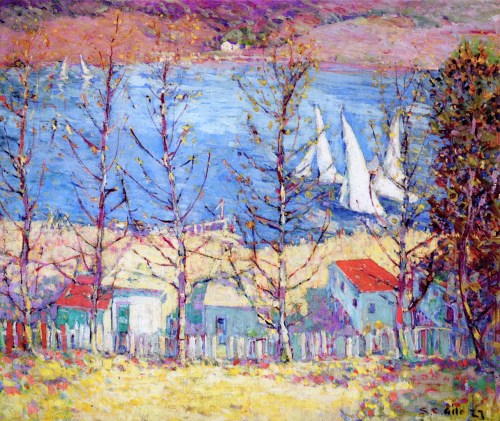
#FineArtFriday: Belvedere 1927 Seldon Connor Gile (a second look)

Title: Belvedere

Artist: Seldon Connor Gile

Medium: Oil on Canvas

Date: 1927

Inscription: signed and dated by Artist: Gile 27


What I love about this painting:

This is a view of San Francisco Bay from a hill in the town of Belvedere, California. Belvedere is located on the San Francisco Bay in Marin CountyCalifornia. Consisting of two islands and a lagoon, it is connected to the Tiburon Peninsula by two causeways.

It is a place the artist clearly loved, and he had his home nearby in Tiburon.

The intensity of color as one looks down the hill toward the shanties lends an atmosphere of purity, of fresh air, and approaching springtime to the painting.

Bold strokes of red and blue convey the atmosphere that is quintessential to Northern California. He offers us a sense of wonder, of peace, of modest post-WWI prosperity in this painting. We are shown the depth of color and vibrancy of a time and sense of place that has long vanished.

This is an era we usually see through old black-and-white photographs and jerky, scratchy newsreels.

Even rundown and undeveloped properties in Tiburon and Belvedere now sell in the high millions. Starving artists and middle-class workers can rarely acquire vacation shanties in that area.

About the Artist, Via Wikipedia:

Selden Connor Gile (20 March 1877 – 8 June 1947) was an American painter who was mainly active in northern California between the early-1910s and the mid-1930s. He was the founder and leader of the Society of Six, a Bay Area group of artists known for their plein-air paintings and rich use of color, a quality that would later figure into the work of Bay Area figurative expressionists.

Though Gile was steadily employed at jobs other than art until the age of 50, his artistic output, primarily from marathon weekends spent painting, was considerable. 1915, the year of the Panama–Pacific International Exposition, marked the beginning of his maturation as an artist, despite that fact that Gile and the Society of Six would not exhibit their art beyond a few occasional paintings until 1923. From their first exhibition at the Oakland Art Gallery on March 11, 1923 to the sixth and final show as a group in 1928, Gile and the Society of Six were generally well received by critics. In the spring of 1927, Gile quit his job as an office manager for Gladding, McBean and Company and moved from his cabin on Chabot Road in Oakland (also known as the “Chow House” where the Society of Six would meet on weekends), into a cottage he had kept since the early 1920s on San Francisco Bay in TiburonMarin County to paint full-time.

Selden Gile continued to paint and exhibited in various group shows every year until 1937. During the 1930s, the number of his oil paintings declined in favor of watercolors. Another change likely brought on by the mood around the Great Depression was to include more people, particularly workers, in his paintings. Despite his discomfort with larger formats, Gile took on the town of Belvedere’s only WPA mural commission, painting a mural for the public library, where he served as a part-time librarian. Towards the end of his life, unable to pay his rent, Gile took on another mural commission, this time for a railroad office in San Francisco. He is remembered from his time in the Tiburon/Belvedere area:

“…as a loner, independent, and very proud. [Gile] enjoyed cordial relationships with some of his neighbors, often chatting with them on the street or in doorways, but he consistently refused their hospitality…In the end Gile was a sick, alcoholic old man surrounded by paintings he never sold, lonely, and not painting. The process of painting and camaraderie that he had enjoyed were past now.”

A few months before he died, Selden Gile checked himself into the Marin County Hospital and Farm, where he spent the rest of his life. On June 8, 1947, Gile died of cirrhosis of the liver.


Credits and Attributions:

Belvedere, California 1927 by Selden Connor Gile, Public domain, via Wikimedia Commons

Wikimedia Commons contributors, “File:Selden Connor Gile Belvedere 1927.jpg,” Wikimedia Commons, the free media repository, https://commons.wikimedia.org/w/index.php?title=File:Selden_Connor_Gile_Belvedere_1927.jpg&oldid=525009834 (accessed March 11, 2021).

2 Comments

Filed under #FineArtFriday

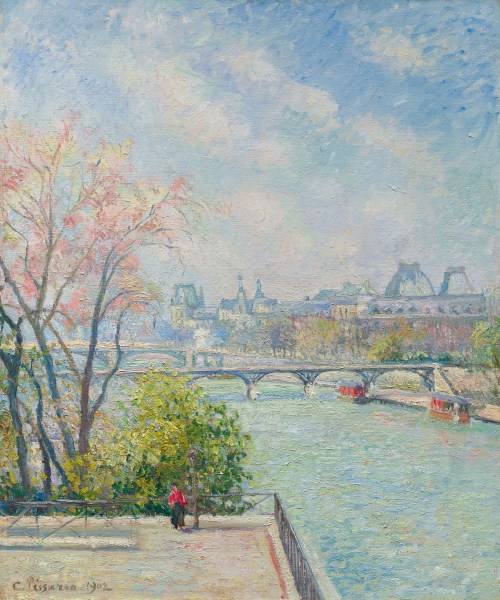
#FineArtFriday: The Louvre, Morning, Spring by Camille Pissarro 1902

1902_Camille_Pissarro_Le_Louvre,_matin,_printempsArtist: Camille Pissarro  (1830–1903)

Title: French: Le Louvre, Matin, Printemps (English: the Louvre, morning, spring)

Date:1902

Medium: oil on canvas

Dimensions: height: 54 cm (21.2 in), width: 64.8 cm (25.5 in)

References: https://www.sothebys.com/en/buy/auction/2023/modern-evening-auction-5/le-louvre-matin-printemps

What I love about this picture:

This is the way spring begins, tentative and holding back as if gauging the audience before leaping to center stage. The style of brushwork lends itself to the misty quality of the pastels of March and early April.

This was one of Pissarro’s final works. It is a pretty picture, a simple scene not unlike one I might see here in the Pacific Northwest this weekend. We are supposed to see a sunny stretch tomorrow through Tuesday, a few days of warmth without rain. The flowering plum trees in my town are poised to burst forth, and we will take a long drive, soaking up the sunlight while we can.

As I said above, this is a pretty picture, not profound or revolutionary, not highbrow in any way. But sometimes, what the soul needs is a pretty picture featuring the beauty and serenity of a sunny day.

About the artist, via Wikipedia:

Jacob Abraham Camille Pissarro (10 July 1830 – 13 November 1903) was a Danish-French Impressionist and Neo-Impressionist painter born on the island of St Thomas (now in the US Virgin Islands, but then in the Danish West Indies). His importance resides in his contributions to both Impressionism and Post-Impressionism. Pissarro studied from great forerunners, including Gustave Courbet and Jean-Baptiste-Camille Corot. He later studied and worked alongside Georges Seurat and Paul Signac when he took on the Neo-Impressionist style at the age of 54.

In 1873 he helped establish a collective society of fifteen aspiring artists, becoming the “pivotal” figure in holding the group together and encouraging the other members. Art historian John Rewald called Pissarro the “dean of the Impressionist painters”, not only because he was the oldest of the group, but also “by virtue of his wisdom and his balanced, kind, and warmhearted personality”. Paul Cézanne said “he was a father for me. A man to consult and a little like the good Lord”, and he was also one of Paul Gauguin‘s masters. Pierre-Auguste Renoir referred to his work as “revolutionary”, through his artistic portrayals of the “common man”, as Pissarro insisted on painting individuals in natural settings without “artifice or grandeur”.

Pissarro is the only artist to have shown his work at all eight Paris Impressionist exhibitions, from 1874 to 1886. He “acted as a father figure not only to the Impressionists” but to all four of the major Post-Impressionists, Cézanne, Seurat, Gauguin, and van Gogh.

Founder of a Dynasty:

Camille’s son Lucien was an Impressionist and Neo-impressionist painter as were his second and third sons Georges Henri Manzana Pissarro and Félix Pissarro. Lucien’s daughter Orovida Pissarro was also a painter. Camille’s great-grandson, Joachim Pissarro, became Head Curator of Drawing and Painting at the Museum of Modern Art in New York City and a professor in Hunter College’s Art Department. Camille’s great-granddaughter, Lélia Pissarro, has had her work exhibited alongside her great-grandfather. Another great-granddaughter, Julia Pissarro, a Barnard College graduate, is also active in the art scene. From the only daughter of Camille, Jeanne Pissarro, other painters include Henri Bonin-Pissarro (1918–2003) and Claude Bonin-Pissarro (born 1921), who is the father of the Abstract artist Frédéric Bonin-Pissarro (born 1964).

The grandson of Camille Pissarro, Hugues Claude Pissarro (dit Pomié), was born in 1935 in the western section of Paris, Neuilly-sur-Seine, and began to draw and paint as a young child under his father’s tutelage. During his adolescence and early twenties he studied the works of the great masters at the Louvre. His work has been featured in exhibitions in Europe and the United States, and he was commissioned by the White House in 1959 to paint a portrait of U.S. President Dwight Eisenhower. He now lives and paints in Donegal, Ireland, with his wife Corinne also an accomplished artist and their children. [1]


Credits and Attributions:

IMAGE: Wikimedia Commons contributors. File:1902 Camille Pissarro Le Louvre, matin, printemps.jpeg [Internet]. Wikimedia Commons; 2024 Feb 20, 05:48 UTC [cited 2024 Mar 13]. Available from: https://commons.wikimedia.org/w/index.php?title=File:1902_Camille_Pissarro_Le_Louvre,_matin,_printemps.jpeg&oldid=853770801.

[1] Wikipedia contributors. Camille Pissarro [Internet]. Wikipedia, The Free Encyclopedia; 2024 Feb 12, 07:32 UTC [cited 2024 Mar 13]. Available from: https://en.wikipedia.org/w/index.php?title=Camille_Pissarro&oldid=1206477040.

2 Comments

Filed under #FineArtFriday

#FineArtFriday: A second look at two paintings by H. A. Brendekilde

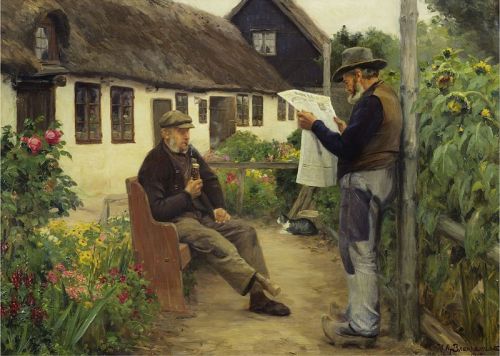
H. A. Brendekilde is one of my favorite artists, which is why I wanted to revisit these two paintings. There is a story in the above painting. I love the details—the patched trousers of the gardener, the mud on his clogs, the other man’s wooden leg—juxtaposed against the lush spring garden and prosperous village life of Denmark in 1912. Their hands and clothes indicate they have stopped work to read the newspaper. Both men seem stunned. Are they perhaps reading of the death of King Frederick VIII, who died on 14 May 1912?

Whatever they are reading, the cat remains undisturbed by the news. Even in 1912, cats were notoriously unconcerned about the life or death of kings.

The next painting also tells a powerful story.

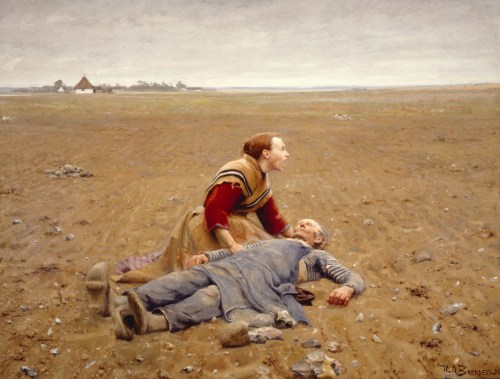
H. A. Brendekilde was a forerunner of the social realist style, embraced by Diego Rivera. His early work often depicted the daily lives of the rural working class. One of his most famous paintings, “Worn Out” (1889) shows an elderly man lying fallen on his back in the plowed field. He has collapsed while picking stones, preparing a field for planting. The stones he had gathered have scattered across the ground, and one of his clogs has fallen off his foot.

Has he worked himself to death? Will he recover? His entire world is this rocky barren field.  A story is in this stark painting.


About the Artist via Wikipedia (be patient–this was written by a non-native English-speaker. We should all speak a foreign language so well!)

[1] Hans Andersen Brendekilde (7 April 1857 – 30 March 1942) was a Danish painter.

Brendekilde’s influence was great not only on society, but also on his many friends among painters and potters. Among the painters especially on L.A. Ring. During their young and poor years they were sharing room and studio in Copenhagen for periods. They painted similar themes, both had the family name Andersen and they were therefore often confused with one another. So in 1884 they changed their family names Andersen to the names of their native villages instead, Brendekilde and Ring. Brendekilde was always in a good mood, was deeply committed to paint life in the small villages, and furthermore was an ardent socialist. Ring was of a more depressive disposition and Brendekilde encouraged him to continue painting and join exhibitions. Brendekilde also introduced Ring to Lars Ebbesen, who had a farm “Petersminde” in “Raagelund” close to Odense. In 1883, Ring was living in extreme poverty in Copenhagen, but the introduction to Lars Ebbesen meant that he could live and paint without worrying about the cost of rent and food for long periods. Both Brendekilde and Ring remained lifelong friends with farm owner Ebbesen. Several of Brendekilde’s paintings became very famous and won medals e.g. at the World Expositions in Paris 1889, in Chicago 1893 and at the “Jahresausstellung” im Glaspalast in München 1891. He also inspired painters like his friends Julius PaulsenPeder MønstedHans Smidth, Paul FischerSøren Lund [da] and H. P. Carlsen.

Brendekilde was the first painter bringing the arts and crafts movement to Denmark when from about 1884 he designed and made integrated frames around his paintings, the frames being part of the paintings and their story. Some frames were symbolistic and others more ornamental.

Many of his paintings are obviously related to those by Anna and Michael AncherP.S. Krøyer and the Swedish painters Carl Larsson and Anders Zorn. All of these displayed their paintings at the international exhibitions in Copenhagen 1888, Paris 1889, Munich 1891 and Chicago 1893. [1]


Credits and Attributions:

[1] Wikipedia contributors, “H. A. Brendekilde,” Wikipedia, The Free Encyclopedia, https://en.wikipedia.org/w/index.php?title=H._A._Brendekilde&oldid=1019433991 (accessed March 11, 2022). Translated from Dutch.

While reading the newspaper news by H. A. Brendekilde 1912 [Public domain], via Wikimedia Commons

Worn Out by H. A. Brendekilde [Public domain], via Wikimedia Commons

2 Comments

Filed under #FineArtFriday

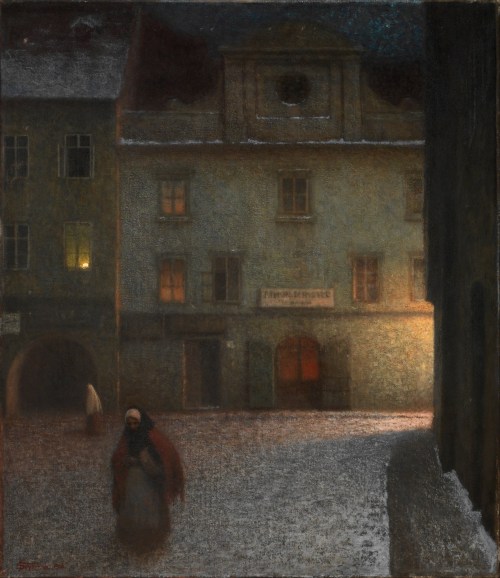
#FineArtFriday: Evening Street by Jakub Schikaneder, 1906

Jakub_Schikaneder_-_Evening_Street_-_Google_Art_ProjectArtist: Jakub Schikaneder (1855–1924)

Title: Evening Street

Date: 1906

Medium: oil on canvas

Inscriptions: signed and dated

Collection: National Gallery Prague

About this Painting, via Copilot GPT (sources listed in the footnotes below):

Evening Street by Jakub Schikaneder is done in the Romanticism style, characterized by its blend of realism and melancholy. In this enchanting cityscape, Schikaneder masterfully captures the quietude of an evening street in Prague. The scene exudes a sense of solitude and nostalgia, as if time has slowed down. The play of light and shadow adds depth to the composition, emphasizing the architectural details and the cobblestone pavement.

The painting invites us to wander through the narrow streets, perhaps imagining the footsteps of passersby and the whispers of history. The subdued palette, with hints of warm tones, evokes the fading light of day. It’s a moment frozen in time—a glimpse into the soul of the city.

Schikaneder often depicted lower-class people in his works, and Evening Street is no exception. The figures, though not prominent, contribute to the overall atmosphere. Their silhouettes blend seamlessly with the surroundings, emphasizing the quiet beauty of everyday life. [1]

About the Artist, via Wikipedia:

Jakub (or Jakob) Schikaneder (February 27, 1855 in Prague – November 15, 1924 in Prague) was a painter from Bohemia.

Jakub (or Jakob) Schikaneder was born to a family of a German customs office clerk in Prague. The family’s love of art enabled him to pursue his studies, despite bad economic circumstances. The aspiring painter was a descendant of Urban Schikaneder, the elder brother of librettist Emanuel Schikaneder.

Following his work in the National Theatre, Schikaneder traveled through Europe, visiting Germany, England, Scotland, The Netherlands, Switzerland, Italy and France. From 1891 until 1923 he taught in Prague’s Art College. Schikaneder counted amongst those who admired the Munich School of the end of the 19th century.

Schikaneder is known for his soft paintings of the outdoors, often lonely in mood. His paintings often feature poor and outcast figures and “combined neoromantic and naturalist impulses.” Other motifs favored by Schikaneder were autumn and winter, corners and alleyways in the city of Prague and the banks of the Vltava – often in the early evening light or cloaked in mist. His first well-known work was the monumental painting Repentance of the Lollards (2.5m × 4m, lost). The National Gallery in Prague held an exhibition of his paintings from May 1998 until January 1999. [2]


Credits and Attributions:

IMAGE: Wikimedia Commons contributors, “File:Jakub Schikaneder – Evening Street – Google Art Project.jpg,” Wikimedia Commons, https://commons.wikimedia.org/w/index.php?title=File:Jakub_Schikaneder_-_Evening_Street_-_Google_Art_Project.jpg&oldid=844404638 (accessed February 22, 2024).

[1] Copilot GPT drew information and quotes from these sources (accessed February 22, 2024):

  1. https://www.wikiart.org/en/jakub-schikaneder/evening-street |
  2. https://www.artrenewal.org/artworks/street-in-the-evening-prague/jakub-schikaneder/100011 |
  3. https://fineartamerica.com/featured/5-evening-street-jakub-schikaneder.html |
  4. https://www.wikiart.org/en/jakub-schikaneder

[2] Wikipedia contributors, “Jakub Schikaneder,” Wikipedia, The Free Encyclopedia, https://en.wikipedia.org/w/index.php?title=Jakub_Schikaneder&oldid=1188016975 (accessed February 22, 2024).

Comments Off on #FineArtFriday: Evening Street by Jakub Schikaneder, 1906

Filed under #FineArtFriday