Category Archives: #FineArtFriday

FineArtFriday: Holiday on the Hudson by George Luks ca. 1912

George_Luks_(American,_1866–1933)_-_Holiday_on_the_Hudson_-_1933.2291_-_Cleveland_Museum_of_ArtArtist: George Luks  (1867–1933)

Title: Holiday on the Hudson

Date: circa 1912

Collection: Cleveland Museum of Art

What I love about this painting:

These are the working-class people of New York on a sunny Sunday in high summer. Fishing has been good, and while the oyster boats and small fishing dories have seen heavy use, they’ve been tidied up a bit, and everyone is looking forward to a carefree day on the water. The fishermen in their sleeveless shirts are quickly moving ropes and gear around to make room for the ladies.

I love the life instilled in the painting, the action, the colors, the intensity, and the way it shouts, “Freedom beckons,” even if that freedom is only temporary.

I see a story here, a historical romance. I imagine that some of this group of friends are the servants of the rich enjoying their half-day off. Besides the fishermen, we have footmen, maids, cooks, and housekeepers. I like to think they’re heading to a favorite beach for a clambake, that time-honored seaside picnic that even the poor working-class could afford.

Who is courting whom? Will they get married?

About the artist, via Wikipedia:

George Benjamin Luks (August 13, 1867 – October 29, 1933) was an American artist, identified with the aggressively realistic Ashcan School of American painting.

After travelling and studying in Europe, Luks worked as a newspaper illustrator and cartoonist in Philadelphia, where he became part of a close-knit group, led by Robert Henri, that set out to defy the genteel values imposed by the influential National Academy of Design. His best-known paintings reflect the life of the poor and hard-pressed on Manhattan’s Lower East Side. [1]

For more about George Luks, I highly recommend continuing to read his biography here: George Luks – Wikipedia


Credits and Attributions:

IMAGE: Wikimedia Commons contributors, “File:George Luks (American, 1866–1933) – Holiday on the Hudson – 1933.2291 – Cleveland Museum of Art.jpg,” Wikimedia Commons, https://commons.wikimedia.org/w/index.php?title=File:George_Luks_(American,_1866%E2%80%931933)_-_Holiday_on_the_Hudson_-_1933.2291_-_Cleveland_Museum_of_Art.jpg&oldid=779825858 (accessed June 27, 2024).

[1]Wikipedia contributors, “George Luks,” Wikipedia, The Free Encyclopedia, https://en.wikipedia.org/w/index.php?title=George_Luks&oldid=1217710156 (accessed June 27, 2024).

Comments Off on FineArtFriday: Holiday on the Hudson by George Luks ca. 1912

Filed under #FineArtFriday

#FineArtFriday: La Mirenda (The Snack) by Elin Danielson-Gambogi 1904

Elin_Danielson-Gambogi_-_La_Merenda_(1904)Artist: Elin Danielson-Gambogi  (1861–1919)

Title: By the Sea – The Snack (La Merenda)

Date: 1904

Medium: oil on canvas

Dimensions: height: 102 cm (40.1 in)

Collection: K. H. Renlund art collection

What I love about this painting:

Elin Danielson-Gambogi gives us a perfect afternoon for an afternoon picnic by the sea with friends. An afternoon beside the surf and the company of friends—it doesn’t get any better.

The good years just prior to the outbreak of WWI seem golden in many ways. Women’s work was never done but they have the luxury of a little leisure time, and they are enjoying it. Two women have removed their headscarves as if they don’t care if they get a little sun-browned. The cast-off squares of cloth lie on the rocky beach as if blown by the wind.

The girl is very likely the artist’s niece, as she and her mother figure prominently in many of Elin’s paintings. I like to think she is pleased to have been included in the picnic, proud to be serving the snacks.

There is a pleasant warmth to this image, the peace of a Goldilocks day, that rare summer’s afternoon that is just right.

About the Artist, via Wikipedia:

Elin Kleopatra Danielson-Gambogi (3 September 1861 – 31 December 1919) was a Finnish painter best known for her realist works and portraits. Danielson-Gambogi was part of the first generation of Finnish women artists who received professional education in art, the so-called “painter sisters’ generation”. The group also included Helene Schjerfbeck (1862–1946), Helena Westermarck (1857-1938), and Maria Wiik (1853-1928).

In 1883 Danielson received a grant and moved to Paris. While there, she took lessons at the Académie Colarossi under Gustave Courtois and painted in Brittany during the summertime. A few years later she returned to Finland and lived with her relatives in Noormarkku and Pori. In 1888 she opened an atelier in Noormarkku. During the 1880s and 1890s she worked as a teacher in several art schools around Finland.  She also attended the artists’ colony Önningeby in Ålands.

In 1895, she received a scholarship and traveled to Florence, Italy. A year later she moved to the village of Antignano in Livorno where she met an Italian painter 13 years younger than herself, Raffaello Gambogi (1874–1943). They began working together and got married on February 27, 1898.  They held exhibitions in Paris, Florence (where she was awarded an art prize by the city) and Milan, and in many Finnish cities, and their paintings were also included in the 1900 World’s Fair in Paris, where she again won bronze medal. She also got to second place in the 1901 national portrait painting competition organized by the Finnish state.  In 1899, King Umberto purchased a painting from her. That same year, she participated in the Venice Biennale.

Their marriage was strained when Raffaello had an affair with Danielson’s Finnish friend Dora Wahlroos.  While the affair quickly ended, it had a lasting impact on the Gambogis’ marriage.  She moved to Finland for a while but returned to Antignano in 1903.  Because of World War I, her connection to her homeland was cut, and by the time she died, of pneumonia, at Antignano in 1919, she had been mostly forgotten in Finland.

Because of her choice of rare subject matters that often even caused some offence, Danielson is now seen as one of the central artists of the Golden Age of Finnish Art. Danielson-Gambogi was included in the 2018 exhibit Women in Paris 1850-1900. [1]


Credits and Attributions:

IMAGE: Wikimedia Commons contributors, “File:Elin Danielson-Gambogi – La Merenda (1904).jpg,” Wikimedia Commons, https://commons.wikimedia.org/w/index.php?title=File:Elin_Danielson-Gambogi_-_La_Merenda_(1904).jpg&oldid=848460780 (accessed June 20, 2024).

[1] Wikipedia contributors, “Elin Danielson-Gambogi,” Wikipedia, The Free Encyclopedia, https://en.wikipedia.org/w/index.php?title=Elin_Danielson-Gambogi&oldid=1203975014 (accessed June 20, 2024).

5 Comments

Filed under #FineArtFriday, writing

#FineArtFriday: View of Bruges with City Hall by August Fischer

August_Fischer_Ansicht_von_Brügge_mit_Rathaus_1905Artist: August Fischer  (1854–1921) 

Title: English: View of Bruges with City Hall, Dansk: Udsigt til Brügge

Date: 1905

Medium: oil on canvas

Dimensions: height: 45 cm (17.7 in); width: 59 cm (23.2 in)

Inscriptions: Signed and dated lower right: Aug. Fischer, Bruges 05.

What I love about this painting:

We see history here, the city of Bruges as it was in 1905, before the outbreak of WWI. It was a prosperous town with many churches and a large middle class.

The boatman has a story. How old is he? Does he support his wife and children with what he earns ferrying people to and from? Or is he just starting out in life, working to earn enough to marry a certain girl? This is a fairytale painting, serene and yet concealing many secrets. I think it’s the perfect setting for fantasy romance.

Perhaps the future looks bright to him now, but in less than a decade, our boatman will be thrown in the most horrific war the world had ever seen. If he is young, he will be sent to the front. If he is old, his boat will be conscripted to ferry soldiers and munitions, and he will do what he must to survive.

More than a century has passed since this scene was recorded. Bruges is now the capital and largest city of the province of West Flanders in the Flemish Region of Belgium.

About the Artist: I could find no Wikipedia article about Fischer, but random searches at the websites of several auction houses yielded some information.

Johannes August Fischer (1854–1921) was a Danish landscape and architecture painter and the elder brother of the Danish artist, Paul Fischer. His parents were the master painter and varnish manufacturer Philip August Fischer (1817—1907) and Gustafva Albertina Svedgren (1827—83). The family was well off, upper middle class. While his father had started as a painter, he became financially successful as a manufacturer of paints and lacquers.

August Fischer was first apprenticed to a sculptor, but at the age of nineteen, he applied to the Royal Danish Academy of Fine Arts, making the switch to painting. His work debuted at the Charlottenborg Spring Exhibition in 1874, where he exhibited until his death in 1921.

August Fischer traveled abroad for much of his career. He lived and worked in Spain and Italy from 1883 to 1884. After that, he traveled to southern Germany and Italy. Several of his more well-known paintings were of Nuremberg and Rothenburg on the Tauber, and Venice and Florence.


Credits and Attributions:

Wikimedia Commons contributors, “File:August Fischer Ansicht von Brügge mit Rathaus 1905.jpg,” Wikimedia Commons, https://commons.wikimedia.org/w/index.php?title=File:August_Fischer_Ansicht_von_Br%C3%BCgge_mit_Rathaus_1905.jpg&oldid=807392532 (accessed June 12, 2024).

3 Comments

Filed under #FineArtFriday

#FineArtFriday: A second look at “Harvesters” by Anna Ancher, 1905

Anna_Ancher_-_Harvesters_-_Google_Art_ProjectArtist: Anna Ancher  (1859–1935)

Title: Harvesters

Date: 1905

Medium: oil on canvas

Dimensions: w56.2 x h43.4 cm (Without frame)

Collection: Skagens Museum

What I love about this painting:

While she normally painted interiors, Anna Ancher captured a perfect late summer morning beneath blue skies in this painting. One can almost hear the rustling of ripe grain moving with the breeze.

I like the placement of the three figures, two women and a man. Are they husband, wife, and daughter? There is a sense of movement in this painting. They enter the scene from the right, and you feel sure they will exit to the left, where the field that is to be cut that day is.

The man will scythe, the woman who follows third will rake, and the woman in the middle will stack the sheaves.

These are not poor people. These farmers are dressed modestly in clean work clothes that aren’t tattered and patched. They are doing well; the grain is high, and life is good in these years of plenty before the outbreak of WWI.

About the Artist, via Wikipedia:

Anna Ancher (18 August 1859 – 15 April 1935), born Anna Kirstine Brøndum, was born in Skagen, Denmark, was the only one of the Skagen Painters who was born and grew up in Skagen, where her father owned the Brøndums Hotel. The artistic talent of Anna Ancher became obvious at an early age and she became acquainted with pictorial art via the many artists who settled to paint in Skagen, in the north of Jylland.

While she studied drawing for three years at the Vilhelm Kyhn College of Painting in Copenhagen, she developed her own style and was a pioneer in observing the interplay of different colors in natural light. She also studied drawing in Paris at the atelier of Pierre Puvis de Chavannes along with Marie Triepcke, who would marry Peder Severin Krøyer, another Skagen painter.

In 1880 she married fellow painter Michael Ancher, whom she met in Skagen. They had one child, daughter Helga Ancher. Despite pressure from society that married women should devote themselves to household duties, she continued painting after marriage.

Anna Ancher was considered to be one of the great Danish pictorial artists by virtue of her abilities as a character painter and colorist. Her art found its expression in Nordic art’s modern breakthrough toward a more truthful depiction of reality, e.g. in Blue Ane (1882) and The Girl in the Kitchen (1883–1886).

Ancher preferred to paint interiors and simple themes from the everyday lives of the Skagen people, especially fishermen, women, and children. She was intensely preoccupied with exploring light and color, as in Interior with Clematis (1913). She also created more complex compositions such as A Funeral (1891). Anna Ancher’s works often represented Danish art abroad. Ancher has been known for portraying similar civilians from the Skagen art colony in her works, including an old blind woman.


Credits and Attributions:

Harvesters, Anna Ancher, Public domain, via Wikimedia CommonsWikimedia Commons contributors, “File:Anna Ancher – Harvesters – Google Art Project.jpg,” Wikimedia Commons, the free media repository, https://commons.wikimedia.org/w/index.php?title=File:Anna_Ancher_-_Harvesters_-_Google_Art_Project.jpg&oldid=371900766 (accessed October 14, 2021).

Wikipedia contributors, “Harvesters (Ancher),” Wikipedia, The Free Encyclopedia, https://en.wikipedia.org/w/index.php?title=Harvesters_(Ancher)&oldid=1047378795 (accessed October 14, 2021).

5 Comments

Filed under #FineArtFriday

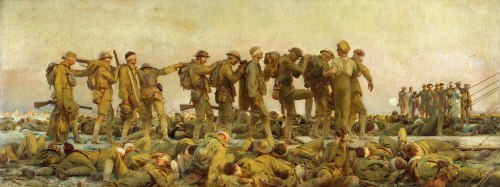
#FineArtFriday: Gassed by John Singer Sargent 1919 #memorialday

2560px-Sargent,_John_Singer_(RA)_-_Gassed_-_Google_Art_ProjectArtist: John Singer Sargent (1856–1925)

Title: Gassed

Date: 1919

Medium: oil on canvas

Dimensions: Height: 231 cm (90.9 in); Width: 611.1 cm (20 ft)

Traditionally in the US, May 30 was Decoration Day. For my father, it was a paid holiday in the middle of the week. My father would reluctantly take my grandmothers to the cemetery so they could take care of the graves of our family members, some of whom had fought in WWI, the war in which this scene was first conceived.

Dad would have preferred to go fishing. He had fought in WWII and didn’t like raking up bad memories. But it made my grandmothers happy, so he did it, despite the fact the two women didn’t really have anything else in common and had little to say to each other.

Ah, family dynamics.

Gramma Ethel and Gramma Florence were both raised in the Edwardian era and both adhered to a strict code of manners. The civility and politeness emanating from the back seat of the 1965 Chevy Impala station wagon could be overwhelming at times.

About Memorial Day from Wikipedia, the Fount of All Knowledge:

Memorial Day (originally known as Decoration Day[1]) is a federal holiday in the United States for honoring and mourning the U.S. military personnel who died while serving in the United States Armed Forces.[2] From 1868 to 1970, it was observed on May 30.[3] Since 1971, it is observed on the last Monday of May.

Many people visit cemeteries and memorials on Memorial Day to honor and mourn those who died while serving in the U.S. military. Many volunteers place American flags on the graves of military personnel in national cemeteries. Memorial Day is also considered the unofficial beginning of summer.[4]

What I love about this painting:

This painting is a deeply moving antiwar statement. John Singer Sargent was a complicated man, as most artists are. Famous as a portrait artist, he painted landscapes that conveyed a sense of mood and emotion that few of his contemporaries could match.

He was commissioned as a war artist by the British Ministry of Information. He illustrated numerous scenes from the Great War. Sargent had been affected by what he had seen while touring the front in France and by the death of his niece Rose-Marie in the shelling of the St Gervais church, Paris, on Good Friday 1918.

The colors are muted, and even the pastels are dark and dirty. The suffering of the maimed and injured men is laid bare. Through the legs of the walking wounded, the rising moon illuminates the desire of the uninjured to try to find some normalcy. Dwarfing the players and their game, the vast sea of dead and injured stretches as far as the eye can see.

Above, two tiny figures represent the clash of biplanes in the distance, the ever-moving machine of death and inhumanity that is war.

About this painting, via Wikipedia:

[1] Gassed is a very large oil painting completed in March 1919 by John Singer Sargent. It depicts the aftermath of a mustard gas attack during the First World War, with a line of wounded soldiers walking towards a dressing station. Sargent was commissioned by the British War Memorials Committee to document the war and visited the Western Front in July 1918 spending time with the Guards Division near Arras, and then with the American Expeditionary Forces near Ypres. The painting was finished in March 1919 and voted picture of the year by the Royal Academy of Arts in 1919. It is now held by the Imperial War Museum. It visited the US in 1999 for a series of retrospective exhibitions, and then from 2016 to 2018 for exhibitions commemorating the centenary of the First World War.

The painting measures 231.0 by 611.1 centimeters (7 ft 6.9 in × 20 ft 0.6 in). The composition includes a central group of eleven soldiers depicted nearly life-size. Nine wounded soldiers walk in a line, in three groups of three, along a duckboard towards a dressing station, suggested by the guy ropes to the right side of the picture. Their eyes are bandaged, blinded by the effect of the gas, so they are assisted by two medical orderlies. The line of tall, blind soldiers forms a naturalist allegorical frieze, with connotations of a religious procession. Many other dead or wounded soldiers lie around the central group, and a similar train of eight wounded, with two orderlies, advances in the background. Biplanes dogfight in the evening sky above, as a watery setting sun creates a pinkish yellow haze and burnishes the subjects with a golden light. In the background, the moon also rises, and uninjured men play association football in blue and red shirts, seemingly unconcerned at the suffering all around them.

The painting provides a powerful testimony of the effects of chemical weapons, vividly described in Wilfred Owen‘s poem Dulce et Decorum Est. Mustard gas is a persistent vesicant gas, with effects that only become apparent several hours after exposure. It attacks the skin, the eyes and the mucous membranes, causing large skin blisters, blindness, choking and vomiting. Death, although rare, can occur within two days, but suffering may be prolonged over several weeks.

Sargent’s painting refers to Bruegel’s 1568 work The Parable of the Blind, with the blind leading the blind, and it also alludes to Rodin’s Burghers of Calais.

About the Artist, via Wikipedia:

[2] John Singer Sargent (January 12, 1856 – April 14, 1925) was an American expatriate artist, considered the “leading portrait painter of his generation” for his evocations of Edwardian-era luxury. He created roughly 900 oil paintings and more than 2,000 watercolors, as well as countless sketches and charcoal drawings. His oeuvre documents worldwide travel, from Venice to the Tyrol, Corfu, the Middle East, Montana, Maine, and Florida.

Born in Florence to American parents, he was trained in Paris before moving to London, living most of his life in Europe. He enjoyed international acclaim as a portrait painter. An early submission to the Paris Salon in the 1880s, his Portrait of Madame X, was intended to consolidate his position as a society painter in Paris, but instead resulted in scandal. During the next year following the scandal, Sargent departed for England where he continued a successful career as a portrait artist.

From the beginning, Sargent’s work is characterized by remarkable technical facility, particularly in his ability to draw with a brush, which in later years inspired admiration as well as criticism for a supposed superficiality. His commissioned works were consistent with the grand manner of portraiture, while his informal studies and landscape paintings displayed a familiarity with Impressionism. In later life Sargent expressed ambivalence about the restrictions of formal portrait work, and devoted much of his energy to mural painting and working en plein air. Art historians generally ignored artists who painted royalty and “society” – such as Sargent – until the late 20th century. [2]


Credits and Attributions:

[1] Wikipedia contributors, “Gassed (painting),” Wikipedia, The Free Encyclopedia, https://en.wikipedia.org/w/index.php?title=Gassed_(painting)&oldid=1029966714 (accessed July 15, 2021).

[2] Wikipedia contributors, “John Singer Sargent,” Wikipedia, The Free Encyclopedia, https://en.wikipedia.org/w/index.php?title=John_Singer_Sargent&oldid=1032671314 (accessed July 15, 2021).

Image source: File:Sargent, John Singer (RA) – Gassed – Google Art Project.jpg – Wikipedia (accessed July 15, 2021).

2 Comments

Filed under #FineArtFriday

#FineArtFriday: a second look at Monet Painting in His Garden by Pierre-Auguste Renoir 1873

Monet Painting in His Garden by Pierre-Auguste Renoir

Date: 1873

Medium: oil on canvas

Dimensions : Height: 46 cm (18.1 in); Width: 60 cm (23.6 in)

Collection: Wadsworth Atheneum Museum of Art

What I love about this painting:

Renoir shows us that Claude Monet’s Garden is lush and a little wild, like the man who owns it. Yet, although he is the subject of this painting, Monet is completely focused on his work. The colors are vivid, and I would love to spend time in this untamed garden, a place of vivid color and intense life. One can almost hear the humming of bees and the calls of birds as they jockey for the best nesting spots.

Renoir visited his good friend many times during the years Monet lived at Argenteuil, a village on the right bank of the Seine River near Paris. In 1873, Monet purchased a small boat equipped to be used as a floating studio, which must have been a draw for Renoir and his friends.

About the artist (via Wikipedia):

In 1862, Auguste Renoir began studying art under Charles Gleyre in Paris. There he met Alfred SisleyFrédéric Bazille, and Claude Monet.  At times, during the 1860s, he did not have enough money to buy paint. Renoir had his first success at the Salon of 1868 with his painting Lise with a Parasol (1867), which depicted Lise Tréhot, his lover at the time. Although Renoir first started exhibiting paintings at the Paris Salon in 1864, recognition was slow in coming, partly as a result of the turmoil of the Franco-Prussian War.

Renoir was inspired by the style and subject matter of previous modern painters Camille Pissarro and Edouard Manet. After a series of rejections by the Salon juries, he joined forces with Monet, Sisley, Pissarro, and several other artists to mount the first Impressionist exhibition in April 1874, in which Renoir displayed six paintings. Although the critical response to the exhibition was largely unfavorable, Renoir’s work was comparatively well received.  That same year, two of his works were shown with Durand-Ruel in London.  [1]


Credits and Attributions:

Monet Painting in His Garden by Pierre-Auguste Renoir / Public domain

[1] Wikipedia contributors, “Pierre-Auguste Renoir,” Wikipedia, The Free Encyclopedia, https://en.wikipedia.org/w/index.php?title=Pierre-Auguste_Renoir&oldid=949963500 (accessed May 19, 2024).

Wikimedia Commons contributors, “File:Renoir-Monet painting.png,” Wikimedia Commons, the free media repository, https://commons.wikimedia.org/w/index.php?title=File:Renoir-Monet_painting.png&oldid=338421916 (accessed May 19, 2024).

3 Comments

Filed under #FineArtFriday

#FineArtFriday – Fishing for Oysters at Cancale by John Singer Sargent 1878

2560px-John_Singer_Sargent_-_CancaleArtist: John Singer Sargent (1856–1925)

Title: En route pour la pêche (Setting Out to Fish) Fishing for Oysters at Cancale

Date: 1878

Medium: oil on canvas

Dimensions: height: 77 cm (30.3 in); width: 121.6 cm (47.8 in)

Inscription: Signed and Dated: John S. Sargent Paris 1878

Collection: National Gallery of Art

What I love about this picture:

This is a perfect summer day, a good day to be out near the water. John Singer Sargent was a complicated man, as most artists are. Famous as a portrait artist, he painted landscapes that conveyed a sense of mood and emotion that few of his contemporaries could match. One of Sargent’s great skills was the ability to convey the sensory impressions of an environment.

He found beauty and drama in the lives of ordinary people and showed his characters outdoors in all the seasons. His paintings of working-class people didn’t romanticize how they dressed, conveyed their moods. Sargent showed the environment they lived and worked in, no matter how good or bad the weather.

Sargent had a gift for painting rare and expensive fabrics, yet no one is dressed in finery in this painting. On the contrary, the women are dressed in shabby clothes that protect them from the sun and salty wind, garments that have seen a great deal of wear. The children are bare-legged and barefoot, while the fishers wear clogs. These women carry baskets and the hope that they will find enough oysters and other shellfish to not only feed their family but have plenty to sell to the fishmonger.

About this picture via MFA Boston: Sargent’s choice of subject was not revolutionary – a similar scene of oyster harvesters had previously won a medal at the Salon. However, his ability to paint the reflections in the tidal pools and the light sparkling on the figures and clouds dazzled viewers, clearly demonstrating that his talents extended beyond portraiture. [1]

About the artist, via Wikipedia:

John Singer Sargent (January 12, 1856 – April 14, 1925) was an American expatriate artist, considered the “leading portrait painter of his generation” for his evocations of Edwardian-era luxury. He created roughly 900 oil paintings and more than 2,000 watercolors, as well as countless sketches and charcoal drawings. His oeuvre documents worldwide travel, from Venice to the TyrolCorfu, Spain, the Middle East, MontanaMaine, and Florida.

Born in Florence to American parents, he was trained in Paris before moving to London, living most of his life in Europe. He enjoyed international acclaim as a portrait painter. An early submission to the Paris Salon in the 1880s, his Portrait of Madame X, was intended to consolidate his position as a society painter in Paris but instead resulted in scandal. During the year following the scandal, Sargent departed for England, where he continued a successful career as a portrait artist.

From the beginning, Sargent’s work is characterized by remarkable technical facility, particularly in his ability to draw with a brush, which in later years inspired admiration as well as criticism for its supposed superficiality. His commissioned works were consistent with the grand manner of portraiture, while his informal studies and landscape paintings displayed a familiarity with Impressionism. In later life, Sargent expressed ambivalence about the restrictions of formal portrait work and devoted much of his energy to mural painting and working en plein air. Art historians generally ignored society artists such as Sargent until the late 20th century.

The exhibition in the 1980s of Sargent’s previously hidden male nudes served to spark a reevaluation of his life and work, and its psychological complexity. In addition to the beauty, sensation and innovation of his oeuvre, his same-sex interests, unconventional friendships with women and engagement with race, gender nonconformity and emerging globalism are now viewed as socially and aesthetically progressive and radical.


Credits and Attributions:

[1] Quote: MFABoston contributors, Fishing for Oysters at Cancale – Works – Museum of Fine Arts, Boston (mfa.org) (accessed May 12, 2024).

[2] Wikipedia contributors, “John Singer Sargent,” Wikipedia, The Free Encyclopedia, https://en.wikipedia.org/w/index.php?title=John_Singer_Sargent&oldid=1223504088 (accessed May 12, 2024).

Comments Off on #FineArtFriday – Fishing for Oysters at Cancale by John Singer Sargent 1878

Filed under #FineArtFriday

#FineArtFriday: The Pedlar, closed state of The Hay Wain by Hieronymus Bosch ca. 1500

The_Pedlar,_closed_state_of_The_Hay_Wain_by_Hieronymus_BoschArtist: Hieronymus Bosch  (circa 1450–1516)

Title: The Pedlar, Part of The Haywain Tryptich

Genre: religious art Edit this at Wikidata

Date: circa 1500

Medium: oil on panel

Dimensions: height: 147.1 cm (57.9 in)

Collection: Museo del Prado

What I like about this painting:

Hieronymus Bosch tells a story in this scene that is the cover of an altar piece. We see a wayfarer walking a path that winds through dangerous territory. Thieves and murderers and carnal temptations tempt him to stop a while, but he keeps walking.

The hound of hell snaps at his heels as he keeps to the path and he shoves it behind him as he passes the bones of the fallen.

Bosch’s most famous altar pieces were quite graphic, gory even, depicting the prevailing 15th century idea of Hell. He painted his vision of what a sinner would face if one didn’t keep to the straight and narrow path of morality and righteousness.

About this painting, via Wikipedia:

The Haywain Triptych is a panel painting by Hieronymus Bosch, now in the Museo del Prado, Madrid, Spain. A date of around 1516 has been established by means of dendrochronological research. The central panel, signed “Jheronimus Bosch”, measures 135 cm × 200 cm (53 in × 79 in) and the wings measure 147 cm × 66 cm (58 in × 26 in). The outside shutters feature a version of Bosch’s The Wayfarer.

The exterior of the shutters, like most contemporary Netherlandish triptychs, was also painted, although in this case Bosch used full colors instead of the usual grisaille. When closed, they form a single scene depicting a wayfarer. Around him is a series of miniatures including the robbery of another wayfarer and a hanged man. The man uses a stick to repel a dog.

According to the most recent interpretations, this figure may represent the man who follows his road in spite of the temptation of sins (such as lust, perhaps symbolized by the two dancing shepherds) and the evil acts occurring around him.[1]

About the Artist, via Wikipedia:

Little is known of Bosch’s life, though there are some records. He spent most of it in the town of ‘s-Hertogenbosch, where he was born in his grandfather’s house. The roots of his forefathers are in Nijmegen and Aachen (which is visible in his surname: Van Aken). His pessimistic fantastical style cast a wide influence on northern art of the 16th century, with Pieter Bruegel the Elder being his best-known follower.

Today, Bosch is seen as a highly individualistic painter with deep insight into humanity’s desires and deepest fears. Attribution has been especially difficult; today only about 25 paintings are confidently given to his hand along with eight drawings. About another half-dozen paintings are confidently attributed to his workshop. His most acclaimed works consist of a few triptych altarpieces, including The Garden of Earthly Delights. [2]


Credits and Attributions:

IMAGE: Wikimedia Commons contributors, “File:The Pedlar, closed state of The Hay Wain by Hieronymus Bosch.jpg,” Wikimedia Commons, https://commons.wikimedia.org/w/index.php?title=File:The_Pedlar,_closed_state_of_The_Hay_Wain_by_Hieronymus_Bosch.jpg&oldid=618864212 (accessed May 4, 2024).

[1] Wikipedia contributors, “The Haywain Triptych,” Wikipedia, The Free Encyclopedia, https://en.wikipedia.org/w/index.php?title=The_Haywain_Triptych&oldid=1221796985 (accessed May 4, 2024).

[2] Wikipedia contributors, “Hieronymus Bosch,” Wikipedia, The Free Encyclopedia, https://en.wikipedia.org/w/index.php?title=Hieronymus_Bosch&oldid=1215179336 (accessed May 4, 2024).

2 Comments

Filed under #FineArtFriday

#FineArtFriday: Bavarian Landscape by Albert Bierstadt

Bierstadt_Albert_Bavarian_LandscapeArtist: Albert Bierstadt  (1830–1902)

Title: Bavarian Landscape

Genre: landscape art

Date: possibly between 1853 and 1857

What I love about this painting:

Albert Bierstadt is one of my favorite artists. He loved the power of nature. His colors are strong, and he employs contrast to good effect. In this painting of cattle in a field, he manages to make even the simplest scene feel epic.

This is one of his earlier works, but the sky is pure Bierstadt—immense, powerful, the vaults of heaven reigning over the world below.

We see a lush, fertile farm with healthy cattle in the foreground. The dark clouds in the distance tell us a summer storm looms, but for us, the sun still shines overhead.

About the artist, via Wikipedia:

Albert Bierstadt (January 7, 1830 – February 18, 1902) was a German American painter best known for his lavish, sweeping landscapes of the American West. He joined several journeys of the Westward Expansion to paint the scenes. He was not the first artist to record the sites, but he was the foremost painter of them for the remainder of the 19th century.

Bierstadt was born in Prussia, but his family moved to the United States when he was one year old. He returned to study painting for several years in Düsseldorf. He became part of the second generation of the Hudson River School in New York, an informal group of like-minded painters who started painting along the Hudson River. Their style was based on carefully detailed paintings with romantic, almost glowing lighting, sometimes called luminism. Bierstadt was an important interpreter of the western landscape, and he is also grouped with the Rocky Mountain School.

In 1851, Bierstadt began to paint in oils. He returned to Germany in 1853 and studied painting for several years in Düsseldorf with members of its informal school of painting. After returning to New Bedford in 1857, he taught drawing and painting briefly before devoting himself full-time to painting.

Bierstadt’s popularity in the U.S. remained strong during his European tour. The publicity generated by his Yosemite Valley paintings in 1868 led a number of explorers to request his presence as part of their westward expeditions. The Atchison, Topeka, and Santa Fe Railroad also commissioned him to visit and paint the Grand Canyon and surrounding region.

Despite his popular success, Bierstadt was criticized by some contemporaries for the romanticism evident in his choice of subjects and for his use of light, which they found excessive.

Some critics objected to Bierstadt’s paintings of Native Americans based on their belief that including Indigenous Americans “marred” the “impression of solitary grandeur.”


Credits and Attributions:

IMAGE: Wikimedia Commons contributors, “File:Bierstadt Albert Bavarian Landscape.jpg,” Wikimedia Commons, https://commons.wikimedia.org/w/index.php?title=File:Bierstadt_Albert_Bavarian_Landscape.jpg&oldid=823443562 (accessed May 2, 2024).

Comments Off on #FineArtFriday: Bavarian Landscape by Albert Bierstadt

Filed under #FineArtFriday

#FineArtFriday – Children’s Games by Pieter Bruegel the Elder

Pieter_Bruegel_the_Elder_-_Children’s_Games_-_Google_Art_ProjectTitle: Children’s Games

Artist: Pieter Bruegel the Elder

Year: 1560

Type: Oil on panel

Dimensions: 118 cm × 161 cm (46 in × 63 in)

Location: Kunsthistorisches Museum, Vienna

What I love about this image:

Pieter Brugel the Elder was one of my first influences in the world of art appreciation. I love the chaos, the raucous jumble of humanity that Brugel always brought to a scene. It is as wild and noisy as his more famous composition, The Wedding Dance. Children have taken over the city and everything is fair game. Brugel’s depiction of village children and their play offered him an opportunity to shine a small light on the hubris and arrogance of mankind, using allegory and misdirection.

About this painting via Wikipedia:

The entire composition is full of children playing a wide variety of games. Over 90 different games that were played by children at the time have been identified.

The artist’s intention for this work is more serious than simply to compile an illustrated encyclopaedia of children’s games, though some eighty particular games have been identified. Bruegel shows the children absorbed in their games with the seriousness displayed by adults in their apparently more important pursuits. His moral is that in the mind of God, children’s games possess as much significance as the activities of their parents. This idea was a familiar one in contemporary literature: in an anonymous Flemish poem published in Antwerp in 1530 by Jan van Doesborch, mankind is compared to children who are entirely absorbed in their foolish games and concerns. [1]

About the Artist, via Wikipedia:

Pieter Bruegel (also Brueghel or Breughelthe Elder c. 1525–1530 – 9 September 1569) was the most significant artist of Dutch and Flemish Renaissance painting, a painter and printmaker from Brabant, known for his landscapes and peasant scenes (so-called genre painting); he was a pioneer in making both types of subject the focus in large paintings.

He was a formative influence on Dutch Golden Age painting and later painting in general in his innovative choices of subject matter, as one of the first generation of artists to grow up when religious subjects had ceased to be the natural subject matter of painting. He also painted no portraits, the other mainstay of Netherlandish art. After his training and travels to Italy, he returned in 1555 to settle in Antwerp, where he worked mainly as a prolific designer of prints for the leading publisher of the day. Only towards the end of the decade did he switch to make painting his main medium, and all his famous paintings come from the following period of little more than a decade before his early death, when he was probably in his early forties, and at the height of his powers.

Around 1563, Bruegel moved from Antwerp to Brussels, where he married Mayken Coecke, the daughter of the painter Pieter Coecke van Aelst and Mayken Verhulst. As registered in the archives of the Cathedral of Antwerp, their deposition for marriage was registered 25 July 1563. The marriage itself was concluded in the Chapel Church, Brussels in 1563. 

Pieter the Elder had two sons: Pieter Brueghel the Younger and Jan Brueghel the Elder (both kept their name as Brueghel). Their grandmother, Mayken Verhulst, trained the sons because “the Elder” died when both were very small children. The older brother, Pieter Brueghel copied his father’s style and compositions with competence and considerable commercial success. Jan was much more original, and very versatile. He was an important figure in the transition to the Baroque style in Flemish Baroque painting and Dutch Golden Age painting in a number of its genres. He was often a collaborator with other leading artists, including with Peter Paul Rubens on many works including the Allegory of Sight.

Other members of the family include Jan van Kessel the Elder (grandson of Jan Brueghel the Elder) and Jan van Kessel the Younger. Through David Teniers the Younger, son-in-law of Jan Brueghel the Elder, the family is also related to the whole Teniers family of painters and the Quellinus family of painters and sculptors, through the marriage of Jan-Erasmus Quellinus to Cornelia, daughter of David Teniers the Younger. [2]


Credits and Attributions:

IMAGE:  Children’s Games, Wikimedia Commons contributors, “File:Pieter Bruegel the Elder – Children’s Games – Google Art Project.jpg,” Wikimedia Commons, https://commons.wikimedia.org/w/index.php?title=File:Pieter_Bruegel_the_Elder_-_Children%E2%80%99s_Games_-_Google_Art_Project.jpg&oldid=725602746 (accessed April 26, 2024).

[1] Wikipedia contributors, “Children’s Games (Bruegel),” Wikipedia, The Free Encyclopedia, https://en.wikipedia.org/w/index.php?title=Children%27s_Games_(Bruegel)&oldid=1198935116 (accessed April 26, 2024).

[2] Wikipedia contributors, “Pieter Bruegel the Elder,” Wikipedia, The Free Encyclopedia, https://en.wikipedia.org/w/index.php?title=Pieter_Bruegel_the_Elder&oldid=1218696694 (accessed April 26, 2024).

1 Comment

Filed under #FineArtFriday