Category Archives: #FineArtFriday

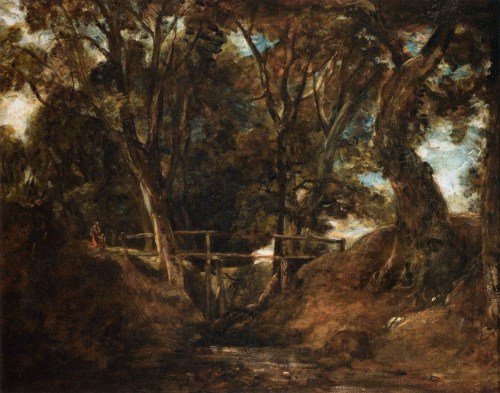
#FineArtFriday: John Constable – Helmingham Dell

John_Constable_-_Helmingham_Dell_-_WGA5193Artist: John Constable (1776–1837)

Title: Helmingham Dell

Genre: landscape art

Date: first half of 19th century

Medium: oil on canvas

Dimensions: height: 103 cm (40.5 in); width: 129 cm (50.7 in)

Collection: Louvre Museum

Current location: Department of Paintings of the Louvre

What I love about this image:

For those of us who write fantasy set in low-tech worlds, this is a view of how people bridged a creek for thousands of years, using the materials at hand. The scene is beautiful, cool and serene. One can hear the quiet murmur of the brook, the calls of different birds, and the chatter of squirrels arguing over their territories.

But at night, the silence is broken by the occasional hoot of an owl, and the rustle of underbrush as the small nocturnal creatures go about their business. A fox might wander through the dell, looking for a meal.

The amazing sky can be seen through the leaves and branches. John Constable gives us a lovely day, a moment of serenity to enjoy across the centuries.

About the Artist, via Wikipedia:

John Constable RA , 11 June 1776 – 31 March 1837) was an English landscape painter in the Romantic tradition. Born in Suffolk, he is known principally for revolutionising the genre of landscape painting with his pictures of Dedham Vale, the area surrounding his home – now known as “Constable Country” – which he invested with an intensity of affection. “I should paint my own places best”, he wrote to his friend John Fisher in 1821, “painting is but another word for feeling”.

Constable’s most famous paintings include Wivenhoe Park (1816), Dedham Vale (1821) and The Hay Wain (1821). Although his paintings are now among the most popular and valuable in British art, he was never financially successful. He became a member of the establishment after he was elected to the Royal Academy of Arts at the age of 52. His work was embraced in France, where he sold more than in his native England and inspired the Barbizon school. [1]


Credits and Attributions:

Image: Wikimedia Commons contributors, “File:John Constable – Helmingham Dell – WGA5193.jpg,” Wikimedia Commons, https://commons.wikimedia.org/w/index.php?title=File:John_Constable_-_Helmingham_Dell_-_WGA5193.jpg&oldid=723632044 (accessed May 25, 2023).

[1] Wikipedia contributors, “John Constable,” Wikipedia, The Free Encyclopedia, https://en.wikipedia.org/w/index.php?title=John_Constable&oldid=1152514837 (accessed May 25, 2023).

Comments Off on #FineArtFriday: John Constable – Helmingham Dell

Filed under #FineArtFriday

#FineArtFriday: In Flanders’ Fields, by John McCrae #MemorialDay (revisited)

Here in the US, we are celebrating Memorial Day. Originally known as Decoration Day, it’s a federal holiday dedicated to honoring those who died while serving in the US military. It used to be observed on May 30 regardless of the day of the week but in 1970 it was moved to the last Monday in May.

The beautiful image of poppies that graces this post is by Tijl Vercaemer from Gent, Flanders and was found on Wikimedia commons. The beauty and serenity of the poppies, rising from the fields where such terrible conflict once happened, is a fitting accompaniment for the poem, In Flanders Fields, by John McCrae, the text of which follows the picture.

From Wikipedia:  “In Flanders Fields” is a war poem in the form of a rondeau, written during the First World War by Canadian physician, Lieutenant-Colonel John McCrae. He was inspired to write it on May 3, 1915, after presiding over the funeral of friend and fellow soldier Alexis Helmer, who died in the Second Battle of Ypres. According to legend, fellow soldiers retrieved the poem after McCrae, initially dissatisfied with his work, discarded it. In Flanders Fields was first published on December 8 of that year in the London-based magazine Punch.

In Flanders Fields and Other Poems, a 1919 collection of McCrae’s works, contains two versions of the poem: a printed text as below and a handwritten copy where the first line ends with “grow” instead of “blow.” (…)

In Flanders fields the poppies blow
Between the crosses, row on row,
That mark our place; and in the sky
The larks, still bravely singing, fly
Scarce heard amid the guns below.

We are the Dead. Short days ago
We lived, felt dawn, saw sunset glow,
Loved and were loved, and now we lie
In Flanders fields.

Take up our quarrel with the foe:
To you from failing hands we throw
The torch; be yours to hold it high.
If ye break faith with us who die
We shall not sleep, though poppies grow
In Flanders fields.

While bed-ridden and recovering in the Veterans Administration Hospital in Vancouver, Washington, after World War II, my father had little to do but read or crochet. To keep busy, he and the other recovering soldiers in his ward made endless numbers of Remembrance Poppies to commemorate fallen American soldiers. Dad always wore his poppy on his left lapel, as it was close to his heart.

Memorial Day is more than just the official launch of Summer here in the US, more than just an Indy car race. Families have always cared for their family graves, but it became a designated day after the American Civil War in 1868, established  as “Decoration Day.” It was a specific time for the nation to decorate the graves of the war dead with flowers. Every family had soldiers who served and gave their lives in the never-ending wars, as we do today.

Officially, Memorial Day is a 3-day holiday weekend. Banks are closed on Monday, and the US Postal Service is also closed. The American flag is traditionally set at half-staff until noon to honor all those whose lives have been given in the service of our country. At noon, it is raised to the top of the staff, signifying that we, as a nation, will rise again.

My paternal grandmother never failed to keep our family’s graves neat and tidy, bringing flowers every week for my uncle, who had died while serving in the Korean War. As she got older, this tradition aggravated my father, who just wanted to listen to the Indianapolis 500 car race on the radio. He couldn’t bear dwelling on the loss of his brother, or the friends he had lost in France in WWII.

But he took her to the cemetery, anyway.

After each great and terrible war of the last two centuries, the hope was always that we had fought a “war to end all wars.” World War I, also known as The Great War, was spoken of in literature as just that: a war to end all wars.

With each conflict we still hope, but we are less able to believe it, today less than ever.


Sources and Attributions

In Flanders Fields, by Lieutenant Colonel John McCrae, MD, PD|75 years

John McCrae died of pneumonia January 28, 1918, near the end of the Great War. In Flanders’ Fields is a staple poem for Memorial Day services.

Wikipedia contributors. “In Flanders Fields.” Wikipedia, The Free Encyclopedia. Wikipedia, The Free Encyclopedia, 1 May. 2018. Web. 24 May. 2018

Poppies Field in Flanders, image By Tijl Vercaemer from Gent, Flanders #Belgium. File:Poppies Field in Flanders.jpg. (2018, January 13). Wikimedia Commons, the free media repository. Retrieved 15:55, May 24, 2018.

Comments Off on #FineArtFriday: In Flanders’ Fields, by John McCrae #MemorialDay (revisited)

Filed under #FineArtFriday, #FlashFictionFriday, Poetry

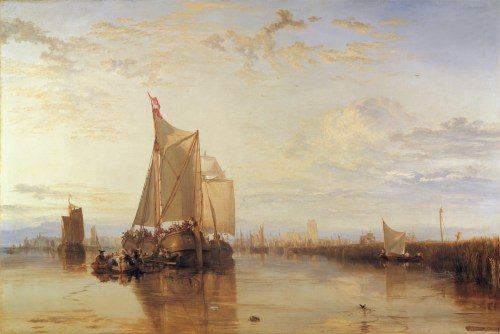
#FineArtFriday: Dort or Dordrecht: The Dort packet-boat from Rotterdam becalmed by J. M. W. Turner 1818 (revisited)

B1977.14.77

Artist: J. M. W. Turner (1775–1851)

Title: Dort or Dordrecht: The Dort packet-boat from Rotterdam becalmed

Genre: marine art

Date: 1818

Medium: oil on canvas

Dimensions: Height: 157.5 cm (62 in); Width: 233.7 cm (92 in)

Collection: Yale Center for British Art

What I love about this painting:

The colors show us a windless evening in summer or fall, a time of day when the smoke from factories and chimneys lingers and turns the sky brown and gold, reflected on the waters.

This is a glimpse into the history of how we once moved goods and mail across long distances. Some packet boats were medium-sized ships, able to navigate shallow rivers and canals. Others were ocean-going vessels. Some were steam driven, but the one we see in this painting is an early ship, powered by the wind.

The wind has failed, and so the crew is being ferried off the ship via a smaller row-boat.

About this painting via Wikipedia:

The Dort, or Dort or Dordrecht: The Dort packet-boat from Rotterdam becalmed is an 1818 painting by J. M. W. Turner, based on drawings made by him in mid-September 1817.  It shows a view of the harbour of Dordrecht. It is the finest example of the influence of Dutch marine painting on Turner’s work.

It was exhibited at the Royal Academy in 1818, where it was described by The Morning Chronicle as “one of the most magnificent pictures ever exhibited, and does honour to the age”. In 1832, John Constable wrote of the picture, “I remember most of Turner’s early works; amongst them one of singular intricacy and beauty; it was a canal with numerous boats making thousands of beautiful shapes, and I think the most complete work of a genius I ever saw”.

It was purchased by Walter Fawkes for 500 guineas at the request of his son, and hung in the drawing room at Farnley Hall until it was bought by Paul Mellon in 1966. It was then donated to the Yale Center for British Art upon the founding of the centre. [1]

About the Artist, via Wikipedia:

Joseph Mallard William Turner was born in Maiden Lane, Covent Garden, London, to a modest lower-middle-class family. He lived in London all his life, retaining his Cockney accent and assiduously avoiding the trappings of success and fame. A child prodigy, Turner studied at the Royal Academy of Arts from 1789, enrolling when he was 14, and exhibited his first work there at 15. During this period, he also served as an architectural draftsman. He earned a steady income from commissions and sales, which due to his troubled, contrary nature, were often begrudgingly accepted. He opened his own gallery in 1804 and became professor of perspective at the academy in 1807, where he lectured until 1828. He travelled to Europe from 1802, typically returning with voluminous sketchbooks.

Intensely private, eccentric and reclusive, Turner was a controversial figure throughout his career. He did not marry, but fathered two daughters, Eveline (1801–1874) and Georgiana (1811–1843), by his housekeeper Sarah Danby. He became more pessimistic and morose as he got older, especially after the death of his father, after which his outlook deteriorated, his gallery fell into disrepair and neglect, and his art intensified. In 1841, Turner rowed a boat into the Thames so he could not be counted as present at any property in that year’s census. He lived in squalor and poor health from 1845, and died in London in 1851 aged 76. Turner is buried in Saint Paul’s Cathedral, London. [2]


Credits and Attributions:

Wikimedia Commons contributors, “File:DortorDordrecht.jpg,” Wikimedia Commons, the free media repository, https://commons.wikimedia.org/w/index.php?title=File:DortorDordrecht.jpg&oldid=554289467 (accessed October 28, 2021).

[1] Wikipedia contributors, “Dort or Dordrecht: The Dort packet-boat from Rotterdam becalmed,” Wikipedia, The Free Encyclopedia, https://en.wikipedia.org/w/index.php?title=Dort_or_Dordrecht:_The_Dort_packet-boat_from_Rotterdam_becalmed&oldid=1000618596 (accessed October 28, 2021).

[2] Wikipedia contributors, “J. M. W. Turner,” Wikipedia, The Free Encyclopedia, https://en.wikipedia.org/w/index.php?title=J._M._W._Turner&oldid=1050867512 (accessed October 28, 2021).

3 Comments

Filed under #FineArtFriday, writing

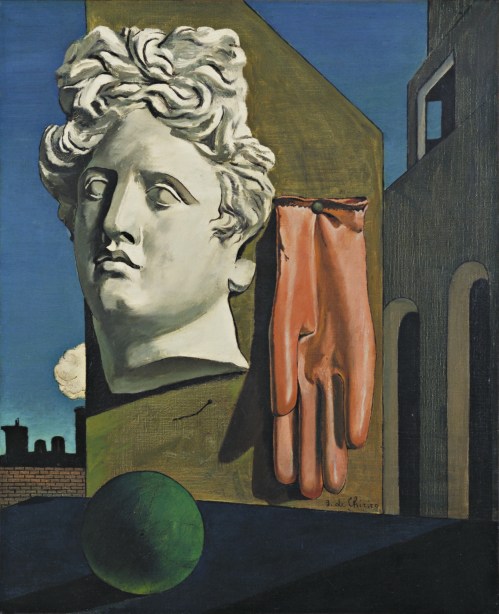
#FineArtFriday: the Song of Love by Georgio de Chirico

De_Chirico's_Love_SongArtist: Giorgio de Chirico, 1914,

Title: The Song of Love,

Genre: Metaphysical Art

Medium: oil on canvas, 73 x 59.1 cm,

Location: Museum of Modern Art, New York

About this painting, via Wikipedia:

Chirico presents a bust of a classical sculpture, a rubber ball, and a rubber glove on a canvas in between some buildings with a train passing by in a scene that spurs a sense of confusion. The bust could be a representation of Chirico’s love of classical art and a disappearing age. Chirico uses the rubber glove as a mold of a hand that implies the void of human presence. The buildings set up a scene that is reminiscent of the cityscapes of Chirico’s past. [1]

About the Artist,  via Wikipedia:

Giuseppe Maria Alberto Giorgio de Chirico; 10 July 1888 – 20 November 1978) was an Italian artist and writer born in Greece. In the years before World War I, he founded the scuola metafisica art movement, which profoundly influenced the surrealists. His best-known works often feature Roman arcades, long shadows, mannequins, trains, and illogical perspective. His imagery reflects his affinity for the philosophy of Arthur Schopenhauer and of Friedrich Nietzsche, and for the mythology of his birthplace.

After 1919, he became a critic of modern art, studied traditional painting techniques, and worked in a neoclassical or neo-Baroque style, while frequently revisiting the metaphysical themes of his earlier work.

The paintings de Chirico produced between 1909 and 1919, his metaphysical period, are characterized by haunted, brooding moods evoked by their images. At the start of this period, his subjects were motionless cityscapes inspired by the bright daylight of Mediterranean cities, but gradually he turned his attention to studies of cluttered storerooms, sometimes inhabited by mannequin-like hybrid figures. [2]

For more on the life and art of Georgio de Chirico, check out this video: Is This £1 Thrift Shop Painting By 20th Century Italian Master? | Fake Or Fortune | Perspective – YouTube


Credits and Attributions:

Image: Love Song by Georgio de Chirico, PD|100, courtesy Wikipedia Contributors, Wikipedia, The Free Encyclopedia https://en.wikipedia.org/wiki/File:De_Chirico%27s_Love_Song.jpg. (Accessed April 30, 2023.)

[1] Wikipedia contributors, “The Song of Love,” Wikipedia, The Free Encyclopedia, https://en.wikipedia.org/w/index.php?title=The_Song_of_Love&oldid=1146489854 (accessed April 30, 2023).

[2] Wikipedia contributors, “Giorgio de Chirico,” Wikipedia, The Free Encyclopedia, https://en.wikipedia.org/w/index.php?title=Giorgio_de_Chirico&oldid=1152305674 (accessed May 4, 2023).

2 Comments

Filed under #FineArtFriday

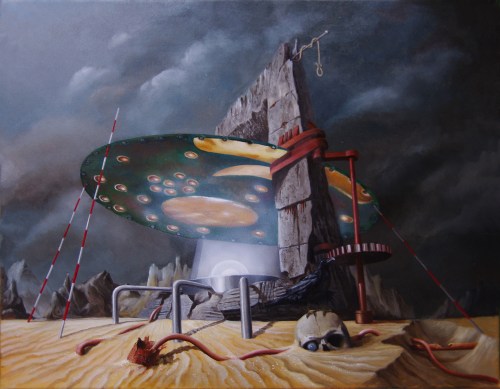
#FineArtFriday: What Remains? by Eberhard Marx 2016

Eberhard Marx

Title: (Deutsch) Was bleibt?

Title: (English) What remains?

Artist:  Eberhard Marx

Description: (Deutsch) surrealistisches Gemälde mit der Himmelsscheibe von Nebra

Description: (English) surrealist painting with the Nebra Sky Disc

Date:   19 May 2016

Today we are looking at Surrealism in art, as painted by a contemporary German artist, Eberhard Marx. This image comes from Wikimedia Commons, as does most of the work featured here.

When viewing surrealist art, the viewer can decide the intent of each element and how they are placed in the composition. The historical importance of the Nebra sky disc, the antiquity of the disc itself, and the craftsmanship that went into its making have always intrigued me, so this painting really caught my eye.

I visited the artist’s website and found where he offers us a way to view his works:

“Eberhard Marx wishes the viewer to take a walk in his paintings. The works are not botanical gardens with descriptions, but rather a bewitched park.” [1]

I have been enjoying doing just that!

About the Nebra sky disc, via Wikipedia:

The Nebra sky disc is a bronze disc of around 30 cm (12 in) diameter and a weight of 2.2 kg (4.9 lb), having a blue-green patina and inlaid with gold symbols. These symbols are interpreted generally as the Sun or full moon, a lunar crescent, and stars (including a cluster of seven stars interpreted as the Pleiades). Two golden arcs along the sides, interpreted to mark the angle between the solstices, were added later. A final addition was another arc at the bottom with internal parallel lines, which is usually interpreted as a solar boat with numerous oars, though some authors have also suggested that it may represent a rainbow, or the Aurora Borealis.

Nebra_disc_1The disc was found buried on the Mittelberg hill near Nebra in Germany. It is dated by archaeologists to c. 1800–1600 BCE and attributed to the Early Bronze Age Unetice culture.Various scientific analyses of the disc, the items found with the disc, and the find spot have confirmed the Early Bronze Age dating.

The Nebra sky disc features the oldest concrete depiction of astronomical phenomena known from anywhere in the world. In June 2013, it was included in the UNESCO Memory of the World Register and termed “one of the most important archaeological finds of the twentieth century.” [2]

About Surrealism in Art, via Wikipedia:

Surrealism is a cultural movement that developed in Europe in the aftermath of World War I in which artists depicted unnerving, illogical scenes and developed techniques to allow the unconscious mind to express itself. Its aim was, according to leader André Breton, to “resolve the previously contradictory conditions of dream and reality into an absolute reality, a super-reality”, or surreality. It produced works of painting, writing, theatre, filmmaking, photography, and other media.

Works of Surrealism feature the element of surprise, unexpected juxtapositions and non sequitur. However, many Surrealist artists and writers regard their work as an expression of the philosophical movement first and foremost (for instance, of the “pure psychic automatism” Breton speaks of in the first Surrealist Manifesto), with the works themselves being secondary, i.e., artifacts of surrealist experimentation. Leader Breton was explicit in his assertion that Surrealism was, above all, a revolutionary movement. At the time, the movement was associated with political causes such as communism and anarchism. It was influenced by the Dada movement of the 1910s.

The term “Surrealism” originated with Guillaume Apollinaire in 1917. However, the Surrealist movement was not officially established until after October 1924, when the Surrealist Manifesto published by French poet and critic André Breton succeeded in claiming the term for his group over a rival faction led by Yvan Goll, who had published his own surrealist manifesto two weeks prior. The most important center of the movement was Paris, France. From the 1920s onward, the movement spread around the globe, impacting the visual arts, literature, film, and music of many countries and languages, as well as political thought and practice, philosophy, and social theory. [3]

I highly recommend a visit to the artist’s website, HOME | EBERHARD MARX (eberhard-marx.eu). You will find many more of his amazing paintings, or you can purchase prints if something interests you.


Credits and Attributions:

Image: Was bleibt? ( English: what remains?). Wikimedia Commons contributors, “File:Was bleibt.jpg,” Wikimedia Commons, https://commons.wikimedia.org/w/index.php?title=File:Was_bleibt.jpg&oldid=528401859 (accessed April 27, 2023).

[1] Quote from Eberhard Marx website, HOME | EBERHARD MARX (eberhard-marx.eu) (accessed April 27, 2023)

2 Comments

Filed under #FineArtFriday

#FineArtFriday: Vincent van Gogh Painting Sunflowers by Paul Gauguin 1888 (revisited)

Title: Van Gogh Painting Sunflowers

Artist: Paul Gauguin

Genre: portrait

Date: 1888

Medium: oil on jute

Dimensions: Height: 73 cm (28.7 ″); Width: 91 cm (35.8 ″)


For a brilliant look a the life and art of Paul Gauguin, see:

Why Is Gauguin So Controversial? (Waldemar Januszczak Documentary) | Perspective – YouTube

For a wonderful documentary on Vincent’s Sunflowers, see:

The Mystery of Van Gogh’s Sunflowers | Raiders Of The Lost Art | Perspective – YouTube


About this Painting, via Wikipedia:

The portrait was painted when Gauguin visited Van Gogh in Arles, France. Vincent had pleaded with Gauguin to come to Arles to start an art-colony. Gauguin eventually agreed after funding for the transportation and expenses was provided by Vincent’s brother Theo Van Gogh; however Gauguin only stayed for two months as the two often quarreled and the famous incident where Van Gogh severed his left ear with a razor occurred after an argument with Gauguin.

Van Gogh’s first impression on seeing the painting was that Gauguin had depicted him as a madman. He later softened his view. “My face has lit up after all a lot since, but it was indeed me, extremely tired and charged with electricity as I was then.”

About the Artist, via Wikipedia:

Eugène Henri Paul Gauguin (UK: /ˈɡoʊɡæ̃/, US: /ɡoʊˈɡæ̃/; French: [øʒɛn ɑ̃ʁi pɔl ɡoɡɛ̃]; 7 June 1848 – 8 May 1903) was a French post-Impressionist artist. Unappreciated until after his death, Gauguin is now recognized for his experimental use of color and Synthetist style that were distinctly different from Impressionism. Toward the end of his life, he spent ten years in French Polynesia, and most of his paintings from this time depict people or landscapes from that region.

Gauguin’s relationship with Vincent proved fraught. In 1888, at (van Gogh’s brother)Theo’s instigation, Gauguin and Vincent spent nine weeks painting together at Vincent’s Yellow House in Arles. Their relationship deteriorated and eventually Gauguin decided to leave. On the evening of 23 December 1888 according to a much later account of Gauguin’s, van Gogh confronted Gauguin with a razor blade. Later the same evening, van Gogh cut off his own left ear. He wrapped the severed tissue in newspaper and handed it to a woman who worked at a brothel both Gauguin and van Gogh had visited, and asked her to “keep this object carefully, in remembrance of me”. Van Gogh was hospitalized the following day and Gauguin left Arles.


Credits and Attributions:

Vincent van Gogh Painting Sunflowers by Paul Gauguin 1888 [Public domain]

Wikipedia contributors, “Paul Gauguin,” Wikipedia, The Free Encyclopedia, https://en.wikipedia.org/w/index.php?title=Paul_Gauguin&oldid=899278654 (accessed May 31, 201 Wikipedia contributors, “The Painter of Sunflowers,” Wikipedia, The Free Encyclopedia, https://en.wikipedia.org/w/index.php?title=The_Painter_of_Sunflowers&oldid=853391418 (accessed May 31, 2019). 9).

Wikimedia Commons contributors, “File:Paul Gauguin – Vincent van Gogh painting sunflowers – Google Art Project.jpg,” Wikimedia Commons, the free media repository, https://commons.wikimedia.org/w/index.php?title=File:Paul_Gauguin_-_Vincent_van_Gogh_painting_sunflowers_-_Google_Art_Project.jpg&oldid=321446852 (accessed May 31, 2019).

5 Comments

Filed under #FineArtFriday

#FineArtFriday: Rhetoricians at a Window by Jan Steen ca. 1666 (revisite

Artist: Jan Steen  (1625/1626–1679)

Title: Rhetoricians at a Window

Genre: genre art

Date: c. 1661-66

Medium: oil on canvas

Dimensions: Height: 759.46 mm (29.90 in); Width: 586.23 mm (23.07 in)

Collection: Philadelphia Museum of Art

I regularly look to art for ideas. One of my favorite images is this one, Rhetoricians at a Window by the Dutch master, Jan Steen. It has appeared here several times, but no matter how often I see this painting, I find something new to appreciate about it.

What I love about this painting:

This is one of my all-time favorite Dutch genre paintings. The vivid characters who inhabit the scene inspired some the characters who pass through my Billy’s Revenge stories, people my protagonists meet along the way. These jolly rogues have such vivid personalities that the viewer immediately feels a kinship to them. Who were they? Did they keep their day jobs?

The reading of a poem or play was clearly the opportunity for the performers to have a good time. At left, the group’s orator reads a paper titled Lof Liet (Song of Praise), while the poet who composed the verse looks on over his shoulder. From the drinker in the shadows of the background, to the grapevines growing around the window, Steen tells us that wine and rhetoric are clearly entwined.

I love the inclusion of both “the critic” who leans his head on his hand and listens analytically, and the man behind him, who is clearly “a little over the limit,” and supports himself by grasping the window frame and heartily agreeing with some point.

The actor who reads is clearly enjoying himself, as are the others.

Symbolism: Some have said the characters in this painting represent the different emotions of the human condition:

  • Sanguine, (active, enthusiastic, and social)
  • Choleric, (fast, irritable, and short-tempered)
  • Melancholic, (analytical, quiet, and wise)
  • Phlegmatic, (peaceful and relaxed)

Thanks to Eelko Kappe’s wonderful article on this painting, Rhetoricians at the Window by Jan Steen, I now have four new words to broaden my vocabulary. I may never have a use for them, but now I know what they mean!

About the Artist (Via Wikipedia):

Jan Havickszoon Steen (c. 1626 – buried 3 February 1679) was a Dutch Golden Age painter, one of the leading genre painters of the 17th century. His works are known for their psychological insight, sense of humour and abundance of colour.

Daily life was Jan Steen’s main pictorial theme. Many of the genre scenes he portrayed, as in The Feast of Saint Nicholas, are lively to the point of chaos and lustfulness, even so much that “a Jan Steen household”, meaning a messy scene, became a Dutch proverb (een huishouden van Jan Steen). Subtle hints in his paintings seem to suggest that Steen meant to warn the viewer rather than invite him to copy this behaviour. Many of Steen’s paintings bear references to old Dutch proverbs or literature. He often used members of his family as models, and painted quite a few self-portraits in which he showed no tendency of vanity.

Steen did not shy from other themes: he painted historical, mythological and religious scenes, portraits, still lifes and natural scenes. His portraits of children are famous. He is also well known for his mastery of light and attention to detail, most notably in Persian rugs and other textiles.

Steen was prolific, producing about 800 paintings, of which roughly 350 survive. His work was valued much by contemporaries and as a result he was reasonably well paid for his work. He did not have many students—only Richard Brakenburgh is recorded—but his work proved a source of inspiration for many painters. [2]

About this painting, Via Wikipedia:

Chambers of rhetoric (Dutch: rederijkerskamers) were dramatic societies in the Low Countries. Their members were called Rederijkers (singular Rederijker), from the French word ‘rhétoricien’, and during the 15th and 16th centuries were mainly interested in dramas and lyrics. These societies were closely connected with local civic leaders and their public plays were a form of early public relations for the city. [1]

In 1945, Sturla Gudlaugsson, a specialist in Dutch seventeenth-century painting and iconography and Director of the Netherlands Institute for Art History and the Mauritshuis in The Hague, wrote The Comedians in the work of Jan Steen and his Contemporaries, which revealed that a major influence on Jan Steen’s work was the guild of the Rhetoricians or Rederijkers and their theatrical endeavors.

It is often suggested that Jan Steen’s paintings are a realistic portrayal of Dutch 17th-century life. However, not everything he did was a purely realistic representation of his day-to-day environment. Many of his scenes contain idyllic and bucolic fantasies and a declamatory emphasis redolent of theater.

Jan Steen’s connection to theater is easily verifiable through his connection to the Rederijkers. There are two kinds of evidence for this connection. First, Jan Steen Steen’s uncle belonged to the Rhetoricians in Leiden, where Steen was born and lived a substantial part of his life. Second, Jan Steen portrayed many scenes from the lives of the Rederijkers, an example being the painting Rhetoricians at a Window of 1658–65. The piece is currently held in the Philadelphia Museum of Art which was established in February 1876. The humanity, humor and optimism of the figures suggest that Jan Steen knew these men well and wanted to portray them positively.

With his lavish and moralising style, it is logical that Steen would employ the stratagems from theater for his purposes. There is conclusive evidence that the characters in Steen’s paintings are predominantly theatrical characters and not ones from reality. [2]


Credits and Attributions:

This post first appeared here on Life in the Realm of Fantasy  in September of 2020.

[1] Wikipedia contributors, “Jan Steen,” Wikipedia, The Free Encyclopedia, https://en.wikipedia.org/w/index.php?title=Jan_Steen&oldid=950709901 (accessed September 10, 2020).

[2] Wikipedia contributors, “Chamber of rhetoric,” Wikipedia, The Free Encyclopedia, https://en.wikipedia.org/w/index.php?title=Chamber_of_rhetoric&oldid=975283829 (accessed September 10, 2020).

Wikimedia Commons contributors, “File:Jan Steen, Dutch (active Leiden, Haarlem, and The Hague) – Rhetoricians at a Window – Google Art Project.jpg,” Wikimedia Commons, the free media repository, https://commons.wikimedia.org/w/index.php?title=File:Jan_Steen,_Dutch_(active_Leiden,_Haarlem,_and_The_Hague)_-_Rhetoricians_at_a_Window_-_Google_Art_Project.jpg&oldid=355150081 (accessed September 10, 2020).

2 Comments

Filed under #FineArtFriday, writing

#FineArtFriday:The Alyscamps, or The Three Graces at the Temple of Venus by Paul Gauguin 1888

Paul_Gauguin_les_alyscamps085

Artist: Paul Gauguin (1848–1903)

Title:  (English)The Alyscamps, or The Three Graces at the Temple of Venus

French: French: Les Alyscamps, ou Les Trois grâces au temple de Venus

Date: 1888

Medium: oil on canvas

Dimensions: height: 91.6 cm (36 in); width: 72.5 cm (28.5 in)

Collection: Musée d’Orsay

What I love about this painting:

Color! I love the vivid colors contrasted against the pale sky. The Three Graces in classical mythology are the goddesses of charm, beauty, nature, human creativity, goodwill, and fertility. They have come to symbolize faith, hope, and charity.

The traditional mythology Paul Gauguin explores in this composition demonstrates his early education and his appreciation of classical art. Before he became an artist, he was both a stockbroker and an art dealer/collector.

Although he never trained formally, Gauguin is known for his use of bold colors, simplified forms, and strong lines. This painting is a prime example of his study of form and color.

The eye is drawn to the vertical lines of the temple standing tall on the hill behind the figures. They are also depicted with a sense of height, and the hills beyond are tall and narrow.

A calm stream flows from beneath the temple, the river of time. The three women stand almost in the background, yet impressive, observing as time passes them. They are as strong and unmovable as the rocky hills and the temple.

Gauguin tells us that time may pass, and things may change, but the Temple of Venus rises above it all. Does this Temple of Venus represent “agape,” a love that is selfless and unconditional? A kind of love that is spiritual in nature? Paul Gauguin was a complicated man, conflicted and tormented by the contrasts of morality and the realities of his life.

Who knows what that temple meant to him on the day he created it, but either way, Gauguin’s Three Graces, Faith, Hope, and Charity stand almost in the shadows, offering him comfort. They are as solid as the mountains and eternal as time. And who is the dark, mysterious fourth who peers over their shoulder?

Paul Gauguin lived an eventful life. For a wonderful documentary on the man and his life, go to:

Why Is Gauguin So Controversial? (Waldemar Januszczak Documentary) | Perspective – YouTube

Also, check out Paul Gauguin – Wikipedia.


Credits and Attributions:

Image: Wikimedia Commons contributors, “File:Paul Gauguin 085.jpg,” Wikimedia Commons, https://commons.wikimedia.org/w/index.php?title=File:Paul_Gauguin_085.jpg&oldid=710795058 (accessed April 6, 2023).

7 Comments

Filed under #FineArtFriday

#FineArtFriday: Red hollyhocks in the garden of the Ancher family at Markvej in Skagen by Anna Ancher ca. 1916 (revisited)

Anna_Ancher_-_Røde_stokroser_i_haven_ved_Ancher-familiens_hus_på_Markvej_i_SkagenArtist: Anna Ancher  (1859–1935)

Title: English: Red hollyhocks in the garden of the Ancher family at Markvej in Skagen.

Date: circa 1916

Medium: oil on canvas

Dimensions: Height: 63 cm (24.8 in); Width: 47 cm (18.5 in)

Collection: Unknown

Inscriptions: Signature bottom right: A. Ancher

What I love about this painting:

Winters tends to be dark and rainy here in the Pacific Northwest. Sunshine is brief and gloomy skies seem eternal. I need a summer day! I found us this gorgeous painting last year and loved it so much. One of my favorite artists, Anna Ancher gives us a perfect day in Skagen a century ago.

She is mostly known for her interiors, but Anna Ancher captured the essence of summer in this painting. Along with foxgloves, hollyhocks are my favorite summer flowers. Anna’s are beautiful, contrasted against the blue sky. Her eye for color was amazing. The yellow and red flowers perfectly complement the color of the building behind the garden.

I feel so much better for having had this glorious day in Anna’s serene garden.

About the Artist via Wikimedia: Anna Ancher preferred to paint interiors and simple themes from the everyday lives of the Skagen people, especially fishermen, women, and children. She was intensely preoccupied with exploring light and color, as in Interior with Clematis (1913). She also created more complex compositions such as A Funeral (1891). Anna Ancher’s works often represented Danish art abroad. Ancher has been known for portraying similar civilians from the Skagen art colony in her works, including an old blind woman.

While she studied drawing for three years at the Vilhelm Kyhn College of Painting in Copenhagen, she developed her own style and was a pioneer in observing the interplay of different colors in natural light. She also studied drawing in Paris at the atelier of Pierre Puvis de Chavannes along with Marie Triepcke, who would marry Peder Severin Krøyer, another Skagen painter.

In 1880 she married fellow painter Michael Ancher, whom she met in Skagen. They had one child, daughter Helga Ancher. Despite pressure from society that married women should devote themselves to household duties, she continued painting after marriage. [1]


Credits and Attributions:

Anna Ancher, Public domain, via Wikimedia Commons. Wikimedia Commons contributors, “File:Anna Ancher – Røde stokroser i haven ved Ancher-familiens hus på Markvej i Skagen.jpg,” Wikimedia Commons, the free media repository, https://commons.wikimedia.org/w/index.php?title=File:Anna_Ancher_-_R%C3%B8de_stokroser_i_haven_ved_Ancher-familiens_hus_p%C3%A5_Markvej_i_Skagen.jpg&oldid=616771666 (accessed January 14, 2022).

[1] Wikipedia contributors, “Anna Ancher,” Wikipedia, The Free Encyclopedia, https://en.wikipedia.org/w/index.php?title=Anna_Ancher&oldid=1041257716 (accessed January 14, 2022).

5 Comments

Filed under #FineArtFriday, writing

#FineArtFriday: Under flowering trees by Adolf Kaufmann

Adolf_Kaufmann_Under_the_treesjpgArtist: Adolf Kaufmann (1848–1916)

Title: Under flowering trees

Date: before 1916

Medium: oil on canvas

Inscription: signed A. Kaufmann

What I love about this painting:

Kaufmann gives us a beautiful spring day with apple trees and cherry trees in full bloom. The weather is misty, cool and damp the way spring mornings often are here in the Pacific Northwest.

Chickens roam the orchard, and two women are digging, breaking the ground for a spring garden.

To the left is a weathered building. Is it a barn? Is it their home? It’s hidden behind the shrubbery so it’s difficult to tell, but it has no window, so I think it may be a barn.

Nothing is romanticized—we see it the way the artist did on that spring day over a century ago.

About the Artist, via Wikipedia:

Adolf Kaufmann (15 May 1848, in Troppau – 25 November 1916, in Vienna) was an Austrian landscape and marine artist.

He was initially self-taught, but completed his studies with the animal painter, Émile van Marcke, in Paris and undertook several study trips, throughout Europe and the Middle East. His residence alternated between Paris, Berlin, Düsseldorf and Munich.

In 1890, he decided to settle in Vienna and opened a studio in the Wieden district. In 1900, together with Carl von Merode [de] and Heinrich Lefler, he opened an “Art School for Ladies”. He continued to visit Paris frequently and, when he painted there, signed his works with the pseudonym “A. Guyot”. Other names he signed with include “A. Papouschek”, “G. Salvi”, “A. Jarptmann”, “R. Neiber”, “J. Rollin” and “M. Bandouch”. Why he did this is unclear, although his choice of signature often reflects stylistic differences.

His landscapes were influenced by the Barbizon school and the style known as “paysage intime,” both of which he was exposed to in France during the 1870s. (The paysage intimate, French for “familiar landscape,” was a style of painting that dealt with simple, simple landscapes and emerged in the mid-19th century. It was the predecessor of the Impressionist style.) [1]


Credits and Attributions:

IMAGE: Wikimedia Commons contributors, “File:Adolf Kaufmann Unter blühenden Bäumen.jpg,” Wikimedia Commons, the free media repository, https://commons.wikimedia.org/w/index.php?title=File:Adolf_Kaufmann_Unter_bl%C3%BChenden_B%C3%A4umen.jpg&oldid=623159308 (accessed March 23, 2023).

[1] Wikipedia contributors, “Adolf Kaufmann,” Wikipedia, The Free Encyclopedia, https://en.wikipedia.org/w/index.php?title=Adolf_Kaufmann&oldid=1094252143 (accessed March 23, 2023).

7 Comments

Filed under #FineArtFriday