Category Archives: #FineArtFriday

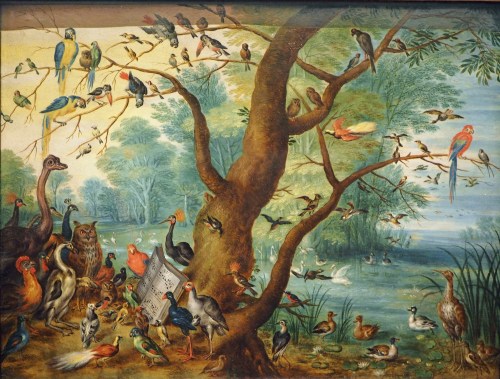
#FineArtFriday: The Bird Concert by Jan Brueghel the Younger ca. 1640 – 45

OLYMPUS DIGITAL CAMERA

Artist: Jan Brueghel the Younger (1601–1678)

Title: the Bird Concert

Date: between circa 1640 and circa 1645

Medium: oil on copper

Dimensions: height: 13.2 cm (5.1 in); width: 17.9 cm (7 in)

Collection: Herzog Anton Ulrich Museum

What I love about this painting:

This is a joyous, surreal exploration of all the birds the artist had ever seen in his native Antwerp, and many rare birds that he could only imagine. Brueghel has gathered birds from all over the world into a mystical, fairytale glen, posing them around a songbook.

They are learning to sing a in a language they all can understand, a wonderful allegory of the aspirations of the artist for humanity in the turbulent times during which he lived.

This painting also celebrates the new discoveries made by European explorers, as Brueghel had only seen scientific drawings of many of these birds. Even though he hadn’t seen some of these birds personally, he paints them as if they are before him.

The amazing flock of birds gathered here gives us an insight into the mind and sense of humor of Jan Brueghel the Younger, a man not too different from us even though he lived over 300 years ago.

This composition must have been important to Brueghel and says something about him. He went to the expense of getting copper as the base upon which he painted this scene. He was comfortable but not rich, so that tells me he intended this painting to last, to be something he would be remembered for.

About the medium of Oil on Copper, via Wikipedia:

Oil on copper paintings were prevalent in the mid sixteenth century in Italy and Northern Europe. The use of copper as a substrate for an oil painting dates back to Medieval times. The Flemish masters and other artists including Jan Breughel the ElderClaudeEl GrecoGuido ReniGuercinoRembrandtCarlo SaraceniAmbrosius Bosschaert IICopley Fielding and Vernet painted on copper. They favored copper for its smooth surface which allowed fine detail, and its durability. Copper is more durable than canvas or wood panel as a support for oil painting, as it will not rot, mildew or be eaten by insects. Contemporary painters also use copper as a base for paintings, some of them allowing the metal or patina to show through.

The old masters prepared the copper for painting first by rubbing it with fine pumice abrasive. The copper surface was then treated with garlic juice which is believed to improve adhesion of the paint. Finally a white or grey ground layer of oil paint was applied as a primer. After drying the copper panel was ready for the artist to begin painting. Later artists used the patina process, in which the copper is oxidized with the use of various acidic solutions, as part of the art work itself. The resulting patina or verdigris includes darkening of the metal, green and blue tones, depending on the chemical solution used. Patina is characterized by beautiful, variated patterns and textures which occur on the metal’s surface. [1]

About the Artist, via Wikipedia:

Jan Brueghel the Younger was born in Antwerp on 13 September 1601 as the son of Jan Brueghel the Elder and Isabella de Jode. His mother was the daughter of the cartographer, engraver and publisher Gerard de Jode. He trained and collaborated with his father in his workshop. His father was a friend and close collaborator of Peter Paul Rubens. Brueghel likely assisted with his father’s large-scale commissions.

On the wishes of his father he traveled around 1622 to Milan where he was welcomed by Cardinal Federico Borromeo. The cardinal was a patron and friend of his father who had met in Rome about 30 years earlier. In what was likely an act of rebellion against his father, he went to Genoa where he stayed with his cousins, the Antwerp painters and art dealers Lucas de Wael and Cornelis de Wael. Their mother was a sister of Brueghel’s mother. At the time his friend and fellow Antwerp artist Anthony van Dyck was also active in Genoa. He later worked in Valletta on Malta in 1623. From 1624 to 1625 he also resided in Palermo on Sicily at the time when van Dyck was also working there.

Brueghel learned that his father had died on 13 January 1625 from cholera only after his return to Northern Italy in Turin. Wanting to return to Antwerp immediately, he had to delay his departure for 16 days due to a severe fever. After recovering from his illness, he set off for his homeland by way of France. In Paris he met the Antwerp art dealer and painter Peter Goetkint the Younger, who was the son of Peter Goetkint the Elder, the master of Jan’s father. Goetkint was eager to return to Antwerp because his wife was expected to deliver a baby soon. The child was born on 25 August, the day on which Breughel arrived in Antwerp with his traveling companion who himself died a few days later.

Brueghel took over the management of his father’s workshop, sold the finished works of his father and finished some of his father’s unfinished paintings after completing them. In the Guild year 1624-1625, Brueghel became a master painter of the Guild of Saint Luke of Antwerp.

In 1626 he married Anna Maria Janssens, daughter of Abraham Janssens, a prominent history painter in Antwerp. He continued to operate the large workshop of his father. He became dean of the Guild of Saint Luke in 1630. That same year he was commissioned by the French court to paint a series of paintings on the life of Adam. It seems that his studio declined after this period and that he started to paint smaller scale paintings which commanded lower prices than those produced earlier.

In later years, he worked independently in Paris in the 1650s and produced paintings for the Austrian court in 1651. He is recorded again in Antwerp in 1657 where he remained until his death. [2]


Credits and Attributions:

[1] Wikipedia contributors, “Oil on copper,” Wikipedia, The Free Encyclopedia, https://en.wikipedia.org/w/index.php?title=Oil_on_copper&oldid=1060711380 (accessed June 9, 2022).

[2] Wikipedia contributors, “Jan Brueghel the Younger,” Wikipedia, The Free Encyclopedia, https://en.wikipedia.org/w/index.php?title=Jan_Brueghel_the_Younger&oldid=1086952033 (accessed June 9, 2022).

Image: The Bird Concert by Jan Brueghel the Younger ca. 1640 -1645, PD|100. Wikimedia Commons contributors, “File:Bruegel Vogelkonzert@Herzog Anton Ulrich Museum (1).JPG,” Wikimedia Commons, the free media
2 Comments

Filed under #FineArtFriday, writing

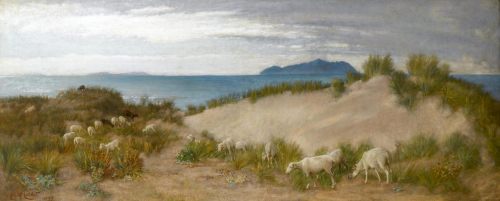
#FineArtFriday: Sheep Grazing in the Dunes on an Italian Coast by Edith Corbet

Edith_Corbet_Sheep_Grazing_in_the_Dunes,_on_an_Italian_CoastTitle: Sheep Grazing in the Dunes, on an Italian Coast

Artist: Edith Corbet (1846 – 1920),

Description: Landscape Art

Medium: oil on canvas

Dimensions: 83.5 x 203 cm. (33 x 80 in.)

What I love about this painting:

There is a softness to this image, and yet it feels as if we are there, viewing the beach and the sheep. We know it was painted in late spring, as the sheep have just been shorn, and a few lambs can be seen with their mothers. To the right of the scene, the sky has darkened, and a storm is moving in.

The beach grass, the color of the dunes, and the shades of the water reflecting the ever-changing colors of the sky feel real, perfectly recreated for us by the artist’s hands. She gives us a peaceful serene moment, a chance to just breathe deeply and let go of the stress of our modern lives.

This kind of day is familiar to me, a scene that could be found on many beaches here in my Northwestern part of the world. I love it when a brief storm moves in over the dunes, stirring the waters, and showing how the sky is the most important part of the scene. It’s as if the sky says to the sea, “You may be big and important, but I am larger and more powerful.”

Little is known about Edith’s life. She travelled a great deal and loved Italy. I suspect her first marriage, to illustrator Arthur Murch, was difficult, as he was in poor health much of the time. It has been said that while he was talented, he rarely finished a project. His reputation was based on the two illustrations he produced for Dalziels’ Bible Gallery, while Edith’s landscapes had begun to bring her some fame. Murch died in Germany, and most of Edith’s life at that time was in Italy.

By the time she painted this scene, in 1897, Edith and her second husband, Matthew Ridley Corbet, may have been living in England for at least part of the year.

About the Artist, via Wikipedia:

Edith Corbet née Edenborough (28 December 1846 – 1920) was a Victorian landscape painter, having close associations with the Macchiaioli group (also known as the Tuscans or Etruscans), who, in a break with tradition, painted outdoors in order to capture natural light effects and favoured a panoramic format for their paintings.

She married the Victorian painter and illustrator Arthur Murch and moved to Rome, where she painted with Giovanni Costa, leader of the Macchiaioli group. In 1876 they both stayed in Venice. Olivia Rossetti Agresti wrote: Costa had a very high opinion of this artist’s gifts and used to remember with pleasure how on that occasion they used to go out together to paint from nature at Fusino (Agresti, 1904).

She frequently exhibited from 1880 to 1890 at the Grosvenor Gallery and the New Gallery. In 1891, after the death of her first husband, she married Matthew Ridley Corbet, one of the Macchiaioli group’s leading members, after which she exhibited mainly at the Royal Academy, visiting Italy and living in London for the remainder of her life. Corbet exhibited her work at the Palace of Fine Arts at the 1893 World’s Columbian Exposition in Chicago, Illinois. She died in Hampstead, north London, in 1920. [1]


Credits and Attributions:

Image: Wikimedia Commons contributors, “File:Edith Corbet Sheep Grazing in the Dunes, on an Italian Coast.jpg,” Wikimedia Commons, the free media repository, https://commons.wikimedia.org/w/index.php?title=File:Edith_Corbet_Sheep_Grazing_in_the_Dunes,_on_an_Italian_Coast.jpg&oldid=617254333 (accessed June 2, 2022).

Comments Off on #FineArtFriday: Sheep Grazing in the Dunes on an Italian Coast by Edith Corbet

Filed under #FineArtFriday, writing

In Flanders’ Fields, by John McCrae #MemorialDay

Here in the US, we are celebrating Memorial Day. Originally known as Decoration Day, it’s a federal holiday dedicated to honoring those who died while serving in the US military. It used to be observed on May 30 regardless of the day of the week but in 1970 it was moved to the last Monday in May.

The beautiful image of poppies that graces this post is by Tijl Vercaemer from Gent, Flanders and was found on Wikimedia commons. The beauty and serenity of the poppies, rising from the fields where such terrible conflict once happened, is a fitting accompaniment for the poem, In Flanders Fields, by John McCrae, the text of which follows the picture.

From Wikipedia:  “In Flanders Fields” is a war poem in the form of a rondeau, written during the First World War by Canadian physician, Lieutenant-Colonel John McCrae. He was inspired to write it on May 3, 1915, after presiding over the funeral of friend and fellow soldier Alexis Helmer, who died in the Second Battle of Ypres. According to legend, fellow soldiers retrieved the poem after McCrae, initially dissatisfied with his work, discarded it. In Flanders Fields was first published on December 8 of that year in the London-based magazine Punch.

In Flanders Fields and Other Poems, a 1919 collection of McCrae’s works, contains two versions of the poem: a printed text as below and a handwritten copy where the first line ends with “grow” instead of “blow.” (…)

In Flanders fields the poppies blow
Between the crosses, row on row,
That mark our place; and in the sky
The larks, still bravely singing, fly
Scarce heard amid the guns below.

We are the Dead. Short days ago
We lived, felt dawn, saw sunset glow,
Loved and were loved, and now we lie
In Flanders fields.

Take up our quarrel with the foe:
To you from failing hands we throw
The torch; be yours to hold it high.
If ye break faith with us who die
We shall not sleep, though poppies grow
In Flanders fields.

While bed-ridden and recovering in the Veterans Administration Hospital in Vancouver, Washington, after World War II, my father had little to do but read or crochet. To keep busy, he and the other recovering soldiers in his ward made endless numbers of Remembrance Poppies to commemorate fallen American soldiers. Dad always wore his poppy on his left lapel, as it was close to his heart.

Memorial Day is more than just the official launch of Summer here in the US, more than just an Indy car race. Families have always cared for their family graves, but it became a designated day after the American Civil War in 1868, established  as “Decoration Day.” It was a specific time for the nation to decorate the graves of the war dead with flowers. Every family had soldiers who served and gave their lives in the never-ending wars, as we do today.

Officially, Memorial Day is a 3-day holiday weekend. Banks are closed on Monday, and the US Postal Service is also closed. The American flag is traditionally set at half-staff until noon to honor all those whose lives have been given in the service of our country. At noon, it is raised to the top of the staff, signifying that we, as a nation, will rise again.

My paternal grandmother never failed to keep our family’s graves neat and tidy, bringing flowers every week for my uncle, who had died while serving in the Korean War. As she got older, this tradition aggravated my father, who just wanted to listen to the Indianapolis 500 car race on the radio. He couldn’t bear dwelling on the loss of his brother, or the friends he had lost in France in WWII.

But he took her to the cemetery, anyway.

After each great and terrible war of the last two centuries, the hope was always that we had fought a “war to end all wars.” World War I, also known as The Great War, was spoken of in literature as just that: a war to end all wars.

With each conflict we still hope, but we are less able to believe it, today less than ever.


Sources and Attributions

In Flanders Fields, by Lieutenant Colonel John McCrae, MD, PD|75 years

John McCrae died of pneumonia January 28, 1918, near the end of the Great War. In Flanders’ Fields is a staple poem for Memorial Day services.

Wikipedia contributors. “In Flanders Fields.” Wikipedia, The Free Encyclopedia. Wikipedia, The Free Encyclopedia, 1 May. 2018. Web. 24 May. 2018

Poppies Field in Flanders, image By Tijl Vercaemer from Gent, Flanders #Belgium. File:Poppies Field in Flanders.jpg. (2018, January 13). Wikimedia Commons, the free media repository. Retrieved 15:55, May 24, 2018.

Comments Off on In Flanders’ Fields, by John McCrae #MemorialDay

Filed under #FineArtFriday, #FlashFictionFriday, Poetry

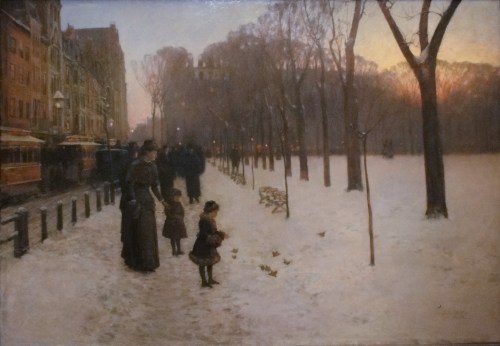
#FineArtFriday: Boston Common at Twilight by Childe Hassam ca. 1885

Childe_Hassam,_'Boston_Common_at_Twilight',_1885–86

Title: At Dusk (Boston Common at Twilight) by Childe Hassam

Date: between 1885 and 1886

Medium: oil on canvas

Dimensions: height: 42 in (106.6 cm); width: 60 in (152.4 cm)

Collection: Museum of Fine Arts, Boston Massachusetts

What I love about this painting:

Childe Hassam was known for his bold landscapes but by the mid-1880s, Hassam began painting cityscapes. This painting, Boston Common at Twilight was of his first cityscapes.

I particularly like the way he used a dark palette of blacks and browns, colors rarely used with such abandon by strict Impressionists (such as his contemporary, Claude Monet). The dark of the buildings and the clothes of the people are contrasted with many shades of white. The dirty snow trodden on the sidewalk shows us the truth of winter in an urban setting.

The contrasting of darkness against lightness on the land below forces the viewer’s eye upward to the dusky-blue sky and the rosy glow of sunset peeking from behind the trees, to the twilight mist forming in the chill evening air.

Two small girls use these last moments of light to play, perhaps to make snowballs under the eye of their mother or governess.

About the Artist, via Wikipedia:

Frederick Childe Hassam was known to all as “Childe” (pronounced like child), a name taken from an uncle. Hassam was born in the family home on Olney Street on Meeting House Hill in the Dorchester neighborhood of Boston, on October 17, 1859. His father, Frederick Fitch Hassam (1825–1880), was a moderately successful cutlery businessman with a large collection of art and antiques. He descended from a long line of New Englanders. His mother, Rosa Delia Hawthorne (1832–1880), a native of Maine, shared an ancestor with American novelist Nathaniel Hawthorne.

His father claimed descent from a seventeenth-century English immigrant whose name, Horsham, had been corrupted over time to Hassam. With his dark complexion and heavily lidded eyes, many took Childe Hassam to be of Middle Eastern descent—speculation which he enjoyed stoking. In the mid-1880s, he took to painting an Islamic-appearing crescent moon (which eventually degenerated into only a slash) next to his signature, and he adopted the nickname “Muley” (from the Arabic “Mawla”, Lord or Master), invoking Muley Abul Hassan, a fifteenth-century ruler of Granada whose life was fictionalized in Washington Irving‘s novel Tales of the Alhambra.

In 1882, Hassam became a free-lance illustrator (known as a “black-and-white man” in the trade) and established his first studio. He specialized in illustrating children’s stories for magazines such as Harper’s WeeklyScribner’s Monthly, and The Century. He continued to develop his technique while attending drawing classes at the Lowell Institute and at the Boston Art Club, where he took life painting classes.

Having had relatively little formal art training, Hassam was advised by his friend and fellow Boston Art Club member Edmund H. Garrett to join him on a two-month “study trip” to Europe during the summer of 1883. They traveled throughout the United Kingdom, the Netherlands, France, Italy, Switzerland, and Spain, studying the Old Masters together and creating watercolors of the European countryside. Hassam was particularly impressed with the watercolors of J. M. W. Turner. Sixty-seven of the watercolors that Hassam painted on this trip formed the basis of his second exhibition in 1884. During this period, Hassam taught at the Cowles Art School. He also joined the “Paint and Clay Club”, expanding his contacts in the art community, which included prominent critics and “the readiest and smartest of our younger generation of artists, illustrators, sculptors, and decorators—the nearest thing to Bohemia that Boston can boast.” Friends found him to be energetic, robust, outgoing, and unassuming, capable of self-mockery and considerate acts, but he could be argumentative and wickedly witty against those in the art community who opposed him. Hassam was particularly influenced by the circle of William Morris Hunt, who like the great French landscape painter Jean-Baptiste-Camille Corot, emphasized the Barbizon tradition of working directly from nature. He absorbed their credo that “atmosphere and light are the great things to work for in landscape painting.” [1]


Credits and Attributions:

[Image] Wikimedia Commons contributors, “File:Childe Hassam, ‘Boston Common at Twilight’, 1885–86.jpg,” Wikimedia Commons, the free media repository, https://commons.wikimedia.org/w/index.php?title=File:Childe_Hassam,_%27Boston_Common_at_Twilight%27,_1885%E2%80%9386.jpg&oldid=618750219 (accessed May 26, 2022).

[1] Wikipedia contributors, “Childe Hassam,” Wikipedia, The Free Encyclopedia, https://en.wikipedia.org/w/index.php?title=Childe_Hassam&oldid=1087821182 (accessed May 26, 2022).

6 Comments

Filed under #FineArtFriday

#FineArtFriday: Street Scene in Montmartre Vincent van Gogh 1887

Scène_de_Rue_à_MontmartreArtist: Vincent van Gogh (1853–1890)

Title: Street Scene in Montmartre

Genre: landscape art

Date: 1887

Medium: oil on canvas

Dimensions: height: 46.1 cm (18.1 in); width: 61.3 cm (24.1 in)

Collection: Private collection

What I love about this painting:

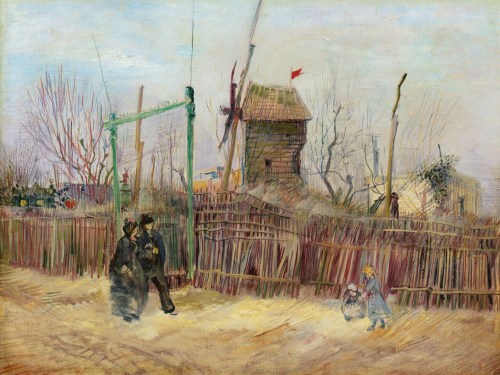
Street Scene in Montmartre is a relatively unknown painting by Vincent van Gogh, unknown because it has been held in private collections and not exhibited to the public. It was auctioned by Sotheby’s in 2021, and the image was posted to Wikimedia Commons courtesy of that auction.

The scene feels like an afternoon scene in winter, with a man and woman walking, and two children playing.

Vincent paid particular attention to the visual construction and texture of the fence, and also to the tangle of garden behind. This is the smaller of two windmills featured in several more well-known paintings in the subset of paintings from Van Gogh’s Montmartre series.

While there are people walking down the dirt lane in this scene, they aren’t the focus. Instead, our eye is directed to the way the windmill rises over the ramshackle fence, neglected garden, and above it all, the flag bravely flying.

The dirt lane, the fence, the winter-barren garden, and the windmill falling to ruin beneath the cold sky offer us a glimpse into Vincent’s mood. He finds beauty in the textures of life, both visual and metaphysical – in the cycle of growth aging to ruin. The flag flying in the breeze and the children playing offer us the hope of brighter days and new possibilities.

About this painting, via Wikipedia:

The Montmartre paintings are a group of works that Vincent van Gogh created in 1886 and 1887 of the Paris district of Montmartre while living there, at 54 Rue Lepic, with his brother Theo. Rather than capture urban settings in Paris, van Gogh preferred pastoral scenes, such as Montmartre and Asnières in the northwest suburbs. Of the two years in Paris, the work from 1886 often has the dark, somber tones of his early works from the Netherlands and Brussels. By the spring of 1887, van Gogh embraced use of color and light and created his own brushstroke techniques based upon Impressionism and Pointillism. The works in the series provide examples of his work during that period of time and the progression he made as an artist.

In van Gogh’s first year in Paris he painted rural areas around Montmartre, such as the butte and its windmills. The colors are somber and evoke a sense of his anxiety and loneliness.

The landscape and windmills around Montmartre were the source of inspiration for a number of van Gogh’s paintings. The Moulin de la Galette, still standing, is located near the apartment he shared with his brother. Built in 1622, it was originally called Blute-Fin and belonged to the Debray family in the 19th century. Van Gogh met artists such as Toulouse-Lautrec, Paul Signac and Paul Gauguin who inspired him to incorporate Impressionism into his artwork resulting in lighter, more colorful paintings.

Windmills also featured in some of van Gogh’s landscape paintings of Montmartre.

Montmartre, sitting on a butte overlooking Paris, was known for its bars, cafes, and dance-hall. It was also located on the edge of countryside that afforded Van Gogh the opportunity to work on paintings of rural settings while living in Paris.

When Van Gogh painted he intended not just to capture the subject, but to express a message or meaning. It was through his paintings of nature that he was most successful at accomplishing his goal. It also created a great challenge: how to portray the subject and create a work that would resonate with the audience. [1]

About the Artist, via Wikipedia:

Vincent Willem van Gogh, 30 March 1853 – 29 July 1890) was a Dutch Post-Impressionist painter who posthumously became one of the most famous and influential figures in Western art history. In a decade, he created about 2,100 artworks, including around 860 oil paintings, most of which date from the last two years of his life. They include landscapes, still lifes, portraits, and self-portraits, and are characterised by bold colours and dramatic, impulsive and expressive brushwork that contributed to the foundations of modern art. He was not commercially successful, struggled with severe depression and poverty, and committed suicide at the age of 37.

Van Gogh was born into an upper-middle-class family, While a child he drew and was serious, quiet and thoughtful. As a young man he worked as an art dealer, often traveling, but became depressed after he was transferred to London. He turned to religion and spent time as a Protestant missionary in southern Belgium. He drifted in ill health and solitude before taking up painting in 1881, having moved back home with his parents. His younger brother Theo supported him financially; the two kept a long correspondence by letter. His early works, mostly still lifes and depictions of peasant labourers, contain few signs of the vivid colour that distinguished his later work. In 1886, he moved to Paris, where he met members of the avant-garde, including Émile Bernard and Paul Gauguin, who were reacting against the Impressionist sensibility. As his work developed he created a new approach to still lifes and local landscapes. His paintings grew brighter as he developed a style that became fully realised during his stay in Arles in the South of France in 1888. During this period he broadened his subject matter to include series of olive trees, wheat fields and sunflowers.

Van Gogh suffered from psychotic episodes and delusions, and though he worried about his mental stability, he often neglected his physical health, did not eat properly and drank heavily. His friendship with Gauguin ended after a confrontation between the two when, in a rage, Van Gogh severed a part of his own left ear with a razor. He spent time in psychiatric hospitals, including a period at Saint-Rémy. After he discharged himself and moved to the Auberge Ravoux in Auvers-sur-Oise near Paris, he came under the care of the homeopathic doctor Paul Gachet. His depression persisted, and on 27 July 1890, Van Gogh is believed to have shot himself in the chest with a revolver, dying from his injuries two days later. [2]


Credits and Attributions:

Image: Scène de Rue à Montmartre, Vincent van Gogh PD|100, Wikimedia Commons contributors, “File:Scène de Rue à Montmartre.jpg,” Wikimedia Commons, the free media repository, https://commons.wikimedia.org/w/index.php?title=File:Sc%C3%A8ne_de_Rue_%C3%A0_Montmartre.jpg&oldid=617922499 (accessed May 19, 2022).

[1] Wikipedia contributors, “Montmartre (Van Gogh series),” Wikipedia, The Free Encyclopedia, https://en.wikipedia.org/w/index.php?title=Montmartre_(Van_Gogh_series)&oldid=1086671125 (accessed May 19, 2022).

[2] Wikipedia contributors, “Vincent van Gogh,” Wikipedia, The Free Encyclopedia, https://en.wikipedia.org/w/index.php?title=Vincent_van_Gogh&oldid=1087073450 (accessed May 19, 2022).

3 Comments

Filed under #FineArtFriday, writing

#FineArtFriday: Twilight Confidences by Cecilia Beaux 1888 (revisited)

Twilight_Confidences_by_Cecilia_BeauxTwilight Confidences by Cecilia Beaux  (1855–1942)
Date: 1888

Medium:  oil on canvas

Dimensions: 23 1/2 x 28 inches, 59.7 x 71.1 cm

Inscriptions: Signed and dated: Cecilia Beaux

What I love about this painting:

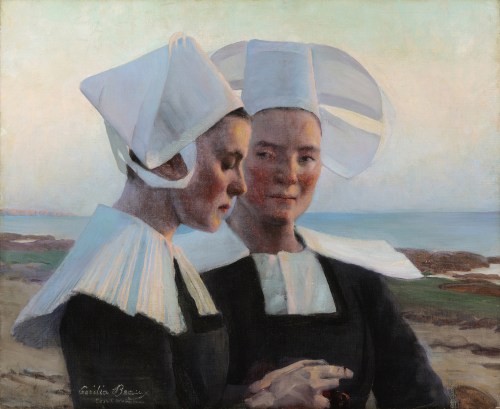
There is an honesty, a real sense of intimacy depicted here. The feeling of sisterhood between the two women is conveyed across the years. One holds an object with a personal meaning. She tells the other something about that object, something she feels she may be judged for. The other takes in what she has been told and accepts it for what it is.

About this painting via Wikimedia Commons:  

Cecilia Beaux was a leading figure and portrait painter and one of the few distinguished and highly recognized women artists of her time in America. Her figures are frequently compared to Sargent’s, but her style relates also to other international leaders of late-19th Century portraiture, including Anders Zorn, Giuseppe Boldini, Carolus-Duran and William Merritt Chase. She was born and lived mostly in Philadelphia, traveling frequently to Europe, especially France from a young age, and exhibited widely in Paris, Philadelphia, New York and elsewhere. Her first acclaimed work, Les Derniers jours d’enfance, a mother and child composition, was exhibited at the Paris Salon in 1887, and Beaux followed it there the next year, spending the summer of 1888 at the art colony at Concarneau in Brittany. Here she painted her remarkable Twilight Confidences of 1888, preceded by numerous studies, which are in the collection of the Pennsylvania Academy of the Fine Arts. Lost for many years, this much admired canvas is Beaux’s first major exercise in plein-air painting, in which the figures and the seascape are artfully and exquisitely juxtaposed, and sunlight permeates the whole composition.


Credits and Attributions:

Twilight Confidences, Cecilia Beaux, Public domain, via Wikimedia Commons

Wikimedia Commons contributors, “File:Twilight Confidences by Cecilia Beaux.jpg,” Wikimedia Commons, the free media repository, https://commons.wikimedia.org/w/index.php?title=File:Twilight_Confidences_by_Cecilia_Beaux.jpg&oldid=355146645 (accessed April 16, 2021).

Comments Off on #FineArtFriday: Twilight Confidences by Cecilia Beaux 1888 (revisited)

Filed under #FineArtFriday

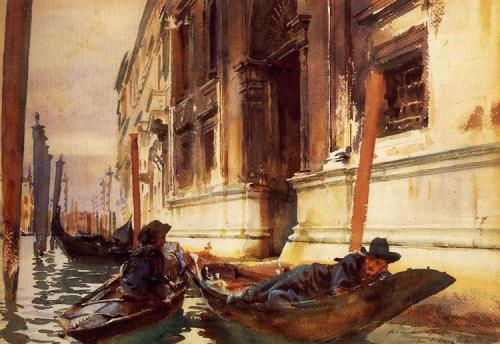
#FineArtFriday: The Gondoliers’ Siesta, John Singer Sargent 1904 (revisited)

The Gondoliers’ Siesta, John Singer Sargent 1904  

Artist: John Singer Sargent  (1856–1925)

Title: English: Gondoliers’ Siesta

Date: circa 1904

Medium: watercolor

Dimensions: 35.6 x 50.8 cm

Collection: Private collection, courtesy of Adelson Galleries

Current location: New York

Source/Photographer   Beyeler Foundation

What I Love About this Painting:

John Singer Sargent shows us a moment in time, set in Venice of 1904. It is an image capturing the heat of midday and the well-deserved rest of two men whose lives are spent on the water. They are well-employed, earning a good living by ferrying passengers from one end of town to another. During their heyday as a means of public transports, teams of four men would share ownership of a gondola — three oarsmen (gondoliers) and a fourth person, primarily shore based and responsible for the booking and administration of the gondola (Il Rosso Riserva).

About Singer’s Watercolors, via Wikipedia:

During Sargent’s long career, he painted more than 2,000 watercolors, roving from the English countryside to Venice to the Tyrol, Corfu, the Middle East, Montana, Maine, and Florida. Each destination offered pictorial stimulation and treasure. Even at his leisure, in escaping the pressures of the portrait studio, he painted with restless intensity, often painting from morning until night.

His hundreds of watercolors of Venice are especially notable, many done from the perspective of a gondola. His colors were sometimes extremely vivid and as one reviewer noted, “Everything is given with the intensity of a dream.” In the Middle East and North Africa Sargent painted Bedouins, goatherds, and fisherman. In the last decade of his life, he produced many watercolors in Maine, Florida, and in the American West, of fauna, flora, and native peoples.

With his watercolors, Sargent was able to indulge his earliest artistic inclinations for nature, architecture, exotic peoples, and noble mountain landscapes. And it is in some of his late works where one senses Sargent painting most purely for himself. His watercolors were executed with a joyful fluidness. He also painted extensively family, friends, gardens, and fountains. In watercolors, he playfully portrayed his friends and family dressed in Orientalist costume, relaxing in brightly lit landscapes that allowed for a more vivid palette and experimental handling than did his commissions (The Chess Game, 1906). His first major solo exhibit of watercolor works was at the Carfax Gallery in London in 1905. In 1909, he exhibited eighty-six watercolors in New York City, eighty-three of which were bought by the Brooklyn Museum. Evan Charteris wrote in 1927:

To live with Sargent’s water-colours is to live with sunshine captured and held, with the luster of a bright and legible world, ‘the refluent shade’ and ‘the Ambient ardours of the noon.’

Although not generally accorded the critical respect given Winslow Homer, perhaps America’s greatest watercolorist, scholarship has revealed that Sargent was fluent in the entire range of opaque and transparent watercolor technique, including the methods used by Homer.

About the Artist, via Wikipedia:

John Singer Sargent born January 12, 1856 – died April 14, 1925, was an American expatriate artist, considered the “leading portrait painter of his generation” for his evocations of Edwardian-era luxury. He created roughly 900 oil paintings and more than 2,000 watercolors, as well as countless sketches and charcoal drawings. His oeuvre documents worldwide travel, from Venice to the Tyrol, Corfu, the Middle East, Montana, Maine, and Florida.

He was born in Florence to American parents, and trained in Paris before moving to London, living most of his life in Europe. He enjoyed international acclaim as a portrait painter. An early submission to the Paris Salon in the 1880s, his Portrait of Madame X, was intended to consolidate his position as a society painter in Paris, but instead resulted in scandal. During the next year following the scandal, Sargent departed for England where he continued a successful career as a portrait artist.

From the beginning, Sargent’s work is characterized by remarkable technical facility, particularly in his ability to draw with a brush, which in later years inspired admiration as well as criticism for a supposed superficiality. His commissioned works were consistent with the grand manner of portraiture, while his informal studies and landscape paintings displayed a familiarity with Impressionism. In later life Sargent expressed ambivalence about the restrictions of formal portrait work, and devoted much of his energy to mural painting and working en plein air. Art historians generally ignored “society” artists such as Sargent until the late 20th century.

Sargent’s early enthusiasm was for landscapes, not portraiture, as evidenced by his voluminous sketches full of mountains, seascapes, and buildings. Carolus-Duran’s expertise in portraiture finally influenced Sargent in that direction. Commissions for history paintings were still considered more prestigious, but were much harder to get. Portrait painting, on the other hand, was the best way of promoting an art career, getting exhibited in the Salon, and gaining commissions to earn a livelihood.


Credits and Attributions:

Wikimedia Commons contributors, “File:John Singer Sargent, Gondoliers’ Siesta.jpg,” Wikimedia Commons, the free media repository, https://commons.wikimedia.org/w/index.php?title=File:John_Singer_Sargent,_Gondoliers%E2%80%99_Siesta.jpg&oldid=149791025 (accessed May 22, 2020).

Wikipedia contributors, “John Singer Sargent,” Wikipedia, The Free Encyclopedia, https://en.wikipedia.org/w/index.php?title=John_Singer_Sargent&oldid=956888160 (accessed May 22, 2020).

Wikipedia contributors, “Gondola,” Wikipedia, The Free Encyclopedia, https://en.wikipedia.org/w/index.php?title=Gondola&oldid=950230627 (accessed May 22, 2020).

Comments Off on #FineArtFriday: The Gondoliers’ Siesta, John Singer Sargent 1904 (revisited)

Filed under #FineArtFriday

#FineArtFriday: Officer and Laughing Girl by Johannes Vermeer circa 1657

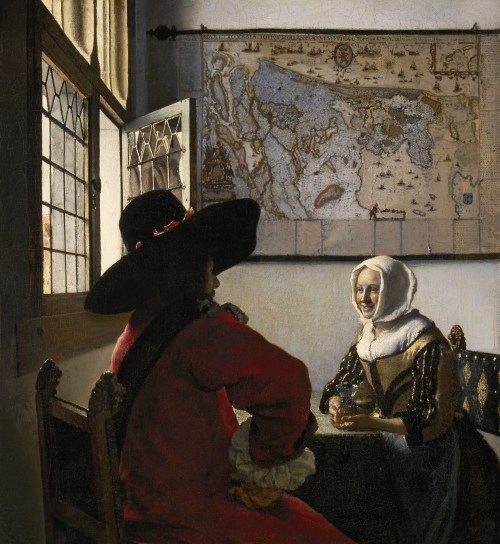
Johannes_Vermeer_-_Officer_and_Laughing_Girl_-_Google_Art_Project

Artist: Johannes Vermeer (1632–1675)

Title: Officer and Laughing Girl

Genre: genre art

Date: circa 1657

Medium: oil on canvas

Dimensions: height: 50.5 cm (19.8 in); width: 46 cm (18.1 in)

Collection: The Frick Collection

What I love about this painting:

Vermeer paints a story for us. He shows us a courting couple, a modestly dressed young woman seated opposite a young officer. Is this the home of her parents?

It is clearly not a tavern, as she has a crystal wine glass, which taverns wouldn’t have. Another clue to her social status is the map on the wall behind her, indicating her family may be merchants. Taverns rarely displayed maps as they were expensive.

Our girl is dwarfed by the map and also by the large man, whose face we don’t see, as he is captivated by her. Yet though she is physically smaller than her companion, she is not made small in this painting. Indeed, she has a large presence; her personality and smile have power, speaking to us across the centuries.

The light falls gently though the open window, illuminating the woman, bathing the scene with that quality Vermeer recreated so brilliantly.

Some male art critics suggest that the position of her hand indicates a less savory transaction is occurring here, but I feel they are wrong. Her hair is completely covered. She is not dressed provocatively, nor are they shown in a tavern or brothel. Her hand is shown as if gesturing in conversation, a natural gesture.

I think that nasty kind of interpretation is the result of a Victorian-era male art critic prejudice against women in art, dismissing them as morally corrupt. That sort of attitude poisons art interpretation at all levels. Maybe traditional critics need to look at paintings such as this with a fresh eye and see what is actually there: a young woman talking to a young man, seated in a corner at a table, most likely in full view of her middleclass parents.

Vermeer paints us a story of courtship within the bounds of society, of two people with middleclass values who are clearly attracted to each other. Will they be married? I like to think so.

The model for the woman in this painting was most likely Vermeer’s wife, and the dress she wears appears in other domestic scenes painted by Vermeer, as does the window and the table.

About Johannes Vermeer, the Master of Light (from Wikipedia)

Johannes Vermeer (October 1632 – December 1675) was a Dutch painter who specialized in domestic interior scenes of middle-class life. He was a moderately successful provincial genre painter in his lifetime but evidently was not wealthy, leaving his wife and children in debt at his death, perhaps because he produced relatively few paintings.

Vermeer worked slowly and with great care, and frequently used very expensive pigments. He is particularly renowned for his masterly treatment and use of light in his work.

Vermeer painted mostly domestic interior scenes. “Almost all his paintings are apparently set in two smallish rooms in his house in Delft; they show the same furniture and decorations in various arrangements and they often portray the same people, mostly women.”

He was recognized during his lifetime in Delft and The Hague, but his modest celebrity gave way to obscurity after his death. He was barely mentioned in Arnold Houbraken‘s major source book on 17th-century Dutch painting (Grand Theatre of Dutch Painters and Women Artists), and was thus omitted from subsequent surveys of Dutch art for nearly two centuries. In the 19th century, Vermeer was rediscovered by Gustav Friedrich Waagen and Théophile Thoré-Bürger, who published an essay attributing 66 pictures to him, although only 34 paintings are universally attributed to him today. Since that time, Vermeer’s reputation has grown, and he is now acknowledged as one of the greatest painters of the Dutch Golden Age. [1]


Credits and Attributions:

Wikimedia Commons contributors, “File:Johannes Vermeer – De Soldaat en het Lachende Meisje – Google Art Project.jpg,” Wikimedia Commons, the free media repository, https://commons.wikimedia.org/w/index.php?title=File:Johannes_Vermeer_-_De_Soldaat_en_het_Lachende_Meisje_-_Google_Art_Project.jpg&oldid=617576363 (accessed April 29, 2022).

[1] Wikipedia contributors, “Johannes Vermeer,” Wikipedia, The Free Encyclopedia, https://en.wikipedia.org/w/index.php?title=Johannes_Vermeer&oldid=1082091616 (accessed April 29, 2022).

Comments Off on #FineArtFriday: Officer and Laughing Girl by Johannes Vermeer circa 1657

Filed under #FineArtFriday

#FineArtFriday: Christ in the Storm on the Sea of Galilee by Rembrandt van Rijn, 1633, reprise

Today’s image is of a picture that was stolen March 18, 1990, in one of the largest art heists in history. It has never been recovered. If it could be recovered from wherever it is, it would be a day of rejoicing for me and art lovers around the world. I suspect it is now in a private collection, somewhere. Perhaps it is being passed off as a copy, or perhaps it is in a hidden room full of stolen art.

It is a terrible thing when art is looted and stolen from its rightful owners. When art is stolen from a musem, it is stolen from the world. I wish the stings of a thousand fleas on the people who paid to acquire the paintings stolen that night.

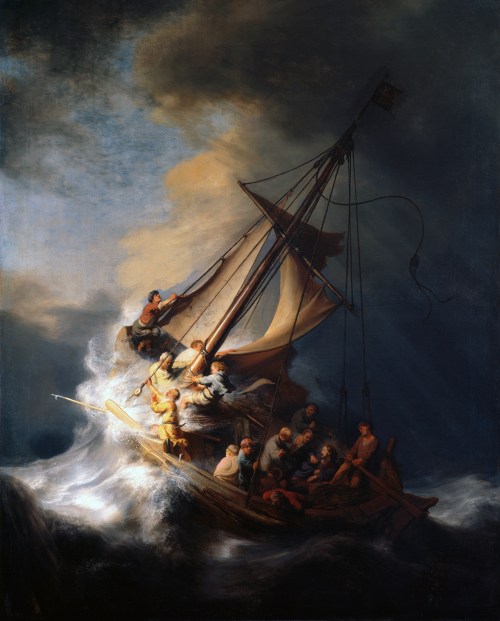
Christ in the Storm on the Sea of Galilee was painted during one of the happiest years of Rembrandt van Rijn’s turbulent life and depicts the miracle of Jesus calming the storm on the Sea of Galilee. A devout Christian, Rembrandt painted it from the description of the event as reported by the Apostle Mark, in the fourth chapter of his Gospel. As far as is known, it is the only seascape Rembrandt ever painted.

Constantijn Huygens, the father of Dutch mathematician and physicist Christiaan Huygens, had seen Rembrandt’s talent and helped him gain important commissions from the Court of The Hague. Many of his best religious paintings date from the years during which he had the favor of both Huygens and Prince Frederick Hendrick.

At the end of 1631, Rembrandt had moved to Amsterdam. The city was becoming the new business capital of the Netherlands, so there was great opportunity there for artists. In Amsterdam, Rembrandt had begun to paint portraits for the first time, and by 1633, his work was in high demand. His religious paintings and history paintings were also receiving the highest praise.

At first, he lived with an art dealer, Hendrick van Uylenburgh, which was where he met Hendrick’s cousin, Saskia van Uylenburgh. During 1633, the year in which Christ on the Sea of Galilee was painted, he was courting Saskia, hoping to marry her. He was earning a good income as a portraitist, and a bright future loomed. He must have felt in many ways as if he had the world by the tail.

What I love about this painting:

Rembrandt’s colors are vivid, standing out against the darkness of the storm. An entire story is captured in this image. The sea is terrifying, monstrous waves battering the ship, men panicking, trying to gain control. The terror of the event is clearly shown, and you feel fear for the men too. In the midst of chaos, Jesus awakes, calm despite the panic around him. Each face has a different expression, and one, a man holding a rope in one hand and pressing his cap to his head with the other, looks directly at us—Rembrandt himself.

The Gospel of Mark records the incident:

He woke up and rebuked the wind, and said to the sea, “Peace! Be still!” Then the wind ceased, and there was a dead calm. He said to them, “Why are you afraid? Have you still no faith?” And they were filled with great awe and said to one another, “Who then is this, that even the wind and the sea obey him?

Rembrandt, a frail man but a devout believer, lived the story as he painted it, as do all good storytellers.

About the theft, via Wikipedia:

On March 18, 1990, 13 works of art valued at a combined total of $500 million were stolen from the Isabella Stewart Gardner Museum in Boston. In the early hours, guards admitted two men posing as police officers responding to a disturbance call. Once inside, the thieves tied up the guards and over the next hour committed the largest-value recorded theft of private property in history. Despite efforts by the Federal Bureau of Investigation (FBI) and multiple probes around the world, no arrests have been made, and no works have been recovered.

The stolen works had originally been purchased by art collector Isabella Stewart Gardner (1840–1924) and intended to be left on permanent display at the museum with the rest of her collection. Since the collection and its layout are permanent, empty frames remain hanging both in homage to the missing works and as placeholders for their potential return. Experts are puzzled by the choice of paintings that were stolen, especially since more valuable artwork was left untouched. Among the stolen works was The Concert, one of only 34 known works by Vermeer and thought to be the most valuable unrecovered painting, valued at over $200 million.[when?] Also missing is The Storm on the Sea of GalileeRembrandt‘s only known seascape. Other works by Rembrandt, DegasManet, and Flinck were also stolen.

Christ in the Storm on the Sea of Galilee by Rembrandt van Rijn

  • Artist:   Rembrandt  (1606–1669)
  • Genre: religious art
  • Date: 1633
  • Medium: oil on canvas
  • Dimensions: Height: 160 cm (62.9 ″); Width: 128 cm (50.3 ″)
  • Current Location: Unknown

Sources and Attributions:

Wikimedia Commons contributors, “File:Rembrandt Christ in the Storm on the Lake of Galilee.jpg,” Wikimedia Commons, the free media repository, https://commons.wikimedia.org/w/index.php?title=File:Rembrandt_Christ_in_the_Storm_on_the_Lake_of_Galilee.jpg&oldid=341966464 (accessed April 4, 2019).

Wikipedia contributors, “Calming the storm,” Wikipedia, The Free Encyclopedia, https://en.wikipedia.org/w/index.php?title=Calming_the_storm&oldid=882782126 (accessed April 4, 2019).

The Isobel Stewart Gardner Museum, CHRIST IN THE STORM ON THE SEA OF GALILEE, 1633, https://www.gardnermuseum.org/experience/collection/10953 (accessed April 4, 2019).

2 Comments

Filed under #FineArtFriday

#FineArtFriday: Shrovetide Revelers by Frans Hals ca. 1616

Frans_Hals,_Merrymakers_at_Shrovetide,_The_Metropolitan_Museum_of_ArtArtist: Frans Hals  (1582/1583–1666)

Title: Shrovetide Revelers

Genre: genre painting

Date: circa 1616–17

Medium: oil on canvas

Dimensions: 51 ¾ × 39 ¼ in. (131.4 × 99.7 cm)

Collection: Metropolitan Museum of Art

What I think about this painting:

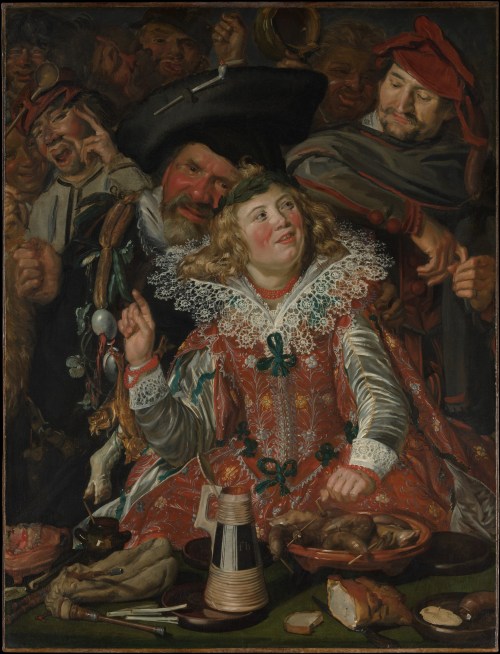
This was a lurid scene at the time it was painted and is still lurid today. The sole female portrayed is a girl dressed in the finest of garments, surrounded by men. She is well-fed, has abundant blonde hair, and represents the concept of “plenty.” The party will go on for as long as she lasts–when she is gone, the party is over.

The color of her hair is gold, an allegory for an abundance of coins. The men posed around her represent the human tendency toward gluttony, drunkenness, and greed.

Frans Hals depicted the embroideries on the fabric of her dress and the intricate lace at her neck and cuffs with exquisite care and attention to detail. The sheen of her satin sleeves gleams in the candlelight, showing off the strings of beads at her neck and wrist. Perhaps the beads are carnelians. Her brightly flushed cheeks give evidence to her inebriation.

All the characters, including the serving man, are shown as having overindulged. The foods on the table are those any person could acquire, but they are shown being wasted, used as decorations for fools.

Food was an incredibly popular subject for paintings during the renaissance–still lifes were exceedingly good sellers for most artists. Food of all varieties was carefully staged and shown with superb realism and minute detail. Those artists we now call the Dutch and Flemish masters used food as an allegory, and even in genre paintings, they loved to paint lavish food displays.

As in the scene above, the foods depicted in scenes of drunkenness and revelry conveyed symbolic meanings, often implying immorality and debauchery.

Mostly, the imagery was intended to be a reminder that great wealth can vanish overnight. Also, they show us that gluttony is both unappealing to look at and unhealthy for the glutton.

But when I see an image such as this painting, I have to think these artists, whose own morals were often quite elastic, were exercising their broad senses of humor.

About this painting, via The Met Museum:

Shrovetide, now better known as Mardi Gras, is the traditional period of indulgence before the fasting and self-discipline of Lent. In the seventeenth-century Netherlands, it was also the occasion for theatrical performances by the painters’ guilds.

Here, Hals depicts two stock figures from these plays, Hans Wurst, with a sausage dangling from his cap, and Pekelharing, who sports a garland of salted fish and eggs.

They flank a richly dressed girl (probably a boy in drag, as women were not permitted to perform on these occasions).

Still life elements litter the foreground, evoking both the traditional foods of the festival and an abundance of erotic innuendo. [1]

About this painting, via Wikipedia:

Shrovetide Revellers, also known as Merrymakers at Shrovetide, is a painting by the Dutch Golden Age painter Frans Hals, painted in around 1616–17. It is one of the earliest surviving works by Hals, and has been held by the Metropolitan Museum of Art, New York City since 1913. The painting shows people festivities at Shrovetide (DutchCarnaval), an annual carnival of food and jollity which takes place before the Christian fasting season of Lent.

The painting shows the face of an elegantly dressed smiling woman raising her right finger to make a point, while a man grabs her shoulder to whisper in her ear: he has a string of herring, eggs and mussels around his neck, with a pig’s trotter and a fox tail, symbols of gluttony and foolishness respectively. Another amused gentleman, with a wurst hanging from his cap, leans on the first man’s shoulder and listens to their banter. Some claim these are the Baroque theatre characters Peeckelhaeringh and Hans Wurst. Behind them other people are talking and laughing. The flagon Bears the initials “fh”. [2]


Credits and Attributions:

[1] Shrovetide Revellers or Merrymakers at Shrovetide by Frans Hals, Met Museum Contibutors © 2000–2022 The Metropolitan Museum of Art. Frans Hals | Merrymakers at Shrovetide | The Metropolitan Museum of Art (metmuseum.org) (Accessed April 14, 2022).

[2] Wikipedia contributors, “Shrovetide Revellers,” Wikipedia, The Free Encyclopedia, https://en.wikipedia.org/w/index.php?title=Shrovetide_Revellers&oldid=1070869013 (accessed April 14, 2022).

4 Comments

Filed under #FineArtFriday, writing