Category Archives: #FineArtFriday

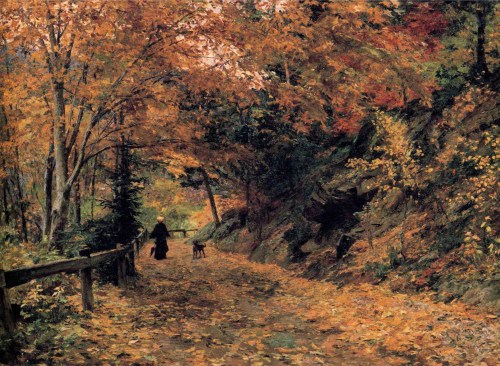
#FineArtFriday: Falling Leaves, by Olga Wisinger-Florian (revisited)

Falling Leaves, by Olga Wisinger-Florian, circa 1899, first appeared here in October of 2018.  It is one of my favorite depictions of autumn. The scene could be happening here in my lovely Pacific Northwestern forests. The colors of the leaves, the dirt road–this is very like where I grew up.

The painting depicts a woman and her dog enjoying a quiet walk in the serenity of an autumn day. Using light and shadow, the artist employs an impressionistic style to convey the forest. Nothing is drawn with precision, yet everything is shown in its entirety. The feeling of this piece is a little dreamlike–she carries an umbrella, so she’s prepared for rain. She is dressed all in black except for her yellow hat. Leaves in all the many shades of green, gold, and red cling to their trees; the damp, aging rails of the wooden fence offers a flimsy barrier to the carriages and motor vehicles that may travel the roadside. Leaves cover the dirt road, and more are falling down, and the dog trots happily along beside her mistress—the story is there for us to see.

About the Artist:

According to Wikipedia, Olga Wisinger-Florian’s early paintings can be assigned to what is known as Austrian Mood Impressionism. In her landscape paintings she adopted Schindler’s sublime approach to nature. The motifs she employed, such as views of tree-lined avenues, gardens and fields, were strongly reminiscent of her teacher’s work. After breaking with Schindler in 1884, however, the artist went her own way. Her conception of landscapes became more realistic. Her late work is notable for a lurid palette, with discernible overtones of Expressionism. With landscape and flower pictures that were already Expressionist in palette by the 1890s, she was years ahead of her time.


Credits and Attributions:

Falling Leaves, by Olga Wisinger-Florian, ca 1899 [Public domain], via Wikimedia Commons

Wikipedia contributors, “Olga Wisinger-Florian,” Wikipedia, The Free Encyclopedia, https://en.wikipedia.org/w/index.php?title=Olga_Wisinger-Florian&oldid=852607929 (accessed October 11, 2018).

Wikimedia Commons contributors, “File:Olga Wisinger-Florian – Falling Leaves.JPG,” Wikimedia Commons, the free media repository, https://commons.wikimedia.org/w/index.php?title=File:Olga_Wisinger-Florian_-_Falling_Leaves.JPG&oldid=273565541 (accessed October 11, 2018).

Comments Off on #FineArtFriday: Falling Leaves, by Olga Wisinger-Florian (revisited)

Filed under #FineArtFriday

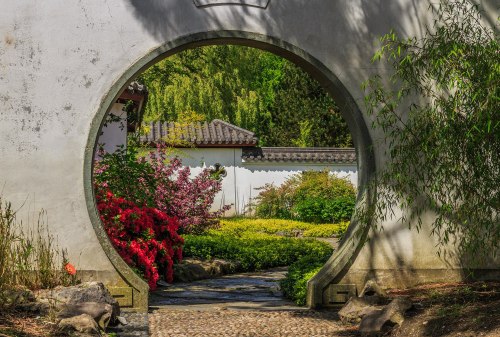
#FineArtFriday: Moon Gate – Chinese Garden in the Hortus Haren by Dominicus Johannes Bergsma

Doorgang_in_muur._Locatie,_Chinese_tuin_Het_Verborgen_Rijk_van_Ming._Locatie._Hortus_Haren_01

Moon Gate, Chinese Garden in the Hortus Haren, The Netherlands

Date: 30 May 2015, 14:31:15

Author: Dominicus Johannes Bergsma

Camera location: 53° 10′ 48.67″ N, 6° 36′ 13.15″ E

About this image, via Wikimedia Commons:

A photograph of the passage in wall known as Moon Gate. Location, Chinese garden, the Hidden Realm of Ming. Location: Hortus Haren, one of the oldest botanical gardens in the Netherlands.

This photograph is a featured picture, which means that members of the community have identified it as one of the finest images on the English Wikipedia, adding significantly to its accompanying article. It was also a finalist in Picture of the Year 2015. [1]

What I love about this photograph:

This is a fairytale image. What magic lies beyond the gate? The composition is perfect. The round gate centered in the ordinary wall, a surprise opening onto a world of color and mystery. I would love to walk in this place.

About Hortus Haren, via Wikipedia:

Hortus Haren is a botanical garden in Haren, Groningen, Netherlands. First created in 1626 by the pharmacist Henricus Munting, it was then situated between Grote Rozenstraat and Grote Kruisstraat in Groningen.  Because of space considerations it relocated to Haren in 1967 and became the largest botanical garden in the country. [2]


Credits and Attributions:

Moon Gate, Chinese Garden in the Hortus Haren, The Netherlands, by Dominicus Johannes Bergsma. Dominicus Johannes Bergsma, CC BY-SA 4.0 https://creativecommons.org/licenses/by-sa/4.0, via Wikimedia Commons.

[1] Wikimedia Commons contributors, “File:Doorgang in muur. Locatie, Chinese tuin Het Verborgen Rijk van Ming. Locatie. Hortus Haren 01.jpg,” Wikimedia Commons, the free media repository, https://commons.wikimedia.org/w/index.php?title=File:Doorgang_in_muur._Locatie,_Chinese_tuin_Het_Verborgen_Rijk_van_Ming._Locatie._Hortus_Haren_01.jpg&oldid=684921659 (accessed September 29, 2022).

[2] Wikipedia contributors, “Hortus Haren,” Wikipedia, The Free Encyclopedia, https://en.wikipedia.org/w/index.php?title=Hortus_Haren&oldid=1111475348 (accessed September 29, 2022).

2 Comments

Filed under #FineArtFriday

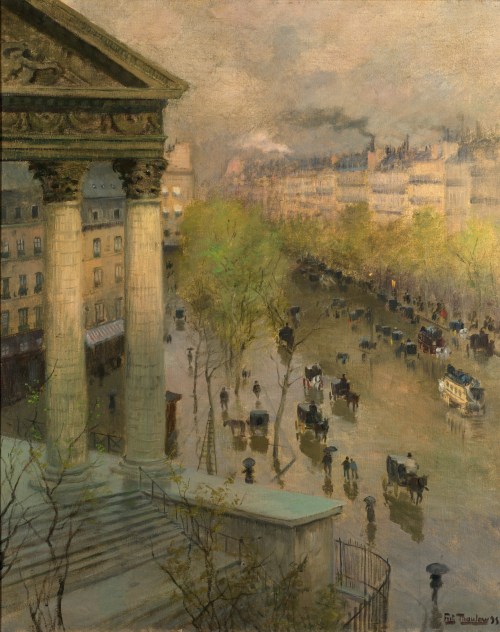
#FineArtFriday: Boulevard de la Madeleine in Paris by Frits Thaulow ca 1897 (revisited)

Frits_Thaulow_-_Boulevard_de_la_Madeleine_à_Paris_(1890s)Title: Boulevard de la Madeleine in Paris by Frits Thaulow

Date: circa 1896-1897

Medium: oil on canvas

Dimensions: Height: 88.2 cm (34.7 in); Width: 66.3 cm (26.1 in)

Collection: Pushkin Museum of Fine Arts

Inscriptions: Signature and date bottom right: Frits Thaulow (date is unclear)

What I like about this painting:

This is a street scene viewed from an angle we rarely see in paintings. The people and vehicles are small, insignificant in comparison with the size and grandeur of the buildings.

While Thaulow didn’t enjoy painting cityscapes, I think Boulevard de la Madeleine in Paris is one of the best of that era.

The soot from the chimneys in the distance, the wet street, the muted, watery colors of a rainy spring day, and the God’s-eye view of the busy street—it all comes together to present a powerful statement.

About the Artist, Via Wikipedia:

Thaulow was one of the earliest artists to paint in Skagen in the north of Jutland, soon to become famous for its Skagen Painters. He arrived there in 1879 with his friend Christian Krohg, who persuaded him to spend the summer and autumn there. They arrived from Norway in Thaulow’s little boat. Thaulow, who had specialized in marine painting, turned to Skagen’s favourite subjects, the fishermen and the boats on the shore.

Thaulow moved to France in 1892, living there until his death in 1906. He soon discovered that the cityscapes of Paris did not suit him. His best paintings were made in small towns such as Montreuil-sur-Mer (1892–94), Dieppe and surrounding villages (1894–98), Quimperle in Brittany (1901) and Beaulieu-sur-Dordogne in the Corrèze département (1903). One of his most famous works once he moved to france was A village street in France. In Dieppe Thaulow and his wife Alexandra made themselves popular: they were friends with artist Charles Conder, and they met Aubrey Beardsley. [1]


Credits and Attributions:

[1] Wikipedia contributors, “Frits Thaulow,” Wikipedia, The Free Encyclopedia, https://en.wikipedia.org/w/index.php?title=Frits_Thaulow&oldid=1026282924 (accessed June 10, 2021).

Boulevard de la Madeleine in Paris, ca 1896-97 by  Frits Thaulow, Public domain, via Wikimedia Commons. Wikimedia Commons contributors, “File:Frits Thaulow – Boulevard de la Madeleine à Paris (1890s).jpg,” Wikimedia Commons, the free media repository, https://commons.wikimedia.org/w/index.php?title=File:Frits_Thaulow_-_Boulevard_de_la_Madeleine_%C3%A0_Paris_(1890s).jpg&oldid=566337323 (accessed June 10, 2021).

7 Comments

Filed under #FineArtFriday

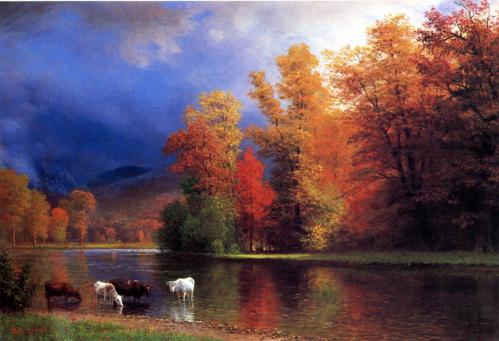
#FineArtFriday: On the Saco by Albert Bierstadt

Bierstadt_Albert_On_the_SacoArtist: Albert Bierstadt (1830–1902)

Title: “On the Saco”

Genre: landscape art

Description: Of the Saco River, Maine.

Date: Unknown date (19th century)

Medium: oil painting.

What I love about this image:

Bierstadt understood and respected the power of nature. The way he rendered the sky is wonderful. He captured that brilliant darkness of a distant storm against the bright sunshine of an autumn afternoon. I love contrasts in this painting, the bright foliage in every shade of red and yellow, the serenity of the cattle drinking in the shallows.

The heavy darkness of the storm in the hills seems to be pushed back by the serene glow of fall’s sunlight on the river. Will it rain itself out before it passes over the herd? Possibly.

About the Artist, via Wikipedia:

Albert Bierstadt (January 7, 1830 – February 18, 1902) was a German-American painter best known for his lavish, sweeping landscapes of the American West. He joined several journeys of the Westward Expansion to paint the scenes. He was not the first artist to record the sites, but he was the foremost painter of them for the remainder of the 19th century.

Bierstadt was born in Prussia, but his family moved to the United States when he was one year old. He returned to study painting for several years in Düsseldorf. He became part of the second generation of the Hudson River School in New York, an informal group of like-minded painters who started painting along the Hudson River. Their style was based on carefully detailed paintings with romantic, almost glowing lighting, sometimes called luminism. Bierstadt was an important interpreter of the western landscape, and he is also grouped with the Rocky Mountain School. [1]


Credits and Attributions:

Image: On the Saco by Albert Bierstadt, Wikimedia Commons contributors, “File:Bierstadt Albert On the Saco.jpg,” Wikimedia Commons, the free media repository, https://commons.wikimedia.org/w/index.php?title=File:Bierstadt_Albert_On_the_Saco.jpg&oldid=618723154 (accessed September 16, 2022).

[1] Wikipedia contributors, “Albert Bierstadt,” Wikipedia, The Free Encyclopedia, https://en.wikipedia.org/w/index.php?title=Albert_Bierstadt&oldid=1107140650 (accessed September 16, 2022).

5 Comments

Filed under #FineArtFriday

#FineArtFriday: The Munitions Girls by Stanhope Forbes,1918 #LaborDay

L0059548 'The Munitions Girls' oil painting, England, 1918

Artist: Stanhope Forbes (1857–1947)

Title: The Munitions Girls

Date: 1918

Medium: oil on canvas

Dimensions: height: 103 cm (40.5 in); width: 127 cm (50 in)

Collection: Science Museum

About this Image, via Wikimedia Commons:       

Commissioned by John Baker & Co, this famous oil painting, The Munitions Girls, shows women working at Kilnhurst Steelworks during the First World War. The artist was Alexander Stanhope Forbes (1857-1947). Like many other steelworks during the war, John Baker & Co’s Kilnhurst site was converted to make shells and ammunition. As men volunteered or were conscripted to fight in the British Army, women became the main work force in industry and farming. Munitions workers could often be picked out in a crowd because of the distinctive yellow coloring of their hair and skin caused by the sulfur used in production. They were nicknamed canaries. [1]

My Usual Fine Art Rant Goes in a Different Direction:

The women in this picture are shown doing dangerous, dirty work. They stepped up and did what they had to do to make sure their husbands and lovers had the weapons they needed to defend their country.

And they are doing it for very little money, less than men would have earned. While that is slowly changing, some things remain the same. It’s difficult to find people who want to do the “ordinary work,” jobs considered blue-collar, or manual labor.

Here in the US, it is Labor Day weekend, the last hurrah of summer, but more importantly, a day dedicated to appreciation of those who make up our labor force, the people who do the unglamorous work that keeps our world turning smoothly.

I’ve always been a writer, but I like to eat. I always held two and three part-time jobs just to keep the roof over my children’s heads and food on their table. I could make the food budget stretch like a politician’s idea of truth.

  • 1970s-80s – a field hand for a multi-national Christmas tree company, bookkeeper, photo lab tech, waitress in a bakery and also worked in a deli.
  • 1980s-90s – a hotel maid, a dark-room technician, a bookkeeper, and an office manager
  • 2000-13 – a bookkeeper, tax-preparer, data entry.

None of my work was glamorous but I always found something to enjoy in each job. By going to work every day I was able to pay my bills, which I did enjoy. Sometimes, especially during the Reagan years and into the 90s, wages were low, and jobs were scarce.

I worked every weekend and every holiday and yes it was not easy, but it was what it was. My kids knew I was doing my best for them, and they appreciated it.

During the late 70s and early 80s I was a field hand for the J. Hofert Company (Christmas trees) and absolutely loved the work. It was outdoors, paid $3.25 an hour and it was seasonal, but I was able to work a lot of overtime, as field hands were as hard to get then as they are now.

My favorite job was as a hotel maid at a large hotel in Olympia–the work was hard, but I enjoyed it for 12 years. For most of the 1990s it was my weekend job that I kept along with my bookkeeping job, because the hotel was a union shop.

As a bookkeeper/office manager for a charter bus company, I made $7.50 an hour (two dollars over minimum at the time). I worked four seven-hour shifts a week, Monday through Thursday, arriving at 06:00 AM to open the shop, ate lunch at my desk, and went home at 1:00 PM (13:00 military time). That job had no benefits whatsoever. However, I was home when my kids got off the school bus and could make sure they got to their after-school activities.

At my second job, 3 eight-hour shifts Friday through Sunday, I worked as a hotel housekeeper in a union shop. I made $8.50 an hour (three dollars over minimum).

I kept those two jobs all through the 1990s because I was home every night and earned enough to live decently and provide for my children.

No matter what other job I had, I kept my weekend job at the hotel, because it paid well and left my mind free to think about what I was writing. When other jobs went away, I always had that one to fall back on.

Because of the union, we who did the dirty work earned a little more than other women in that line of work, and had a few benefits, such as health insurance and a 401k. Without the union, we hotel maids would have had nothing more than minimum wage.

Not every union is good, and not every union is reasonable. But while I don’t agree with everything every union does and stands for, I do feel gratitude that I and my family was protected by a good, reasonable organization during those years of struggle.

I’m retired now and have the time to write all I want. The world is a different place in many ways, and workers are in short supply. Every place is short-staffed because there are more job openings than workers to fill them.

Someone must do the dirty jobs, the work that no one else wants. I have nothing but respect for those who work long hard hours in all areas of the service industry, struggling to support their families. Look around you, and see the people who make your life easier, by being there every day doing their job.

Every one of them is a person just like you, a living, caring human being with hopes, ambitions, triumphs, and tragedies. Every one of them has a story and a reason to be where they are, doing the task they have been given.

Say a little thank you to all those who take your unintentional abuse when you are stressed out and “don’t have time to wait,” or are upset by things you have no control over and need to vent at someone who can’t or won’t fight back.

The women in Stanhope Forbes’ painting are all gone now, memories of a moment in history. But what they did was important. Give a little thanks to those who do the dirty work and enable you to live a little easier.

About the Artist, via Wikipedia:

Forbes was born in Dublin, the son of Juliette de Guise Forbes, a French woman, and William Forbes, an English railway manager, who was later transferred to London. He had an older brother, Sir William Forbes, who was a railway manager for the London, Brighton, and South Coast Railway.

He was married in the summer of 1889 to fellow painter Elizabeth Armstrong at Newlyn’s St Peter’s Church. Their first home was at the “Cliffs Castle” cottage, which overlooked the sea. They had a son named Alexander (Alec). The couple had a home built for the family in Higher Faughan, Penzance. Elizabeth died in 1912.

Forbes generally painted genre scenes and landscapes en plein air.

Beyond his plein air painting, he also made interior scenes and was adept at capturing the “warm and charming” effects of lighting on a room and the people in it, such as The Lantern, made in 1897. More poignantly, Mrs. Lionel Birch writes of his style and particularly the painting The Health of the Bride: “[The painting depicts the] dominant note of his life’s message, his sense of sympathetic humanity. These people in their humble little parlour, are real and living. Intolerant of all shams and false sentiment, the painter has made himself one with the people he depicts; he has understood the humour which lies so close to tears.”

Of Forbes’s works, Norman Garstin said: “he is a good unsentimental painter, his work has a sense of sincerity that appeals to everyone”. [2]


Credits and Attributions:

[1] Wikimedia Commons contributors, “File:’The Munitions Girls’ oil painting, England, 1918 Wellcome L0059548.jpg,” Wikimedia Commons, the free media repository, https://commons.wikimedia.org/w/index.php?title=File:%27The_Munitions_Girls%27_oil_painting,_England,_1918_Wellcome_L0059548.jpg&oldid=667352991 (accessed September 1, 2022).

[2] Wikipedia contributors, “Stanhope Forbes,” Wikipedia, The Free Encyclopedia, https://en.wikipedia.org/w/index.php?title=Stanhope_Forbes&oldid=1089060843 (accessed September 1, 2022).

2 Comments

Filed under #FineArtFriday

#FineArtFriday: Two Photographs via Wikimedia Commons

Best_Nature_Picture_of_the_dayDescription: Best Nature Picture of the Day, by Guruspsingh

English: This picture for nature and anyone see now and save nature

Date: 1 August 2020

Source: Own work

Author: Guruspsingh

About these images:

I enjoy looking at the various photographs of nature that one can find through Wikimedia Commons. Every day, it’s something new and different. Sometimes I come across an image that should be an award winner, but so far as I know, has gone unnoticed. These are two of those.

The author titled the above photograph “Best Nature Picture of the Day” and I have to agree with her/him, whoever they are. The intensity of color, the serenity of the composition – this image is powerful.

I wish I could find out more about this photographer and their work. The photographer doesn’t have a completed bio on Wikimedia. I could find no information or website for them, so I have no way of directing viewers to their artwork. There are numerous photographers with the last name of Singh. This particular artist has a singular identifiable style of composition and an affinity for intense, saturated colors.

Fortunately, the above photograph can be found on Wikimedia Commons, along with another amazing image by this artist, one of butterflies taken at dusk: Best Butterfly Picture of the Day.

Best_Butterfly_picture_of_the_day 

Description: Best Butterfly Picture of the Day, by Guruspsingh

Date: 1 August 2020

Source: Own work

Author: Guruspsingh

Guruspsingh was kind enough to make their work available for us through Wikimedia Commons, a virtual art gallery where anyone can view the finest art in the world. I hope you enjoy these pictures as much as I do. They express the beauty of nature as seen through the eyes of an extremely talented photographer.


Credits and Attributions:

Best Nature Picture of the Day, by Guruspsingh, CC BY-SA 4.0 <https://creativecommons.org/licenses/by-sa/4.0&gt;, via Wikimedia Commons

Wikimedia Commons contributors, “File:Best Nature Picture of the day.jpg,” Wikimedia Commons, the free media repository, https://commons.wikimedia.org/w/index.php?title=File:Best_Nature_Picture_of_the_day.jpg&oldid=505869626 (accessed August 18, 2022).

Best Butterfly Picture of the Day, by Guruspsingh, CC BY-SA 4.0

<https://creativecommons.org/licenses/by-sa/4.0&gt;, via Wikimedia Commons

Wikimedia Commons contributors, “File:Best Butterfly picture of the day.jpg,” Wikimedia Commons, the free media repository, https://commons.wikimedia.org/w/index.php?title=File:Best_Butterfly_picture_of_the_day.jpg&oldid=627864380 (accessed August

Comments Off on #FineArtFriday: Two Photographs via Wikimedia Commons

Filed under #FineArtFriday

#FineArtFriday: Dawn In The Hills by Julian Onderdonk 1922 (revisited)

Julian_Onderdonk_(1882-1922)_-_Dawn_In_The_Hills_(1922)

Artist: Julian Onderdonk  (1882–1922)

Title: Dawn In The Hills

Date    1922

Medium: oil on canvas

Dimensions: Height: 76.2 cm (30″); Width: 101.6 cm (40″)

Collection: Private collection

What I love about this painting:

Onderdonk captured the surreal essence of early morning near San Antonio, Texas. The mists are rising in the hills, slowly revealing the riotous splendor of deep blue wildflowers. It is a rolling sea of bluebonnets, with the occasional white of the blackfoot or fleabane daisy mingled in.

The artist perfectly conveyed the mystical quality of that singular moment of the morning when the air is still and golden, and the day ahead is full of possibilities.

I could spend hours in this place.

About this painting:

Art historian Jeffrey Morseburg writes, “In the fall of 1922, as he was just entering his prime, Onderdonk was rushed to the hospital with an intestinal blockage. He failed to recover from the emergency surgery and died on October 27, 1922. His sudden death created an outpouring of emotion for the man who had become “The Dean of Texas Painters.” Just before he died, Onderdonk had finished a beautiful early morning view of a Texas hillside carpeted with Bluebonnets titled ‘Dawn in the Hills’ and another work, a bold fall scene titled ‘Autumn Tapestry.’” [1]

About the Artist, Via Wikipedia:

Julian Onderdonk was born in San Antonio, Texas, to Robert Jenkins Onderdonk, a painter, and Emily Gould Onderdonk. He was raised in South Texas and was an enthusiastic sketcher and painter. As a teenager Onderdonk was influenced and received some training from the prominent Texas artist Verner Moore White who also lived in San Antonio at the time. He attended the West Texas Military Academy, now the Episcopal School of Texas, graduating in 1900. His grandfather Henry Onderdonk was the Headmaster of Saint James School in Maryland, from which Julian’s father Robert graduated.

At 19, with the help of a generous neighbor, Julian left Texas in order to study with the renowned American Impressionist William Merritt Chase. Julian’s father, Robert, had also once studied with Chase. Julian spent the summer of 1901 on Long Island at Chase’s Shinnecock Hills Summer School of Art. He studied with Chase for a couple of years and then moved to New York City to attempt to make a living as an en plein air artist. While in New York he met and married Gertrude Shipman and they soon had a son.

Onderdonk returned to San Antonio in 1909, where he produced his best work. His most popular subjects were bluebonnet landscapes. Onderdonk died on October 27, 1922 in San Antonio.

President George W. Bush decorated the Oval Office with three of Onderdonk’s paintings. The Dallas Museum of Art has several rooms dedicated exclusively to Onderdonk’s work.

His art studio currently resides on the grounds of the Witte Museum.


Credits and Attributions:

[1] Julian Onderdonk, An Illustrated Biography by Jeffrey Morseburg, © 2011 https://julianonderdonk.wordpress.com/tag/julian-onderdonk-biography/  (accessed March 4, 2020).

Wikimedia Commons contributors, “File:Julian Onderdonk (1882-1922) – Dawn In The Hills (1922).jpg,” Wikimedia Commons, the free media repository, https://commons.wikimedia.org/w/index.php?title=File:Julian_Onderdonk_(1882-1922)_-_Dawn_In_The_Hills_(1922).jpg&oldid=278966540 (accessed March 4, 2020).

Wikipedia contributors, “Julian Onderdonk,” Wikipedia, The Free Encyclopedia, https://en.wikipedia.org/w/index.php?title=Julian_Onderdonk&oldid=882101452 (accessed March 4, 2020).

6 Comments

Filed under #FineArtFriday

#FineArtFriday: The Bridge of Sighs, John Singer Sargent ca,1905 – 1908

John_Singer_Sargent_-_The_bridge_of_sighsArtist: John Singer Sargent (1856–1925)
Title: The Bridge of Sighs

Date: between 1905 and 1908

Medium: watercolor on paper

Dimensions: height: 25.4 cm (10 in); width: 35.6 cm (14 in)

Collection: Brooklyn Museum

Current location: American Art collection

What I love about this picture:

John Singer Sargent was known for his portraits, but it is his watercolors that fascinate me. This painting of Venice’s Bridge of Sighs is one of his finest. Done in every shade of blue and brown, he conveys the mood of an afternoon. He gives us the bridge as seen from a gondola, and the view of ladies beneath parasols going by, passing us in the opposite direction.

By his choice of colors, Sargent paints the atmosphere of a poignant, tragic place.

About this picture, via Wikipedia:

The Bridge of Sighs (Italian: Ponte dei Sospiri, Venetian: Ponte de i Sospiri) is a bridge in Venice, Italy. The enclosed bridge is made of white limestone, has windows with stone bars, passes over the Rio di Palazzo, and connects the New Prison (Prigioni Nuove) to the interrogation rooms in the Doge’s Palace.

The view from the Bridge of Sighs was the last view of Venice that convicts saw before their imprisonment. The bridge’s English name was bequeathed by Lord Byron in the 19th century as a translation from the Italian “Ponte dei sospiri”, from the suggestion that prisoners would sigh at their final view of beautiful Venice through the window before being taken down to their cells. [1]

About The Artist via Wikipedia:

John Singer Sargent (January 12, 1856 – April 14, 1925) was an American expatriate artist, considered the “leading portrait painter of his generation” for his evocations of Edwardian-era luxury. He created roughly 900 oil paintings and more than 2,000 watercolors, as well as countless sketches and charcoal drawings. His oeuvre documents worldwide travel, from Venice to the TyrolCorfu, the Middle East, Montana, Maine, and Florida.

Born in Florence to American parents, he was trained in Paris before moving to London, living most of his life in Europe. He enjoyed international acclaim as a portrait painter. An early submission to the Paris Salon in the 1880s, his Portrait of Madame X, was intended to consolidate his position as a society painter in Paris, but instead resulted in scandal. During the next year following the scandal, Sargent departed for England where he continued a successful career as a portrait artist.

From the beginning, Sargent’s work is characterized by remarkable technical facility, particularly in his ability to draw with a brush, which in later years inspired admiration as well as criticism for a supposed superficiality. His commissioned works were consistent with the grand manner of portraiture, while his informal studies and landscape paintings displayed a familiarity with Impressionism. In later life Sargent expressed ambivalence about the restrictions of formal portrait work and devoted much of his energy to mural painting and working en plein air. Art historians generally ignored society artists such as Sargent until the late 20th century.

With his watercolors, Sargent was able to indulge his earliest artistic inclinations for nature, architecture, exotic peoples, and noble mountain landscapes. And it is in some of his late works where one senses Sargent painting most purely for himself. His watercolors were executed with a joyful fluidness. He also painted extensively family, friends, gardens, and fountains. In watercolors, he playfully portrayed his friends and family dressed in Orientalist costume, relaxing in brightly lit landscapes that allowed for a more vivid palette and experimental handling than did his commissions (The Chess Game, 1906). His first major solo exhibit of watercolor works was at the Carfax Gallery in London in 1905. In 1909, he exhibited eighty-six watercolors in New York City, eighty-three of which were bought by the Brooklyn MuseumEvan Charteris wrote in 1927:

To live with Sargent’s water-colours is to live with sunshine captured and held, with the luster of a bright and legible world, ‘the refluent shade’ and ‘the Ambient ardours of the noon.’

Although not generally accorded the critical respect given Winslow Homer, perhaps America’s greatest watercolorist, scholarship has revealed that Sargent was fluent in the entire range of opaque and transparent watercolor technique, including the methods used by Homer. [2]


Credits and Attributions:

[1] Wikipedia contributors, “Bridge of Sighs,” Wikipedia, The Free Encyclopedia, https://en.wikipedia.org/w/index.php?title=Bridge_of_Sighs&oldid=1096829521 (accessed August 5, 2022).

[2] Wikipedia contributors, “John Singer Sargent,” Wikipedia, The Free Encyclopedia, https://en.wikipedia.org/w/index.php?title=John_Singer_Sargent&oldid=1099859237 (accessed August 5, 2022).

[Image] Wikimedia Commons contributors, “File:John Singer Sargent – The bridge of sighs.jpg,” Wikimedia Commons, the free media repository, https://commons.wikimedia.org/w/index.php?title=File:John_Singer_Sargent_-_The_bridge_of_sighs.jpg&oldid=660236372 (accessed August 5, 2022).

Comments Off on #FineArtFriday: The Bridge of Sighs, John Singer Sargent ca,1905 – 1908

Filed under #FineArtFriday

#FineArtFriday: Tanguar Haor by Abdul Momin, 2017

Tanguar_haor,_Bangladesh_01Photograph: Tanguar Haor by Abdul Momin

Date: 2 November 2017 [1]

What I love about this image:

Today I’m detouring briefly from Renaissance art and delving into modern photographic art with a wonderful image by a brilliant young photographer, Abdul Momin. A photograph has to be uniquely special if it is to be selected as a Wikimedia Commons Picture of the Day. This image more than deserved that honor.

As a lover of fantasy art, I feel it was shot at the perfect time of evening.

The artist’s eye comes into play in how the picture was framed. The skill and craft of the photographer comes across in his choice of filters, shutter speed, and how the image was digitally processed to become what we see depicted here.

The scene is simple, only black juxtaposed against shades of gray and orange. Yet there is a surreal quality to this landscape. The silhouettes of the birds and people against the evening sky, with the tree centered and anchoring the scene is magical.

The photographer’s eye and artistic ability gives us a beautiful moment in time, a windless moment of peace and serenity, of humankind coexisting with nature.

About this image, via Wikimedia Commons:

This image was selected as picture of the day on Wikimedia Commons for 4 July 2022. Tanguar Haor is a unique wetland ecosystem of national importance and has come into international focus. The area of Tanguar haor including 46 villages within the haor is about 100 square kilometres. It is the source of livelihood for more than 40,000 people.

Bangladesh declared it an Ecologically Critical Area in 1999 considering its critical condition as a result of overexploitation of its natural resources.

Every winter the haor is home to about 200 types of migratory birds. In 1999–2000, the government earned 7,073,184 takas as revenue just from fisheries of the haor. There are more than 140 species of freshwater fish in the haor. The more predominant among them are: ayirCatfishbaim, tara, gutum, gulsha, tengra, titna, garia, beti, kakia. Gulli, balua, ban tulsinalkhagra and other freshwater wetland trees are in this haor. [2]

About the photographer, via Wikimedia Commons:

Born and raised in Bangladesh, Abdul Momin has earned his name as an emerging photographer with works that are recognized by the global community. He started photography in his college days. Since then, his work has been published in The Guardian, The Times, National Geographic, The Mail, The Mirror, The Telegraph and many more platforms around the world. He has earned various awards from different parts of the globe for his photography works. He says that for him, “Photography changed my life totally. I would have been a typical office going guy, but photography made me see more, to see deeply into the lives of people. It also made me to love nature. The best part of being a photographer is having the ability, the power to show others exactly how you see the world around you.” [1]


Credits and Attributions:

[1] Image: Tanguar Haor by Abdul Momin and licensed under the Creative Commons Attribution-Share Alike 4.0 International license. Wikimedia Commons contributors, “File:Tanguar haor, Bangladesh 01.jpg,” Wikimedia Commons, the free media repository, https://commons.wikimedia.org/w/index.php?title=File:Tanguar_haor,_Bangladesh_01.jpg&oldid=675047221 (accessed July 29, 2022).

[2] Wikipedia contributors, “Tanguar Haor,” Wikipedia, The Free Encyclopedia, https://en.wikipedia.org/w/index.php?title=Tanguar_Haor&oldid=1095980778 (accessed July 29, 2022).

2 Comments

Filed under #FineArtFriday, writing

#FineArtFriday: Dunes Under the Sun by Anna Boch

Anna_Boch_006Title: “Dunes Under the Sun”

Artist:  Anna Boch

Medium:  oil on canvas

Dimensions: (62 x 95 cm) by the Belgian painter

Collection: Musée d’Ixelles (Belgium)

What I love about this painting:

Anna Boch painted the dunes on summer day along an ocean strand. The landscape she gives us looks and feels real, as if we were walking through the dunes. She captured the soft grittiness of high-piled sand, and the hardy brown grasses struggling to conquer the dunes and reach the sun. No sooner does the grass emerge from the sand than the wind and waves bury it again. Still, the grass continues its battle. Every tough blade climbing into the sunshine is a win.

About the Artist, via Wikipedia:

Anna Rosalie Boch (10 February 1848 – 25 February 1936) was a Belgian painter, born in Saint-VaastHainaut. Anna Boch died in Ixelles in 1936 and is interred there in the Ixelles CemeteryBrussels, Belgium. She was born into the fifth generation of the Boch family, a wealthy dynasty of manufacturers of fine china and ceramics, still active today under the firm of Villeroy & Boch

Anna Boch participated in the Neo-Impressionist movement. Her early works used a Pointillist technique, but she is best known for her Impressionist style which she adopted for most of her career. A pupil of Isidore Verheyden, she was influenced by Théo van Rysselberghe whom she met in the Groupe des XX.

Besides her own paintings, Boch held one of the most important collections of Impressionist paintings of her time. She promoted many young artists, including Vincent van Gogh, whom she admired for his talent and who was a friend of her brother Eugène BochLa Vigne Rouge (The Red Vineyard), purchased by Anna Boch, was long believed to be the only painting Van Gogh sold during his lifetime. The Anna Boch collection was sold after her death. In her will, she donated the money to pay for the retirement of poor artist friends.

140 of her own paintings were left to her godchild Ida van Haelewijn, the daughter of her gardener. Many of these paintings show Ida van Haelewijn as a little girl in the garden. In 1968, these 140 paintings were purchased by her great nephew Luitwin von Boch, the CEO of Villeroy & Boch Ceramics. The paintings remained in the house of Ida van Haelewijn until her death in 1992. The Anna & Eugène Boch Expo opened 30 March 2011.


Credits and Attributions:

Wikimedia Commons contributors, “File:Anna Boch 006.JPG,” Wikimedia Commons, the free media repository,  https://commons.wikimedia.org/w/index.php?title=File:Anna_Boch_006.JPG&oldid=555267549(accessed July 21, 2022).

Wikipedia contributors, “Anna Boch,” Wikipedia, The Free Encyclopedia, https://en.wikipedia.org/w/index.php?title=Anna_Boch&oldid=1063159988 (accessed July 21, 2022).

Wikipedia contributors, “Eugène Boch,” Wikipedia, The Free Encyclopedia, https://en.wikipedia.org/w/index.php?title=Eug%C3%A8ne_Boch&oldid=1088797052 (accessed July 21, 2022).

5 Comments

Filed under #FineArtFriday, writing