Category Archives: #FineArtFriday

#FineArtFriday: The Bridge of Sighs, John Singer Sargent ca,1905 – 1908

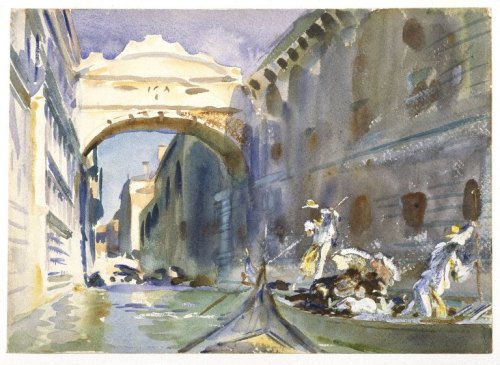
John_Singer_Sargent_-_The_bridge_of_sighsArtist: John Singer Sargent (1856–1925)

Title: The Bridge of Sighs

Date: between 1905 and 1908

Medium: watercolor on paper

Dimensions: height: 25.4 cm (10 in); width: 35.6 cm (14 in)

Collection: Brooklyn Museum

Current location: American Art collection

What I love about this picture:

John Singer Sargent was known for his portraits, but it is his watercolors that fascinate me. This painting of Venice’s Bridge of Sighs is one of his finest. Done in every shade of blue and brown, he conveys the mood of an afternoon. He gives us the bridge as seen from a gondola, and the view of ladies beneath parasols going by, passing us in the opposite direction.

By his choice of colors, Sargent paints the atmosphere of a poignant, tragic place.

About this picture, via Wikipedia:

The Bridge of Sighs (Italian: Ponte dei Sospiri, Venetian: Ponte de i Sospiri) is a bridge in Venice, Italy. The enclosed bridge is made of white limestone, has windows with stone bars, passes over the Rio di Palazzo, and connects the New Prison (Prigioni Nuove) to the interrogation rooms in the Doge’s Palace.

The view from the Bridge of Sighs was the last view of Venice that convicts saw before their imprisonment. The bridge’s English name was bequeathed by Lord Byron in the 19th century as a translation from the Italian “Ponte dei sospiri”, from the suggestion that prisoners would sigh at their final view of beautiful Venice through the window before being taken down to their cells. [1]

About The Artist via Wikipedia:

John Singer Sargent (January 12, 1856 – April 14, 1925) was an American expatriate artist, considered the “leading portrait painter of his generation” for his evocations of Edwardian-era luxury. He created roughly 900 oil paintings and more than 2,000 watercolors, as well as countless sketches and charcoal drawings. His oeuvre documents worldwide travel, from Venice to the Tyrol, Corfu, the Middle East, Montana, Maine, and Florida.

Born in Florence to American parents, he was trained in Paris before moving to London, living most of his life in Europe. He enjoyed international acclaim as a portrait painter. An early submission to the Paris Salon in the 1880s, his Portrait of Madame X, was intended to consolidate his position as a society painter in Paris, but instead resulted in scandal. During the next year following the scandal, Sargent departed for England where he continued a successful career as a portrait artist.

From the beginning, Sargent’s work is characterized by remarkable technical facility, particularly in his ability to draw with a brush, which in later years inspired admiration as well as criticism for a supposed superficiality. His commissioned works were consistent with the grand manner of portraiture, while his informal studies and landscape paintings displayed a familiarity with Impressionism. In later life Sargent expressed ambivalence about the restrictions of formal portrait work and devoted much of his energy to mural painting and working en plein air. Art historians generally ignored society artists such as Sargent until the late 20th century.

With his watercolors, Sargent was able to indulge his earliest artistic inclinations for nature, architecture, exotic peoples, and noble mountain landscapes. And it is in some of his late works where one senses Sargent painting most purely for himself. His watercolors were executed with a joyful fluidness. He also painted extensively family, friends, gardens, and fountains. In watercolors, he playfully portrayed his friends and family dressed in Orientalist costume, relaxing in brightly lit landscapes that allowed for a more vivid palette and experimental handling than did his commissions (The Chess Game, 1906). His first major solo exhibit of watercolor works was at the Carfax Gallery in London in 1905. In 1909, he exhibited eighty-six watercolors in New York City, eighty-three of which were bought by the Brooklyn Museum. Evan Charteris wrote in 1927:

To live with Sargent’s water-colours is to live with sunshine captured and held, with the luster of a bright and legible world, ‘the refluent shade’ and ‘the Ambient ardours of the noon.’

Although not generally accorded the critical respect given Winslow Homer, perhaps America’s greatest watercolorist, scholarship has revealed that Sargent was fluent in the entire range of opaque and transparent watercolor technique, including the methods used by Homer. [2]


Credits and Attributions:

[1] Wikipedia contributors, “Bridge of Sighs,” Wikipedia, The Free Encyclopedia, https://en.wikipedia.org/w/index.php?title=Bridge_of_Sighs&oldid=1096829521 (accessed August 5, 2022).

[2] Wikipedia contributors, “John Singer Sargent,” Wikipedia, The Free Encyclopedia, https://en.wikipedia.org/w/index.php?title=John_Singer_Sargent&oldid=1099859237 (accessed August 5, 2022).

[Image] Wikimedia Commons contributors, “File:John Singer Sargent – The bridge of sighs.jpg,” Wikimedia Commons, the free media repository, https://commons.wikimedia.org/w/index.php?title=File:John_Singer_Sargent_-_The_bridge_of_sighs.jpg&oldid=660236372 (accessed August 5, 2022).

Comments Off on #FineArtFriday: The Bridge of Sighs, John Singer Sargent ca,1905 – 1908

Filed under #FineArtFriday

#FineArtFriday: Tanguar Haor by Abdul Momin, 2017

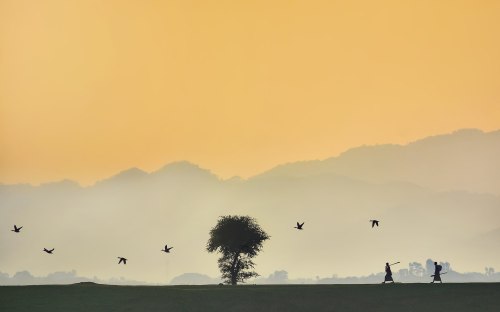
Tanguar_haor,_Bangladesh_01Photograph: Tanguar Haor by Abdul Momin

Date: 2 November 2017 [1]

What I love about this image:

Today I’m detouring briefly from Renaissance art and delving into modern photographic art with a wonderful image by a brilliant young photographer, Abdul Momin. A photograph has to be uniquely special if it is to be selected as a Wikimedia Commons Picture of the Day. This image more than deserved that honor.

As a lover of fantasy art, I feel it was shot at the perfect time of evening.

The artist’s eye comes into play in how the picture was framed. The skill and craft of the photographer comes across in his choice of filters, shutter speed, and how the image was digitally processed to become what we see depicted here.

The scene is simple, only black juxtaposed against shades of gray and orange. Yet there is a surreal quality to this landscape. The silhouettes of the birds and people against the evening sky, with the tree centered and anchoring the scene is magical.

The photographer’s eye and artistic ability gives us a beautiful moment in time, a windless moment of peace and serenity, of humankind coexisting with nature.

About this image, via Wikimedia Commons:

This image was selected as picture of the day on Wikimedia Commons for 4 July 2022. Tanguar Haor is a unique wetland ecosystem of national importance and has come into international focus. The area of Tanguar haor including 46 villages within the haor is about 100 square kilometres. It is the source of livelihood for more than 40,000 people.

Bangladesh declared it an Ecologically Critical Area in 1999 considering its critical condition as a result of overexploitation of its natural resources.

Every winter the haor is home to about 200 types of migratory birds. In 1999–2000, the government earned 7,073,184 takas as revenue just from fisheries of the haor. There are more than 140 species of freshwater fish in the haor. The more predominant among them are: ayir, Catfish, baim, tara, gutum, gulsha, tengra, titna, garia, beti, kakia. Gulli, balua, ban tulsi, nalkhagra and other freshwater wetland trees are in this haor. [2]

About the photographer, via Wikimedia Commons:

Born and raised in Bangladesh, Abdul Momin has earned his name as an emerging photographer with works that are recognized by the global community. He started photography in his college days. Since then, his work has been published in The Guardian, The Times, National Geographic, The Mail, The Mirror, The Telegraph and many more platforms around the world. He has earned various awards from different parts of the globe for his photography works. He says that for him, “Photography changed my life totally. I would have been a typical office going guy, but photography made me see more, to see deeply into the lives of people. It also made me to love nature. The best part of being a photographer is having the ability, the power to show others exactly how you see the world around you.” [1]


Credits and Attributions:

[1] Image: Tanguar Haor by Abdul Momin and licensed under the Creative Commons Attribution-Share Alike 4.0 International license. Wikimedia Commons contributors, “File:Tanguar haor, Bangladesh 01.jpg,” Wikimedia Commons, the free media repository, https://commons.wikimedia.org/w/index.php?title=File:Tanguar_haor,_Bangladesh_01.jpg&oldid=675047221 (accessed July 29, 2022).

[2] Wikipedia contributors, “Tanguar Haor,” Wikipedia, The Free Encyclopedia, https://en.wikipedia.org/w/index.php?title=Tanguar_Haor&oldid=1095980778 (accessed July 29, 2022).

2 Comments

Filed under #FineArtFriday, writing

#FineArtFriday: Dunes Under the Sun by Anna Boch

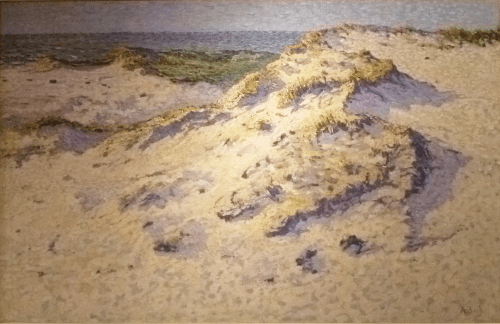
Anna_Boch_006Title: “Dunes Under the Sun”

Artist:  Anna Boch

Medium:  oil on canvas

Dimensions: (62 x 95 cm) by the Belgian painter

Collection: Musée d’Ixelles (Belgium)

What I love about this painting:

Anna Boch painted the dunes on summer day along an ocean strand. The landscape she gives us looks and feels real, as if we were walking through the dunes. She captured the soft grittiness of high-piled sand, and the hardy brown grasses struggling to conquer the dunes and reach the sun. No sooner does the grass emerge from the sand than the wind and waves bury it again. Still, the grass continues its battle. Every tough blade climbing into the sunshine is a win.

About the Artist, via Wikipedia:

Anna Rosalie Boch (10 February 1848 – 25 February 1936) was a Belgian painter, born in Saint-Vaast, Hainaut. Anna Boch died in Ixelles in 1936 and is interred there in the Ixelles Cemetery, Brussels, Belgium. She was born into the fifth generation of the Boch family, a wealthy dynasty of manufacturers of fine china and ceramics, still active today under the firm of Villeroy & Boch. 

Anna Boch participated in the Neo-Impressionist movement. Her early works used a Pointillist technique, but she is best known for her Impressionist style which she adopted for most of her career. A pupil of Isidore Verheyden, she was influenced by Théo van Rysselberghe whom she met in the Groupe des XX.

Besides her own paintings, Boch held one of the most important collections of Impressionist paintings of her time. She promoted many young artists, including Vincent van Gogh, whom she admired for his talent and who was a friend of her brother Eugène Boch. La Vigne Rouge (The Red Vineyard), purchased by Anna Boch, was long believed to be the only painting Van Gogh sold during his lifetime. The Anna Boch collection was sold after her death. In her will, she donated the money to pay for the retirement of poor artist friends.

140 of her own paintings were left to her godchild Ida van Haelewijn, the daughter of her gardener. Many of these paintings show Ida van Haelewijn as a little girl in the garden. In 1968, these 140 paintings were purchased by her great nephew Luitwin von Boch, the CEO of Villeroy & Boch Ceramics. The paintings remained in the house of Ida van Haelewijn until her death in 1992. The Anna & Eugène Boch Expo opened 30 March 2011.


Credits and Attributions:

Wikimedia Commons contributors, “File:Anna Boch 006.JPG,” Wikimedia Commons, the free media repository,  https://commons.wikimedia.org/w/index.php?title=File:Anna_Boch_006.JPG&oldid=555267549(accessed July 21, 2022).

Wikipedia contributors, “Anna Boch,” Wikipedia, The Free Encyclopedia, https://en.wikipedia.org/w/index.php?title=Anna_Boch&oldid=1063159988 (accessed July 21, 2022).

Wikipedia contributors, “Eugène Boch,” Wikipedia, The Free Encyclopedia, https://en.wikipedia.org/w/index.php?title=Eug%C3%A8ne_Boch&oldid=1088797052 (accessed July 21, 2022).

5 Comments

Filed under #FineArtFriday, writing

#FineArtFriday: The Sycamores by Alexandre Calame 1854

1175px-'The_Sycamores'_by_Alexandre_Calame,_Cincinnati_Art_MuseumTitle: The Sycamores by Alexandre Calame
Genre: landscape art

Date: 1854

Medium: oil on canvas

Dimensions: height: 54.3 cm (21.3 in)

Collection: Cincinnati Art Museum

What I love about this painting:

These are trees with a presence. They grow on a rocky, sunlit hillside and seem as tough as the boulders surrounding them. Like people, these trees have seen some stuff. No delicate hothouse specimens here – these are hardy peasant trees, able to make do with whatever nature throws at them.

About the Artist, via Wikipedia:

Alexandre Calame (28 May 1810 – 19 March 1864) was a Swiss landscape painter, associated with the Düsseldorf School.

He was born in Arabie at the time belonging to Corsier-sur-Vevey, today a part of Vevey. He was the son of a skillful marble worker in Vevey, but because his father lost the family fortune, Calame could not concentrate on art, but rather he was forced to work in a bank from the age of 15. When his father fell from a building and then died, it was up to the young Calame to provide for his mother.

In his spare time he began to practice drawing small views of Switzerland. In 1829 he met his patron, the banker Diodati, who made it possible for him to study under landscape painter François Diday. After a few months he decided to devote himself fully to art.

In 1835 he began exhibiting his Swiss-Alps and forest paintings in Paris and Berlin. He became quite well known, especially in Germany, although Calame was more a drawer than an illustrator. He is associated with the Düsseldorf school of painting. In 1842 he went to Paris and displayed his works Mont Blanc, the Jungfrau, the Brienzersee, the Monte Rosa and Mont Cervin.


Credits and Attributions:

Wikimedia Commons contributors, “File:’The Sycamores’ by Alexandre Calame, Cincinnati Art Museum.JPG,” Wikimedia Commons, the free media repository, https://commons.wikimedia.org/w/index.php?title=File:%27The_Sycamores%27_by_Alexandre_Calame,_Cincinnati_Art_Museum.JPG&oldid=618822225 (accessed July 15, 2022).

Wikipedia contributors, “Alexandre Calame,” Wikipedia, The Free Encyclopedia, https://en.wikipedia.org/w/index.php?title=Alexandre_Calame&oldid=1088977147 (accessed July 15, 2022).

4 Comments

Filed under #FineArtFriday

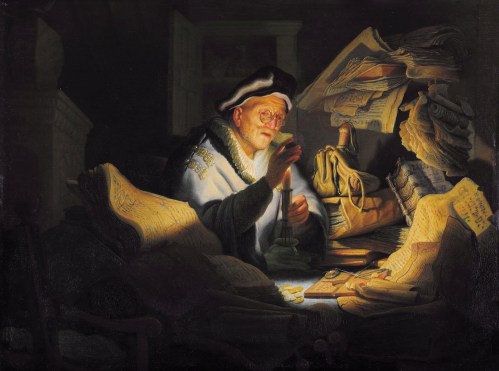
#FineArtFriday: The Parable of the Rich Fool by Rembrandt ca. 1627 (revisited)

  • By Rembrandt (1606–1669)
  • Title: The Parable of the Rich Fool
  • Genre: religious art
  • Date: 1627 Monogram and date bottom left: RH. 1627.
  • Medium: oil on oak panel
  • Dimensions: Height: 31.9 cm (12.5 ″); Width: 42.5 cm (16.7 ″)

Rembrandt’s early career focused on religious paintings, which were well received by influential patrons. Today’s featured painting, The Parable of the Rich Fool, is one of his early works, from the time when he shared a studio with Jan Lievens.

About this parable, via Wikipedia:

The rich farmer in this parable is portrayed negatively, as an example of greed.  By replacing his existing barn, he avoids using agricultural land for storage purposes, thus maximizing his income, as well as allowing him to wait for a price increase before selling. St. Augustine comments that the farmer was “planning to fill his soul with excessive and unnecessary feasting and was proudly disregarding all those empty bellies of the poor. He did not realize that the bellies of the poor were much safer storerooms than his barns.”


Credits and Attributions:

Wikipedia contributors, “Parable of the Rich Fool,” Wikipedia, The Free Encyclopedia, https://en.wikipedia.org/w/index.php?title=Parable_of_the_Rich_Fool&oldid=912095443

(accessed September 27, 2019).

Wikimedia Commons contributors, “File:Rembrandt – The Parable of the Rich Fool.jpg,” Wikimedia Commons, the free media repository, https://commons.wikimedia.org/w/index.php?title=File:Rembrandt_-_The_Parable_of_the_Rich_Fool.jpg&oldid=354111849

(accessed September 27, 2019).

1 Comment

Filed under #FineArtFriday

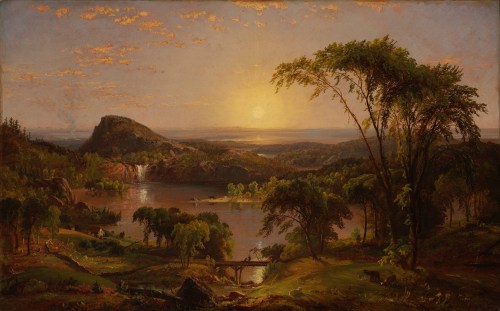
#FineArtFriday: Summer, Lake Ontario by Jasper Francis Cropsey 1857

Cropsey,_Jasper_Francis_-_Summer,_Lake_Ontario_-_Google_Art_ProjectTitle: Summer, Lake Ontario by Jasper Francis Cropsey (1823–1900)
Genre: landscape art

Date: 1857

Medium: oil on canvas

Collection: Indianapolis Museum of Art

What I love about this painting:

Cropsey paints a summer evening in New York State, along the shore of one of Lake Ontario’s bays. Near the bottom center, a pair of fishers are placed on the wooden bridge over a creek. This image has a fantasy quality, as if it depicts a dream or a fond memory.

Our point of view is from a hill, looking down to the creek, the bridge, and the bay shore, and then across low hills to the great lake beyond. Cropsey gives equal importance to the earth below and sky above.

Cropsey’s signature deep colors are featured in this panoramic view of a summer evening. Warm reds, browns, yellows, and dark greens are lightened by wispy mists rising in the early evening air, lit by the setting sun.

About the Artist, via Wikipedia:

Jasper Francis Cropsey (February 18, 1823 – June 22, 1900) was an important American landscape artist of the Hudson River School.

Cropsey was born on his father Jacob Rezeau Cropsey’s farm in Rossville on Staten Island, New York, the oldest of eight children. As a young boy, Cropsey had recurring periods of poor health. While absent from school, Cropsey taught himself to draw. His early drawings included architectural sketches and landscapes drawn on notepads and in the margins of his schoolbooks.

Trained as an architect, he set up his own office in 1843. Cropsey studied watercolor and life drawing at the National Academy of Design under the instruction of Edward Maury and first exhibited there in 1844. A year later he was elected an associate member and turned exclusively to landscape painting; shortly after he was featured in an exhibition entitled “Italian Compositions.”

Cropsey traveled in Europe from 1847–1849, visiting England, France, Switzerland, and Italy. He was elected a full member of the Academy in 1851. Cropsey was a personal friend of Henry Tappan, the president of the University of Michigan from 1852 to 1863. At Tappan’s invitation, he traveled to Ann Arbor in 1855 and produced two paintings, one of the Detroit Observatory, and a landscape of the campus. He went abroad again in 1856, and resided seven years in London, sending his pictures to the Royal Academy and to the International exhibition of 1862.

Returning home, he opened a studio in New York and specialized in autumnal landscape paintings of the northeastern United States, often idealized and with vivid colors. Cropsey co-founded, with ten fellow artists, the American Society of Painters in Watercolors in 1866. He also made the architectural designs for the stations of the elevated railways in New York. [1]


Credits and Attributions:

Image: Summer, Lake Ontario by Jasper Francis Cropsey 1857. Wikimedia Commons contributors, “File:Cropsey, Jasper Francis – Summer, Lake Ontario – Google Art Project.jpg,” Wikimedia Commons, the free media repository, https://commons.wikimedia.org/w/index.php?title=File:Cropsey,_Jasper_Francis_-_Summer,_Lake_Ontario_-_Google_Art_Project.jpg&oldid=618625179 (accessed June 30, 2022).

[1] Wikipedia contributors, “Jasper Francis Cropsey,” Wikipedia, The Free Encyclopedia, https://en.wikipedia.org/w/index.php?title=Jasper_Francis_Cropsey&oldid=1093620569 (accessed June 30, 2022).

2 Comments

Filed under #FineArtFriday, writing

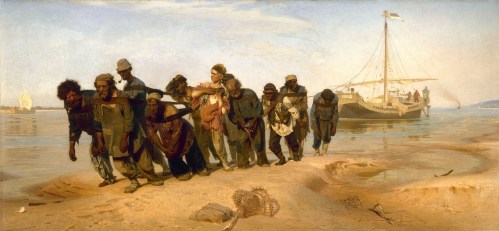
#FineArtFriday: Barge Haulers on the Volga by Ilya Repin, 1870 (revisited)

Barge Haulers on the Volga by Ilya Repin  (1844–1930)

  • Date: 1870
  • Medium: oil on canvas
  • Dimensions: Height: 131.5 cm (51.7 ″); Width: 281 cm (110.6 ″)
  • Current location: Ж-4056 (Russian Museum)
  • Inscriptions: Signature and date: И. Репин / 1870-73

What I love about this painting:

A burlak was a person who hauled barges and other vessels upstream from the 17th to 20th centuries in the Russian Empire. Most burlaks were landless or poor peasants.

These men are shown working, painted with brutal truth. They are beyond exhausted. Their skin is darkened and weathered from years of work in the unremitting sun, except for the young man in the middle. One day he will be like the older men, hardened to the misery and enduring his lot in life.

Each face is filled with emotion, with a story of their own. Who knows what tragedies brought them to agree to this terrible existence, this seasonal slavery of physically towing boats upriver?

For the women and men who towed the barges, winter was even worse, because once the river froze over these burlaki were unemployed. Their life was a constant circle of starvation and hellish labor under the harshest conditions.

This post first appeared in November of 2019. Each time I view this painting, I am moved by the unwritten stories, the tragedies that led these people to the life of a burlak, and the hardship shown so clearly here.

About this Painting (via Wikipedia)

Barge Haulers on the Volga or Burlaki (Russian: Burlaki na Volge, Бурлаки на Волге) is an 1870–73 oil-on-canvas painting by artist Ilya Repin. It depicts 11 men physically dragging a barge on the banks of the Volga River. They are at the point of collapse from exhaustion, oppressed by heavy, hot weather.[1][2]

The work is a condemnation of profit from inhumane labor.[3] Although they are presented as stoical and accepting, the men are defeated; only one stands out: in the center of both the row and canvas, a brightly colored youth fights against his leather binds and takes on a heroic pose.

Repin conceived the painting during his travels through Russia as a young man and depicts actual characters he encountered. It drew international praise for its realistic portrayal of the hardships of working men, and launched his career.[4] Soon after its completion, the painting was purchased by Grand Duke Vladimir Alexandrovich and exhibited widely throughout Europe as a landmark of Russian realist painting. Barge Haulers on the Volga has been described as “perhaps the most famous painting of the Peredvizhniki movement [for]….its unflinching portrayal of backbreaking labor”.[5]

The characters are based on actual people Repin came to know while preparing for the work. He had had difficulty finding subjects to pose for him, even for a fee, because of a folklorish belief that a subject’s soul would leave his possession once his image was put down on paper.[8] The subjects include a former soldier, a former priest, and a painter.[9] Although he depicted eleven men, women also performed the work and there were normally many more people in a barge-hauling gang; Repin selected these figures as representative of a broad swathe of the working classes of Russian society. That some had once held relatively high social positions dismayed the young artist, who had initially planned to produce a far more superficial work contrasting exuberant day-trippers (which he himself had been) with the careworn burlaks. Repin found a particular empathy with Kanin, the defrocked priest, who is portrayed as the lead hauler and looks outwards towards the viewer.[10] The artist wrote,

“There was something eastern about it, the face of a Scyth…and what eyes! What depth of vision!…And his brow, so large and wise…He seemed to me a colossal mystery, and for that reason I loved him. Kanin, with a rag around his head, his head in patches made by himself and then worn out, appeared none the less as a man of dignity; he was like a saint.”[11]


Credits and Attributions:

Wikipedia contributors, “Barge Haulers on the Volga,” Wikipedia, The Free Encyclopedia, https://en.wikipedia.org/w/index.php?title=Barge_Haulers_on_the_Volga&oldid=918607811 (accessed November 1, 2019).

3 Comments

Filed under #FineArtFriday

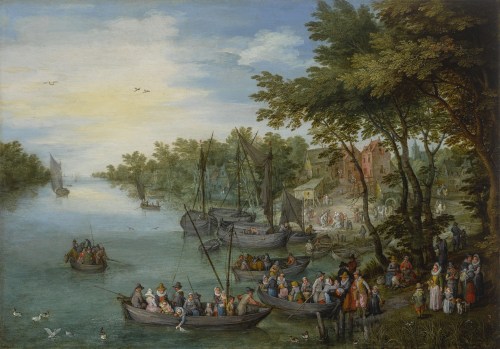
#FineArtFriday: River Landscape by Jan Brueghel the Elder 1614

A_Wooded_River_Landscape_with_a_Landing_Stage,_Boats…_by_Jan_Brueghel_the_ElderArtist: Jan Brueghel the Elder (1568–1625)

Title: River Landscape (Wooded river landscape with a landing stage, boats, various figures and a village beyond).

Date: 1614

Medium: oil on copper

Dimensions: height: 25.9 cm (10.1 in); width: 37 cm (14.5 in)

What I love about this painting:

Men, women, and children fill the boats for a day on the river, dressed in colorful garb. Everyone is in good spirits, looking forward to a day of relaxing and perhaps a little fishing. Onshore, crews will fillet and smoke or salt whatever can’t be eaten right way. When weather is fine and the fish are plentiful, the party is on. Everyone will eat well for a few days.

About this painting, via Wikipedia:

Jan Brueghel’s father, Pieter Bruegel the Elder, is regarded as an important innovator of landscape art. By introducing greater naturalism in his Alpine mountain settings, his father had expanded on the world landscape tradition that had been founded mainly by Joachim Patinir. Some of Pieter the Elder’s works also foreshadowed the forest landscape that would start to dominate landscape painting around the turn of the 16th century. Pieter the Elder also developed the village and rural landscape, placing Flemish hamlets and farms in exotic prospects of mountains and river valleys.

Jan developed on the formula he learned from his father of arranging country figures traveling a road, which recedes into the distance. He emphasized the recession into space by carefully diminishing the scale of figures in the foreground, middle-ground, and far distance. To further the sense of atmospheric perspective, he used varying tones of brown, green, and blue progressively to characterize the recession of space. His landscapes with their vast depth are balanced through his attention to the peasant figures and their humble activities in the foreground.

Jan Brueghel’s landscape paintings with their strong narrative elements and attention to detail had a significant influence on Flemish and Dutch landscape artists in the second decade of the 17th century. His river views were certainly known to painters working in Haarlem, including Esaias van de Velde and Willem Buytewech, whom Brueghel may have met there when he accompanied Peter Paul Rubens on a diplomatic mission to the Dutch Republic in 1613. [1]

About the Artist, via Wikipedia:

Jan Brueghel (also Bruegel or Breughel) the Elder 1568 – 13 January 1625) was a Flemish painter and draughtsman. He was the son of the eminent Flemish Renaissance painter Pieter Bruegel the Elder. A close friend and frequent collaborator with Peter Paul Rubens, the two artists were the leading Flemish painters in the first three decades of the 17th century.

Brueghel worked in many genres including history paintings, flower still lifes, allegorical and mythological scenes, landscapes and seascapes, hunting pieces, village scenes, battle scenes and scenes of hellfire and the underworld. He was an important innovator who invented new types of paintings such as flower garland paintings, paradise landscapes, and gallery paintings in the first quarter of the 17th century. He further created genre paintings that were imitations, pastiches and reworkings of his father’s works, in particular his father’s genre scenes and landscapes with peasants. Brueghel represented the type of the pictor doctus, the erudite painter whose works are informed by the religious motifs and aspirations of the Catholic Counter-Reformation as well as the scientific revolution with its interest in accurate description and classification. He was court painter of the Archduke and Duchess Albrecht and Isabella, the governors of the Habsburg Netherlands.

The artist was nicknamed “Velvet” Brueghel, “Flower” Brueghel, and “Paradise” Brueghel. The first is believed to have been given him because of his mastery in the rendering of fabrics. The second nickname is a reference to his fame as a painter of (although not a specialist in) flower pieces and the last one to his invention of the genre of the paradise landscape. His brother Pieter Brueghel the Younger was traditionally nicknamed “de helse Brueghel” or “Hell Brueghel” because it was believed he was the author of a number of paintings with fantastic depictions of fire and grotesque imagery. These paintings have now been reattributed to Jan Brueghel the Elder. [1]


Credits and Attributions:

Image:  River Landscape by Jan Brueghel the Elder, 1614. Wikimedia Commons contributors, “File:A Wooded River Landscape with a Landing Stage, Boats… by Jan Brueghel the Elder.jpg,” Wikimedia Commons, the free media repository, https://commons.wikimedia.org/w/index.php?title=File:A_Wooded_River_Landscape_with_a_Landing_Stage,_Boats%E2%80%A6_by_Jan_Brueghel_the_Elder.jpg&oldid=358393285 (accessed June 17, 2022).

[1] Wikipedia contributors, “Jan Brueghel the Elder,” Wikipedia, The Free Encyclopedia, https://en.wikipedia.org/w/index.php?title=Jan_Brueghel_the_Elder&oldid=1082625249 (accessed June 17, 2022).

Comments Off on #FineArtFriday: River Landscape by Jan Brueghel the Elder 1614

Filed under #FineArtFriday

#FineArtFriday: The Bird Concert by Jan Brueghel the Younger ca. 1640 – 45

OLYMPUS DIGITAL CAMERA

Artist: Jan Brueghel the Younger (1601–1678)

Title: the Bird Concert

Date: between circa 1640 and circa 1645

Medium: oil on copper

Dimensions: height: 13.2 cm (5.1 in); width: 17.9 cm (7 in)

Collection: Herzog Anton Ulrich Museum

What I love about this painting:

This is a joyous, surreal exploration of all the birds the artist had ever seen in his native Antwerp, and many rare birds that he could only imagine. Brueghel has gathered birds from all over the world into a mystical, fairytale glen, posing them around a songbook.

They are learning to sing a in a language they all can understand, a wonderful allegory of the aspirations of the artist for humanity in the turbulent times during which he lived.

This painting also celebrates the new discoveries made by European explorers, as Brueghel had only seen scientific drawings of many of these birds. Even though he hadn’t seen some of these birds personally, he paints them as if they are before him.

The amazing flock of birds gathered here gives us an insight into the mind and sense of humor of Jan Brueghel the Younger, a man not too different from us even though he lived over 300 years ago.

This composition must have been important to Brueghel and says something about him. He went to the expense of getting copper as the base upon which he painted this scene. He was comfortable but not rich, so that tells me he intended this painting to last, to be something he would be remembered for.

About the medium of Oil on Copper, via Wikipedia:

Oil on copper paintings were prevalent in the mid sixteenth century in Italy and Northern Europe. The use of copper as a substrate for an oil painting dates back to Medieval times. The Flemish masters and other artists including Jan Breughel the Elder, Claude, El Greco, Guido Reni, Guercino, Rembrandt, Carlo Saraceni, Ambrosius Bosschaert II, Copley Fielding and Vernet painted on copper. They favored copper for its smooth surface which allowed fine detail, and its durability. Copper is more durable than canvas or wood panel as a support for oil painting, as it will not rot, mildew or be eaten by insects. Contemporary painters also use copper as a base for paintings, some of them allowing the metal or patina to show through.

The old masters prepared the copper for painting first by rubbing it with fine pumice abrasive. The copper surface was then treated with garlic juice which is believed to improve adhesion of the paint. Finally a white or grey ground layer of oil paint was applied as a primer. After drying the copper panel was ready for the artist to begin painting. Later artists used the patina process, in which the copper is oxidized with the use of various acidic solutions, as part of the art work itself. The resulting patina or verdigris includes darkening of the metal, green and blue tones, depending on the chemical solution used. Patina is characterized by beautiful, variated patterns and textures which occur on the metal’s surface. [1]

About the Artist, via Wikipedia:

Jan Brueghel the Younger was born in Antwerp on 13 September 1601 as the son of Jan Brueghel the Elder and Isabella de Jode. His mother was the daughter of the cartographer, engraver and publisher Gerard de Jode. He trained and collaborated with his father in his workshop. His father was a friend and close collaborator of Peter Paul Rubens. Brueghel likely assisted with his father’s large-scale commissions.

On the wishes of his father he traveled around 1622 to Milan where he was welcomed by Cardinal Federico Borromeo. The cardinal was a patron and friend of his father who had met in Rome about 30 years earlier. In what was likely an act of rebellion against his father, he went to Genoa where he stayed with his cousins, the Antwerp painters and art dealers Lucas de Wael and Cornelis de Wael. Their mother was a sister of Brueghel’s mother. At the time his friend and fellow Antwerp artist Anthony van Dyck was also active in Genoa. He later worked in Valletta on Malta in 1623. From 1624 to 1625 he also resided in Palermo on Sicily at the time when van Dyck was also working there.

Brueghel learned that his father had died on 13 January 1625 from cholera only after his return to Northern Italy in Turin. Wanting to return to Antwerp immediately, he had to delay his departure for 16 days due to a severe fever. After recovering from his illness, he set off for his homeland by way of France. In Paris he met the Antwerp art dealer and painter Peter Goetkint the Younger, who was the son of Peter Goetkint the Elder, the master of Jan’s father. Goetkint was eager to return to Antwerp because his wife was expected to deliver a baby soon. The child was born on 25 August, the day on which Breughel arrived in Antwerp with his traveling companion who himself died a few days later.

Brueghel took over the management of his father’s workshop, sold the finished works of his father and finished some of his father’s unfinished paintings after completing them. In the Guild year 1624-1625, Brueghel became a master painter of the Guild of Saint Luke of Antwerp.

In 1626 he married Anna Maria Janssens, daughter of Abraham Janssens, a prominent history painter in Antwerp. He continued to operate the large workshop of his father. He became dean of the Guild of Saint Luke in 1630. That same year he was commissioned by the French court to paint a series of paintings on the life of Adam. It seems that his studio declined after this period and that he started to paint smaller scale paintings which commanded lower prices than those produced earlier.

In later years, he worked independently in Paris in the 1650s and produced paintings for the Austrian court in 1651. He is recorded again in Antwerp in 1657 where he remained until his death. [2]


Credits and Attributions:

[1] Wikipedia contributors, “Oil on copper,” Wikipedia, The Free Encyclopedia, https://en.wikipedia.org/w/index.php?title=Oil_on_copper&oldid=1060711380 (accessed June 9, 2022).

[2] Wikipedia contributors, “Jan Brueghel the Younger,” Wikipedia, The Free Encyclopedia, https://en.wikipedia.org/w/index.php?title=Jan_Brueghel_the_Younger&oldid=1086952033 (accessed June 9, 2022).

Image: The Bird Concert by Jan Brueghel the Younger ca. 1640 -1645, PD|100. Wikimedia Commons contributors, “File:Bruegel Vogelkonzert@Herzog Anton Ulrich Museum (1).JPG,” Wikimedia Commons, the free media

2 Comments

Filed under #FineArtFriday, writing

#FineArtFriday: Sheep Grazing in the Dunes on an Italian Coast by Edith Corbet

Edith_Corbet_Sheep_Grazing_in_the_Dunes,_on_an_Italian_CoastTitle: Sheep Grazing in the Dunes, on an Italian Coast

Artist: Edith Corbet (1846 – 1920),

Description: Landscape Art

Medium: oil on canvas

Dimensions: 83.5 x 203 cm. (33 x 80 in.)

What I love about this painting:

There is a softness to this image, and yet it feels as if we are there, viewing the beach and the sheep. We know it was painted in late spring, as the sheep have just been shorn, and a few lambs can be seen with their mothers. To the right of the scene, the sky has darkened, and a storm is moving in.

The beach grass, the color of the dunes, and the shades of the water reflecting the ever-changing colors of the sky feel real, perfectly recreated for us by the artist’s hands. She gives us a peaceful serene moment, a chance to just breathe deeply and let go of the stress of our modern lives.

This kind of day is familiar to me, a scene that could be found on many beaches here in my Northwestern part of the world. I love it when a brief storm moves in over the dunes, stirring the waters, and showing how the sky is the most important part of the scene. It’s as if the sky says to the sea, “You may be big and important, but I am larger and more powerful.”

Little is known about Edith’s life. She travelled a great deal and loved Italy. I suspect her first marriage, to illustrator Arthur Murch, was difficult, as he was in poor health much of the time. It has been said that while he was talented, he rarely finished a project. His reputation was based on the two illustrations he produced for Dalziels’ Bible Gallery, while Edith’s landscapes had begun to bring her some fame. Murch died in Germany, and most of Edith’s life at that time was in Italy.

By the time she painted this scene, in 1897, Edith and her second husband, Matthew Ridley Corbet, may have been living in England for at least part of the year.

About the Artist, via Wikipedia:

Edith Corbet née Edenborough (28 December 1846 – 1920) was a Victorian landscape painter, having close associations with the Macchiaioli group (also known as the Tuscans or Etruscans), who, in a break with tradition, painted outdoors in order to capture natural light effects and favoured a panoramic format for their paintings.

She married the Victorian painter and illustrator Arthur Murch and moved to Rome, where she painted with Giovanni Costa, leader of the Macchiaioli group. In 1876 they both stayed in Venice. Olivia Rossetti Agresti wrote: “Costa had a very high opinion of this artist’s gifts and used to remember with pleasure how on that occasion they used to go out together to paint from nature at Fusino“ (Agresti, 1904).

She frequently exhibited from 1880 to 1890 at the Grosvenor Gallery and the New Gallery. In 1891, after the death of her first husband, she married Matthew Ridley Corbet, one of the Macchiaioli group’s leading members, after which she exhibited mainly at the Royal Academy, visiting Italy and living in London for the remainder of her life. Corbet exhibited her work at the Palace of Fine Arts at the 1893 World’s Columbian Exposition in Chicago, Illinois. She died in Hampstead, north London, in 1920. [1]


Credits and Attributions:

Image: Wikimedia Commons contributors, “File:Edith Corbet Sheep Grazing in the Dunes, on an Italian Coast.jpg,” Wikimedia Commons, the free media repository, https://commons.wikimedia.org/w/index.php?title=File:Edith_Corbet_Sheep_Grazing_in_the_Dunes,_on_an_Italian_Coast.jpg&oldid=617254333 (accessed June 2, 2022).

Comments Off on #FineArtFriday: Sheep Grazing in the Dunes on an Italian Coast by Edith Corbet

Filed under #FineArtFriday, writing