Category Archives: #FineArtFriday

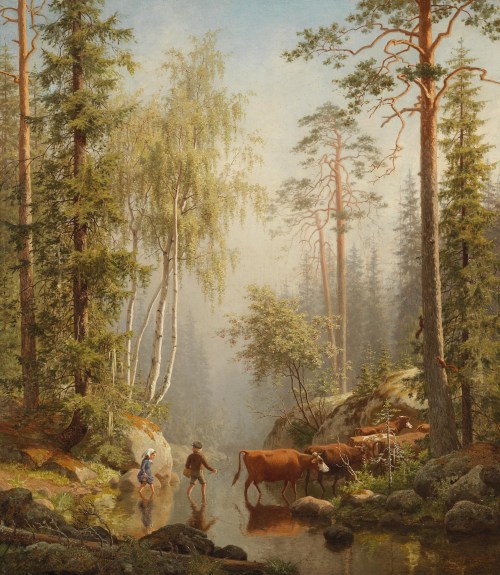
#FineArtFriday: In the Woodland Stream by Carl Bögh 1872

Artist: Carl Bögh  (1827–1893)

Title: In the Woodland Stream

Description: Forest landscape with rising haze. Children drive cattle through a ford.

Date: 1872

Medium: oil on canvas

Dimensions: Height: 111 cm (43.7 in); Width: 96 cm (37.7 in)

Inscriptions: Signature and date at bottom right: Carl Bögh / 1872

What I love about this painting:

The level of detail here is impressive. The artist has faithfully recorded a perfect morning, the opening of a summer day. It’s all here in perfect historical accuracy, down to the lichen on the smallest of trees. The muddy tracks where the cattle daily walk, the moss on the stones, the reflections on the waters–all are shown with faithful attention to detail. The morning mist is rising, and the day is already beginning to warm.

A breeze gently moves through the branches of the white birch, stirring their shimmering leaves. In the stream below, two children attend the family’s wealth—their cattle. The children are well-behaved and dutifully follow the herd. The water is cool water on their feet as they cross, a slow-moving, gentle stream. Brother carries their midday meal in a covered basket. He keeps the cattle moving and urges his sister to keep up.

The forest is lush with fir, birch, and pine growing, and flowering shrubs. All the low-growing plants are here too—one can almost hear the hum of insects starting their day, and the birds’ gossiping among the branches.  The occasional lowing of the cattle as they head toward their meadow is a counterpoint to the ordinary sounds of the forest, filling the morning air with the promise of a fine summer day.

About the Artist, via Wikipedia:

Carl Henrik Bøgh (3 September 1827, Copenhagen – 19 October 1893, Copenhagen) was a Danish painter; best known for his scenes with animals. After serving as a soldier in the First Schleswig War, he attended the Royal Danish Academy of Fine Arts, where he studied with Johan Ludwig Lund, and decided to specialize in animal painting. He first had a showing in 1854, in the Spring Exhibition at Charlottenborg Palace. Three years later was awarded the Neuhausenske Prize [da].

From 1860 to 1861, he made a study trip abroad, with the travel scholarship from Academy; visiting Brussels and Antwerp, but spending most of his time in Paris. In 1870 and 1875, some of his works were purchased by the “Royal Painting Collection” (now the National Gallery of Denmark). In 1873, he became a Professor.

His paintings of deer were among his most popular. He also made painting expeditions to Norway and Sweden.


Credits and Attributions:

Wikimedia Commons contributors, “File:Carl Bøgh – In the Woodland Stream (1872).jpg,” Wikimedia Commons, the free media repository, https://commons.wikimedia.org/w/index.php?title=File:Carl_B%C3%B8gh_-_In_the_Woodland_Stream_(1872).jpg&oldid=368737131 (accessed December 10, 2020).

Wikipedia contributors, “Carl Bøgh,” Wikipedia, The Free Encyclopedia, https://en.wikipedia.org/w/index.php?title=Carl_B%C3%B8gh&oldid=944301648 (accessed December 10, 2020).
3 Comments

Filed under #FineArtFriday

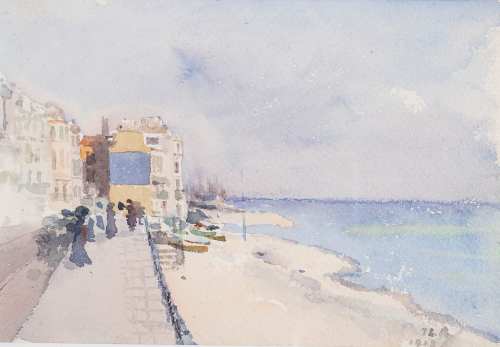
#FineArtFriday: Hastings: the Front by Theodore Casmir Roussel 1908


Title: Hastings: the Front.

Medium: Watercolor.

Signed and dated: Theodore Roussel 1908.

Dimensions: 6.75×10 inches. Framed: 13.75×16 inches.”

Hastings is a seaside town in East Sussex on the south coast of England, south east of London. In the 19th and early 20th century, when this painting made, the railway enabled ordinary tourists and visitors to reach the town, and it became a popular seaside resort.

What I love about this painting:

I love watercolors. The medium allows for a dreamy atmosphere, and in this case, the artist has presented us with the impression of a sundrenched afternoon at the seashore. Roussel’s work grew more atmospheric as he grew older, but he was known more for his classically depicted nudes than as an impressionist. However, it’s clear he had an eye for impressionism and the ability to show a story with watercolors.

Tourists stroll along the breakwater in front of the hotels, wearing broad hats and coats. Like many days at the beach on the Washington Coast, where I live, even in summer the wind often carries a chill.

About the Artist, via Wikipedia:

Theodore Casimir Roussel (1847–1926) was a French-born English painter and graphic artist, best known for his landscapes and genre scenes. He came to painting late, in 1872, after his military service had ended, and he was entirely self-taught. His earliest works were scenes of daily life, rendered in the style of the Old Masters. In 1878, he moved to London and, two years later, married the widow Frances Amelia Smithson Bull (1844–1909), a distant collateral relative of James Smithson. In 1885, he met James McNeill Whistler, who became a lifelong friend and mentor.


Credits and Attributions:

Hastings: the Front by Théodore Roussel, Public domain, via Wikimedia Commons

Wikipedia contributors, “Theodore Roussel,” Wikipedia, The Free Encyclopedia, https://en.wikipedia.org/w/index.php?title=Theodore_Roussel&oldid=896039278 (accessed December 3, 2020).

Comments Off on #FineArtFriday: Hastings: the Front by Theodore Casmir Roussel 1908

Filed under #FineArtFriday

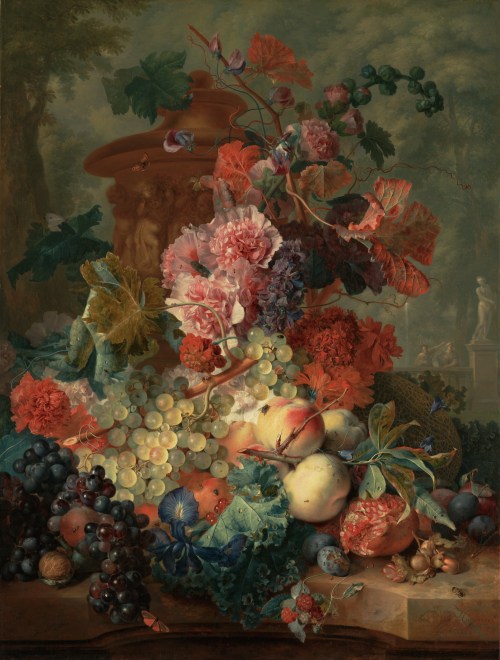
FineArtFriday: Fruit Piece by Jan van Huysum 1722

Fruit Piece by Jan van Huysum (Dutch, 1682 – 1749)– artist (Dutch)

Genre: still-life

Date: 1722

Medium: oil on panel

Dimensions: Height: 800 mm (31.49 in); Width: 610 mm (24.01 in)

What I love about this painting:

This scene depicts the very essence of abundance and comfort. Every piece of fruit in this image is perfect, begging to be eaten, every flower wishes to be admired. Carnations, grapes, plums, figs, apples, a melon, raspberries, and numerous other fruits occupy the center of the image. Butterflies have found the flowers.

In the background, slightly out of focus as if the centerpiece is seen through a camera lens, we have a lush garden, a fantasy of earthly paradise. Far to the rear of the scene, painted as if they just happened to stray into it, two figures on a low bridge carry on a quiet conversation beneath a graceful statue.

More than any other artist of his time, van Huysum understood how to show the “life” aspect of still-life by combining fantasy with the faithful reproduction of perfect, ripe fruit.

Yesterday, here in the US, we enjoyed our lockdown pandemic version of Thanksgiving. Despite not hosting the large extended family gathering we usually do, we offered our thanks for the abundance in our lives, the multitude of blessings for which we are truly grateful.

This painting celebrates food in plentiful, mouthwatering profusion, a true blessing for which we should all be thankful.

About the Artist: The website at the National Gallery says:

Jan van Huysum (1682 – 1749)  was the last of the distinguished still life painters active in the Northern Netherlands in the 17th and early 18th centuries, and an internationally celebrated artist in his lifetime. Although he specialised in flower still lifes, van Huysum also painted a few landscapes.

His early works are more concentrated in design than his elaborate later paintings, like the Gallery’s Flowers in a Terracotta Vase, with its lighter background and superabundance of detail.

Van Huysum was a native of Amsterdam and was trained, according to Arnold Houbraken, by his father, who was also a still life painter. His first dated work is of 1706.

Van Huysum often travelled to horticultural centres like Haarlem so he could make sketches of rare and unusual flowers. During his lifetime, his flower paintings were sold for as much as 2,000 guilders, and he had famous patrons including the Duc d’Orléans, William VIII, Landgrave of Hesse-Kassel, and Sir Robert Walpole.


Credits and Attributions:

Wikimedia Commons contributors, “File:Jan van Huysum (Dutch – Fruit Piece – Google Art Project.jpg,” Wikimedia Commons, the free media repository, https://commons.wikimedia.org/w/index.php?title=File:Jan_van_Huysum_(Dutch_-_Fruit_Piece_-_Google_Art_Project.jpg&oldid=507579017 (accessed November 25, 2020).

National Gallery Contributors, Biography of Jan van Huysum (1682 – 1749) | National Gallery, London ©2020 National Gallery, London  https://www.nationalgallery.org.uk/artists/jan-van-huysum (accessed November 25, 2020).

Comments Off on FineArtFriday: Fruit Piece by Jan van Huysum 1722

Filed under #FineArtFriday

#FineArtFriday: Mountain River Landscape, Jan Brueghel the younger and Joos de Momper the Younger

A collaborative work by:

Jan Brueghel the Younger  (1601–1678)

Joos de Momper the Younger  (1564–1635)

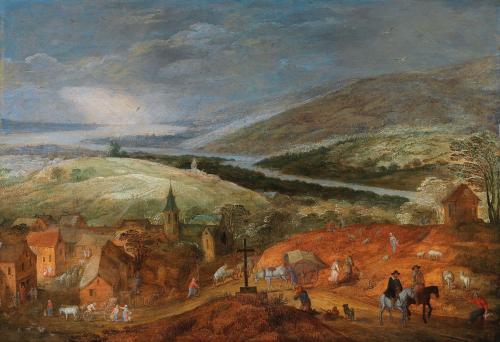
Title:    An extensive mountainous river landscape with travellers near a village

Date:   by 1678

Medium: oil on panel

Dimensions: Height: 46.5 cm (18.3 in); Width: 66 cm (25.9 in)

Collection: Private collection

What I like about this painting:

There is an intensity, a richness of color in the foreground, and a subtle chastisement the subject matter of this picture.

In the center we have a beggar on his knees and praying before a cross, with his worldly possessions stacked beside him and his dog patiently waiting. All around him, the world is going about its business. Shepherds are moving their flocks from one field to another, a merchant urges his horse-drawn cart down the hill. Further down the hill, another merchant unloads a wagon. At the right of the beggar, two travelers on horseback ignore the outstretched hand of yet another beggar, this one an old woman.

This painting is relatively less known, a scene composed and executed by two prolific artists, both of whom were the sons of two of the more famous artists of the 17th century.

At first glance this seems like an ordinary bucolic view of a village and surrounding countryside. Yet, I think the lesson they offer us is clear—we go through life relatively comfortably, unaware of the opportunities for charity that are all around us.

Both artists made their livings from their work so there was a market for what they produced. For both Brueghel and de Momper, their fathers (and in Brueghel’s case, his grandfather ) were hard acts to follow.

About the Artists, via Wikipedia:

Joos de Momper the Younger  primarily painted landscapes, the genre for which he was highly regarded during his lifetime. Only a small number of the 500 paintings attributed to de Momper are signed and just one is dated. The large output points to substantial workshop participation. He often collaborated with figure painters such as Frans Francken II, Peter Snayers, Jan Brueghel the Elder and Jan Brueghel the Younger, usually on large, mountainous landscapes, whereby the other painters painted the staffage (people) and de Momper the landscape. His works were often featured in the prestigious gallery paintings of collections (real and imagined) from the early seventeenth century.

Jan Brueghel the Younger was born and died in the 17th century in Antwerp. He was trained by his father and spent his career producing works in a similar style. Along with his brother Ambrosius, he produced landscapes, allegorical scenes and other works of meticulous detail. Brueghel also copied works by his father and sold them with his father’s signature. His work is distinguishable from that of his parent by being less well executed and lighter.

In an episode of BBC’s Britain’s Lost Masterpieces broadcast in November 2019, a very badly damaged picture of a village scene, whose panel has spilt into two pieces, was located at Birmingham Art Gallery. Following a complete restoration by Simon Gillespie, the landscape was attributed to Joos de Momper and the figures were attributed to Jan the Younger.


Credits and Attributions:

Wikimedia Commons contributors, “File:Jan Brueghel II and Joos de Momper II – An extensive mountainous river landscape with travellers near a village.jpg,” Wikimedia Commons, the free media repository, https://commons.wikimedia.org/w/index.php?title=File:Jan_Brueghel_II_and_Joos_de_Momper_II_-_An_extensive_mountainous_river_landscape_with_travellers_near_a_village.jpg&oldid=345270137 (accessed November 19, 2020).

Wikipedia contributors, “Jan Brueghel the Younger,” Wikipedia, The Free Encyclopedia, https://en.wikipedia.org/w/index.php?title=Jan_Brueghel_the_Younger&oldid=988772158 (accessed November 19, 2020).

Wikipedia contributors, “Joos de Momper,” Wikipedia, The Free Encyclopedia, https://en.wikipedia.org/w/index.php?title=Joos_de_Momper&oldid=988664019 (accessed November 19, 2020).

Comments Off on #FineArtFriday: Mountain River Landscape, Jan Brueghel the younger and Joos de Momper the Younger

Filed under #FineArtFriday

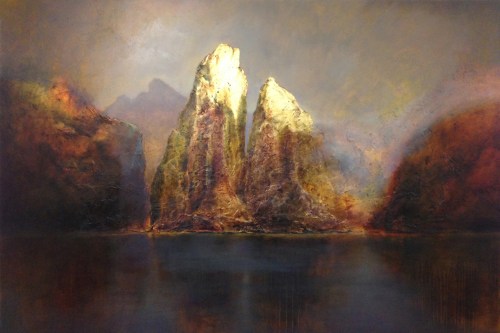
#FineArtFriday: Communion by Steven DaLuz, 2018

Title: Communion by Steven DaLuz, 2018

Medium:  oil, metal leaf on panel

Size: 40″ x 60″

What I love about this painting:

Where do I begin? This simple scene speaks to me on a spiritual level. The calmness and serenity, the intensely rich colors, and the way the sky and water are depicted make this one my favorite contemporary paintings. There is power here, but  it is quiet and doesn’t need to go out of its way to impress the viewer.

I am impressed just by being in its presence. Power lies in the intimacy, the unity and companionship of the two main subjects, split rock spires who lean toward each other. Power also lies in the way light and shadow cloak the surrounding scene and reveal the spires.

DaLuz breathes life into the stone, showing us the living mountains. The use of metal leaf and oil paints to create the light and shadow is a wonderful technique.

About Luminism, via Wikipedia:

Luminism is an American landscape painting style of the 1850s to 1870s, characterized by effects of light in landscape, through the use of aerial perspective and the concealment of visible brushstrokes. Luminist landscapes emphasize tranquility, and often depict calm, reflective water and a soft, hazy sky.

Ingredients of luminism – such as majestic skies, calm waters, rarefied light, and other representations of magnificence – have been also appreciated in contemporary American painting.

About the artist, via Wikipedia:

Steven DaLuz (born 1953) is a contemporary American Neoluminist artist known for using chemically induced patinas on metal leaf and mixed media to produce figurative works and imagined landscapes often reflecting upon the sublime as a pictorial theme.

DaLuz was born in Hanford, California. His works have been published in art periodicals, such as American Art Collector, Fine Art Connoisseur,, The Artist,  Professional ArtistThe Huffington Post  and Poets and Artists magazine, where he received the cover for the Nov 2009 Issue.  Considered “ethereal and transcendent,” his artwork has been said to combine “a spectacular dissertation on light and shadow with a brilliant collection of colors.” DaLuz holds degrees in Social Psychology (BA, Park University 1979), Management ((MA, Central Michigan University, 1981)), Graphic Design (AAS, San Antonio College, 2001), and Fine Arts (BFA, University of Texas at San Antonio, 2003).

He donates works of art and part of the proceeds from the sale of his work in favor of many charitable actions.


Credits and Attributions:

Communion; oil, metal leaf on panel; 40″ x 60″; 2018; by Steven DaLuz

Wikimedia Commons contributors, “File:Communion 40 x 60.jpg,” Wikimedia Commons, the free media repository, https://commons.wikimedia.org/w/index.php?title=File:Communion_40_x_60.jpg&oldid=508468900 (accessed November 12, 2020).

Wikipedia contributors, “Luminism (American art style),” Wikipedia, The Free Encyclopedia, https://en.wikipedia.org/w/index.php?title=Luminism_(American_art_style)&oldid=983664068 (accessed November 12, 2020).


Sdaluz, CC BY-SA 4.0 <https://creativecommons.org/licenses/by-sa/4.0&gt;, via Wikimedia Commons

1 Comment

Filed under #FineArtFriday

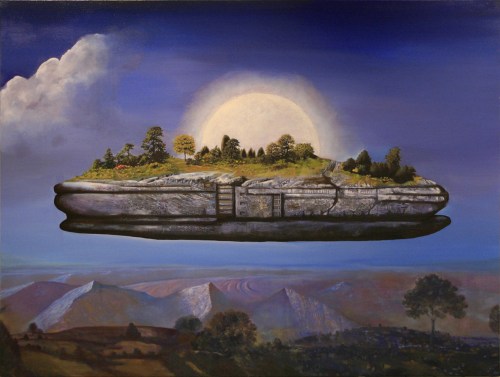
#FineArtFriday: Utopien 04 by Makis E. Warlamis 2007

Artist: Makis E. Warlamis

Title: Utopien 04

Medium: painting

Collection: Kunstmuseum Waldviertel

Source/Photographer: Own work, Daskunstmuseum, 2007-01-05

About the word “Utopia,” via Wikipedia:

The word utopia was coined from Ancient Greek by Sir Thomas More in 1516. “Utopia” comes from Greek: οὐ (“not”) and τόπος (“place”) which translates as “no-place” and literally means any non-existent society, when ‘described in considerable detail’. However, in standard usage, the word’s meaning has shifted and now usually describes a non-existent society that is intended to be viewed as considerably better than contemporary society.

In his original work, More carefully pointed out the similarity of utopia to eutopia, which is from Greek: εὖ (“good” or “well”) and τόπος (“place”), hence eutopia means “good place”, which ostensibly would be the more appropriate term for the concept the word “utopia” has in modern English. The pronunciations of eutopia and utopia in English are identical, which may have given rise to the change in meaning.

What I love about this painting:

This Utopia is unreachable, as all true Utopias are. It floats high above the mundane world, visible but just out of reach. The colors are intense, vibrantly moody. The landscape above which this perfect island floats is serene, a beautiful place.

Every idea of perfection is different. Warlamis’ Utopia is not the golden city many storytellers and writers of speculative fiction might imagine, but is instead an island of undisturbed landscape, looking almost like the untrammeled headland one might find beside the sea.

His Utopia is a step back to nature, to a simpler time.

In truth, it isn’t too different from the land over which it flies. And, if that is the case, why strive to reach it?

What story lurks within this painting? What a great visual prompt to jumpstart Nation Novel Writing Month.

About the Author via Wikipedia DE:

Efthymios “Makis” Warlamis (also: Efthymis, Efthymios Varlamis; born 1942 in Veria, in Central Macedonia, Greece; died 27 December 2016) was a Greek-Austrian architect, painter, poet, writer, educator and museum founder.

Warlamis was a versatile artist. In addition to his basic profession as an architect, he worked as a sculptor, painter, designer and writer. He had exhibitions in museums and exhibition centres in Europe, USA, Asia and Egypt. His works are represented in international public and private collections such as the Graphic Collection of the Albertina Vienna, Museum moderner Kunst Wien, DAM Deutsches Architekturmuseum Frankfurt, Collection Alexander Jolas, Collection of the State of Austria, Collection Liaunig.

In 1992, together with his wife Heide, he founded the International Center for Art and Design I.DE. A. in Schrems. He planned and built the Kunstmuseum Waldviertel, which opened in Schrems in 2009.


Credits and Attributions:

Wikimedia Commons contributors, “File:2010 Utopien arche04.jpg,” Wikimedia Commons, the free media repository, https://commons.wikimedia.org/w/index.php?title=File:2010_Utopien_arche04.jpg&oldid=501416249 (accessed October 30, 2020).

Wikipedia contributors, “Utopia,” Wikipedia, The Free Encyclopedia, https://en.wikipedia.org/w/index.php?title=Utopia&oldid=986041921 (accessed October 30, 2020).

Wikipedia DE Contributors, Efthymios Warlamis, Wikipedia the Free Encyclopedia, https://de.wikipedia.org/wiki/Efthymios_Warlamis (accessed October 30, 2020).

2 Comments

Filed under #FineArtFriday

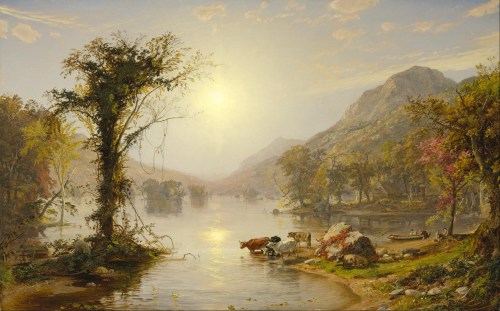
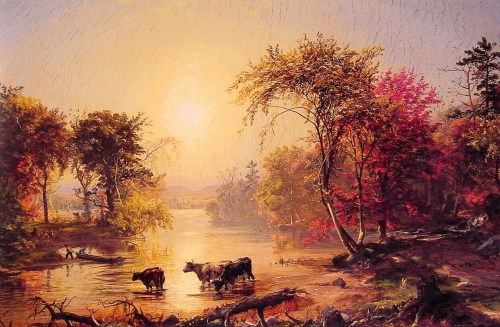
#FineArtFriday: Autumn On Greenwood Lake – two landscapes by Jasper Francis Cropsey (revisited)

This post first appeared here in October of 2018. It features two beautiful images of Autumn in New England in the mid-nineteenth century. I like both these paintings for the way the water is depicted, and the hazy hills.

Jasper Francis Cropsey created many paintings of Greenwood Lake, a freshwater lake on the border between New York State and New Jersey, beginning in 1843. Over the next few decades, Cropsey painted numerous scenes of the area, many from the same viewpoint on the lake as today’s featured paintings, each with varying intensities of color.

What I love about these two paintings, done years apart, is  difference in the quality of  the light. One is done in an early autumn, the other later in the season. The subject matter is similar, cows drinking at waters edge, fishers and their rowboat, but the trees are different, more mature in the second, and it is later in the evening. The autumn haze completely hides the hills.

Clearly, this was a place that was beloved by the artist, as he returned year after year, and made many landscapes of this beach and the surrounding area.

About the artist (Via Wikipedia):

Jasper Francis Cropsey (February 18, 1823 – June 22, 1900) was an important American landscape artist of the Hudson River School. He was best known for his lavish use of color and, as a first-generation member from the Hudson River School, painted autumn landscapes that startled viewers with their boldness and brilliance. As an artist, he believed landscapes were the highest art form and that nature was a direct manifestation of God. He also felt a patriotic affiliation with nature and saw his paintings as depicting the rugged and unspoiled qualities of America.

Jasper Cropsey died in anonymity but was rediscovered by galleries and collectors in the 1960s.


Credits and Attributions:

Autumn on Greenwood Lake, ca. 1861, by Jasper Francis Cropsey [Public domain], via Wikimedia Commons

Autumn in America, by Jasper Francis Cropsey [Public domain], via Wikimedia Commons

Wikipedia contributors, “Jasper Francis Cropsey,” Wikipedia, The Free Encyclopedia, https://en.wikipedia.org/w/index.php?title=Jasper_Francis_Cropsey&oldid=842742891 (accessed October 19, 2018).

Comments Off on #FineArtFriday: Autumn On Greenwood Lake – two landscapes by Jasper Francis Cropsey (revisited)

Filed under #FineArtFriday

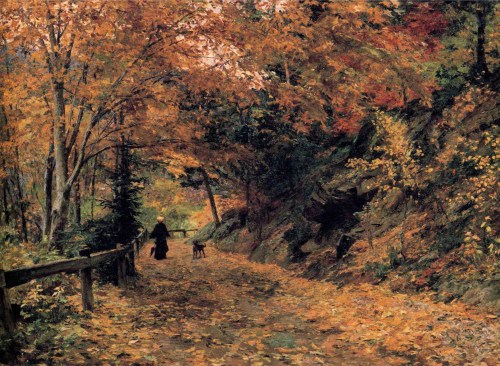
#FineArtFriday: Falling Leaves, by Olga Wisinger-Florian (reprise)

Falling Leaves, by Olga Wisinger-Florian, circa 1899, first appeared here in October of 2018.  It is one of my favorite depictions of autumn. The scene could be happening here in my lovely Pacific Northwestern forests. The colors of the leaves, the dirt road–this is very like where I grew up.

The painting depicts a woman and her dog enjoying a quiet walk in the serenity of an autumn day. Using light and shadow, the artist employs an impressionistic style to convey the forest. Nothing is drawn with precision, yet everything is shown in its entirety. The feeling of this pieces is a little dreamlike–she carries an umbrella, so she’s prepared for rain. She is dressed all in black except for her yellow hat. Leaves in all the many shades of green, gold, and red cling to their trees; the damp, aging rails of the wooden fence offers a flimsy barrier to the carriages and motor vehicles that may travel the roadside. Leaves cover the dirt road, and more are falling down, and the dog trots happily along beside her mistress—the story is there for us to see.

About the Artist:

According to Wikipedia, Olga Wisinger-Florian’s early paintings can be assigned to what is known as Austrian Mood Impressionism. In her landscape paintings she adopted Schindler’s sublime approach to nature. The motifs she employed, such as views of tree-lined avenues, gardens and fields, were strongly reminiscent of her teacher’s work. After breaking with Schindler in 1884, however, the artist went her own way. Her conception of landscapes became more realistic. Her late work is notable for a lurid palette, with discernible overtones of Expressionism. With landscape and flower pictures that were already Expressionist in palette by the 1890s, she was years ahead of her time.


Credits and Attributions:

Falling Leaves, by Olga Wisinger-Florian, ca 1899 [Public domain], via Wikimedia Commons

Wikipedia contributors, “Olga Wisinger-Florian,” Wikipedia, The Free Encyclopedia, https://en.wikipedia.org/w/index.php?title=Olga_Wisinger-Florian&oldid=852607929 (accessed October 11, 2018).

Wikimedia Commons contributors, “File:Olga Wisinger-Florian – Falling Leaves.JPG,” Wikimedia Commons, the free media repository, https://commons.wikimedia.org/w/index.php?title=File:Olga_Wisinger-Florian_-_Falling_Leaves.JPG&oldid=273565541 (accessed October 11, 2018).

Comments Off on #FineArtFriday: Falling Leaves, by Olga Wisinger-Florian (reprise)

Filed under #FineArtFriday

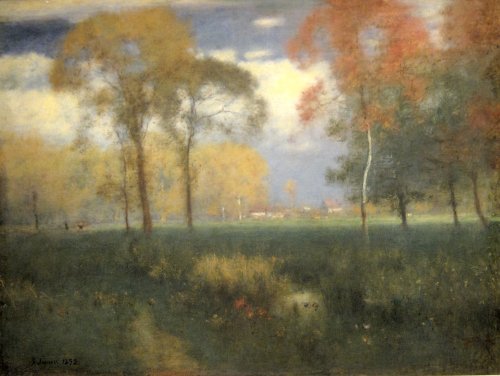
#FineArtFriday: Sunny Autumn Day by George Inness, 1892

Sunny Autumn Day, by George Inness

Date: 1892

Medium: oil on canvas

Dimensions: Height: 81 cm (31.8 in); Width: 106 cm (41.7 in)

Collection: Cleveland Museum of Art 


What I love about this painting:

This was painted toward the end of the artist’s life. We are given the impression of a beautiful day in September, with the leaves just beginning to turn color, still clinging to their trees. It’s warm enough to go without a jacket, one of the last good days before the weather turns cold. A dreamlike quality softens the edges, as if it depicts a scene viewed through the mystical glass of memory.

About the Artist, via Wikipedia:

George Inness (May 1, 1825 – August 3, 1894) was a prominent American landscape painter.

One of the most influential American artists of the nineteenth century, Inness was influenced, in turn, by the Old Masters, the Hudson River school, the Barbizon school, and, finally, the theology of Emanuel Swedenborg, whose spiritualism found vivid expression in the work of Inness’s maturity (1879–1894).

A master of light, color, and shadow, he became noted for creating highly ordered and complex scenes that often juxtaposed hazy or blurred elements with sharp and refined details to evoke an interweaving of both the physical and the spiritual nature of experience. In Inness’s words, he attempted through his art to demonstrate the “reality of the unseen” and to connect the “visible upon the invisible.”

After Inness settled in Montclair, New Jersey in 1885, and particularly in the last decade of his life, this mystical component manifested in his art through a more abstracted handling of shapes, softened edges, and saturated color (October, 1886, Los Angeles County Museum of Art), a profound and dramatic juxtaposition of sky and earth (Early Autumn, Montclair, 1888, Montclair Art Museum),  an emphasis on the intimate landscape view (Sunset in the Woods, 1891, Corcoran Gallery of Art), and an increasingly personal, spontaneous, and often violent handling of paint. It is this last quality in particular which distinguishes Inness from those painters of like sympathies who are characterized as Luminists.

In a published interview, Inness maintained that “The true use of art is, first, to cultivate the artist’s own spiritual nature.” His abiding interest in spiritual and emotional considerations did not preclude Inness from undertaking a scientific study of color, nor a mathematical, structural approach to composition: “The poetic quality is not obtained by eschewing any truths of fact or of Nature…Poetry is the vision of reality.”


Credits and Attributions:

Wikimedia Commons contributors, “File:’Sunny Autumn Day’ by George Inness, 1892.JPG,” Wikimedia Commons, the free media repository, https://commons.wikimedia.org/w/index.php?title=File:%27Sunny_Autumn_Day%27_by_George_Inness,_1892.JPG&oldid=428214252  (accessed October 2, 2020).

Wikipedia contributors, “George Inness,” Wikipedia, The Free Encyclopedia, https://en.wikipedia.org/w/index.php?title=George_Inness&oldid=975996784 (accessed October 2, 2020).

2 Comments

Filed under #FineArtFriday

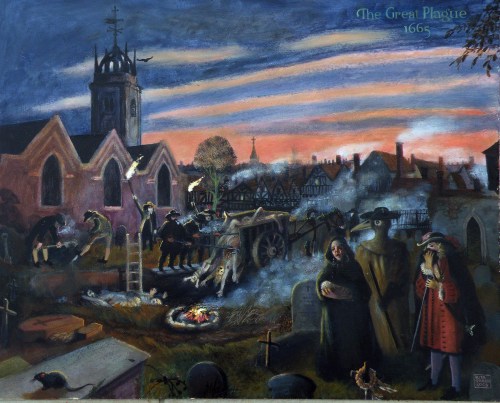
#FineArtFriday: The Great Plague 1665 by Rita Greer 2009

Title: The Great Plague 1665, by Rita Greer 2009

Description (via Wikimedia Commons): Like many who could afford to, Robert Hooke left London for six months during the worst of the bubonic plague. All cats and dogs were destroyed as a preventive measure. This allowed rats to flourish and spread the disease which was carried by their fleas. The image shows a scene of horror. After sunset carts were driven through the streets to collect the dead. They were taken to the nearest graveyard to be buried in plague pits. Fires burned to make smoke. Pipes of tobacco were smoked, posies of herbs worn, and faces covered with masks. This was thought to be protection against contagion. London was overwhelmed with fear, terror and grief. It is thought that as many as 100,000 perished in London alone.

Date: 2009

Source/Photographer: The original is an oil painting on board by Rita Greer, history painter, 2009. This was digitized by Rita and sent via email to the Department of Engineering Science, Oxford University, where it was subsequently uploaded to Wikimedia.

What I love about this painting:

Rita Greer paints history as if she lived it, with meticulous detail. In this street scene, she manages to capture the despair and hopelessness that pervaded London with the advent of the plague. This scene is dark, and filled with emotion. Death walks the smoke-hazed streets, feeding on tragedy. Grief and fear are the driving forces, and no one’s family is spared.

This year, 2020, feels like an apocalypse year, in many ways. It helps to keep in mind that for London and all the great cities of Europe, 1665 was worse.

About the artist:

Rita Greer is a history artist, goldsmith, graphic designer, food scientist and author/writer. On retirement in 2003 Rita began the Robert Hooke project, “to put him back into history.” Much her work is available to be viewed at Wikimedia Commons, Category: Paintings by Rita Greer.


Credits and Attributions:

Wikimedia Commons contributors, “File:20 The Great Plague.JPG,” Wikimedia Commons, the free media repository, https://commons.wikimedia.org/w/index.php?title=File:20_The_Great_Plague.JPG&oldid=450173019 (accessed September 24, 2020).

Comments Off on #FineArtFriday: The Great Plague 1665 by Rita Greer 2009

Filed under #FineArtFriday