Category Archives: #FineArtFriday

#FineArtFriday: The Chess Game, by Sofonisba Anguissola ca. 1555 (reprise)

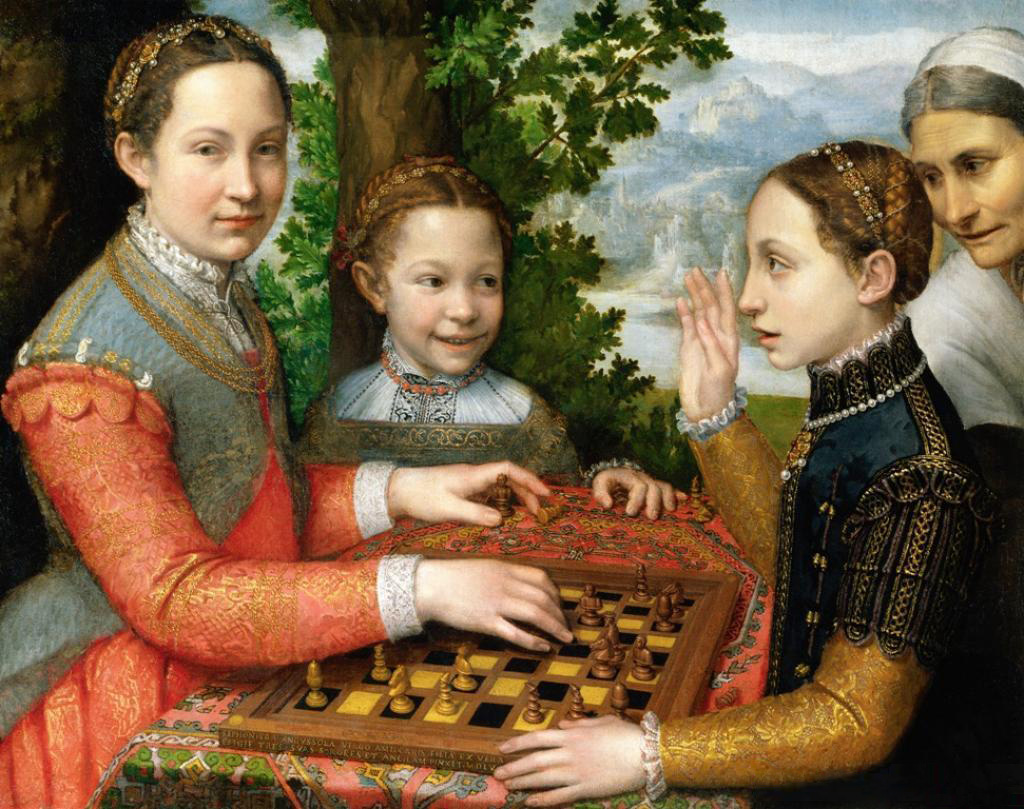
Title: The Chess Game (Portrait of the artist’s sisters playing chess)

Artist: Sofonisba Anguissola

Date: 1555

Medium: oil on canvas

Dimensions: Height: 72 cm (28.3 ″) Width: 97 cm (38.1 ″)

Today we’re revisiting The Chess Game, which is a portrait of the artist’s sisters playing chess. This post first appeared here on September 13, 2019 and is a wonderful window into the personalities of three girls in an upper class family in the 16th century. Anguissola had a marvelous ability to capture the moods of her subjects.

What I love about this painting:

The colors are vibrant,

Because it is a game of war and strategies for winning a war, chess has historically been considered a predominantly male game. That Anguissola’s sisters are playing it at so young an age is a testimony to the atmosphere of education surrounding the home.

Their features are modern in the way they are shown with a roundness that is unusual in early renaissance portraits, which were often so highly formal that they were visually flat. These girls could be my granddaughters.

Anguissola has captured the emotions and happiness of a family at play. Her sisters’ personalities are clearly shown. The older sister has taken a pawn, the younger fears she might lose the game to a more experienced player. The youngest is enjoying the game immensely, seeing the sister who sometimes bosses her around being handed her own medicine.

About the Artist, via Wikipedia:

Sofonisba Anguissola (c. 1532 – 16 November 1625), also known as Sophonisba Angussola or Anguisciola, was an Italian Renaissance painter born in Cremona to a relatively poor noble family. She received a well-rounded education, that included the fine arts, and her apprenticeship with local painters set a precedent for women to be accepted as students of art. As a young woman, Anguissola traveled to Rome where she was introduced to Michelangelo, who immediately recognized her talent, and to Milan, where she painted the Duke of Alba. The Spanish queen, Elizabeth of Valois, was a keen amateur painter and in 1559 Anguissola was recruited to go to Madrid as her tutor, with the rank of lady-in-waiting. She later became an official court painter to the king, Philip II, and adapted her style to the more formal requirements of official portraits for the Spanish court. After the queen’s death, Philip helped arrange an aristocratic marriage for her. She moved to Sicily, and later Pisa and Genoa, where she continued to practice as a leading portrait painter.

On 12 July 1624, Anguissola was visited by the young Flemish painter Anthony van Dyck, who recorded sketches from his visit to her in his sketchbook. Van Dyck, who believed her to be 96 years of age (she was actually about 92) noted that although “her eyesight was weakened”, Anguissola was still mentally alert. Excerpts of the advice she gave him about painting survive from this visit, and he was said to have claimed that their conversation taught him more about the “true principles” of painting than anything else in his life. Van Dyck drew her portrait while visiting her.

About this painting, via Wikipedia:

Although Anguissola enjoyed significantly more encouragement and support than the average woman of her day, her social class did not allow her to transcend the constraints of her sex. Without the possibility of studying anatomy or drawing from life (it was considered unacceptable for a lady to view nudes), she could not undertake the complex multi-figure compositions required for large-scale religious or history paintings.

Instead, she experimented with new styles of portraiture, setting subjects informally. Self-portraits and family members were her most frequent subjects, as seen in such paintings as Self-Portrait (1554, Kunsthistoriches Museum, Vienna), Portrait of Amilcare, Minerva and Asdrubale Anguissola (c. 1557–1558, Nivaagaards Malerisambling, Niva, Denmark), and her most famous picture, The Chess Game (1555, Muzeum Narodowe, Poznań), which depicted her sisters Lucia, Minerva and Europa.

Painted when Sofonisba was 23 years old, The Chess Game is an intimate representation of an everyday family scene, combining elaborate formal clothing with very informal facial expressions, which was unusual for Italian art at this time. The Chess Game explored a new kind of genre painting which places her sitters in a domestic setting instead of the formal or allegorical settings that were popular at the time. This painting has been regarded as a conversation piece, which is an informal portrait of a group engaging in lively conversation or some activity .


Credits and Attributions:

Wikimedia Commons contributors, “File:The Chess Game – Sofonisba Anguissola.jpg,” Wikimedia Commons, the free media repository, https://commons.wikimedia.org/w/index.php?title=File:The_Chess_Game_-_Sofonisba_Anguissola.jpg&oldid=359367567 (accessed September 12, 2019).

Wikipedia contributors, “Sofonisba Anguissola,” Wikipedia, The Free Encyclopedia, https://en.wikipedia.org/w/index.php?title=Sofonisba_Anguissola&oldid=908120352 (accessed September 12, 2019).

Comments Off on #FineArtFriday: The Chess Game, by Sofonisba Anguissola ca. 1555 (reprise)

Filed under #FineArtFriday

#FineArtFriday: Accident at the Old Pier, by Andreas Achenbach 1863

OLYMPUS DIGITAL CAMERA

Artist: Andreas Achenbach  (1815–1910)

Title: Accident at the Old Pier, by Andreas Achenbach 1863

Genre: landscape art

Date: 1863

Medium: oil on panel

Dimensions: Height: 92.5 cm (36.4 in) Width: 70.8 cm (27.8 in)

Collection: Kunsthalle Bremen 

Object history: 1865: purchased by Kunsthalle Bremen

Inscriptions: Signature and date bottom left: A. Achenbach 1863

What I love about this painting:

The scene depicted here is both historical, and current. It is a scene that plays out in our modern world in the same way as it did in 1863.

No matter what part of the world you live, anyone who lives near the sea will recognize the style of the rickety, weathered pier. Storms and saltwater wreak their will on both the wooden docks and the hubris of those who think to conquer the waves. Wood is no match for the storm; we fish and travel the waters at the mercy of the weather, and if the wind is wrong, approaching the dock can be dicey.

Along the pier, men work to keep the boat from crashing. A ship of that size would take out at least a section of the dock, if not the whole dock.

To this day, there is only one way to fend a boat away from a bad docking if they are at the mercy of the storm, and that is what we see here. Dockworkers push the vessel with poles to hold it off, hoping to reduce its momentum. A timber floats in the waves, as the boat has struck the pier at least once with the full force of the gale winds.

For the crew, disembarking will be a challenge. Should these sailors remain on board or try to jump onto the pier, risking being crushed between the rolling, lurching ship and the waves?

About the Artist, via Wikipedia:

Andreas Achenbach (29 September 1815, Kassel – 1 April 1910, Düsseldorf) was a German landscape and seascape painter in the Romantic style. He is considered to be one of the founders of the Düsseldorf School. His brother, Oswald, was also a well known landscape painter. Together, based on their initials, they were known as the “Alpha and Omega” of landscape painters. [1]


Credits and Attributions:

Wikimedia Commons contributors, “File:Achenbach Havarie am alten Pier@Albert König Museum20160904.jpg,” Wikimedia Commons, the free media repository, https://commons.wikimedia.org/w/index.php?title=File:Achenbach_Havarie_am_alten_Pier@Albert_K%C3%B6nig_Museum20160904.jpg&oldid=526736266 (accessed August 19, 2021).

[1] Wikipedia contributors, “Andreas Achenbach,” Wikipedia, The Free Encyclopedia, https://en.wikipedia.org/w/index.php?title=Andreas_Achenbach&oldid=1037476363 (accessed August 19, 2021).

1 Comment

Filed under #FineArtFriday, writing

#FineArtFriday: Autumn by František Michl 1949

1949-Autumn

Artist: František Michl

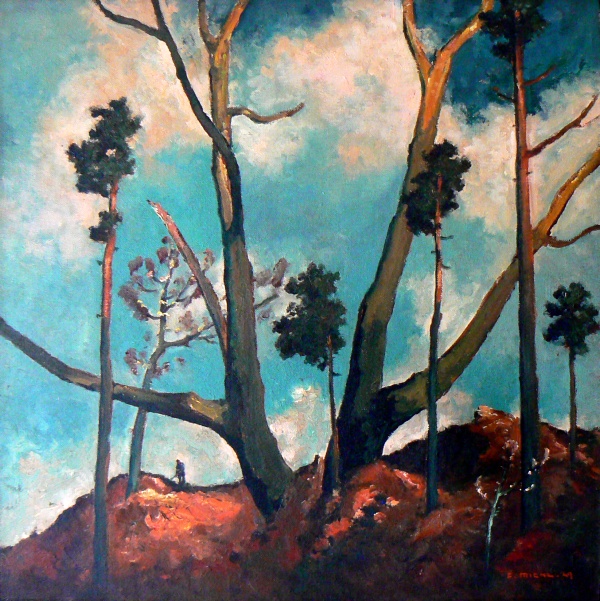
Title:  Autumn, 1949.

Medium: oil on canavas (private collection)


What I love about this painting:

This is a powerful, moody piece. It conveys the chill and dampness of a day in late autumn, contrasted against the brilliant blue of the skies between rain squalls. Some trees cling to their leaves, defying the cold breeze while others are bare, mingled among the tall evergreens. The grass is brown, and a solitary hiker takes advantage of the sunshine, making their way over the ridge in solitary peace.

One feels that soon this hillside will be covered with snow.

About the Artist, via Wikipedia:

[1] František Michl (20 November 1901, – 4 June 1977), Czech academic painter, graphic artist, and original designer of the Škoda Works emblem, the “Winged Arrow”. He was imprisoned in Pankrac Prison, and the concentration camps Terezin and Flossenbürg after his arrest by Nazis for an anti-fascist demonstration at Domažlice. After the war he was arrested in the Czechoslovak Socialist Republic for listening to the anticommunist Radio Liberty.

Michl, being a free-minded and anticommunist spirit, was imprisoned in Plzeň Prison in 1961. The trial was based on the accusation that Michl listened to Radio Liberty, which was considered by the totalitarian regime as treason. His name was blacklisted and his family persecuted.

The diminished political pressure in 1967 opened new prospects for Michl’s art in Czechoslovakia and abroad. In March 1968 his paintings were exhibited in Montreal. The Rullos Gallery in New York bought 165 paintings in November 1968. Unfortunately, preparation of Michl’s exhibition in the London National Gallery was interrupted by the Soviet invasion in August 1968.

The time of normalization brought back the ban on Michl’s name. Michl was not allowed to publicly display his art (though several illegal exhibitions, organized by his friends, took place, camouflaged under fake titles, for example “Successes of building socialism”). After his first brain stroke in 1972, which left half of his body paralyzed, Michl kept painting. It was only after his sixth stroke that Michl remained permanently bedridden until his death on June 4, 1977.

In 1991, František Michl’s name was fully politically rehabilitated, and his contribution to the anti-fascist and anticommunist resistance was recognized. Michl’s work, however, is still awaiting public recognition. [1]


Credits and Attributions:

Wikimedia Commons contributors, “File:1949-stromy.jpg,” Wikimedia Commons, the free media repository, https://commons.wikimedia.org/w/index.php?title=File:1949-stromy.jpg&oldid=423191687 (accessed August 13, 2021).

[1] Wikipedia contributors, “František Michl,” Wikipedia, The Free Encyclopedia, https://en.wikipedia.org/w/index.php?title=Franti%C5%A1ek_Michl&oldid=1002262176 (accessed August 13, 2021).

2 Comments

Filed under #FineArtFriday

#FineArtFriday: The Hay Harvest by Pieter Bruegel the Elder, 1565

Haymaking,_Pieter_Brueghel_the_Elder (1)Artist: Pieter Bruegel the Elder (1526/1530–1569)
Title: The Hay Harvest

Genre: genre art

Date: 1565

Medium: oil on panel

Dimensions: Height: 117 cm (46 in) Width: 161 cm (63.3 in)

According to the Web Gallery of Art, Haymaking, also known as The Hay Harvest, belongs to the Series of the Months. All the other panels in this series are dated 1565. July and August are the months when most summer crops are harvested. This painting and the August panel (The Corn Harvest) show the bringing-in of the harvest.

Workers scythe grain in the large field toward the center of the painting. In the foreground, other laborers harvest vegetables and pick berries. Everyone works to bring in the food, men, women, and children, as winter isn’t that far away, and the hay will sustain the draft animals in the long cold months ahead.

While each painting in the series shows the traditional occupation of that month, Bruegel’s real subject is the landscape itself, its ever-changing appearance.

I have always loved Bruegel the Elder’s work because he portrays the gathering of food as a fundamental human activity. He shows us that the quantity of food we have on our tables is determined by the knowledge and labor of others.

The variety of foods we have available to us is dictated by the form of the landscape. To carve a living from the earth a farmer must understand and care for the land that sustains them. They must know what areas of soil will be best for each crop and use that knowledge when laying out how the fields will be planted, as each crop has different nutrient requirements. Within one valley, many types of soils will exist, so what serves to grow hay may not work for more delicate vegetables.

In the lush bounty of this painting, Bruegel the Elder shows us the wisdom of farmers, knowledge that sustains us to this day. He illustrates the way all people who grow and gather our food are bound to the land.

In this regard, we who grow food in our back gardens understand and respect the labors of those small farmers who grow produce for our local markets.

About the series, Months of the Year, via Wikipedia:

(Bruegel’s) famous set of landscapes with genre figures depicting the seasons are the culmination of his landscape style; the five surviving paintings use the basic elements of the world landscape (only one lacks craggy mountains) but transform them into his own style. They are larger than most previous works, with a genre scene with several figures in the foreground, and the panoramic view seen past or through trees. Bruegel was also aware of the Danube School‘s landscape style through prints.

The series on the months of the year includes several of Bruegel’s best-known works. In 1565, a wealthy patron in Antwerp, Niclaes Jonghelinck, commissioned him to paint a series of paintings of each month of the year. There has been disagreement among art historians as to whether the series originally included six or twelve works. Today, only five of these paintings survive and some of the months are paired to form a general season. Traditional Flemish luxury books of hours (e.g., the Très Riches Heures du Duc de Berry; 1416) had calendar pages that included the Labours of the Months, depictions set in landscapes of the agricultural tasks, weather, and social life typical for that month.

Bruegel’s paintings were on a far larger scale than a typical calendar page painting, each one approximately three feet by five feet. For Bruegel, this was a large commission (the size of a commission was based on how large the painting was) and an important one. In 1565, the Calvinist riots began and it was only two years before the Eighty Years’ War broke out. Bruegel may have felt safer with a secular commission so as to not offend Calvinist or Catholic. Some of the most famous paintings from this series included The Hunters in the Snow (December–January) and The Harvesters (August). [1]

About the Artist, Via Wikipedia:

Pieter Bruegel (also Brueghel or Breughelthe Elder c. 1525–1530 – 9 September 1569) was the most significant artist of Dutch and Flemish Renaissance painting, a painter and printmaker, known for his landscapes and peasant scenes (so-called genre painting); he was a pioneer in making both types of subject the focus in large paintings.

He was a formative influence on Dutch Golden Age painting and later painting in general in his innovative choices of subject matter, as one of the first generation of artists to grow up when religious subjects had ceased to be the natural subject matter of painting. He also painted no portraits, the other mainstay of Netherlandish art. After his training and travels to Italy, he returned in 1555 to settle in Antwerp, where he worked mainly as a prolific designer of prints for the leading publisher of the day. Only towards the end of the decade did he switch to make painting his main medium, and all his famous paintings come from the following period of little more than a decade before his early death, when he was probably in his early forties, and at the height of his powers.

As well as looking forwards, his art reinvigorates medieval subjects such as marginal drolleries of ordinary life in illuminated manuscripts, and the calendar scenes of agricultural labours set in landscape backgrounds, and puts these on a much larger scale than before, and in the expensive medium of oil painting. He does the same with the fantastic and anarchic world developed in Renaissance prints and book illustrations.

He is sometimes referred to as “Peasant Bruegel”, to distinguish him from the many later painters in his family, including his son Pieter Brueghel the Younger (1564–1638). From 1559, he dropped the ‘h’ from his name and signed his paintings as Bruegel; his relatives continued to use “Brueghel” or “Breughel”. [2]


Credits and Attributions:

Wikimedia Commons contributors, “File:Haymaking, Pieter Brueghel the Elder.jpg,” Wikimedia Commons, the free media repository, https://commons.wikimedia.org/w/index.php?title=File:Haymaking,_Pieter_Brueghel_the_Elder.jpg&oldid=431869636 (accessed August 5, 2021).

[1] Wikipedia contributors, “Pieter Bruegel the Elder,” Wikipedia, The Free Encyclopedia, https://en.wikipedia.org/w/index.php?title=Pieter_Bruegel_the_Elder&oldid=1028859234 (accessed August 5, 2021).

[2] Wikipedia contributors, “Pieter Bruegel the Elder,” Wikipedia, The Free Encyclopedia, https://en.wikipedia.org/w/index.php?title=Pieter_Bruegel_the_Elder&oldid=1028859234 (accessed August 5, 2021).

Comments Off on #FineArtFriday: The Hay Harvest by Pieter Bruegel the Elder, 1565

Filed under #FineArtFriday

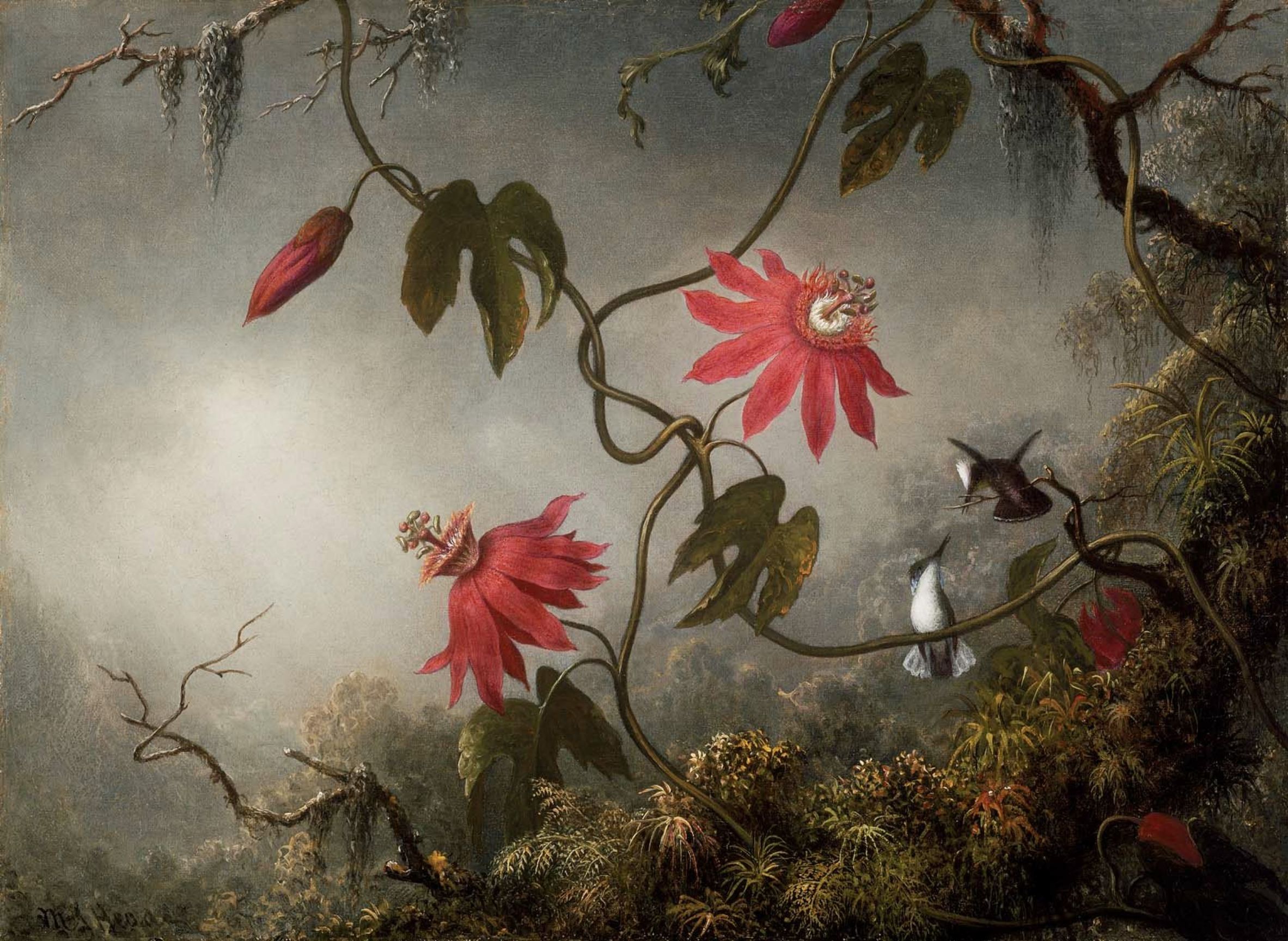
#FineArtFriday: Passion Flowers and Hummingbirds by Martin Johnson Heade

MJ_Heade_Passion_Flowers_and_HummingbirdsArtist: Martin Johnson Heade (1819–1904)
Title: Passion Flowers and Hummingbirds

Genre:  floral painting

Date: circa 1870–83

Medium: oil on canvas

Dimensions: Height: 39.3 cm (15.5 in); Width: 54.9 cm (21.6 in)


About this painting, via Wikimedia Commons:

[1] In Passion Flowers and Hummingbirds, Heade depicted two snowcap hummingbirds, small black-and-white birds found in Panama, and the most brilliantly colored species of passionflower, Passiflora racemosa, in a steamy, lush jungle setting.

The passionflower is so named because missionaries saw correspondences between the parts of the flower and the Passion (or sufferings) of Christ. For example, the ten petals represent the ten apostles present at the crucifixion, the corona filaments resemble the crown of thorns, and the three stigmas relate to the nails.

In this work, Heade successfully combined his scientific interests and his aesthetic sensitivity. He rendered the birds and the passionflowers accurately in a close-up view but also gracefully composed the winding stems across the surface of the picture and contrasted the cool greens and grays with the dazzling red of the flowers.

Although Heade was one of the first to reflect Darwin’s theories in his paintings of flowers in their natural habitats, other artists were subsequently affected by Darwin’s view of the vitality of plants and the interaction of plants with their environment. [1]

About the Artist, via Wikipedia:

[2] Martin Johnson Heade (August 11, 1819 – September 4, 1904) was an American painter known for his salt marsh landscapes, seascapes, and depictions of tropical birds (such as hummingbirds), as well as lotus blossoms and other still lifes. His painting style and subject matter, while derived from the romanticism of the time, are regarded by art historians as a significant departure from those of his peers.

Heade was born in Lumberville, Pennsylvania, the son of a storekeeper. He studied with Edward Hicks, and possibly with Thomas Hicks. His earliest works were produced during the 1840s and were chiefly portraits. He travelled to Europe several times as a young man, became an itinerant artist on American shores, and exhibited in Philadelphia in 1841 and New York in 1843. Friendships with artists of the Hudson River School led to an interest in landscape art. In 1863, he planned to publish a volume of Brazilian hummingbirds and tropical flowers, but the project was eventually abandoned.

He travelled to the tropics several times thereafter, and continued to paint birds and flowers. Heade married in 1883 and moved to St. Augustine, Florida. His chief works from this period were Floridian landscapes and flowers, particularly magnolias laid upon velvet cloth. He died in 1904. His best known works are depictions of light and shadow upon the salt marshes of New England.

Heade was not a widely known artist during his lifetime, but his work attracted the notice of scholars, art historians, and collectors during the 1940s. He quickly became recognized as a major American artist. Although often considered a Hudson River School artist, some critics and scholars take exception to this categorization. Heade’s works are now in major museums and collections. His paintings are occasionally discovered in unlikely places such as garage sales and flea markets. [2]


Credits and Attributions:

[1] Wikimedia Commons contributors, “File:MJ Heade Passion Flowers and Hummingbirds.jpg,” Wikimedia Commons, the free media repository, https://commons.wikimedia.org/w/index.php?title=File:MJ_Heade_Passion_Flowers_and_Hummingbirds.jpg&oldid=577409420 (accessed July 29, 2021).

[2] Wikipedia contributors, “Martin Johnson Heade,” Wikipedia, The Free Encyclopedia, https://en.wikipedia.org/w/index.php?title=Martin_Johnson_Heade&oldid=1013422150 (accessed July 29, 2021).

Comments Off on #FineArtFriday: Passion Flowers and Hummingbirds by Martin Johnson Heade

Filed under #FineArtFriday, writing

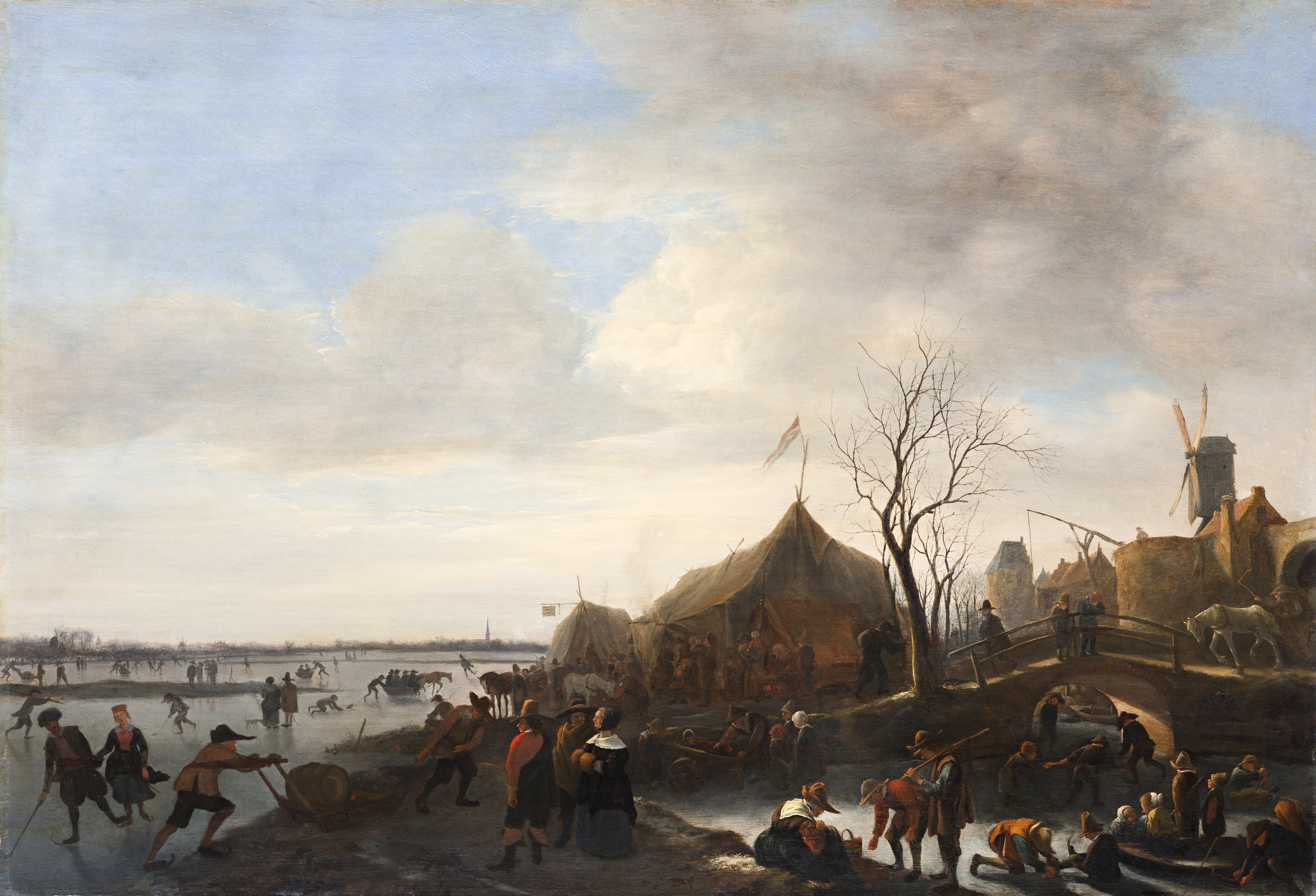
#FineArtFriday: Winter Scene by Jan Steen 1650

Inv.nr: 10032

Artist: Jan Steen (1625/1626–1679)

Title: Winter Scene

Date: circa 1650

Medium: oil on canvas

Dimensions: Height: 660 mm (25.98 in); Width: 960 mm (37.79 in)

About this painting, Via Wikimedia Commons:

[1] Winter Scene is one of the earliest known paintings by Steen. With its diagonal composition and silhouetted figures on the ice one can clearly see his early inspirations from paintings such as Isaac van Ostade’s Winter from 1645. Here, as often seen in other works by Steen and his contemporaries, the activities are being watched by a well-dressed couple who occupies a central position in the composition. [1]

About the Artist, via Wikipedia:

[2] Jan Havickszoon Steen (c. 1626 – buried 3 February 1679) was a Dutch Golden Age painter, one of the leading genre painters of the 17th century. His works are known for their psychological insight, sense of humour and abundance of colour.

Daily life was Jan Steen’s main pictorial theme. Many of the genre scenes he portrayed, as in The Feast of Saint Nicholas, are lively to the point of chaos and lustfulness, even so much that “a Jan Steen household,” meaning a messy scene, became a Dutch proverb (een huishouden van Jan Steen). Subtle hints in his paintings seem to suggest that Steen meant to warn the viewer rather than invite him to copy this behaviour. Many of Steen’s paintings bear references to old Dutch proverbs or literature. He often used members of his family as models, and painted quite a few self-portraits in which he showed no tendency of vanity.

Steen did not shy from other themes: he painted historical, mythological and religious scenes, portraits, still lifes and natural scenes. His portraits of children are famous. He is also well known for his mastery of light and attention to detail, most notably in Persian rugs and other textiles.

Steen was prolific, producing about 800 paintings, of which roughly 350 survive. His work was valued much by contemporaries and as a result he was reasonably well paid for his work. He did not have many students—only Richard Brakenburgh is recorded—but his work proved a source of inspiration for many painters. [2]


Credits and Attributions:

Wikimedia Commons contributors, “File:Måleri, landskapsbild, vinterlandskap. Jan Steen – Skoklosters slott – 88965.tif,” Wikimedia Commons, the free media repository, https://commons.wikimedia.org/w/index.php?title=File:M%C3%A5leri,_landskapsbild,_vinterlandskap._Jan_Steen_-_Skoklosters_slott_-_88965.tif&oldid=428348165 (accessed July 22, 2021). Photographer:  Jens Mohr.

Wikipedia contributors, “Jan Steen,” Wikipedia, The Free Encyclopedia, https://en.wikipedia.org/w/index.php?title=Jan_Steen&oldid=1022958604 (accessed July 22, 2021).

Comments Off on #FineArtFriday: Winter Scene by Jan Steen 1650

Filed under #FineArtFriday

#FineArtFriday: Gassed by John Singer Sargent 1919

2560px-Sargent,_John_Singer_(RA)_-_Gassed_-_Google_Art_ProjectArtist: John Singer Sargent (1856–1925)

Title: Gassed

Date: 1919

Medium: oil on canvas

Dimensions: Height: 231 cm (90.9 in); Width: 611.1 cm (20 ft)

What I love about this painting:

This painting is a powerful antiwar statement. John Singer Sargent was a complicated man, as most artists are. Famous as a portrait artist, he painted landscapes that conveyed a sense of mood and emotion that few of his contemporaries could match.

He was commissioned as a war artist by the British Ministry of Information. He illustrated numerous scenes from the Great War. Sargent had been affected by what he had seen while touring the front in France and by the death of his niece Rose-Marie in the shelling of the St Gervais church, Paris, on Good Friday 1918.

The colors are muted, and even the pastels are dark and dirty. The suffering of the maimed and injured men is laid bare. Through the legs of the walking wounded, the rising moon illuminates the desire of the uninjured to try to find some normalcy. Dwarfing the players and their game, the vast sea of dead and injured stretches as far as the eye can see.

Above, two tiny figures represent the clash of biplanes in the distance, the ever-moving machine of death and inhumanity that is war.

About this painting, via Wikipedia:

[1] Gassed is a very large oil painting completed in March 1919 by John Singer Sargent. It depicts the aftermath of a mustard gas attack during the First World War, with a line of wounded soldiers walking towards a dressing station. Sargent was commissioned by the British War Memorials Committee to document the war and visited the Western Front in July 1918 spending time with the Guards Division near Arras, and then with the American Expeditionary Forces near Ypres. The painting was finished in March 1919 and voted picture of the year by the Royal Academy of Arts in 1919. It is now held by the Imperial War Museum. It visited the US in 1999 for a series of retrospective exhibitions, and then from 2016 to 2018 for exhibitions commemorating the centenary of the First World War.

The painting measures 231.0 by 611.1 centimeters (7 ft 6.9 in × 20 ft 0.6 in). The composition includes a central group of eleven soldiers depicted nearly life-size. Nine wounded soldiers walk in a line, in three groups of three, along a duckboard towards a dressing station, suggested by the guy ropes to the right side of the picture. Their eyes are bandaged, blinded by the effect of the gas, so they are assisted by two medical orderlies. The line of tall, blind soldiers forms a naturalist allegorical frieze, with connotations of a religious procession. Many other dead or wounded soldiers lie around the central group, and a similar train of eight wounded, with two orderlies, advances in the background. Biplanes dogfight in the evening sky above, as a watery setting sun creates a pinkish yellow haze and burnishes the subjects with a golden light. In the background, the moon also rises, and uninjured men play association football in blue and red shirts, seemingly unconcerned at the suffering all around them.

The painting provides a powerful testimony of the effects of chemical weapons, vividly described in Wilfred Owen‘s poem Dulce et Decorum Est. Mustard gas is a persistent vesicant gas, with effects that only become apparent several hours after exposure. It attacks the skin, the eyes and the mucous membranes, causing large skin blisters, blindness, choking and vomiting. Death, although rare, can occur within two days, but suffering may be prolonged over several weeks.

Sargent’s painting refers to Bruegel’s 1568 work The Parable of the Blind, with the blind leading the blind, and it also alludes to Rodin’s Burghers of Calais.

About the Artist, via Wikipedia:

[2] John Singer Sargent (January 12, 1856 – April 14, 1925) was an American expatriate artist, considered the “leading portrait painter of his generation” for his evocations of Edwardian-era luxury. He created roughly 900 oil paintings and more than 2,000 watercolors, as well as countless sketches and charcoal drawings. His oeuvre documents worldwide travel, from Venice to the Tyrol, Corfu, the Middle East, Montana, Maine, and Florida.

Born in Florence to American parents, he was trained in Paris before moving to London, living most of his life in Europe. He enjoyed international acclaim as a portrait painter. An early submission to the Paris Salon in the 1880s, his Portrait of Madame X, was intended to consolidate his position as a society painter in Paris, but instead resulted in scandal. During the next year following the scandal, Sargent departed for England where he continued a successful career as a portrait artist.

From the beginning, Sargent’s work is characterized by remarkable technical facility, particularly in his ability to draw with a brush, which in later years inspired admiration as well as criticism for a supposed superficiality. His commissioned works were consistent with the grand manner of portraiture, while his informal studies and landscape paintings displayed a familiarity with Impressionism. In later life Sargent expressed ambivalence about the restrictions of formal portrait work, and devoted much of his energy to mural painting and working en plein air. Art historians generally ignored artists who painted royalty and “society” – such as Sargent – until the late 20th century. [2]


Credits and Attributions:

[1] Wikipedia contributors, “Gassed (painting),” Wikipedia, The Free Encyclopedia, https://en.wikipedia.org/w/index.php?title=Gassed_(painting)&oldid=1029966714 (accessed July 15, 2021).

[2] Wikipedia contributors, “John Singer Sargent,” Wikipedia, The Free Encyclopedia, https://en.wikipedia.org/w/index.php?title=John_Singer_Sargent&oldid=1032671314 (accessed July 15, 2021).

Image source: File:Sargent, John Singer (RA) – Gassed – Google Art Project.jpg – Wikipedia (accessed July 15, 2021).

Comments Off on #FineArtFriday: Gassed by John Singer Sargent 1919

Filed under #FineArtFriday

#FineArtFriday: Dogs by Jan Stobbaerts

Jan_Stobbaerts_-_DogsTitle: Dogs

Artist: Jan Stobbaerts  (1839–1914)

Date: between 1858 and 1914

Medium: oil on canvas

Dimensions: Height: 36.5 cm (14.3 in); Width: 45.5 cm (17.9 in)

What I like about this painting:

These dogs have the run of the house. They’re not too well groomed and probably spend a certain amount of time roaming the neighborhood. Both dogs have personality, and both are unrepentant ruffians.

This is a pair of canine hooligans bent on having a good time.

About the Artist, via Wikipedia [1]:

Jan Stobbaerts or Jan-Baptist Stobbaerts (18 March 1838 – 25 November 1914) was a Belgian painter and printmaker. He is known for his scenes with animals, landscapes, genre scenes and portraits or artists. With his dark-brown studio tones and forceful depiction of trivial subjects, Stobbaerts was a pioneer of Realism and ‘autochthonous’ Impressionism in Belgium.

While in his early works he painted scenes with pets in kitchen interiors in which the genre and anecdotal elements prevailed, from 1880 onwards stables and barns became a dominant theme in his work.[5] The compositions in this period were painted with an almost photographic realism.[8] His sober monochrome palette developed to a more balanced color scheme and he gave more attention to the effect of light.

Around 1890, Stobbaerts’ style underwent a considerable change likely under the influence of his discovery of Impressionism and his personal search for resolving the problem of light. Stobbaerts abandoned the detailed realism in favour of a very personal sfumato of light. His style became velvety, his brushwork looser and the paint more fluid. His paintings of the 1890s depicting scenes around the river Woluwe were made with an opaque, somewhat transparent paste. The artist concentrated on the effect of light and the forms, while they remained recognizable, became less clear as if seen through a soft-focus lens. The subject matter itself became less important. [1]


Credits and Attributions:

Wikimedia Commons contributors, “File:Jan Stobbaerts – Dogs.jpg,” Wikimedia Commons, the free media repository, https://commons.wikimedia.org/w/index.php?title=File:Jan_Stobbaerts_-_Dogs.jpg&oldid=354839586 (accessed July 9, 2021).

[1] Wikipedia contributors, “Jan Stobbaerts,” Wikipedia, The Free Encyclopedia, https://en.wikipedia.org/w/index.php?title=Jan_Stobbaerts&oldid=1025124429 (accessed July 9, 2021).

2 Comments

Filed under #FineArtFriday, writing

#FineArtFriday: Dawn In The Hills by Julian Onderdonk 1922

  • Julian_Onderdonk_(1882-1922)_-_Dawn_In_The_Hills_(1922)
  • Artist: Julian Onderdonk  (1882–1922)
  • Title: Dawn In The Hills
  • Date    1922
  • Medium: oil on canvas
  • Dimensions: Height: 76.2 cm (30″); Width: 101.6 cm (40″)
  • Collection: Private collection

What I love about this painting:

Onderdonk captured the surreal essence of early morning near San Antonio, Texas. The mists are rising in the hills, slowly revealing the riotous splendor of deep blue wildflowers. It is a rolling sea of bluebonnets, with the occasional white of the blackfoot or fleabane daisy mingled in.

The artist perfectly conveyed the mystical quality of that singular moment of the morning when the air is still and golden, and the day ahead is full of possibilities.

I could spend hours in this place.

About this painting:

Art historian Jeffrey Morseburg writes, “In the fall of 1922, as he was just entering his prime, Onderdonk was rushed to the hospital with an intestinal blockage. He failed to recover from the emergency surgery and died on October 27, 1922. His sudden death created an outpouring of emotion for the man who had become “The Dean of Texas Painters.” Just before he died, Onderdonk had finished a beautiful early morning view of a Texas hillside carpeted with Bluebonnets titled ‘Dawn in the Hills’ and another work, a bold fall scene titled ‘Autumn Tapestry.’” [1]

About the Artist, Via Wikipedia:

Julian Onderdonk was born in San Antonio, Texas, to Robert Jenkins Onderdonk, a painter, and Emily Gould Onderdonk. He was raised in South Texas and was an enthusiastic sketcher and painter. As a teenager Onderdonk was influenced and received some training from the prominent Texas artist Verner Moore White who also lived in San Antonio at the time. He attended the West Texas Military Academy, now the Episcopal School of Texas, graduating in 1900. His grandfather Henry Onderdonk was the Headmaster of Saint James School in Maryland, from which Julian’s father Robert graduated.

At 19, with the help of a generous neighbor, Julian left Texas in order to study with the renowned American Impressionist William Merritt Chase. Julian’s father, Robert, had also once studied with Chase. Julian spent the summer of 1901 on Long Island at Chase’s Shinnecock Hills Summer School of Art. He studied with Chase for a couple of years and then moved to New York City to attempt to make a living as an en plein air artist. While in New York he met and married Gertrude Shipman and they soon had a son.

Onderdonk returned to San Antonio in 1909, where he produced his best work. His most popular subjects were bluebonnet landscapes. Onderdonk died on October 27, 1922 in San Antonio.

President George W. Bush decorated the Oval Office with three of Onderdonk’s paintings. The Dallas Museum of Art has several rooms dedicated exclusively to Onderdonk’s work.

His art studio currently resides on the grounds of the Witte Museum.


Credits and Attributions:

[1] Julian Onderdonk, An Illustrated Biography by Jeffrey Morseburg, © 2011 https://julianonderdonk.wordpress.com/tag/julian-onderdonk-biography/  (accessed March 4, 2020).

Wikimedia Commons contributors, “File:Julian Onderdonk (1882-1922) – Dawn In The Hills (1922).jpg,” Wikimedia Commons, the free media repository, https://commons.wikimedia.org/w/index.php?title=File:Julian_Onderdonk_(1882-1922)_-_Dawn_In_The_Hills_(1922).jpg&oldid=278966540 (accessed March 4, 2020).

Wikipedia contributors, “Julian Onderdonk,” Wikipedia, The Free Encyclopedia, https://en.wikipedia.org/w/index.php?title=Julian_Onderdonk&oldid=882101452 (accessed March 4, 2020).

Comments Off on #FineArtFriday: Dawn In The Hills by Julian Onderdonk 1922

Filed under #FineArtFriday