Category Archives: #FineArtFriday

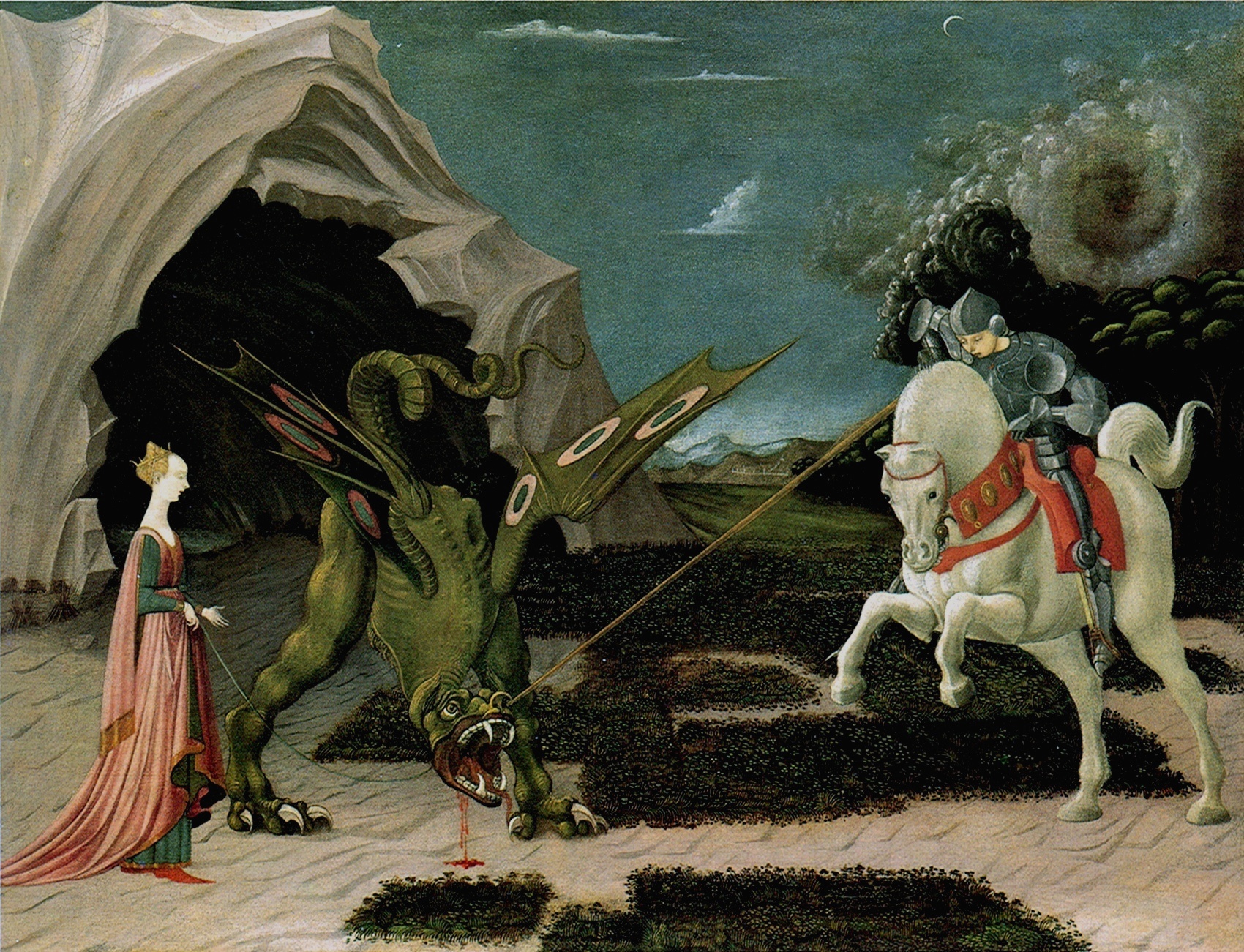
#FineArtFriday: Saint George and the Dragon by Paolo Uccello

paolo_uccello_stgeorge_and_dragonArtist:  Paolo Uccello (1397–1475)

Title: Saint George and the Dragon

Medium: oil on canvas

Dimensions: Height: 57 cm (22.4 in); Width: 73 cm (28.7 in)

The above painting by Paolo Uccello, from around 1470, is a surreal, stylized retelling of the legend of Saint George and the Dragon. The legend tells of the knight slaying a dragon that demanded human sacrifices. With the slaying of the dragon, the hero has saved the princess who was chosen to be the next offering.

Nothing looks real except the dragon which is nightmare come to life. I love the hyper-heroic way Uccello portrayed horses. The people are pallid, with no personality to their features. The dragon and the horse are alive, as if the scene is about them only. All the passion of the moment converges in the dragon and the horse.

Done in oil on canvas, the painting was one of the last of Uccello’s creations.

According to Wikipedia, the Fount of All Knowledge: The narrative (of Saint George) has pre-Christian origins (Jason and MedeaPerseus and AndromedaTyphon, etc.), and is recorded in various saints’ lives prior to its attribution to St George specifically. It was particularly attributed to Saint Theodore Tiro in the 9th and 10th centuries, and was first transferred to Saint George in the 11th century. The earliest narrative record of Saint George slaying a dragon is found in a Georgian text of the 11th century. [1]

About the Artist (via Wikipedia)

Born Paolo di Dono, his nickname, Uccello (of the birds), came from his fondness for painting birds. He worked in the Late Gothic tradition, emphasizing colour and pageantry rather than the classical realism that other artists were pioneering. His style is best described as idiosyncratic (eccentric or unique), and he left no school of followers.

With his precise and analytical mind, Paolo Uccello tried to apply a scientific method to depict objects in three-dimensional space. In particular, some of his studies of the perspective foreshortening of the torus are preserved, and one standard display of drawing skill was his depiction of the mazzocchio.

In the words of G. C. Argan: “Paolo’s rigour is similar to the rigour of Cubists in the early 20th century, whose images were more true when they were less true to life. Paolo constructs space through perspective, and historic event through the structure of space; if the resulting image is unnatural and unrealistic, so much the worse for nature and history.”

The perspective in his paintings has influenced many famous painters, such as Piero della FrancescaAlbrecht Dürer and Leonardo da Vinci, to name a few. [2]


Credits and Attributions:

Wikimedia Commons contributors, “File:Paolo Uccello 047.jpg,” Wikimedia Commons, the free media repository, https://commons.wikimedia.org/w/index.php?title=File:Paolo_Uccello_047.jpg&oldid=308602797  (accessed January 18, 2019).

Wikipedia contributors, “Saint George,” Wikipedia, The Free Encyclopedia, https://en.wikipedia.org/w/index.php?title=Saint_George&oldid=1029544183 (accessed June 23, 2021). [1]

Wikipedia contributors, “Paolo Uccello,” Wikipedia, The Free Encyclopedia, https://en.wikipedia.org/w/index.php?title=Paolo_Uccello&oldid=873078862  (accessed January 18, 2019). [2]

Comments Off on #FineArtFriday: Saint George and the Dragon by Paolo Uccello

Filed under #FineArtFriday, writing

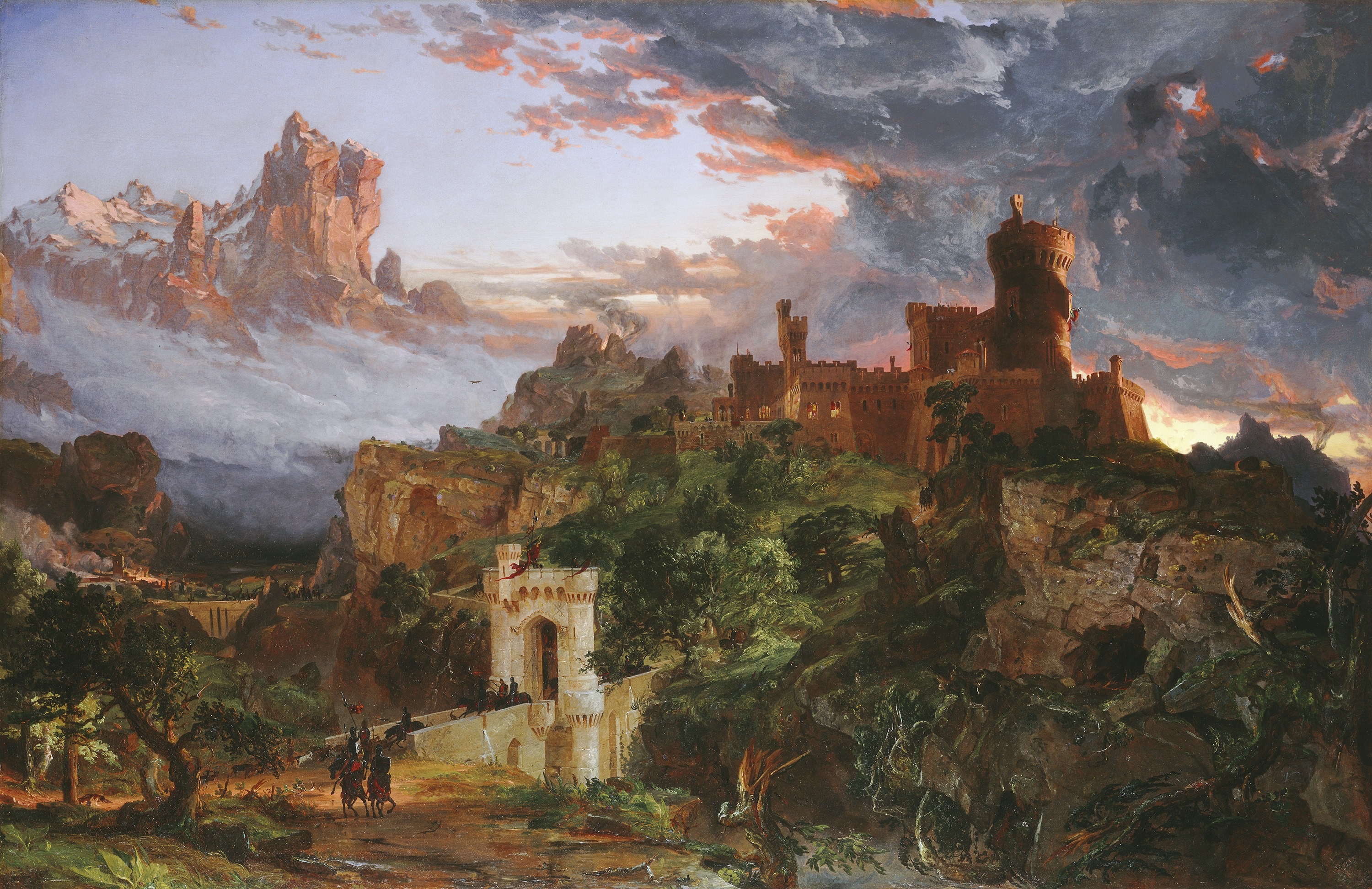
#FineArtFriday: The Spirit of War by Jasper Francis Cropsey 1851

The spirit of war

Title: The Spirit of War by Jasper Francis Cropsey  (1823–1900)

Genre: landscape

Date: 1851

Medium: painting

Dimensions: Height: 110.8 cm (43.6 in); Width: 171.6 cm (67.5 in)

Collection: National Gallery of Art

Place of creation: United States of America [1]

What I love about this painting:

The Spirit of War by Jasper Francis Cropsey is one of a two-part fantasy that Cropsey painted in 1851; the other is the Spirit of Peace. During Cropsey’s lifetime, these two paintings were his most celebrated, but now he is known more for his ethereal paintings depicting autumn scenes, several of which I have featured here.

This painting was inspired both by the aftermath of the Mexican-American War and the looming threat of the American Civil War. It shows the young artist’s love of Arthurian tales and demonstrates his ability to deliver a story. His signature luminism is still in its infancy here, yet one can see the seeds of what would become a mastery of light and illumination.

Cropsey contrasts light and shadow as if they were good and evil. He paints godlike mountains that reign over deep valleys and strongholds. In the foreground, a strong fortress represents prosperity, her richly attired knights riding out to do battle. In the distance, a citadel burns, the smoke of raging fires billowing toward the darkening sky.

This is a powerful painting, one that tells a story and shows an entire novel.

About the Artist, via Wikipedia:

Jasper Francis Cropsey (February 18, 1823 – June 22, 1900) was an important American landscape artist of the Hudson River School.

Trained as an architect, he set up his own office in 1843. Cropsey studied watercolor and life drawing at the National Academy of Design under the instruction of Edward Maury and first exhibited there in 1844. A year later he was elected an associate member and turned exclusively to landscape painting; shortly after he was featured in an exhibition entitled “Italian Compositions”.

Cropsy traveled in Europe from 1847–1849, visiting England, France, Switzerland, and Italy. He was elected a full member of the Academy in 1851. Cropsey was a personal friend of Henry Tappan, the president of the University of Michigan from 1852 to 1863. At Tappan’s invitation, he traveled to Ann Arbor in 1855 and produced two paintings, one of the Detroit Observatory, and a landscape of the campus. He went abroad again in 1856, and resided seven years in London, sending his pictures to the Royal Academy and to the International exhibition of 1862.

Returning home, he opened a studio in New York and specialized in autumnal landscape paintings of the northeastern United States, often idealized and with vivid colors. Cropsey co-founded, with ten fellow artists, the American Society of Painters in Water Colors in 1866.

Cropsey’s interest in architecture continued throughout his life and was a strong influence in his painting, most evident in his precise arrangement and outline of forms. But Cropsey was best known for his lavish use of color and, as a first-generation member from the Hudson River School, painted autumn landscapes that startled viewers with their boldness and brilliance. As an artist, he believed landscapes were the highest art form and that nature was a direct manifestation of God. He also felt a patriotic affiliation with nature and saw his paintings as depicting the rugged and unspoiled qualities of America. [2]


Credits and Attributions:

[1] Wikimedia Commons contributors, “File:The-spirit-of-war.jpg,” Wikimedia Commons, the free media repository, https://commons.wikimedia.org/w/index.php?title=File:The-spirit-of-war.jpg&oldid=565046310 (accessed June 17, 2021).

[2] Wikipedia contributors, “Jasper Francis Cropsey,” Wikipedia, The Free Encyclopedia, https://en.wikipedia.org/w/index.php?title=Jasper_Francis_Cropsey&oldid=1018920537 (accessed June 17, 2021).

3 Comments

Filed under #FineArtFriday, writing

#FineArtFriday: Boulevard de la Madeleine in Paris by Frits Thaulow ca 1897
Frits_Thaulow_-_Boulevard_de_la_Madeleine_à_Paris_(1890s)Title: Boulevard de la Madeleine in Paris by Frits Thaulow

Date: circa 1896-1897

Medium: oil on canvas

Dimensions: Height: 88.2 cm (34.7 in); Width: 66.3 cm (26.1 in)

Collection: Pushkin Museum of Fine Arts

Inscriptions: Signature and date bottom right: Frits Thaulow (date is unclear)

What I like about this painting:

This is a street scene viewed from an angle we rarely see in paintings. The people and vehicles are small, insignificant in comparison with the size and grandeur of the buildings.

While Thaulow didn’t enjoy painting cityscapes, I think Boulevard de la Madeleine in Paris is one of the best of that era.

The soot from the chimneys in the distance, the wet street, the muted, watery colors of a rainy spring day, and the God’s-eye view of the busy street—it all comes together to present a powerful statement.

About the Artist, Via Wikipedia:

Thaulow was one of the earliest artists to paint in Skagen in the north of Jutland, soon to become famous for its Skagen Painters. He arrived there in 1879 with his friend Christian Krohg, who persuaded him to spend the summer and autumn there. They arrived from Norway in Thaulow’s little boat. Thaulow, who had specialized in marine painting, turned to Skagen’s favourite subjects, the fishermen and the boats on the shore.

Thaulow moved to France in 1892, living there until his death in 1906. He soon discovered that the cityscapes of Paris did not suit him. His best paintings were made in small towns such as Montreuil-sur-Mer (1892–94), Dieppe and surrounding villages (1894–98), Quimperle in Brittany (1901) and Beaulieu-sur-Dordogne in the Corrèze département (1903). One of his most famous works once he moved to france was A village street in France. In Dieppe Thaulow and his wife Alexandra made themselves popular: they were friends with artist Charles Conder, and they met Aubrey Beardsley. [1]


Credits and Attributions:

[1] Wikipedia contributors, “Frits Thaulow,” Wikipedia, The Free Encyclopedia, https://en.wikipedia.org/w/index.php?title=Frits_Thaulow&oldid=1026282924 (accessed June 10, 2021).

Boulevard de la Madeleine in Paris, ca 1896-97 by  Frits Thaulow, Public domain, via Wikimedia Commons. Wikimedia Commons contributors, “File:Frits Thaulow – Boulevard de la Madeleine à Paris (1890s).jpg,” Wikimedia Commons, the free media repository, https://commons.wikimedia.org/w/index.php?title=File:Frits_Thaulow_-_Boulevard_de_la_Madeleine_%C3%A0_Paris_(1890s).jpg&oldid=566337323 (accessed June 10, 2021).

2 Comments

Filed under #FineArtFriday

#FineArtFriday: A London Garden by Edith Corbet 1911

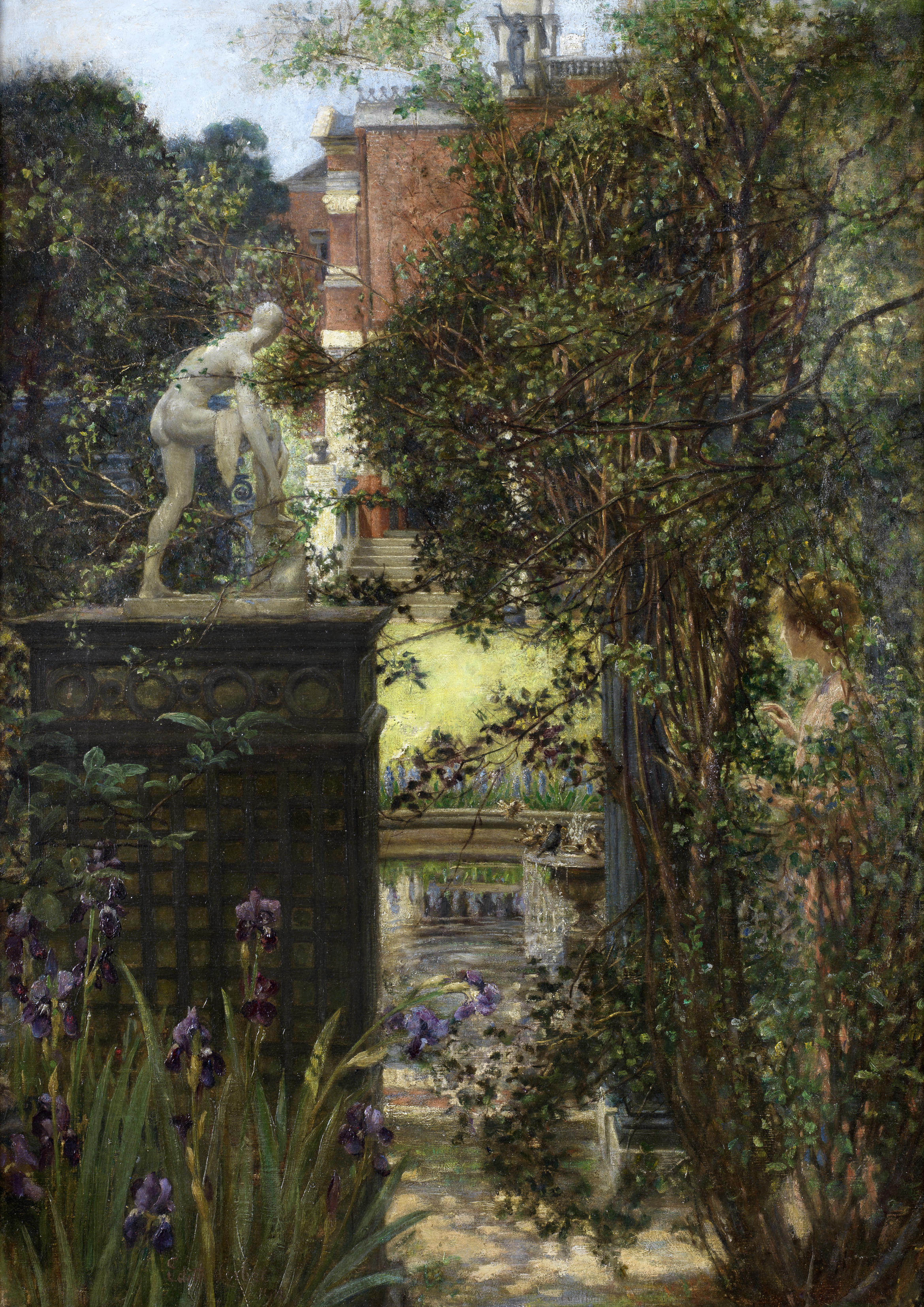
Edith_Corbet_A_London_gardenTitle: A London Garden

Artist: Edith Corbet (1846-1920)

Description: oil on canvas; 62 x 45 cm

Date: 1911

Signed and dated ‘Edith Corbet/1911’ (lower left).

What I love about this painting:

I love the serenity of older, slightly overgrown gardens. This garden is peaceful, with irises blooming, and beyond the gate, a path winds toward a pool ringed by hyacinths. Further beyond, steps lead to a home. Whoever lives here is lucky to have such a garden out their front door.

Birds find mature shrubbery attractive and make their homes there. Several birds are enjoying the birdbath, secure and safe from predators.

About the artist, via Wikipedia:

Edith Corbet née Edenborough (28 December 1846 – 1920) was a Victorian landscape painter, having close associations with the Macchiaioli group (also known as the Tuscans or Etruscans), who, in a break with tradition, painted outdoors in order to capture natural light effects and favoured a panoramic format for their paintings

She married the Victorian painter and illustrator Arthur Murch and moved to Rome, where she painted with Giovanni Costa, leader of the Macchiaioli group. In 1876 they both stayed in Venice. Olivia Rossetti Agresti wrote: Costa had a very high opinion of this artist’s gifts and used to remember with pleasure how on that occasion they used to go out together to paint from nature at Fusino (Agresti, 1904).

She frequently exhibited from 1880 to 1890 at the Grosvenor Gallery and the New Gallery. In 1891, after the death of her first husband, she married Matthew Ridley Corbet, one of the Macchiaioli group’s leading members, after which she exhibited mainly at the Royal Academy, visiting Italy and living in London for the remainder of her life. Corbet exhibited her work at the Palace of Fine Arts at the 1893 World’s Columbian Exposition in Chicago, Illinois. She died in Hampstead, north London, in 1920. [1]


Credits and Attributions:

Wikimedia Commons contributors, “File:Edith Corbet A London garden.jpg,” Wikimedia Commons, the free media repository, https://commons.wikimedia.org/w/index.php?title=File:Edith_Corbet_A_London_garden.jpg&oldid=555317886 (accessed June 3, 2021).

[1] Wikipedia contributors, “Edith Corbet,” Wikipedia, The Free Encyclopedia, https://en.wikipedia.org/w/index.php?title=Edith_Corbet&oldid=936468065 (accessed June 3, 2021).

Comments Off on #FineArtFriday: A London Garden by Edith Corbet 1911

Filed under #FineArtFriday

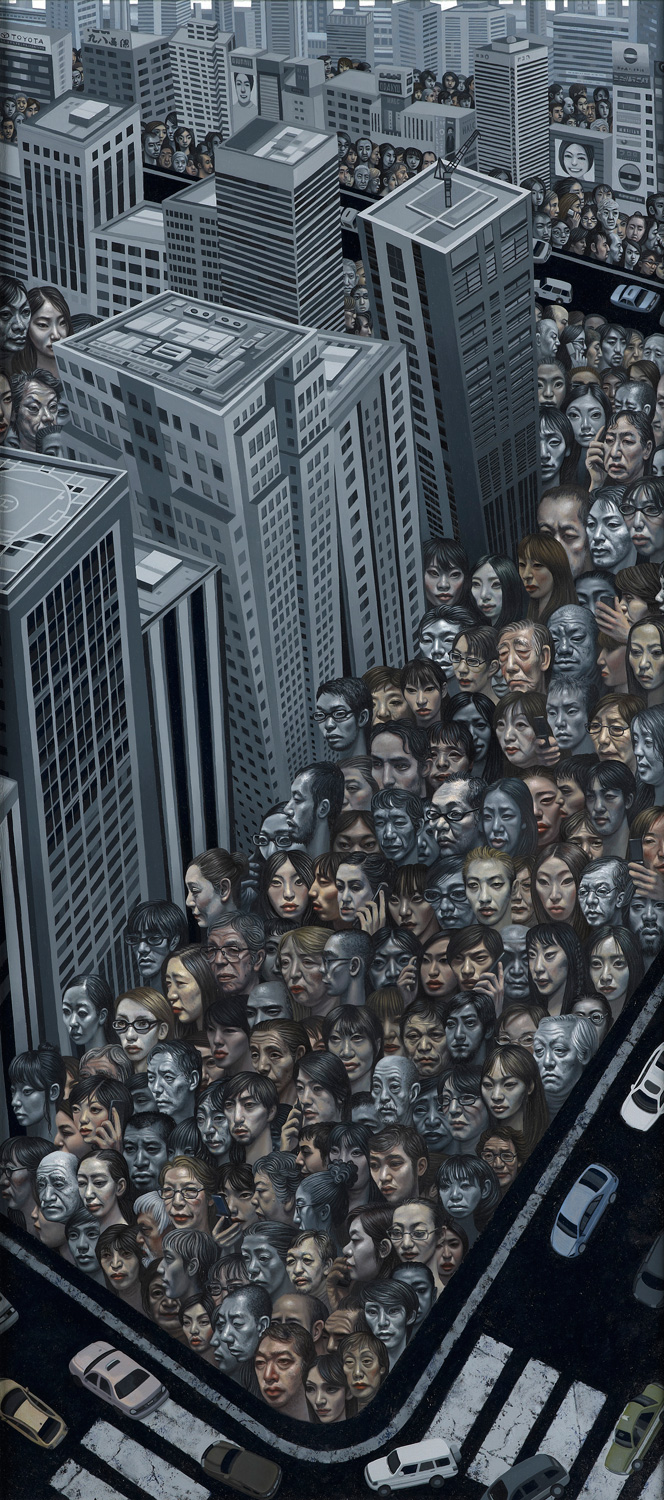
#FineArtFriday: Tokyo by Carl Randall 2011

Carl-randall-tokyo-painting-cityscapeArtist: Carl Randall (1975 – )

Title: Tokyo

Date: 2011

Medium: oil on canvas

Dimensions: Height: 150 cm (59 in); Width: 65 cm (25.5 in)

What I love about this image:

This image shows us the artist’s view of modern 21st Century society before the Covid-19 pandemic, painted predominantly in shades of gray. Technology is the all-knowing, ever-watchful god in this world.

Buildings, filled to capacity, loom over streets jammed with people, most talking into devices. Everyone goes forward, each individual focused on their own goal, unaware of the seething ocean of humanity around them, carried along on the currents and the tide.

About the artist (via Wikipedia):

Carl Randall was born in 1975, in the UK. He is a graduate of The Slade School of Fine Art London (BA Fine Art), the Royal Drawing School London (The Drawing Year), and Tokyo University of the Arts Japan (MFA & PhD Fine Art).

He was awarded The BP Travel Award 2012, for his proposal to walk in the footsteps of the Japanese ukiyo-e printmaker Andō Hiroshige, creating paintings of the people and places of contemporary Japan.  His project involved spending time in Japan resulting in a group of 15 paintings exhibited at the National Portrait Gallery in London as part of The 2013 BP Portrait Award exhibition, under the title “In the Footsteps of Hiroshige – The Tokaido Highway and Portraits of Modern Japan”. The exhibition subsequently toured to The Aberdeen Art Gallery Scotland, The Wolverhampton Art Gallery England, and then formed his solo exhibition in Japan ‘Portraits from Edo to the Present at The Shizuoka City Tokaido Hiroshige Museum, where the paintings were exhibited alongside Hiroshige’s original The Fifty-three Stations of the Tōkaidō woodblock prints. In conjunction with these exhibitions, the book Carl Randall – Japan Portraits was published, illustrating paintings and drawings made in Japan, with a foreword by British author Desmond Morris, and an introduction by the late American writer Donald Richie. A short documentary, Carl Randall – Japan Portraits was also made, showing the artist painting and drawing in Japan His Japan paintings were also the subject of a 2016 ‘World Update’ interview by the BBC World Service (titled ‘Painting the faces in Japan’s crowded cities’), and he was also interviewed by CNN about his Japanese work. [1]

To learn more about Carl Randall and his art, go to Carl Randall – Artist. Contemporary Figurative Painter.


Credits and Attributions:

[1] Wikipedia contributors, “Carl Randall,” Wikipedia, The Free Encyclopedia, https://en.wikipedia.org/w/index.php?title=Carl_Randall&oldid=1018005949 (accessed May 27, 2021).

Wikimedia Commons contributors, “File:Carl-randall-tokyo-painting-cityscape.jpg,” Wikimedia Commons, the free media repository, https://commons.wikimedia.org/w/index.php?title=File:Carl-randall-tokyo-painting-cityscape.jpg&oldid=504966563 (accessed May 27, 2021). This file is licensed under the Creative Commons Attribution-Share Alike 4.0 International lice

Comments Off on #FineArtFriday: Tokyo by Carl Randall 2011

Filed under #FineArtFriday

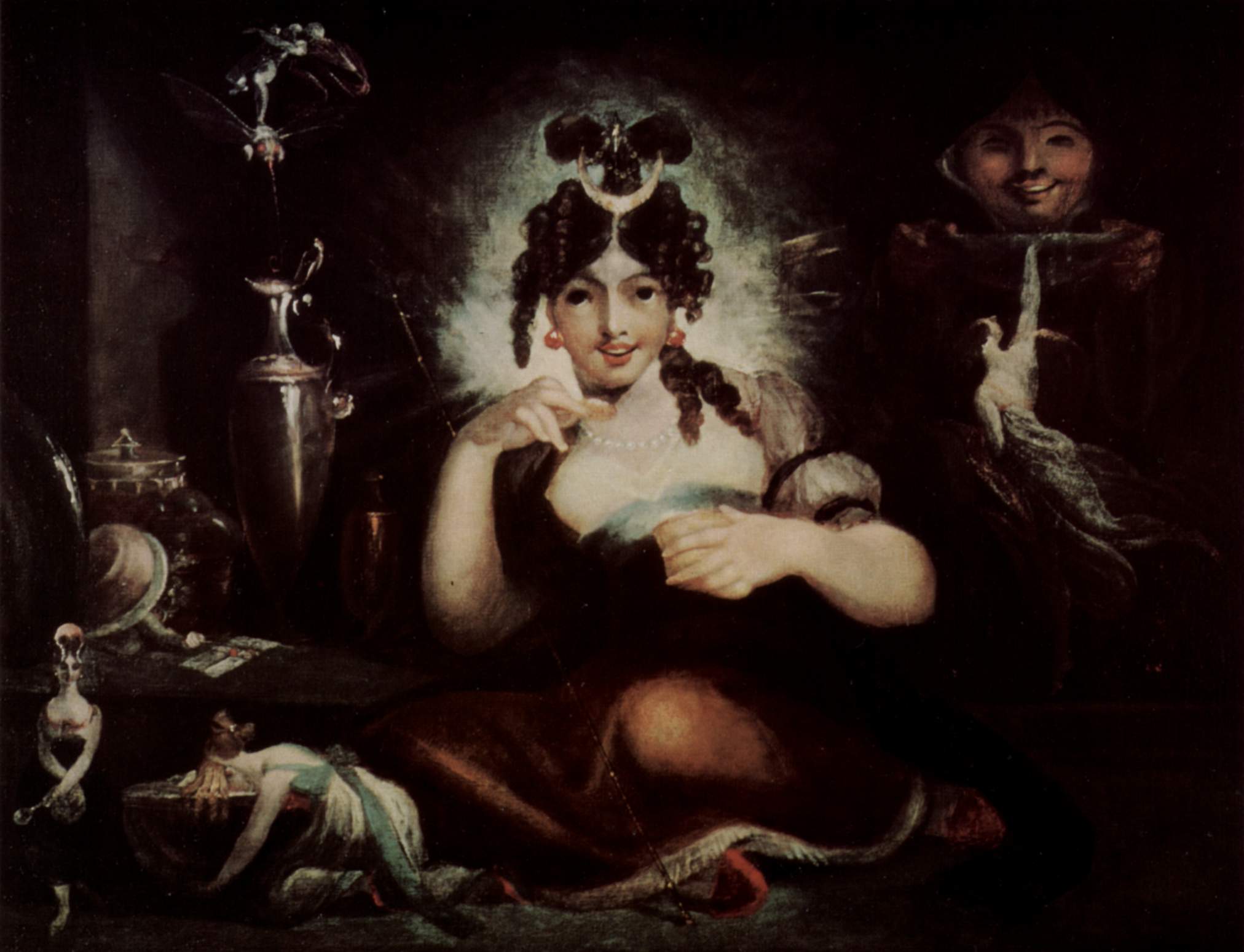
#FineArtFriday: The Fairy Mab, Henry Fuseli ca 1815-20

The Fairy Mab Johann_Heinrich_Füssli_038The Fairy Mab

Artist: Henry Fuseli  (1741–1825)

Date: from 1815 until 1820

Medium: oil on canvas

Dimensions: Height: 70 cm (27.5 in); Width: 90 cm (35.4 in)

Collection: Folger Shakespeare Library 

Current location: Washington, D.C.


About the artist, via Wikipedia:

[1] Describing Fuseli’s style, the 1911 edition of the Encyclopædia Britannica said that:

His figures are full of life and earnestness, and seem to have an object in view which they follow with intensity. Like Rubens he excelled in the art of setting his figures in motion. Though the lofty and terrible was his proper sphere, Fuseli had a fine perception of the ludicrous. The grotesque humour of his fairy scenes, especially those taken from A Midsummer-Night’s Dream, is in its way not less remarkable than the poetic power of his more ambitious works.

Though not noted as a colourist, Fuseli was described as a master of light and shadow. Rather than setting out his palette methodically in the manner of most painters, he merely distributed the colours across it randomly. He often used his pigments in the form of a dry powder, which he hastily combined on the end of his brush with oil, or turpentine, or gold size, regardless of the quantity, and depending on accident for the general effect. This recklessness may perhaps be explained by the fact that he did not paint in oil until the age of 25. [1]


Credits and Attributions:

The Fairy Mab by Henry Fuseli, Public domain, via Wikimedia Commons. Wikimedia Commons contributors, “File:Johann Heinrich Füssli 038.jpg,” Wikimedia Commons, the free media repository, https://commons.wikimedia.org/w/index.php?title=File:Johann_Heinrich_F%C3%BCssli_038.jpg&oldid=386917365  (accessed May 15, 2021).

[1] Wikipedia contributors, “Henry Fuseli,” Wikipedia, The Free Encyclopedia, https://en.wikipedia.org/w/index.php?title=Henry_Fuseli&oldid=1022033114 (accessed May 15, 2021).

Comments Off on #FineArtFriday: The Fairy Mab, Henry Fuseli ca 1815-20

Filed under #FineArtFriday

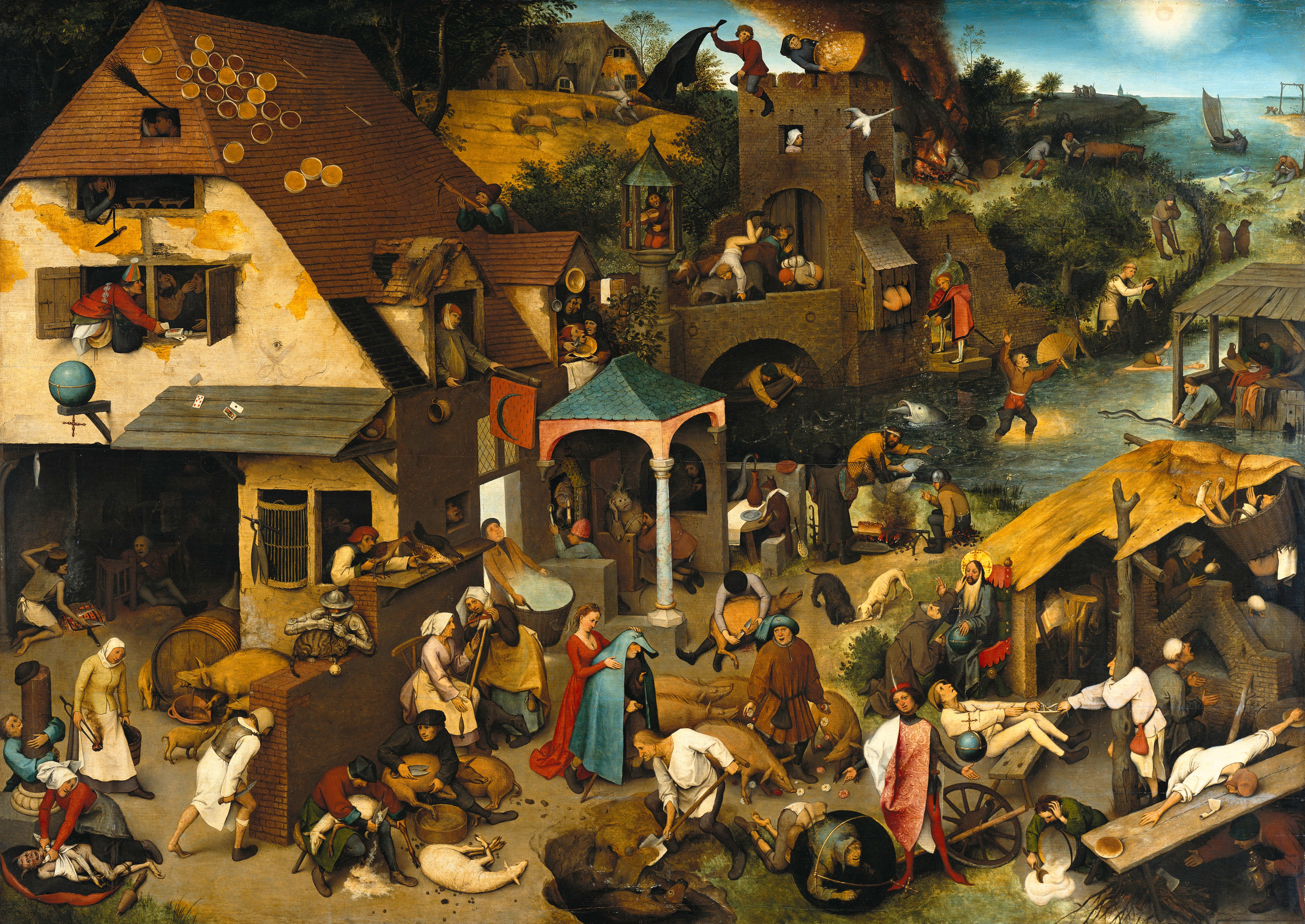
#FineArtFriday: The Dutch Proverbs by Pieter Bruegel the Elder, revisited

Pieter_Brueghel_the_Elder_-_The_Dutch_Proverbs_-_Google_Art_ProjectOne of the best allegorical paintings of all time is The Netherlandish Proverbs (also known as The Dutch Proverbs) by Pieter Brueghel the Elder, which was painted in 1559. A master at humor, allegory, and pointing out the follies of humanity, Brueghel the Elder is one of my favorite artists.

Artist: Pieter Bruegel the Elder
Year: 1559
Medium: Oil-on-panel
Dimensions: 117 cm × 163 cm (46 in × 64 in)
Location: Gemäldegalerie, Berlin

Quote from Wikipedia:

Critics have praised the composition for its ordered portrayal and integrated scene. There are approximately 112 identifiable proverbs and idioms in the scene, although Bruegel may have included others which cannot be determined because of the language change. Some of those incorporated in the painting are still in popular use, for instance “Swimming against the tide”, “Banging one’s head against a brick wall” and “Armed to the teeth”. Many more have faded from use, which makes analysis of the painting harder. “Having one’s roof tiled with tarts”, for example, which meant to have an abundance of everything and was an image Bruegel would later feature in his painting of the idyllic Land of Cockaigne (1567).

The Blue Cloak, the piece’s original title, features in the centre of the piece and is being placed on a man by his wife, indicating that she is cuckolding him. Other proverbs indicate human foolishness. A man fills in a pond after his calf has died. Just above the central figure of the blue-cloaked man another man carries daylight in a basket. Some of the figures seem to represent more than one figure of speech (whether this was Bruegel’s intention or not is unknown), such as the man shearing a sheep in the centre bottom left of the picture. He is sitting next to a man shearing a pig, so represents the expression “One shears sheep and one shears pigs”, meaning that one has the advantage over the other, but may also represent the advice “Shear them but don’t skin them”, meaning make the most of available assets.

You can find all of the wonderful proverbs on the painting’s page on Wikipedia, along with the thumbnail that depicts the proverb.

My favorite proverbs in this wonderful allegory?

Horse droppings are not figs. It meant we should not be fooled by appearances.

He who eats fire, craps sparks. It meant we shouldn’t be surprised at the outcome if we attempt a dangerous venture.

Now THAT is wisdom!


Credits and Attributions:

The Netherlandish Proverbs (Also known as The Dutch Proverbs) by Pieter Brueghel the Elder 1559 [Public domain], via Wikimedia Commons.

Wikipedia contributors, “Netherlandish Proverbs,” Wikipedia, The Free Encyclopedia, https://en.wikipedia.org/w/index.php?title=Netherlandish_Proverbs&oldid=829168138  (accessed May 3, 2018).

Comments Off on #FineArtFriday: The Dutch Proverbs by Pieter Bruegel the Elder, revisited

Filed under #FineArtFriday, writing

#FineArtFriday: Bringing down marble from the quarries to Carrara, Sargent 1911 (revisited)

John_Singer_Sargent_-_Bringing_Down_Marble_from_the_Quarries_to_Carrara_(1911)Today we are revisiting a painting I first posted in January of this year,  Bringing down marble from the quarries to Carrara, by John Singer Sargent  (1856–1925). This is a painting that conveys the lives and efforts of quarrymen in the way all of Sargent’s paintings of the working class do. You see the heat they work in, and feel their effort as they go about their tasks in the same way as their fathers did before them, and their grandfathers.

Date: 1911

Medium: oil on canvas

Dimensions: Height: 71.4 cm (28.1 in); Width: 91.8 cm (36.1 in)

Collection: Metropolitan Museum of Art

Inscriptions: Signature bottom left: John S. Sargent

What I love about this painting:

This picture details the relentless heat of the day, the back-breaking labor of men cutting marble. This is how quarrying was done prior to World War I, with steam-donkeys and great physical peril. The ropes are huge and heavy, and these men secure the dangerous load with practiced ease.

Carrara Italy is an important center for the extraction and processing of marble. The famous stone is white and exceedingly valuable.

One of Sargent’s great skills was the ability to convey the sensory impressions of an environment, depicting his characters outdoors in all the seasons.

About the Artist, via Wikipedia:

John Singer Sargent, January 12, 1856 – April 14, 1925) was an American expatriate artist, considered the “leading portrait painter of his generation” for his evocations of Edwardian-era luxury. He created roughly 900 oil paintings and more than 2,000 watercolors, as well as countless sketches and charcoal drawings. His oeuvre documents worldwide travel, from Venice to the Tyrol, Corfu, the Middle East, Montana, Maine, and Florida.

Born in Florence to American parents, he was trained in Paris before moving to London, living most of his life in Europe. He enjoyed international acclaim as a portrait painter. An early submission to the Paris Salon in the 1880s, his Portrait of Madame X, was intended to consolidate his position as a society painter in Paris, but instead resulted in scandal. During the next year following the scandal, Sargent departed for England where he continued a successful career as a portrait artist.

From the beginning, Sargent’s work is characterized by remarkable technical facility, particularly in his ability to draw with a brush, which in later years inspired admiration as well as criticism for a supposed superficiality. His commissioned works were consistent with the grand manner of portraiture, while his informal studies and landscape paintings displayed a familiarity with Impressionism. In later life Sargent expressed ambivalence about the restrictions of formal portrait work, and devoted much of his energy to mural painting and working en plein air. Art historians generally ignored artists who painted Royalty and “Society” – such as Sargent – until the late 20th century.


CREDITS AND ATTRIBUTIONS

John Singer Sargent, Public domain, via Wikimedia Commons

“Carrara.” Wikipedia, The Free Encyclopedia. 16, 2021, 12:36 utc. 29 Jan 2021, 03:23 <//en.wikipedia.org/w/index.php?title=Carrara&oldid=118022943>.

“File:John Singer Sargent – Bringing Down Marble from the Quarries to Carrara (1911).jpg.” Wikimedia Commons, the free media repository. 15 Jun 2019, 13:13 UTC. 29 Jan 2021, 03:24 <https://commons.wikimedia.org/w/index.php?title=File:John_Singer_Sargent_-_Bringing_Down_Marble_from_the_Quarries_to_Carrara_(1911).jpg&oldid=354733943>.

2 Comments

Filed under #FineArtFriday, writing

#FineArtFriday: Corporal J.D.M Pearson GC (WAAF) by Dame Laura Knight 1940

Corporal_J.D.M_Pearson,_GC,_WAAF_(1940)_(Art._IWM_ART_LD_626)About this image via Wikipedia:

A three- quarters length portrait of Corporal J. D. M. Pearson, GC, WAAF (1940) – shows Corporal Daphne Pearson of the Women’s Auxiliary Air Force, WAAF, a recipient of the Empire Gallantry Medal, later exchanged for the George Cross. Although Pearson, at Knight’s insistence, sat for the portrait holding a rifle, the finished painting shows her holding a respirator. As WAAF personal were not allowed to carry arms on duty, Knight had to paint over the rifle. [1]

Joan Daphne Mary PearsonGC (25 May 1911 – 25 July 2000) was a Women’s Auxiliary Air Force officer during the Second World War and one of only thirteen women recipients of the George Cross, the highest decoration for gallantry not in the face of an enemy that can, or could, be awarded to a citizen of the United Kingdom or commonwealth.

Pearson joined the Women’s Auxiliary Air Force (WAAF) as a medical orderly shortly after the outbreak of the Second World War in 1939.

In the early hours of the morning on 31 May 1940, Avro Anson bomber R3389 of No. 500 Squadron RAF undershot on approach to an airstrip near the WAAF quarters in DetlingKent, crashing into a field. Upon landing, a bomb exploded, killing the navigator instantly, and leaving the pilot seriously injured. Corporal Pearson entered the burning fuselage, released the pilot from his harness and removed him from the immediate area around the aircraft. After she was 27 metres (30 yards) from the aircraft, a bomb exploded. She flung herself on top of the pilot to protect him. After medical staff had removed the pilot, she went back to the plane to look for the fourth crew member, the radio operator. She found him dead. For her deeds, Pearson was awarded the Empire Gallantry Medal (EGM). [2]

About the Artist, via Wikipedia:

Dame Laura Knight, (née Johnson), DBE RA RWS (4 August 1877 – 7 July 1970) was an English artist who worked in oils, watercolors, etching, engraving and drypoint. Knight was a painter in the figurative, realist tradition, who embraced English Impressionism. In her long career, Knight was among the most successful and popular painters in Britain. Her success in the male-dominated British art establishment paved the way for greater status and recognition for women artists.

In 1929 she was created a Dame, and in 1936 became the first woman elected to full membership of the Royal Academy. Her large retrospective exhibition at the Royal Academy in 1965 was the first for a woman. Knight was known for painting amidst the world of the theatre and ballet in London, and for being a war artist during the Second World War. She was also greatly interested in, and inspired by, marginalized communities and individuals, including Gypsies and circus performers. [1]


Credits and Attributions:

File:Corporal J.D.M Pearson, GC, WAAF (1940) (Art. IWM ART LD 626).jpg|

[1] Wikipedia contributors, “Laura Knight,” Wikipedia, The Free Encyclopedia, https://en.wikipedia.org/w/index.php?title=Laura_Knight&oldid=1019091508 (accessed April 29, 2021).

[2] Wikipedia contributors, “Daphne Pearson,” Wikipedia, The Free Encyclopedia, https://en.wikipedia.org/w/index.php?title=Daphne_Pearson&oldid=1000936279 (accessed April 29, 2021).

Comments Off on #FineArtFriday: Corporal J.D.M Pearson GC (WAAF) by Dame Laura Knight 1940

Filed under #FineArtFriday

#FineArtFriday: Twilight Confidences by Cecilia Beaux 1888

Twilight_Confidences_by_Cecilia_BeauxTwilight Confidences by Cecilia Beaux  (1855–1942)

Date: 1888

Medium:  oil on canvas

Dimensions: 23 1/2 x 28 inches, 59.7 x 71.1 cm

Inscriptions: Signed and dated: Cecilia Beaux

About this painting via Wikimedia Commons:  

Cecilia Beaux was a leading figure and portrait painter and one of the few distinguished and highly recognized women artists of her time in America. Her figures are frequently compared to Sargent’s, but her style relates also to other international leaders of late-19th Century portraiture, including Anders Zorn, Giuseppe Boldini, Carolus-Duran and William Merritt Chase. She was born and lived mostly in Philadelphia, traveling frequently to Europe, especially France from a young age, and exhibited widely in Paris, Philadelphia, New York and elsewhere. Her first acclaimed work, Les Derniers jours d’enfance, a mother and child composition, was exhibited at the Paris Salon in 1887, and Beaux followed it there the next year, spending the summer of 1888 at the art colony at Concarneau in Brittany. Here she painted her remarkable Twilight Confidences of 1888, preceded by numerous studies, which are in the collection of the Pennsylvania Academy of the Fine Arts. Lost for many years, this much admired canvas is Beaux’s first major exercise in plein-air painting, in which the figures and the seascape are artfully and exquisitely juxtaposed, and sunlight permeates the whole composition.


Credits and Attributions:

Twilight Confidences, Cecilia Beaux, Public domain, via Wikimedia Commons

Wikimedia Commons contributors, “File:Twilight Confidences by Cecilia Beaux.jpg,” Wikimedia Commons, the free media repository, https://commons.wikimedia.org/w/index.php?title=File:Twilight_Confidences_by_Cecilia_Beaux.jpg&oldid=355146645 (accessed April 16, 2021).

Comments Off on #FineArtFriday: Twilight Confidences by Cecilia Beaux 1888

Filed under #FineArtFriday