Category Archives: #FineArtFriday

#FineArtFriday: The Netherlandish Proverbs by Pieter Brueghel the Elder

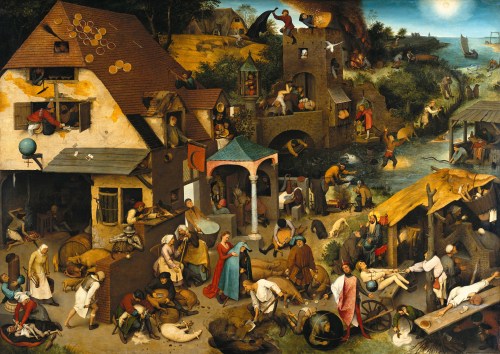
One of the best allegorical paintings of all time is The Netherlandish Proverbs (also known as The Dutch Proverbs) by Pieter Brueghel the Elder, which was painted in 1559. A master at humor, allegory, and pointing out the follies of humanity, Brueghel the Elder is one of my favorite artists.

Quote from Wikipedia:

Critics have praised the composition for its ordered portrayal and integrated scene. There are approximately 112 identifiable proverbs and idioms in the scene, although Bruegel may have included others which cannot be determined because of the language change. Some of those incorporated in the painting are still in popular use, for instance “Swimming against the tide”, “Banging one’s head against a brick wall” and “Armed to the teeth”. Many more have faded from use, which makes analysis of the painting harder. “Having one’s roof tiled with tarts”, for example, which meant to have an abundance of everything and was an image Bruegel would later feature in his painting of the idyllic Land of Cockaigne (1567).

The Blue Cloak, the piece’s original title, features in the centre of the piece and is being placed on a man by his wife, indicating that she is cuckolding him. Other proverbs indicate human foolishness. A man fills in a pond after his calf has died. Just above the central figure of the blue-cloaked man another man carries daylight in a basket. Some of the figures seem to represent more than one figure of speech (whether this was Bruegel’s intention or not is unknown), such as the man shearing a sheep in the centre bottom left of the picture. He is sitting next to a man shearing a pig, so represents the expression “One shears sheep and one shears pigs”, meaning that one has the advantage over the other, but may also represent the advice “Shear them but don’t skin them”, meaning make the most of available assets.

You can find all of the wonderful proverbs on the painting’s page on Wikipedia, along with the thumbnail that depicts the proverb.

My favorite proverbs in this wonderful allegory?

Horse droppings are not figs. It meant we should not be fooled by appearances.

He who eats fire, craps sparks. It meant we shouldn’t be surprised at the outcome if we attempt a dangerous venture.

Now THAT is wisdom!


Credits and Attributions:

The Netherlandish Proverbs (Also known as The Dutch Proverbs) by Pieter Brueghel the Elder 1559 [Public domain], via Wikimedia Commons.

Wikipedia contributors, “Netherlandish Proverbs,” Wikipedia, The Free Encyclopedia, https://en.wikipedia.org/w/index.php?title=Netherlandish_Proverbs&oldid=829168138  (accessed May 3, 2018).

4 Comments

Filed under #FineArtFriday

#FineArtFriday: The Caves, by Robert S. Duncanson


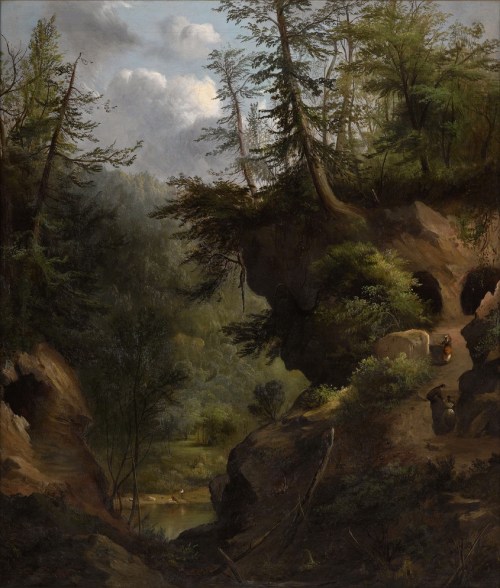
The Caves, by Robert S. Duncanson, 1869 is thought to depict Hocking Hills State Park in Ohio. Three caves are shown with people climbing to the caves on the right. In the center background on the shore are tiny human figures. A self-taught artist, Duncanson was inspired by the Hudson River School, a mid-19th century American art movement embodied by a group of landscape painters  whose artistic vision was heavily influenced by romanticism.

From Wikipedia:

Robert Seldon Duncanson was one of few African American landscape painters of the nineteenth century, and he achieved levels of success unknown to his contemporaries. Richard Powell of American Visions says that Duncanson’s success is a “victory over society’s presumptions of what African-American artist should create.” Duncanson became nationally and internationally known for his landscape paintings modeled after the Hudson River School tradition, and is credited with developing the regional Ohio River Valley art form.  Art historian Joseph D. Ketner claims that Duncanson’s greatest contribution to art was “his distinctively picturesque-pastoral vision of landscape painting with allusions to popular romantic literature.” 


Sources and Attributions:

Wikipedia contributors, “Robert S. Duncanson,” Wikipedia, The Free Encyclopedia,  https://en.wikipedia.org/w/index.php?title=Robert_S._Duncanson&oldid=827763141  (accessed April 13, 2018).

Comments Off on #FineArtFriday: The Caves, by Robert S. Duncanson

Filed under #FineArtFriday

#FineArtFriday: A Back Road, by Childe Hassam

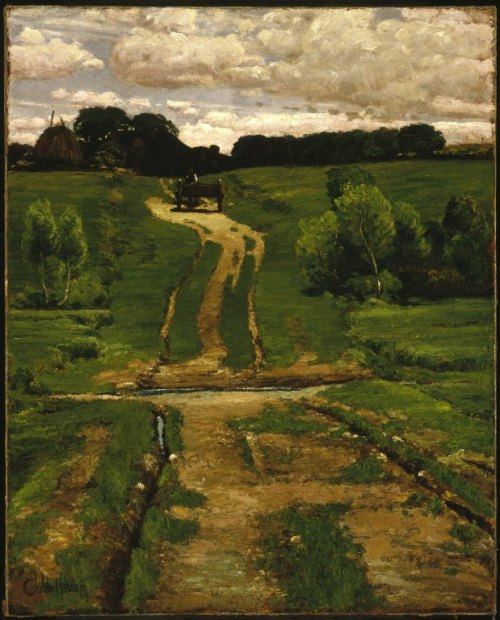
If you want to know what a road looked like to travelers before the advent of blacktop and concrete made the modern freeways and highways possible, turn to art. The above painting by Frederick Childe Hassam, shows what a good road looked like.  It goes across the land, cut into the earth by the travelers who use it. Along the better roads, such as this one, ditches were dug to enable drainage.

No bridge crosses the small creek–travelers must cross the water on foot or in the wagon. In winter it becomes a mushy, muddy track, and in summer it’s sun baked and hard. In spring, the grass grows green, making it a pleasant place.

A Back Road (1884) was painted in his early years, while Hassam was still influenced by the works of William Morris Hunt, who like the great French landscape painter Jean-Baptiste-Camille Corot, emphasized the Barbizon tradition of working directly from nature.

From Wikipedia: In 1885, a noted critic, in part responding to Hassam’s early oil painting A Back Road (1884), stated that “the Boston taste for landscape painting, founded on this sound French school, is the one vital, positive, productive, and distinctive tendency among our artists today…the truth is poetry enough for these radicals of the new school. It is a healthy, manly muscular kind of art.”

I like the composition of this piece, the way the land is larger than the sky. The grass feels damp and the clouds herald more spring rain–this painting has life.

In his later years, Hassam moved away from realism and became known as one of the best of the American impressionists.


Credits and Attributions:

A Back Road, Childe Hassam 1884 [No restrictions or Public domain], via Wikimedia Commons

Wikipedia contributors, “Childe Hassam,” Wikipedia, The Free Encyclopedia, https://en.wikipedia.org/w/index.php?title=Childe_Hassam&oldid=831999910 (accessed April 6, 2018).

2 Comments

Filed under #FineArtFriday

#FineArtFriday: Two Paintings by H. A. Brendekilde

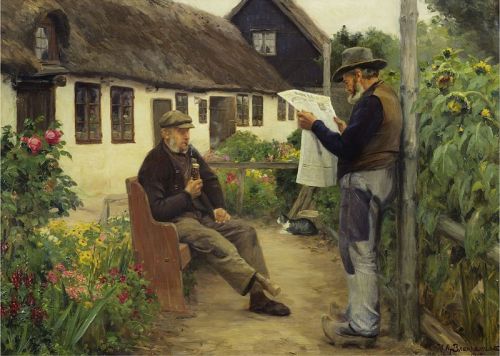
There is a story in this painting. I particularly like the details—the patched trousers of the gardener, the mud on his clogs, the other man’s wooden leg—juxtaposed against the lush spring garden and prosperous village life of Denmark in 1912. Their hands and clothes indicate they have stopped work to read the newspaper. Both men seem stunned. Are they perhaps reading of the death of King Frederick VIII, who died on 14 May 1912? Whatever they are reading, the cat remains undisturbed by the news.

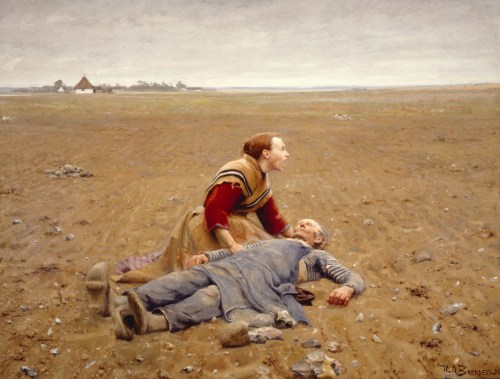
H. A. Brendekilde was a forerunner of the social realist style, embraced by Diego Rivera. His early work often depicted the daily lives of the rural working class. One of his most famous paintings, “Worn Out” (1889) shows an elderly man lying fallen on his back in the plowed field. Has he worked himself to death? Will he recover? His entire world is this rocky barren field.  A story is in this stark painting.


Credits and Attributions:

While reading the newspaper news by H. A. Brendekilde 1912 [Public domain], via Wikimedia Commons

Worn Out by H. A. Brendekilde [Public domain], via Wikimedia Commons

Comments Off on #FineArtFriday: Two Paintings by H. A. Brendekilde

Filed under #FineArtFriday

#FineArtFriday: Mount Adams by Albert Bierstadt

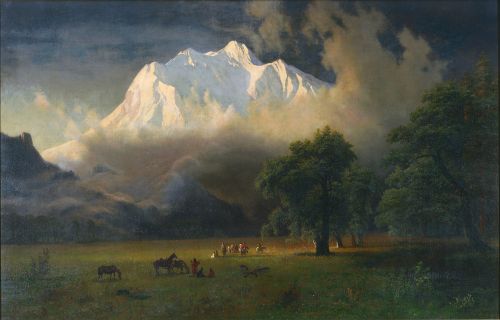
Quote from Wikimedia Commons: Albert Bierstadt enjoyed great success in the years surrounding the Civil War, producing finely detailed vistas of nature’s splendor in majestic canvases that were similarly invested with significance beyond their surface appearance.

The first technically advanced artist to portray the American West, Bierstadt offered to a rapidly transforming nation pictures whose spectacular size and fresh, dramatic subject matter supplied a visual correlative to notions of American exceptionalism, while also contributing to the developing concept of Manifest Destiny.

Trained in the highly finished manner of the Düsseldorf Academy, Bierstadt’s precise style imbued his works with a reassuring sense of veracity despite their sublime subjects and occasional liberties with geographic reality. In Mount Adams, Washington, he characteristically combined an impressively scaled natural background with a foreground view of American Indian life, which serves to heighten the picture’s putative realism even as it enhances its exotic appeal.

The implied movement of the clouds and the sunlit figures on horseback similarly off to the right seems to open up the depicted space for the viewer to inhabit, providing an apt pictorial metaphor for the actual occupation and exploitation of the West by the eastern interests that constituted the artist’s clientele.


Credits and Attributions:

Mount Adams by Albert Bierstadt [Public domain], via Wikimedia Commons

Wikimedia Commons contributors, “File:1875, Bierstadt, Albert, Mount Adams, Washington.jpg,” Wikimedia Commons, the free media repository, https://commons.wikimedia.org/w/index.php?title=File:1875,_Bierstadt,_Albert,_Mount_Adams,_Washington.jpg&oldid=272380899 (accessed March 9, 2018).


3 Comments

Filed under #FineArtFriday

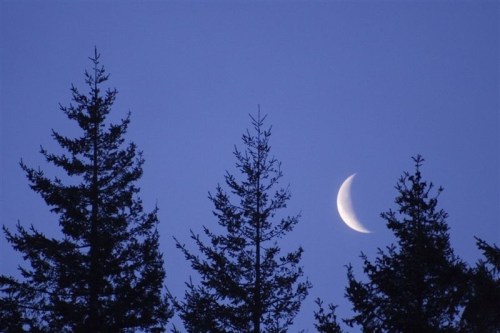
Early Morning Moon #flashfictionfriday

Early morning moon

Waltzing across the sky at dawn

Lights the frozen land beneath.

Winter morning moon

Not blue, not blood,

Unique only for its rarity.

Early morning moon

Naked, uncloaked by clouds,

Waltzing across the sky at dawn.


Credits and Attributions:

By Jeff Fennell from Oregon, USA (Early Morning Moon) [CC BY 2.0 (http://creativecommons.org/licenses/by/2.0)%5D, via Wikimedia Commons

Early Morning Moon, poem by Connie J. Jasperson © 2018 All Rights Reserved

2 Comments

Filed under #FineArtFriday, #FlashFictionFriday, Poetry

#FineArtFriday: Prusik Peak from Gnome Tarn

The above picture of Gnome Tarn was found on Wikimedia Commons. This serene alpine pool is approachable only on foot, a hike that usually takes two days each way. It a long, steep, and grueling hike that is not for the inexperienced. The trail through The Enchantments (where this photograph was taken) climbs 6.5 miles (10.5 km) to Snow Lake, gaining 4,100 feet (1,200 m). The trail climbs over sloping granite rock to the Lower Enchantments. The entire hike is 9 miles (14 km) one-way, with 6,000 feet (1,800 m) of elevation gain to an end elevation of 7,800 feet (2,400 m).

But those of us no longer able to make such a grueling jaunt can still enjoy the scenery, thanks to Wikimedia Commons and the wonderful imagery of photographers like Niko Kurov. 

Quote from Wikipedia: By the 1940s climbers discovered the area and began naming the crags. Bill and Peg Stark of Leavenworth, became frequent visitors who drew upon various mythologies to name features of the landscape. When they made their first visit in the fall of 1959, they were captivated by the golden splendor of the larch trees in the fall, the numerous lakes and tarns, and jagged peaks towering above. They used fairy names such as Gnome Tarn, Troll Sink, Naiad Lake (officially Temple Lake), Sprite and King Arthur legends in the Lower Enchantment Basin because “the lower basin was not as austere as the upper basin,” according to Peg. They used Norse names and mythology for features of the upper basin, for example Brynhild Lake (officially Inspiration Lake), Lake Freya (officially Tranquil Lake), and Valhalla Cirque because, Peg said, it felt “as if the Ice Age had just gone off.”

I grew up in the Pacific Northwest, not too far from where this image was taken. Pictures like this remind me of my youth, bringing back the memories of places where I have walked and the sights that produced such a profound respect for the natural world. These memories find their way into my work, hopefully with the magic still intact!


Credits and Attributions:

By Niko Kirov (Own work) [CC BY-SA 4.0 (https://creativecommons.org/licenses/by-sa/4.0)%5D, via Wikimedia Commons

Wikipedia contributors, “The Enchantments,” Wikipedia, The Free Encyclopedia, https://en.wikipedia.org/w/index.php?title=The_Enchantments&oldid=803292318 (accessed January 26, 2018).

2 Comments

Filed under #FineArtFriday, writing

#FineArtFriday: Frost Fair on the River Thames near the Temple Stairs, by Thomas Wyke

Quoted from Wikipedia: During the Great Frost of 1683–84, the worst frost recorded in England, the Thames was completely frozen for two months, with the ice reaching a thickness of 11 inches (28 cm) in London. Solid ice was reported extending for miles off the coasts of the southern North Sea (England, France and the Low Countries), causing severe problems for shipping and preventing the use of many harbours. Near Manchester, the ground was frozen to 27 inches (69 cm), in Somerset, to more than 4 feet (1.2 m).

In the pedestrian tunnel under the south bank of Southwark Bridge, there is an engraving by Southwark sculptor Richard Kindersley, made of five slabs of grey slate, depicting the frost fair.[19]

The frieze contains an inscription that reads (two lines per slab):

Behold the Liquid Thames frozen o’re,
That lately Ships of mighty Burthen bore
The Watermen for want of Rowing Boats
Make use of Booths to get their Pence & Groats
Here you may see beef roasted on the spit
And for your money you may taste a bit
There you may print your name, tho cannot write
Cause num’d with cold: tis done with great delight
And lay it by that ages yet to come
May see what things upon the ice were done

The inscription is based on handbills,[20] printed on the Thames during the frost fairs.


Credits and Attributions:

Wikipedia contributors, “River Thames frost fairs,” Wikipedia, The Free Encyclopedia, https://en.wikipedia.org/w/index.php?title=River_Thames_frost_fairs&oldid=820904368 (accessed January 19, 2018).

Frost Fair on the River Thames near the Temple Stairs, by Thomas Wyke ca.1683-1684 via Wikimedia Commons (scan from FT magazine, 2007-09-30) [Public domain]

7 Comments

Filed under #FineArtFriday

#FineArtFriday: Home, Sweet Home by Winslow Homer

Home, Sweet Home is one of the most famous paintings of the American Civil War, depicting a moment in time, painted by Winslow Homer. On opposite shores of the Rappahannock River, opposing armies are caught up in an awareness of brotherhood, as music becomes the medium that lays bare the humanity of the soldiers on both sides.

Winslow Homer was best known for his landscapes featuring the many moods of the ocean, but he also painted many iconic images of that turbulent time before, during, and after the American Civil War. His art captures a sense of familiarity, a feeling that the viewer knows these people and their stories intimately.

Wikipedia says, “Harper’s (magazine) sent Homer to the front lines of the American Civil War (1861–1865), where he sketched battle scenes and camp life, the quiet moments as well as the chaotic ones. His initial sketches were of the camp, commanders, and army of the famous Union officer, Major General George B. McClellan, at the banks of the Potomac River in October 1861.

“Although the drawings did not get much attention at the time, they mark Homer’s expanding skills from illustrator to painter. Like with his urban scenes, Homer also illustrated women during wartime, and showed the effects of the war on the home front. The war work was dangerous and exhausting. Back at his studio, Homer would regain his strength and re-focus his artistic vision. He set to work on a series of war-related paintings based on his sketches, among them Sharpshooter on Picket Duty (1862), Home, Sweet Home (1863), and Prisoners from the Front (1866). He exhibited paintings of these subjects every year at the National Academy of Design from 1863 to 1866. Home, Sweet Home was shown at the National Academy to particular critical acclaim; it was quickly sold and the artist was consequently elected an Associate Academician, then a full Academician in 1865.[10]”

The story behind the painting, Home, Sweet Home, is told poignantly in the autobiography, Reminiscences of a Private, by Frank Mixson, who served in the Confederate Army.

“The Yankee band would play the popular airs of theirs amid much yelling and cheering; our bands would do the same with the same result. Towards the wind-up the Yankee band struck up “Yankee Doodle.” Cheers were immense. When they stopped our band struck up “Dixie,” and everything went wild. When they finished this, both bands, with one accord and simultaneously, struck up “Home, Sweet Home.” There was not a sound from anywhere until the tune was finished and it then seemed as if everybody had gone crazy. I never saw anything to compare with it. Both sides were cheering, jumping up and throwing up hats and doing everything which tended to show enthusiasm. This lasted for at least a half hour. I do believe that had we not had the river between us that the two armies would have gone together and settled the war right there and then.”

Quote from: Reminiscences of a Private, by Frank Mixson (1910)


Sources and Attributions:

Wikipedia contributors, “Winslow Homer,” Wikipedia, The Free Encyclopedia, https://en.wikipedia.org/w/index.php?title=Winslow_Homer&oldid=817253575 (accessed January 4, 2018).

Home, Sweet Home: “Had we not had the river between us,” posted by Marek,  https://civilwarfolkmusic.com/2013/12/15/1862-home-sweet-home/ accessed 04 January 2018.

Reminiscences of a Private, by Frank Mixson (published 1910 by Columbia, S.C., The State Company)

Home, Sweet Home (oil on canvas) by Winslow Homer – circa 1863 | Winslow Homer [Public domain], via Wikimedia Commons, accessed 04 January 2018.

6 Comments

Filed under #FineArtFriday, writing

#Drabble “Ted”

Today is the first day of 2018! An area of writing that I really enjoy is called The Drabble. Writing such short fiction forces the author to develop economy of words. We will be exploring Drabbles and the craft of writing short fiction more closely here on Life in the Realm of Fantasy during the month of January.

A Drabble is an extremely short story, usually no more than 100 words, although some contests will allow as much as 300 words.

My first Drabble was this one, penned in 2013, and it remains one of my favorite short pieces.


TED

Edna stirred her coffee and looked out the window toward the shed.

“Did you feed the chickens?” Marion always asked, despite knowing Edna had.

Edna tore her gaze from the shed. “Of course.” Her eyes turned back to the small building. “We won’t be able to keep him in there much longer. He’s growing too big. We should have a barn built for him.”

“Ted was always a greedy boy.” Marion sipped her coffee. “I warned him he behaved like a beast, and now look.”

A rumbling bellow shook the shed. A long green tail snaked out of the door.


“Ted,” by Connie J. Jasperson ©2013 – 2018

Garden Shed, Australia, By Rod Waddington from Kergunyah, Australia (Garden Shed, Australia) [CC BY-SA 2.0 (https://creativecommons.org/licenses/by-sa/2.0) ], via Wikimedia Commons

Comments Off on #Drabble “Ted”

Filed under #FineArtFriday, #FlashFictionFriday, writing