Category Archives: #FineArtFriday

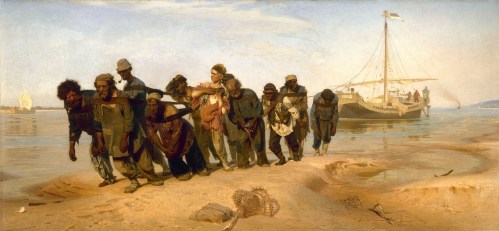
#FineArtFriday: Barge Haulers on the Volga by Ilya Repin, 1870 #writing #prompt

Barge Haulers on the Volga by Ilya Repin  (1844–1930)

  • Date: 1870
  • Medium: oil on canvas
  • Dimensions: Height: 131.5 cm (51.7 ″); Width: 281 cm (110.6 ″)
  • Current location: Ж-4056 (Russian Museum)
  • Inscriptions: Signature and date: И. Репин / 1870-73

To see this image best, right click on it and have it open in a new tab. or visit the Wikimedia page (which will open in a new tab).

What I love about this painting:

A burlak was a person who hauled barges and other vessels upstream from the 17th to 20th centuries in the Russian Empire. Most burlaks were landless or poor peasants.

These men are shown working, painted with brutal truth. They are beyond exhausted. Their skin is darkened and weathered from years of work in the unremitting sun, except for the young man in the middle. One day he will be like the older men, hardened to the misery and enduring his lot in life.

Each face is filled with emotion, with a story of their own. Who knows what tragedies brought them to agree to this terrible existence, this seasonal slavery of physically towing boats upriver?

For the women and men who towed the barges, winter was even worse, because once the river froze over these burlaki were unemployed. Their life was a constant circle of starvation and hellish labor under the harshest conditions.

This post first appeared in November of 2019. Each time I view this painting, I am moved by the unwritten stories, the tragedies that led these people to the life of a burlak, and the hardship shown so clearly here.

What stories are inspired by this image? Which burlak most inspires your creative mind?

About this Painting (via Wikipedia)

Barge Haulers on the Volga or Burlaki (Russian: Burlaki na Volge, Бурлаки на Волге) is an 1870–73 oil-on-canvas painting by artist Ilya Repin. It depicts 11 men physically dragging a barge on the banks of the Volga River. They are at the point of collapse from exhaustion, oppressed by heavy, hot weather.[1][2]

The work is a condemnation of profit from inhumane labor.[3] Although they are presented as stoical and accepting, the men are defeated; only one stands out: in the center of both the row and canvas, a brightly colored youth fights against his leather binds and takes on a heroic pose.

Repin conceived the painting during his travels through Russia as a young man and depicts actual characters he encountered. It drew international praise for its realistic portrayal of the hardships of working men, and launched his career.[4] Soon after its completion, the painting was purchased by Grand Duke Vladimir Alexandrovich and exhibited widely throughout Europe as a landmark of Russian realist painting. Barge Haulers on the Volga has been described as “perhaps the most famous painting of the Peredvizhniki movement [for]….its unflinching portrayal of backbreaking labor”.[5]

The characters are based on actual people Repin came to know while preparing for the work. He had had difficulty finding subjects to pose for him, even for a fee, because of a folklorish belief that a subject’s soul would leave his possession once his image was put down on paper.[8] The subjects include a former soldier, a former priest, and a painter.[9] Although he depicted eleven men, women also performed the work and there were normally many more people in a barge-hauling gang; Repin selected these figures as representative of a broad swathe of the working classes of Russian society. That some had once held relatively high social positions dismayed the young artist, who had initially planned to produce a far more superficial work contrasting exuberant day-trippers (which he himself had been) with the careworn burlaks. Repin found a particular empathy with Kanin, the defrocked priest, who is portrayed as the lead hauler and looks outwards towards the viewer.[10] The artist wrote,

“There was something eastern about it, the face of a Scyth…and what eyes! What depth of vision!…And his brow, so large and wise…He seemed to me a colossal mystery, and for that reason I loved him. Kanin, with a rag around his head, his head in patches made by himself and then worn out, appeared none the less as a man of dignity; he was like a saint.”[11]


Credits and Attributions:

Wikipedia contributors, “Barge Haulers on the Volga,” Wikipedia, The Free Encyclopedia, https://en.wikipedia.org/w/index.php?title=Barge_Haulers_on_the_Volga&oldid=918607811 (accessed November 1, 2019).

3 Comments

Filed under #FineArtFriday

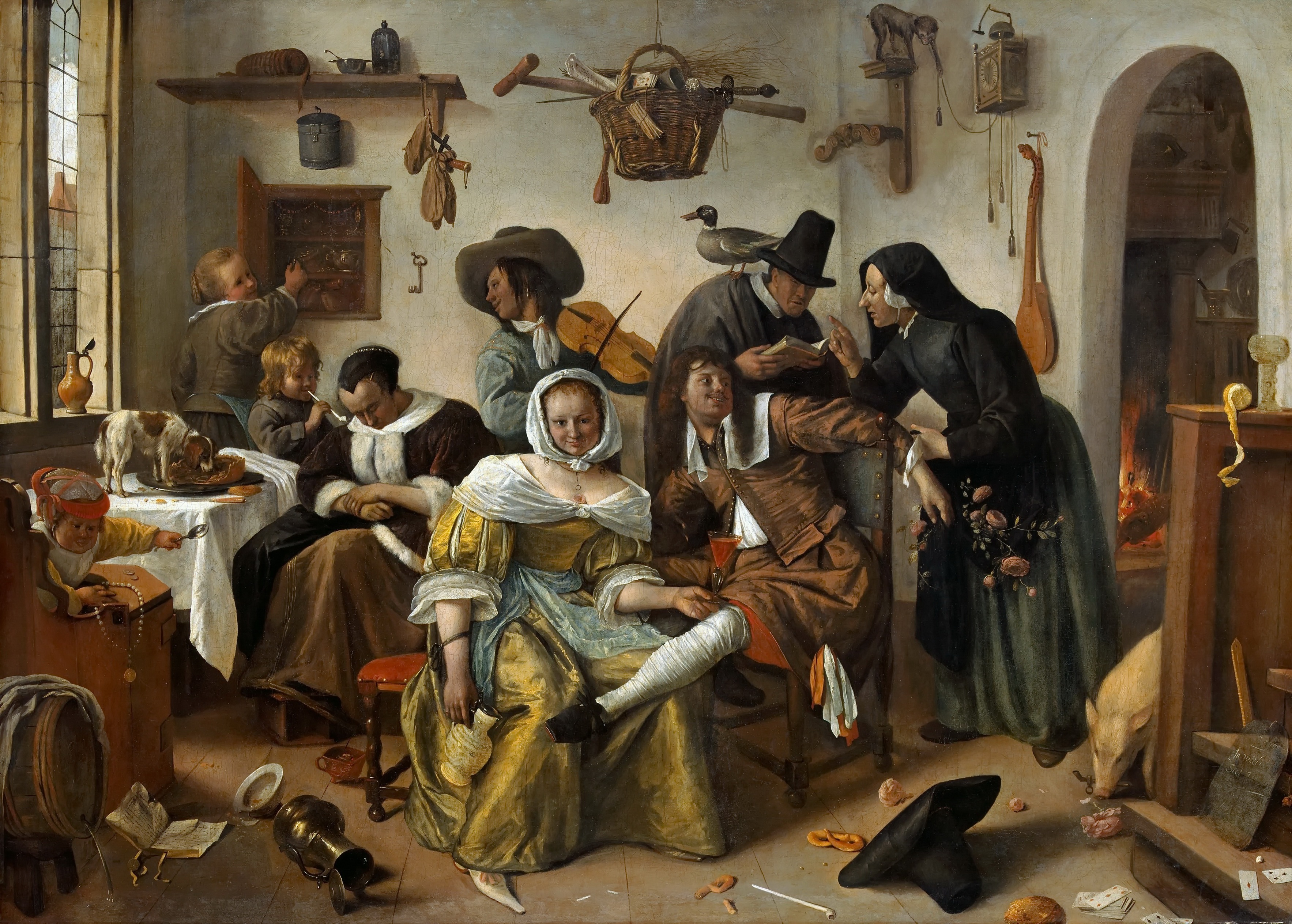
#FineArtFriday: Beware of Luxury by Jan Steen ca.1663 #prompt #NovemberWriter

Öèôðîâàÿ ðåïðîäóêöèÿ íàõîäèòñÿ â èíòåðíåò-ìóçåå Gallerix.ru

Artist: Jan Steen (1625/1626–1679)

Title: Beware of Luxury (“In Weelde Siet Toe”)

Date: circa 1663

Medium: oil on canvas

Dimensions: height: 105 cm (41.3 in); width: 145 cm (57 in)

Collection: Kunsthistorisches Museum

What I love about this painting:

Jan Steen lampoons family life in this riotous scene. Mother is taking a well-deserved nap, and the family is running wild, drinking to excess and partying like it was 1599. Grandma ignores the rumpus and instead, she is lecturing the Reverend on doctrine. The house is trashed, and the dog is on the table eating the pie. The baby is playing with the mother’s pearls. The oldest daughter’s suitor is sitting with his leg over her lap is a visual nod to promiscuity. “Getting his leg over her” was slang for premarital canoodling.

Although each of the many characters and every element of set dressing is realistically depicted, we know this is not a portrayal of a real moment in the artist’s life. We are presented with a theatrical drama here, a situation that is staged and satirized for our entertainment.

The Age of the Puritan had swept across Europe and while it was waning in the mid-seventeenth century, puritanism had a large influence on life in Holland as much as elsewhere.

This painting is a wonderful visual exhortation reminding the good people to live a sober life. Steen himself was not a puritan, as he was born into a family of brewers and ran taverns and breweries off and on throughout his life. But he did need to sell his paintings as he was never a successful businessman, and his allegorical paintings were quite popular.

About the Artist, via Wikipedia:

Jan Havickszoon Steen (c. 1626 – buried 3 February 1679) was a Dutch Golden Age painter, one of the leading genre painters of the 17th century. His works are known for their psychological insight, sense of humour and abundance of colour.

In 1648 Jan Steen and Gabriël Metsu founded the painters’ Guild of Saint Luke at Leiden. Soon after he became an assistant to the renowned landscape painter Jan van Goyen (1596–1656), and moved into his house on the Bierkade in The Hague. On 3 October 1649, he married van Goyen’s daughter Margriet, with whom he would have eight children. Steen worked with his father-in-law until 1654, when he moved to Delft, where he ran the brewery De Slang (“The Snake”) for three years without much success.  After the explosion in Delft in 1654 the art market was depressed, but Steen painted A Burgomaster of Delft and his daughter. It does not seem to be clear if this painting should be called a portrait or a genre work.

Steen lived in Warmond, just north of Leiden, from 1656 until 1660 and in Haarlem from 1660 until 1670 and in both periods he was especially productive. In 1670, after the death of his wife in 1669 and his father in 1670, Steen moved back to Leiden, where he stayed the rest of his life. When the art market collapsed in 1672, called the Year of Disaster, Steen opened a tavern. In April 1673 he married Maria van Egmont, who gave him another child. In 1674 he became president of the Saint Luke’s Guild. Frans van Mieris (1635–1681) became one of his drinking companions. He died in Leiden in 1679 and was interred in a family grave in the Pieterskerk. [1]


Credits and Attributions:

IMAGE: Beware of Luxury by Jan Steen, ca. 1663. Wikimedia Commons contributors, “File:Jan Steen 004b.jpg,” Wikimedia Commons, https://commons.wikimedia.org/w/index.php?title=File:Jan_Steen_004b.jpg&oldid=617576422 (accessed November 15, 2024)

[1] Wikipedia contributors, “Jan Steen,” Wikipedia, The Free Encyclopedia, https://en.wikipedia.org/w/index.php?title=Jan_Steen&oldid=1249713624 (accessed November 15, 2024).

Comments Off on #FineArtFriday: Beware of Luxury by Jan Steen ca.1663 #prompt #NovemberWriter

Filed under #FineArtFriday

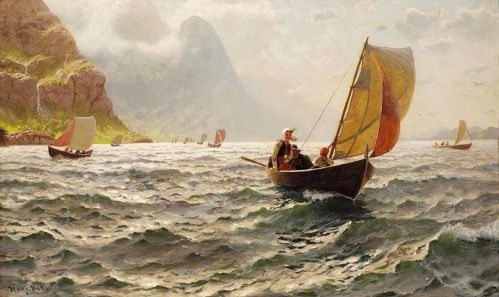
#FineArtFriday: Upon Sunny Waves, by Hans Dahl #prompt #NovemberWriter


Artist: Hans Dahl  (1849–1937)

Title: Upon Sunny Waves

Date: before 1937

Medium: oil painting

Hans Dahl was a Norwegian painter trained in Germany and is associated with the Düsseldorf school of painting, which was characterized by finely detailed imaginary landscapes. In his later years, he endured mean-spirited criticism from other artists and art critics, because he chose to remain true to his idealized fantasy art, resisting the movement from Romanticism to Modernism.

What I love about this painting:

I first featured this painting in 2019 and think it’s a good image for a writing prompt. I love the way Dahl shares with us the bold freedom of sailing on a sunny summer day. He captures the feeling of flying on the water that makes sailing a small boat so much fun.

We aren’t on a leisurely fishing expedition here—this is boating for the sake of adventure. We’re running with wind and enjoying every minute of it. The wind is brisk, and the waters are choppy. There’s a hint of danger, the glee of knowing we’re pushing the boundaries. We’d best be strong swimmers because if we capsize, the waters are cold, and someone might not survive.

Who are these people? What is their relationship to each other? What dramas are they seeking a temporary escape from on this glorious day on the waves?

Hans Dahl has given us a painting with great story potential.

About the Artist, via Wikipedia:

In the 1890s a new school of art arose, and artists like Dahl were not very popular in the leading circles in the capital. He was particularly criticized by the art historian Jens Thiis. He was severely criticized by fellow artists especially by Christian Krohg, who was one of the leading figures in the transition from romanticism to naturalism which characterized Norwegian art in this period. Throughout his life, he increasingly narrowed his range of topics. Dahl often described the scenery of the western part of Norway in brilliant sunshine with smiling people in national costumes. His vibrant colors and charming portrayals of young Norwegian girls in their national costume have always been very popular. [1]


Credits and Attributions:

[1] Wikipedia contributors, “Hans Dahl,” Wikipedia, The Free Encyclopedia, https://en.wikipedia.org/w/index.php?title=Hans_Dahl&oldid=827399492 (accessed November 7, 2024).

IMAGE: Upon Sunny Waves, by Hans Dahl PD|70 [Public domain]

Wikimedia Commons contributors, “File:Hans Dahl – Upon sunny waves.jpg,” Wikimedia Commons, the free media repository, https://commons.wikimedia.org/w/index.php?title=File:Hans_Dahl_-_Upon_sunny_waves.jpg&oldid=140877929 (accessed November 7, 2024).

Comments Off on #FineArtFriday: Upon Sunny Waves, by Hans Dahl #prompt #NovemberWriter

Filed under #FineArtFriday

#FineArtFriday: Gassed by John Singer Sargent 1919 #prompt #NovemberWriter

2560px-Sargent,_John_Singer_(RA)_-_Gassed_-_Google_Art_ProjectArtist: John Singer Sargent (1856–1925)

Title: Gassed

Date: 1919

Medium: oil on canvas

Dimensions: Height: 231 cm (90.9 in); Width: 611.1 cm (20 ft)

Writing Prompt: November is once again upon us, the month when many people are inspired to begin their writing career. But what shall we write about?

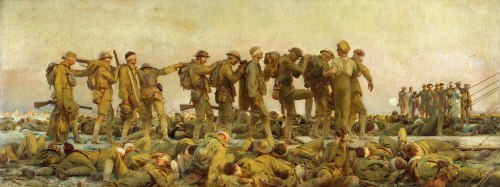
John Singer Sargent tells many stories in this one powerful statement about war and the inhumanity of humankind. He also lays bare our resilience, our drive to survive. What thoughts, what ideas are prompted by what you see here?

What I love about this painting:

I first featured this painting in 2021 and have gone back to it every year since. This is a deeply moving antiwar statement that only John Singer Sargent could have shown us. He was commissioned as a war artist by the British Ministry of Information. He illustrated numerous scenes from the Great War. Sargent had been deeply affected by what he had seen while touring the front in France and by the death of his niece Rose-Marie in the shelling of the St Gervais church, Paris, on Good Friday 1918.

John Singer Sargent was a complicated man, as most artists are. Famous as a portrait artist, he painted landscapes that conveyed a sense of mood and emotion that few of his contemporaries could match.

The colors are muted, and even the pastels are dark and dirty. The suffering of the maimed and injured men is laid bare. Through the legs of the walking wounded, the rising moon illuminates the desire of the uninjured to try to find some normalcy. Dwarfing the players and their game, the vast sea of dead and injured stretches as far as the eye can see.

Above, two tiny figures represent the clash of biplanes in the distance, the ever-moving machine of death and inhumanity that is war.

About this painting, via Wikipedia:

[1] Gassed is a very large oil painting completed in March 1919 by John Singer Sargent. It depicts the aftermath of a mustard gas attack during the First World War, with a line of wounded soldiers walking towards a dressing station. Sargent was commissioned by the British War Memorials Committee to document the war and visited the Western Front in July 1918 spending time with the Guards Division near Arras, and then with the American Expeditionary Forces near Ypres. The painting was finished in March 1919 and voted picture of the year by the Royal Academy of Arts in 1919. It is now held by the Imperial War Museum. It visited the US in 1999 for a series of retrospective exhibitions, and then from 2016 to 2018 for exhibitions commemorating the centenary of the First World War.

The painting measures 231.0 by 611.1 centimeters (7 ft 6.9 in × 20 ft 0.6 in). The composition includes a central group of eleven soldiers depicted nearly life-size. Nine wounded soldiers walk in a line, in three groups of three, along a duckboard towards a dressing station, suggested by the guy ropes to the right side of the picture. Their eyes are bandaged, blinded by the effect of the gas, so they are assisted by two medical orderlies. The line of tall, blind soldiers forms a naturalist allegorical frieze, with connotations of a religious procession. Many other dead or wounded soldiers lie around the central group, and a similar train of eight wounded, with two orderlies, advances in the background. Biplanes dogfight in the evening sky above, as a watery setting sun creates a pinkish yellow haze and burnishes the subjects with a golden light. In the background, the moon also rises, and uninjured men play association football in blue and red shirts, seemingly unconcerned at the suffering all around them.

The painting provides a powerful testimony of the effects of chemical weapons, vividly described in Wilfred Owen‘s poem Dulce et Decorum Est. Mustard gas is a persistent vesicant gas, with effects that only become apparent several hours after exposure. It attacks the skin, the eyes and the mucous membranes, causing large skin blisters, blindness, choking and vomiting. Death, although rare, can occur within two days, but suffering may be prolonged over several weeks.

Sargent’s painting refers to Bruegel’s 1568 work The Parable of the Blind, with the blind leading the blind, and it also alludes to Rodin’s Burghers of Calais.

About the Artist, via Wikipedia:

[2] John Singer Sargent (January 12, 1856 – April 14, 1925) was an American expatriate artist, considered the “leading portrait painter of his generation” for his evocations of Edwardian-era luxury. He created roughly 900 oil paintings and more than 2,000 watercolors, as well as countless sketches and charcoal drawings. His oeuvre documents worldwide travel, from Venice to the Tyrol, Corfu, the Middle East, Montana, Maine, and Florida.

Born in Florence to American parents, he was trained in Paris before moving to London, living most of his life in Europe. He enjoyed international acclaim as a portrait painter. An early submission to the Paris Salon in the 1880s, his Portrait of Madame X, was intended to consolidate his position as a society painter in Paris, but instead resulted in scandal. During the next year following the scandal, Sargent departed for England where he continued a successful career as a portrait artist.

From the beginning, Sargent’s work is characterized by remarkable technical facility, particularly in his ability to draw with a brush, which in later years inspired admiration as well as criticism for a supposed superficiality. His commissioned works were consistent with the grand manner of portraiture, while his informal studies and landscape paintings displayed a familiarity with Impressionism. In later life Sargent expressed ambivalence about the restrictions of formal portrait work, and devoted much of his energy to mural painting and working en plein air. Art historians generally ignored artists who painted royalty and “society” – such as Sargent – until the late 20th century. [2]


Credits and Attributions:

[1] Wikipedia contributors, “Gassed (painting),” Wikipedia, The Free Encyclopedia, https://en.wikipedia.org/w/index.php?title=Gassed_(painting)&oldid=1029966714 (accessed July 15, 2021).

[2] Wikipedia contributors, “John Singer Sargent,” Wikipedia, The Free Encyclopedia, https://en.wikipedia.org/w/index.php?title=John_Singer_Sargent&oldid=1032671314 (accessed July 15, 2021).

Image source: File:Sargent, John Singer (RA) – Gassed – Google Art Project.jpg – Wikipedia (accessed July 15, 2021).

4 Comments

Filed under #FineArtFriday

#FineArtFriday: A Boating Party by John Singer Sargent ca. 1889

RISDM 78-086

Artist: John Singer Sargent (1856–1925) 

Title: A Boating Party

Date: circa 1889

Dimensions: height: 88.3 cm (34.7 in) width: 91.4 cm (35.9 in)

Collection: Rhode Island School of Design Museum  

What I Love About this Painting:

We’re looking at a fine day toward the end of summer. The day is warm enough that light jackets are all that are needed. The trees along the riverbank have begun to turn, and some leaves have fallen. 

One thing I have always appreciated about John Singer Sargent’s subjects is the way he captures people in the act of doing something. The eye immediately goes to the lady in white who is carefully stepping from the riverbank and into a boat, aided by a man in the shadows on the bank. Her reflection on the still waters is masterfully done.

In the right foreground, a man lounges in another boat that is tied up at the pier, with his leg thrown over both the boat’s gunwale and the dock’s rail. Beside him, another lady sits on the pier. Judging from the way Sargent has positioned them, I feel they are a married couple, and they are in no hurry to go anywhere.

About the Artist, via Wikipedia:

[1] John Singer Sargent (January 12, 1856 – April 14, 1925) was an American expatriate artist, considered the “leading portrait painter of his generation” for his evocations of Edwardian-era luxury. He created roughly 900 oil paintings and more than 2,000 watercolors, as well as countless sketches and charcoal drawings. His oeuvre documents worldwide travel, from Venice to the Tyrol, Corfu, the Middle East, Montana, Maine, and Florida.

Born in Florence to American parents, he was trained in Paris before moving to London, living most of his life in Europe. He enjoyed international acclaim as a portrait painter. An early submission to the Paris Salon in the 1880s, his Portrait of Madame X, was intended to consolidate his position as a society painter in Paris, but instead resulted in scandal. During the next year following the scandal, Sargent departed for England where he continued a successful career as a portrait artist.

From the beginning, Sargent’s work is characterized by remarkable technical facility, particularly in his ability to draw with a brush, which in later years inspired admiration as well as criticism for a supposed superficiality. His commissioned works were consistent with the grand manner of portraiture, while his informal studies and landscape paintings displayed a familiarity with Impressionism. In later life Sargent expressed ambivalence about the restrictions of formal portrait work, and devoted much of his energy to mural painting and working en plein air. Art historians generally ignored artists who painted royalty and “society” – such as Sargent – until the late 20th century. [1]


Credits and Attributions:

IMAGE: Wikimedia Commons contributors, “File:John Singer Sargent – A Boating Party – 78.086 – Rhode Island School of Design Museum.jpg,” Wikimedia Commons, https://commons.wikimedia.org/w/index.php?title=File:John_Singer_Sargent_-_A_Boating_Party_-_78.086_-_Rhode_Island_School_of_Design_Museum.jpg&oldid=809452828 (accessed October 24, 2024).

[1]Wikipedia contributors, “John Singer Sargent,” Wikipedia, The Free Encyclopedia, https://en.wikipedia.org/w/index.php?title=John_Singer_Sargent&oldid=1032671314 

(accessed Oct. 24, 2024).

5 Comments

Filed under #FineArtFriday, writing

#FineArtFriday: revisiting After the Hurricane, Bahamas by Winslow Homer (and hurricane relief)

Artist: Winslow Homer (1836–1910)

Title: After the Hurricane

Date: 1899

Medium: Transparent watercolor, with touches of opaque watercolor, rewetting, blotting and scraping, over graphite, on moderately thick, moderately textured (twill texture on verso), ivory wove paper.

Dimensions: Height: 38 cm (14.9 in); Width: 54.3 cm (21.3 in)

Inscriptions: Signature and date bottom left: Homer 99

Current Location: Art Institute of Chicago, not on view

October 2024 has been a terrible month for the East Coast of the US. Two intense hurricanes swept up from the tropics, devastating the southern coastal region and bringing flooding inland.

The swath of death and destruction wrought by these storms is hard to describe. For those who lived through them but lost everything, life will always be defined in terms of “before the hurricane” and “after.”

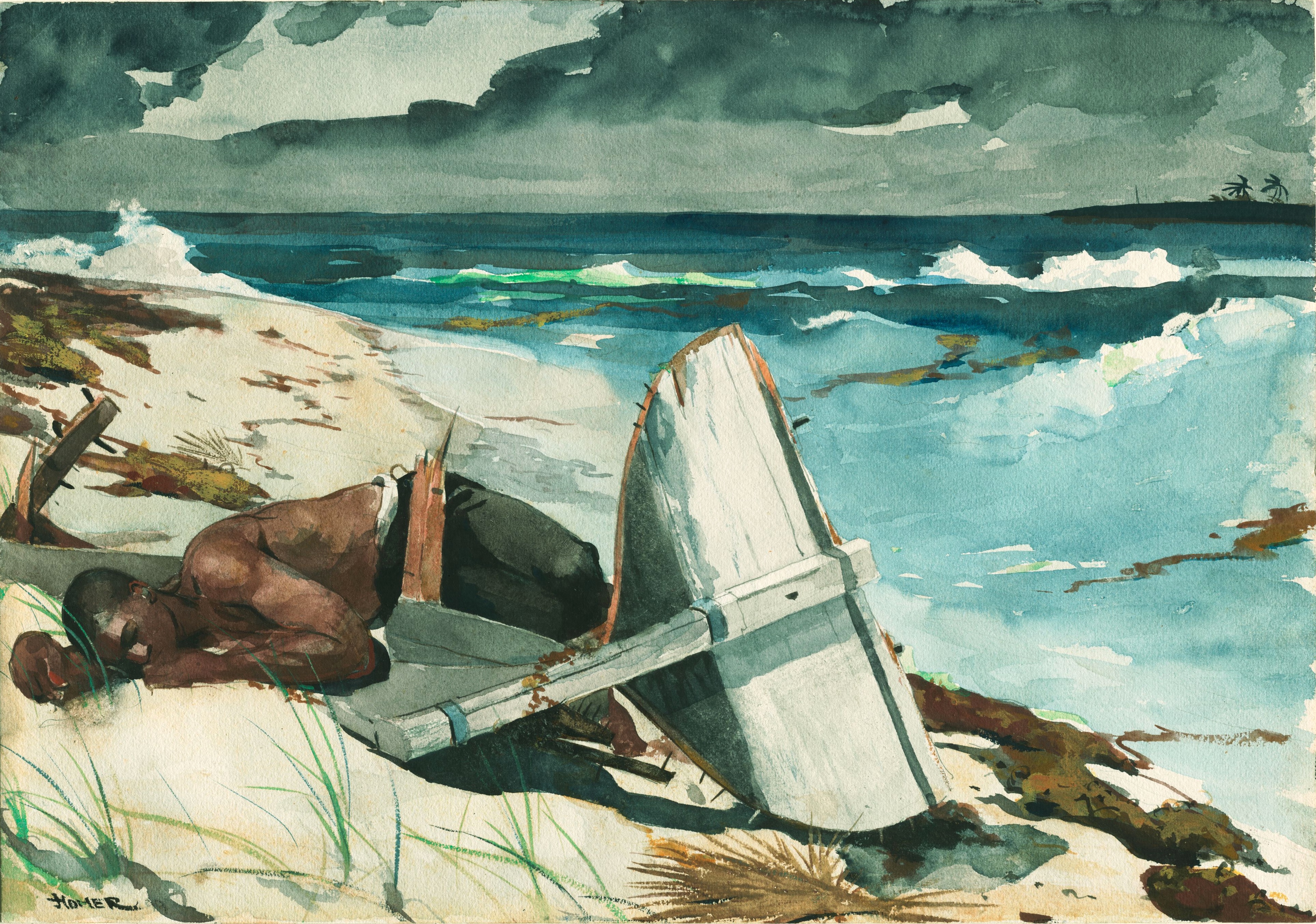
In view of the deadly nature of these storms, I thought it appropriate to revisit “After the Hurricane, Bahamas” by Winslow Homer.

If you live in the US, Walmart and Kroger stores offer an option to donate a dollar or more to various hurricane relief organizations at checkout, as do many other grocery chains. Also, you can donate directly to the relief effort by going to How to help those impacted by Hurricane Helene: Charities, organizations to support relief efforts – ABC News (go.com).

About Hurricane Helene, via Wikipedia: Hurricane Helene – Wikipedia

In advance of Helene’s expected landfall, states of emergency were declared in Florida and Georgia due to the significant impacts expected, including very high storm surge along the coast and hurricane-force gusts as far inland as AtlantaHurricane warnings also extended further inland due to Helene’s fast motion. The storm caused catastrophic rainfall-triggered flooding, particularly in western North CarolinaEast Tennessee, and southwestern Virginia, and spawned numerous tornadoes. As of October 12, at least 252 deaths have been attributed to the storm. [1]

About Hurricane Milton, via Wikipedia: Hurricane Milton – Wikipedia

Ahead of the hurricane, Florida declared a state of emergency in which many coastal residents were ordered to evacuate. Preparations were also undertaken in Mexico’s Yucatán Peninsula. The hurricane spawned a deadly tornado outbreak and caused widespread flooding in Florida. As of October 14, 2024, Hurricane Milton killed at least 28 people: 25 in the United States and three in Mexico. Preliminary damage estimates place the total cost of destruction from the storm at over US $30 billion. [2]

What I love about this painting:

After the Hurricane, Bahamas is a watercolor painting by the American artist, Winslow Homer. It shows a man washed up on the beach after a storm, surrounded by the fragments of his shattered boat. The wreckage of the boat gives evidence of the severity of the powerful hurricane, which is retreating. Black clouds still billow but recede into the distance, and sunlight has begun to filter through the clouds.

The man may have lost his boat, but he has survived.

I love the way the whitecaps are depicted, and the colors of the sea are true to the way the ocean looks after a severe storm. Winslow Homer’s watercolor seascapes are especially intriguing to me as they are extremely dramatic and forceful expressions of nature’s power. The beauty and intensity of Homer’s vision of “ocean” are unmatched—in my opinion his seascapes are alive in a way few other artists can match.

This painting was done in 1899 and marked the end of Homer’s watercolor series depicting man against nature. That series was begun with Shark Fishing in 1885, the year he first visited the Caribbean and is comprised of at least six known paintings. The most famous of these watercolor paintings is The Gulf Stream, which was also painted in 1899. After the Hurricane, Bahamas is the last of the series.

About the artist, via Wikipedia

Winslow Homer (February 24, 1836 – September 29, 1910) was an American landscape painter and printmaker, best known for his marine subjects. He is considered one of the foremost painters in 19th-century America and a preeminent figure in American art.

Homer started painting with watercolors on a regular basis in 1873 during a summer stay in Gloucester, Massachusetts. From the beginning, his technique was natural, fluid and confident, demonstrating his innate talent for a difficult medium. His impact would be revolutionary. [3]


Credits and Attributions:

After the Hurricane, Bahamas by Winslow Homer, [Public domain], via Wikimedia Commons

[1] Wikipedia contributors, “Hurricane Helene,” Wikipedia, The Free Encyclopedia, https://en.wikipedia.org/w/index.php?title=Hurricane_Helene&oldid=1251667279 (accessed October 17, 2024).

[2] Wikipedia contributors, “Hurricane Milton,” Wikipedia, The Free Encyclopedia, https://en.wikipedia.org/w/index.php?title=Hurricane_Milton&oldid=1251634007 (accessed October 17, 2024).

[3] Wikipedia contributors, “Winslow Homer,” Wikipedia, The Free Encyclopedia, https://en.wikipedia.org/w/index.php?title=Winslow_Homer&oldid=1055649094 (accessed December 9, 2021).

IMAGE: Wikimedia Commons contributors, “File:Winslow Homer – After the Hurricane, Bahamas.jpg,” Wikimedia Commons, the free media repository, https://commons.wikimedia.org/w/index.php?title=File:Winslow_Homer_-_After_the_Hurricane,_Bahamas.jpg&oldid=428549979 (accessed December 9, 2021).

Comments Off on #FineArtFriday: revisiting After the Hurricane, Bahamas by Winslow Homer (and hurricane relief)

Filed under #FineArtFriday

#FineArtFriday: Indian Summer on the Hudson River by Albert Bierstadt 1861

Bierstadt_Albert_Indian_Summer_Hudson_RiverArtist: Albert Bierstadt  (1830–1902)

Title: “Indian Summer on the Hudson River”

Genre: landscape painting

Date: 1861

Medium: oil on canvas

Dimensions: height: 60.9 cm (24 in); width: 104.1 cm (41 in)

What I love about this painting:

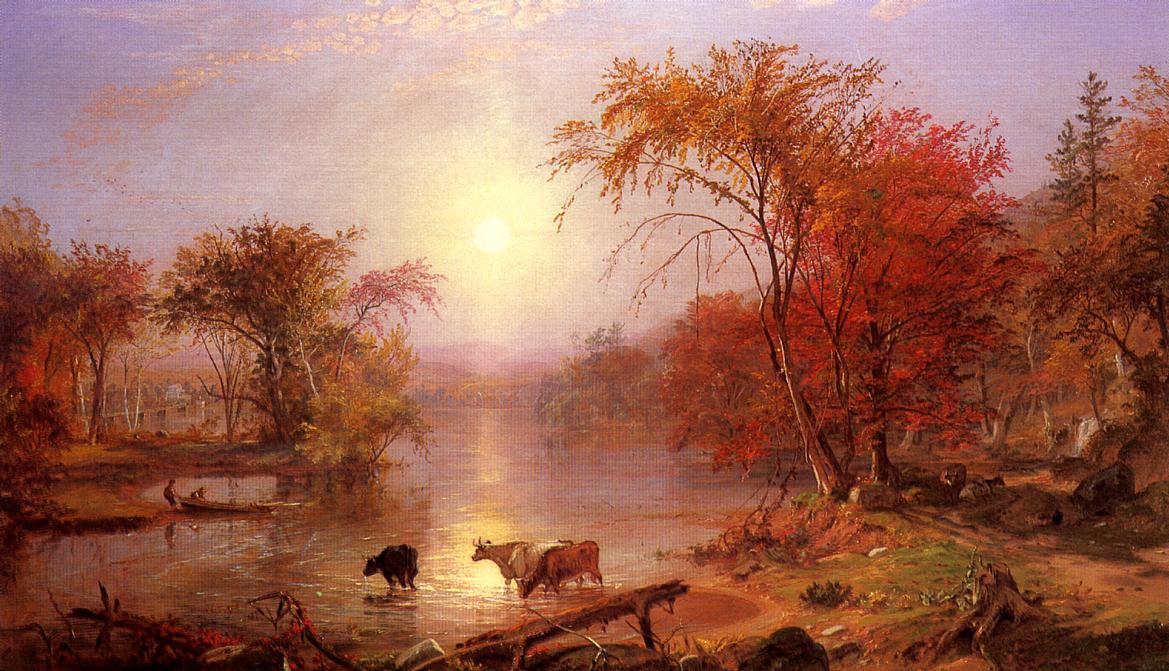
This is the quintessential autumn afternoon in New England on the Hudson River one-hundred and sixty-three years ago. The woods along the banks were old, ancient in some places. Deciduous trees like sugar maples, hornbeams, and sycamores grew along the riverbank.

In this scene, cattle are being watered while a pair of fishers pull their boat ashore, hopefully with a good catch in that basket.

One can almost hear soft splash of the occasional fish snatching waterbugs from the surface of the waters. The evening songs of the woodland birds as they settle down for the night drift across the waters. Tomorrow, the birds will take flight, heading south, while winter birds from further north will arrive and take their place.

About the artist, via Wikipedia:

Albert Bierstadt (January 7, 1830 – February 18, 1902) was a German American painter best known for his lavish, sweeping landscapes of the American West. He joined several journeys of the Westward Expansion to paint the scenes. He was not the first artist to record the sites, but he was the foremost painter of them for the remainder of the 19th century.

Bierstadt was born in Prussia, but his family moved to the United States when he was one year old. He returned to study painting for several years in Düsseldorf. He became part of the second generation of the Hudson River School in New York, an informal group of like-minded painters who started painting along the Hudson River. Their style was based on carefully detailed paintings with romantic, almost glowing lighting, sometimes called luminism. Bierstadt was an important interpreter of the western landscape, and he is also grouped with the Rocky Mountain School. [1]

Credits and Attributions:

Image: Wikimedia Commons contributors, “File:Bierstadt Albert Indian Summer Hudson River.jpg,” Wikimedia Commons, https://commons.wikimedia.org/w/index.php?title=File:Bierstadt_Albert_Indian_Summer_Hudson_River.jpg&oldid=837006005 (accessed October 11, 2024).

[1] Wikipedia contributors, “Albert Bierstadt,” Wikipedia, The Free Encyclopedia, https://en.wikipedia.org/w/index.php?title=Albert_Bierstadt&oldid=1137881139 (accessed October 10,  2024).

4 Comments

Filed under #FineArtFriday

#FineArtFriday: ‘Falling Leaves,’ by Olga Wisinger-Florian, my favorite image of autumn

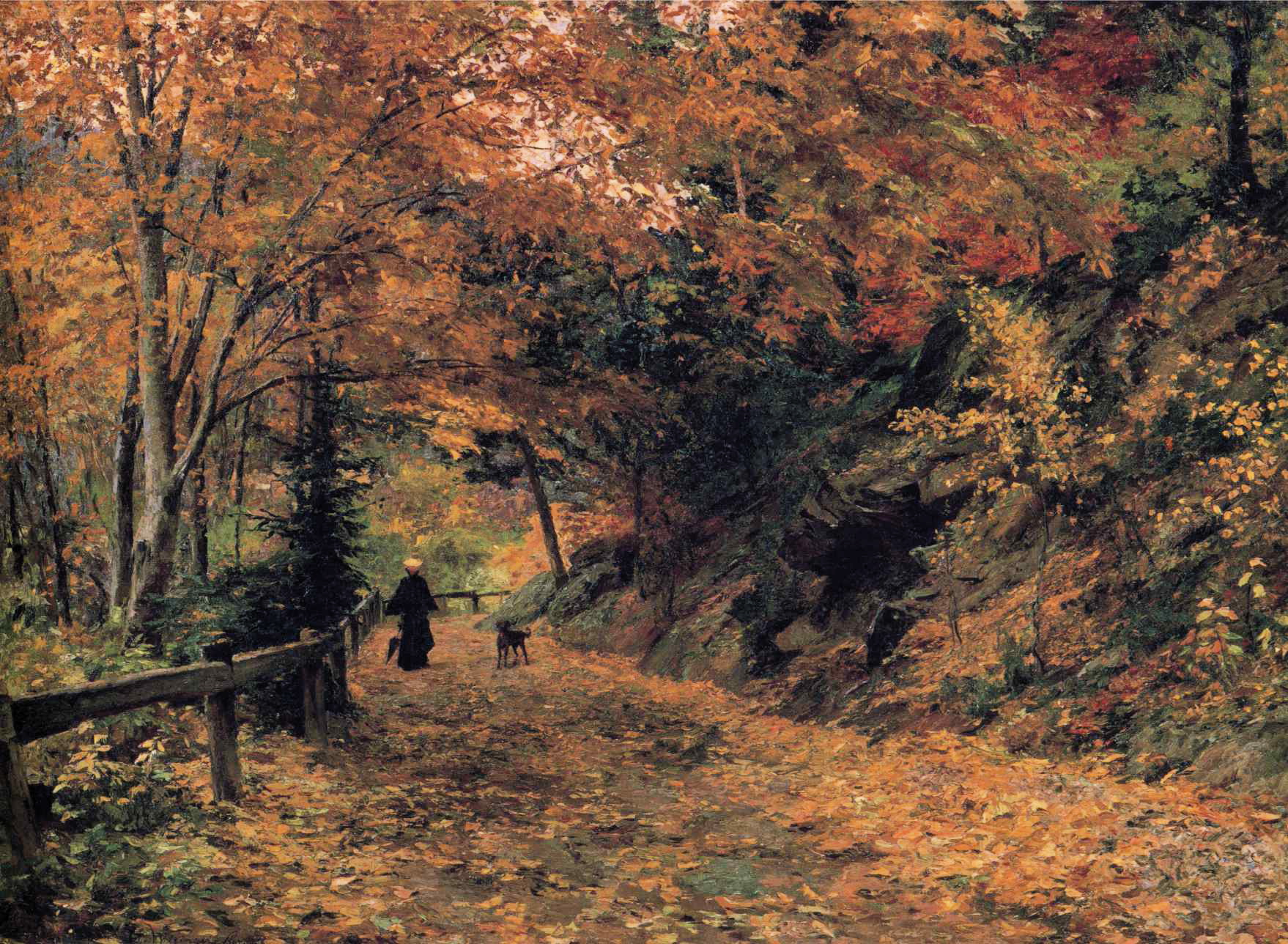
Falling Leaves, by Olga Wisinger-Florian, circa 1899, first appeared here in October of 2018 and again in autumn of 2022.  When I think of autumn, this painting always springs to mind. It captures the mood and atmosphere of a quiet day when the leaves are falling and the forest is settling in for a winter’s nap.

It is one of my favorite depictions of autumn. The scene could be happening here in my lovely Pacific Northwestern forests. The colors of the leaves, the dirt road–this is very like where I grew up.

The painting depicts a woman and her dog enjoying a quiet walk in the serenity of an autumn day. Using light and shadow, the artist employs an impressionistic style to convey the forest. Nothing is drawn with precision, yet everything is shown in its entirety. The feeling of this piece is a little dreamlike–she carries an umbrella, so she’s prepared for rain. She is dressed all in black except for her yellow hat. Leaves in all the many shades of green, gold, and red cling to their trees; the damp, aging rails of the wooden fence offers a flimsy barrier to the carriages and motor vehicles that may travel the roadside. Leaves cover the dirt road, and more are falling down, and the dog trots happily along beside her mistress—the story is there for us to see.

About the Artist via Wikipedia:

 Olga Wisinger-Florian’s early paintings can be assigned to what is known as Austrian Mood Impressionism. In her landscape paintings she adopted Schindler’s sublime approach to nature. The motifs she employed, such as views of tree-lined avenues, gardens and fields, were strongly reminiscent of her teacher’s work. After breaking with Schindler in 1884, however, the artist went her own way. Her conception of landscapes became more realistic. Her late work is notable for a lurid palette, with discernible overtones of Expressionism. With landscape and flower pictures that were already Expressionist in palette by the 1890s, she was years ahead of her time.


Credits and Attributions:

Falling Leaves, by Olga Wisinger-Florian, ca 1899 [Public domain], via Wikimedia Commons

Wikipedia contributors, “Olga Wisinger-Florian,” Wikipedia, The Free Encyclopedia, https://en.wikipedia.org/w/index.php?title=Olga_Wisinger-Florian&oldid=852607929 (accessed October 11, 2018).

Wikimedia Commons contributors, “File:Olga Wisinger-Florian – Falling Leaves.JPG,” Wikimedia Commons, the free media repository, https://commons.wikimedia.org/w/index.php?title=File:Olga_Wisinger-Florian_-_Falling_Leaves.JPG&oldid=273565541 (accessed October 11, 2018).

Comments Off on #FineArtFriday: ‘Falling Leaves,’ by Olga Wisinger-Florian, my favorite image of autumn

Filed under #FineArtFriday

#FineArtFriday: revisiting Indian Summer by William Trost Richards 1875

Indian_Summer_MET_DT276257Title: Indian Summer by William Trost Richards

Genre: landscape art

Date: 1875

Medium: oil on canvas

Dimensions: 24 1/8 x 20 in. (61.3 x 50.8 cm)

Collection: Metropolitan Museum of Art

What I love about this painting:

Autumn is upon us once again. I was looking through the vault at Wikimedia Commons, and my eye kept being drawn to this painting by William Trost Richards. I featured this painting two years ago, and still love the feeling of “zen” that Trost Richards managed to instill into this scene.

He captured a singular moment of tranquility. A light breeze barely ruffles the surface of our pond. At the bottom right, two girls play beside a large boulder at the water’s edge.

Across the pond, in the center and nearly hidden in the shadows, a teamster and his oxen wade across the shallows.

Autumn’s haze lends a feeling of mystery to the scene, muting the reds, yellows, and oranges of leaves about to fall. This last burst of grandeur can’t hold back winter, though it tries. Soon, the forest will sleep, snow and ice will decorate barren limbs, and ice will stop the waters’ gentle motions.

But beneath the grasp of winter, new life will bide its time, and winter will fade into spring. The seasons will follow their course, but today is autumn’s day to shine, to go down in a blaze of golden glory.

A century ago, William Trost Richards painted a scene of peace and serenity, perfectly capturing it. He preserved the glory of the scenery, but more than that, he captured the mood and the atmosphere of a perfect autumn day. When we view this scene, we can sit back and admire the beauty of our world.

 >>><<<

About William Trost Richards via Wikipedia:

William Trost Richards (November 14, 1833 – November 8, 1905) was an American landscape artist. He was associated with both the Hudson River School and the American Pre-Raphaelite movement. [1]

In 1856, he married Anna Matlack Richards (1834–1900), a 19th-century American children’s author, poet and translator best known for her fantasy novel, A New Alice in the Old Wonderland. The couple had eight children, only five of whom lived past infancy. Anna educated the children at home to a pre-college level in the arts and sciences. [2]

One of the couple’s sons, Theodore William Richards, would later win the 1914 Nobel Prize in Chemistry. Anna Richards Brewster, their sixth child, went on to become an important painter in her own right, having received an early arts education from her father as well. [2]

Richards rejected the romanticized and stylized approach of other Hudson River painters and instead insisted on meticulous factual renderings. His views of the White Mountains are almost photographic in their realism. In later years, Richards painted almost exclusively marine watercolors. [1]


Credits and Attributions:

Indian Summer by William Trost Richards, Wikimedia Commons contributors, “File:Indian Summer MET DT276257.jpg,” Wikimedia Commons, the free media repository, https://commons.wikimedia.org/w/index.php?title=File:Indian_Summer_MET_DT276257.jpg&oldid=678817431 (accessed November 3, 2022). Public Domain.

[1] Wikipedia contributors, “William Trost Richards,” Wikipedia, The Free Encyclopedia, https://en.wikipedia.org/w/index.php?title=William_Trost_Richards&oldid=1089835304 (accessed November 3, 2022).

[2] Wikipedia contributors, “Anna Matlack Richards,” Wikipedia, The Free Encyclopedia, https://en.wikipedia.org/w/index.php?title=Anna_Matlack_Richards&oldid=1055684363 (accessed November 3, 2022).

4 Comments

Filed under #FineArtFriday, writing

#FineArtFriday: Undergrowth with Two Figures, Vincent van Gogh 1890, a second look

Vincent_van_Gogh_-_Undergrowth_with_Two_Figures_(F773)Artist: Vincent van Gogh (1853–1890)

Title: Undergrowth with Two Figures

Date: late June 1890

Medium: oil on canvas

Dimensions: height: 50 cm (19.6 in); width: 100.5 cm (39.5 in)

Collection: Cincinnati Art Museum

Two years ago, in April of 2022, I was privileged to attend an immersive exhibit of Vincent van Gogh’s life through his work. Viewers roamed freely inside an everchanging exhibit that flowed through many of his most famous works and zoomed in on bits one wouldn’t ordinarily notice.

I managed a few shots with my cell phone that offered some idea of what the exhibition was like, but sadly, the camera on that phone wasn’t the best. Here is the one that nearly shows what we experienced, a glimpse into van Gogh’s Starry Night:

Van Gogh immersive 1 connie j jasperson LIRF04072022

The exhibit was such a moving, emotional experience. It really brought you into touch with the man and his art. I became a Vincent van Gogh fangirl that day.

We were in, above, and surrounded by his work. The powerful soundtrack of classical music paired perfectly with the images, complementing them like fine wine does good food.

The link to what we saw at that exhibit is here: Van Gogh, The Immersive Experience.

What I love about Undergrowth with Two Figures:

This very late work was painted at the end of June 1890, a few weeks before Van Gogh’s death. It was one of several paintings in Auvers-sur-Oise, a commune on the northwestern outskirts of Paris, France. This was also the place where Vincent van Gogh died from injuries suffered in an attempted suicide.

This painting is one of several he made in the last weeks of his life using a double-square format. The double-square paintings were made on uncommonly large canvases, rectangular, twice as wide as they were tall. Vincent’s need to express his art couldn’t be contained on an ordinary canvas—he saw the world with a panoramic view.

One of the things I love about this painting is the use of violet and blue in the trunks of the poplars. They are tall, immense, like bars in a window framing the courting pair. The trees stand out against the black backdrop. They have power and are the soul of the painting, even more so than the flowers and undergrowth through which the couple walks.

I think it’s a wonderful composition, with strong brush strokes and deep, dark colors. He saw the beauty in life and painted it.

[1] About this painting, via Google Arts and Culture:

In a letter to his younger brother, Theo, dated June 30, 1890, van Gogh explained the structure and brilliant colors of “Undergrowth with Two Figures”: “The trunks of the violet poplars cross the landscape perpendicularly like columns,” adding “the depth of Sous Bois is blue, and under the big trunks the grass blooms with flowers in white, rose, yellow, and green.”

“Undergrowth with Two Figures” has a silvery tonality characteristic of van Gogh’s works from Auvers. His brushwork may be swift and visceral, his colors strong and biting, his emotion raw and visible, but the composition reveals no hint of psychological torment.

It is painted on a double square canvas, twice as wide as it is high. Van Gogh explored the artistic possibilities of this panoramic format in several of his last paintings. [1]


Credits and Attributions:

[1] Google Arts and Culture Contributors, Undergrowth with two Figures, Vincent van Gogh 1890, Accessed April 7, 2022.

Wikimedia Commons contributors, “File:Vincent van Gogh – Undergrowth with Two Figures (F773).jpg,” Wikimedia Commons, the free media repository, https://commons.wikimedia.org/w/index.php?title=File:Vincent_van_Gogh_-_Undergrowth_with_Two_Figures_(F773).jpg&oldid=618842665 (accessed April 8, 2022).

View of Vincent’s Starry Night, © 2022 Connie J. Jasperson, own work,

2 Comments

Filed under #FineArtFriday