Category Archives: Humor

Under the Oregon Stars, a State of Being

Moonless Meteors and the Milky Way Image Credit & Copyright: Petr Horálek courtesy NASA

Moonless Meteors and the Milky Way
Image Credit & Copyright: Petr Horálek courtesy NASA

In fragile folding chairs we sit watching the fire, listening to the music of the surf. We form a circle of people bound by blood somewhat, but in reality bound by that strongest of cements—love. Some are children of my body, given to me as gifts from the universe. Others are the children of my heart, given to me when I married their father.

All are my children—mine, do you hear me? Each one is my precious, my dearest earthly treasure, and I can’t remember a time when I didn’t love them with all the meddling, coddling love a Cancerian brings to motherhood.

I think about how it hurt to see these people grow to adulthood and leave the nest, but over and above the sense of loss at their fledging I was proud that I was a part of their lives.  They are who they are, separate from me, better, and unique.

As it should be.

We are blessed to have a family where love is thicker than blood, and if you cut one of us, we all bleed red. It is the friendship, the camaraderie, the need to be with each other that forges this blended family.

Our genetics may differ but we are the unit of us—a family united widely by marriage, closely by adoption, yes, some by birth. We are a melange of “inlaws and outlaws,” and that is okay. New spouses enter the group under duress and with trepidation, but soon  find themselves at ease, and we all make new memories.

There are many passports into this family, and blood is only a small part of it. Sometimes we go a while apart but memories of lazy summer vacations and stressed-out Christmases, and the challenge of making Thanksgiving menus work for everyone (even the vegan) draw us back together. Dietary dramas fade when unconditional love is applied to the injury.

That connection, these traditions, this path that leads us to each other is the core of a state of being that is hard to define, a concept we call family.

We are not all around this fire tonight. In low voices we talk about how we miss those who couldn’t make the journey this year. We laugh about their youthful antics and how we miss them. We understand well how being an adult means you can’t get time off when you want it, even for a traditional week of family rest and renewal.

Beneath the Oregon stars, my grandchildren run wild and the dunes echo with their laughter. Tonight I am contented, blessed in a way everyone should be.

4 Comments

Filed under Humor, Publishing, writer, writing

R & R for the soul

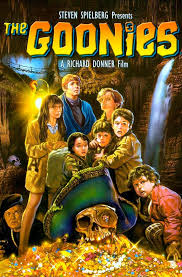
the goonies posterAs of this week I am on vacation. Yay for the burning heat or foggy chill of the Oregon Coast! As always we are in Cannon Beach, where the weather is random and as many of our large family as can make it come to kick off our shoes and play in the surf. This year several great-grandchildren I have never met are visiting from the east coast.

We are engineers and designers as well as artists and musicians–we will build a monument to sandcastles!

Or hang out at grandma’s condo and assemble a jigsaw-puzzle if it should suddenly turn cold and rainy.

Or we’ll watch TV on my son-in-law’s portable outdoor theater, which I find intriguing–I rarely watch TV at home. But we have to watch The Goonies, since we are in Cannon Beach–it’s a family tradition and a rule.

Tenth_of_DecemberFor reading material, I have my kindle loaded with Tenth of December by George Saunders. I listened to the Audible book, and I was so impressed with Saunders’ narration that I have to read it with my own eyes. Yep–this will be an awesome, relaxing reading-for-pleasure kind of vacation.

By virtue of past experience with Cannon Beach cuisine, I know I can eat in several cafes that offer vegan/vegetarian options–they are good, but limited.

But we always rent a condo, and I am doing most of my own cooking, as no one really gets that vegans eat vegetables–go figure! (oh god, a vegan–what will I cook?) I am the queen of barbecue tofu sliders, and all food homemade, not just vegan.

We always stay down by Ecola, and love that end of the beach. Watching the grand-kids and great-grand-kids play in the sun and surf is awesome. Making vegan smores is a total treat. The others are not vegan but I use vegan chocolate and if I can’t find any Dandies, I just won’t eat the marshmallows. The simplicity of sitting around the fire at night listening to my kids talk about their work, their ambitions, and their parenting lives inspires a sense of pride in me that is hard to explain.

The little ones are building memories that will bind them closer together, cousins with a common history of one particular place they went, a week-long family party, and a summer that seemed endless.

Amaranthus and Savvy at the needles by haystack rock cannon beach 2012Kite-flying is my big down-time hobby. I keep it simple, and have found through experience that flying a kite in the fog is not always as easy as it sounds. In many ways writing is a lot like flying a kite–it takes a little effort, but wow, once you’re aloft it’s mesmerizing.

I always return completely revitalized, and ready to get back into publishing and writing. Who knows what amazing revelations regarding my work will have occurred to me while I am enjoying the views and salt-sea air that Ursula K. Le Guin frequently enjoys?

Le Guin’s work was one of the many that inspired me to think I might be able to write–her way of telling a story was so compelling I couldn’t get enough of it. The first book of hers that I read,  A Wizard of Earthsea is set in the fictional archipelago of Earthsea. I loved how she painted that world with words, and brought it to life in my mind. And it was just my cup of tea–the story follows the education of a young mage named Ged who joins a school of wizardry—and is my favorite fantasy book of all time. She knows how to write great prose, and how to keep it moving so that even picky-wannabe-critics forget they are reading great prose.

Now, if only some of that  gift for word-bending will rub off on me while I am building sandcastles and flying kites in her old stomping grounds!

2 Comments

Filed under Humor, Uncategorized, writer, writing

Essays–the vegan discusses Bacon and other meaty reads

consider the lobsterWe have talked a lot about fiction and writing novels as well as short stories. You might think that outside of journalism and blogging there isn’t much left for an author. But there is another area of writing that we’ve all heard of but don’t often think about. They are Essays.

Essays are not just that bane of every school child’s existence–essays are where some of the best works of western literature can be found.

We shall go to the fount of all knowledge, Wikipedia, and ask the holy guru “what is an essay”: “Essays have been defined as “prose composition with a focused subject of discussion” or a “long, systematic discourse”.

Well–that was distinctly un-enlightening.

In her introduction to The Best American Essays 1988, Annie Dillard claims that “The essay can do everything a poem can do, and everything a short story can do—everything but fake it.”

The word essay also means to attempt–and why this meaning is important will emerge later.

But let’s take a look at essays, starting with Sir Francis Bacon, renaissance author, courtier, and father of deductive reasoning. The life and works of this English essayist and statesman had a major impact in his day and still resonate in modern literature. Essayes: Religious Meditations. Places of Perswasion and Disswasion. Seene and Allowed (1597) was his first published book.

The 1999 edition of The Oxford Dictionary of Quotations includes  91 quotations from the Essays. No one gets that many quotes unless his work has struck a chord with centuries of readers.

  • “Knowledge itself is power.”
  • “Riches are a good handmaid, but the worst mistress”

MusicAtNightAldous Huxley‘s book Jesting Pilate, an Intellectual Holiday had as its epigraph, “What is Truth? said jesting Pilate; and would not stay for an answer” quoted from Bacon’s essay “Of Truth”.  Huxley himself was a brilliant essayist and, according to Wikipedia, he defined essays in this way: “essays belong to a literary species whose extreme variability can be studied most effectively within a three-poled frame of reference”. These three poles (or worlds in which the essay may exist) are:

  • The personal and the autobiographical: The essayists that feel most comfortable in this pole “write fragments of reflective autobiography and look at the world through the keyhole of anecdote and description”.
  • The objective, the factual, and the concrete-particular: The essayists that write from this pole “do not speak directly of themselves, but turn their attention outward to some literary or scientific or political theme. Their art consists on setting forth, passing judgement upon, and drawing general conclusions from the relevant data”.
  • The abstract-universal: In this pole “we find those essayists who do their work in the world of high abstractions”, who are never personal and who seldom mention the particular facts of experience. (end quote)

Essays offer an author the opportunity to use prose to expound ideas and values. Michel de Montaigne (1533–1592) was the first author to describe his work as essays–by which he meant attempts. He used the term to characterize these short pieces as “attempts” to put his thoughts into writing. Montaigne’s essays grew out of his work that was then known as “commonplacing”:  published books that were essentially scrapbooks filled with items of every kind: medical recipes, quotes, letters, poems, tables of weights and measures, proverbs, prayers, legal formulas. Think of them as mini-encyclopedias.

Sir Francis Bacon and Aldous Huxley are two men whose works shaped modern literature and they did it though essays.

I highly recommend reading essays as a way to expand your imagination. Essays offer us ideas, philosophical, sociological, and ask us to examine our values.  This examination of the world through the eyes of essayists offers us many insights which will make their way into our own work in ways both seen and unseen, such as Huxley’s reference of Bacon’s work.

Some contemporary essayists I have read and who left an impression on me (some good, some bad) are:

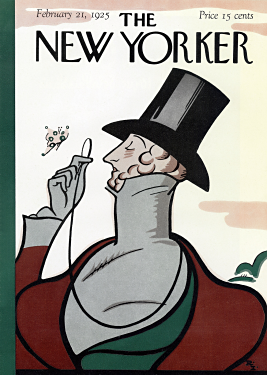
Original_New_Yorker_coverJohn McPhee, The Search for Marvin Gardens published in the September 9, 1972 issue of The New Yorker

Norman Mailer, Advertisements for Myself (published by G.P. Putnam’s Sons in 1959)

David Foster Wallace, “Consider the Lobster” (originally appeared in Gourmet, 2004)

George Saunders, “The Braindead MegaPhone” (Essays by George Saunders) (published by Riverhead, 2007)

Norman Mailer was definitely not my cup of tea, but he might be yours. Great writing is not always comfortable, but it always challenges your view of the world. I still didn’t like it.

Essays most frequently appear in magazines, so that is where to look for awesome contemporary work by today’s best-known authors of mainstream fiction–and much of it is sitting around in waiting-rooms the world over. If you fly Alaska Airlines (as I usually always do) take a look at that magazine they provide you with. You will find essays by authors like Scott Driscoll.

Essays are also frequently referred to as “Creative Non-Fiction” which sounds like an oxymoron–after all, when we are growing up “creative truthing” was called “lying.”  Get creative with your ideas and philosophies–put them in an essay.

Comments Off on Essays–the vegan discusses Bacon and other meaty reads

Filed under Humor, Literature, Publishing, Uncategorized, writer, writing

My impressions of Windows 10

hp-touchsmart-320-1030-full-setI got this machine in Jan 2012, and it just happened to come with the newer style of touchscreen. I have a HP Touchsmart 320 PC, but even though it was WIN 8 ready, I never went with WIN 8 because, for what I do, I prefer to use a mouse, and at that point (in 2012) I wasn’t sure that I liked the “swipe and go” method.

So, I’ve had Windows 10 now for about a week. It was different, being in the first wave of folks making the change from WIN 7 to 10.  I lost pretty much of an evening to making the switch, but you do expect that, when you upgrade something as fundamental as your OS (operating system).

So far I like it. Good job Microsoft–it works on my machine as it was designed.

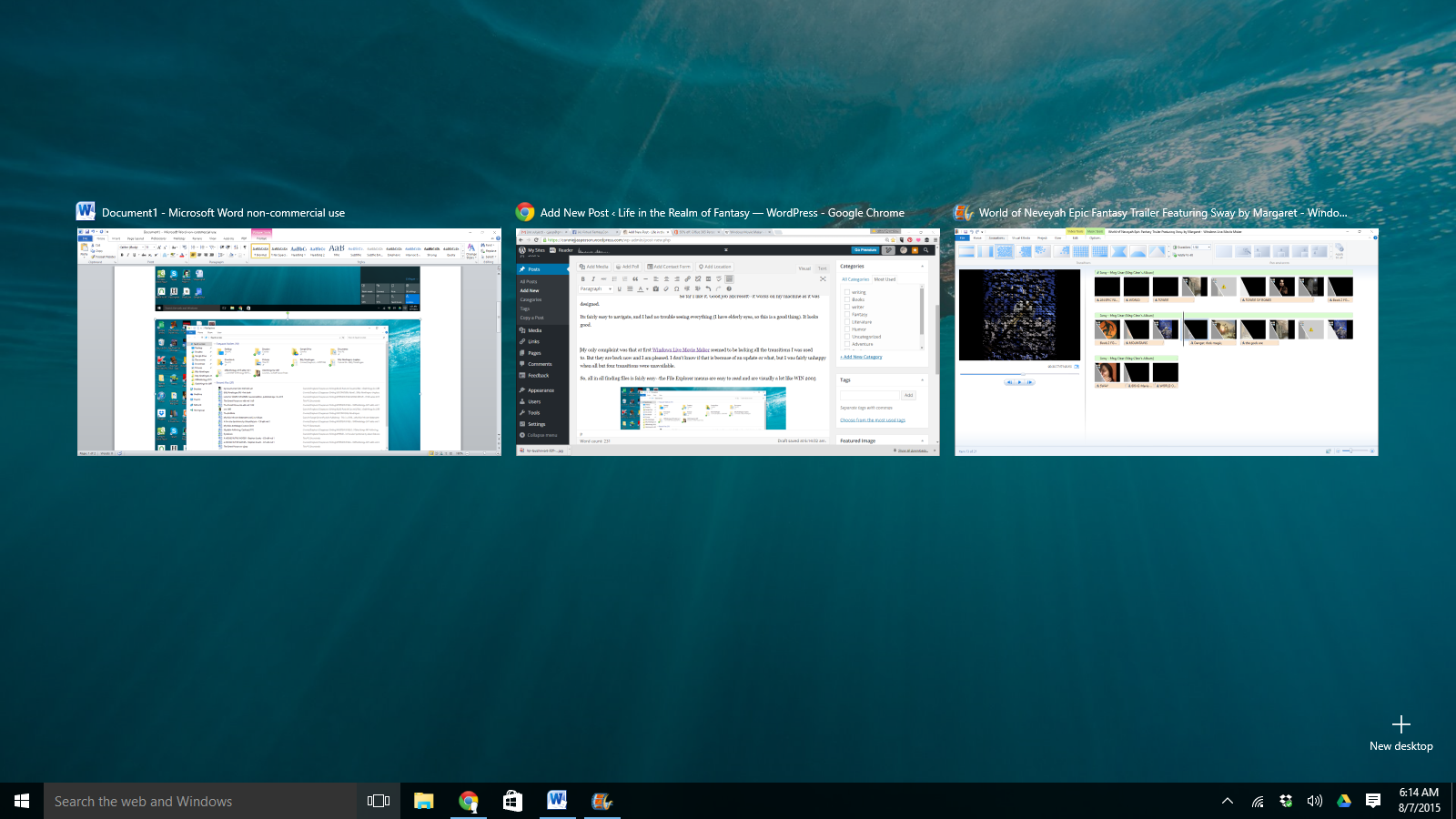
It’s fairly easy to navigate, and I had no trouble seeing everything on the screen. (I have elderly eyes, so this is a good thing). It looks good.  You can easily access the task screen.

prnt scrn win 10 task screen

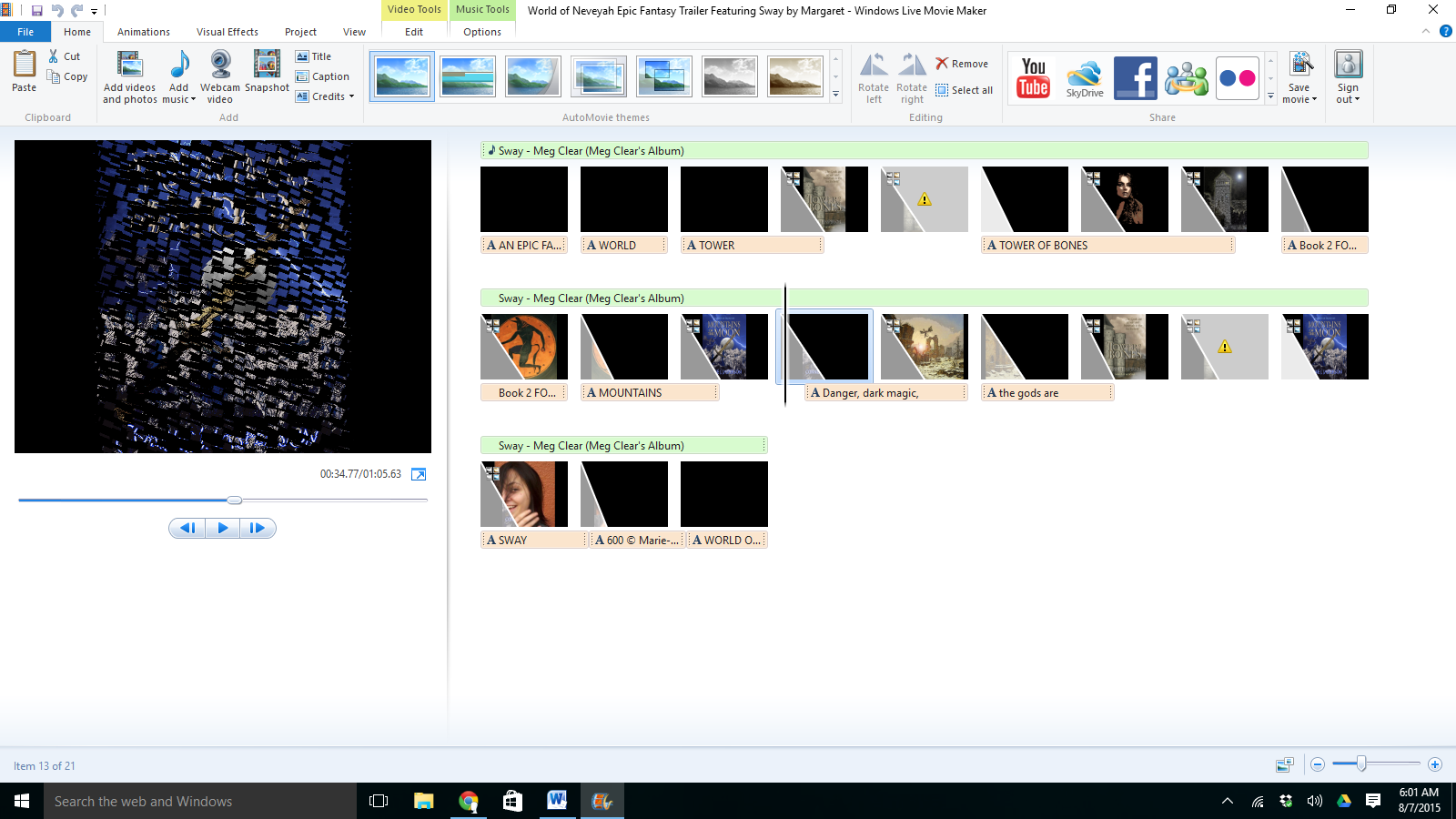
My only complaint was that at first Windows Live Movie Maker seemed to be lacking all the transitions I was used to. But they are back now and I am pleased. I don’t know if that is because of an update or what, but I was fairly unhappy when all but four transitions were unavailable.

prnt scrn wlmm TOB

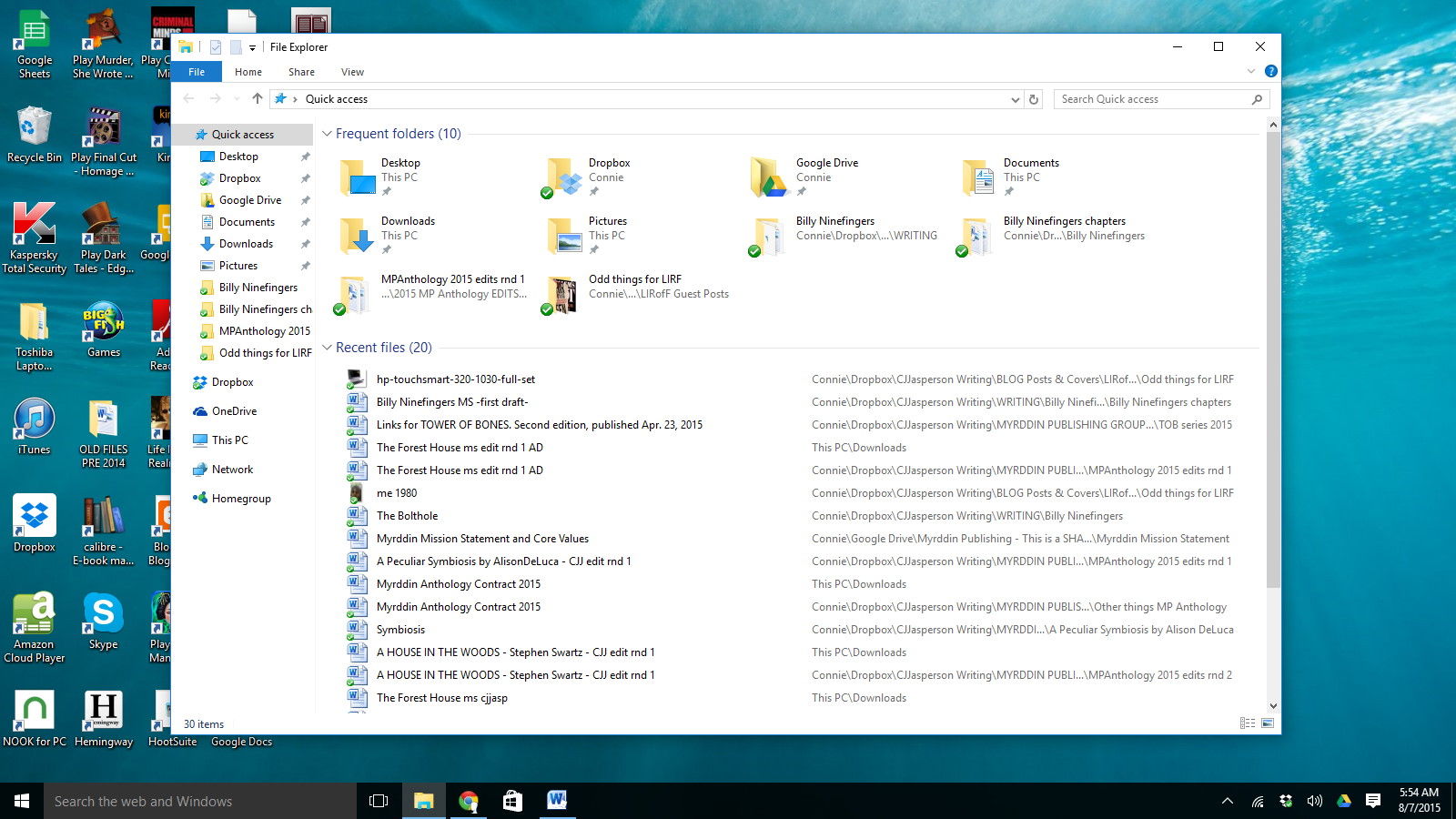
All in all finding files is fairly easy–the File Explorer menus are easy to read and are visually a lot like WIN 2003

prnt scrn win 10 file menu

I have just received the invite to subscribe to the new MS Office. I have it on my devices and I will be checking it out to see if that subscription covers my PC as well. I have to say, I like Office 2010, and am not that keen on switching, unless it is so awesome that I can’t resist the awesomeness. So I will be doing a little research on that.

For Dave Cantrell’s view of WIN 10, check out his recent post at Dave Said It.

3 Comments

Filed under Humor, Publishing, writing

Is it damn fool, damnfool, or damned fool?

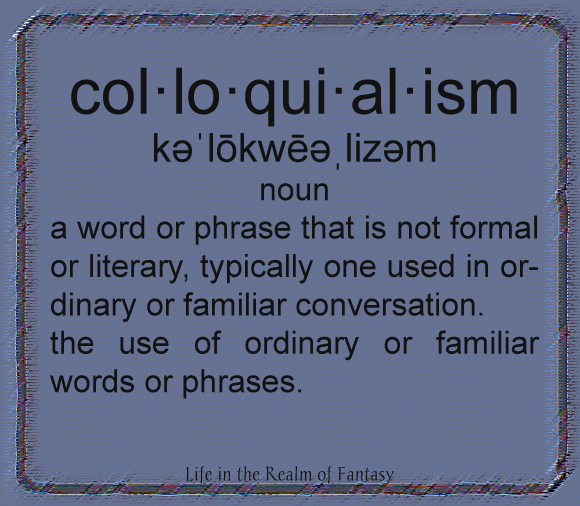
colloquialism memeOne of the more interesting things about being an editor is the amazing amount of time you spend stopping what you are doing and doing a little research. This is especially true if you are editing a piece that has a lot of colloquialisms in it.

Fortunately, some colloquialisms have made it into the Webster’s Dictionary, and the rest are out there on the internet somewhere.

Let’s consider the question of if we mean damn fool, damnfool, or damned fool:

According to the Urban Dictionary

  • A person who is extremely foolish. Their actions are not only irresponsible to themselves, but can possibly be harmful towards others.
  • If a guy tries and talk you out of using a condom, he is a damn fool. (You can’t make this stuff up–you have to go to the internet for it.)
  • Did you see that damned fool? He was swerving all over the road. (end quoted text)
And just for fun, lets see what Wiktionary has to say:
  • damn fool (adjective)
  • damnfool 
  1. (informal) Contemptibly foolish. (end quoted text)
He was a damned fool.

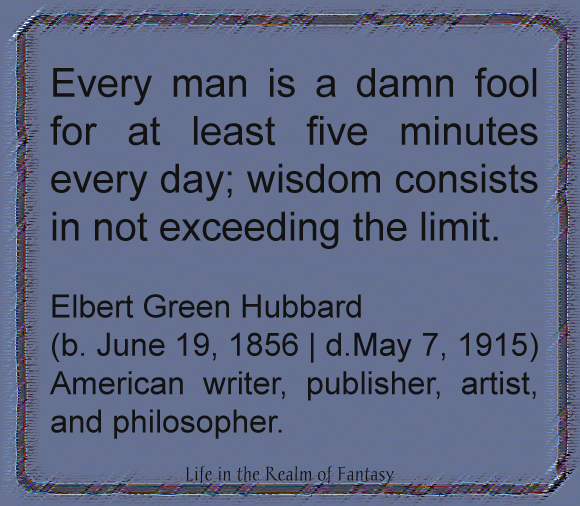
Ellbert Hubbard memeHow I see it:

  1. He was a damned fool. (I just cursed him to hell.)
  2. He was a damn fool. (He was contemptibly foolish)
  3. He did a damnfool thing. (He was contemptibly foolish and I will curse him to hell.)
Now this can be tricky if you are unsure which of these damnfool things the author meant, so this is where I insert a comment asking the author what kind of a damned fool she is writing about.
.
What other fun little “OMG I have to stop and look this up” things do I play with when I should be working?
  • I love looking up Pagan rituals, or indigenous peoples’ religious rituals.
  • I love anything to do with history, and exact dates.
  • Ooh! Ooh! Let me look it up on a map!
Yep–looking things up is part and parcel of the fun. I’m just not as keen on looking up where to properly place commas–the rules make my head hurt.
 .
So let’s talk commas and where to stick ’em, or better yet, where NOT to stick ’em. I found a wonderful website that has a handy-dandy list of comma don’ts phrased in simple language that did not make my eyes go numb: The Proper Care & Feeding of Commas
 .
chicago manual of styleImproperly installed commas can wreak havoc in a paragraph. This is because they are punctuation: “…the act or practice of inserting standardized marks or signs in written matter to clarify the meaning (of a sentence.)” (quoted from Google)
.
Commas are there to separate clauses and to make sentences understandable. Consistently used according to the accepted rules, commas make it so that every English-speaking reader understands what you have written. We don’t put them in to indicate to the reader where we pause or take a breatheveryone pauses and breathes differently and what makes sense to you will not make sense to someone else.
.
These are the same rules for everyone, which make our work understandable in Brisbane, Houston, London, Hong Kong or Seattle. But the rules in the Chicago Manual of Style (my go-to manual) are often ambiguously phrased and are hard to remember. SO, when checking on simple points, I love this website for a quick list of comma dos: Your Dictionary: Comma Rules
 .
Dialect and local sayings play a huge part in contemporary work–sometimes I get a piece that was written by a UK author.  Perhaps it is an Urban Fantasy and it will have all sorts of words I have never heard of: again, I go to Your Dictionary: Common UK Expressions. This  is also a problem with American dialects and local slangs–the internet is my friend! Texas-talk is “a whole nuther thang” and sometimes more difficult to follow than Cockney EnglishHowdy Get Rowdy
 .
It is an editor’s job to do a certain amount of research whenever a question arises in the manuscript to ensure his comments will help the author clarify ambiguous and hard-to-understand areas. Having fun surfing the internet looking up obscure and interesting facts is just one of the perks!
.
keep-calm-and-say-you-fool-you-damn-fool

2 Comments

Filed under Books, Fantasy, Humor, Literature, Publishing, Uncategorized, writer, writing

Why indies should write short stories

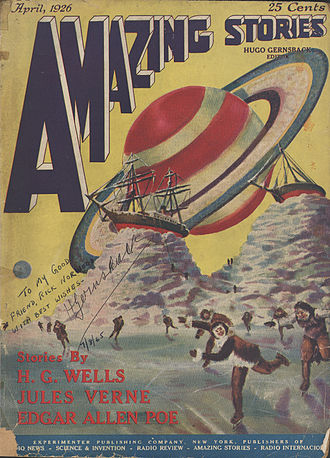
Amazing_Stories,_April_1926._Volume_1,_Number_1Some of the work that moved me most as a reader have been short stories. It is through writing short stories that people like Anne McCaffrey and Isaac Asimov first began to find acceptance in the publishing community.

Magazines focusing on speculative fiction were popular and at that time, there weren’t many authors writing in that genre. People didn’t have the internet, but they did have limited free time and short attention spans.

Magazines offered surprisingly high quality short fiction in lengths that fit into the busy lifestyle of the time.  My father subscribed to four magazines as did my mother. Magazines or books would arrive in our mailbox each week, as my parents were also members of the Science Fiction Book Club and the Double Day Book Club. This meant that besides the eight magazines, four new hard-cover books would arrive at our house every month.

Frequently, those books were anthologies of short stories.

Times have changed and so has the publishing industry. But writing short stories is still the way to get your foot in the door and not only gain visibility, but you will grow as a writer. Magazines are springing up all over the internet, and they are accepting submissions.

It is a good idea to begin putting together a collection of short pieces in a variety of genres and in as wide a range of topics as you can think of.  The following is a list of  on-line sci-fi/fantasy magazines, and many in every other genre are also accepting submissions:

Apex Magazine (submissions re-open in September)

Fantasy Scroll Magazine

Strange Horizons 

Challenger 

Space and Time Magazine 

Interzone 

Asimov’s Science Fiction 

The Magazine of Fantasy & Science Fiction

Analog Science Fiction and Fact

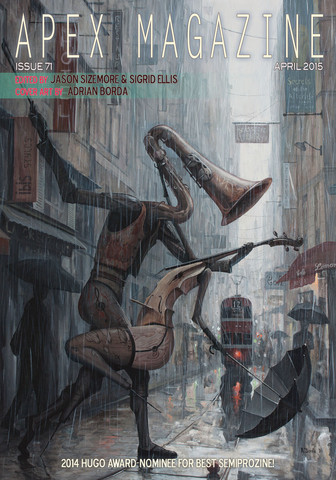
 ApexMag04_11b0889b-3b61-4c44-9a8d-9b2e89347e47_largeNow, I hear the Ghost of Rejections Past wailing in the background “But what if I get rejected?” Rejection happens. I could wallpaper the inside of an outhouse with them. Step back, take a good look at the story, and if you still think it is your best work, shop it to a different magazine. The ones I’ve listed are only the tip of the iceberg–there is opportunity out there for indies to gain both visibility and credibility by publishing short works through traditional routes.

The thing is, magazines are not the only reason you need a backlog of short stories–consider CONTESTS. Many are free and have reputable histories. The Write Life posted this article on 27 Free Writing Contests.

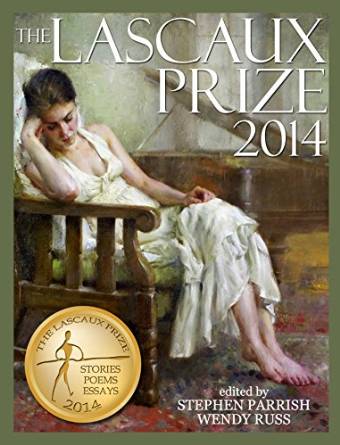
Not all contests are free, and not all contests are reputable. Exercise “due-diligence” here. I enter the Lasceaux Review contest every time a new one pops up, simply because it is highly reputable and is one of the most friendly to indies, and has a reasonable entry fee, usually $10.00.

lasceax prizeYes, that is cheap, and I know that entering contests can be far more expensive. I hear you asking if you must pay  to enter and you can’t be guaranteed a prize, why should you do it?

Writing chops. Because you must write to the parameters of the contest, you develop your writing muscles each time you exercise them. Being forced to work within the confines of an arbitrary external limit forces you to become more creative if you are (as I am) of a naturally rebellious nature.

You have to use common sense here. If you can’t afford it, don’t enter that contest. Find one you can afford and see what you have that fits their needs. Every contest has rules and limits for the work they want to see in their submissions.

Writing short stories gets you writing  more: more often, more widely on a wide range of topics, and more creatively using a variety of style. Using and building these writing-chops can only grow you as an author.

8 Comments

Filed under Books, Fantasy, Humor, Literature, Publishing, writer, writing

Epiphany, and the Writers’ Conference

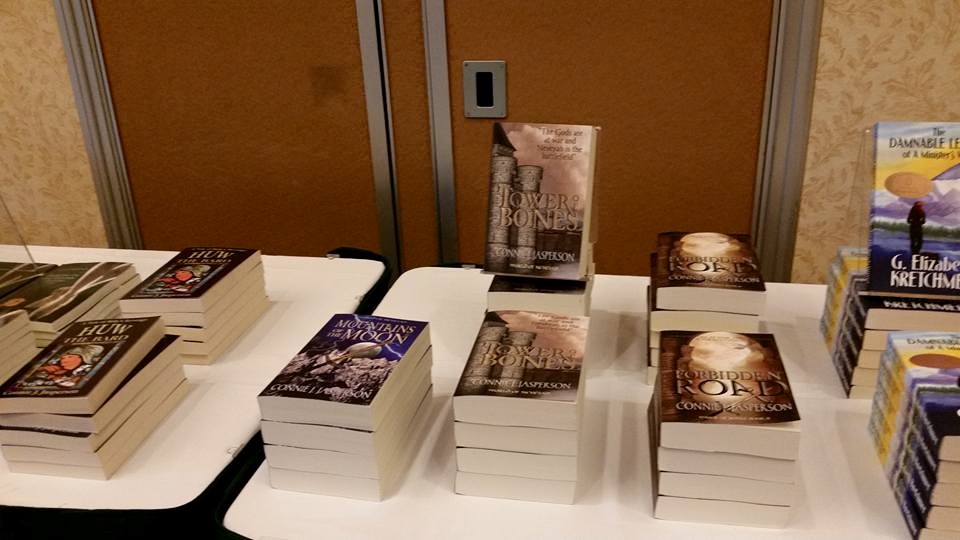
PNWA 2015 My Books in the Bookstore

Epiphany.

A sudden revelation.

A moment in time where suddenly you understand the why of a certain thing. For a writer this can mean the plot suddenly unthickens and we know what we need to do!

This often happens when I am in traffic and completely unable to put said revelation into practice, but hey, we go with what we have, right?

I had several such moments of glory while in Seattle at the PNWA 2015 Writers Conference this last week. Fortunately I was able to immediately put my chicken-scratched notes into a more readable form via the little Android tablet, and these flashes of knowledge will soon be causing some positive changes in my current works-in-progress.

Over the next few months a lot of what the speakers and teachers had to say will filter through my mind and into this blog, but first I need meditate on it until I know what their insights mean to me on a practical level.

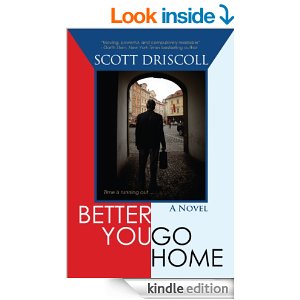
Better You Go Home Scott DriscollI attended two seminars offered by Scott Driscoll, who cuts right to the chase and explains his ideas clearly. One was on understanding your characters’ values and how the evolution of those core values fundamentally drives the story, and the other was on the inciting incident. Those two seminars dovetailed beautifully, and I had my first “I know what I need to do” moment after leaving the one on identifying and understanding the values (or ethics) your characters hold dear. If you ever get a chance to go to a seminar offered by him, I would recommend you do it.

Another speaker whose seminar really motivated me was offered by Bill Carty, on the intersection of ‘poetry and the everyday’ as a means for generating our own poems. (Yes, I have a dark side–I write poetry when no one is watching.)

I listened to my good friend, Janet Oakleyspeaking on a panel about bringing the past to life, when writing historical fiction. That too had an “ah hah!” moment.

Bharti Kirchner gave a seminar on the five essential elements of a short story, and she is an intriguing speaker. As you know, I am a strong proponent of writing short stories as exercise, to develop your writing chops, and I came away from that class knowing how to organize my thoughts so that a short story will remain short, and not accidentally turn into a novella or an epic trilogy.

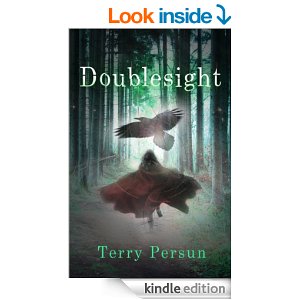
Doublesight--Terry PersunI wanted to attend the seminar on using language with intention that was offered by Terry Persun and his daughter, Nicole Persun, but I had a conflict and had to choose which class served a more immediate need, so I was unable to attend it. But all is not lost–I will be purchasing the download of that seminar. I had several wonderful conversations with Terry and he will be writing a guest post for this blog, perhaps on that subject.

Instead of that, I attended a class offered by Lindsay Schopfer on identifying the sub-genres of science fiction and fantasy so that when a book is published you can best identify your intended target audience. This is absolutely critical because when you go to publish, your publishing platform will always ask you what your “BISAC code” is. BISAC is an acronym for Book Industry Subject and Category subject headings, which are a mainstay in the industry and required for participation in many databases.
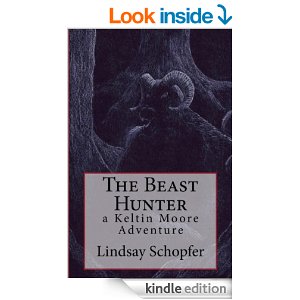
The Beast Hunter, Lindsay SchopferKnowing if you are writing Epic Fantasy or High Fantasy is critical when it comes to marketing your book to the proper audience, as die-hard readers of each sub-genre have strong feelings about what constitutes their favorite genre. Thus, there are certain tropes readers of those genres will expect, so proper labeling is critical if want your target audience to read your book.

Being able to immerse myself in learning the craft is absolutely wonderful, and I look forward to this conference every year. This year William Kenower  offered the final seminar of the event. Bill is an intriguing, energetic speaker who gets his listeners involved in what he teaching. His seminar on reconnecting with your confidence was quite appropriate for me, as I sometimes  listen to my inner critic and forget the joy I have in writing.
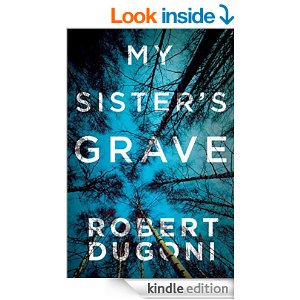
my sisters grave robert dugoniOther people spoke, Andre Dubus III and Robert Dugoni-two men with vastly different experiences and different styles of writing, and yet both had something to say that moved me in one way or another.  J.A. Jance, Nancy Kress , Elizabeth Boyle and Kevin O’Brien were on a panel that was fun to listen to.

If you are serious about writing, I highly recommend that you seek out and attend writing conferences. A great deal of good information can be found on the internet, but there is something about the networking and actually talking shop with the other authors that fires creativity and keeps the creativity flowing through the veins.

I suggest that you actively google writers’ conferences in your area, and see if you can find one that is affordable and offers sessions by respected authors in a wide variety of genres, and who are welcoming to authors who intend to go indie as well as those who hope to be traditionally published. It will be money well-spent.

An intriguing thing happened at this conference during the book signing event. A highly respected agent (who shall remain unnamed) stopped by my table and looked over my books. He picked up Tower of Bones, and leafed through it, checking out the cover and the graphics, and also the maps. Pausing, he asked if I was indie published, and I explained I was, through a publishing group, Myrddin Publishing. He then paid me the highest compliment ever–my books were “highly professional.”

That interaction proves how important it is to put your best work out there. When you do that, you can be proud to play on that not-so-level playing field.


2 Comments

Filed under Books, Humor, Literature, Publishing, writer, writing

Lay, lie, laid

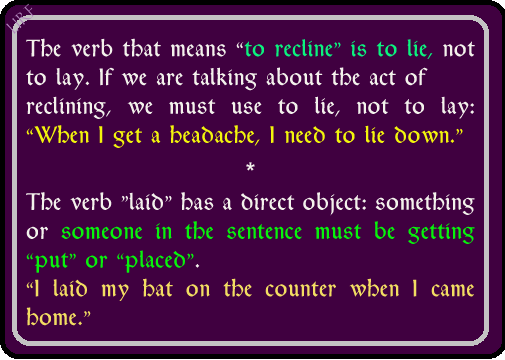
to lie means to restIs it to lay, to lie, or what? I want to get this right but these words can be a complicated morass of misery. It boils down to a simple concept: is it RECLINING  or was it PLACED THERE?

“Lay” is a verb meaning to put or place something somewhere. It has a direct object. Its principal parts are “lay,” “laid,” “laid,” and “laying.”

What the words refer to is the action: If you set it (object) there, it is laying there. Lay it there. Lay it on the pillow.

If it is resting or reclining, it is lying there. Lie down. Lying down. Lie down, Sally. (Clapton had it wrong? Say it isn’t so!)

The internet is your friend, and can teach you many things besides how to make cute kitty memes. Quote from the wonderful website Get it Write: The verbs to lie and to lay have very different meanings. Simply put, to lie means “to rest,” “to assume or be situated in a horizontal position,” and to lay means “to put or place.” (Of course, a second verb to lie, means “to deceive,” “to pass off false information as if it were the truth,” but here we are focusing on the meaning of to lie that gives writers the most grief.)

As another great resource, in his July 7th, 2015 post on this subject for Writers’ Digest,  Brian A. Klems gave us a useful chart:

Lay vs. Lie Chart


Infinitive    Definition         Present    Past    Past Participle    Present Participle


to lay      to put or place     lay(s)           laid     laid                     laying
something down

to lie     to rest or recline    lie(s)            lay      lain                     lying

“end of quoted text” 
Brian A. Klems is an awesome author and blogger. Check out his personal blog at The Life of Dad.

>>><<<

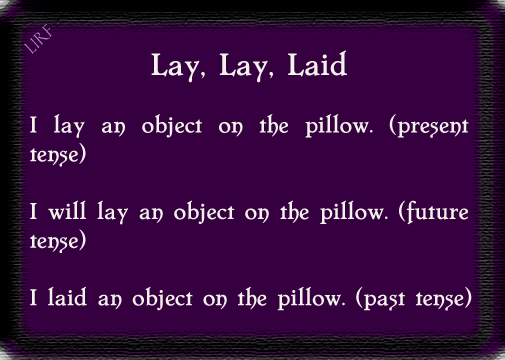
This is where things get tense: present, past and future.

A ring lay on the pillow. 

Lay, Lie, Laid

But I needed to rest:

LYING AS IN RESTING copy

So what this all boils down to is:

final comment lay laid

But just to confuse things:

A living body lies down and rests as is needed.

A dead body is cleaned up and laid out by other people,  if said corpse was important to them. However, after having been laid out, said corpse is lying in state to allow mourners to pay their respects.

5 Comments

Filed under Humor, Literature, Publishing, Uncategorized, writer, writing

Achieving balance

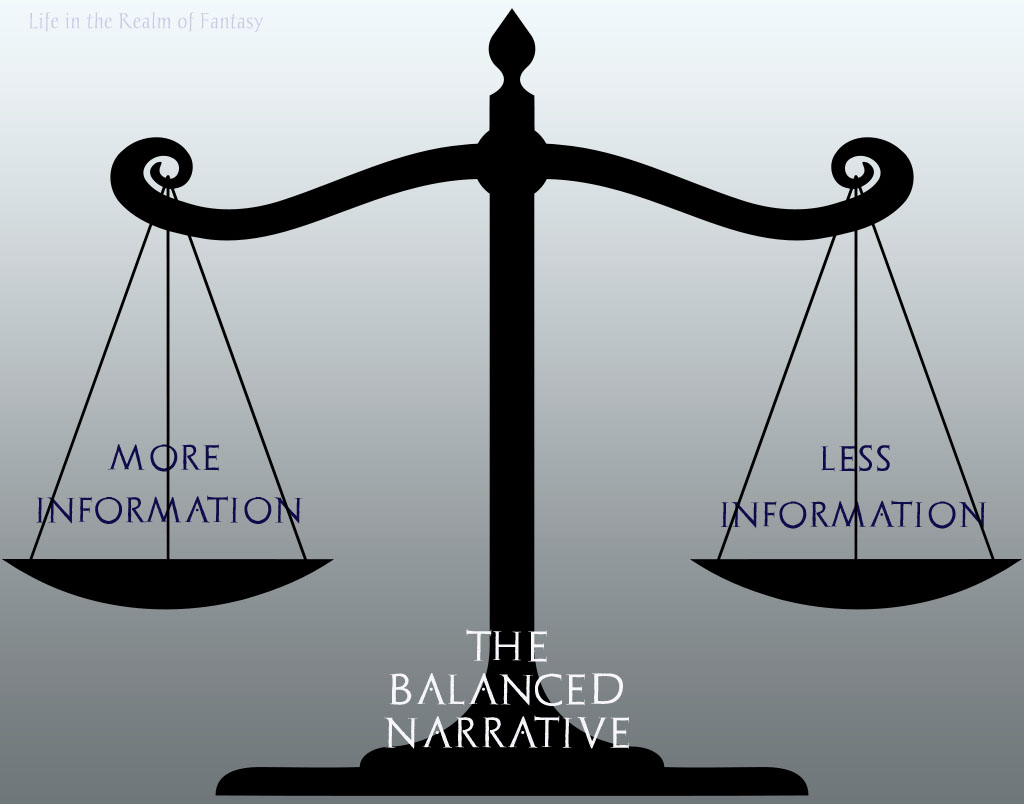
the balanced narrativeYou’ve heard the saying, “a little knowledge is a dangerous thing.” The implication is that a small amount of knowledge can lead to overconfidence and leaping to invalid conclusions based on what you do know without taking into account the things that you don’t know.

When we are newly-hatched authors, we eagerly soak up the wisdom offered to us through writing seminars and handbooks on the craft of writing.

But if you are an avid reader, someone who reads widely and in many different genres, you can see that writing is not simply a matter of following rules.

This is especially true in regard to the many-layered concept of exposition, introducing background and necessary information into the narrative.

Sometimes there is life in a manuscript that has broken all the rules. The work shines because it’s clear that the writer had passion and it was conveyed in the written word. Life is a natural consequence of the rush of creativity and is set into the manuscript when the first words are written.

Unfortunately it is easy to murder what began as a beautiful story. Consider those writers who spend years carefully combing every spark of accidental passion out of their work, creating textbook-perfect sentences that are flat, toneless. The reader has no desire to care about the characters or their struggle.

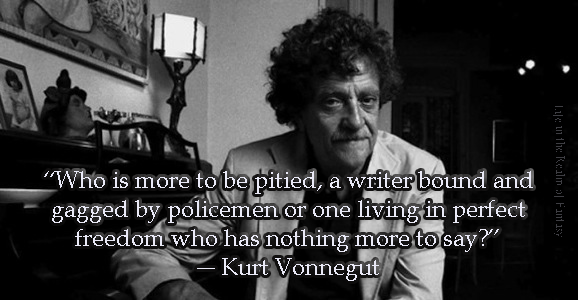
kurt-vonnegut_quoteI’ve also known people who use “the ‘f’ word” regularly in their work  because they think it’s cutting edge, and then they have the balls to say they write like Kurt Vonnegut.

They don’t.

Blindly breaking rules without understanding them is not good writing craft. Vonnegut understood the rules, and when he broke them, he did it to inject life into his work.

He understood balance and was not afraid to use it.

You want to create a balanced narrative:

  1. Information must be delivered only as the protagonists need it.
  2. The information can never be something everyone already knows.
  3. You must offer SOME information–people appearing out of nowhere mean nothing if you do not offer an explanation for them.
  4. No one will die if you use an adjective to describe an object, once in a while.
  5. Show people by using simple, general descriptions such as handsome or dark-haired, and use their mannerisms to convey their moods–things that allow the reader to form their own idea of what the characters look like and how they are feeling. But do give the reader something to build their visualization around.
  6. Stick to simple basic speech tags like said and replied, and if the conversation has only two people, skip them sometimes for a sentence or two.

I know a few authors who are like pendulums. They have no concept of balance and leave each meeting of their writing group with the notion that they have to go all or nothing when deploying information.

Thus, if they have been told they gave too much information, they go too far and now their characters appear out of the ether, with unexplained powers and do things that make no sense.

First you have to realize that no one writes a perfect, completely flawless manuscript, not even Neil Gaiman. And then you have to decide: are you writing for the critics who might be out there, or because you love to write.

If you are not writing for the joy of writing, quit now.

Otherwise, keep writing. Only by continued practice will you develop the balance you know you need. And you don’t have to be committed to only writing novels. Some of the best work I’ve ever read was in the form of short stories.

You can gain a handle on balance by writing short-stories and essays.

With each short-story you write, you increase your ability to tell a story with minimal exposition. This is especially true if you limit yourself to writing the occasional practice story—telling the whole story in 1000 words or less. These practice shorts serve several purposes:

  • You have a finite amount of time to tell what happened, so only the most crucial of information will fit within that space.
  • You have a limited amount of space so your characters will be limited to just the important ones.
  • There is no room for anything that does not advance the plot, or affect the outcome.
  • You will build a backlog of short stories and characters to draw on when you need a good story to enter into a contest.

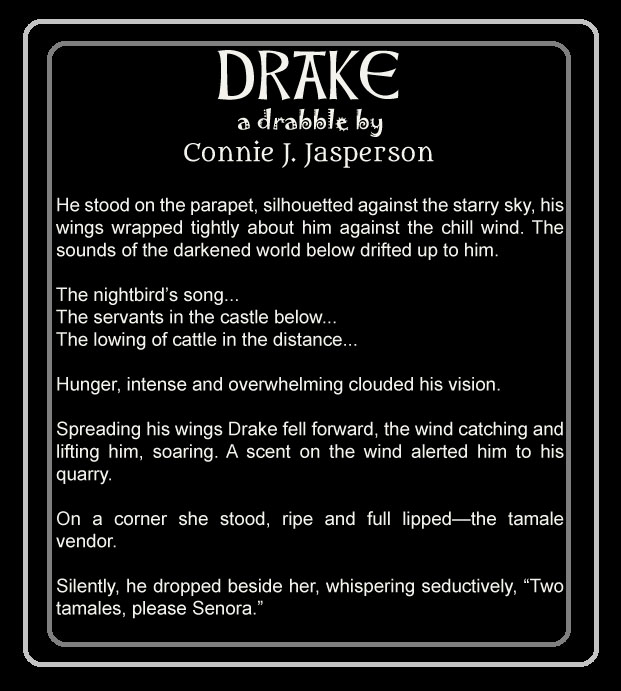
Go for the gusto, and try writing flash fiction–give yourself less than 1000 words to tell a story. Or really challenge yourself–tell that story in around 100 words ( a drabble):

Drake - a drabble by cjj

Drake, © Connie J. Jasperson 2013, All Rights Reserved

4 Comments

Filed under Humor, Publishing, Uncategorized, writer, writing

To England and Wales, the mother country(s), on the 4th of July

First of all, my beloved sister nation, Great Britain, I want you to know that I love you like the siblings we are.

We here on the west side of the Atlantic just needed our own space, and having separate rooms really did improve how we interacted with each other.

We have so much in common, and by golly no one had better pick on you, because you are family!

My Father’s side of the family came to America from Herne Hill, Canterbury, England in 1630, sailing on the Winthrop Fleet, and ended up in Massachusetts.

My mother’s side came from  Laugharne, Carmarthenshire, Wales right around the same time, and ended up in Virginia.

So, today as we celebrate Independence Day here in jolly old America, I will raise my gin(less) tonic/w a twist of lime to the mother country(s)–and listen to the Beatles, in honor of my roots and my dear friends in both England and in Wales.

fireworks via wikipeda

Fireworks, via Wikipedia

2 Comments

Filed under Humor, Publishing, writer, writing