Category Archives: writing

My Writing Life – #amwriting on the road

Once again Greg and I are at the beautiful Alderbrook Resort and Spa. He is here for a conference, and I am here as driver and for my wit and charm (not). We have the room for one night but of course the weather was cold and rainy when we arrived yesterday, so I didn’t get out for much of a hike. I did spend a great deal of time in the coffee bar, artfully labeled the Drinkery.

MyWritingLife2021Today, however, I plan a long walk along the beach.

One of the great things about writing in a different environment is how it jumpstarts my creative mind. I find it easy to write in coffee shops.

So, what am I working on?

I’m beta-reading a book of short stories for a friend and enjoying it a lot. These stories are set during the Vietnam War era and are quite interesting to me. I knew many people who were very like the characters in his stories.

Also, I am still trying to plot the final act of a duology that has been in the works for far too long. When that fails, I go back to working on the outline for November’s NaNoWriMo book, and both tasks are oozing along reluctantly.

On the fun side of things, I’m preparing for an in-person book selling event on July 1st at Olympia’s Pride Festival. I haven’t done an in-person event since before the pandemic. The best part of this is I will be with three other authors, Judy Kiehart, Ellen King Rice, and Johanna Flynn.

One of the questions prospective buyers always ask (and I hate) is, “What is your book about?”

My mind goes blank, and my mental response is “I don’t know” but since that won’t sell a book, I struggle to explain the core of my books in only a sentence or two. So, while I’m here at Alderbrook Resort, I’m working on my spiels. My goal is to make them short, concise (and hopefully) interesting.

Identifying the core plot device around which my narrative revolves is important.

Who or what is the book about?

I can sell either the idea of the book or the main character. Once I choose what to sell, main character or idea, I must stick to that. If I choose the character, I will use only the protagonist in the description, and forget the others, because it is that character’s story that I’m trying to sell.

Keep the spiel short. It’s easy to be long-winded and rambling about my work but I’ll only have about 60 seconds to sell that book.

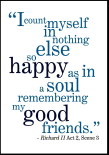
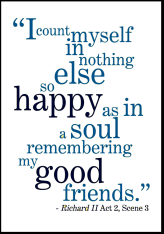
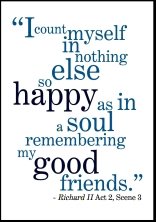
ICountMyself-FriendsI have no trouble selling my friends’ books – I’ve read them all and love them, and love selling them. Maybe I can sell their books because I’m not emotionally invested in their creation, but I am invested as a reader.

But back to this lovely resort—a place that is conducive to creativity. Greg and I were here at Alderbrook last year, and as a vegan, I found the food was both delightful and unusual. The food this year has been outstanding, created with care and attention. If you’re curious, here’s the link to my post from a year ago, #RoadTrip! The Resort, The Vegan, and June-uary #amwriting.

(June-uary is what we call a normal June around here because it will be cold, overcast, and rainy, like a slightly warmer January without the snow.) We like cold gray and rainy Junes here in the Great Northwest, because July, August, and September tend to be hot and dry. The summer drought normally starts on July 5th, but since today is warm and partly sunny, 74 degrees (23 Celsius), and weather models for the foreseeable future look the same or warmer, the annual dry spell may be starting early this year.

I’ve enjoyed our brief stay here at Alderbrook Inn. The view of Hood Canal is fabulous, the grounds here are beautiful, and the peace of this place is soothing. I’ve gotten some good work done.

We’re still unpacking at our new apartment. I’m not sure where some things are, but gradually our new home is shaping up. I like the ambiance of my new office. I think a lot of new plot twists are just waiting to emerge from my subconscious and complicate things.

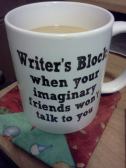
Lucky Coffee CupNext week on this blog we will talk about the creative process and the importance of mind-wandering. We’ll also talk about why it is important to beta read for your fellow writers, and how to be a good reader, one who gives positive feedback and offers constructive suggestions.

In the meantime, happy writing!


2 Comments

Filed under writing

Pacing part 3 – Plotting the End #amwriting

Maybe you’re a “pantser,” not a “plotter.” Unlike me, you like to wing it when you write; just let the ideas flow freely.

Margaret Atwood on writing LIRF07252022I have “pantsed it” occasionally, which can be liberating but for me, there always comes a point where I realize my manuscript has gone way off track and is no longer fun to write. Then I must return to the point where the story stopped working and make an outline.

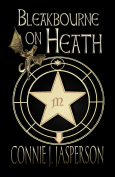
This year, I finally published Bleakbourne on Heath, a novel that began as a serial published in 2015 – 2016 on Edgewise Words Inn. That experience was how I discovered that writing and publishing a chapter a week is not my forte. I hit a dead spot at the ¾ mark, and the book was on hold for several years because of other writing commitments, but finally, it was finished, and now it is out the door.

Another bit of unfinished business is book two of a duology. I’ve committed to writing the second book in this set before publishing the first because I know from experience it will be years between installments, and readers don’t like that. This ensures the wait time for the second book’s release is reasonable. Even though the entire story will span two books, this first half must have a finite ending, and I think I have finally achieved that goal.

It’s at what would be considered the midpoint of the 2-book story arc. The problem has been deciding where in the overall story arc of the duology the ending of book one occurs and how it leads into the action of the opening chapters in the second half.

I have stopped floundering and (literally) cut my losses. I trimmed book two back to where the narrative dissolved into chaos. Now I must figure out how to bring the story to its intended conclusion.

This isn’t unusual. Fortunately, my years of doing NaNoWriMo have given me some tools for just such an emergency.

Jack Kerouak on writing LIRF07252022The first tool is a sense of balance. Every published novel has entire sections that were cut or rewritten at least once before it got to the editing stage.

Much of what you cut out can be recycled, reshaped, and reused, so never delete weeks of work. Save everything you cut to a new document, labeled and dated something like “Outtakes_AF_rewrite2_06-19-2023.” (For me, that stands for Outtakes, Aelfrid Firesword, rewrite 2, June-19-2023)

Now, we must consider what will be the most logical way to end this mess.

What is the core conflict? For me, a good way to pull the ending out of my subconscious is to revisit the outline I made of the story arc. Fortunately, I have been on top of things, so deviations from the original plans have been noted on my outline.

The problem I am experiencing now is that I didn’t know precisely where this duology would end when I began writing it so that part never got plotted. Now I can see how the internal growth of the characters has caused two of them to fundamentally change from what was originally planned. Their personal goals have radically deviated from what I had initially thought, and they have a lesser part to play.

By visualizing the whole picture of the story to this point, I usually find the inspiration to put together the final scenes that I know must happen. I know what must be achieved in the last chapters – I just can’t get it onto paper. This is where I stop and drag out a notebook and pen. I sit outside or in a coffee shop and write down those loose ideas for an hour or so. I find an outline is crucial, especially when trying to write a solid ending. The list of events helps me get the story out of my head in a logical sequence.

What must occur between the place where the plot was derailed and the end? I write a list of chapters with the keywords for each scene noted.

Once I have made a few notes as ideas occur to me, I start a new document and save it with a name indicating that it’s a worksheet for that novel: AF_Final_Chpts_Worksheet_06-19-2023 (Aelfrid Firesword, final chapters worksheet, and the date)

F Scott Fitzgerald on Good Writing LIRF07252022At first, the page is only a list of headings that detail the events I must write for each chapter. I know what end I have to arrive at. But the chapter headings are pulled out of the ether, accompanied by the howling of demons as I force my plot to take shape:

  • Chapter – Sunhammer revealed/Alf swears the vows of protection
  • (and so on until the last event)

You’ll note that there are no numbers, but the word “chapter” and a rudimentary title are there. I don’t number my chapters until the final draft is complete, although I do head each section with the word “chapter” written out, so it is easy to find with a global search. The titles will disappear, or be changed, depending on which series it is.

This is because, in my world, first drafts are not written linearly. Things change structurally with each rewrite. So the numbers are only put in when the manuscript is finalized.
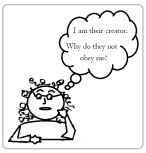
  • I begin writing details that pertain to the section beneath each chapter heading as they occur to me.
  • Once that list is complete, those sketchy details get expanded on and grow into complete chapters,
  • Which I then copy and paste into the manuscript.

When I begin designing the ending, it’s as challenging as plotting the opening scenes. I go back to the basics and ask myself the same questions I asked in the beginning.

It’s a good idea to have a separate worksheet that lists each character and contains notes detailing what they wanted initially. That way, you can see how they’ve been changed by the events they have experienced.

  1. What do the characters want now that they have achieved a significant milestone?
  2. What will they have to sacrifice next?
  3. What stands in the way of their achieving the goal?
  4. Do they get what they initially wanted, or do their desires evolve away from that goal when new information is presented?

ok to write garbage quote c j cherryhDon’t be afraid to rewrite what isn’t working. Save everything you cut because I guarantee you will want to reuse some of that prose later at a place where it makes more sense.

Not having to reinvent those useful sections will significantly speed things up, so I urge you to save them with a file name that clearly labels them as background or outtakes.

We all suffer from the irrational notion that if we wrote it, we have to keep it, even though it no longer fits. No amount of rewriting and adjusting will make a scene or chapter work if it’s no longer needed to advance the story. When the story is stronger without that great episode, cut it.

Outtakes are fodder for a short story or novella set in that world. This is how prolific authors end up with so many short stories to make into compilations. Every side quest not used in the final manuscript can quickly become a short story featuring characters you already know well.

What you have written but not used in the finished novel is a form of world-building. It contributes to the established canon of that world and makes it more real in your mind.

UrsulaKLeGuinQuote

3 Comments

Filed under writing

#FineArtFriday: The Bird Concert by Jan Brueghel the Younger ca. 1640 – 45 (revisited)

OLYMPUS DIGITAL CAMERA

Artist: Jan Brueghel the Younger (1601–1678)

Title: the Bird Concert

Date: between circa 1640 and circa 1645

Medium: oil on copper

Dimensions: height: 13.2 cm (5.1 in); width: 17.9 cm (7 in)

Collection: Herzog Anton Ulrich Museum

Today we are taking a second look at one of my favorite paintings of the 17th century.

What I love about this painting:

This is a joyous, surreal exploration of all the birds the artist had ever seen in his native Antwerp, and many rare birds that he could only imagine. Brueghel has gathered birds from all over the world into a mystical, fairytale glen, posing them around a songbook.

They are learning to sing a in a language they all can understand, a wonderful allegory of the aspirations of the artist for humanity in the turbulent times during which he lived.

This painting also celebrates the new discoveries made by European explorers, as Brueghel had only seen scientific drawings of many of these birds. Even though he hadn’t seen some of these birds personally, he paints them as if they are before him.

The amazing flock of birds gathered here gives us an insight into the mind and sense of humor of Jan Brueghel the Younger, a man not too different from us even though he lived over 300 years ago.

This composition must have been important to Brueghel and says something about him. He went to the expense of getting copper as the base upon which he painted this scene. He was comfortable but not rich, so that tells me he intended this painting to last, to be something he would be remembered for.

About the medium of Oil on Copper, via Wikipedia:

Oil on copper paintings were prevalent in the mid sixteenth century in Italy and Northern Europe. The use of copper as a substrate for an oil painting dates back to Medieval times. The Flemish masters and other artists including Jan Breughel the ElderClaudeEl GrecoGuido ReniGuercinoRembrandtCarlo SaraceniAmbrosius Bosschaert IICopley Fielding and Vernet painted on copper. They favored copper for its smooth surface which allowed fine detail, and its durability. Copper is more durable than canvas or wood panel as a support for oil painting, as it will not rot, mildew or be eaten by insects. Contemporary painters also use copper as a base for paintings, some of them allowing the metal or patina to show through.

The old masters prepared the copper for painting first by rubbing it with fine pumice abrasive. The copper surface was then treated with garlic juice which is believed to improve adhesion of the paint. Finally a white or grey ground layer of oil paint was applied as a primer. After drying the copper panel was ready for the artist to begin painting. Later artists used the patina process, in which the copper is oxidized with the use of various acidic solutions, as part of the art work itself. The resulting patina or verdigris includes darkening of the metal, green and blue tones, depending on the chemical solution used. Patina is characterized by beautiful, variated patterns and textures which occur on the metal’s surface. [1]

About the Artist, via Wikipedia:

Jan Brueghel the Younger was born in Antwerp on 13 September 1601 as the son of Jan Brueghel the Elder and Isabella de Jode. His mother was the daughter of the cartographer, engraver and publisher Gerard de Jode. He trained and collaborated with his father in his workshop. His father was a friend and close collaborator of Peter Paul Rubens. Brueghel likely assisted with his father’s large-scale commissions.

On the wishes of his father he traveled around 1622 to Milan where he was welcomed by Cardinal Federico Borromeo. The cardinal was a patron and friend of his father who had met in Rome about 30 years earlier. In what was likely an act of rebellion against his father, he went to Genoa where he stayed with his cousins, the Antwerp painters and art dealers Lucas de Wael and Cornelis de Wael. Their mother was a sister of Brueghel’s mother. At the time his friend and fellow Antwerp artist Anthony van Dyck was also active in Genoa. He later worked in Valletta on Malta in 1623. From 1624 to 1625 he also resided in Palermo on Sicily at the time when van Dyck was also working there.

Brueghel learned that his father had died on 13 January 1625 from cholera only after his return to Northern Italy in Turin. Wanting to return to Antwerp immediately, he had to delay his departure for 16 days due to a severe fever. After recovering from his illness, he set off for his homeland by way of France. In Paris he met the Antwerp art dealer and painter Peter Goetkint the Younger, who was the son of Peter Goetkint the Elder, the master of Jan’s father. Goetkint was eager to return to Antwerp because his wife was expected to deliver a baby soon. The child was born on 25 August, the day on which Breughel arrived in Antwerp with his traveling companion who himself died a few days later.

Brueghel took over the management of his father’s workshop, sold the finished works of his father and finished some of his father’s unfinished paintings after completing them. In the Guild year 1624-1625, Brueghel became a master painter of the Guild of Saint Luke of Antwerp.

In 1626 he married Anna Maria Janssens, daughter of Abraham Janssens, a prominent history painter in Antwerp. He continued to operate the large workshop of his father. He became dean of the Guild of Saint Luke in 1630. That same year he was commissioned by the French court to paint a series of paintings on the life of Adam. It seems that his studio declined after this period and that he started to paint smaller scale paintings which commanded lower prices than those produced earlier.

In later years, he worked independently in Paris in the 1650s and produced paintings for the Austrian court in 1651. He is recorded again in Antwerp in 1657 where he remained until his death. [2]


Credits and Attributions:

[1] Wikipedia contributors, “Oil on copper,” Wikipedia, The Free Encyclopedia, https://en.wikipedia.org/w/index.php?title=Oil_on_copper&oldid=1060711380 (accessed June 9, 2022).

[2] Wikipedia contributors, “Jan Brueghel the Younger,” Wikipedia, The Free Encyclopedia, https://en.wikipedia.org/w/index.php?title=Jan_Brueghel_the_Younger&oldid=1086952033 (accessed June 9, 2022).

Image: The Bird Concert by Jan Brueghel the Younger ca. 1640 -1645, PD|100. Wikimedia Commons contributors, “File:Bruegel Vogelkonzert@Herzog Anton Ulrich Museum (1).JPG,” Wikimedia Commons, the free media

Comments Off on #FineArtFriday: The Bird Concert by Jan Brueghel the Younger ca. 1640 – 45 (revisited)

Filed under #FineArtFriday, writing

Pacing part 2 – plotting the midpoint #amwriting

As I said in my previous post, Foreshadowing and the Strong Opening, I am writing the first draft of a new novel. I am filling in and altering the outline as I go. This means that nothing is canon, and many plot points, even major ones, will have changed by the time I am ready to publish this mess.

Words-And-How-We-Use-ThemSome novels are character-driven, others are event-driven, but all follow an arc. I’m a poet, and while I read in every genre, I seek out literary fantasy, novels with a character-driven plot. These are works by authors like Naomi Novik,  Tad Williams, and Patrick Rothfuss. These writers spend time crafting every aspect of their novels. For that reason, they cannot churn a new book out every year or even every two years.

Literary fantasy is a subgenre whose novels appeal to dedicated and determined readers. The authors spend time crafting prose that reflects a deep and often dark storyline, so if you prefer easily-digested fantasy, this is not for you. Complex themes play with and sometimes warp the expected fantasy tropes.

This subgenre focuses on the characters and how they are changed by their circumstances. Plot elements take place in a richly developed fantasy world. However, both setting and events are not the point of the story—they only frame and enable a character’s evolution.

hyperboleAnd the prose … words with impact, words combined with other words, set down in such a way that I feel silly even thinking I can write such works. Thankfully, my editor weeds out pretentious hyperbole and slaps me back to reality.

I am working on the first draft of a character-driven novel, trying to get the plot out of my head and noting events in the outline as I go. I have the first quarter nailed down reasonably well.

The midpoint of a novel is the longest section. It covers the second and third quarters of the book’s overall word count. In this section, emotions intensify, and the action does too. From this point on, the forces driving the plot are a train on a downhill run, picking up speed, and there is no stopping it or turning back now. The characters continue to be put to the test, and subplots kick into gear.

From the midpoint to the final plot point, pacing is critical.

And this is where I struggle as a writer.

These events tear the heroes down. They must break them emotionally and physically so that in the book’s final quarter, they can be rebuilt, stronger, and ready to face the enemy on equal terms.

As you approach the midpoint of the story arc, personal growth begins to drive the plot.

In the story I am plotting, two of the protagonists lose faith in themselves. One has a crisis of conscience, which is the result of the inciting incident. The other carries on doing what hasn’t worked in the past. Both have heavy burdens of guilt that must be shed.

Each must learn to live with who they are rather than who they wish to be.

Other characters know bits of the history behind these two, but no one knows everything. In this section, information must gradually emerge, showing the reader why they react the way they do. In the process, the four will learn to work together, setting aside their insecurities. By the final act, they must be hardened, able to function as a team, and determined to finish the task.

Book- onstruction-sign copyThis part of the novel is often difficult for me to get right. The protagonist must be put through a personal crisis. Their inner world must be shaken to the foundations.

But what is the lynchpin of this disaster?

It must be a logical outcome of events to that moment. My editor must be able to say, “Yes, that’s how it would happen.”

So now I need a terrible event. At this point in laying down the story, I don’t know what it is, but somehow, the protagonists have suffered a severe loss.

  • How are they emotionally destroyed by the events?
  • How was their own weakness responsible for the bad outcome?
  • How does this cause the protagonist to question everything they once believed in?
  • What gives them the courage to keep on going?
  • How does this personal death and rebirth event change them?

The midpoint is crucial because the truth underlying the conflict now emerges. As we approach the final act, the enemy’s weaknesses become apparent. My protagonists will overcome their crises and exploit those flaws—I just don’t know how yet.

I do know part of the plot. I have plans for the midpoint’s second half, an event where the protagonists must make hard decisions. They will scrape up the courage to do what must be done.

I haven’t discussed the enemy much, but I haven’t neglected them. They have had their day in the sun, and to my protagonists, it looks like the opponent has won. But even so, our heroes will reach into the depths of their souls and do what must be done, make that final effort.

plotting as a family picnicThis emotional low point is necessary for our characters’ personal arcs. It is the place where they are forced to face their weaknesses and rebuild themselves. They must discover they are stronger than they ever knew.

At this point in the novel, if I have done it right, my editor (who is also my first reader) will be worried, hoping everyone can hold it together long enough to overcome the hardships.

Fingers crossed, and with a fully fleshed-out outline at hand, it might happen. My writing group is a resource I will turn to as the plot progresses. They will kindly keep me from going off the rails, and that is a blessing.


Other posts in this series:

Pacing part one: foreshadowing and the strong opening #amwriting | Life in the Realm of Fantasy (conniejjasperson.com)

6 Comments

Filed under writing

Pacing part one: foreshadowing and the strong opening #amwriting

I’ve been struggling to find the place where the narrative of my new novel actually begins. Is it the day of his divorce? Is it the day of his brother’s death? Or is it the day he is released from the care of the healers after his breakdown?

MyWritingLife2021BAnd what of my female protagonist? Where does her story begin?

And the other pair—the ones that really need their own book but aren’t going to get it. What about them?

At this point, all I have is a mountain of backstory. It’s important because it tells me who my people are the day the novel begins.

It doesn’t need to be the opening chapter.

Every story begins with an opening act. The characters are introduced, and the scene is set. These paragraphs establish the tone of what is to follow, and if I have gotten my phrasing and pacing right, they will hook the reader.

This is where pacing comes into it. The intended impact of the book can and should be established in the first pages—but it takes work. I am writing a first draft right now, so most of what I write is a code telling me what I need to know when I get to the revision process.

I have introduced the setting. Where are the characters? Well, in this case, it’s easy. They are in the World of Neveyah, and fortunately for me, the world, the society, and the magic systems are already built. Some things are canon, which forces me to be creative and work within those limits.

Finally, I must introduce the conflict. What does the protagonist want? What hinders them?

My female protagonist must learn to live with her limits and trust her team. She must learn to delegate.

While she is doing that, my male protagonist must move beyond what he has lost and learn to appreciate what he still has.

My other female lead must be the friend the protagonist needs and make a choice between her career as a soldier or choosing to leave and raise a family.

Conversely, the other male lead must emerge from his father’s domination and choose to make his career as an artisan.

Not only that, but I must use my words in such a way that my readers don’t want to put the book down.

Novels are built the same way as a Gothic cathedral. Small arcs support other arcs in layers, creating an intricate structure that rises high and withstands all that nature can throw at it for the centuries to come.

Like our cathedral, the strength of a novel’s story arc depends on the foundation you lay in the book’s first quarter.

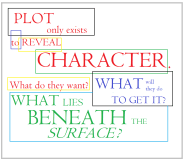
Plot-exists-to-reveal-characterI must introduce a story-worthy problem in those pages, a test propelling the protagonist to the middle of the book. The opening paragraphs are vital. They are the hook, the introduction to my voice, and must offer a reason for the reader to continue past the first page.

So, I must find where that story really begins, and trust me, it isn’t with a mental breakdown. The story begins with each character arriving at their new duty stations, each with a history that makes them who they are that day. Their pasts are known to others and do come out, but only when the other characters and the reader needs it.

I find pacing is the most challenging part of writing a first draft. Eighty percent of my writing will not make it into the final manuscript.

But it will be available in a file labeled ‘backstory’ for me to access when needed. I note names and relationships in my stylesheet and outline as I go.

One character is dark and brooding. I won’t explain why at the outset, as his backstory must emerge gradually, each morsel emerging when my female character must know. My side characters have an easier path, but their task is to provide information when required and to assist in the surface quest—catching a murderer.

With the back history in a separate file, I must open the novel with my characters in place. A  question must be raised, or I must introduce the inciting incident. This sets the four on the trail of the answer, throwing them into the action.

It’s too easy to frontload the opening pages with a wall of backstory. We always think, “Before you learn this, you must know that.”

All of that is true, but the history belongs in a separate file. I learned this the hard way—long lead-ins don’t hook the reader.

If my characters don’t need to hear the history of the Caverns of Despair, it’s likely that the readers also don’t care. The name is a pretty descriptive indicator of what lies ahead, so the twelve paragraphs detailing how the caves got their name are probably unnecessary.

The_Pyramid_Conflict_Tension_PacingMy favorite books open with a minor conflict, evolving to a series of more significant problems, working up to the first pinch point, where the characters are set on the path to their destiny.

I will open with a strong scene, an arc of action that

  • illuminates the characters’ motives,
  • allows the reader to learn things as the protagonist does, and
  • offers clues regarding things the characters do not know that will affect the plot.
  • The end of one scene is the launching pad for the next scene, propelling the story arc.

The clues I offer at the beginning are foreshadowing. Through the book’s first half, foreshadowing is important, as it piques the reader’s interest and makes them want to know how the book will end.

In the opening paragraphs, I will focus on the protagonists and hint at their problems. Subplots, if there are any, will be introduced after the inciting incident has taken place. They must relate to that incident in some way.

If you introduce side quests too soon, they are distracting. They make for a haphazard story arc if they don’t relate to the central quest. I think side quests work best if they are presented once the book’s tone and the central crisis have been established. Good subplots are excellent ways of introducing the emotional part of the story.

Even if I were to open the story by dropping my characters into the middle of an event, I’d need a pivotal event at the 1/4 mark that completely rocks their world. The event that changes everything is the core of the story.

Following the inciting incident is the second act: more action occurs, leading to more trouble and rising to a severe crisis.

I know how long I plan the book to be. I will take that word count and divide it by 4. I place the first significant event in the first quarter, presenting it after I introduce the characters. The following two quarters form the second act, the middle. If I have plotted well, the middle of the story arc should fall into place like dominoes.

We’ll talk about that in my next post.

storyArcLIRF10032021

3 Comments

Filed under writing

The story arc – plot points, a series of life-changing events #amwriting

Every good story has an arc to it. It begins at a place of change and is created by one event following another until it comes to a place where the narrative is concluded.

MyWritingLife2021The inciting incident is followed by a series of plot points, places where complications are introduced into the narrative.

Real life is the same way. As many of you know, this last year has been one of change for me and my husband. If I were writing the story of this year,  it would begin with the inciting incident which occurred a year ago this last week. My husband was involved in a car wreck which ultimately led to his diagnosis of Parkinson’s disease. That was a bad day for us, but thankfully he wasn’t seriously injured, and we got it handled.

Just as in a novel, there was fallout from the inciting incident. Unfortunately, it meant the protagonist’s spouse could no longer drive. That would be the second plot point because it meant all plans for the summer had to be rearranged on the fly.

Orange_Door_with_Hydrangeas_©_Connie_Jasperson_2019The opening setting for this story is a small town in an exceedingly rural part of Thurston County. One must travel at least ten miles in any direction to find another city. After sundown, you must drive on narrow, winding, pitch-black country roads. I, the protagonist in my story, suffer from severe night blindness, which meant we had to return home before sundown, putting a real crimp in our social life.

The third pinch point comes in the sudden amount of traveling we had to do for physical therapy and neurology appointments. All medical services are twenty miles north in the Olympia area, as are the full-service grocery stores and a multitude of services we now need. It was like having a day job again. We would get up, have breakfast, and hit the road.

The story’s midpoint comes when, in January, we examined our options. Ultimately, we decided the best solution was to sell our home of eighteen years and move twenty miles north, back to Olympia.

The plot arc of the year had crested the midpoint, and now it was hurtling toward the next complication—trying to pack up, get the house ready to sell, and be a contributing grandparent to the family.

That was not easy.

Three family members have faced serious health problems since January. For one, epilepsy reared its head like the curse it is, and he landed in the hospital again. For the first time, I wasn’t any help other than offering a supportive voice on the other end of a phone call.

medical symbolMajor surgeries happened for the other two, and I was many miles away to the south, getting our house on the market. But our sons and daughters are entering middle age, and our older grandchildren are adults. Despite our worries, our granddaughters proved they were mature and more than capable of handling their lives.

And they all do so, brilliantly.

This is the final battle. The protagonists have been forced to let go and be the caring sounding board whenever one is needed.

And now, we approach the happy ending. The protagonists have managed to get packed up and moved by the deadline. Every task was done, and the house was ready to put on the market by the self-imposed deadline. As of today, our two characters have received some good offers and accepted one. Now they have to hope everything goes as well as possible and the deal closes by the end of June as it should.

Is there an epilogue? Of course. What is the setting for this final chapter? We find our couple in a small apartment in an urban village.

Lucky Coffee CupThe protagonists are settling into the new neighborhood. One of the niftiest things about their community is the Starbucks—and yes, I did say Starbucks. The owners of the Chambers Prairie Grange building took a huge risk, choosing to renovate rather than tear it down. It was built in 1908 when this area was outside the city limits and was long abandoned, falling into serious disrepair. This Starbucks has the feel and ambiance of a mom-and-pop coffee shop with plenty of comfortable, widely spaced seating placed with a post-pandemic eye. The original flooring has been refurbished, along with the original walls. Even the old Chambers Prairie Grange sign is hung inside there.

Moving to this neighborhood is coming full circle for me, the protagonist. I worked for a large rhododendron nursery in 1989, and the greenhouses I worked in were on the very site where my apartment building currently sits. Across the street from my windows is the property where my uncle and aunt lived in 1966. A large condominium complex is going up where my uncle’s house was, nearing completion. Some friends of ours have bought one of the condos.

From our windows, we have a view of the old grange hall. Back in the day, my ex-hubby’s heavy metal band played there for keggers. Attendees paid two dollars at the door. One dollar went to the band, the other to the host to pay for the beer. (No one underage allowed, no exceptions.) They played many a night there in the early 1970s before the grange hall was shut down and abandoned.

The epilogue of our story shows how life is much simpler for our protagonists. It shows the point of view character, me, admitting how she could get used to the lack of stress and how it feels like a vacation.

The story is an arc that begins at a place of change (the inciting incident), details the complicating events (pinch points), and concludes at a place of relative calm and introspection (the epilogue).

boxLIRF04182023I find that writing is easy here. Creativity comes in bursts, and I feel good about my writing. We have pared our possessions down to the point that they don’t possess us—something you don’t realize is a problem until you are faced with serious downsizing.

With my husband’s diagnosis of Parkinson’s, we have entered a new phase of life. Our children tell us we have earned our stress-free life, and it’s time to enjoy it.

Yes, winter was long and hard, but now summer is here, and the days are long and bright. So, let the good times roll—real life is unscripted, unpredictable, and no matter the plot points, life is always good.

12 Comments

Filed under writing

Maps—Managing Scope Creep #amwriting #worldbuilding

Scope creep (aka project creep, requirement creep, or kitchen sink syndrome) in project management refers to ongoing changes and continuous (or uncontrolled) growth of a project. This can occur at any point after the project commences.

Untitled.pngworldbuilding-maps-LIRF07052022In writing, this happens when the narrative keeps expanding, and expanding, and expanding … and what was canon in chapter 4 is contradicted in chapter 44. The story grows as we write it.

I love the name kitchen sink syndrome. It means we begin adding everything but the kitchen sink to the project—one of my fatal flaws. This becomes a problem when building science fiction and fantasy worlds because they emerge from our imaginations and grow and evolve with every new idea we have.

Scope creep is built into the early drafts. Readers remember the smallest details and use them to visualize the world they are reading about. They notice contradictions.

We fantasy and sci-fi authors can inadvertently build flaws into the geography as we lay the story down on paper and expand on scenes and interactions. This is why you need some idea of distances and how long it takes to travel using the common mode of transportation.

We don’t want to build contradictions into our narrative, but we all want a way to speed up the process of finishing the first draft. I find a small, hand-scribbled map is the best way to do this. I begin with the opening location.

Also, and this is important–when I get stuck and can’t think of what to write, creating a map helps jog things loose.

Much of my work takes place in the world of Neveyah. This alien environment is familiar to me because I based the plants and topography on the Pacific Northwest, where I live. Other than the Escarpment, the visible scar left behind by the Sundering of the Worlds, the plants and geography are directly pulled from Southern Puget Sound’s forested hills and the farmlands of Western Washington State.

Map of Neveyah, in the time of Aelfrid

Conversely, the Valley of Mal Evol is a reflection of the eastern half of our geographically divided state.

In 2008, when I first began writing in this world, I went to science to see how long it takes for an environment to recover from cataclysmic events. I took my information from the Channeled Scablands of Washington State, a two-hour drive from my home. This vast desert area is formed by the scars of a series of natural disasters occurring around 13,000 years ago.

From Wikipedia: The Cordilleran Ice Sheet dammed up Glacial Lake Missoula at the Purcell Trench Lobe. A series of floods occurring over the period of 18,000 to 13,000 years ago swept over the landscape when the ice dam broke. The eroded channels also show an anastomosing, or braided, appearance. [1]

But what if we’re writing a historical novel. No matter when or where your book is set, a certain amount of worldbuilding will be required. But even though your book may explore a real woman’s experiences, researched through newsreels, her diary, and the interviews you had with her just before her death at the age of 103, you are still writing a fantasy.

This is because, in reality, the world of any book exists only in three places: it begins in the author’s imagination, lands on the pages of the book, and then flows into the reader’s experience through the written word.

We can only view history through the stained glass of time. History, even recent events, assumes a mythical quality when we attempt to record it. Even a documentary movie that shows events filmed by the news camera may not be portrayed as it was truly experienced. The facts are filtered through the photographer’s eye and the historian’s pen.

Any story set in prehistorical times is a fantasy.

  • Historical eras are those where we have written records.
  • Any story set in a society without written records must be considered a fantasy. Although mythology, conjecture, and theorizing abound, few scientific facts exist until an archeological expedition can investigate any artifacts and ruins they left behind. And even then, there will be a certain literary license to the archaeologist’s conclusions.

If you are setting your novel in a real-world city as it currently exists, make good use of Google Earth. Bookmark it now, even if you live in that town, as the maps you will generate will help you stay on track.

proto_city_map_LIRF07052022If you are writing a tale set in a fantasy or sci-fi setting, you are creating that world.

The first map of my world of Neveyah series was scribbled with a pencil on graph paper. Over time it evolved into a full-color relief map of the world as it exists in my mind.

I love maps. My own maps start out in a rudimentary form, just a way to keep my story straight. I use pencil and graph paper at this stage because:

  • As the rough draft evolves, sometimes towns must be renamed.
  • They may have to be moved to more logical places.
  • Whole mountain ranges may have to be moved or reshaped so our characters encounter forests and savannas where they are supposed to be in the story.

What should go on a map? Truthfully, not a whole lot.

  • Where your people are.
  • Where the places they will go are in relation to their starting point (north, south, east, or west).
  • Where the story ends.

Yep, that’s it unless you want to draw maps—my hobby. All you need for now is the jumping-off point and the essential places. When the mighty heroine leaves home with her trusty sword or phaser, she will always know where she is. She won’t inadvertently transport an entire town from the north to the south of that mountain range.

Neveyahmap jpeg of original scanned doc

Original Map of Neveyah from 2008 ©Connie J. Jasperson

As your story evolves, you will add all the details as they occur to you and believe me—they will come. In the meantime, your map page will be ready and waiting for you to note the particulars. When you are spilling words, the details will emerge, and you will have towns, geological features, and names firmly in your mind.

What if you are only beginning to write your story? Why should you be worried about mapping it out now?

When traveling great distances, your characters may pass through villages on their way. Perhaps the environment will impede them, or better yet, create an obstacle that must be overcome. The map will grow and shrink as you add or delete places from it.

Suppose environmental or geographical obstacles are pertinent to the story. In that case, taking a moment to note their location on your map will be easy. This way, you won’t interrupt the momentum of your writing and won’t contradict yourself if your party must return the way they came.

If your work is sci-fi, consider making a map of where the action happens, even though no one will see it but you. It could be a pencil-drawn floor plan of a space station/ship or a line drawing of part of an alien world.  I drew the floorplan of the inn, Billy’s Revenge, for my reference as most of the novel Billy Ninefingers takes place there.

Billy's Revenge Floor plan ground floorYour map doesn’t have to be fancy. Use a pencil to easily update your map if something changes during revisions. You want to know:

  • Where your people are.
  • Where the places they will go are in relation to their starting point (north, south, east, or west)
  • Where the story ends
  • Names of places and their proper spelling

Maybe you feel you aren’t artistic but know you’ll want a nice map later. Your scribbled map will enable a map artist to provide you with a beautiful and accurate product. You will have a map that contains the information needed for readers to enjoy your book.


Credits and Attributions:

Map of Neveyah © 2012 Connie J. Jasperson all rights reserved.

Floorplan of Billy’s Revenge © Connie J. Jasperson all rights reserved.

[1] Wikipedia contributors, “Channeled Scablands,” Wikipedia, The Free Encyclopedia, https://en.wikipedia.org/w/index.php?title=Channeled_Scablands&oldid=963105167 (accessed June 4, 2023).

13 Comments

Filed under writing

Revisiting Syntax and Instinctive Grammar Rules #amwriting

Moving into our new apartment has eaten heavily into my writing time but after today, our work in the old house is done. But due to my time constraints, today we are revisiting a post from January 16th, on words and the way we use them. If you have already seen this post, thank you for stopping by! Next week we will talk about sci-fi and fantasy maps and discuss mapmaking.

Warping words and abusing the rules of grammar can be exhilarating, but no matter what our native language, some speech habits are ingrained in us. We want our written conversations to sound natural, so here are a few speech habits native speakers of English learn from birth:


Syntax is defined as the arrangement of words and phrases to create well-formed sentences in a language. English has certain standard rules of speech that are learned so early on in life that they are instinctual.

Words-And-How-We-Use-ThemNo matter the level of our education or the dialect we speak, we use these rules and don’t realize we are doing so.

Several years ago, I found three delightful quotes on these rules from linguist Steven Pinkereditor Stan Carey, and Tim Dowling, a journalist for The Guardian.

The Jolly Green Giant rule:

The rule is that multiple adjectives are always ranked accordingly: opinion, size, age, shape, colour, origin, material, purpose. Unlike many laws of grammar or syntax, this one is virtually inviolable, even in informal speech. You simply can’t say My Greek Fat Big Wedding, or leather walking brown boots. And yet until last week, I had no idea such a rule existed. Tim Dowling, for The Guardian, 13 September 2016. [1]

My editor often finds and points out words whose order must be rearranged to sound natural. Some sentences seem clumsy when she reads them because when I first wrote that section, I was going too fast and put my words in the wrong order.

I didn’t notice it during the revision process. Some hokey phrasing goes unnoticed by me through upwards of six revisions.

Why do we overlook typos and errors in our work? StudySkills.com tells us:

… the more familiar our brains are with the content in print, the less we are able to focus on details. It’s how our brains are designed to work. We often cannot see our own writing mistakes. (Susan Kruger Winter, CEO & Founder of SOAR Learning, Inc. Why We Can’t See Our Own (Writing) Mistakes, 22 July 2018) [2]

It happens because, in the first draft, I am madly getting the words out of my head. My ability to use a pen or run the keyboard can’t keep up with the stream of words falling from my mind.

  • (Wrong) My red large Cadillac is fun to drive.
  • (Right) My large red Cadillacis fun to drive.

Actually, my small blue KIA Soul is fun to drive. (Grandma’s imaginary red Ferrari would be a lot more fun, but no one would be safe on the road.)

powerwordsWordCloudLIRF06192021Muddled phrasings often slip by when I revise my work because my mind sees the words as if they were in the correct order. This is the writer’s curse—the internal editor knows what should be there, and the eye skips over what we actually wrote.

This ability to see our work as if it were finished is a necessary aspect of creativity. We have an image of what it should look like and know what needs to be done to shape it that way. However, after so many hours of laboring on a manuscript, our brains can trick us into seeing what we intended to write, overlooking the flaws.

When I first began writing, I had a naïve belief in the perfection of my work. I was soon shown differently, and (once I grew a thicker skin) I found a good editor.

In every language, native speakers automatically order their words in specific ways. In English, we order them this way:

  1. opinion,
  2. size,
  3. age,
  4. shape,
  5. color,
  6. origin,
  7. material,
  8. purpose

Stephen’s dark blue wool jacket was left behind.

Another rule I love is the Mishmash rule:

“Reduplication” is when a word or part of a word is repeated, sometimes modified, and added to make a longer term, such as aye-aye, mishmash, and hotchpotch. This process can mark plurality or intensify meaning, and it can be used for effect or to generate new words. The added part may be invented or it may be an existing word whose form and sense are a suitable fit. (Stan Carey, A hotchpotch of reduplication, MacMillan Dictionary Blog 2012.) [3]

mish-mash-ruleI adore mishmash words. They’re poetic and musical and roll off the tongue with a satisfying rhythm. Sadly, while I regularly bore my grandchildren with them, I hardly ever get to write them. Mishmash. Hip-hop.

The Hip-Hop rule:

Have you ever wondered why we say fiddle-faddle and not faddle-fiddle? Why is it ping-pong and pitter-patter rather than pong-ping and patter-pitter? Why dribs and drabs rather than vice versa? Why can’t a kitchen be span and spic? Whence riff-raff, mishmash, flim-flam, chit-chat, tit for tat, knick-knack, zig-zag, sing-song, ding-dong, King Kong, criss-cross, shilly-shally, seesaw, hee-haw, flip-flop, hippity-hop, tick-tock, tic-tac-toe, eeny-meeny-miney-moe, bric-a-brac, clickey-clack, hickory-dickory-dock, kit and kaboodle, and bibbity-bobbity-boo? The answer is that the vowels for which the tongue is high and in the front always come before the vowels for which the tongue is low and in the back. (Pinker, The Language Instinct, 1994:167) [4]

Verbs are power words. The order in which we place them affects how readers see our work. Sometimes we frontload our sentences with fluff: In any situation, Charlotte runs toward danger.

Moving the action to the beginning of the sentence and losing a few words makes it stronger. Nouns followed by verbs make active prose: Charlotte runs toward danger, never away.

First drafts are the place where we might write something like: Running toward danger, Charlotte was happy. This kind of awkwardness says what we mean but does it poorly. It might slip through many revisions because the internal editor rearranges them correctly, and we don’t see it as written.

WordItOut-word-cloud-4074543“Ing” words are a terrible temptation to those of us raised on Tolkien. He was writing a century ago, but that style of lush prose has fallen out of fashion. We open the gate to all sorts of verbal mayhem when we lead off with an “ing” word at the front of a sentence.

So, you now have a mishmash of words and a bunch of rules that native speakers of English use without consciously thinking about it. Wonky word order is one more thing to watch for when revising our manuscript.

But it’s easier to notice strange syntax when we are reading another author’s work.


CREDITS AND ATTRIBUTIONS:

[1] Tim Dowling, Order force: the old grammar rule we all obey without realizing, © The Guardian 2016, https://www.theguardian.com/commentisfree/2016/sep/13/sentence-order-adjectives-rule-elements-of-eloquence-dictionary (accessed 13 January 2023).

[2] Susan Kruger Winter, CEO & Founder of SOAR Learning, Inc. Why We Can’t See Our Own (Writing) Mistakes, 22 July 2018 (accessed 13 January 2023).

[3] Stan Carey, A hotchpotch of reduplication, MacMillan Dictionary Blog 2012 © Macmillan Publishers Limited 2009-2023. http://www.macmillandictionaryblog.com/a-hotchpotch-of-reduplication (accessed 13 January 2023).

[4] Steven Pinker, The Language Instinct, Pinker, Steven. 1994. The Language Instinct. New York: HarperPerennial.

3 Comments

Filed under writing

Book Review:  The Hunter’s Apprentice: A Keltin Moore Adventure by Lindsay Schopfer

Today I am reviewing The Hunter’s Apprentice: A Keltin Moore Adventure by Lindsay Schopfer. As my longtime friends will tell you, I never review a book I didn’t honestly like.

magicI have been following the adventures of Keltin Moore and his friends since the first novel, The Beast Hunter: A Keltin Moore Adventure came out. It is a compelling series, and I have become quite fond of one particular character, Jaylocke.

But First, the Blurb:

Can the beast hunter’s apprentice prove his worth?

Professional monster hunter Keltin Moore has worked hard to teach his trade to Jaylocke, his good friend and apprentice. But the time for teaching is over when Jaylocke receives word that the woman of his dreams may marry someone else if he cannot prove to his people that he has mastered his trade.

Together, master and apprentice must assemble their friends and travel the fabled Salt Road to the annual Gathering of the Weycliff wayfarers. But there’s more than a simple test of skill awaiting them among the mysterious, nomadic people. Bitter rivalries and titanic beasts will put Keltin’s talents as hunter, teacher, and friend to the test as Jaylocke struggles to prepare for the most important trial of his life.

This is the fourth installment of the award-winning Adventures of Keltin Moore, a series of steampunk-flavored fantasy novels. If you love compelling characters, fantastic creatures, and intense action then you will love these stories!

***

My Review:

BookCover FinalBeasts and weaponry abound in this installment of Keltin Moore’s adventures. The story opens with Keltin trying to keep his fledgling business afloat and pay the bill it incurs. It details the journey of his apprentice, Jaylocke. Jaylocke is a Weycliffe Wayfarer, a young man seeking to regain his status within his clan, by participating in a ritual called the Proving.

Elaine Destov, one of my favorite characters, is Keltin’s romantic interest. She becomes his office manager.

Jaylocke’s storyline shows his growth into true Weycliffe adulthood. I like that Schopfer did not take the apprentice’s story in an expected direction. The character arcs of both Keltin and Jaylocke are fully developed, and the conclusion of this novel thoughtful and realistic.

Each of the sentient races have personalities and societies that are unique. Prejudice, racial discrimination, the way the different peoples interact with each other when living in another race’s community is shown with compassion.

One aspect of Schopfer’s writing that appeals to me is his ability to show the world his characters inhabit by having them interact with it as a matter of course – it just is, and it’s all they know.

All in all, if you like action adventure with an old west flair, I highly recommend this installment in the Beast Hunter series.

***

Lindsay SchopferLindsay Schopfer is the award-winning author of The Adventures of Keltin Moore, a series of steampunk-flavored fantasy novels about a professional monster hunter. He also wrote the sci-fi survivalist novel Lost Under Two Moons and the fantasy short story collection Magic, Mystery and Mirth. Lindsay’s workshops and seminars on the craft of writing have been featured in a variety of Cons and writing conferences across the Pacific Northwest  and beyond.

Lindsay’s Social Media Links

Author Website:  www.lindsayschopfer.com

Amazon Author Page: http://www.amazon.com/Lindsay-Schopfer/e/B007EF3MQS

Twitter: https://twitter.com/LindsaySchopfer

Facebook: https://www.facebook.com/lindsayschopfer

Goodreads: https://www.goodreads.com/author/show/7078379.Lindsay_Schopfer

Patreon: https://www.patreon.com/lindsayschopfer?ty=h

2 Comments

Filed under Book Reviews, writing

Guest post: Five Things I Learned While Writing The Adventures of Keltin Moore by Lindsay Schopfer

As my regular readers know, my husband and I are in the process of moving from our home of eighteen years to an apartment, and time is short. So, while I am neck deep in paring down my possessions, sci-fi and fantasy author, Lindsay Schopfer, has kindly agreed to help me out today. I’ve attended several seminars presented by him, and think you’ll enjoy this post. I really like his work and am looking forward to the launch of the third book in his Beast Hunter series, which happens on Friday.

Take it away, Lindsay!


BookCover FinalIt’s been over ten years since I first started writing my series about the adventures of a professional monster hunter. With the release of The Hunter’s Apprentice as the fourth installment in the series, I thought I’d take a little time to reflect on some of the things I’ve learned while writing these stories over the last decade.

An Appreciation for Steampunk

When I first started writing Keltin’s adventures, I struggled to find a suitable name for the genre I was working in. Despite the stories’ fanciful monsters and subtle magic system, there was something in the technology and aesthetic of the world that suggested something a little different from a standard epic fantasy environment. After some searching, I stumbled on steampunk as a genre and a community and quickly embraced them both. That being said, I’ll admit that my stories are more rural than most of the Victorian, urban settings found in typical steampunk fiction, which is why I’ve taken to calling my stories steampunk-flavored fantasy. Regardless, I am still immensely grateful to have discovered the world of steampunk, and I will always be grateful to have been adopted into this creative and friendly community.

How to Pan for Gold

In book two of the series, Keltin and his friends go Into the North to protect prospectors from all sorts of monsters during a Yukon-inspired gold rush. In an effort to add an air of authenticity to the book, I decided to talk with an experienced gold panner and practice the art of prospecting a little bit. While I may not have struck it rich, I was inspired by the experience and the thrill of seeing that flash of gold amongst the silt.

The History and Mechanics of Firearms

the beast hunterOne of my most treasured experiences in writing The Adventures of Keltin Moore has been meeting the fantastic subject experts in the course of my research. I already mentioned panning for gold, but there have been so many more generous, enthusiastic people I’ve spoken to on subjects ranging from big game hunters to horse-pulled wagons. In particular, I feel blessed to have known Gordon and Nancy Frye. The Fryes are a fantastic wealth of historical information, particularly regarding the development and implementation of firearms over the centuries. If you ever read something in my stories and thought that something involving guns was particularly cool, you can probably thank the Fryes for contributing to it!

How to be an Author

The Keltin Moore Online Serial came out before I’d even published my first novel, and I’ve been working on Keltin’s adventures ever since. Over the course of writing this series, I’ve learned how to craft, revise, format, publish, and market my books. I’ve learned how to work with cover artists, how to price my books, and how to pitch them at book dealer events. The Adventures of Keltin Moore have been the vehicle that have carried me through the majority of my career as an independent author thus far, and for that, I am deeply indebted to these stories.

How to Keep Having Fun While Writing

The inspiration for Keltin Moore came as a quirky little idea, and the stories were more for my benefit than anyone else’s, especially at first. Despite a long publication history and a growing community of amazing fans, Keltin’s stories have remained very personal to me. Years ago, I gave myself permission to write stories that I enjoyed, and I’ve held myself to that commitment ever since. I write my stories for myself first, focusing on characters, plots, and settings that inspire, uplift, and entertain me. The Adventures of Keltin Moore do all of that for me and more, and I’m so grateful that so many fans feel the same way.

***

If you’d like to begin your own adventures with Keltin, be sure to start where it all began with The Beast Hunter: A Keltin Moore Adventure.


Lindsay SchopferLindsay Schopfer is the award-winning author of The Adventures of Keltin Moore, a series of steampunk-flavored  fantasy novels about a professional monster hunter. He also wrote the sci-fi survivalist novel Lost Under Two Moons and the fantasy short story collection Magic, Mystery and Mirth. Lindsay’s workshops and seminars on the craft of writing have been featured in a variety of Cons and writing conferences across the Pacific Northwest  and beyond.

Lindsay’s Social Media Links

Author Website:  www.lindsayschopfer.com

Amazon Author Page: http://www.amazon.com/Lindsay-Schopfer/e/B007EF3MQS

Twitter: https://twitter.com/LindsaySchopfer

Facebook: https://www.facebook.com/lindsayschopfer

Goodreads: https://www.goodreads.com/author/show/7078379.Lindsay_Schopfer

Patreon: https://www.patreon.com/lindsayschopfer?ty=h

2 Comments

Filed under writing