Category Archives: writing

Choosing a Writing Group, revisited #amwriting

NaNoWriMo is roaring along, and once again, authors are asking me about local writing groups.  This post first appeared here on Life in the Realm of Fantasy on June 28, 2017. What I said then still stands today: connecting with a good writing group has been an invaluable asset to my writing path. Their insights have helped form the foundations of my work.


Writing groups come in all sorts and sizes, some specializing in general fiction and some in genres like mystery, science fiction, fantasy, or romance.

Some focus on critiquing, others on beta reading, still others on supporting each other’s career.

Most communities have clusters of authors. In your community, you will find groups for beginning writers and some that cater to more advanced crowds. I guarantee there will be one to fit your needs.

Making a poor choice can be devastating—it can undermine an author’s self-confidence and destroy their joy in the craft. We’ve all heard the horror stories regarding critique groups, and perhaps even experienced one. You are not required to return to their next meeting. Continue seeking out a more welcoming group.

However, most writing groups are good, supportive gatherings of authors who stay for years and welcome new authors into their group with open arms.

There is a difference in types of writing groups. Some are traditional critique groups, people who usually read a few pages aloud at their sessions and the others discuss it in detail in a round-table fashion, while the author listens. Often, these groups are large and because they are pressed for time, they don’t allow the author to ask questions or clarify points of confusion. Despite that flaw, this sort of focus on your work can be just right for some authors.

A group like that can tell you if you have made editing errors and point out areas that need work within the few pages they have sampled. For authors strapped for cash and unable to afford to hire an editor, this sort of group is an invaluable resource.

What you learn about your writing habits in those pages will carry over into the larger manuscript, improving your writing skills.

However, because traditional critique groups focus only on 3 or 4 pages at a time, they lack the context to be able to discern inconsistencies and flaws in the overall story arc. They don’t see enough of the work to tell if your protagonist is developed sufficiently by the first 1/4 of the tale, or if you have flattened your arc by placing your inciting incident too far from the beginning.

Unless you have submitted your entire novel over a period of time, formal critique groups usually can’t see subtle problems with

  • pacing
  • the overall story arc
  • worldbuilding
  • character development

They can’t see these things because these larger elements can only be judged by sampling more than three or four pages of a novel. One way around that is to seek input privately from one of the members if you have found someone who reads the genre in which you write and feel comfortable enough to share that much with them.

If you are looking for input on large issues, my advice is to find a beta reading group.

But how do you select a group? Before you join a critique or beta reading group, you have the right to know what that group focuses on. Attend one of their meetings as an observer.

What do I want from this group? How do they treat each other’s work? When you get home, ask yourself these questions:

  • Did they address places where the submitted chapter bogged down?
  • What did the group think about the characters?
  • Did they address places where they became confused?
  • Did the group point out spots they had to read twice?
  • How did the group address places where the story become unbelievable or too convenient?
  • Did the readers care enough to wonder what would happen to the characters next?
  • How did the group phrase their comments? Was it supportive as well as instructional?
  • Did they encourage conversation about the chosen work?
  • Is discussion discouraged? If the author was not allowed to discuss their work or ask questions, it is a red flag that should be noted.

Ask yourself, “What vibes did I get from this group of people? Will I benefit from sharing my work with this group? Did the comments they made to each other sound helpful?” Hopefully, the answer to those questions will be a resounding “yes.”

If you are considering joining the group, ask the leader/chairperson these questions:

  • If the group is a beta reading group focused on first drafts, what do they consider a first draft? Do you have it thoroughly edited before you submit it to this group? Because that is not a first draft, and that group would be a waste of your time.
  • Will you receive insights into your manuscript on points you hadn’t considered, or will the focus of the discussion center on minor editing issues that you are already aware of?

Ask the leader to define for you the specific areas that readers will be looking at:

  • Character development,
  • Pacing and the arc of the scene,
  • The arc of the conversation,
  • Worldbuilding.

When you think have found a group you feel comfortable sharing your work with, and you trust them enough to submit your first piece to them, take notes on the experience. When you are home, ask yourself:

  • Do I still feel positive about my work or do I feel like my work was treated as being less than important?
  • Did I gain anything from the experience that would advance the plot, or did I just hear a rehash of armchair editing from a wannabe guru?
  • Did I feel as if they were sincerely interested in helping me with my work?

If the answers are anything other than a resounding “yes” you have the right to leave the group.
The answers to these questions have to be that you feel good about your work, that you saw the weaknesses through their eyes, and you now know what you need to do to make your story great. You must be filled with the conviction that you know what needs to be done, and you must still have passion for the story.

Authors attend their first meeting with a new writing group hoping to find likeminded people. We are filled with uncertainty and fear the first time we meet these people. At the end of the day, you have to feel as if you have gained something from the experience.

Hopefully, you will be as fortunate as I have been, and find a group of authors who will support and nurture you in the craft of writing. The way to repay them for their help is to support them and their efforts wholeheartedly.


Credits and Attributions:

Choosing a Writing Group  ©2017 by Connie J. Jasperson first appeared here on Life in the Realm of Fantasy on Jun 28, 2017

3 Comments

Filed under writing

Hyphens and Compound Words #amwriting

National Novel Writing Month is in full swing. I am busy writing incomprehensible words that will require a great deal of revising and editing. But all that aside, this perfectly good post on hyphens and compound words was just lying around, so here you go! It was first posted on June 26, 2017, and since then, nothing has changed in the world of hyphenation. However, we can always use a little refresher when it comes to compound words and their usage.


Compound words are frequently a source of grief when I receive my manuscript back from my editor. Despite my best efforts, I habitually hyphenate words that should not be hyphenated.

Most people know that a compound word combines two or more words that function as a single unit of meaning.

Most people also know that there are two types of compounds:

  • those written as single words, with no hyphenation and which are called “closed compounds”– such as the word “bedspread,”
  • “hyphenated compounds,” such as “jack-in-the-box” and “self-worth.”

But there is a third group. They are the bane of my writing life–those mysterious, ephemeral denizens of the deepest corner of writer’s hell, called open compounds. These seemingly innocent instruments of torture are written as separate words–the nouns “school bus” and “decision making,” for example.

Fortunately, the English language has rules to guide us when deciding if it’s one word, two separate words, or a hyphenated word:  

Do not use a hyphen unless it serves a purpose. If a compound adjective cannot be misread or, as with many psychological terms, its meaning is established, a hyphen is not necessary.

The American Psychological Association  style guide gives us these examples:

covert learning techniques, health care reform, day treatment program, sex role differences, grade point average

Use a hyphen in a temporary compound that is used as an adjective before a noun

Use a hyphen if the term can be misread or if it expresses a single thought.

  • “The children resided in two parent homes” means that two homes served as residences with one or more parents.
  • If the children resided in “two-parent homes,” they each would live in a single household headed by two parents.

In that case, a properly placed hyphen helps the reader understand the intended meaning.

We also use hyphens for compound words that fall into these categories:

  • if the base word is capitalized: pro-African
  • when writing numbers: post-1910, twenty-two
  • an abbreviation: pre-ABNA manuscript
  • more than one word: non-achievement-oriented students
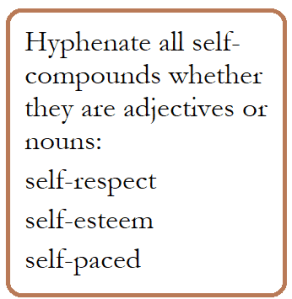
  • All “self-” compounds whether they are adjectives or nouns such as self-respect, self-esteem, self-paced.

We hyphenate words that could be misunderstood when there are diverse meanings if they’re unhyphenated:

  • re-pair (to pair again) as opposed to repair (to mend)
  • re-form (to form again) as opposed to reform (to improve)

We hyphenate words in which the prefix ends, and the base word begins with the same vowel:

  • metaanalysis
  • antiintellectual

The problem is, unless you are a technical writer, how often are we going to use those terms? Hence, the confusion when we DO use them.

Get It Write online says, “One way to decide if a hyphen is necessary is to see if the phrase might be ambiguous without it. For example, “large-print paper” might be unclear written as “large print paper” because the reader might combine “print” and “paper” as a single idea rather than combining “large” and “print.” Another such example is “English-language learners.” Without the hyphen, a reader might think we are talking about English people who are learning any language rather than people who are learners of the English language.”

A good rule to remember is most words formed with prefixes and suffixes are written as one word with NO hyphen.

Prefixes: Afterglow, extracurricular, multiphase, socioeconomic

Suffixes: Arachnophobia, wavelike, angiogram

When I am laying down prose in the first draft, my natural inclination when writing these words would be to hyphenate them, but that is wrong. My editor always kindly reminds me of this.

In the end, if you are in doubt and it’s holding up your work, go to an online dictionary to see the various ways it can be combined. Just go to:

http://www.merriam-webster.com

What it all comes down to is this—when editing for another author, I can see these things clearly. In my own work–it’s like my finger has a twitch that absolutely MUST add a hyphen to compound words that should remain separate and separates words that should be joined.

This is why the editor has an editor for her own work.


CREDITS AND ATTRIBUTIONS:

When do you need to use a hyphen for compound words? The American Psychological Association, http://www.apastyle.org/learn/faqs/when-use-hyphen.aspx accessed June 25, 2017

Compound Words: When to Hyphenate, Get It Write, Nancy Tuten and Gayle Swanson  http://www.getitwriteonline.com/archive/042703compwdshyph.htm, 2017

This article first appeared on Jun 26, 2017, as Compound Words and Hyphens by Connie J. Jasperson, © 2017 https://wp.me/p1pa44-2X5

22 Comments

Filed under writing

Goals and Rewards – the No-Punishment guide to #NaNoWriMo2020 #amwriting

Most people who undertake a first project for NaNoWriMo aren’t “career” writers. For them, it’s a hobby they must fit in around their work schedule.

When we first set out to write, we are fired up about our project, and the words flow. Unfortunately, the fire of enthusiasm burns low as time goes on, and the magnitude of the undertaking becomes apparent.

I think that to be successful as a writer, one must be obsessed with their own art. However, even many successful authors either have day jobs or a spouse whose salary pays the bills. Unless you write Romance, royalties and fat advances don’t fall from the sky except for the lucky few.

We must make time and steal time to write. When you have bills to pay and mouths to feed, there is no other way to produce a finished book.

But to be happy, one must have a balanced life. What is the point of life if you’re so busy writing about fictional lives that you aren’t present in your own?

That need to be present in my real life is why I schedule my writing time. It’s also why I reward myself for achieving my writing goals.

Some people manage to fit short bursts of writing into their daily schedule, writing at work while on break or at lunch.

Others must schedule a dedicated block of time for writing, either rising two hours before they depart for work or skipping some TV in the evening.

During my working years, I fell into both categories.

When I am gripped with a new idea, I find myself stopping wherever I am, pulling out my notebook, and noting that idea for later use.

While driving on the freeway, this isn’t possible. And that is when my best ideas all seem to occur, more’s the pity.

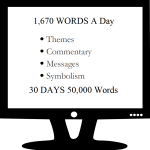
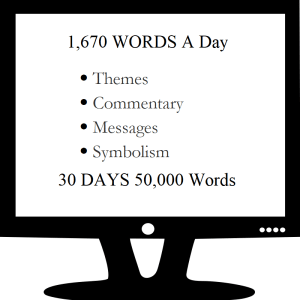
First, we must write at least 1,670 words every day (three more than is required). This takes me about 2 hours because I’m not fast at this.

I can’t stress this enough: write every day, no matter if you have an idea worth noting or not. If you are a person who needs a dedicated block of time, do it even if you have to get up at 4:00 am and don’t let anything disrupt you. On December 1st, you can reward yourself by sleeping in.

But maybe you can’t sit still for too long. Write in small increments—ten minutes here, half-an-hour there. These short bursts add up.

Perhaps your mind has gone blank. If you are stuck, write about how your day went and how you feel about life, or write that grocery list. Just write and think about where you want to take your real story.

Write about what you would like to make happen in that story. Soon, you will be writing what you intended, and everything tallies toward your daily word count goal.

Stay connected. Check in to the national threads and your regional thread to keep in contact with other writers. This is a reward that will keep you enthused about your project.

Nowadays, I fit household chores into my writing time the way I used to squeeze writing into my working life.

But we have one hard, inviolable rule in my home. Whatever else happens during the day, we sit down to the table and eat dinner together. Then we work together to clear the table and clean the kitchen, continuing any discussions that were begun during dinner.

This is a reward for all the goals each family member met that day, a pocket of time dedicated to keeping the lines of communication open and maintaining the connections that bind us.

All through “the blender years” of child-rearing, dinner at the table with the family was required. Some evenings, food was accompanied by the sarcasm of a disgruntled teenager who was angry that we couldn’t “just nuke some Hot Pockets like normal people.” Yes, they were upset, but they were there.

Balance and rewards are the keys to a happy writing life. We want to feel productive and creative, and we want to share our experiences and interests with others.

Achieving your word count goals for NaNoWriMo is a reward but enjoying your life while doing it is critical.

We who write must make time to write, allowing us to be creative and still support and cheer on our families who all have activities and interests of their own. You might find yourself sitting in the car while the children are at sports (as I have often done), but I look at that as at least an hour of undisturbed writing time.

Use it to your advantage.

To be a writer requires discipline and the ability to set aside an hour or so just for that pursuit. You deserve that pocket of time where no one is allowed to disturb you.

I used to encourage my children to use that time to indulge in their interests and artistic endeavors. They became hard workers with challenging day jobs, but with hobbies in music and the arts.

As November and NaNoWriMo progresses, writing becomes more challenging and more onerous.

It becomes work.

Rewarding yourself for achieving your word count goals is essential, especially since you won’t receive a raise or a promotion for them.

Some rewards aren’t good for us. Giving yourself permission to eat junk food as a reward can be a bad idea.

If you want junk food or chocolate, just have it and enjoy it, no strings attached. Life is too short to waste time denying yourself the small pleasures.

However, a reward like scheduling time to watch something on Netflix or a regular show you’ve been looking forward to is a good thing.

The most important thing is this: don’t punish yourself and don’t feel guilty for not making a goal one day. Simply try to make it up over the next few days.

That is what NaNoWriMo is all about. Writing, developing discipline, and feeling good about indulging your creativity.

To be happy, one must have a balanced life.

Above all, be present in your life, and be happy with what you create.

4 Comments

Filed under writing

Making the most of your writing time #writetip #nanowrimo2020

No matter where you are in the process, the act of writing daily is an important thing. Many people participate in NaNoWriMo because having a visible goal forces them to find the time to write.

I have been a Municipal Liaison for my region since 2011, and my co-ML is author Lee French. Between us, we keep the writers in our area stoked about their projects and help them get through the rough spots. In the past, we have hosted write-ins, both virtual and at libraries and coffee shops.

This year, due to the pandemic, we are going completely virtual, hosting meetups through Discord and Zoom.

As established authors, we have learned a few tricks that we’re always happy to share with those planning to “do” NaNoWriMo for the first time.

If you are just embarking on this literary joyride for the first time, here are a few quick tips and resources to help you stay organized:

Things you want to have at your fingertips, so you don’t have to stop and look it up:

MAPS: If you are writing a story set in our real world and your characters will be traveling, walking a particular city, or visiting landmarks, bookmark google maps for that area and refer back to it regularly to make sure you are writing it correctly.

If you are writing about a fantasy world and your characters will be traveling, quickly sketch a rough map. Refer back to it to ensure the town names and places remain the same from the first page to the last. Update it as new locations are added.

TECH: Many people are writing sci-fi novels. In hard sci-fi, technology and science are the central core of the stories, so it’s a good idea to know what tech is available to your characters well in advance of writing their scenes. A little planning now will aid you greatly in the writing process.

If you are writing fantasy involving magic or supernatural skills, briefly draw up a list of rules identifying who can do what with each ability. Remember:

  • Magic without rules is both impossible and creates a story with no tension. No one wants to read a story where the characters have nothing to struggle against. Working within the rules develops opportunities for growth.
  • Each character should have limits to their abilities. Because they are not individually all-powerful, they will need to interact and work with each other and the protagonist. Establishing boundaries can drive your story in some creative and unusual directions.

Looking things up on the internet can suck up an enormous amount of your writing time. Do yourself a favor and bookmark your resources well in advance, so all you have to do is click on a link to get the information you want. Then you can quickly get back to writing.

Resources to kickstart stalled creativity:

Resources to bookmark in general:

  • www.Thesaurus.Com (What’s another word that means the same as this but isn’t repetitive?)
  • Oxford Dictionary (What does this word mean? Am I using it correctly?)
  • Wikipedia (The font of all knowledge. I did not know that.)

Three websites a beginner should go to if they want instant answers about grammar, written in plain English:

Never delete, do not self-edit as you go. Don’t waste time re-reading your work. You can do all that in December when you go back to look at what you have written. If you don’t like it, change the font color or use strike-out. Those words will all count when you go to upload the manuscript, even those using the strike out. You wrote them, so count them!

Make a style sheet: If you love your sanity, make a list of all the names and words you invent as you go and update it each time you create a new one, so the spellings don’t evolve as the story does. Save this to your desktop, so all you have to do is click on the icon to open it for updating.

My co-ML Lee French and I have found that setting a goal of 1667 words a day really is the best way to meet the goal of 50,000 words by November 30th.

However, if the stress of writing that many words a day is too much, step back and write at a speed you are comfortable with.

Sure, there’s a contest full of personal goals involved. Still, NaNoWriMo is really about encouraging the act of writing and developing the discipline to set aside time to write daily.

Every word you write is essential because it gets you closer to having a book you can hold in your hand and say, “I wrote this.” By writing in short bursts whenever you have the opportunity, you will get your first draft finished.

Here is a list of earned badges we who participate hope to acquire from the national website:

  1. (this one is the easiest) Update your progress! If you want some of the later badges, do it on day 1, and then do it every day after that.
  2. Update more than once in one day!
  3. Start a streak – update two days in a row (do you see a pattern here?)
  4. Update 3 days in a row!
  5. Update 7 days in a row.
  6. Update 14 days in a row.
  7. Update 21 days in a row.
  8. Update 30 days in a row (our personal favorite!)
  9. Achieve par every day (1667 words) (difficult, but doable).
  10. Update at precisely 1667 words (fun!)
  11. Reach 5 k words.
  12. Reach 10 k words.
  13. Reach 25 k words.
  14. Reach 40 k words.
  15. Reach 50 k words by November 30th!
  16. Download that winner’s certificate!

Some years I write words like a fountain spews water and write two novels worth of words.

In other years, every word is torn from my keyboard, accompanied by the howling of banshees. During those years, I can barely make my word count.

For me, the most important thing is having my project that much closer to completion.

If you choose to embark on this project, make that your goal. Write because you have a story burning to be told, and have fun doing it.

3 Comments

Filed under writing

#FineArtFriday: The Gust by Willem van de Velde the Younger ca. 1680

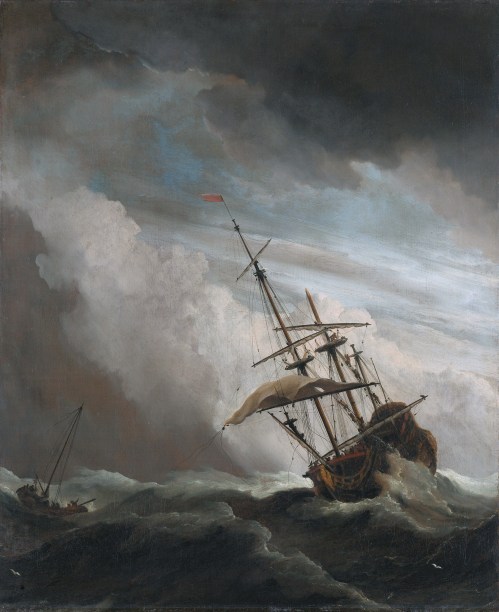
Title: De Windstoot (English: The Gust) by Willem van de Velde the Younger

Artist: Willem van de Velde the Younger  (1633–1707)

Genre: marine art. Description: A ship in high seas in a heavy storm. A three-masted ship on a high wave. To the left a smaller vessel.

Date: Circa 1680

Medium: oil on canvas

Dimensions: Height: 77 cm (30.3 in); Width: 63.5 cm (25 in)

Collection: Rijksmuseum

What I love about this painting:

Willem van de Velde the Younger captured the emotion of  a terrifying day at sea. Darkness in the middle of the day, the wild seas, raging winds–this ship is at the mercy of mountainous waves.

The storm hit suddenly, catching the ship before all the sails could be reefed. The force of the gale is such that the wind in the unfurled sail could capsize the ship. At the very least, they’ve most likely lost that sail.

Will those sailors make it back to port?

We can only hope.


Credits and Attributions:

De Windstoot (English: The Gust) by Willem van de Velde the Younger, Public domain, via Wikimedia Commons 1707.

Wikimedia Commons contributors, “File:De Windstoot – A ship in need in a raging storm (Willem van de Velde II, 1707).jpg,” Wikimedia Commons, the free media repository, https://commons.wikimedia.org/w/index.php?title=File:De_Windstoot_-_A_ship_in_need_in_a_raging_storm_(Willem_van_de_Velde_II,_1707).jpg&oldid=387246804 (accessed October 23, 2020).

Comments Off on #FineArtFriday: The Gust by Willem van de Velde the Younger ca. 1680

Filed under writing

Theme, Discipline, and Drabbles, warmup for  #NaNaNoWriMo2020 #amwriting

November, also known as National Novel Writing Month, is racing toward us. If you are planning to participate, it’s a good idea to give your project a working title.

Some even go so far as to write the first sentence and then leave the rest blank. That way, the project is waiting for them to dive into on November 1st.

Most authors have a difficult time churning out 1667 words a day, so not everyone is cut out to participate in this writing rumble. However, you don’t have to officially sign up. You can set your self a daily goal of 100 – 300 or more new words a day and try to accomplish that.

You never know what you will come up with.

I think of writing as a muscle of sorts, working the way all other muscles do. We’re healthiest when we exercise regularly.

Writing daily is easier once it becomes a behavioral habit

A little practice in advance helps. The more frequently you write, the more confident you become. Spending a small amount of time writing every day is crucial. It develops discipline, and if you want to succeed in your goal for NaNoWriMo, personal discipline is essential.

Trust me, it is not asking too much for you to have some time every day that is sacred and dedicated to writing.

On a personal level, you must decide what is most meaningful to you. Is your dream of writing that novel important? Or do you choose to watch a television show that is the result of someone else’s dream? This is a choice only you can make.

Suppose you are planning to write a novel in November. In that case, writing random short scenes and vignettes is a good way to develop that world in advance. This is also a good opportunity to create the characters you will put to paper on November 1st.

In writing these scenes, you have the chance to identify the themes and subthemes you hope to explore during NaNoWriMo. Theme is different from the subject of a work. As an example that most people know of, the subject of Star Wars is “the battle for control of the galaxy between the Galactic Empire and the Rebel Alliance.”

The themes explored in those films might be “moral ambiguity” or “the conflict between technology and nature.”

At some point, you might become brave enough to submit your work to a magazine or anthology. When you choose to submit to an open call for themed work, your work must demonstrate your understanding of what is meant by the word ‘theme’ as well as your ability to craft clean and compelling prose.

For practice, try picking a theme and thinking creatively. Think a little wide of the obvious tropes (genre-specific, commonly used plot devices and archetypes). Look for an original angle that will play well to that theme, and then go for it.

Most of my own novels have been epic or medieval fantasy, based around the hero’s journey, detailing how their experiences shape the characters’ reactions and personal growth. The hero’s journey is a theme that allows me to employ the sub-themes of brother/sisterhood and love of family.

These concepts are heavily featured in the books that inspired me, and so they find their way into my writing.

To support the theme, you must layer

  • character studies
  • allegory
  • imagery

These three layers must all be driven by the central theme and advance the story arc. A way to get a grip on these concepts for your NaNo Novel is to do a little advance writing that explores your intended theme. Think of it as a bit of literary mind-wandering.

Some of the best work I’ve ever read was in the form of extremely short stories. Authors grow in the craft and gain different perspectives when they write short stories and essays. Each short piece that you write increases your ability to tell a story with minimal exposition.

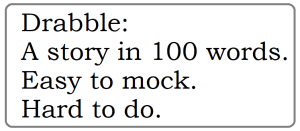
This is especially true if you write the occasional drabble—a whole story in 100 words or less. These practice shorts serve several purposes, but most importantly they grow your habit of writing new words every day.

Writing such short fiction forces the author to develop an economy of words. You have a finite number of words to tell what happened, so only the most crucial information will fit within that space.

Writing drabbles means you have a limited amount of space, so your narrative will be limited to one or two characters. There is no room for anything that does not advance the plot or affect the story’s outcome.

The internet is rife with contests for drabbles, some offering cash prizes. A side-effect of building a backlog of short stories is the supply of ready-made characters and premade settings you have to draw on when you need a longer story to submit to a contest.

Writing a 100-word story takes less time than writing a 3,000-word story, but all writing is a time commitment. When writing a drabble, you can expect to spend an hour or more getting it to fit within the 100-word constraint.

To write a drabble, we need the same basic components as we do for a longer story:

  1. A setting
  2. One or more characters
  3. A conflict
  4. A resolution.

First, we need a prompt, a jumping-off point. We have 100 words to write a scene that tells the entire story of a moment in a character’s life.

Some contests give whole sentences for prompts, others offer one word, and still others no prompt at all.

A prompt is a word or visual image that kick starts the story in your head. If you need an idea, go to 700+ Weekly Writing Prompts.

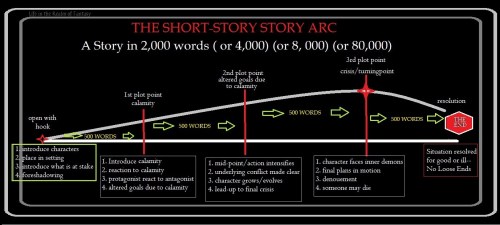
In a previous post on writing short stories, I showed how I use a loose outline to break short stories into acts. I’ve included that graphic at the bottom of this post.

A drabble works the same way.

We break down the word count to make the story arc work for us. We have about 25 words to open the story and set the scene, about 50 – 60 for the heart of the story, and 10 – 25 words to conclude it.

Info dumps about character history and side trails to nowhere have no place in short stories. However, they do make useful background files for your world-building and character development.

When you write to a strict word count limit, every word is precious and must be used to the greatest effect. By shaving away the unneeded info in the short story, the author has more room to expand on the story’s theme and how it supports the plot.

Save your drabbles and short scenes in a clearly labeled file for later use. Each one has the potential to be a springboard for writing a longer work or for submission to a drabble contest in its proto form.

Spend an hour to get that idea and emotion down before you forget it. The completed scene is a small gift you give yourself.

Whether you choose to submit a drabble to a contest or hang on to it doesn’t matter. Either way, the act of writing a drabble hones your skills, and you will have captured the emotion and ambiance of the brilliant idea.

Good drabbles are the distilled essences of novels. They contain everything the reader needs to know about that moment and fills them with curiosity to learn what happened next.

That is what true writing is about.


3 Comments

Filed under writing

Jump-starting #NaNoWriMo2020 #amwriting

I have been a Municipal Liaison for NaNoWriMo since 2012. I started participating in this annual writing rumble in 2010. I  found myself taking the lead as the unofficial ML for my region in 2011 when our previous ML didn’t return. Organizing write-ins, cheering on my fellow writers—I didn’t know how it all worked. But it was a lot of fun, and I became close friends with a fantastic group of writers.

Over the years, I have learned many tricks to help people get a jump on their NaNoWriMo project.

Most writers will start an entirely new project. Some have an outline, others are flying blind, or in author speak, “pantsing it.”

Other writers will continue writing the first draft of an unfinished work-in-progress. On November first, they write all the new work in a separate manuscript that is for NaNoWriMo validation purposes.

This year I have several projects. One will be to write the final chapters of Bleakbourne on Heath, a novel that began life in 2015 as a weekly serial. I have the outline all written for that, and the ending is now firmly established. Finishing that should cover about 20,000 – to 25,000 words.

My second project is for my new duology set in Neveyah. I need to write the chapters that show my antagonist’s storyline. They are also outlined now, and when Bleakbourne is finished, I will move on to the Aeoven Cycle.

I also have three short stories and a novella to fill in on those days when I can’t focus on the tasks at hand, so I will have plenty to keep my mind churning.

Several years came where I had no novel-length ideas. For those years I wrote collections of short stories to submit to magazines and contests.

But what if you think you have no ideas worth writing?

Feel free to look on the internet for writing prompts.

Don’t let your flashes of inspiration slip into oblivion. Write them down and use them. A pre-prepared list of prompts can stimulate any number of projects. It’s like an “extra brain,” full of ideas to jump-start a short story.

Great novels all begin with a random idea, a “what if,” so I save this document to my computer’s desktop. It’s nothing fancy, just a list of ideas and one-liners that seemed interesting.

You could use sticky notes or a pencil and paper, but the important thing is to not forget them.

Whenever I don’t have a specific project to write on, I go to that list, select a prompt, and start writing. I write new words on that idea for fifteen minutes.

Often, I end up with a drabble or a poem to show for my fifteen minutes. Other times, what I produce is not worth much, but the act of writing new words is essential.

It trains your brain to think like a writer.

The following are some of my favorite prompts:

  • Edgar always said there was no place for pansies in this war. His preferred weapon was a dahlia.
  • Dogs and little children hated Winston. The rest of us merely despised him.
  • Death is the one thing you can take with you, and Sheila Harris was packed up and ready to go.
  • The body in the trunk of Edna’s car had become a real inconvenience.

Another trick to both jump-starting and finishing a NaNo Novel is to write the last chapter first. Then set it aside in a separate document from the NaNo Manuscript, and write the story to that moment.

Yes—it’s true. I wrote my first NaNoWriMo novel by writing the last chapter first and then wondering how the characters had gotten to that point, that place.

Once I knew how the book ended, I could write 60,000 to 70,000 words to connect up to that final denouement.

The original premise: An old man returns to a town that was the scene of his most treasured memories.

The book opens when he is a young man and takes him through grand love affairs and miserable failures. My soul was on fire with that book, and I couldn’t think of anything else.

Julian Lackland had a rough journey but was published this year.

Julian Lackland @ Books2Read

Julian Lackland @ Amazon

Julian wasn’t my first novel, but it was the first one I had completed. If you don’t finish your projects, the world will never read your work.

NaNoWriMo has shown me that writing prompts are an excellent tool that we can use to jump-start our imaginations. The Writer’s Digest website has an excellent post dedicated to writing prompts:

Creative Writing Prompts

If you want to practice writing something but can’t think of what, take a look and see if something interests you.  No two people are alike, so don’t be afraid to use a prompt from a popular site like Writer’s Digest. The way you go with it will be as unique and individual as you are.

Every day, things occur that I think would make such good magazine articles, and November is a great month to write them.

  • A spring day at the Olympia Farmer’s Market (one of the largest on the west coast).
  • The story of a mentally ill homeless woman whom I met on a rainy day.
  • A road trip down Washington State Route 105 from Westport to Raymond, and the ghostly, nearly abandoned coastal towns of rural Washington State.

So many random ideas and so little time to write those stories! That is why November and participating in NaNoWriMo has become so precious to me.

1 Comment

Filed under writing

The Antagonist’s Story Arc – part 2 #amwriting #nanowrimo2020

In Monday’s post, The Antagonist’s Story Arc, I explained how I organized my notes for each book or series using a workbook from a spreadsheet program, such as Excel or Google Sheets. Today I am continuing to plot out the opposition’s story arc to dovetail with what has already been established in the protagonist’s storyline.

So now, I go back to the notes on my protagonist, Alf, and look at my calendar of events. What clues have I inserted about the antagonist, Daryk, from Alf’s point of view? I need to make sure those are noted on Daryk’s timeline.

At this point, Daryk is only partially formed in my mind. I see him as he was before he triggered the mage trap, which is how Alf sees him. Daryk was a close companion, a canny adversary in any competition, and especially at the game of stones. He was a dedicated Sword of Aeos, deeply committed to rooting out the Bull God’s secret covens. Strategy and battle tactics were second nature to him. His best skill was how well prepared he was for every turn of events. He and Alf had worked together successfully since becoming hunters.

Alf only wants to remember him that way but knows he will be forced into a direct confrontation at some point. I have written the book’s opening chapter, where the event that changes everything occurs.

Since NaNoWriMo ended last year, I’ve gotten the first draft of most of Alf’s story arc written to the point where these two characters must face their destinies.

But only the protagonist has been fleshed out.

One thing that occurred to hold up this aspect of the first draft was the protracted illness and death of my good friend and structural editor, Dave Cantrell. Dave was an integral part of my writing posse, giving me the male perspective, which helped to round out my characters.

Now I need to decide how many chapters will be devoted to Daryk, and what events are important enough to be highlighted from his view. First, I need to identify his quest.

In a good novel, characters aren’t evil for no reason. Perhaps what the protagonist perceives as evil is merely a radically different way of living, a cultural difference. Or maybe they’re under pressure from some external force. In Daryk’s case, it is both.

While battling a mindbender and his coven, Daryk is separated from the Swords of Aeos. He enters the enemy’s altar room and finds a statue cut from amethyst crystal. This is a trap set to snare mages serving Aeos, Goddess of Hearth and Home.

The moment he touches it, Tauron, the Bull God, seizes Daryk’s mind. No mere mortal can withstand the personal attention of a god, and Daryk is now set on a collision path with destiny. Tauron is the God of War, jealous, paranoid, and insecure. He demands abject worship, extreme sacrifices, and harshly punishes those who fail. Success is rewarded richly, and the strongest rise to the top to rule over the weak.

Steeped in the lore of his warrior culture, Daryk is easily bent to the Bull God’s path. He is now convinced that he is the rightful heir to be the War Leader. He sees Alf as serving a weak and feeble deity, and that the tribes have lost their strength. His goal is to seize power and use the tribes to conquer Neveyah for the Bull God.

Tauron gives Daryk new gifts, one of which is the ability to sway large gatherings of people. Since he has no empathic magic, he needs to find and snare an empathically gifted healer to project his compulsions.

To do this, Daryk must accomplish several things from the outset:

  1. He must find the crystal cave and undertake a vision quest. The Bull God doesn’t know how Barbarian shamans are trained, so this quest is very different. The high trial Alf undertakes is vastly different from his first shamanic quest. Daryk was not trained to be a shaman, so he doesn’t know what the true trial entails. Since only the strongest are fit to rule, the test the Bull God sets before him is a much darker journey, one of overcoming and bending demons to his will.
  2. Having survived the trial, his first task is to find an empathically gifted healer and bind her to him. He uses Helene to project his spells of compelling and takes over her village to make his small army.
  3. Daryk needs a base of operations, so he must acquire a citadel. He and his new wife go to a lesser known place, Kyrano, as it isn’t somewhere Alf would look for him. Using compulsions to present themselves as distant relatives and charming the elderly baron, they are officially named his heirs. The old man dies that night in his sleep.
  4. Daryk needs to conceal the fact he is a rogue-mage, or he will have enemies on all sides, and he isn’t ready for that yet. He acquires a coven of elemental mages, binding them to him and using them to have a greater chi reserve to draw on when casting spells. They conceal from the population at large the fact that their new baron is a rogue mage.
  5. He must gather the resources to lay siege on Aeoven. Everything is at stake here: if he can’t defeat Alf on his home turf, Daryk will never bring Neveyah to the Bull God.

By charting his story arc, I’m laying the framework for what I will begin writing in November. Those weeks will be spent writing backstory and building Daryk’s world. I will connect Daryk’s timeline to Alf’s.

This kind of work is mind wandering, in a way. By writing this out, I am cementing Daryk and Helene’s characters and passionate commitment to their struggle in my mind.

Certain scenes showing critical information that Alf doesn’t have will be included in the final draft, but only those essential to the advancement of the plot. This is so the reader knows what is happening in the enemy’s camp.

For the reader, this knowledge raises the tension. Daryk must be shown to have a stronger position and better resources.

I intend to write about 30,000 words detailing Daryk’s story. Little of what I write will find its way into the final manuscript. My hope is that it will be there in how solidly I show these characters, their deities, and why they do what they must.

1 Comment

Filed under writing

The Antagonist’s Story Arc #amwriting #nanowrimo2020

We’re already approaching the middle of October. This is prime NaNo prep season for me. A few weeks ago, I shared that one of my projects was writing the final chapters to Bleakbourne on Heath, a novel that began life in 2015 as a weekly serial. I have the outline all written for that, and the ending is now firmly established. Finishing that should cover about 20,000 – to 25,000 words.

My second project is for my new duology set in Neveyah. I need to write the chapters that show my antagonist’s storyline. For my protagonist’s story to make sense and be compelling, I must show why my antagonist opposes Alf, and why we should have compassion for him and his struggle.

To that end, I must spend the next few days outlining what needs to happen for him at each point in the overall two-book story arc.

I also have three short stories and a novella to fill in on those days when I can’t focus on the tasks at hand, so I’ll be well set up with ideas.

So, let’s take a look at what I have to accomplish on Heaven’s Altar before November 1st.

The first hurdle I must leap is a trap of my own devising.

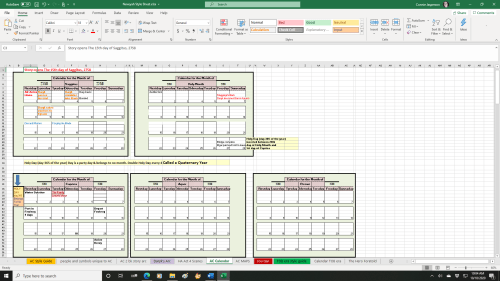
The calendar.

Neveyah Calendar © 2015 Connie J. Jasperson

In 2008 when we were designing the world of Neveyah as an RPG and before the story had been written, I had the bright idea to make a calendar where each month has

  1. 28 days
  2. The months are named after astrological signs and the days are sort of named like the Julian calendar.
  3. The 13th month is called Holy Month and is between Harvest and winter, but belongs to no season. It’s set aside for religious observances and family events.
  4. The 365th day of the year falls on the Winter Solstice and is called Holy Day. A day of feasting, it stands alone between Holy Month and Caprica, the first month of the new year. Every 4 years you have a double Holy Day, and the community throws a big party.

Was I out of my mind?

Yes! I suggest you stick to the common Julian calendar we know today, as it makes things a lot easier for you.

However, six books later, it’s canon in that world, so I have to roll with it. Fortunately, I was smart enough to make a visual calendar in an Excel workbook. I can cut and paste easily, note changes, and move events around if need be. This workbook covers all of the books set in the Tower of Bones world of Neveyah.

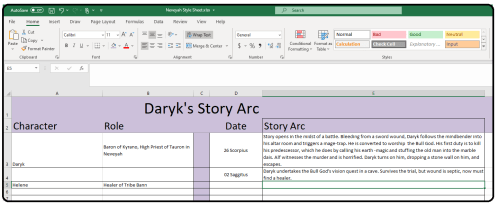
I was a bookkeeper for many years, so I use an Excel workbook to keep the stylesheet, plot outline, pertinent back history, and worldbuilding in one logical place. The tabs across the bottom show the different sheets detailing each aspect I need know for that world and that story.

I do this for every project or series, and you can do the same. If you don’t have Excel, you can use any free spread-sheeting program, such as Google Sheets. It’s just a visual way to keep things organized and avoid introducing conflicting elements.

The process of writing out my antagonist’s storyline is essential. At the outset, from Alf’s storyline, we know that Daryk has powerful earth-magic. However, Tauron, the Bull God, gives him new gifts, one of which is called “compelling.” Since he has no empathic magic, he needs to find and snare an empathically gifted healer to project his compulsions. He also needs to enslave a coven of elemental mages to have a greater chi reserve to draw on when casting spells.

So, there are five people with whom he has close relationships and conversations. The backstory of each of these characters must be created and added to both Daryk’s storyline and the overall cast of characters.

This is so I don’t inadvertently give two characters the same (or ludicrously similar) name.

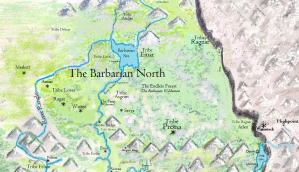
I have already designed the magic systems for both sides of this conflict, and the world has been established. I have comprehensive maps that I use in conjunction with the calendar for plotting my events.

I’m fallible, but I do try to take everything into account when plotting my events. This way, when I begin writing I can concentrate on laying down the opposition’s story as if he were the hero and maybe generate a little sympathy for him.

4 Comments

Filed under writing

Thoughts on narrative perspective part 2: closeup on the antagonist #amwriting

For scriptwriters, the closeup is an essential aspect of pacing. It focuses on one character and shows us details about them and their role that they (the characters) might not be aware of. This importance transfers over to how we show scenes in our written narratives. To get the most out of our words, we who write stories must frame our scenes the way scriptwriters do theirs.

We vary the narrative distance, which is our best tool to show humanity in our characters. The wide view shows the protagonist and their companions as they move through their environment.

Then we narrow the focus, perhaps take it down to a conversation between two people. One person drops out of the conversation, and we are left with the closeup view of our protagonist.

At our closest to them, we are in their heads. We hear their mental ruminations in real-time. By listening to this voice, the reader sees what the characters believe is at stake and how weak or strong they consider their position.

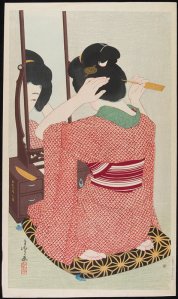
When we are drawn into a character’s head, we view them through the mirror in which they see themselves.

What we, as authors, have to consider is how that mirror is distorted. Never forget that all self-reflections are skewed, often to the positive, but usually toward the negative. We see flaws in ourselves that no one else does, so we don’t usually see ourselves as heroes.

This is because we subconsciously compare ourselves to others. We observe their abilities and are acutely aware of our own vulnerabilities in comparison. So, we strive to better ourselves.

Through manipulating the narrative distance, the author shows how the protagonist regards their companions, and what kind of people they are.

Sometimes, it raises the stakes if the author writes a chapter focusing on the antagonist. Take this opportunity to show us who the antagonist sees when they gaze into the mirror of self-reflection. Since nothing happens without a root cause, we can learn why they oppose the protagonist, and what their strengths are.

Now here is where we can make things interesting. What if the antagonist isn’t trying to be wicked? What if they are fighting for what they believe is the right thing? What if, in their view, they are the heroes who have the moral high ground?

Think of how much evil has come out of civil wars in humanity’s history. Then consider how firmly the opposite sides believed in their moral superiority, and what was lost or gained in the end. All interpersonal disputes are wars, just on a lesser scale.

How will you choose to show this on a smaller, personal level? The closeup shows us who the antagonist believes they are and why they have the right to oppose the protagonist.

Sometimes, if the writer shows little sympathy for the devil, it raises the emotional stakes.

Readers want to understand why the action is happening. Both sides need an opportunity to explore what they perceive as the conflict’s fundamental cause.

Authors show this through internal dialogue, moving out to a broader view with conversations, and expanding again to an external narrative.

As a reader, having hints of what is at stake for the opposition makes me care about the outcome. With the relationship established, we can widen the picture and show what is at stake for both sides. I want to feel a little compassion, or if not that, I want to understand how failing will change the losers’ lives.

Good pacing of narrative distance—moving in close, then widening out, and then moving back in—adds emotional power to the story. This tempo allows the reader to process the information and action at the same time as the characters.

Keep the stakes high and the emotions intense, and I will stay immersed in that book.


Credits and Attributions:

Wikimedia Commons contributors, “File:Before the Mirror.jpg,” Wikimedia Commons, the free media repository, https://commons.wikimedia.org/w/index.php?title=File:Before_the_Mirror.jpg&oldid=462235289 (accessed October 6, 2020).

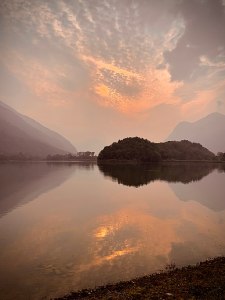
Wikimedia Commons contributors, “File:Mirror of the souls.jpg,” Wikimedia Commons, the free media repository, https://commons.wikimedia.org/w/index.php?title=File:Mirror_of_the_souls.jpg&oldid=478982509 (accessed October 6, 2020).

7 Comments

Filed under writing