Category Archives: writing

Life is a river #amwriting

Most people have struggled in their personal life at one time or another. During the years I was raising my children, I had three failed marriages, worked three part-time jobs, and it was hard to find time to write.

We came through the lean times as a tight-knit family. But I think of life as being like a river, because you never know what is around the bend. By the time my last chick left the nest, I had gained financial security, but a new difficulty arose.

Two of my children developed adult onset epilepsy, a complication which has made our comfortable life… interesting.

When you look at the statistics detailing the age of all patients at the time of their first seizure, the number of those whose first documented seizure occurs after reaching adulthood is far higher than those who experience it as children.

Yet little research has been done to document the experience of living with a seizure disorder as an adult.

They once lived their lives the way normal adults do. They used to be able to legally drive a car without endangering other people, to say nothing of themselves. They didn’t have to worry that a short flight of stairs could kill them or that cooking their breakfast could send them to a long stay in the burn unit.

There is anger, confusion. Why me? What did I do wrong? What can I change? There is even denial–it can’t be epilepsy; it’s never going to happen again.

The truth is, no one knows what causes most forms of epilepsy, and each patient responds to the medications differently. And every well-meaning auntie in the universe has sage advice to offer, despite not having any experience with it. “Try marijuana.” “Go on a Keto diet.” These are effective treatments for some people, but not for everyone, and not my son or daughter.

There is no miracle drug or diet out there at this time.

Epilepsy is not a poster-child kind of disease, so funding for research is limited. At this point, because the cause is rarely knowable, all the medical community can do is offer drugs to control the symptoms. Most times, seizure disorders are not operable, unless it is a tumor or some other obvious thing. When you look at the wide spectrum of patients with adult onset, you see those “easy-to-find with an MRI” causes are quite rare.

Many, like my son, are never quite able to get it under control, and it affects their jobs, their relationships, and their ability to live a fully independent life.

Others, like my daughter, go many years between seizures, and their lives are mostly unaffected by it. She has her own business, volunteers at her son’s school and is also the co-chairwoman of the PTA there.

Both of my children have suffered terrible injuries during seizure episodes. Both have spent time in the hospital, had to have surgeries to repair wounds incurred, and no one has ever been able to find the cause of their seizures.

Writing has been an escape that kept me sane when nothing was certain except my daughter and son were in terrible trouble, and the doctors didn’t know why and couldn’t cure it. The medical community wants to cure it, but the way this condition affects each sufferer is different, which frustrates the doctors as much as the patients.

For many people, after they have a large seizure event, there is a post-seizure stage where they suffer an altered state of consciousness. This can be dangerous if they are alone. They’re locked in a dream and make no sense when they speak. As they begin to come out of that stage, they’re unable to think clearly, can’t focus their attention or follow a conversation. This altered state is like sleepwalking and sleep-talking, which is why it’s dangerous. As they move out of this stage, they will also have problems with short term memory, and may have decreased verbal and interactive skills.

Fortunately, that is a temporary thing, lasting only one or two hour for some, but it can go one or two days for my son. After recovering from that stage, it still takes about two weeks for my son to get back to where he can think clearly enough to work on whatever project he is doing. He can’t be alone then, but  between his wonderful girlfriend and I, we care for him until he can be on his own again.

This post-seizure state cost my son his long-time job (ten years) as a software developer at Amazon and made it difficult for him to find work elsewhere. Most employers can’t accommodate an employee who is randomly unable to work for two weeks, two or three times a year.

After a time of intense depression and searching for answers that don’t exist, my son decided to be proactive. He started his own company, doing what he loves. He is now writing his own software and apps and is his own boss so he can work around his situation.

We could allow this epilepsy thing to overshadow our every waking moment, but that would change nothing. Research, they say, is ongoing, but nothing has changed treatment-wise since my daughter’s first seizure at the age of twenty-eight—sixteen years ago. My children still sometimes have seizures, and we have learned to laugh and enjoy our life despite the occasional setback.

The hours spent in hospitals as my son or daughter recovered from injuries incurred during a seizure helped forge my writing. Life is what happens when we aren’t on that merry-go-round, and other than that, our lives are good.

Life is a journey, and you never know what lies around the corner, but a sense of humor can be a solace when nothing else is. Wikipedia, the fount of all knowledge, says: Gallows humor has the social effect of strengthening the morale of the oppressed and undermines the morale of the oppressors. According to Wylie Sypher, “to be able to laugh at evil and error means we have surmounted them.”

Laughing and making crude jokes about the situation is how we survive the chaos and fear—it is what gets us through to the better days that wait just beyond the battle. Life can deal us a hand full of the worst cards, and epilepsy is not the end of the world.

My father’s career in the military ended when he lost his left leg as a result of a bone infection–he was forced into retirement after 15 years of service. While he was in the hospital, his family lost everything when their farm burned to the ground. He had survived WWII, but lost his brother in Korea. Yet despite what he had been through in France and the losses on the home front, he had a wicked sense of humor and an enormous passion for life.

Other people inspire me to avoid self-pity. I have two writing companions, one here in Washington state and one in California. Both are paralyzed, life changing events that would be devastating to any family. Yet they made it through the dark days and live every day to the fullest. Both have wonderful laughs, both make me feel weak in the face of their power and self-determination.

Loss of limbs, loss of physical independence, loss of loved ones, loss of jobs, loss of dignity, loss of face—we all deal with loss and hard times in one way or another.

But in between those rough times, we have times of happiness and joy, forgetting the pain and anger for a moment. Those are the precious hours we have earned, and they are the real life we are given.

Life is a river. What the river has taken is gone, and we can’t get it back, but the currents are carrying us in a different direction, to new shores. Yes, we must adapt to these changes, but that is what humans do.

My life is good today, and easy as compared to last summer. “Easy” won’t always be the case, so I am enjoying it while I have it. Life is always in a state of change, and when I next find myself in the midst of chaos and pain, I will try to think of the good things I still have, and I will find a way to be grateful.

We none of us know what the future holds—all we can ever really be sure of is this moment, this minute, and this beautiful day.


Credits and Attributions:

Wikipedia contributors, “Gallows humor,” Wikipedia, The Free Encyclopediahttps://en.wikipedia.org/w/index.php?title=Gallows_humor&oldid=759474185     (accessed  July 22, 2018).

8 Comments

Filed under Epilepsy, writing

Carving time for #writing

Time management is crucial for me. I don’t claim to be a great housekeeper, but I do need some order in my home, so it gets one hour of my attention. Laundry, dishes, dusting, picking up—one hour is all housekeeping gets. Period.

I have developed mad skills at carving out time for writing because every November, I participate in NaNoWriMo. As a municipal liaison for the Olympia area, I must get a minimum of 1,667 new words written each day. I usually average 3,000 to 5,000 words per day during that month. The rest of the year? 500 to 1,100.

I do this by having my daily prompts all set out in advance, and then I lock myself into my office and just wing it for at least two hours. Some of what emerges is good, and some, not so much. But it is an exercise in stream-of-consciousness writing at its most extreme, and it’s a good challenge for my elderly brain. Some of my better work was produced in its raw form during NaNoWriMo.

During the 1990’s, when I was working two jobs, I wrote every evening while my kids did their homework. Some nights I didn’t get a lot of words written, but many nights I did. Some days I wrote during my lunch half-hour. Countless afternoons were spent sitting in the car waiting for one of the kids to finish their after school activities, and I wrote then.

Every half-hour I spent writing was a gift in those days.

After the kids were out of the nest, I still wrote every night. I missed a lot of TV that way, but I had to choose what was important, and writing won.

Now I’m retired and write full-time. One of the most difficult parts of being a full-time author is the fact that we “work from home.” This means we’re on call at all times for any family emergency. It’s difficult for people to believe you are working if there is no tangible, visible reward such as a paycheck for your efforts.

However, once people can see that, yes, books have been published, they know that you really do write. But often, people still don’t understand how much time it takes to do this sort of work properly, or how difficult it is to get back into the writing mind after an interruption.

Time management comes into play for me because authors, both traditional and Indie, must be their own public relations team. I am very bad at this, but I use every automated assist available to me for that—Hootsuite has been a great help to me in scheduling tweets on my non-blogging days so that I don’t fade completely out of the Twitterverse. I care about that because much of my traffic here to this blog comes from Twitter.

WordPress’s “Publicize” tool is a real help. Thanks to that tool, this blog posts automatically to Twitter, Tumblr, LinkedIn, and my author Facebook page. I also went out to Amazon’s author central and linked it to my Amazon author page. I keep forgetting to post it to my Goodreads page because I don’t like the climate there and rarely visit that strange place. One of my other blogs posts there—a book review blog.

Of course, time management occasionally flies out the window. I drop everything to go sit with my grandkids, who all live a two- to three-hour drive away, or to help when a family member is dealing with difficult times. I have two kids with epilepsy, so difficult times happen with no warning.

But we handle those episodes and I keep writing because my laptop travels with me. Writing is my refuge, at times. But when life is uncomplicated and going well, writing is still my great joy, and the time I have to write is really important to me on a personal level.

Life in all its random glory is why good time management is so important for me. I schedule my writing time now that I am retired just as I did when I was working in Corporate America. If I didn’t, life’s little demands would eat away at my ability to just sit down and write.

After I finish editing on Sunday morning, I open Hootsuite and preschedule a week’s worth of random tweets on vegan food, favorite books, life observations, etc., which takes about ten minutes. Then I write at least one blog post, but usually, I write all the posts for the week. Being able to preschedule everything takes much of the work out of this gig.

I do any editing I may have for clients first thing in the morning. After editing, I get that one hour of housekeeping in. If you go fast enough, you actually get a good workout—dusting and vacuuming can be quite invigorating when done at top speed. Laundry looks a little haphazard when folded that quickly, but hey—once it’s shoved in the closet, who’s gonna notice?

Once I have put in my one hour of housekeeping, I put on my writing music, and that is my time to get some writing done. This time is inviolable—God help the neighbor who interrupts me to borrow an ax—they might get it, but not the way they hoped.

(Bad author! Bad! Bad!)

(No neighbors were harmed in the writing of this blogpost.)

7 Comments

Filed under writing

Disagreement, Dispute, and Combat #amwriting

In many books, the characters are forced to do a certain amount of fighting, whether it is a marital dispute, neighborhood quarrel, war, or a kickboxing tournament. Unfortunately, some authors don’t understand how important it is to choreograph the scenes of disagreement and disputes.

These scenes are crucial to the advancement of the story. They should be carefully planned and inserted into the novel as if one were staging a pivotal scene in a film.

Scenes involving physical action can be a morass of mindless mayhem, if  not well-choreographed to begin with. It takes time, but over the course of several hours, you can put the skeleton of your fight scene on paper. What is physically possible and what is not? The next step, after the action is laid down, is fine tuning it, so the reactions and responses of your characters are natural and real.

But there is a larger consideration for your battle: Scenes involving fighting are controlled chaos—controlled on the part of the author. The battle must advance the story.  Why did it happen? What is the purpose of injecting that conflict into the narrative?

I mentioned this in my last post on literary violence: In Billy Ninefingers, besides the obvious fact that he is seriously injured in the fight, which is the core plot point of the book, I had two other goals with that fight scene:

  1. I needed to show how the Bastard is jealous and acts on any thought that passes through his alcohol-soaked mind.
  2. In the resolution of that scene, I demonstrated that Billy, even with his life in ruins, has a sense of fair-play.

There are two sorts of fights, verbal and physical. Both have commonalities, although words are the weapons  in the verbal dispute.

Many authors get hung up on the technical side of the fight—how they were dressed, who hit who with what words or weapons, and so on.

Just as if the physical dispute were a verbal dispute, we map the violence out as we would a journey, with every slap, curse word, and gunshot occurring at its proper point in the melee. If physical violence is involved and you are not a martial arts aficionado or a weapons specialist, these are necessary elements of the combat scene that good, responsible research and an author’s diligence can resolve.

What we have to consider in each quarrel is that each character in the fight is, and must remain, a unique individual. There should be no blurring of personalities, which can happen when an author focuses too intently on the action of the fight scene, writing it as if they lived it. For the author, acting out the action ensures that the moves are reasonable and make sense, but you aren’t done writing that scene just because the hacking, slashing, and gunshots are on paper. It’s far too easy for the author’s voice to intrude in these scenes, as the author is so wrapped up in the emotion of the event they don’t see that the characters have fallen silent, and he is the one doing all the shouting.

If the dispute is verbal, the words hurled back and forth must be the words that character would use. Each character has habitual mannerisms. In real life, they wouldn’t all react the same way, so they can’t all be superheroes in your fight scene. You must go back to the first part of that section, and make sure you haven’t lost the individuality of the characters in the chaos. Each character’s reactions must be portrayed in the action sequence in such a way the reader doesn’t say, “He wouldn’t do that.”

I try to show this in small, unobtrusive ways by sitting back and visualizing the scene after the choreography is laid on paper. I replay it in my mind as if I were a witness to the events and look for the facial expressions and reactions of each combatant.

The most important reactions get briefly mentioned in the story, the reactions that push the plot forward. The others are witnessed but given less prominence, becoming part of the scenery.

When I choreograph a fight, I think of it as choreographing a conversation. In real life, people miss a few beats when they are speaking. They gather their thoughts and speak in short bursts. They shift in their chair, or stand up, or wave a hand to emphasize a point. They turn and sometimes mumble. In our literary conversations, we want to paint the impression of their individuality without boring the reader with minute details.

We must approach the fight scene the same way. When it comes to fighting, I keep it concise and linear, as drawn-out fight scenes bore me to tears. Just the facts, the immediate emotional impact, and we move on to the recovery scene.

In so many novels, battle scenes are long, drawn out, convoluted passages detailing blood and guts, but which make no sense. I don’t like books where the fights are senseless and too chaotic to follow, because I know that isn’t true to life. Violence is orderly and happens in a sequence of actions, within a fundamental framework of order.

I have been married four times, so trust me, I understand disputes and how they can escalate out of control. But I also have personal experience with physical violence. I played hockey for four years as a young woman, and I also took martial arts as a young adult. From my personal experience, I know that each fight is comprised of a specific sequence of events, despite the fact it appears to be chaotic. 

  1. the inciting incident – what triggers it
  2. the response – what each combatant does and how the opponent responds
  3. the resolution – how does it end?
  4. the aftermath

It is the swiftness of the event and the emotional impact of the violence that conveys the overwhelming sense of chaos.

Once you have the order of events, who did what and what the result of that action was, you must add the emotion, the sense of fear, the feeling that things are happening too swiftly that is the true chaos of the battle.

Every character’s emotions and reactions are individual, uniquely theirs. You, as the author, visualize them this way, but the difference between success and failure as an author is the ability to commit their uniqueness to paper. Many authors don’t succeed at this—they either fail to give enough subtle clues to the reader, or they are too specific. The fine line between enough and too much is where the author’s artistry comes in.

This has also been said before, but it bears mentioning again. Through physical actions and conversational interactions, we make our characters knowable and likable (or not, as the case may be).

Their actions as they interact with their environment and each other illustrate the world they exist in. Each scene, especially a fight scene, is your opportunity to convey the setting and the mood of your characters without resorting to an info dump.

We are painters with words. We give the impression of detail, offering the reader a framework to hang his imagination on. We use our words sparingly and with intention, giving the reader the idea and the atmosphere of the conflict as if painting the scene in the style of the impressionists.


Credits and Attributions:

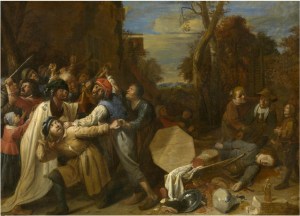
Dutch: De dood is fel en snel: Ruzie in een pub, English: Death is Violent and Fast: Quarrel in a Pub, painting by Joos van Craesbeeck, ca. 1630 – 1635 PD|100 via Wikimedia Commons.

4 Comments

Filed under writing

Information and Misinformation #amwriting

This week, I am involved in editing for clients, hosting a writing meetup, and working hard on a first draft.

Over the weekend I made good headway with new material, and now I am putting much of what we have previously discussed into action as I expand on those chapters.

I’m ensuring that within the larger story, I have a structure of smaller arcs,  scenes that will come together to create this all-encompassing two-volume drama. If I do this right, I will keep my readers’ hearts invested in the narrative until the end of the second book.

I’ve talked before about the arc of the scene vs. the overall arc of the novel.

The end of the scene is the platform from which your next scene launches. This means each scene begins at a slightly higher point on the novel’s narrative arc than the previous scene did, driving the narrative. That pulse is critical to creating the necessary tension.

At this point, I’m still fine-tuning the plot, deciding who has the critical knowledge. The fact that some characters are working with limited information is what creates the tension, a concept known as asymmetric information. This a situation in which one party has more or superior information compared to another. In business, this can prevent other companies from effectively entering and competing in an industry or market. The company with the information has a monopoly.

In real life, a monopoly of information creates a crisis. In the novel, it creates tension. A conversation scene should be driven by the fact that one person has knowledge the others need to know at that moment. Whether or not they receive the information in time is up to you in the plotting stage.

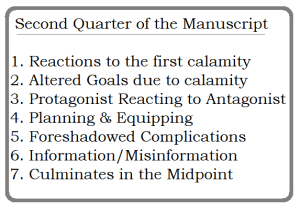
So, this is what I am doing now, making sure the information is divided up disproportionately. No one ever has all the knowledge, and what my protagonist doesn’t know at the beginning is central to the plot and the final confrontation at the end of the second half.

The reader must get answers at the same time as the other characters, gradually over the first 3/4 of each novel. Book one has the first half of the story line and a satisfying conclusion, and book two is the protagonists’ ultimate destination and final meeting with the enemy. Dispersing small but necessary bits of info at just the right moment so there are no info dumps is tricky but by the final draft of both books, all will have been smoothed out.

As I said, I am creating small arcs, scenes that pose questions, but also provide answers to previously posed questions. Large and small events occur but are linked by conversations because events don’t happen randomly. Sometimes an incident is self-explanatory, but action alone wouldn’t be enlightening.

My characters are charismatic, as they exist in my head. My task in this first draft is to show them in such a way that the reader sees the magic in them that I see. I have to create a pulse of each character’s desires and objectives, laced with information and misinformation. I am creating a trail of breadcrumbs leading to the first conclusion at the end of book one.

Book one’s final confrontation has to be good and resolve the first conflict. I hate cliff-hanger endings so there will be none of that in my work.

I will finish both books before I publish book one, with book two in the final editing stage when book one goes to press. By planning out my production schedule like this, I hope I can achieve what I envision, an epic fantasy that hooks the reader with small rewards of emotional satisfaction along the way to the big event.

My trusty beta readers will “politely” inform me (with a brick to my head) if I don’t somehow accomplish just that.

Comments Off on Information and Misinformation #amwriting

Filed under writing

De-junking #amwriting

Fifteen years ago, my husband and I bought a house and gradually filled it with furniture. We weren’t rich, but we got the most durable pieces we could afford.

Alas, the recliners were the first to fall victim to old age, with my husband’s obnoxiously big (but incredibly comfy) chair failing first. Not sure what to do with it as it was the size of a dinosaur, the broken corpse sat in a corner for four years serving as an “overflow coat-rack” when we had a lot of company.

The nice recliner with the fabric I liked so much, and which was purchased for me, became “the captain’s chair.” I had written Huw the Bard, Tower of Bones, and Forbidden Road in that chair, but it was still in perfect condition.

I didn’t mind sitting on the sofa, but I never was able to get too comfy with my laptop there. For the most part, I found myself hanging out my office, playing RPGs and writing rather than watching TV.

However, that chair too went the way of all things, falling apart and looking worse than Martin Crane’s hideous recliner on the old TV show, “Frasier.”

In the process of shopping for new chairs, we decided to go with a smaller dining room table, as the two of us don’t need a nine foot long dining room table. When we have large family gatherings, we have the Costco folding table that I use for book signing events and several card tables.

When we got rid of the broken chairs, we also trashed several other large pieces that had begun to show their age, not unlike their owners:

  • The wobbly sofa table on which we proudly displayed our dead houseplants.
  • The backless cabinet that held my dried-up art supplies.
  • The broken bar stool that we dropped our empty shopping bags on instead of putting them away.

After all the broken furniture was gone, I looked around in shock, faced with the glaring evidence of my crummy housekeeping habits.

Grandma went on a cleaning rampage.

So, the house is a bit empty today, but cleaner. It looks rather like it did the day we moved in. I had forgotten how big the place is but seeing it half empty reminded us of why we loved this house in the first place.

New furniture is coming to my house on Tuesday. This time we have modern Scandinavian-style lounge-chairs, with separate footstools. These won’t fail the way the recliners did. The new round dining table will seat four comfortably, and six if they like each other.

And that brings me to the strangest side note to all of this: In the midst of getting rid of the unwanted debris collected over fifteen years, I wrote two full chapters in my first draft, totaling around 6,000 new words. These are good chapters that broke through one of the worst sticking points in plotting that book. What I wrote yesterday advances the story and take it to the midpoint crisis.

Cleaning house seems to have cleared my mind.

Maybe I should clean my house more often.

Nah, probably not gonna happen.

8 Comments

Filed under writing

Freedom of Thought #CelebrateDiversity

When you look back far enough, every person in this country is an immigrant. The Native American tribes and First Nations peoples came first, across the waters and across the land bridges. This was their land for thousands of years.

But we who claim European, African, and Asian ancestry are all recent immigrants. We are only here because our parents and grandparents found a place where they could raise their family in relative safety, and forced their way in. Some were brought here against their will, but stayed, hoping to find a better life. It wasn’t easy, and those times were difficult.

In some ways, Independence Day celebrates the possibilities, the promise that lives in every human being, and which our founders also saw and hoped to preserve. Yes, these men were flawed, as are all human beings, but they were freethinkers.

When you read historical accounts written at the time by the men and women who lived the American Revolution, you discover it was about so much more than simply breaking away from England. It was a time of revolution all over the western world, also happening in Great Britain, and in France, and across Europe. It was a tidal wave of freedom of thought.

These freethinkers discussed their ideas. They wrote books on philosophy and natural history and writing some of the greatest works of fiction, works that still figure largely in our literary canon.

History shows us that when dictators come to power, they begin cleansing society of the unwanted, usually starting with the immigrants. Then they move on to those whose faith is the “wrong” religion, and then to the freethinkers, burning books that espouse ideas contrary to the new regime. Clergy, artists, writers, entertainers, and philosophers become enemies of the state and risk imprisonment for “perilous thinking.”

We live in a time where narrow minds are poised to snatch freedoms we take for granted from us.

We run the risk of losing 242 years of the right to bear thoughts, dangerous, incendiary things if left lying around where just anyone can find them.

Today we are still allowed to argue politics and discuss religion freely. We still have access to the internet and can discuss books and the impact they make on us as readers. Those of us fortunate enough to be protected by proof of citizenship will celebrate the 4th of July with our children, in the safety of our home. We will celebrate in our small ways, protected by the freedoms firmly espoused in 1776 document that begins with the words “We the People,” and signed by the founding fathers.

We are decent people, trying to live good lives. Individually, we don’t see ourselves as exclusionary or cruel. We believe in the greater good, and because we do, change will come. The face of America will evolve.

Immigrants have always come to America and always will, and they will be a part of what makes this nation a good place to live. We will find common ground because this is a small planet in a large universe, and right now, we have nowhere else to go. Change and growth are never easy.


Credits and Attributions

US Flag, Backlit By Jnn13 [CC BY-SA 3.0 (https://creativecommons.org/licenses/by-sa/3.0) or GFDL (http://www.gnu.org/copyleft/fdl.html)%5D, from Wikimedia Commons (accessed 04 July 2018)

8 Comments

Filed under writing

The Paragraph #amwriting

This post pertains to the paragraphs in a literary narrative, whether the genre is contemporary, sci fi, fantasy, mystery, romance—or any kind of writing that is fiction.

Paragraphs are not just short blocks of randomly assembled sentences. A paragraph is a group of sentences that fleshes out a single idea. That means that only one thought or speaker is featured in each paragraph.

This rule is cast in stone and is especially critical if you are writing a technical piece. I have edited work for people who are pursuing literary degrees. That is a different kind of writing and requires strict adherence to style policies as set down by the professor at the beginning of the semester.

In scholastic and technical writing, a good paragraph begins with a topic sentence and is comprised of sentences that support the main idea. In writing for literature, we don’t begin with a topic sentence as such, but we do explore and expand on only one idea in each paragraph.

The rules are simple:

  • Present a single idea per paragraph.
  • Present the dialogue and reactions of only one person per paragraph.
  • Present the viewpoint of one character per paragraph.

I have used this example of a paragraph gone wrong before, but it is a good one:

Jamie said, “You cheated on me.” Kerry cringed and wept. “I don’t want to lose you.” He spat, “You disgust me.”

That is a confusing passage, but it doesn’t have to be. Three ideas are explored there: Jamie’s accusation, Kerry’s guilt and fear of losing him, and finally his disgust.

Jamie said, “You cheated on me.”

Kerry cringed and wept. “I don’t want to lose you.”

He spat, “You disgust me.”

While it makes for short paragraphs, you must break out Kerry’s reaction. One thought, one point of view per paragraph, no matter how short that makes it.

A good paragraph agrees with itself, is logical, and the central idea it contains is developed. Sometimes, this creates long paragraphs.

With that said, some considerations must be given to manuscripts intended for publication as an eBook. If you are self-publishing, I highly recommend you format at least two manuscripts for your book, three if you are planning an epub as well as a Kindle version.

One manuscript will be for the print version, which will be the version you send to Ingram Sparks, KDP, or CreateSpace. The other manuscripts will be the mobi (kindle) and epub (other ebook sellers) manuscripts. I use Draft2Digital to create both types of eBook manuscripts—it is free, and the simple instructions make it incredibly easy. You can also format your paper book there, also for free.

In a paper book, paragraph length isn’t as much of a problem as in an eBook. I’ve noticed that versions of eBook novels containing long paragraphs tend to appear as page after page of an unbroken wall of words. That can be confusing, and the reader may decide to move on to a different book.

Thus, for a manuscript that you intend to publish as an eBook, you will want to divide long passages at logical places, using two paragraphs to explore the idea. This is especially a problem when the paragraph contains a long section of internal dialogue, which is frequently written in italics.

In any type of writing, emails, literature, or scholastic, when a new idea comes into your writing, or a different character speaks, you must begin a new paragraph.

No matter what, you must have an amazing opening paragraph. One of the greatest hooks in literature is the following one by French author, Albert Camus, which opens the 1942 novel, The Stranger.

Mother died today. Or maybe yesterday, I don’t know. I had a telegram from the home: ‘Mother passed away. Funeral tomorrow. Yours sincerely.’ That doesn’t mean anything. It may have been yesterday.

One idea is explored here in ten short sentences, which combine to offer up a wealth of information. Put bluntly, Meursault received a telegram, possibly from an old-folks home, informing him his mother was dead and when the funeral was.

These first paragraphs are where Camus shows his skill. He takes a simple idea and presents it in deliberately crafted prose that feels loose, almost indifferent. Rather than a plain statement of fact, the few sentences exploring that one thought makes us curious about the protagonist and his state of mind.

Authors, please present only one central idea per paragraph. However, you are free to offer up that idea with your own flair and style.


Credits and Attributions

Quote from The Stranger, by Albert Camus, Original title L’Étranger © 1942 (Gallimard, French) © 1946 (Hamish Hamilton, English)

Wikipedia contributors, “The Stranger (novel),” Wikipedia, The Free Encyclopedia, https://en.wikipedia.org/w/index.php?title=The_Stranger_(novel)&oldid=796803119 (accessed August 30, 2017).

The Paragraph by Connie J. Jasperson was first published on Aug 30, 2017, and has been edited and updated with new material for this post.


8 Comments

Filed under writing

Gormenghast and Lyonesse #amwriting

Alas—the annual tradition of the “summer cold” has laid me low, so I am napping a lot and not doing much writing today. Because I’m not thinking too clearly, I thought I should reprise my article on two famous and highly literary fantasy series, Gormenghast (Book 1 – Titus Groan, 1946) by Mervyn Peake, and The Lyonesse Trilogy (Book 1 – Lyonesse, Suldrun’s Garden, 1983) by Jack Vance.

It has been said of the Gormenghast series that it is the first true fantasy of manners. I suspect Jack Vance was a fan of Mervyn Peake’s brilliant work.

A “comedy of manners” satirizes the manners and affectations of certain social classes and is a literary trope that is often represented by highly stereotypical stock characters.

A “fantasy of manners” is fantasy literature that owes as much to the comedy of manners as it does to the traditional heroic fantasy of J. R. R. Tolkien and other authors of high fantasy.

Both Gormenghast and Lyonesse more than meet that challenge. Now, my post from 05 June 2017, Literature and Language: Gormenghast and Lyonesse. Enjoy!


Two series of fantasy novels that had a profound effect on me as a reader are the Gormenghast series of novels, written by Mervyn Peake, and The Lyonesse Trilogy by Jack Vance. Both series are literary, yet still fantastic,

They are both considered a fantasy of manners, yet they are wildly different from each other. Both combine the comedy of manners with the hero’s journey of traditional high fantasy. Gormenghast is dark and gothic, while Lyonesse is set in an alternate Arthurian world.

The Washington Post Book World had this to say about the Gormenghast series:  “This extravagant epic about a labyrinthine castle populated with conniving Dickensian grotesques is the true fantasy classic of our time.”

The Gormenghast series opens with the book, Titus Groan. Although the book takes its name from Titus, and he is technically the main character, the book only covers the first two years of his life. At the age of one, he becomes the Earl of Groan. Titus-the-baby appears irregularly throughout the narrative, but he is central to the plot, inciting change in the routine of the immense castle.

The vast, labyrinthine Hayholt, featured in Tad Williams’ epic masterpiece, Memory, Sorrow, and Thorn, seemed reminiscent of castle Gormenghast to a certain extent when I first read that series. I don’t know if Williams is a Gormenghast fan. I do know he is not afraid to write great literary fantasy.

Vance’s vision of Lyonesse has influenced fantasy literature in the subtlest of ways, creating a canon for those who write alternate Arthurian history that is nearly set in stone.

Wikipedia says, Vance builds the history of his world using layers of facts, names and religions taken from various European cultures — Greeks, Romans, Celts, pre-Carolingian French and Spanish “kingdoms” etc., and adding in places and peoples imagined by those same cultures — Atlantis, Ys, Avalon, Formor and so on. This fantastical/factual mix is used to ground his tale in “history.” It also seems to give some of the same depth that a longer series of books might develop where place, relationships, and plot are built up over time (as in Thomas Hardy’s “Wessex” or Trollope’s “Barsetshire”). It seems to provide the believability that develops where a story is set in a well-known, well-defined historical setting as if the reader holds merely a hitherto untold story.

These complicated, convoluted books are not for everyone. They are beautifully written, but the less perceptive, more impatient type of reader will find Gormenghast confusing and plot-less. Despite being a dark, Gothic fantasy, the prose is literary.

For some casual readers, both Gormenghast and Lyonesse will be considered too heavy on the descriptions.

But for those readers like me, readers who adore beautiful prose, deep, involving books, and darkly baroque settings peopled with unforgettable characters, these two watershed works strike a chord deep within the soul.

These books must be savored, experienced in the fullest sense of the word. The focus is on the breathtaking visual descriptions, and while I am thrilled by it, the verbal beauty of Mervyn Peake and Jack Vance’s prose is what will leave many impatient modern readers cold.

When you are reading these novels, the journey itself is more important than the destination. While Gormenghast is often compared to Tolkien’s work, there is little similarity between the two, other than they are both extremely well written fantasy, written by authors with a good command of the English language and all its nuances.

Literature drives changes in language and is in turn driven by changes in language.

For me, Gormenghast is a surreal, visual painting, created of beautifully crafted words.

The prose of Jack Vance’s Lyonesse is equally beautiful, describing a time and place that never was but could have been.


Sources and Attributions:

Literature and Language: Gormenghast and Lyonesse, © 2017 by Connie J. Jasperson, was first published on Life in the Realm of Fantasy on 05 June 2017

Wikipedia contributors, “Lyonesse Trilogy,” Wikipedia, The Free Encyclopedia, https://en.wikipedia.org/w/index.php?title=Lyonesse_Trilogy&oldid=782651719 (accessed June 4, 2017).

Wikipedia contributors, “Titus Groan,” Wikipedia, The Free Encyclopedia, https://en.wikipedia.org/w/index.php?title=Titus_Groan&oldid=769262142 (accessedJune 4, 2017).

Titus Groan, by Mervyn Peake, cover art also by Mervyn Peake, published by Eyre & Spottiswoode 1946 https://en.wikipedia.org/w/index.php?title=Titus_Groan&oldid=769262142 (accessed June 4, 2017).


5 Comments

Filed under writing

Using polarity in literature #amwriting

We all know opposites attract—it seems to be a fundamental law of physics. It is as if the one end of the magnetic spectrum supplies a needed missing element for the other, something they can’t resist.

In literature, polarity gives your theme dimension. Remember, the theme is the backbone of your story, the thread that runs though it and connects the disparate parts. Themes are often polarized: One obvious polarity in literature is good vs. evil. Another is love vs. hate.

The circle of life explores birth, growth, degeneration, and death. Young vs. old is a common polarity—many times we find opportunities for conflict within the family. Both sides of this age-old conflict tend to be arrogant and sure of their position in each skirmish.

Wealth vs. poverty offers the opportunity to delve into social issues and inequities.

But looking beyond the obvious are the subtle polarities we can instill into our work, the small subliminal conflicts that support the theme and add texture to the narrative.

Consider justice. Without injustice, there is no need for justice. Justice only exists because of injustice.

Or pain–the absence of pain, emotional or physical, is only understood when someone has suffered pain. Until we have felt severe pain, we don’t even think about the lack of it. In literature, emotional pain can be a thread adding dimension to an otherwise stale relationship.

Truth and falsehood (reality/unreality) go a long way toward adding drama to a plot and provide a logical way to underscore the larger theme.

Ease should be framed with difficulty.

Many commonly used words have opposites, such as the word attractive, the opposite of which is repulsive. When you really want to add texture to your narrative, look at how you could apply the ideas generated by your list of antonyms, words with the opposite meanings.

Think about how some of the concepts of the more common “D” words with opposites could be used to good effect:

  • dangerous – safe
  • dark – light
  • decline – accept
  • deep – shallow
  • definite – indefinite
  • demand – supply
  • despair – hope
  • discourage – encourage
  • dreary – cheerful
  • dull – bright, shiny
  • dusk – dawn

I love and regularly use the Oxford Dictionary of Synonyms and Antonyms to spur my creativity. It can be purchased in paperback, so it’s not too spendy. Often you can find these sorts of reference books second hand.

The internet is also your friend. A large, comprehensive list of common antonyms can be found at Enchanted Learning. If you don’t have the Oxford Dictionary of Synonyms and Antonyms and are feeling the financial pinch most authors feel, this is a free resource.

Applied with a deft hand, opposites add dimension and rhythm to our work. Polarity is an essential tool of world building, as small polarities in the interactions your characters have with each other add to the atmosphere and serve to show their world in subtle ways.

  • courage – cowardice
  • create – destroy
  • crooked – straight/honorable
  • cruel – kind

What polarities can you use to your advantage in your current work in progress? When inserted unobtrusively they become invisible, an organic part of the larger picture. Yet, each small polarity will create a little conflict, push your characters a bit further, and underscore your larger theme.

These are just a few ideas and thoughts to help you jump start your work, if you’re a little stranded. Happy writing!

14 Comments

Filed under writing

Thoughts on revisions and self-editing #amwriting

New and beginning authors often (loudly) assert their ability to edit their own work. If you are “editing” your own manuscript, you have a fool for a client. There is no such thing as self-editing—the best you can do is make revisions and admire your work. For that reason, we need other eyes on our work.

As authors, we see what we intended to write rather than what was written. We misread clumsy sentences and overlook words that are missing or are included twice in a row.  If you are in a critique group, you have a great resource in your fellow authors—they will spot things you have overlooked your work just as you do in theirs.

The first draft of any manuscript is the story as it flowed out of your mind and onto the paper. Yes, there is life and energy in your words, but your manuscript is not publishable at this stage, no matter how many times you go over it.

You need an unbiased eye upon your work, or your book will be published with typos, awkward sentences, dropped words—the list of inadvertent errors goes on.

Every author needs someone to read their work before it is published. Just because I can see six instances of the word ‘long’ in one paragraph of someone else’s work does not mean that I will spot it in my own.

To the author in the first flush of victory, the completed first draft of his manuscript is a thing of beauty, a flawless diamond to be cherished and adored.  It is the child of their creative muse and is perfect in every way.

Let us consider the word ‘that.’ The following passage is from one of my original manuscripts as it emerged from the first draft in 2008, ten years ago.

 Jeanne was not upset over something that he had not done or not said. Now he sensed that it was a mixture of anger, hurt, and guilt that she was feeling.

In just two sentences, my stream-of-consciousness writing included 3 instances of the word ‘that’ and 3 of ‘not.’  Yet, in my own mind, it was as good as I could make it. I didn’t see those unnecessary words.

This is how that paragraph read in my mind and is how I would write it now, ten years on:

Jeanne wasn’t upset over something he had done or said. He sensed she felt a mixture of anger, hurt, and guilt.

I began working with an editor in 2012, and that is when I truly began to grow as an author. Each time they showed me where I had gone wrong, I learned from it and gradually, my stream-of-consciousness writing improved. I use fewer unnecessary words, and my prose is leaner.

Better writing habits are learned over time by writing regularly and by consciously applying the tricks and tips you learn from other authors.

Once your writing/critique group has given you their best opinions on your manuscript and you have revised it to your best ability, you need an editor. Ask other authors who they might recommend as an editor and see if you can work well with that person.

Your editor will likely point some things out that you didn’t see, but that a reader will.  At that point, you might be slightly shocked and hurt, but if you’re smart you’ll consider each comment and make your revisions accordingly.

Once you see your work through someone else’s unbiased eyes, you will be able to take your story to the next level.

The fact is, unless you can accept criticism, your work will never be what you want it to be. You must be open to viewing your work the way the reader will see it. You’re not obligated to follow every suggestion an editor makes, but 9 times out of 10 I make changes along the lines they suggest because when I look at the problem area, I can see exactly what they meant.

Writing seems like a solitary craft, and much of the time it is. However, joining a local writing support group or a critique group will give you a sounding board that costs you nothing, but from which you will reap many benefits.

28 Comments

Filed under writing