Category Archives: writing

World building, ensuring consistency #amwriting

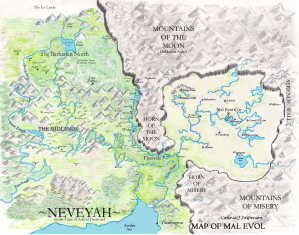
The key to making both fiction and nonfiction real for the reader is subtle but crucial: world building. Maps, no matter how rudimentary, are the foundation of world building in my writing process.

The first map of what eventually became my world of Neveyah series emerged from a conversation with a game designer and was scribbled on a piece of note paper in a Starbucks. I transferred the scribble to graph paper, and over time, that map grew, evolving into a full color relief map of the world as it exists in my mind.

I love maps. Since that early scribble, my maps all start out in a rudimentary form, just a way to keep my work straight. I use pencil and graph paper at this stage, because as the manuscript evolves, sometimes towns must be renamed. They may have to be moved to more logical places. Whole mountain ranges may have to be moved or reshaped so that forests and savannas will appear where they are supposed to be in the story.

And that tendency for embellishment and evolution in the story teller’s mind is what has led to my most embarrassing moment of the week.

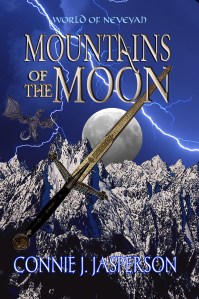
I went back to the original manuscript of Mountains of the Moon, Wynn Farmer’s story, just to check on how I had described the terrain of the high country of the Escarpment, as I am writing a short story set there. While I was searching for the passage I wanted, I noticed that I had described Widge as the northernmost navigable port on the River Fleet.

Which means that Dervy can’t be the northernmost port, and the novel I am not working on for the duration of NaNoWriMo has a large plot-hole that won’t be fixed until December.

Fortunately, it is set five hundred years before Wynn’s time, so I’m not going to scrap that portion.

Instead, I made a series of notes for when I get back to writing that novel after NaNoWriMo is over. I will show how at that time, Dervy had some commerce via flat-bottomed barges owned by daring traders. The courses of rivers are changeable, like the Mississippi or the Nile. Where a harbor was possible three hundred years ago, it may not be possible now. (see How The Nile Has Changed Course Over The Past 5,000 Years.)

So, I just had a sharp reminder to check my work for inconsistencies while I still have the chance to either make them possible or remove them.

Perhaps you think you don’t need a map. You aren’t writing fantasy, so the real world is your setting. If your characters are traveling and you are writing about their travels, you want to be accurate. Google earth and a good map will help, as will timetables for trains and airlines.

In my books, people are going hither and yon with great abandon, and if I am not really on top of it, the names of towns will evolve throughout the novel.

The basic pencil-drawn map, in conjunction with my style-sheet, is my indispensable tool for keeping the story straight. I just have to keep referring back to them, rather than trying to keep it all in my head.

What is a style-sheet? When a manuscript comes across their desk, editors and publishers create a list of names, places, created words, and other things that may be repeated and that pertain only to that manuscript. This is called a style-sheet.

The style-sheet can take several forms. It’s a visual guide to print out or keep minimized until it’s needed. I copy and paste every new word or name onto my list, doing this the first time they appear in the manuscript. If I am conscientious about this, I’ll be less likely to inadvertently contradict myself later on in the tale. I also do this for my clients when I edit a manuscript.

Some people use Scrivener. I prefer to keep it simple, so I just use Excel for this because I like keeping my maps and the glossary in the same workbook. Google Docs works just as well, and it’s free, or you can just keep a list on a document or notepad.

Regardless of how you create your style-sheet, I suggest you include these elements:

  • The cast of characters and how their names are spelled
  • Their home town
  • The places they go
  • Every made-up word or name
  • The page on which it first appears
  • What it means

What should go on a map? When your characters are traveling great distances, certain differences in the terrain will impede your characters. If they are pertinent to the story, you will want to note:

  • Rivers
  • swamps
  • mountains
  • hills
  • towns
  • forests
  • oceans

What if your setting is indoors, such as an office, a mansion, or a hotel? You want to make sure the rooms and corridors that get mentioned in the narrative aren’t described in a contradictory way. If a room is next to the kitchen in the opening scene, it should still be there at the end of the story, barring a tornado.

Billy Ninefingers is set in a wayside inn. I made a drawing of the floor plan for my purposes because the inn is the world in which the story takes place. If you are writing a space opera, map out your ship or station, just for yourself.

Know your world.

As a side note, if you are writing fantasy, I suggest you keep the actual distances mushy because some readers will nitpick the details, no matter how accurate you are.

From Wikipedia, the fount of all knowledge: “A league is a unit of length (or, in various regions, area). It was long common in Europe and Latin America, but it is no longer an official unit in any nation. The word originally meant the distance a person could walk in an hour.[1] Since the Middle Ages, many values have been specified in several countries.”

Therefore, a league is what you say it is, within some loose parameters. I go with the distance you can walk in an hour, which means you must take the terrain into consideration. In my current work, I don’t even mention distance by measure. Instead, I use time—they travel for an hour, or day, or two days.

Not everyone is an artist. Perhaps your work is set in a fantasy world, but you feel your hand-drawn map isn’t good enough to include in the finished product.

One option is to go to a game designer’s map generating site, play around with it until you find a map you like, then write the story to that map. Another option indie authors might consider is hiring an artist to make a map from their notes.

I’m fortunate to have some skill as an artist, so my pencil-drawn map always evolves into artwork for the book.


Credits and Attributions:

Wikipedia contributors, “League (unit),” Wikipedia, The Free Encyclopedia, https://en.wikipedia.org/w/index.php?title=League_(unit)&oldid=865343305(accessed November 4, 2018).

Map of Neveyah ©2015 Connie J. Jasperson, All Rights Reserved.

9 Comments

Filed under writing

Version Control: Naming Your Files #amwriting

With the advent of November and NaNoWriMo, naming files and version control becomes an issue, especially for new and beginning writers.

For every new document you create, I recommend that BEFORE you do any work whatsoever, you give the file a working name and save it to whatever folder you normally work out of.

Do that immediately.

Do it while the page or spreadsheet is still blank, before you write the first line.

Most people never had more than a few personal files to manage. For this reason, they have no concept of how easily something that should have been simple can veer out of control.

This is where a good system of version control comes in handy. The worst thing that can happen is when you accidentally save an old file over the top of your new file or delete the file entirely.

It is vitally important for writers to save their work regularly. I don’t like thumb-drives because they’re easily lost, so I use a file hosting service called Dropbox. I have a lot of images on file, so I pay for an expanded version, but they do have a free version that offers you as much storage as a thumb drive. I like using a file hosting service because it can’t be lost or misplaced and is always accessible. I work out of those files, so they are automatically saved and are where I want them when I close out.

But you can use a standard portable USB flash drive.

What I want to discuss today is naming your files, so they are consistent and easy to identify.

A consistent system for naming your files eliminates accidents when it comes to saving your manuscript and subsidiary research files.

DIRECTORY

> FOLDERS

>> SUB-FOLDERS

> >>DOCUMENTS

My work is all saved in a folder labeled Writing.

Inside the master folder are many subfolders, one for each book, and one for essays and short stories.

Bleakbourne_on_Heath

Each subfolder contains documents, and each document has a proper file name:

Bleakbourne_V1_cjjasp

That stands for Bleakbourne on Heath, version one, by Connie J. Jasperson

A more recent version of that manuscript is named Bleakbourne_V2_cjjasp.

By clearly denoting which version it is in the file name, I should have no disasters.

In older Operating Systems the underscore was used instead of a space because the OS could not process filenames with spaces. Many publishers, editors, and agents want the files you send them to be named in this way, so it’s a good habit to get into.

When I first began working in an office that had upgraded to computers in the early 1990s, we had a rule for naming files: use no spaces, use an underscore where the spaces would go. There was a good reason for this.

When transferring files between different operating systems with different file naming conventions, the underscore prevents using what may be an illegal character in another OS.

So, if an office had to send files to an outside agency, the two users could open the files in their respective programs.

What are the different Operating Systems currently in use that your work may come across?

Linux

MacOS

Windows

Unix

Chrome OS

Some operating systems are more business oriented, but if you send files to a variety of publishers, your work could end up on a machine with a different OS than yours. Usually it will be a PC (Windows) or a Mac, as those two operating systems are most common. Using a Mac or PC is a personal preference. When purchasing gear, employers usually cater to the wishes of those who will use the machine, so the offices of publishers and editors will usually have both.

For this reason, we have some rules to obey regarding certain characters when we are naming files.

What are common “illegal characters?” The following characters are invalid as file or folder names on Windows using NTFS (New Technology File System) which took over from FAT as the primary file system being used in Windows:

/ ? < > \ : * | ”

Any character you can type with the Ctrl key. Most Alt Codes are also not permissible.

In addition to the above illegal characters, the caret ^ may also not be permitted in some Windows operating systems, those using the older FAT (File Allocation Table) system.

Also, don’t use # % & {   }@

These characters make files that can’t be opened on some operating systems, so even if your operating system allows these symbols, it is best to not use them.

One thing I learned the hard way is to be mindful of something called “Version Control.” Anyone who writes using both a laptop and a desktop machine will understand why this is still an issue, even when we save to Google Drive, OneDrive, Dropbox, or any cloud-based storage service.

The scenario: you went to the coffee shop to write, and suddenly realized you were running late for an appointment. You saved your file but forgot to close out, simply shutting your laptop and going home, forgetting your word processing program was still open. That evening you go to the PC (or Mac) in your regular writing space, open your file, and continue writing.

When you save it, you have created a “conflicted file.”

According to Dropbox’s website, there are three ways you can end up with conflicted files if you are using cloud storage.

A conflicted copy is a file that is created when multiple people have access to a shared file and edit the same file at the same time. There are three ways a conflicted copy can happen:

  • Two users change the same file at the same time

  • Someone edits a file offline while someone else edits the same file

  • A file is left open on another user’s computer, which Dropbox saves as a new edit—this is especially common when using applications with an auto-save feature

Note: The last version saved will always appear as the conflicted copy, with the user’s name, such as File_Name_Connie’s_conflicted_copy.

So, now we know why we who use cloud storage sometimes end up with conflicted files. But how do we consistently and professionally name our files so that we don’t inadvertently save over work we want to keep, but aren’t currently using?

First of all, if you are trying to “save as” and a dialog box pops up warning you a file already exists with that name, you should click on cancel and rename your new file, or you will lose the one you just saved over.

Before your novel is published, you may create several versions of your manuscript. I advise you manage your versions with meticulous care. Nothing hurts like losing files you have worked on for months. Even having to rewrite a section you just wrote is aggravating.

Name your files promptly and save often—two things that will save you a lot of heartache when you are deep into writing your novel.


Credits and Attributions

Dropbox Help Center, What’s a Conflicted Copy, https://www.dropbox.com/help/syncing-uploads/conflicted-copy accessed 30 October 2018.

Open File Cabinet 2 Clip Art, PD, via Clker.co, Free Clip Art. http://www.clker.com/clipart-open-file-cabinet.html accessed 30 October 2018.

2 Comments

Filed under writing

About Dialogue #amwriting #nanowrimo

We who write must be able to visualize and describe conversations. We must do it in such a way that the reader forgets they’re reading a book and becomes engrossed in the discussion.

However, we don’t want to be completely accurate. How many people have mannerisms that impede their speech, uhhhhmming and aaahhhhing their way through each thought? And yet others may have a lisp or stutter that makes you have to listen more closely to them. These are normal parts of our lives but are things we don’t include in our written descriptions of conversations.

So how do we get the conversation down so the reader will enjoy it?

First of all, there are certain fundamental rules of the road that readers will expect authors to be educated in. When authors don’t obey these rules, readers put the book down, unfinished. The rules are clearly listed in the Chicago Manual of Style but can also be found in the Chicago Guide to Grammar, Usage, and Punctuation by Bryan A. Garner. These are two books authors should own and refer back to whenever they have questions about grammar.

On a side note, I was lurking in a writers’ forum when a new member boldly commented, “Why are you so concerned about this? Who the hell cares about grammar? We write what we want and to hell with rules.”

Wisely, I stayed out of that poo-storm. It is good for us to remember that “grammar-nazis” are not the only people who care about sentence construction and the mechanics of good writing.

Readers care. Words have intersections, and punctuation acts as a traffic signal, preventing jam-ups and wrecks. Authors who care take the time to learn a few basic rules, things that signal stop, go, slow down, and “someone is talking.”

Much of what follows has been written here before. So, if you have already seen this, thank you for stopping by!

Here are the rules of how to write readable dialogue:

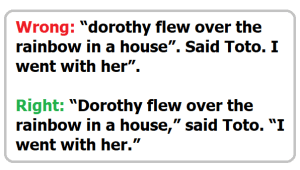
  1. Always begin what is actually spoken (dialogue) with a capitalized word, no matter where in the sentence it begins.
  • Gemma glanced over her shoulder and said, “I’m sorry. I can’t go with you.” 

However, interrupted dialogue, when it resumes, is not capped, although the rules of punctuation and quotation marks still apply.

  • “I’m sorry to tell you,” said Gemma, “but I can’t go with you.”
  1. Direct dialogue is someone speaking to you or someone else and requires quotation marks.
  • “I’m sorry. I can’t go with you,” said Gemma.

I’m a US author, so I used double quotes, also called closed quotes. The UK usage is different and often uses apostrophes, or what they call inverted commas.

Regardless of whether you are a UK or US author, be consistent and make sure ALL punctuation goes inside the quote marks.

Yes, I did say All punctuation.

  1. How does one set off a quote from someone else within dialogue?

Set it apart with single quotes (apostrophes, inverted commas) and keep it inside the closed quotes. You can do this in two ways:

  • Jason said, “When I asked her, Gemma replied ‘I can’t go.’ But I’m sure she was lying.”
  • Jason said, “When I asked, Gemma replied ‘I can’t go.’”

Note that in the second sentence 3 apostrophes are placed after the period (full stop): 1 apostrophe and 1 double (closed) quote mark. This is in keeping with the rule that all punctuation in dialogue goes inside the quotation marks.

  1. Indirect dialogue is a recapping of dialogue that someone previously spoke.
  • When asked, Jason said Gemma couldn’t go.

Note there are no quotes used in indirect dialogue. Also, in the above sentence, the word that is implied between said and Gemma.

Dialogue tags, or attributions (said, replied) can come before the dialogue, especially if you want the dialogue tag to be noticed. To make them less noticeable put them in the middle or at the end of sentences. In my own work, I want the dialogue and not the attribution to stand out. However, when more than two people are involved in a conversation, I move the dialogue tags further to the front, so the reader isn’t left wondering who is speaking.

  1. You can skip using dialogue tags altogether for a back-and-forth or two, but
  • not if there are more than two speakers in the scene, and
  • not for more than a few exchanges.

Readers want to be able to track who is saying what.

Sometimes it’s okay to miss a few beats. Beats are what screen-writers call the little bits of physical action that is inserted into dialogue. Small actions showing the mood of a character are often best placed where there is a natural break in the dialogue, as they allow the reader to experience the same pause as the characters. They’re an effective tool and are essential to good dialogue, but don’t overdo it.

If your characters are shifting in their chair, gazing into the distance, or opening their laptops between every second line of conversation, the scene becomes about the action and not the dialogue, and the impact is diluted or lost entirely.

When we add gestures and actions to the conversation, we want them to be meaningful.  Otherwise, just use a simple dialogue tag, like said, or replied.

Please don’t get rid of attributions entirely because the verbal exchanges become confusing and the action takes over, making the dialogue fade into the background noise of foot shuffling and paper rattling.

I’ve mentioned before that I prefer simple attributions such as said, replied, and answered because they are not as likely to stop the reader’s eye. Some things to consider:

  1. People don’t
  • snort,
  • smirk,
  • smile,
  • or frown dialogue as it is physically impossible.

They can say it with a smile, a frown, a smirk, or a snort, but while facial expressions convey emotion, they do not speak. Simple attributions in combination with lean, descriptive narrative are all you need.

  • “Oh, that looks nice.” Jenny snorted. “I wouldn’t be caught dead in it.”

Sometimes we have two ideas that we think are one, and we connect them with commas. But closer examination shows they are not.

  • “Hello, sir, we bathed your dog,” she said.

The above dialogue contains a run-on sentence, despite its shortness. We may actually speak it in this fashion, words run together, but for a reader, punctuation clarifies ideas.

The dialogue contains two separate ideas. “Hello, sir,” is an acknowledgment and a greeting. “We bathed your dog,” indicates an action was taken regarding his dog. It should be:

  • “Hello, sir. We bathed your dog,” she said.
  • “Hello sir,” she said. “We bathed your dog.”

To wind this up, authors can take some style and voice liberties with dialogue but must use common sense. Adhering to the accepted standard rules of punctuation makes your work readable by anyone who speaks or reads English.


Credits and Attributions:

Portions of this post have previously appeared here on Life in the Realm of Fantasy as The Mechanics of Writing Dialogue, posted December 14, 2016

Traffic Light, © Free Clip Art Now https://www.freeclipartnow.com/transportation/traffic-lights/

Researched Source: Section 13.13, Quotations and Punctuation, page 719: The Chicago Manual of Style, 17th Edition, University of Chicago Press, © 2017

8 Comments

Filed under writing

Many will begin, few will succeed #amwriting

Every year, many writers begin writing on November 1st, fully intending to get their 1,667 words (or more) written every day, to get their 50,000 words by November 30th. In my region last year, 245 writers created profiles and began an official manuscript at www.nanowrimo.org.

The reality sets in within the first week. Last year 64 writers in our region never got more than 5,000 words written.

Some are young people just out of school who “always wanted to write a book.” They usually don’t have any idea of what they want to write, and no clue of how to be disciplined enough to spend two hours a day writing any words, much less the number of words it takes to make a novel.

They start, get 30 to 1,000 words in, and realize they have nothing to say. But 34 people made it to the 10,000 word mark before they stopped writing. That is almost a novella.

Others do well for a week, or even two, and then, at the 20,000 word mark, they take a day off. Somehow, they never get back to it. Someday, they may actually succeed in finishing that book. Just not this year.

Even seasoned writers may find the commitment to sit and write 1,667 words every day is not doable for them. Things come up—life happens.

But 78 writers out of the 245 in our region made it to the 50,000 word mark, and 5 exceeded 100,000 words.

It takes personal discipline to write 1,667 new words every day. This is not revising old work—this is writing something new, not looking at what you wrote yesterday. This is starting where you left off and moving forward.

For me, having the outline keeps me on track.

I’m not a good typist. The words that fall out of my head during this month are not all golden, just so you know. Some words will be garbled and miskeyed. This means I sometimes have a lot of revising of the work I intend to keep.

Some of what I write will be worth keeping, and some not at all. But even among the weeds, some passages and scenes  will be found that could make a story work. I will keep and use them because they say what I mean to say, and the others I will revise.

One flash fiction that came out of November 2015 fully formed and required little in the way of revisions is The Iron Dragon. The story wanted to be told, and I wrote it in two hours one morning.

Yet another very short story came out of NaNoWriMo 2015, The Cat, the Jeweler, and the Thief. That story remained very much as it began, and also was written in one morning.

I had the prompts and basic ideas of what I intended to write when I sat down. The words fell out of my mind, and the stories told themselves.

For me, as a NaNo Rebel, this is my little vacation from the serious novels that take up most of my time. I don’t accept any editing clients during November or December—my attention is on writing in November and cooking in December.

It’s a matter of getting the ideas down and putting the words on paper. If you don’t get those ideas out of your head and onto paper, you can’t revise and reshape them into something worth reading.

How do we develop the discipline to write every day? This is my list of suggestions for how to have a successful NaNoWriMo, and end November with that winner’s certificate:

  1. Write at least 1,670 words every day (three more than is required) This takes me about 2 hours – I’m not fast at this.
  2. Write every day, no matter if you have an idea worth writing about or not. Do it even if you have to get up at 4:00 am to find the time and don’t let anything derail you.
  3. If you are stuck, write about how your day went and how you are feeling about things that are happening in your life, or write that grocery list. Just write and think about where you want to take your real story. Write about what you would like to have happen in that story. Soon, you will be writing that story.
  4. Check in on the national threads and your regional thread to keep in contact with other writers.
  5. Attend a write-in if your region is having any or join a virtual write-in at NaNoWriMo on Facebook. This will keep you enthused about your project.
  6. Delete nothing. Passages you want to delete later can be highlighted, and the font turned to red or blue, so you can easily separate them out later.
  7. Remember, not every story is a novel. If your story comes to an end, start a new story in the same manuscript. Use a different font or a different color of font, and you can always separate the stories later. That way you won’t lose your word count.
  8. Validate your word count every day.

These suggestions require you to actually sit in a chair and write. Talking about what you intend to write isn’t getting the book written—for that you must sit your backside down and write.

That is what NaNoWriMo is all about. Writing, and developing discipline.

Authors write. Authors have finished manuscripts to show for their efforts, whether they are good or bad.

If you don’t actually have time to write, you may be a dreamer and a story teller, but you aren’t an author – yet.

Set aside the time to write, develop a habit of writing, and don’t let anything get in the way of your writing time. Don’t allow your writing time to be infringed upon, but also, don’t let it eat into your family time. In 1989, as a single parent with one child still at home, I found myself writing on the bus as I rode to work. I hadn’t ever had the thought that someone would want to read my work, but I had one hour of peace and quiet each way in the morning and evening, and so I wrote in a notebook.

Find the least intrusive block of time for you to have to yourself. What would happen if you dedicated two hours an evening to writing your novel instead of watching TV? What if you got up an hour early and wrote before you went to work every day? Make it your rule, your daily habit to use that time to write 1,667 new words a day for the month of November.

That is how you can get your first draft of a novel written in 30 days and still have time for your family.


Credits and Attributions:

Leo Tolstoy by Ilya Repin [Public domain], via Wikimedia Commons

Notebooks, by L.Marie (https://www.flickr.com/photos/lenore-m/2812598573/) [CC BY 2.0 (https://creativecommons.org/licenses/by/2.0)%5D, via Wikimedia Commons

6 Comments

Filed under NaNoWriMo, writing

#NaNoWriMo2018 pre-planning

When I begin penning a story, the working title is usually just a handle, something to carry it by for the time being, and which will be changed when I rewrite it anyway. While the title might not actually exist, the story does, in the form of an idea, a prompt.

So, before I sit down to write anything, I answer a short list of questions about the overall story arc of my intended tale.

I mentioned a few post’s back that I keep a document pinned to my desktop, one that I write down topics and ideas for stories on. This list is crucial, and now, as part of my preparations for next month’s madness, I am taking each idea, and answering eight questions, and making a separate file folder for each story.

I have a master folder in my writing folder that is titled: NaNoWriMo2018. Within that folder are my small files, one for each story I plan to write.

For a novel, you only need two files: your work-in-progress document, and a document to keep all the back story in.

But I am a NaNo Rebel and so for me, at this point, there are fifteen file folders in that file. I will probably only get ten of them written at 4,000 to 10,000 words per story.

I title each story folder with a working-title, such as Mitzi.

The file contains two documents. The first one is blank except for one line, which is the prompt, the  premise of the story. It is labeled MITZIdraft1. That stands for Mitzi first draft. This document will be the manuscript for that story. Any subsequent revisions will be labeled title_draft2, etc.

At 12:01 a.m. in November 1st, I will open this document and begin writing Mitzi’s story. I think her tale will top out at about 4,000 words. Then I will open the next file: Doors. I’ll begin working on that short story, which I expect will top out at 5,000 words.

I doubt I’ll keep the title of Mitzi, but it’s about a dog who “lives” at about six different homes, who answers to six different names, and the people who think they own her.

I got the idea for that story from “Rufus,” the name I gave the cat who sleeps on my back porch all day, but who actually belongs to one of our neighbors. We don’t know his real name, or which neighbor owns him. We never have to feed him, and his vet bills are not an issue for us. We just get to enjoy his orange and white fur, all over our outdoor furniture.

I mentioned there were two documents in each file. The other document is the basic premise of the story, answered in eight questions. Each answer is simply one or two lines telling me what to write.

  1. Who are the players?
  2. Who is the POV character?
  3. Where does the story open?
  4. What does the protagonist have to say about their story?
  5. How did they arrive at the point of no return?
  6. What do they want and what are they willing to do to get it?
  7. What hinders them?
  8. How does the story end? Is there more than one way this could go?

The answers to these questions make writing the actual story go faster because I know what happened, what the goal is, why the goal is difficult to achieve, and how the story ends.

Once you have answered questions one and two, you know who you are writing about and which character has the most compelling story.

At that point, you must decide what will be your inciting incident. An event happens that throws them into the action. Now, what is their goal/objective?

At the beginning of the story, what does our protagonist want that causes them to risk everything to acquire it? How badly do they want it and why? The answer to that question must be that they want whatever it is desperately.

Question number six is an important thought to consider. What moral (or immoral) choice is the protagonist going to have to make in their attempt to overcome the odds and achieve their objective?

Many final objectives are not issues of morality, but all final objectives should have consequences and should involve a struggle.

The answer to question number seven is vitally important because the story hinges on how the protagonist overcomes adversity. What hinders them? Is there an antagonist? If so, who are they and why are they the villain of the piece?

Answering question eight is crucial if I want to complete my short story during November. Endings are frequently difficult to write because I can see so many different outcomes. Because it is NaNoWriMo, and every new word I write counts toward my goal, I write as many endings as I need to.

This is where making use of scene breaks can be your friend. For a short story, an ending is usually only 500 words or so. I simply head that section (in bolded front) with the words Possible Ending 1 or 2, or however many endings I have come up with.

Once I have finished my short story, I save that file, close it, and move on to the next. I have to keep that story factory working, because during the rest of the year, whatever novel I am writing takes priority in the writing queue.

But I always have time to revise something that is already written, especially if I have come to a stopping place in my novel.

Every evening, I copy and paste each day’s work into my NaNo Master Manuscript, which is also in my NaNoWriMo2018 file. This gives me the satisfaction of seeing my total word count growing day by day.  I upload that manuscript every night to the www.nanowrimo.org website so that my work is validated and my writing buddies can see I am meeting my daily word count goals.

November is the only time I can dedicate to exploring the many topics and wild ideas that come to me over the course of a year. On December 1st, I will go back to my usual routine, editing for clients in the morning and working on my novel after editing is done.

When I need a break and something new to work on, I will pull out my short story file, and begin revisions. The work I have planned for selected anthologies will be revised first, as they will have deadlines early in 2019.

This keeps me working and ensures I am being productive even when my novel is stranded in the desert of “Now What?”.

Pre-planning means I have a good system established for version control for my revisions, as each story has its own file and I don’t have to waste time dealing with that on the front end. As I say, this is my system, and it works for me. I use this system for all my work.

Develop your system, lay the groundwork for your novel. Create the master file, and in that file, include any sub-files that pertain to your novel. Do it now, well in advance of November 1st, so that all you have to do is write and save your work.

4 Comments

October 22, 2018 · 6:00 am

Layers of a scene: Action #amwriting

Scenes are often comprised of people talking, a little action, and then more talking. Sometimes the action is minor, taking the characters from one place to another. Two characters talking in a coffee shop would have minimal action, but a lot of dialogue.

Other times the dialogue is minimal, and the action is violence. It can be sudden, as in a car wreck, or planned as in a battle.

At the outset of any story, our characters are in a comfortable place. An incident/event occurs, throwing them out of what they know and into disarray, beginning the real story.

Once they recover from the first obstacle, they realize they must do or find something important. Only a certain object or person will resolve the situation. To acquire what they need, the protagonist and their companions must enter unfamiliar circumstances.

They must struggle and make mistakes until they become accustomed to their new situation. This is where the action comes into the story.

I have read books were the author was so involved in setting traps and roadblocks for the protagonist and their nemesis that the story line wandered off and got lost. The author failed to entertain me.

Action scenes must fulfil several requirements:

  • They must entertain the reader.
  • They must create new circumstances.
  • They must force the character to grow and change.

The events the protagonist experiences must push the plot forward. In the process, the action should force the characters involved in it to become greater than they were, to find something within themselves they didn’t know existed.

I’m just going to get this out into the open: long, drawn-out fight scenes bore me to tears.

So many authors get hung up on the technical side of the fight—how the combatants were dressed, who hacked, who slashed, and so on. Scenes involving fighting should be written as controlled chaos. They must be logical and real and must give the impression of a chaotic event. Just as if the physical dispute were a dance, we choreograph it.

We all know the common fundamentals of the fight scene:

  1. Physical violence/weapons
  2. Shouting/screaming/other loud noises
  3. Damage to the immediate environment
  4. Injuries/death

Those are part of the elements that comprise the “push” of the action—the chaos. It takes time, but over the course of several hours, you can put the skeleton of your fight scene on paper. What is physically possible and what is not?

But what of a non-violent action scene? Perhaps the characters are sneaking into a room or attempting to board a crowded train. What furnishings does the immediate environment contain, and how does that affect their movements? What hinders the characters moving within their space? What aids them?

For much of the morning they rode in silence. The path climbed more steeply than Alf had imagined a fully laden cart or wagon could manage. The vertical wall of the Escarpment on the left side of the trail and a waist-high stone barrier with a terrible drop on the right made him jittery. It occurred to him that the low wall was little more than a robust fence, knee high to his horse.

The next step, after the action is laid down, is fine tuning it, so the reactions and responses of your characters are natural and real. If the scene is about dialogue, insert the action so it is minimal. It can be a slight buzz in the background that serves as a speech tag:

He forced himself to loosen his grip on the reins. “I suspect the little barrier is there mainly to keep the wagons from sliding over the edge in the winter. It does provide some comfort to know that, while I would be launched amazingly far, my horse would likely be saved.”

Dex looked at him sharply. “Don’t tell me you’re afraid of heights. This is nothing compared to what we’ll deal with when we leave Hemsteck.”

After the push, comes the “glide” where the characters assess what just happened, tend to their injuries, and decide what to do next. They must catch their breath and figure out where they went wrong.

Every now and then a manuscript comes to me that is impossible to navigate because the author is afraid to let their characters rest and regroup, and it basically becomes a nonstop beating for the protagonist. The author may fear that the reader will find it boring if he pauses the action for any reason. That continual pressure on the protagonist is exhausting to me as a reader.

If you don’t allow your characters to process the violence they just experienced, the story gets lost in the chaos. Once the reader can no longer suspend their disbelief, you have lost them.

Most of us understand verbal disputes and how they are constructed. But if physical violence is involved and you are not a martial arts aficionado or a weapons specialist, you may wish to consult someone who is and have them look at your scene. They will tell you what is physically possible and what is not.

Once I have a fight scene choreographed, I run it past my writing friends, Dave and Lee, both of whom will point out the areas where it is no longer believable.

To wind this post up, a constant assault of random action, scene after scene, makes no sense unless you allow the reader to put the events into perspective. Scenes inserted for shock value and with no pause for rest and reflection don’t allow the protagonist to demonstrate personal growth.

As a reader, I will put that book down, unfinished.


Credits and Attributions:

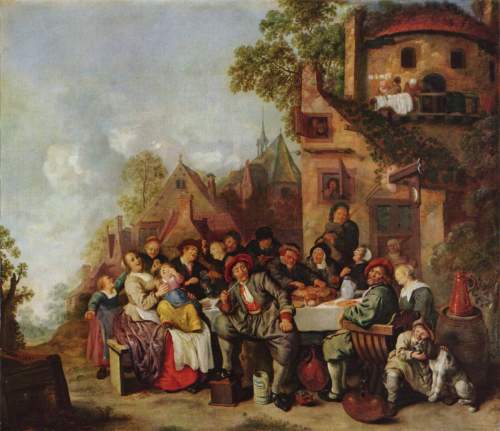
Death is Violent and Fast: Quarrel in a Pub, painting by Joos van Craesbeeck, ca. 1630 – 1635 PD|100 via Wikimedia Commons.

10 Comments

Filed under writing

Layers of a Scene—Immediate Environment #amwriting

While you are reading this post, you are probably sitting in a room, or perhaps sitting in some form of public transportation and reading on your phone. Wherever you currently are physically, you are reading a blog post. Because you are reading this post, your attention is in my room. The sounds of your environment have faded, and you are here with me, observing as I write about writing.

It’s 05:38 am, and my house is quiet, but not quite silent. It’s not a dark place, as the nightlight in the living room casts a warm glow, and the ceiling light in the room I call my “office” keeps me hitting the right keys, mostly. The furnace has come on, and the vents are making that familiar soft wooshing sound.

A cat once lived in this room, but she is gone, nine years now. Still, her spirit lingers among the dusty books and boxes of the storeroom that is my Room of Shame—a room no one is allowed to see when they visit. A sign on the door clearly warns, if you’re not in my book, keep out.

I wear a blue robe and ratty pink slippers. My feet are propped on a folding chair from Costco and the keyboard rests on my lap. Filing cabinets, boxes, shelves, dusty books, my husband’s citronella plants in the window, boxes and more boxes—this room is a cacophony of visual noise.

And yet this room is my haven, my quiet space, my room to write.

My keyboard has a certain rattle to it, a few keystrokes forward and the backspace key is pressed several times, then we go forward again. The end of a sentence arrives, and the punctuation is firmly added.

The aroma of fresh-brewed coffee calls to me. I set my work aside and go to the kitchen, the room that, despite its location in the rear corner of the house, is the center of my home. As I pour my first cup of coffee, my plan is to make a Sunday breakfast, bake bread, and maybe make oatmeal cookies with dried cranberries and walnuts.

But perhaps not. Perhaps after breakfast, I’ll return to the Room of Shame and write.

This is my immediate environment.

Our characters also occupy a particular environment at any given moment of their story. Whether they live in a condo, a house, or a caravan, their immediate environment reflects their personality.

The larger world is comprised of sound and scent as much as it is physical objects. The out-of-doors has a certain smell, perhaps of damp grass, or fresh-turned earth. In the city, smog has a scent all its own.

The smaller world, the immediate environment can be shown with brief strokes. My room has sounds that are unique to it: the furnace vents, the keyboard, the sound of the TV in another room. But some things are universal–coffee cups, small appliances, etc. We all have an idea of what a kitchen looks like. Place your character in a room with certain common props and the reader’s imagination will supply the rest of the scene:

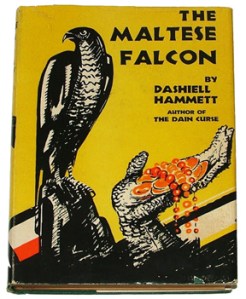
Rick closed the drapes, which smelled faintly of cigarettes. He switched the TV on—for light or companionship? Maybe both. The hotel’s movie selection was minimal, but The Maltese Falcon seemed appropriate. Unable to relax, he sat on the worn sofa, waiting, his gun at the ready.

Whenever you mention an object in a scene, it becomes important. When you mention odors, they become important, as do sounds. This is why using your character’s senses is a part of world building. What they see, hear, and smell shapes the world the reader experiences.

As an exercise, picture your immediate environment. What are your impressions of the place where you are now? Write a brief word picture of those impressions. For me, the impressions of my immediate space are: Glow of monitor, rattle of keyboard, looming boxes, cooling coffee.

Those four things show my environment.

4 Comments

Filed under writing

Ideas to jump-start #NaNoWriMo2018 #amwriting

I have been a Municipal Liaison for NaNoWriMo since 2012. I started participating in this annual writing rumble in 2010. I  found myself taking the lead as the unofficial ML for my region in 2011 when our previous ML didn’t return, and we didn’t have one that year. Organizing write-ins, cheering on my fellow writers–I didn’t really know a lot about how it all worked, but it was a lot of fun and I met so many wonderful people.

Over the years I have learned a lot of little tricks to help people get a jump on their NaNoWriMo project.

Some people continue writing the first draft of an unfinished work-in-progress but on November first, they write all the new work in a separate manuscript that is only for NaNoWriMo validation purposes.

Most will start an entirely new project, which is what I do. Actually,  since 2012, I have started a bunch of new projects, an attempt to amass a collection of short stories to submit to magazines and contests.

Many times, I don’t know exactly what I’m going to do until 12:01 a.m. on November 1st.

But that lack of a finite plan doesn’t mean I have no ideas. I am always prepared to write something new.

One of my favorite tools is the prepared list of one-liners that I keep on hand, little ideas to open a story with.

You must write every day, even when you are only writing for yourself. When you write every day, you keep your “writing mind” in top condition–you are training yourself the way an athlete trains for a big event.

For this reason, I have a document saved to my desktop that I use to write down ideas as they hit my brain.

Everyday I pick a prompt out of my list and start writing. I write new words on that idea for fifteen minutes.

Often, I end up with a good drabble to show for my fifteen minutes. Other times, what I produce is not worth much, but the act of writing new words is important.

On November first I will pick one that will be the first short story I write, giving me a jumping off point to riff on.

1 – Leonard always said there was no place for pansies in this war. His preferred weapon was a dahlia.

2 – Dogs and little children hated Eldon. The rest of us merely despised him.

3 – Death is the one thing you can take with you, and Harvey Milton was packed up and ready to go.

4 – No dogs or cats for Mrs. G—she had pygmy goats.

5 – The body in the trunk of Edna’s car had become a real inconvenience.

6  – “Technically, it’s not my cow. It’s my stepdad’s cow. Anyway, we aren’t going to harm her. She’s just going to school for a day.”

And what about essays, those wonderful commentaries and literary pieces for various magazines? I’m stricken every day with ideas that would make such good essays, and November is my month to write them.

  • Impressions of a spring day at the Olympia Farmer’s Market (one of the largest on the west coast).
  • The story of a mentally ill homeless woman whom I met on a rainy day.
  • A road trip down Washington State Route 105 from Westport to Raymond, and the ghostly, nearly abandoned coastal towns of rural Washington State.

So many random ideas and so little time to write those stories! That is why November has become so precious to me—it is my time to make use of my flashes of inspiration.

Another trick to both jump-starting and finishing a NaNo Novel is to write the last chapter first and set it aside in a separate document from the NaNo Manuscript.

Yes–its true. I wrote my first complete novel by writing the last chapter first and then wondering how the characters had gotten to that point, that place.

Once I knew how the book ended, I was easily able to write 60,000 to 70,000 words to connect up to that final denouement.

The original premise: An old man returns to a town that was the scene of his most treasured memories.

The book opens when he is a young man of barely twenty and takes him through grand love affairs and miserable failures, a Don Quixote-like story of madness and bravery. My brain was on fire with that book.

I still love that book and one day I will republish it.

Maybe.

That wasn’t my first novel, but it was the first one I had completed—and if you don’t complete your projects, you can’t really lay claim to being an author.

We all have false starts—it’s part of writing. My first novel was begun in 1994 on an old Macintosh Performa. The original manuscript was lost when I switched to a PC in 1998, but I rewrote it. Over the next ten years, that version evolved to over 250,000 rambling words, ten different story lines, and it was still nowhere near the finish line.

I promise you, that is one book that will never see the light of day.

NaNoWriMo has shown me that writing prompts are a wonderful tool that we can use to jump-start our imaginations. The Writer’s Digest website has an excellent post dedicated to writing prompts:

Creative Writing Prompts

If you want to practice writing something but can’t think of what, take a look and see if something interests you.  No two people are alike, so don’t be afraid to use a prompt from a popular site like Writer’s Digest. The way you go with it will be as unique and individual as you are.

In the meantime, start keeping a list of ideas, prompts that you think would make great stories. Save it to your desktop so it is always available with just a click. Great novels all begin with a random idea, a “what if.” Don’t let your ideas slip into oblivion–write them down and use them.

4 Comments

Filed under writing

Layers of a Scene #amwriting

I try to approach writing each dialogue scene as it would be portrayed in a movie. I think of each conversation as an event that must advance the story, so dialogue must do at least one (if not all) of these things:

  1. Offer information the characters are only now learning.
  2. Show the state of mind the characters are experiencing.
  3. Show the relationship of the characters to each other.
  4. Show the relationship of the characters to their world.

In the first stage of the rough draft, with those goals in mind, I sit down and picture the characters and their relationship. Then, I write just the dialogue for several back-and-forth exchanges. No speech tags, just the exchange. I do this in short bursts, to get the basic words down. It’s a two stage process—the scenery and background get filled in after the dialogue has been written.

“What are you doing?”

“Oh, just drawing.”

“Drawing what?”

“You’ll laugh or find a reason to mock me for it.”

Once I know what they are talking about and have the rudimentary dialogue straight, I add in the scenery and attributions, and the dialogue grows with each layer. This is because the scene has become sharper in my mind and I know more of the mental state my characters are in.

The next morning, when his stepmother came down for coffee, John was once again working on something in his notebook. He stood, gathering his pens.

“What are you doing?” Ann’s clipped tones cut the silence.

“Oh, just drawing.” The peace he’d sought had gone, earlier than he hoped.

“Drawing what?”

John’s normally open features were closed, inscrutable. “You’ll laugh or find a reason to mock me for it.” Closing his sketchbook, he attempted to leave but stopped when she put her hand on his shoulder.

“Show me. Now.” When Ann repeated her demand, he reluctantly opened the book. Page after page was covered in stylized dragons, leafy vines, and runes. “Why do you waste your time with this crap? You could be brilliant, but no! People want real art, not this drivel.”

“This is how I earn my living.”

Ann poured herself a cup of coffee, pausing only to sneer. “You don’t have a pot to—”

“Stop.” John reclaimed the sketchbook. “Coming back here was a mistake. I did it because Dad asked me to, and because it’s Christmas.” He crossed toward the dining room. “Enjoy your breakfast.” The kitchen door closed behind him, cutting off his stepmother’s rant.

We know the characters’ relationship to each other, and what their place in this environment is. The layers that form this scene are:

  1. Action: She comes down for coffee. He holds a notebook, gathers pens, and stands.
  2. Dialogue: shows long-simmering resentment between the two players and gives us a time reference—it’s Christmas.
  3. Environment: a kitchen, closed off from the rest of the house. In this story, the woman’s closed off kitchen is symbolic of her closed off personality. The place that is the heart of a home is closed off. She is at odds with her own son, as well as her stepchildren.

We work with layers to create each scene. With these layers, we show the reader everything they need to know about that moment in time.

In many ways, each scene is a story-within-a-story, with a beginning, middle, and end. Every scene should have an arc, leading us to the next scene. We link the mini-stories together to form the larger story, pushing the characters to the final confrontation that ends the novel.

By beginning with the dialogue in each scene, I can get the words down and then concentrate on visualizing the setting where the conversation takes place. Over the course of a book, conversations take place in different settings, so readers are eventually shown the entire world these characters live in. They will see that world without our having to dump a floor-plan or itinerary on the reader. Remember our basic conversation?

“What are you doing?”

“Oh, just drawing.”

“Drawing what?”

“You’ll laugh or find a reason to mock me for it.”

Let’s put that dialogue and the notebook into a fantasy setting and change how the characters are related to each other:

At the end of her watch the next morning, Ann warmed the flatbread from the day before and filled it with goat cheese for breakfast. Traveling alone with John was different without the others, more difficult in ways she didn’t want to acknowledge. 

Clearly surprised at waking to a hot meal, John thanked her but remained on his side of the fire. He opened his journal and made an entry, then with his breakfast eaten, he began drawing something in his sketch book.

This time she decided to see what was so absorbing. “What are you doing?”

“Oh, just drawing.”

“Drawing what?” Ann couldn’t read his expression, and normally she could.

“You’ll laugh or find a reason to mock me for it.” Closing his sketchbook, John attempted to rise but stopped when she put her hand on his shoulder.

“Show me,” she commanded. “I promise I won’t mock you. I’m just curious.”

Now the look in his eyes confused her. It was guarded yet had the same quality he did after praying. Clearly against his better judgement, he opened his notebook.

Page after page was covered with portraits of all the members of their tribe, including her, all looking as full of life as if they could step off the page. Every messenger they had ever been sent was there, and people she didn’t know whom he must have met on his travels. She nearly wept on seeing the many portraits of her brother, handsome and laughing.

“These… they’re amazing. You’ve detailed our life for the last three years. And David… it’s the way I want to remember him. Thank you.”

John seemed confused by her approval. His gaze was far away when he answered. “I dream all night long, and then I have to draw. I don’t know why.”

We began with the same words and a notebook, and used the same names. But with different relationships, we ended up with different characters. They have a different quest, and their story is written for a different genre. However, the layers in this fantasy do the same work as in the contemporary piece. The layers that form this scene are:

Action: Ann prepares breakfast, something John is surprised to find her doing. He opens a notebook.

Dialogue: shows a wary interaction between two people who know each other well, and who may be entering a different stage in their relationship.

Environment: a campsite, an open fire. It is set in the wide outdoors, yet it is intimate.

The words are the same, the notebook is there, but the direction the conversation takes is different because the story is different.

By beginning with the conversation and envisioning it as if it were a scene in a movie, I can flesh it out and show everything the reader needs to hang their imagination on. Readers are smart and don’t want to be told what to think. The reader’s mind will supply the details of a kitchen or a campsite, depending on the clues I give.

How will you add the layers to your conversations? The possibilities are endless.

6 Comments

Filed under writing

#FineArtFriday: “Tomorrow is Another Day”:  Mark Bradford, American Artist at the 2017 Biennale

Today’s guest post concludes my two part series on two exhibits of the 2017 Biennale in Venice: the Glasstress exhibit, and the Mark Bradford Exhibit. Today’s post is by Dr. Colleen Getz, and digs deep into the mysteries of American artist Mark Bradford’s creative genius. Enjoy!


“Tomorrow is Another Day”:  Mark Bradford, American Artist at the 2017 Biennale

By Colleen Getz

The works of Mark Bradford, Los Angeles-based African-American artist command the American Pavilion at the 2017 Biennale in Venice.  All but one of the works were created for the Biennale.  When Bradford spoke at the opening of the exhibit, his remarks focused on his role as an artist and citizen.  Thus, it is not only appropriate, but rather essential that any review of his Biennale installation focus first on Bradford’s view of himself and his role in the world.

Bradford spoke compellingly about his interest in politics, social policies and community.  “Being an artist doesn’t mean I lost my passport to my citizenship.  We need to expand the definition of artist,” he stated.  For Bradford art and social engagement are parts of a whole, and both begin with community.

In Los Angeles he founded Art + Practice an organization that supports children in foster care (children who are in government care) and provides the local community opportunities to experience contemporary art.  Similarly, in Venice he founded Process Collecttivo, which works in partnership with a local organization that works with prisoners to support their transition back into society by developing skills that will allow them to be self-sufficient.  Both are long-term projects, in keeping with Bradford’s commitment to economic sustainability, to give people a solid foundation in life.  He declared he is “obsessed by sustainability.”  He gets involved, he explained, by talking to people outside of the art world, by listening to what they need and determining what he can do to help them sustain themselves.

So it is no surprise that the physical material and content of his work come from his engagement with the world.  He says he pulls information—the people, the stories—as well as the physical material he uses from the world into his studio.  There he adds his perspective to it all—the urgency he finds, the hope he feels.  The resulting work is a project created not just of material taken from the outside world, nor something created in a hermetically-sealed art studio.  Rather it is something in between, artistic creations he calls a little bit elegant and a little rough.  He declares he’s a “big process person, a big ‘I don’t know’ person.”  He feels most comfortable when people tell him they’re trying to figure something out, working through something.  Similarly, he doesn’t mind letting people into his thinking process.  He doesn’t need to be “Instagram perfect.”  He believes perfection can alienate.

And, alienation is clearly an anathema to Bradford.  His life and art together—are determinedly an ongoing masterwork against alienation and marginalization.  He said firmly while he may have problems with aspects of the world, he has never had a problem being in the world.  His response to contemporary events is to engage and encourage others to engage as well.  Similarly, he asserted that he has no problem being black, but does have a problem with being reduced to what some people mean by that.  He proclaimed what’s exciting about the situation in the United States now is “we’re having conversations about what it is to be North American that are not just about race.  We’re beginning to have conversations about nationhood that are about more than black and white.”   He is encouraged that a lot more young people are getting involved in the political machinery of the country.  He declares it “super healthy” that his nieces and nephews want to discuss how the U.S. Congress operates.  He says recent events in American politics are like “when the ground moves and certain gases escape.”  As a result, people are becoming interested in the North American political structure.  “I see possibility in that, I’m always looking for possibility, no matter what happens.  Whatever I get thrown I can work with it.  For me it’s always about navigation, not crying about roadblocks, it’s always about trying to find a way to navigate.  Navigate and negotiate.”

When asked how to bring marginalized voices into the national discussion Bradford said you can’t disappear because you’re nervous and scared, and referencing his Biennale exhibition avows, “though my exhibition begins with a collapse and a push to the center, we have to push back into it even if it’s a bit problematic; we can’t allow ourselves to accept marginalization, that’s something we can never allow.  Progressives belong at the table.  My whole life people told me, Mark you know you don’t belong at that table and I said, yeah, I do.   We have to demand that we push into the center as close as we can get and I’m going to do this as an artist.  The center needs to see me more than I need to see them.  People In the center don’t know what an artist looks like any more.  They have some romantic notion of what we do, but they don’t see what we do.”

So what has Mark Bradford done in his Biennale exhibit?  He has created a journey through works that that both encapsulate the artist’s personal vision and provides the opportunity for viewers to find their own vision within.

The first notable aspect of the exhibition is its title, which is the closing line of Gone with the Wind, both book and movie.  It is Scarlett O’Hara’s declaration of hope and faith in her power to move forward and shape her future in the face of great loss.  Given the racism in Margaret Mitchell’s work, it is not an obvious choice for an exhibition by an African-American artist.  When asked, Bradford said that he had chosen it two years before, with an entirely different theme for the Biennale in mind.  But, although his ideas for the exhibition changed, he found the words still relevant, given what is currently occurring in the United States.   So these few words both encapsulate both Bradford’s attitude towards American life and guide visual and philosophical journey on which Bradford takes the viewer.

The visual experience begins with the interplay between his works and the architecture of the American pavilion itself.  It is an example, in miniature, of a classic American government building, found not just throughout Washington D.C., but in cities and towns across America.  The structure, with its columned façade and central rotunda is the physical embodiment of “the center” of power and authority in American society to which Bradford referred in his remarks.  You enter it, and the exhibition, from the left wing and immediately are confronted by that power and authority in the shape of a massive bulb of paper that hangs from the ceiling, filling the room and forcing you to edge your way around it.   As Bradford described it, this tumorous mass represents a kind of collapse of the structure of “the center”.   With its scabby surface of rough spots of black, orange, red and white (layers of paper that have been blasted with a pressure hose) it intimidates and marginalizes the viewer.  There is no way to view it comfortably.  And to get past it, we have to use Bradford’s approach to life, we have to navigate and negotiate our way around it to the next room.

There we find in the center of the room a tall sculpture of twisted ropes of black paper partially bleached yellow.  The viewer does not need to be told that the artist named it “Medusa.”  It’s powerful, seething mass, is both complemented and counterbalanced by the works that surround it on the walls.  In these pieces Bradford has returned to a form he explored earlier in his artistic career.  Endpapers—used in styling women’s hair, and here dyed shimmering shades of purplish-black, create compositions of subtle color gradations that invite the eye to explore their nuances.  The use of endpapers is inspired by Bradford’s early life.  His mother is a hairdresser and owned a beauty salon in which he worked for years.  When asked why he had returned to this medium, he replied simply that he “hadn’t finished with it, there were still some paintings I wanted to do”.  He added that he had stopped doing them because he felt they had led people to reduce his life down to a rap video—a “black hairdresser from south central Los Angeles.”   But, “black people’s stories are as diverse and messy as everybody else’s. I just want diversity.”

And diversity is what he has created in this room.  In substance it is an homage to the black women, including his mother, of whose inspiring, supporting role in his life he speaks frequently.  In style it exemplifies “elegant and rough” in Bradford’s work and demonstrates how they can work together to convey a coherent and compelling vision.

What then to make of the next installation in the pavilion?  One steps from the expanse of this room into the confines of the small space under the rotunda at the center of the pavilion and is immediately overwhelmed by an encrustation of the same black and bleached paper as the Medusa sculpture, which coats the dome and pours down the sides of the room.  He explained how it came about—originally he had planned an entirely different work for this space but decided shortly before the start of the Biennale that it “wasn’t working” for him.  He terms the work in the rotunda “a lot of process”, and thus a prime example of how Bradford does not mind letting people into his creative process.

It is physically intimidating and visually striking, but what does it mean?  The artist himself called the rotunda “monstrous but beautiful.”  In his remarks Bradford said he is more comfortable when people tell him that they are trying to figure something out, or are working through something.  The rotunda certainly provides them with such an opportunity.  The work lends itself to several interpretations, all in keeping with Bradford’s keen sense of himself as an American citizen.  First, there is the obvious inference to American history and slavery, since the rotunda as an architectural form in America is often associated with Thomas Jefferson.  Jefferson developed a love of Palladian architecture while serving as a diplomat in France, and designed a rotunda for both his home, Monticello, and the main building of the University of Virginia, whose original campus he designed.  It is easy to interpret the dark mass covering the rotunda as a metaphor for the monstrous enslavement of Africans whose labor sustained Jefferson’s elegant intellectual life.  The contrast between the smooth neo-classical form and Bradford’s seething work addresses an ongoing question in American history:  how to understand the contradiction within the man who could write the Declaration of Independence yet enslave others his entire life?   One can take even a broader view of the contrast of form and surface in the rotunda.  Since the rotunda is at the center of a building that is the physical embodiment of the centers of social and political power in the United States, the viewer can also see Bradford the citizen at work here.  He has demonstrated how the realities of American life have encrusted the elegant, beautiful and inspiring ideals on which the country was founded.  But, because the encrustation appears dynamic, he also has demonstrated that there exists opportunity for movement and change.

That change is manifest in the following room.  Here form and color of the compositions become lighter, and dynamic in a way that lifts the spirit and brightly engages the eye.  Bradford has dyed, bleached and molded the paper with his hands to create complex compositions of diverse surfaces, shapes and colors.  Red is startlingly present in some, suggesting violence and drama.  Examine the compositions up close and the multiplicity of round shapes suggests the molecules that make up life; step back and the compositions taken as whole suggest an ever-expanding, ever-progressing universe.  Above all, they engage in a way that is entirely in keeping with Bradford’s approach to current American life—the ability to see possibility and opportunity, to navigate and negotiate our way forward.

We then arrive at the final work in Bradford’s exhibition.  The only one which was not created for the Biennale.  It is a 2005 film of a young, strong African-American man striding down a city street, seen only from the back, walking away from the camera.  It is not a staged walk, it is real—the man used to walk by Bradford’s studio every day—intriguing the artist so much that he asked to film him.  And one can see why.  He symbolizes the apotheosis of the ideal of citizenship Bradford spoke about.  He does not need to navigate or negotiate his way.   He has made his place at the table, he is seen; he belongs. He walks forward with assurance.  The viewer sees him, confident in his place in the world, striding into his future.  And thus, the ultimate message of Bradford as American artist and contemporary American citizen is conveyed—that always, “Tomorrow is Another Day.”

>>><<<                                                                >>><<<                                                                >>><<<

About the author, Dr. Colleen Getz

Dr. Colleen Getz studied art history at Smith College.  She has published op-eds in the New York Times and Wall St. Journal as the official speechwriter for a senior government official and in the Washington Times under her own name.  She has previously served as an editorial consultant to the art journal gallery.spb; this is her first article for it, which will be published in its online version later this year.


Credits and Attributions:

“Tomorrow is Another Day”: Mark Bradford, American Artist at the 2017 Biennale, by Colleen Getz, ©2018 Colleen Getz, All Rights Reserved. Printed by Permission.

All images used in this article are ©2018 by Colleen Getz, and are intended solely to illustrate this post. Used by permission.

Comments Off on #FineArtFriday: “Tomorrow is Another Day”:  Mark Bradford, American Artist at the 2017 Biennale

Filed under #FineArtFriday, writing