Category Archives: writing

#FlashFictionFriday: Stolen Heaven

Hydrangea_cropped_July_11_2017_copyright_cjjasperson_2017 copy

Sunlight gently falling

On blue,

Lighting the green

Branches that support you,

Leaves that frame you.

Blue the color of

Heaven on good day,

Framed by a green

Limes would envy.

Sleep eluded me and

I was there at dawn,

Witnessing the splendor of

Heaven,

Stolen for a few brief moments

And illuminated by the sun.


Attributions:

Hydrangea © Connie J. Jasperson 2017 (author’s own photo)

Stolen Heaven © Connie J. Jasperson 2017

3 Comments

Filed under #FlashFictionFriday, Poetry, writing

#amwriting: lay, lie, laid

A few days ago, a discussion in an  author’s’ online chat room raised a question, “Is it lay, lie, or what?”

Thus, it’s time to revisit my post on one of the more misused verbs in the English language: the verb lay.’ In my own work, I often have to stop and make sure I am using it correctly. Do I mean to lay down or lie down? It boils down to a simple concept: is the object of the verb RECLINING  or was it PLACED THERE?

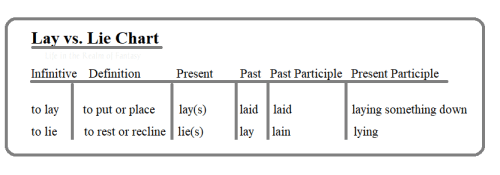
“Lay” is a verb meaning to put or place something somewhere. It has a direct object. Its principal parts are “lay,” “laid,” “laid,” and “laying.”

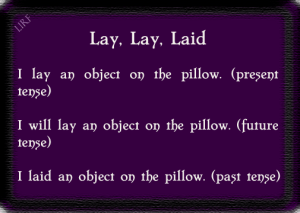
What the words refer to is the action: If you set it (object) there, it is laying there. Lay it there. Lay it on the pillow.

If it is resting or reclining, it is lying there. Lie down. Lying down. Lie down, Sally. (Clapton had it wrong? Say it isn’t so!)

The internet is your friend. Quote from the wonderful website Get it Write: The verbs to lie and to lay have very different meanings. Simply put, to lie means “to rest,” “to assume or be situated in a horizontal position,” and to lay means “to put or place.” (Of course, a second verb to lie, means “to deceive,” “to pass off false information as if it were the truth,” but here we are focusing on the meaning of to lie that gives writers the most grief.)

This is where things get tense: present, past, and future.

A ring lay on the pillow. 

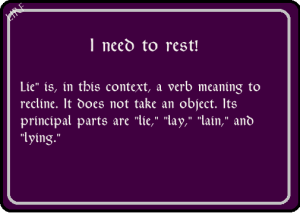
But I needed to rest:

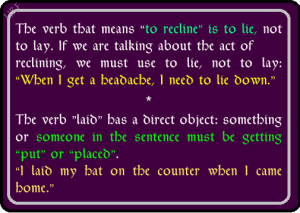
So what this all boils down to is:


But just to confuse things:

A living body lies down and rests as is needed.

A dead body is cleaned up and laid out by other people if said corpse was important to them. However, after having been laid out the corpse is lying in state to allow mourners to pay their respects.


Attributions and Credits:

This post first appeared on Life in the Realm of Fantasy on July 15, 2015, as Lay, Lie, Laid, © 2015-2017 by Connie J. Jasperson, all rights reserved.

Quote from: To Lie, or To Lay, Get it Write online, http://www.getitwriteonline.com/archive/051402lielay.htm, accessed July 11, 2017

4 Comments

Filed under writing

#amwriting: personality and the fight scene

I am in the process of getting one of my works in progress, Billy Ninefingers, ready for publication. This tale takes place in the world of Waldeyn, and Huw the Bard makes an appearance, although not in the opening chapters.

The book opens on a sunny day, and my characters are wearing armor. Their conversation tells us they’re nervous about the trail they are on. Through their casual comments, we learn that the world they live in is dangerous, and people must hire guards to protect them from more than just highwaymen if they choose to travel. The three paragraphs of that conversation are all the reader needs to know about the work my characters do and the trail they are riding. That scene ends and the next scene takes them and the merchant they are guarding to their destination, the dark, dirty town of Somber Flats.

The second scene is the setup for the inciting incident, the moment we meet the first antagonist, Bastard John. When he enters the scene, it is one of the few times when the Bastard will be in such a place that we can see who he is as a person. The inciting incident makes no sense unless the reader knows that the Bastard is an obnoxious bastard, and proud to be so-named.

At this point, an argument ensues, which turns violent. Scenes involving fighting are controlled chaos—controlled on the part of the author. There must be a reason for the fight, one that goes beyond the need for livening things up. When it comes to fighting, I keep it concise and linear, as drawn-out fight scenes bore me to tears.

Most authors get hung up on the technical side of the fight–how they were dressed, who hit who with what weapon, and so on. These are necessary elements of the scene that good, responsible research and an author’s diligence can resolve.

But there is a larger consideration to your battle: you must have a good reason for the conflict. No one is going to stick with a novel where random, convoluted battles happen for no good reason. They hack, they slash, blood flows, the winner walks away–but why did it happen? What is the purpose of injecting that conflict into the narrative? In Billy Ninefingers, besides the obvious fact that he is seriously injured in the fight, which is the core plot point of the book, I had two other goals with that fight scene:

  1. I needed to show how the Bastard is jealous and acts on any thought that passes through his alcohol-soaked mind.
  2. In the resolution of that scene, my intention was to demonstrate that Billy, even with his life in ruins, has a sense of fair-play.

Each character in the fight is, and must remain, a unique individual. There should be no blurring of personalities, which can happen when an author focuses to intently on the action of the fight scene, writing it as if they lived it. For the author, acting out the action ensures that the moves are reasonable and make sense, but you aren’t done writing that scene just because the hacking, slashing, and gunshots are on paper. You must go back to the first part of that section, and make sure you haven’t lost the individuality of the characters in the chaos. Each character must be portrayed in the actions sequence in such a way the reader doesn’t say, “He wouldn’t do that.”

Consider the people you know. Picture the ones you like to spend time with. What is it about them that captured your interest in the first place? I’m not talking lovers here, so set the irresistible chemistry aside and think about their mannerisms, their habits.

That sense of uniqueness is what we must give our characters through their habitual movements and speech, and it is crucial we maintain those differences when we describe a fight scene.

Our bodies, as well as our faces, are in constant motion. You can show this in small, unobtrusive ways by sitting back and visualizing your scene as if you were the witness rather than a participant, making it real in your mind before you commit it to paper.

In conversation, people miss a few beats when they are speaking. They gather their thoughts and speak in short bursts. They shift in their chair, or stand up, or wave a hand to emphasize a point. They turn, and sometimes mumble.

Every character’s mannerisms are individual, uniquely theirs. You, as the author, visualize them this way, but the difference between success and failure as an author is the ability to commit their personalities to paper. Many authors don’t succeed at this—they either fail to give enough subtle clues to the reader, or they are too specific. The fine line between enough and too much is where the author’s artistry comes in.

Through physical actions and conversational interactions, we make our characters knowable and likable (or not, as the case may be). Their actions as they interact with their environment and each other illustrate the world they exist in. Each scene is your opportunity to convey the setting and the mood of your characters without resorting to an info dump.

Especially when describing a fight scene, the author must give the impression of detail, offering the reader a framework to hang his imagination on. We use our words sparingly and with intention, painting the idea and the atmosphere of the conflict as if painting  the scene in the style of the impressionists.

I love it when I can suspend my disbelief and become immersed in the story, getting wrapped up in the fight because the battle is crucial, and the good people must win.

4 Comments

Filed under writing

#amgaming: Stardew Valley, by Chucklefish Games

I’ve mentioned before that I spend a certain amount of time playing computer games, especially when I am trying to avoid doing any serious writing. Just like the books I read when dodging work, I love to talk about whatever game I’m playing.

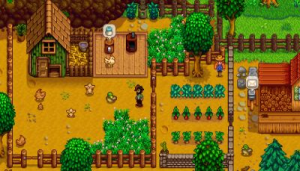
Today I am reviewing Stardew Valley, an open-ended country-life RPG which was built by indie programmer, Eric Barone under the alias Concerned Ape, and published by Chucklefish Games. It was released for Microsoft Windows in February 2016, with ports for OS X, Linux, PlayStation 4 and Xbox One appearing later that same year.

I love old-school, indie-built RPGs, and Stardew Valley is one of the more absorbing games I’ve played lately.

But first, the Blurb:

You’ve inherited your grandfather’s old farm plot in Stardew Valley. Armed with hand-me-down tools and a few coins, you set out to begin your new life. Can you learn to live off the land and turn these overgrown fields into a thriving home? It won’t be easy. Ever since Joja Corporation came to town, the old ways of life have all but disappeared. The community center, once the town’s most vibrant hub of activity, now lies in shambles. But the valley seems full of opportunity. With a little dedication, you might just be the one to restore Stardew Valley to greatness!

My Review:

The art and graphics are excellent and colorful. Each setting is fun to roam around in. If I have any complaint, it’s the amount of walking back and forth over the same ground that one has to do to complete the many tasks, and the game clock keeps ticking while you struggle to get your farm up and running. Fortunately, from day one of the game there are many places to forage from, and what you find can be sold to buy more supplies.

In this game, I always play a female character, but you can create a male character just as easily. You can choose one of five farm maps, each with different pros and cons. I prefer the one with extra foraging opportunities, but there is one with more mining resources and another with a fishing river.

In all the scenarios, the farm plot is initially overrun with boulders, trees, stumps, and weeds, and the player must work to clear them to rebuild the farm: you will be tending to crops and livestock to generate revenue so you can further expand the farm’s buildings and facilities.

I started over with different characters, once I figured out what I didn’t know when setting up the first character. That’s how I discovered the joy of having 4 completely different games going at once. (I laugh, but really I’m cringing.) Because I like each of the different storylines, I play whichever game I’m in the mood for, as none of the storylines are finished. I have married my each characters off to different bachelors, which generates a different storyline and completely different cutscenes every time.

There are ten marriageable characters, and each generates a different storyline. You can marry anyone you choose, male or female. If you marry a member of your own sex, you will be offered the option of adopting children.

Friendships are important, and you can gain a lot of friends by doing odd jobs which will be posted on the community bulletin board. Romance happens slowly because figuring out what the character you are wooing likes can be difficult.

The mines are difficult, with some tough monsters. The creatures are fun, and some are hard to beat, but you do gain strength, and the wise miner brings food, so nothing is impossible. Fishing takes a bit of work, and it’s not easy to learn, and figuring out how things work is challenging.

You will spend game time walking from place to place. A day on the farm typically takes 15 minutes of real time. Every task eats time—for instance, a walk to town consumes half an hour of the character’s game-day. Added to the challenge is the 3 hours (6-to-9:00 am or longer in game-time, not real time) you will devote to trying to get your chores done each morning so you can get going on cutting wood, fishing, or mining. All those tasks are important if you want to improve your farm.

This game contains many adult situations and isn’t really for young children. This game also teaches budgeting and planning, real-life skills many adults don’t have a great grip on. You do have to be careful with your gold. I suggest you add chickens and cows as soon as possible because, in Stardew Valley, mayonnaise is money—it’s the first reliable source of daily income, producing revenue even in the winter.

During recent weeks here at la Casa del Jasperson, the road of real life has been too rocky for me to write. Hence, I’ve found this game to be quite the enjoyable time-sink. As of this post, I have not completed all the side quests, but since May 13th I have put well over 100 hours into it.

I purchased Stardew Valley on Steam for my PC and play with an X-Box controller, but the game is available for the Nintendo PS4.

I give Stardew Valley 5 out of 5 stars, as it is an excellent example of indie produced RPG games.


Attributions:

Stardew Valley Screenshot, © 2016 Eric Barone, via Wikipedia

Comments Off on #amgaming: Stardew Valley, by Chucklefish Games

Filed under Game Reviews, writing

#amwriting: it’s #magic

Once magic enters your story, you must do some foot work, or your premise won’t be believable. It’s critical that you have finite rules for limiting how magic works. If your magic rules are too elastic, or you imbue too many amazing abilities into your main character, you will make them too good to be true. Readers won’t be able to relate to their story.

When I sit down to write a fantasy story, there will be magic, and I will have planned carefully for it. I have three worlds with three radically different systems of magic.

  1. In my serial, Bleakbourne on Heath, sorcerers use incantations sung to certain melodies.
  2. In Huw the Bard people can purchase magic (majik) amulets and potions.
  3. In the Tower of Bones series, magic and religion are intertwined. Aeos, the goddess, has decreed that all children who begin to show healing-empathy, or the ability to use the magic of the elements must be brought to the Temple and trained, for the protection of society in general. There are rules, certain things which can and can’t be done. As in real life, there are certain exceptions, but they too have limitations. No one is all-powerful.

Each time you make parameters and frameworks for your magic you make opportunities for conflict within your fantasy world. Remember, conflict drives the plot.

First, you must consider who has magic? What kind of magic–healing or offensive or both? What are the rules for using that magic and why do those rules exist? Magic is an intriguing tool in fantasy, but it should only be used if certain conditions have been met:

  • if the number of people who can use it is limited
  • if the ways in which it can be used are limited
  • if not every mage can use every kind of magic
  • if there are strict, inviolable rules regarding what each kind magic can do and the conditions under which it will work.
  • if there are some conditions under which the magic will not work
  • if the learning curve is steep and sometimes lethal

What challenges does your character have to overcome when learning to wield magic?

  • Is he unable to fully use his own abilities?
  • If that is so, why is he hampered in that way?
  • How does that inability affect his companions and how do they feel about it?
  • Are they hampered in anyway themselves?
  • What has to happen before your hero can fully realize his abilities?

Even if this aspect does not come into the story, for your own information, you should decide who is in charge of teaching the magic, how that wisdom is dispensed, and who will be allowed to gain that knowledge.

  • is the prospective mage born with the ability to use magic or
  • is it spell-based and any reasonably intelligent person can learn it if they can find a teacher?

Magic and the ability to wield it usually denotes power. That means the enemy must be their equal or perhaps their better. So, if they are not from the same school, you now have two systems to design. You must create the ‘rules of magic.’  Take the time to write them out.

In creating both social and magic systems, you are creating a hidden framework that will support and advance your plot. Within your magic system, there can be an occasional exception to a rule, but there must be a good reason for it, and it must be clear to the reader why that exception is acceptable.

Another important point to take note of is this: the only time the reader needs to know these systems exist is when they affect the characters and their actions. Dole this information out in conversations or in other subtle ways and it will become a natural part of the environment rather than an info dump.

It is a fact that sometimes books that were outlined to a certain storyline sometimes go off in their own directions, and the story is better for it. I haven’t experienced the sudden influx of magic into the story as that plot twist is always planned for, but I have had other random events throw a curveball at me.


Attributions:

Portions of this post have previously appeared here on Life in the Realm of Fantasy and also in my column on writing craft for the Northwest Independent Writers Association (NIWA).

Comments Off on #amwriting: it’s #magic

Filed under writing

#amwriting: the ‘e’ word #epilepsy

As many of my regular readers know, my husband and I share five children, all adults, two of whom have a seizure disorder.

Both my daughter and son were diagnosed with epilepsy when they were well into adulthood. Both have been hospitalized with severe injuries, but while our daughter’s journey with the seizure disorder has been relatively trouble free for the last ten years, our son has not had such luck.

Daughter 1 responds well to the medication and rarely has issues. Son 2 has had trouble getting his medication regulated, and his high stress lifestyle has often interfered with his ability to stay on track.

In conversation, as soon as folks hear the word ‘epilepsy’ they begin armchair prescribing cannabis, as the new cure-all for seizure disorders, and while the CBD end of the cannabis spectrum does have a miraculous effect for some patients, it is like any other medicine—it is not useful for everyone. My children are among those who do not benefit from it.

A ketogenic diet may help, but again, not every type of seizure disorder responds to this diet. However, it doesn’t hurt to try it, and so we are.

Surgery is an option when a cause for the seizures is clear and operable, but for most patients, there is no discernable cause. My children fall into this group, and until a more efficient type of brain scan is available, MRIs and EEGs remain inconclusive.

Epilepsy is caused by a range of conditions that are not well understood, and it is one of the less popular afflictions for research. The way it is treated is to throw medication at it until they happen on one that works, rather like Edison trying to invent the lightbulb.

At times, epilepsy rears its ugly head like Cthulhu rising from the depths, and when that happens life goes sideways for a while. The last two months have been difficult in many ways. I have been unable to focus on creative writing, although writing for this blog has been a lifesaver.

Revisions on Billy Ninefingers (a novel set in the same world as Huw the Bard) are going slowly, although I still hope to publish him in September. The first draft of my new (and as yet unnamed) series, set in the World of Neveyah (Tower of Bones), is on and off—sometimes more off than on.

This is just life, just the way stuff happens.  All is not lost. The creative muse will return as it always does.

Three weeks ago, my son had a partial seizure while cooking, and burned his right hand. He then spent four days in Harborview, the regional burn center for the Pacific Northwest. The burns are situated in such a way they are not good candidates for skin grafts, so they are healing slowly. In the process, I have developed some mad wound care skills. For perhaps another week or so, my son is staying with us as he is right handed and the wounds are in tricky places. Soon, he will be healed enough to tend to his own wounds and will go back to his own home.

The real story is, despite the wounds and temporary setbacks, life has been amazingly good. Healing is progressing. We have spent many hours playing Stardew Valley and sitting on the back porch talking and laughing about everything imaginable. This has been a good experience in ways we have found surprising. We have discovered we are not only family, but we are also friends with so many things in common.

This is why the old saying about clouds and silver linings is true—with every ill wind, something good has come along to offset the bad.

1 Comment

Filed under Epilepsy, writing

#amwriting: choosing a writing group

Every writer needs honest, constructive feedback to grow in their craft. Many will join critique or beta reading groups. These groups come in all sorts and sizes, some specializing in general fiction and some in genres like mystery, science fiction, fantasy, or romance.

Most communities have clusters of authors. In your community, you will find groups for beginning writers and some that cater to more advanced crowds. I guarantee there will be one to fit your needs.

We’ve all heard the horror stories regarding critique groups, and perhaps even experienced one. Making a poor choice can be devastating—it can undermine an author’s self-confidence and destroy their joy in the craft.

The seas are rough out there, but most writing groups are really good, supportive gatherings of authors who stay for years and welcome new authors into their group with open arms.

You may stumble upon groups who seem cliquish, unwelcoming, and daunting to new arrivals. Authors just beginning to explore this necessary part of the craft are not required to return to one of these groups if they were given the cold-shoulder the first time.

There is a difference in types of writing groups. Some are traditional critique groups, people who usually read a few pages aloud at their sessions and the others discuss it in detail in a round-table fashion, while the author listens. Often, these groups are large and because they are pressed for time, they don’t allow the author to ask questions or clarify points of confusion. Despite that flaw, this sort of focus on your work can be just right for some authors.

A group like that can tell you if you have made editing errors, and point out errors within the few pages they have sampled. For authors strapped for cash and unable to afford to hire an editor, this sort of group is an invaluable resource. What you learn about your writing habits in those pages will carry over into the larger manuscript.

However, because traditional critique groups focus only on 3 or 4 pages at a time they lack the context to be able to discern inconsistencies and flaws in the overall story arc. They don’t see enough of the work to tell if your protagonist is developed sufficiently by the first 1/4 of the tale, or if you have flattened your arc by placing your inciting incident too far from the beginning.

Unless you have submitted your entire novel over a period of time, formal critique groups usually can’t see subtle problems with

  • pacing
  • the overall story arc
  • worldbuilding
  • character development

They can’t see these things because these larger elements can only be judged by sampling more than three or four pages of a novel. One way around that is to seek input privately from one of the members if you have found someone who reads the genre in which you write, and feel comfortable enough to share that much with them.

If you are looking for input on large issues, my advice is to find a beta reading group.

But how do you select a group? Before you join a critique or beta reading group, you have the right to know what that group focuses on. Attend one of their meetings as an observer.

What do I want from this group? How do they treat each other’s work? When you get home, ask yourself these questions:

  • Did they address places where the submitted chapter bogged down?
  • What did the group think about the characters?
  • Did they address places where they became confused?
  • Did the group point out spots they had to read twice?
  • How did the group address places where the story become unbelievable or too convenient?
  • Did the readers care enough to wonder what would happen to the characters next?
  • How did the group phrase their comments? Was it supportive as well as instructional?
  • Did they encourage conversation about the chosen work?
  • Is discussion discouraged? If the author was not allowed to discuss their work or ask questions, it is a red flag that should be noted.

Ask yourself, “What vibes did I get from this group of people? Will I benefit from sharing my work with this group? Did the comments they made to each other sound helpful?” Hopefully, the answer to those questions will be a resounding “yes.”

If not, run now. Run far, far away.

If you are considering joining the group, ask the leader/chairperson these questions:

  • If the group is a beta reading group focused on first drafts, what do they consider a first draft? Do you have to hire an editor and have it thoroughly edited before you submit it to this group? Because that is not a first draft, and that group would be a waste of your time.
  • Will you receive insights into your manuscript on points you hadn’t considered, or will the focus of the discussion center on minor editing issues that you are already aware of?
  • Ask the leader to define for you the specific areas that readers will be looking at: Character development, pacing the arc of the scene, pacing the arc of the conversation, worldbuilding.

When you think have found a group you feel comfortable sharing your work with, and you trust them enough to submit your first piece to them, take notes on the experience. When you are home, ask yourself:

  • Do I still feel positive about my work or do I feel like my work was treated as being less than important?
  • Did I gain anything from the experience that would advance the plot or did I just hear a rehash of armchair editing from a wannabe guru?
  • When I was discussing the direction I wanted to take the tale in, did I sense that they were interested in my story?

If the answers are anything other than a resounding “yes” you have the right to leave the group.

The answers to these questions have to be that you feel good about your work, that you saw through their eyes the weaknesses, and you now know what you need to do to make your story great. You must be filled with the conviction that you know what needs to be done, and you must still have passion for the story.

Authors attend their first meeting with a new writing group hoping to find likeminded people. We are filled with uncertainty and fear the first time we meet these people. At the end of the day, you have to feel as if you have gained something from the experience.

Hopefully, you will be as fortunate as I have been, and find a group of authors who will support and nurture you in the craft of writing. The way to repay them for their help is to support them and their efforts wholeheartedly.

9 Comments

Filed under writing

#amwriting: compound words and hyphens

Compound words are frequently a source of grief when I receive my manuscript back from my editor. Despite my best efforts, unless I am on my toes in the writing process I habitually hyphenate words that should not be hyphenated.

Most people know that a compound word is a combination of two or more words that function as a single unit of meaning.

Most people also know that there are two types of compounds:

  • those written as single words, with no hyphenation and which are called “closed compounds”– such as the word “bedspread,”
  • “hyphenated compounds,” such as “jack-in-the-box” and “self-worth.”

But there is a third group, and they are the bane of my writing life–those mysterious, ephemeral denizens of the deepest corner of writer’s hell, called open compounds. These seemingly innocent instruments of torture are written as separate words–the nouns “school bus” and “decision making,” for example.

Fortunately, the English language has rules to guide us when deciding if it’s one word, two separate words, or a hyphenated word:  

Do not use a hyphen unless it serves a purpose. If a compound adjective cannot be misread or, as with many psychological terms, its meaning is established, a hyphen is not necessary.

The American Psychological Association  style guide gives of these examples:

covert learning techniques, health care reform, day treatment program, sex role differences, grade point average

Use a hyphen in a temporary compound that is used as an adjective before a noun

Use a hyphen if the term can be misread or if the term expresses a single thought.

  • “the children resided in two parent homes” means that two homes served as residences, whereas if the children resided in “two-parent homes,” they each would live in a household headed by two parents.  In that case, a properly placed hyphen helps the reader understand the intended meaning.

We also use hyphens for compound words that fall into these categories:

  • if the base word is capitalized: pro-African
  • when writing numbers: post-1910, twenty-two
  • an abbreviation: pre-ABNA manuscript
  • more than one word: non-achievement-oriented students
  • All “self-” compounds whether they are adjectives or nouns such as self-respect, self-esteem, self-paced.

We hyphenate words that could be misunderstood when there are diverse meanings if they’re unhyphenated:

  • re-pair (to pair again) as opposed to repair (to mend)
  • re-form (to form again) as opposed to reform (to improve)

We hyphenate words in which the prefix ends, and the base word begins with the same vowel:

  • metaanalysis
  • antiintellectual

The problem is unless you are a technical writer, how often are we going to use those terms? Hence, the confusion when we DO use them.

Get It Write online says, “One way to decide if a hyphen is necessary is to see if the phrase might be ambiguous without it. For example, “large-print paper” might be unclear written as “large print paper” because the reader might combine “print” and “paper” as a single idea rather than combining “large” and “print.” Another such example is “English-language learners.” Without the hyphen, a reader might think we are talking about English people who are learning any language rather than people who are learners of the English language.”

A good rule to remember is most words formed with prefixes and suffixes are written as one word with NO hyphen.

Prefixes: Afterglow, extracurricular, multiphase, socioeconomic

Sufixes: Arachnophobia, wavelike, angiogram

When I am laying down prose in the first draft, my natural inclination when writing these words would be to hyphenate them, but that is wrong, and my editor always kindly reminds me of this.

When in doubt, it is wisest to look the word up in an online dictionary to see the various different ways it can be combined. Just go to:

http://www.merriam-webster.com

What it all comes down to is this—when editing for another author I am able to see these things clearly. In my own work–it’s like my finger has a twitch that absolutely MUST add a hyphen to compound words that should remain separate, and separates words that should be joined.

This is why the editor has an editor for her own work.


Credits and Attributions:

When do you need to use a hyphen for compound words? The American Psychological Association, http://www.apastyle.org/learn/faqs/when-use-hyphen.aspx accessd June 25, 2017

Compound Words: When to Hyphenate, Get It Write, Nancy Tuten and Gayle Swanson  http://www.getitwriteonline.com/archive/042703compwdshyph.htm, 2017

Parts of this post were originally posted March 4, 2014, as Hyphen Help Us, by Connie J. Jasperson, © 2014-2017.

13 Comments

Filed under writing

#FlashFictionFriday: Quiet of an Early Summer Morning

Passer_insularis_Smit

The quiet of

An early summer

Morning

Sinks into my soul,

Warming my spirit like coffee.


At twelve past five

The birds are present,

Singing,

Songs of love, poems of war

While I appreciate my coffee.


Feathered beings

Living swift and fierce,

Passionately,

As summer waxes into fall

And I enjoy my coffee.


Quiet of an Early Summer Morning, by Connie J. Jasperson © 2017 Connie J. Jasperson, All Rights Reserved.

Depiction of the Socotra Sparrow, from its description in the Proceedings of the Scientific Meetings of the Zoological Society of London. Female above, male below. Joseph Smit 1881 [Public domain], via Wikimedia Commons

Comments Off on #FlashFictionFriday: Quiet of an Early Summer Morning

Filed under #FlashFictionFriday, Poetry, writing

#amwriting: Writing a Short Story to a Theme

Writing short stories is both difficult and easy. They are easy because you can keep it simple, just a few characters, one problem, and an overarching theme that runs through the whole thing.

However, they are difficult because of those same constraints.

What are the main considerations when writing a short story?

Plot Structure, or the way the story is arranged:

  1. the setup
  2. the obstacle
  3. the turning point
  4. the resolution/outcome

The Set-up: You must have a good hook. In some cases, the first line is the clincher, but especially in a short story, by the end of the first page, you must have your reader hooked and ready to be enthralled.

The theme, or the core of the plot, an idea-thread that runs through a story from the opening pages to the end. Theme binds the four primary elements of characters, conversations, actions, and reactions. Theme is independent of the setting or genre.

Word Count: Many times, publications and anthologies will have strict limits on the wordcount, such as no more than 4,000 or less than 2,000.

When you are new to writing short stories, limiting the background information and sticking to the theme and is the most difficult part of the task. In my own early drafts, I often have a lot of information that doesn’t advance the story. Background information on the sidekicks is not needed, nor is any background on the setting unless the setting is a core plot point.

In a short story, you must take one idea and riff on it until you reach the end, and if you are offered a theme to write to, you at least have a framework on which to hang your plot.

Wikipedia, the fount of all knowledge, describes theme as:

The most common contemporary understanding of theme is an idea or point that is central to a story, which can often be summed in a single word (e.g. love, death, betrayal). Typical examples of themes of this type are: conflict between the individual and society; coming of age; humans in conflict with technology; nostalgia; and the dangers of unchecked ambition. A theme may be exemplified by the actions, utterances, or thoughts of a character in a novel. An example of this would be the theme loneliness in John Steinbeck‘s Of Mice and Men, wherein many of the characters seem to be lonely. It may differ from the thesis—the text’s or author’s implied worldview.

Often we can visualize a complex theme, but we can’t explain it. If we can’t explain it, how do we show it? Consider the theme of “grief.” It is a common emotion that can play out against any backdrop, sci-fi or reality based, where there are humans interacting on an emotional level.

Perhaps you have an idea for a story about a woman who has just lost her husband to a preventable accident. Her grief is the main theme. When you learn the accident that killed him was preventable, you know the subtheme: anger. The protagonist’s goal in this story is to prevent such accidents from happening again–perhaps she must battle a corporation or take on a government agency. Rage is the motivator that forces her to wake up each day and take on the Goliaths, but at the root of the story, it is her grief that is the driving force behind her subsequent actions.

Grief is an extremely complex experience, as anyone who has ever suffered the loss of a loved one will tell you. It is a fundamental emotion, chaotic and weighing heavy in the heart of one who grieves. It is experienced in many identifiable stages with elements of loneliness, anger, guilt, and deep suffering. It is sometimes accompanied by thoughts of suicide.

Everything your character sees and experiences in the opening scenes underscores and represents her sense of loss and inspires the accompanying emotions of anger, futility, and depression. As her story progresses and she begins live despite her loss, she will still be affected on many levels and to a certain extent, driven by those complex emotions. While she is interacting with others who are happy and who believe she has gotten past her pain, you can employ subtle allegories and symbolism to paint the deeper picture of her mental state to show how she is deeply depressed and possibly suicidal.

Once your protagonist has beaten the enemy, what is her reaction? Without the battle to sustain her rage, does she learn to accept her loss begin to find happiness? Or does she allow herself to spiral into ever worsening depression?

When writing short stories,

  • we keep the cast of characters to a minimum
  • we keep the setting narrow: one place, one environment, be it a cruise ship, a restaurant, or a gas station—the setting cannot be epic in scale.
  • We introduce no side quests.

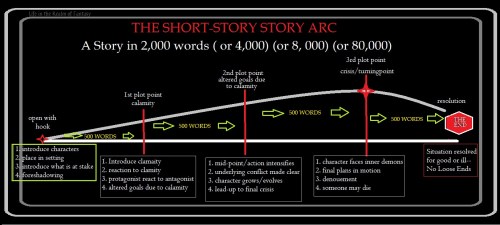
Let’s say you want to write a story that can be no longer than 2,000 words. You know have an idea, but when you sit down and begin writing, you find you have too much story for only 2,000 words.

You need to map it out.

Short-stories are just like novels, in that they follow the story arc. If you know what theme you must write to and you have an idea for a plot, you can make the story arc work for you.  The following illustration is a visual guide to help you when mapping out your short story:


Credits:

Wikipedia contributors, “Theme (narrative),” Wikipedia, The Free Encyclopedia, https://en.wikipedia.org/w/index.php?title=Theme_(narrative)&oldid=765573400 (accessed June 20, 2017).

11 Comments

Filed under writing