#amwriting: mindwandering and the creative muse

kleenexI’ve been suffering from a heavy cold all weekend, and doing my work from bed. Me and NyQuil are once again best friends. So, imagine my surprise yesterday when I wrote what was supposed to be today’s blogpost and instead of pressing the “save as draft” button, I hit “publish.”

Oops.

So that meant I didn’t have a post for today. Thus, I have gone to the archives, and pulled up an old post, updated a few thing and voila! I have a post for today. Yesterday’s post  still there, so check it out!


When people first discover I write fantasy tales, the first thing they ask (after what the heck are you thinking) is where I get ideas for my tales.  I usually give them some song-and-dance about adapting modern relationships and values to mythological world situations and while it’s true, it’s not the whole truth.

The real truth is, these thing just pop into my head, and I think “Wow – that would be a good story.”  I will be riding in the car listening to music, not thinking about anything in particular and I will have a flash of brilliance – What if the dark ages never happened? or  How would Europe look if the Druids had conquered Europe instead of the Romans?

If I’m smart, I will write the idea down, because I’m 63 years old and the old main-frame ain’t what she used to be, memory-wise.

The flow of random thoughts really is the river of creativity for me. Letting your mind roam free and allowing the possibilities to enter your stream of consciousness (or not, as they will) is good for you.  Fifteen or twenty minutes a day of simply watching the world go by will rejuvenate you.

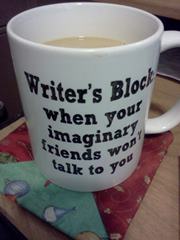
Some people will say, “I don’t have time to waste daydreaming,” and that’s all right for them. I personally need to throw open the windows of my mind and let the breezes clear away the musty ideas which get in the way of my creativity. For me, the path to writer’s block is paved with “I don’t have time to relax!”

Don’t get me wrong, I get up at 5:30 am and immediately begin blogging. After noon I read for several hours and then I do revisions or work on my current Work In Progress. I read before I go to sleep.  I do two weekly book review blogs besides this blog, and all in all I work 10 to 16 hours a day at this job, but it is interspersed with various household tasks and errands.  I also take the time to let my mind rest, simply watching the town go by from my back porch.

Some people call it meditation, and some people call it a waste of time.

I call it necessary.

I think of my mind as if it were an ‘idea farm.’.Just as a wise farmer allows his fields to occasionally lie fallow it is important to let your mind rest. Letting farmlands lie fallow is one of the best ways of allowing the land to replenish its nutrients, and regain its fertility. Letting your mind roam with no particular direction is essential in lowering your stress levels (!) which immediately improves your health and your thought processes.

So I guess  when  someone asks me where I get ideas for my tales I should tell them the truth:

I don’t really know!


mindwandering and the creative muse was first published on Life in the Realm of Fantasy on July 11, 2012 under the title The Idea Farm.

Comments Off on #amwriting: mindwandering and the creative muse

Filed under writing

#amwriting: magic and creating the rules of engagement

magicEvery now and then, new authors look at me with an awestruck expression, and say something like. “I was just  writing along, and all of a sudden my characters gained the ability to use magic. I wasn’t writing a fantasy, but now I am.” (It could be any ability or thing, but we are discussing magic today.)

It is a fact that sometimes books that were outlined to a certain storyline sometimes go off in their own directions, and the story is better for it. I haven’t experienced the sudden influx of magic into story, but I have had other random events throw a curve ball at me.

The fact is, when I sit down to write a fantasy story, there will be magic, and I will have planned carefully for it. I have three worlds with three radically different systems of magic.

In my serial, Bleakbourne on Heath, sorcerers use incantations sung to certain melodies.

In Huw the Bard people can purchase magic (majik) amulets and potions.

In the Tower of Bones Series, magic and religion are intertwined. Aeos, the goddess, has decreed that all children who begin to show healing-empathy, or the ability to use the magic of the elements must be brought to the Temple and trained, for the protection of society in general. There are rules, certain things which can and can’t be done. As in real life, there are certain exceptions, but they too have limitations. No one is all-powerful.

Once magic enters your story, you must do some foot work, or your premise won’t be believable. It’s critical that you have finite rules for limiting how magic works. If your magic rules are too elastic, or you imbue too many amazing abilities into your main character, you will make them too good to be true. Readers won’t be able to relate to their story.

Each time you make parameters and frameworks for your magic you make opportunities for conflict within your fantasy world. Remember, in fantasy, conflict drives the plot.

Without rules, there would be no conflict, no reason for the hero to struggle, and no story to tell.

First you must consider who has magic? What kind of magic–healing or offensive or both? What are the rules for using that magic and why do those rules exist? Magic is an intriguing tool in fantasy, but it should only be used if certain conditions have been met:

  1. if the number of people who can use it is limited
  2. if the ways in which it can be used are limited
  3. if not every mage can use every kind of magic
  4. if there are strict, inviolable rules regarding what each kind magic can do and the conditions under which it will work.
  5. if there are some conditions under which the magic will not work
  6. if the learning curve is steep and sometimes lethal

What challenge does your character have to overcome in regard to his magic?

  • Is he unable to fully use his own abilities?
  • If that is so, why is he hampered in that way?
  • How does that inability affect his companions and how do they feel about it?
  • Are they hampered in anyway themselves?
  • What has to happen before your hero can fully realize his abilities?

Even if this aspect does not come into the story, for your own information you should decide who is in charge of teaching the magic, how that wisdom is dispensed, and who will be allowed to gain that knowledge.

  1. is the prospective mage born with the ability to use magic or
  2. is it spell-based, and any reasonably intelligent person can learn it if they can find a teacher?

Magic and the ability to wield it usually denotes power. That means the enemy must be their equal or perhaps their better. So if they are not from the same school, you now have two systems to design. You must create the ‘rules of magic.’  Take the time to write them out.

In creating both social and magic systems, you are creating a hidden framework that will support and advance your plot. Within your magic system, there can be an occasional exception to a rule, but there has to be a good reason for it, and it must be clear to the reader why that exception is acceptable.

Another important point to take note of is this: the only time the reader needs to know these systems exist is when they affect the characters and their actions. Dole this information out in conversations or in other subtle ways and it will become a natural part of the environment rather than an info dump.

1 Comment

Filed under writing

#amthinking: Contemplations on the Sin of Hubris

hubrisI have been considering the concept of “hubris” lately. It is a somewhat rare word, one we don’t hear too often, but it is one we may be hearing more of in the coming years. It is also a word with a unique, multilayered meaning that no other word quite embodies.

Hubris is an extreme form of pride and is generally considered a sin in the world’s religions. The great Christian writer, C. S. Lewis discussed extreme pride in his book,  Mere Christianity. He states that pride is the “anti-God” state, the position in which the ego and the self are directly opposed to God: “Unchastity, anger, greed, drunkenness, and all that, are mere fleabites in comparison: it was through Pride that the devil became the devil: Pride leads to every other vice: it is the complete anti-God state of mind.”

This is why hubris is such a fine quality for a literary super-villain, but a poor quality for a world leader. Yet many world leaders are gifted with a large capacity for it.

Quote from Wikipedia: Hubris (/ˈhjuːbrɪs/, also hybris, from ancient Greek ὕβρις) describes a personality quality of extreme or foolish pride or dangerous over-confidence. In its ancient Greek context, it typically describes behavior that defies the norms of behavior or challenges the gods, and which in turn brings about the downfall, or nemesis, of the perpetrator of hubris.

The way I see it: Hubris often indicates an unrealistic perception of one’s own competence, accomplishments or capabilities. It is characterized by a lack of self-restraint, excessive vanity, and is a trait with moral and/or ethical implications. In some cases, it is so extreme that a lack of empathy and victim blaming frequently go hand-in-hand with hubris. Other people are less important, perhaps even disposable.

People possessed of hubris hear and see only that which supports their fantasy. They are deaf and blind to anything that runs counter to their unreality.

In Literature:

Paradise Lost: John Milton

FrankensteinMary Shelley

Things Fall ApartChinua Achebe

frankenstein (1)A defense mechanism against poor self-esteem, the person exhibits an inflated sense of superiority. Those possessed of hubris often refuse to accept that they are not better than the average person even when faced with proof of their folly.

Quote from Wikipedia: The proverb “pride goeth before destruction, a haughty spirit before a fall” (from the biblical Book of Proverbs, 16:18) is thought to sum up the modern use of hubris. Hubris is also referred to as “pride that blinds.”

People possessed of hubris frequently make decisions that defy rational thinking. This is not a trait we wish to see in our world leaders, but as I say, it makes fine fodder for developing the character of a literary super-villain.

The ancient Greeks had a view of hubris slightly different from the modern view: Consider the following quote:

Definition of Hubris by Aristotle

Aristotle mentions Hubris in his book “Rhetoric”:

“Hubris consists in doing and saying things that cause shame to the victim…simply for the pleasure of it. Retaliation is not hubris, but revenge. … Young men and the rich are hubristic because they think they are better than other people.”


LiteraryDevices Editors. “Hubris” LiteraryDevices.net. 2013. http://literarydevices.net/hubris/ (accessed November 24, 2016).

Hubris. Author: Wikipedia contributors. Publisher: Wikipedia, The Free Encyclopedia.

2 Comments

Filed under writing

#amwriting: #gratitude

gravy_1The best thing about the Thanksgiving meal is the gravy.

Just saying.

And for this vegan, mashed taters and mushroom gravy are heaven on a plate.

To be vegan means I only eat plants and foods made from plants. I don’t eat meat, fish, dairy, or eggs. Unlike some people, I’m not evangelical about my dietary choice. I simply bring my own food wherever I go.

I choose this diet because I have an autoimmune form of arthritis triggered by dairy and animal proteins. I have been pain-free since adopting this lifestyle in 2012. In terms of money, it’s far less expensive, as beans are my go-to protein source, and a variety of vegetables are relatively inexpensive. Other family members have more ethical reasons for not eating animals–if you are curious as to the many reasons for choosing a vegan lifestyle, click here.

We’re going to daughter number two’s house this year. I am bringing vegan foods, as there will be several vegans there besides me. I make my mashed potatoes with lots of Earth Balance margarine (100% plant-based, unlike most margarines) and I also throw in a heft dollop of Sour Supreme (Tofutti’s brand of vegan sour cream). We don’t make mashed potatoes very often, as we are careful about the amount of fat we normally consume, but this is a special meal.

This year I am making everything gluten free that I can, because my daughter’s mother-in-law has celiac disease, and anything with gluten will make her terribly ill. I found an amazing recipe for that most delicious of comfort foods, gluten-free mushroom gravy as created by Molly Katzen. I’m also making a crustless pumpkin custard–the vegan pumpkin pie filling in custard dishes rather than in a pie shell. Wheat flour is the natural source of gluten, so there will be no wheat in anything I make and bring to this event.

I am not a fan of that well-known holiday staple, the Tofurkey, although many vegans are. I prefer to just eat the side-dishes and I do go a little wild on the vegan cheese tray. Miyoko’s Kitchen makes the most amazing spreadable cheese, and it’s all plant-based. It’s quite expensive, but for a special occasion it is so worth it.

I’m playing around with the idea of stuffed squash boats, using a savory wild-rice pilaf to stuff them with, if I can find the perfect squash. Or perhaps I’ll stuff the pilaf into those colorful little mini-peppers.

Food Network Vegan Pumpkin Pie

Food Network Vegan Pumpkin Pie

Regardless, it will be a famdamily free-for-all as four of our five children will be there along with their extended families. The grandchildren will be running wild, our daughter’s kitchen will be packed, seven conversations will be occurring at once, and the noise level will approach that of a space-shuttle launch.

No longer the main cooks, my husband and I and the other older people will keep the grandparental eye on the littlest grandkids so their parents can get the meal ready to be served. When the tables are set, and the prayer is said, we old people will be thankful for our many, many blessings.

Here in the US, Thanksgiving “traditionally” marks the beginning of the Christmas shopping season, but I tell you this now: Being in the company of our children and their children, and sharing this meal with our children’s in-laws is a gift more precious than anything that could arrive wrapped in tissue paper.

The dinner will be loud, and not always polite as the youngest are still learning manners. There will be the lovingly waged war between the vegans and the carnivores. We will find common ground in the mashed potatoes and the two different kinds of gravy. But chaotic and messy though it will be, it will be a table full of love and that is a dish no one can pass up. This large, noisy, sometimes dysfunctional family we have blended from so many disparate pieces is the only real treasure we have. My husband and I are filled with gratitude for every minute we have in their company, grateful in ways that can’t be expressed with mere words.

Vegan Pumpkin Pie recipe here

Vegan Gluten Free Gravy recipe here

Vegan Mashed Potatoes recipe here

Miyoko’s Kitchen|Artisan Cultured Vegan Cheese

3 Comments

Filed under Vegan, writing

#amwriting: the truth about #NaNoWriMo

NaNoWriMo-General-FlyerEvery author knows that writing is about so much more than merely laying words down on a page.   Most people with a minimal education can do that, and can even whack out a creditable paragraph or two. However, sustaining the momentum and carrying that vision through an entire story is quite another thing.

Over the years, I’ve seen disparaging articles where people have expressed their scorn and disdain of authors who participate in Nation Novel Writing Month, mocking the notion of a “competition.”

But these naysayers are overlooking one important point: to write a novel one must begin a novel and then complete it.

If it takes a special month of writing and a group frenzy to get some people fired up about an idea they’ve had rolling around in their heads, who am I to complain?  I am a reader as much as I am an author, and I say the more, the merrier!

Take a look at some of the most well-known “NaNo Novels” of all time:

  1. Water for Elephants, by Sara Gruen. On the best-seller lists for over a year, turned into a movie starring Reese Witherspoon and Robert Pattinson, started as a NaNo novel.
  2. The Night Circus, by Erin Morgenstern. What eventually became The Night Circus began life in 2004, seven years before it was finally published, started as a NaNo novel.
  3. Wool, by Hugh Howey. Howey’s dystopian sci-fi novel is one of those credited with putting self-publishing on the map, started as a NaNo novel.

I’m not bothered by the “poo-poo on the contest” noise. Whatever gets a writer fired up and writing is fine by me, and we are all the better for the experience.

The real thing that causes angst among the elite is the notion that anyone with an idea can sit down and write the bare bones of a book in 30 days. Being an author is not being in a private club anymore, and it secretly bothers some of the stodgier “real” authors that a person of any background, religion, or ethnicity can dare to write meaningful or entertaining work, even people with minimal education.

Fear and Loathing, we call that. It’s irrational, but then no one ever accused authors of being rational! There will always be a need for more authors and more books, as once a book has been read, the dedicated reader wants a new book. It is the law of supply and demand, and publishing is a business.

The fact is, most people who begin a novel in November do not reach their goal of 50,000 words and never finish those novels. They do not have the discipline to sit down every day and dedicate a portion of their time to this project.

A great number of Nano Authors discover that doing NaNoWriMo is just like doing karaoke. They love to read, and they want to write the next Gone with the Wind, but their work reads like a tone-deaf drunk sounds when singing Wind Beneath my Wings.  They are not talented writers. But so what? The cream always rises to the top, my grandma used to say.

Because of NaNoWriMo, many truly talented people are now embarking on learning a craft, committing their time and resources to educating themselves about how to write a novel that others will want to read. Several years down the road, who knows what wonderful works of fiction will have emerged from this year’s madness?

NANO CrestI only know that I am always looking for a good book, and so I will be first in line, hoping to be blown away by a fresh, new work of art. This is why I volunteer as a Municipal Liaison for NaNoWriMo. Every year we have new, young writers, with fresh, amazing ideas. But we also have many new older people who are writing their first novel, embarking on a dream they always had but never thought they could do.

Most who begin their novel this year will never write again. But every year a few writers  in each age group continue on after the month of madness is over. When I talk to them and hear how fired up and passionate they are, I am proud to have been a part of their writing life. They see the goal, and and are filled with the desire to finish what they started.

They have embarked on the quest to learn how to write well.

2 Comments

Filed under NaNoWriMo, writing

#flashfictionfriday: Scrofulous Mudd (reprise)

Scrofulous Mudd was first published here in May of 2016. The story itself was prompted by the first line. Once I had that, the rest of the story followed. 


Scrofulous Mudd was a dirty old man.

By that I mean he was an elderly man who sorted through the leavings in ancient privies and wrote highly boring papers detailing the history of what he uncovered. He kept himself moderately clean, and took baths every Saturday unless an additional effort was required, such as for his mother’s funeral.

I suppose his fascination with filth began with his elegantly disease-ridden name. His was a difficult delivery, and when the elderly volunteer came around asking about the new baby’s name, Maude Mudd was still a little out of it. A scholar of Roman Literature, what she had actually said was “Rogellus.”

The volunteer, a retired nurse of infectious diseases, had misunderstood her mumbled words. Thus, Scrofulous, or Scroffy, as he was known at school, was given a name difficult to live up to.

Young Scroffy never knew his father, nor was any father named on his birth certificate. He assumed his had been a virgin birth, as his mother had never said otherwise and to his knowledge she never had gentlemen callers.

In truth, Maude’s single night of passion with the Professor of Antiquities had occurred after both had consumed far too much sherry at a faculty mixer at the at the beginning of fall semester. Hung-over, embarrassed, and terribly disappointed by sex in general, she immediately accepted the offer of a research position at a University far, far away, in Scotland to be exact.

It wasn’t until several months later that she realized she had a little Mudd in the oven. Things were different in those days, and rather than lose her position at the University for being morally unfit, she padded her chest, making herself appear to be merely stout. She hired a live-in housekeeper and continued with her work until the day of his delivery, which occurred just at the beginning of summer break. When the next term began, a much slimmer Professor Maude Mudd returned to school as if nothing had happened.

via wikimedia commons

Nanny MacDuff cared for young Scroffy as much as she was able, which was not a lot, as she had a pinched heart, but she did do her best by him. Many times Scroffy and his pram were left parked outside the post office, forgotten until Nanny arrived home and suddenly wondered where the washing powder she had tucked in his carriage was.

However, she saw to it he was as clean and well-fed as any other child. Both the infant Scroffy and Maude Mudd’s house were vigorously scrubbed daily, and both shone like polished chrome.

Never having been a maternal woman, Maude felt she had fulfilled her parental obligation, by hiring a nanny. While she did occasionally ask after his health in a general sort of way and whether he was doing well in school, she rarely had any reason to communicate with him.

As a small child, the books in his mother’s library fascinated him, but that room was strictly off limits. Nanny explained that little boys had dirty fingers, and so he should never touch the ancient, irreplaceable tomes. However, he often stood just outside the door, peering in, wondering what mysteries lay concealed within those pages.

Scroffy spent his childhood at boarding school. He did well in primary school and was a good student during his secondary years. It was there he discovered history could be uncovered by digging through the garbage left behind by our ancestors, and it was a science called Archaeology.

Perhaps it was his lifetime of rigorously enforced cleanliness at the hands of Nanny and the various Matrons, or perhaps it was the only rebellion he could think of, but dirt, and what it concealed, attracted him.

He was rarely invited home for holidays, and thus, Maude had nearly forgotten about her son when she was surprised to receive a letter from him thanking her for his education. He also explained he would be taking his newly earned Doctorate in Archaeology to London, and hoped she would understand.

In London, he indulged his passion for filth, digging up medieval midden heaps and privies, sifting the soil, and exclaiming over dubious treasures. Unlike his fellow scientists, he didn’t mind the filthy conditions, and relished a good, big find, feeling as if the night-soil of generations past somehow filled in the blank, far-too-clean slate of his childhood. He also began acquiring his own library of rare books, and manuscripts of historical significance, all of them shining a little light on the dark, dirty realities of medieval life.

It was said by his peers that Scrofulous Mudd knew more about the dark ages than the people who’d actually lived through those times. Had he been told that to his face, he would have agreed.

Forty years passed, during which time Maude Mudd rarely gave any thought to her absent son, although he thought of her at times. At first, he’d hoped for a letter or card, or an invitation to Christmas dinner but eventually gave up believing there was any connection there.

He had a brief, cordial conversation with his mother at Nanny’s funeral. Maude was heartbroken at Nanny’s loss, and terribly concerned she would never find a cleaner with as much respect for the many irreplaceable manuscripts in her library as Nanny had embodied. Scroffy had agreed it would be difficult. On the train back to London, he comforted himself with the thought his old nanny was in floor-polishing heaven.

He was a congenial, if obsessed, guest at faculty dinner parties, and was always willing to talk about his work. The more fastidious guests suspected he was invited as much for shock value as anything else. Conversations would stutter into pained silence when he began describing how the layers of earth and ancient human waste concealed the shards of history, things tossed into the privy or accidentally lost.

The arrival of the main course would inspire the observation that usually he found evidence of what people in various strata of society dined on, in their petrified dung. Then he would casually mention he didn’t watch the telly, as he spent his evenings with his microscope, puzzling over samples.

Time passed, the world changed, and having been born and raised in a life of academia, Scroffy evolved with it. He rose to a high post at his university. He had a team of several young women and men who were as intrigued by the waste and garbage of the past as he was. The BBC made several documentaries on what his work digging up medieval privies had unearthed, and how our ancestors had really lived.

When Scrofulous was sixty-five, he received a letter from Maude’s solicitor informing him of his mother’s passing. He had inherited the house and her library, which, as a child, he was never allowed to touch.

After the funeral, he walked through Maude’s house, looking into rooms that seemed so large when he was a child.

Walking through each room, he saw his mother had found another cleaning person as deeply offended by dust and dirt as Nanny MacDuff. Every room smelled of furniture polish and gleamed in the light shed by windows so clean he had to look twice to see they were there.

The ancient tomes that were his mother’s closest companions seemed as much a mystery to him as she had been.

Old Restored booksA book lay on Maude’s desk, with an envelope sticking out of the top as if marking a place. A pair of clean, white, cotton gloves lay beside it. He opened the book, seeing it was a first edition of a famous treatise on an archaeological dig in Mesopotamia. It was a book which he also had in his collection, albeit his was a later edition. Then he saw the envelope was addressed to him, from his mother.

“I never really knew you, as my work precluded everything else. Nevertheless, I have always been pleased you were successful in your career. But whatever you do, wear gloves when you handle the pages of these books.”

Scroffy reflected that even in death Maude cared more for her books than her son. Yet, the scientist in him realized she must have left something behind for him to dig up about his own history, and he intended to discover it.

He looked down at the book in which he had found the note. The author had been one of his professors, a solitary man obsessed with antiquities, and who only came to life when discussing some of his more obscure finds. He’d learned a great deal from him, finding a kindred spirit when it came to unearthing the past.

He wondered why Maude had chosen that book, when she had been a scholar of Roman literature, and inherently unable to discuss anything else. He sat down suddenly, his knees giving way under the realization she had chosen the only way she knew to tell him something important, something she had withheld from him for all those years.

Nanny’s words came back to him, about little boys having dirty fingers. He was aware of how little had changed, that he was in actuality a dirty old man, due in part to his advanced age, but mostly to his profession. Accordingly, he drew on the white gloves and opened his mother’s desk. He pored through his mother’s papers, physician’s instructions, tax returns, payroll receipts–being who she was, Maude had been unable to dispose of any. She had kept everything, but had filed them as neatly as she had kept her library. He searched and sorted until he came to the year prior to his birth.

The light had begun to fade when he refiled his mothers papers as neatly she had originally, and shut the drawer. For a long while, he sat in his late mother’s study, staring into the gloom, thinking.

Having met both his mother and his father, and found them to be exceptionally solitary people, he concluded that his existence could only be explained as a miracle. And while, as a boy, he’d often wished for a less arduous name to explain to new acquaintances, he was terribly glad his mother hadn’t named him after his father.

If ‘Scrofulous Mudd’ had been the cause of the occasional fist fight at school, he suspected Hamza Pigg Jr. wouldn’t have been any easier.


Scrofulous Mudd © Connie J. Jasperson 2016, All Rights Reserved

Comments Off on #flashfictionfriday: Scrofulous Mudd (reprise)

Filed under #FlashFictionFriday

#amwriting: The strong novella vs. a weak novel

via buzzfeed

Sometimes we find that our work-in-progress is not really a novel after all. We get to the finish point, and that place might be only at the 40,000-word mark (or less).

In some circles, 40,000 words is a novel, but in fantasy, it is less than half a book. A short novel that has been read to shreds is far better than a long, boring book ending its days as a doorstop.

I recommend not trying to stretch the length if you have nothing of value to add to the tale. It’s better to be known for having written a strong novella than a weak novel. So, now at the end of the rough draft, your book must become a novella.

In the second draft, you will weed out many words and cut the unnecessary repetitions. The manuscript is going to both expand and contract, but when the final ms is complete, it may be only 35,000 words. But why do I think this?

I have experienced this very thing. Sometimes, when I was just finishing the rough draft, I discovered that besides the four chapters that had to go since they don’t belong there anymore, 3 more chapters were mostly background, rambling to get my personal mindset into the story. That sort of background doesn’t need to be in the finished product, other than a brief mention in conversation. Often, when I go in and remove large chunks of exposition, I’m able to condense those chapters into one passage or scene that actually moves the story forward.

Another thing to watch for when you are in the second draft, are areas where you may have repeated yourself, with a slightly different phrasing. These are hard for the author to pick out, but they can be found. Decide which phrasing you like the best, and go with that.

Also in the rough draft, we use a lot of words we can cut or find alternatives for, words and phrases that weaken our narrative:

  • There was
  • To be

We change these words to more active phrasing, and sometimes we gain a few words in the process.

In conversations especially, it’s good to use contractions. ‘Was not’ becomes ‘wasn’t,’ ‘has not becomes hasn’t,’ etc.

It’s amazing how many times we can simply cut some words out, and find the prose is stronger without them. Many times they need no replacement.

Sometimes we use what I think of as “crutch” words. You can really lower your word-count when you look at each instance and see if you can get rid of these words. These are overused words that fall out of our heads along with the good stuff as we are sailing along:

  • so,
  • very,
  • that,
  • just,
  • literally
  • very

The fact is, you must be willing to be ruthless. Yes, you may well have spent three days or even weeks writing a chapter you are about to cut. But now that you see it in the context of the overall story arc, you realize it is bogging things down, and NO–Sometimes there is no fixing it. Just because we wrote something does not mean we have to keep it in the story.

But do save it in a separate file, as you may be able to use it later. I always have a file folder labeled “Outtakes.” Many times those cut pieces become the core of a new story.

I strongly feel that no matter how much you like the prose you have just written for a given chapter, if the chapter or passage does not advance the story, it must go.

Pay close attention to the story arc. Large chunks of exposition flatten it, pushing the plot point back, and the reader may give up. Once you have your rough draft complete, measure the tale against the blueprint of the story arc.

  • Where does the inciting incident occur?
  • Where does the first pinch point occur?
  • What is happening at midpoint? Are the events of the middle section moving the protagonist toward their goal?
  • Where does the third plot point occur?

short story arc

It’s not important to have written a novel. Whether you write short stories or 700-page doorstops, you are an author.  It is, however, extremely important to have written well. A powerful, well-written novella can be a reading experience that shakes the literary world:

  1. A Christmas Carol, by Charles Dickens
  2. Breakfast at Tiffany’s, by Truman Capote
  3. Candide, by Voltaire
  4. Three Blind Mice, by Agatha Christie
  5. The Strange Case of Dr. Jekyll and Mr. Hyde, by Robert Louis Stevenson
  6. The Time Machine, by H.G, Wells
  7. Of Mice and Men, by John Steinbeck
  8. The Old Man and the Sea, by Ernest Hemingway
  9. Animal Farm, by George Orwell
  10. The Turn of the Screw, by Henry James

8 Comments

Filed under writing

#amwriting: Midpoint in the Character Driven Novel

LOTR advance poster 2Some novels are character-driven, others are event-driven.

ALL novels follow an arc.  For my personal reading pleasure, I prefer literary fantasy, which has a character-driven plot. Events happen, often in a fantasy setting, but the growth of the characters is the central theme, and the events are just the means to enable that growth.

You may have built a great world, created a plausible magic system or, conversely, you may have created an alien world with plausible technologies based on advanced scientific concepts. You may have all sorts of adventures and hiccups for your protagonist to deal with. All that detail may be perfect, but without great, compelling characters, setting and action is not reason enough for a reader to stick with your story.

Despite your amazing setting and the originality of your plot, if you skimp on character development, readers won’t care about your protagonist. You must give them a reason to stick with it.

In a character driven novel, the midpoint is the place where the already-high emotions really intensify, and the action does too. From this point on, the forces driving the plot are a train on a downhill run, picking up speed. There is no  turning back now. The characters continue to be put to the test, and the subplots kick into gear.

Of course, plotting and pacing of your entire story arc is critical, but it is especially so from midpoint to the third plot point.

As you approach midpoint of the story arc, the personal growth for the protagonist and his/her friends begins to drive the plot. These are the events that tear the hero down, break him emotionally and physically so that in the final fourth of the book he can be rebuilt, stronger, and ready to face the villain on equal terms.

How does the protagonist react to the events? What emotions drive him/her to continue toward the goal?

In a character -driven novel, this is the place where the protagonists suffer a loss of faith or have a crisis of conscience. It may be a time when the main character believes they have done something unfair or morally wrong, and they have to learn to live with it.

What personal revelations come out about the protagonist, or conversely what does he discover about himself?

This part of the novel is often difficult to write because the protagonist has been put through a personal death of sorts–his world has been destroyed or shaken to the foundations. You as the author are emotionally invested in the tale and are being put through the wringer as you lay it down on the paper.

What has happened? Remember, the protagonist has suffered a terrible personal loss or setback. Perhaps she no longer has faith in herself or the people she once looked up to.

  • How is she emotionally destroyed by the events?
  • How was her own personal weakness responsible for this turn of events?
  • How does this cause the protagonist to question everything she ever believed in?
  • What makes her pull herself together and just keep on going?
  • How is she different after this personal death and rebirth event

LOTR advance posterThe truth underlying the conflict now emerges. Also, the villain’s weaknesses become apparent. The hero must somehow overcome her own personal crisis and exploit her opponent’s flaws. It’s your task to convey the hard decisions she must make, and show that she truly does have the courage to do the job. The villain has had his/her day in the sun, and they could possibly win.

This low point is a crucial part of the hero’s journey, the place during which she is taken down to her component parts emotionally, and rebuilds herself to be more than she ever believed she could be.

At this point in the novel, if you have done it right, your reader will be sweating bullets, praying that Frodo and Sam can just hold it together long enough to make it to Mt. Doom.

2 Comments

Filed under writing

#flashfictionfriday: The Cat, the Jeweler, and the Thief (reprise)

The Cat, the Jeweler, and the Thief was  written during November 2015 and first published here in May of 2016. It is one of my favorites because it has possibilities. Another story could be in Scuttle’s future! Anyway, as it is once again November and I am madly writing new fiction, I offer you this little morsel of merriment:


Barliman gazed at the statue of the cat, and then out the polished window, not seeing the passersby. His eyes turned back to the stylishly dressed thief who stood before him. “It’s a nice enough  statue, well-made. What makes it worth the amount you are asking?”

Scuttle smiled. “It’s more than merely well-made. It’s brilliant. Look at it—have you ever seen such detail rendered in marble?” Thin, with a face slightly resembling that of a pleasant, well-favored weasel, he kept his desperation tightly tamped beneath a business-like demeanor.

Scuttle’s lady, Mari, was so ill that an ordinary herb doctor wouldn’t do. Their landlady believed she had contracted river fever and insisted only a healer from the Church could resolve it. But the Church never healed the poor; only the wealthy could afford a Church Healer. For that reason, Scuttle had to have those coins. He put on his most persuasive voice. “This is a miracle of art, created in marble. The hand of a master freed this cat from the stone.”

“I agree it’s beautiful, but I doubt you came by it honestly. I will be limited in who I can resell it to. Who made it? If I can at least tell a prospective purchaser whose hand created it, I will understand its value, and be better able to get a fair price for it.”

Scuttle snorted. “A fair price…usury has no concept of ‘fair.’ But all right, I’ll tell you who I believe to have made it. Benevolio.” Raising his hand, he forestalled Barliman’s comment. “I have no proof, and there is no maker’s mark on it anywhere.” Picking up the statue he held it to the light, turning it to reveal the remarkable craftsmanship. “Look at the face. Each hair, each whisker, every feature is there in the most minute detail, as if a cat had turned to stone as it sat there. Even soles of the paws which can’t be seen unless one picks the statue up–only Benevolio himself could have created such a masterpiece.”

Silence reigned in the shop as Barliman digested that comment. He pulled his magnifier from his pocket and examined the life-sized statue inch by inch. Scuttle had expected he would, and occupied himself with calculating the value of the objects displayed in the shop. Silver tea services, gold-handled cutlery, delicate jewelry set with precious stones—all rested on dark velvet in glass cases, gleaming in the light cast by wide diamond-paned windows. The fact they were on display meant those items had been purchased from more reputable sources.

The thief had come to Barliman because the jeweler sometimes supplied the wealthier class with things they could acquire nowhere else. Scuttle was a “discreet thief,” a man who ordinarily only stole on commission. However, the cat had been liberated from the house of a prosperous merchant newly in town, something he had only done because of Mari’s illness. The fact he was there in person to sell the statue indicated to the jeweler that this had been a private matter, making Scuttle’s bargaining position perilous. The jeweler was his only resort–no one else would have given him a copper for the statue, much less what he needed.

What Mari needed.

Barliman set the cat back down on the counter. He replaced the magnifier in the pocket of his vest. “With no maker’s mark, I can’t guarantee authenticity. That will substantially lower the price I can get for it. Therefore, I can’t give six golds coins. Three is my offer–consider, it please. It comes to three months wages for an ordinary man.”

“Five would be less than fair for a statue of this quality, and you would still make an absurd profit. If you can’t offer five, I must withdraw it.” Scuttle had no idea what he would do if Barliman refused. He didn’t dare take the time to go all the way to Westerberg. Three days there and back—Mari would be dead before he returned.

Barliman pursed his lips, deliberating. “Five golds, then.”

Though he felt like dancing, Scuttle comported himself with dignity as the coins were handed over. Barliman placed the cat statue beneath the counter and bowing, the thief departed the shop.

>>><<<

As the door closed behind the thief, the curtain behind the jeweler whisked open. Cardinal Valente stood framed in the doorway. “Good.” The Cardinal’s acidic tones fell like lead in the shop. “Here is your five golds, plus fifteen more for your trouble.”

Barliman handed Valente the heavy, marble statue. “Whose hand created this cat?” he asked. “Even Benevolio could never have done such fine work.”

Instead of answering, the Cardinal set the statue on the counter. “Observe.” He muttered some incomprehensible words, passing his hands over the cat.

Fantasy Desk With Books And Scrolls © Unholyvault | Dreamstime.com

To Barliman’s surprise, the statue stretched and yawned, then stood up and jumped down. Twining about the Cardinal’s ankles, the cat purred.

“God’s hand created this cat. A spell turned it to stone, and I placed it in the home of my concubine. Then I allowed rumors of its existence to come to Scuttle’s ears.”

Barliman could not conceal his dismay. “Why? Was it to trap him? He has…skills. He’s useful, and not only to me. Imprisoning him would be bad for my business.”

“He is indeed useful. However, a personal matter  interfered with my thief’s ability to gain an artifact I must have. He needs coins to resolve the issue but he is not a man to ask for charity, and I am not known for my generosity. Hence, I devised a way for him to help himself.” The Cardinal laughed, a grating sound. “By the day after tomorrow at the latest, my thief will resume the important task I have set before him, and soon I will have my artifact.” A sly smirk lit his bony features. “And now I know what matters most in the world to my thief, and where to lay my hands on it if I should ever need a bargaining chip. That knowledge alone was worth twenty golds. Never forget this: knowledge is power, Barliman. It’s good to be the one with the knowledge.”


The Cat, the Jeweler, and the Thief © Connie J. Jasperson 2016 All Rights Reserved

4 Comments

Filed under writing

#amwriting: choosing an effective writing group

MSClipArt MP900390083.JPG RF PD

As it is November, and I am attending a lot of write-ins with people just beginning their writing careers, I am frequently asked if I am a member of a writing group. I am, but it is not a traditonal group, by any means. We are all published authors and are more of an author-support beta-reading group. But what the new author is asking, is how to find a group that will be a good fit for them. To answer that question, I am revisiting a post from March of 2015, originally titled “Critique groups vs beta reading groups.”


Every writer needs honest, constructive feedback in order to grow in their craft. Many will join critique or beta reading groups. These groups come in all sorts and sizes, some specializing in general fiction and some in genres like mystery, science fiction, fantasy, or romance.

Most communities have clusters of authors—after all, nowadays everyone either is an author or has a couple in the family . In your community you will find groups for beginners, or some that cater to more advanced crowds. I guarantee there will be one to fit your needs.

We’ve all heard the horror stories regarding critique groups, and perhaps even experienced one. Making a poor choice in writing groups can be devastating—it can undermine a budding author’s confidence and destroy a person’s joy in the craft. The seas are rough out there but many writing groups are really good, supportive gatherings of authors who stay for years and welcome new authors into their group with open arms.

Other groups can be cliquish, unwelcoming, and daunting to new arrivals. Authors just beginning to explore this necessary part of the craft will not come back to one of these groups if they were given the cold-shoulder the first time.

I suggest that you sit in on a group in your area. Do not offer your work on the first time, but do take notes, paying special attention to these points:

  1. Do they treat the submitted work with respect, or do they nitpick it to shreds?
  2. Do they allow discussion of a critiqued work or is the author supposed to sit there and silently take the punishment?

hazing-definitionIf the latter is the case, that group is engaged in a subtle form of hazing, more than in critiquing. Thank them for allowing you to sit in, and walk away from them.

There is a difference in types of writing groups, too. Some are traditional critique groups, people who usually read a few pages aloud at their sessions and discuss it in detail in a round-table fashion. This sort of focus can be just right for some authors, especially those in the final stages of making their manuscript submission-ready.

Because traditional critique groups focus only on 3 or 4 pages at a time, they lack the context to be able to discern if your protagonist has developed sufficiently along his character arc by the first 1/4 of the tale. However, they can tell you if you have made editing errors, and discuss small points of technique within those few pages, which you can then apply to the overall manuscript.

This is an important aspect of the process, but is not always the kind of input an author is seeking.

The one flaw these sorts of groups have is they don’t have the ability to properly critique the larger picture—pacing, overall story arc, worldbuilding, character development, and on, and on–because these things can only be judged in larger context. So if, like me, that is the sort of input you are looking for, my advice is to find a beta reading group.

Critique groups cannot do what beta readers can.

But how do you select a group? Before you join a writing group, you have the right to know what that group focuses on.

A beta reading group will focus on these questions:

  1. Where did my chapter bog down?
  2. What did they think about my characters?
  3. Where did they get confused and what did they have to read twice?
  4. Did it become unbelievable or too convenient at any point?
  5. What do they think will happen to the characters now?

Then after you have sat in on one of their sessions and observed how they treat each others’ work, ask yourself, “What kind of vibes did I get from this group of people? Will I benefit from sharing my work with this group? Did the comments they made to each other sound helpful?” Hopefully, the answer to those questions will be a resounding “yes.”

If the answer is anything other than a resounding “yes,” run now. Run far, far away.

Red Flags to Watch For:

There are common negatives to watch out for in all writing groups: If you have stumbled into a group where the most visible member is a self-important, read-all-the-books-on-writing-so-I-know-it-all kind of a person, don’t bother joining or you’ll be subjected to many accounts of how their writing group in Minnesota was so much better than this pathetic group.

Another author you might watch out for is the ubiquitous Famous-Author-Name-Dropper, a person who must be important because she has been to a great many seminars and conventions with these famous people, and hung out in the bar with one of them once. If it turns out she is in your prospective group, it may not be the group you are looking for. Sometimes they are the same person, sometime not, but either one of these wannabe-famous authors are poison—in their eyes the group only exists to admire them, and they will casually cut your work to shreds, dismissing it as merely amateur in the face of their “professional” experience.

When you are considering joining a group, ask the leader/chairperson these questions:

  1. If the group is a beta reading group focused on first drafts, what do they consider a first draft? Do you have to hire an editor and have it thoroughly edited before you submit it to this group? I say this because a fully edited manuscript is not a first draft, and that group would be a waste of your time.
  2. Will you receive insights into your manuscript on points you hadn’t considered, or will the focus of the discussion centered on minor editing issues that you are already aware of?
  3. Ask the leader to define for you the specific areas that readers will be looking at:
  1. Character development,
  2. pacing the arc of the scene,
  3. pacing the arc of the conversation,
  4. worldbuilding,

So let’s say you have found a group who seems to a good bunch of people, and yes, they read and write in your genre. You trust them enough to submit your first piece to the group. After the session is over, ask yourself:

  1. Do I still feel positive about my work or do I feel like my work was treated as being less than important?
  2. Did I gain anything from the experience that would advance the plot or did I just hear a rehash of arm-chair editing from a wannabe guru?

that which does not kill meThe answers to these questions have to be that you feel good about your work, that you saw through their eyes the weaknesses, and that they can be fixed.

New authors join writing groups feeling a great deal of trepidation, filled with uncertainty and fear. They fear being belittled and told their work is crap, and sometimes that happens. At the end of the day, you have to feel as if you have gained something from the experience.

Hopefully you will be as fortunate as I have been, and find a group of beta readers you can mesh with, people who will support and nurture you in the same way that you will them.


This post was first published March 2, 2015, under the title “Critique groups vs beta reading groups” by Connie J. Jasperson

7 Comments

Filed under writing