#amwriting: Update on Works in Progress

Quill_pen smallAs always, I have several writing projects going at once.

Project one: I’ve been making headway on the rough draft of my next book set in the Tower of Bones world of Neveyah. I still don’t have an actual title, but it’s a prequel set far back in the past and highlights the people and events that led to the founding of the College of Warcraft and Magic and the city of Aeoven. I am still in the early stage of creating the framework of the story. The characters are beginning to take shape, and their motives are becoming more apparent to me.

As these people evolve, the framework of the story changes so I am constantly adjusting things. Fortunately I keep a spreadsheet of so I don’t derail my story arc.

I have written the hook and introduced the characters. The inciting incident and the first plot point are written. Another hitch in my main character’s plans has just occurred, changing things up a bit. I am on my way to the midpoint and a major stumbling block. I do have an outline for this, although it’s not a firm plan. I hope to top out at 90,000 words in the final draft, and I have an idea of where events should fall within the expected word count.

Project two: I am in the process of doing character sketches and outlining a contemporary novel set on the Washington coast. Those characters are clear to me, and their motives are clear. I’m in the process of deciding the order of events and mapping out the locale in which the story takes place.

Project three: I am in the final stages of getting Billy Ninefingers (a literary medieval fantasy set in the same world as Huw the Bard) ready for my trusty beta readers. I still don’t have a cover, but it will be similar to Huw the Bard. I intend to Publish Billy in June.

Project four: I have been stalled on the final chapters of my serial,  Bleakbourne on Heath. I know what has to happen, but am not sure how I want to write it, so it’s on hiatus at the moment. I still intend to have it finished by June. As I said, I know what has to happen. I know what the final pinch point is, and I know what the final resolution must be.

I know who will not survive and why that must be.

Project five: Two longish short stories for anthologies: one with a theme of redemption, and the other with a theme of bridges. Both due March 30th. Both in the oh-my-god-I-don’t-know-what-to-write stage.

Trust me,  I got this.

Probably.

My Coffee Cup © cjjasp 2013>>>———<<<

When I reach a stopping point on one project, I move on to another, so writer’s block doesn’t completely waylay me.

I just need to sit somewhere peaceful with a cup of Earl Grey. I need the chance to stare off into space, visualizing how these events will unfold, and then I will have my grand finale. Sometimes a change of scenery for me boosts my ability to think creatively.

So, that is the basic update on my works-in-progress. How are your projects going? Update us in the comments section!

4 Comments

Filed under writing

#amwriting: Humility, or what I’ve learned from blogging

Tablet_KeyBoard_©cjjasp_LIRFDec19_2016One of the best things about being an indie author is the freedom I have regarding my writing schedule. Unfortunately, I’m someone who frequently over-commits myself, so that freedom is also a curse.

Blogging regularly is part of my writing commitment. It’s a good way to connect with readers. This website is where I advertise my books, discuss the craft of writing, and talk about my life in general.

I have made a personal commitment to post three times a week on this blog, plus I contribute posts to three other blogs. I do this because each time I write an essay on the craft of writing, I clarify my own thoughts on those points. Also, posting flash fiction every Friday keeps me sharp and keeps me writing little bits of prose I might otherwise not have the chance to write.

I’ve mentioned this before (old people frequently repeat themselves): I first began blogging because my former publisher insisted. It was a struggle and I wasn’t good at it because those posts were pathetic attempts to write about current affairs as a journalist, something that has never interested me. For a blog to be successful, you should discuss what you are passionate about, be it travel, sports, cooking, motorcycles, books, or writing craft.

What I learned from that otherwise negative experience is important: it wasn’t until I stopped trying to fit into a mold someone else had designed for me and began writing about my interests that I learned to love the craft of blogging. When I made that connection and commitment to writing about what I enjoy, I began to grow as a writer.

I admit it’s a challenge. I have to work hard to proofread my own work and then publish it. When I’ve had a small success and am in danger of becoming too full of myself, blogging never fails to provide me with a sharp dose of reality. Nothing bursts your bubble of self-importance like discovering gross errors and bloopers several days after you published the post.

Or years.

Oops.

Regularly writing blogposts has made me a “thinking” author, as well as a “pantser.” I can write using the “stream of consciousness” method, or write from an outline of whatever interests me at the time. I do the research, and the post begins to write itself.

A good blogpost should have at least 500 words but not more than 1000. This means I have to keep my area of discussion narrow, and not get sidetracked. Also, flash fiction can only be up to 1000 words, so keeping it small is sometimes the issue.

Writing blogposts isn’t that difficult per se, as I can knock one out in less than an hour if I’m fired up about the subject. The real challenge of blogging regularly is finding interesting content. But that is part of the challenge.

The way I handle my blogging commitments is this: during the week I make a note of any interesting topic that might make a good blogpost. The only day I write blogposts is Sunday, but I write the entire week’s posts that day. If there is a lot of research involved I make footnotes as I go, and getting the articles ready could take the whole day. Usually writing the posts for the week only involves the morning.

For a blogger who only posts once a week, it should only take an hour or so.

I spell-check and self-edit my posts as well as possible. Then I go to each website, copy and paste the document into the body of the post, make any adjustments needed, add pictures, and edit the date for publishing so they are prescheduled for right publishing date.  Prescheduling allows my blog to post a new article three times a week at 06:45 am my time (on a Monday, Wednesday or Friday) which is 09:45 US Eastern time. It updates without my having to babysit it.

I do have to be observant when I am scheduling these things. Occasionally I accidentally hit the “publish immediately” button, which means I end up with an extra post that week whether I meant to or not. When that happens I sometimes use naughty words, such as, “Sassafras!” And “Dirty Words!” When I get done cursing, I either skip the Monday post or write an extra one.

Having the ability to write each post ahead of time, edit them, and select the date for publishing allows me work the rest of the week  on my true job, which is writing novels.

If you are an author, you really should be blogging too. If you want to know more about getting your own blog up and running, see my post of December 14, 2015, Blogging is Writing TooThat post has screenshots and step-by-step instructions. It also talks about how to use the new default system here at WordPress so that you can insert pictures and make a nice looking post.

3 Comments

Filed under blogging, writing

#FineArtFriday: Thoughts on a Christmas Card

 Vintage Christmas Card 1910

Somewhere, 100 and more years ago,

a unknown but talented artist painted

a warm, wonderful picture that

represents a feeling of home and family and joy,

and it fits neatly in an envelope.

A piece of fine art arriving in the mail,

Along with a little poem.

“Merry Christmas and a Happy New Year.”

I wish the same to you and you and you.

4 Comments

Filed under #FineArtFriday, #FlashFictionFriday

#amwritng: The #NanoNovel: the mechanics of writing dialogue

jack-kerouac-quote-memeEveryone has read books that inspire them to become writers. But many authors just starting out don’t know how to write the kind of book they envision.

Consider writing conversations: it’s just people talking, right? No big deal.

Wrong. Many authors just starting out don’t know where the periods (full stops) and commas go, inside or outside the quotation marks. They are inconsistent where they put them throughout the manuscript because they are unsure of what way is right.

They send me things with the punctuation inside the quotation marks sometimes, outside sometimes, and with quote marks missing half the time. I always decline those editing jobs, as it would take a year of my time to get that work into shape. But I do tell them why I couldn’t accept it, and how to correct it so an editor could work with them.

Wrong: “dorothy flew over the rainbow in a house”. Said Toto. I went with her”.

Right: “Dorothy flew over the rainbow in a house,” said Toto. “I went with her.”

1. Always begin what is actually spoken (dialogue) with a capitalized word, no matter where in the sentence it begins.

  • Mary glanced over her shoulder and said, “I’m sorry. I can’t go with you.” 

However, interrupted dialogue, when it resumes, is not capped, although the rules of punctuation and quotation marks still apply.

  • “I’m sorry to tell you,” said Mary, “but I can’t go with you.”

2. Direct dialogue is someone speaking to you or someone else and requires quotation marks.

  • I’m sorry. I can’t go with you,” said Mary.

I’m a US author, so I used double quotes, also called closed quotes. The UK usage is different and often uses apostrophes, or what they call inverted commas.

Regardless of whether you are a UK or US author, be consistent and make sure ALL punctuation goes inside the quote marks.

Yes, I did say All punctuation.

3. How does one set off a quote from someone else within dialogue?

Set it apart with single quotes (apostrophes, inverted commas) and keep it inside the closed quotes. You can do this two ways:

George said, “When I asked her, Mary replied ‘I can’t go.’ But I’m sure she was lying.”

George said, “When I asked, Mary replied ‘I can’t go.'”

Note that in the second sentence 3 apostrophes are placed after the period (full stop): 1 apostrophe and 1 double (closed) quote mark. This is in keeping with the rule that all punctuation in dialogue goes inside the quotation marks.

4. Indirect dialogue is a recapping of dialogue that someone previously spoke.

  • When asked, George said Mary couldn’t go.

Note there are no quotes used in indirect dialogue. Also in the above sentence, the word that is implied between said and Mary.

Dialogue tags, or attributions (said, replied) can come before the dialogue, especially if you want the dialogue tag to be noticed. To make them less noticeable put them in the middle or at the end of sentences. In my own work, I want the dialogue and not the attribution to stand out. However, when more than two people are involved in a conversation, I move the dialogue tags further to the front, so the reader isn’t left wondering who is speaking.

5. You can skip using dialogue tags altogether for a back-and-forth or two, but

  • not if there are more than two speakers in the scene, and
  • not for more than a few exchanges.

Readers want to be able to track who is saying what.

Sometimes it’s okay to miss a few beats. Beats are what screen-writers call the little bits of physical action that is inserted into dialogue. Small actions showing the mood of a character are often best placed where there is a natural break in the dialogue, as they allow the reader to experience the same pause as the characters. They’re an effective tool and are essential to good dialogue, but don’t overdo it. If your characters are fluttering their eyelashes, gazing into the distance or opening their laptops between every second line of conversation, the scene becomes about the action and not the dialogue, and the impact is diluted or lost entirely.

This means that when we add gestures and actions to the conversation we want it to be meaningful,.  Otherwise, just use a simple dialogue tag, like said, or replied.

Please don’t make the mistake of getting rid of attributions entirely because the verbal exchanges become confusing and the action takes over, making the dialogue fade into the background noise of foot shuffling and paper rattling.

I’ve mentioned before that I prefer simple attributions such as said, replied, and answered because they are not as likely to stop the reader’s eye. Some things to consider:

6. People don’t

  • snort,
  • smirk,
  • smile,
  • or frown dialogue as it is physically impossible.

They can say it with a smile, but the smile is a facial expression and does not speak.

Avoid verbal tics like “hmmm…” and “ahhh…” as they just take up space and add fluff to your narrative. When people in real life preface all of their sentences with drawn-out ahs and hmms it can be aggravating to listen to them. Consider how irritating it would be to read it.

writing_conventions_meme_lirf20167. Sometimes we have two ideas in a sentence that we think are one, and we connect them with commas.  But closer examination shows they are not.

  • “Hello, sir, we bathed your dog,” she said.

The above dialogue contains a run-on sentence, despite its shortness. We may actually speak it in this fashion, words run together, but for a reader, punctuation clarifies ideas.

The dialogue contains two separate ideas. “Hello, sir,” is an acknowledgment and a greeting. “We bathed your dog,” indicates an action was taken regarding his dog. It should be:

  • “Hello, sir. We bathed your dog,” she said.
  • “Hello sir,” she said. “We bathed your dog.”

We can take some style and voice liberties with dialogue, and indeed, we should, but adhering to the accepted standard rules of punctuation makes your work readable by anyone who speaks or reads English.


Researched Source:

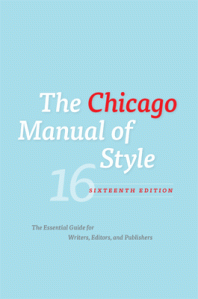
Section six, Punctuation, pages 306-310: The Chicago Manual of Style, 16th Edition, University of Chicago Press, © 2010

4 Comments

Filed under writing

#amwriting: the #nanonovel: starting with the basics

a writer's styleI receive a lot of unsolicited manuscripts, by new authors looking for an editor. Most of them are from authors who just completed NaNoWriMo. They’re just learning the ropes and don’t realize their work is still in the unreadable stage. I always explain to them why these manuscripts are not submission ready, much less ready for an editor to have a look at.

What many first-time authors lack is knowledge, so I direct them to workshops, seminars, and writing groups.

This is where the work comes into it. We must learn and use the basic writing conventions that underpin how all English literature is written. These conventions consist of:

  • Spelling
  • Punctuation
  • Capitalization
  • Grammar

These are the fundamental rules authors follow so their work is understandable by any person who can read English, no matter if they are from Sacramento, London, Sydney, or Mumbai.

Kathleen Cali, in an article at Learn NC, says: “Conventions are the surface features of writing — mechanics, usage, and sentence formation. Conventions are a courtesy to the reader, making writing easier to read by putting it in a form that the reader expects and is comfortable with.”

When we write, whether we are writing a book, an essay, or an email, we are writing something we want the intended reader to comprehend. Therefore, we write using universally accepted rules for sentence construction.

So what makes an understandable sentence? It will consist of

  • a subject (My dog)
  • a verb (barked)
  • some words to help explain those two things (all night long.)
  • My dog barked all night long.

Sentences consist of clauses. Commas are the universally acknowledged pausing and joining symbol. Periods (or full stops) are how we signify the end of a sentence. Without these pausing and stopping symbols, our words become a jumble and make no sense. You might think this is a “Well, Duh!” moment, but when a person is in the throes of laying down the first draft they begin to write in a kind of mental shorthand, and sometimes these fundamentals fall by the way. This is why we do a second draft before we have anyone look at it.

Readers expect to find a pause between two clauses and commas are sometimes the signifiers of those pauses. Words that are conjunctions (such as and, or, but) also serve to join clauses to form compound sentences.

According to About EducationA clause may be either a sentence (an independent clause) or a sentence-like construction within another sentence (a dependent or subordinate clause).

Subordinate Clause definition: A group of words that has both a subject and a verb but (unlike an independent clause) cannot stand alone as a sentence. Also known as a dependent clause. Contrast with coordinate clause.

Example:

If a free society cannot help the many who are poor, it cannot save the few who are rich.
(John F. Kennedy)

Mostly I find subordinate clauses cropping up in conversation–dialogue–when I look at my own writing. These “grammatical juniors” are like any other form of seasoning in our writing and must be used consciously and sparingly. When we write with too many subordinate clauses, we separate the reader from the narrative.

We provide balance in how we phrase our sentences, using a variety of sentence structures. We use complex sentences, consisting of:

  1. a simple clause 

I went to the grocery store.  (the meat of the matter)

  1. a dependent clause

because I needed skewers. (technically not necessary but adds to it)

  1. I went to the grocery store because I needed skewers.  

Who was I going to skewer? I don’t know, but I at least I had the right tool for the job.

We can set the clause off with commas:

The lake, its surface calm and black, called to me.

The lake called to me is the meat of this sentence, the clause describing it is technically not necessary, but without that clause the sentence is flat.

Sometimes, we want to use sentence fragments in our narrative. When they are written well and interspersed correctly, using sentence fragments emphasizes certain passages, creates a desired atmosphere, and can make conversations sound more natural.

A sentence expresses a complete thought.  Also, every sentence, no matter how short, contains a subjector an implied subject—and a verb.  Linda Neuman of Sophia.org says:

So a sentence fragment would be a piece of a sentence.  It’s not a sentence because it’s incomplete, and does not contain both a subject and a verb.  Sometimes sentence fragments are referred to as incomplete sentences.  There is something missing, and you know it when you read it.  The thought is not complete, like a sentence would be.

Example of a sentence:  Her car was old, but very stylish.

Example of a sentence fragment:  Her car was old.  But very stylish.

The internet is full of good information about sentence construction and how to write a narrative that any reader of English, no matter what their nationality, will be able to understand. You can access a great deal of information on how to construct a readable narrative and it will cost you nothing.

commaThe Chicago Manual of Style is a volume that defines the rules of the road for US English Grammar.  I consider it an indispensable guide for serious authors. This particular book is the reference manual used by the US publishing industry and is the foundation book for my personal reference library. It is one of the oldest and most comprehensive style guides available, and for me in my role as an editor, it’s an indispensable tool because it contains information that I can’t find anywhere else. While I could easily access it all via the online version, I do like having my large book at my fingertips.


Quoted and Researched Sources:

AboutEducation.com: Clause (Grammar) by Richard Nordquist, accessed Dec. 11, 2016

GrammarRevolution.com:  What are Clauses by Elizabeth O’Brien, accessed Dec. 11, 2016

LearnNC.com: The five features of effective writing, by Kathleen Cali and Kim Bowen, accessed Dec. 11, 2016

Sophia.org: Using Sentence Fragments Wisely, by Linda Neuman, accessed Dec. 11, 2016

11 Comments

Filed under writing

#FlashFictionFriday: remembering Mama and the year of the tipsy reindeer #christmas

HolidayTree2012Web Olympia Downtown AssociationI live in a very small town. The residents here go all out decorating their houses and yards for the month of December. It makes for a wonderful drive after dark, just cruising the local neighborhoods admiring the inventive displays.

The city maintenance department decorates the main drag through town and it looks amazing. I wish we could have those awesome lights up all winter long. They make the long, dark nights feel so much kinder.

All up and down our street, homes are decorated for the season, but our home is always quite simple in its holiday decorating–a tree, candles, a cute centerpiece for the table. Outside, my hubby puts up small lighted displays,  but nothing too fancy.

We keep it simple because we have to tear it down and put it all away over New Year’s day, and that rapidly becomes a bore.  It’s work, and I don’t like anything that falls into the category of labor.

In 2008, my mother was terribly ill with lung cancer and was living with us in her final days. She was 82, and had always been an active, hardworking woman, managing a pizza parlor, and wrangling my eccentric, alcoholic father. She had kept an immaculate home with religious zeal, and maintained her garden just as neatly.

It was a sign of just how ill she was that she allowed me to move her into my home so I could care for her.

My hubby had set up the lighted reindeer  display: three sweet reindeer made of wire and white lights. However, the snow was quite deep, and around their little electric feet it would melt from the heat of the lights, but not evenly.

The little one kept falling over, which looked awful as compared to the neighbor’s fancy displays. Every day, Mama checked on that reindeer first thing in the morning, wanting to get out there and fix it herself, but she was too frail.

The disease had taken her health, but it hadn’t taken her sense of humor. The snow provided a form of entertainment for her, and she would laugh and make all sorts of ribald comments as she watched me or my hubby try to stand the rickety Rudolph back up and attempt to anchor it  more securely into the frozen turf.

No matter how we tried, our display that year was the lamest one on the street, with our neighbors pointing and laughing at the prone reindeer as they walked to the grocery store. We would check on it and make sure it was upright before we went to bed, but it never failed–sometime during the night, the wind would blow that one particular reindeer over.

lighted-reindeerOne morning, a few days before Christmas, I was in the kitchen, and Mama was looking out the front window, talking on the phone to my Aunt Lillian. “That littlest reindeer is a terrible influence. Usually he’s the only souse in the lot, but today we have a yard full of drunken reindeer.”

Aunt Lillian said something, and Mama replied, “I’m not joking. The whole herd is passed out in the snow. Either that, or we had a drive-by shooting and the reindeer were the casualties.”

Sure enough, when Greg went out to go to work, all three electric reindeer were laying on their sides.

That was Mama’s last Christmas.

I miss her when the neighborhood is decorated like wonderland and the yard is full of snow. She loved life so much and clung to it fiercely despite the chemo and the vile disease that was killing her.

This year, snow is falling again, and we will put up some sort of display, although the reindeer have long since gone to broken ornament heaven.

Somehow, decorating for Christmas isn’t the same without them.

4 Comments

Filed under #FlashFictionFriday

#amwriting: Villainous motivation (or why should they bother?)

voldemortYou have a hero.  He/she is awesome. Your beta readers love him/her.

You have a villain. Unfortunately, your beta readers find him/her murky and hard to believe, so they don’t really understand your story. What is their problem?

The problem is not with the beta readers – you haven’t gotten a grip on that villain yourself, and therefore the antagonist has no motivation for being evil other than possessing a bastardly disposition, which doesn’t make a really compelling story.

First you need to understand what defines evil: Google Definitions defines evil as:

e·vil

ˈēvəl

adjective

  1. profoundly immoral and malevolent.

“his evil deeds”

synonyms:  wickedbadwrongimmoralsinfulfoulviledishonorablecorruptiniquitous, depravedreprobatevillainousnefariousviciousmaliciousmalevolentsinister,demonicdevilishdiabolicalfiendishdarkmonstrousshockingdespicable,atrociousheinousodiouscontemptiblehorribleexecrable;

informal lowdowndirty

“an evil deed”

noun

  1. profound immorality, wickedness, and depravity, especially when regarded as a supernatural force.

“the world is stalked by relentless evil”

So now we have an overly simplified concept of evil.

First of all, very few people are evil for no reason at all. They want something, and are willing to do nearly anything to gain it. The best villains lack compassion. Why do they lack this basic human emotion? It could be they are narcissistic and are incapable of empathy, exhibiting it only when they gain something by displaying feigned compassion.

Most people who are considered evil by society are highly narcissistic. BPDcentral.com defines a narcissist as a person who:

  • Lacks empathy: is unwilling to recognize or identify with the feelings and needs of others
  • Has a grandiose sense of self-importance (e.g., exaggerates achievements and talents, expects to be recognized as superior without commensurate achievements)
  • Has a sense of entitlement, i.e., unreasonable expectations of especially favorable treatment or automatic compliance with his or her expectations
  • Is interpersonally exploitative, i.e., takes advantage of others to achieve his or her own ends
  • Is often envious of others or believes others are envious of him or her
  • Requires excessive admiration
  • Shows arrogant, haughty behaviors or attitudes
  • Believes that he or she is “special” and unique and can only be understood by, or should associate with, other special or high-status people (or institutions)
  • Is preoccupied with fantasies of unlimited success, power, brilliance, beauty, or ideal love

Our villain is determined to have his own way at any cost, and to that end he/she is Manipulative. In their personal relationships they will:

  1. Employ “Gaslighting,” a manipulative tactic that can be described in different variations of three words: ‘That didn’t happen,’ ‘You imagined it,’ and ‘Are you crazy?’ This is an insidious manipulative tactic, because it works to distort and erode the victim’s sense of reality. It eats away at the victim’s knowledge of events and their ability to trust their instincts. This tactic keeps them from feeling justified in calling out abuse and mistreatment.
  2. Employ cutting remarks masked as jokes.
  3. Switch conversational topics as a means to avoid accountability.
  4. Attempt to distract you by focusing your attention on the supposed threat of another person (reporting supposed gossip about you).

It is important to understand that villains want to win at any cost, and sometimes have no concept of what they will do once they achieve their goal, as they haven’t thought that far ahead. They are completely focused just on winning.

Now that we know what our villain is like as human being, we know that most likely greed and/or a lust for power is what is driving this person.

Your task as an author is to clearly define what goal this person has set for themselves and why they believe they deserve to achieve it.

Thor-Everything-LokiMany villains don’t walk on screen as full-blown supervillains, especially in contemporary fiction and romances. They appear innocuous, even loving. You will want to slip small clues for the reader about their personality into the narrative in the beginning pages:

  1. Is he/she a liar? (Hint that they may be a cheating spouse, slick salesman, politician.)
  2. Are they a thief? (Hint that they may be an embezzler, a tax evader, or business person who profits from deliberately bankrupting their own businesses.)
  3. Do they take outrageous risks? Drop mentions and hints as to this aspect of their character early on in the narrative.

The villain is often the most complex character you will write. They must be multilayered or they can appear cartoonish.  If their goals are clearly defined and their actions in keeping with their personality, you will have a good enemy opposing your protagonist.

Whether you are writing fantasy, sci-fi, westerns, romance, or any genre of fiction, chances are you will have a villain. It is your task to make that villain come to life, and to that end, you need to know how they think and why they think that way.


Quoted and researched sources:

www.BPDCentral.com, Hallmarks of Narcissistic Personality Disorder, Copyright © 2014. BPD Central. All rights reserved.

10 Techniques Used by Manipulators (and How to Fight Them), Jessica Stillman, contributor. © Inc.com July 18, 2016

10 Comments

Filed under writing

#amwriting: setting the scene: making use of maps and floorplans

cape_disappointmentOnce again I am mapping a novel. This one will most likely top out at 80,000 words in the first draft and settle back to about 75,000  by the third draft. Right now I am writing the high points of this story as a rough draft.

However, to do this right, I need to put together the background and research the most up to date maps.

This piece is a contemporary novel and is set in a place that really exists: the area of Cape Disappointment on the south coast of Washington State. It is a place I visited many times as a child, and have fond memories of. This also gives my hubby and me the opportunity to revisit the place to see how it has changed and to better set the scene in my mind.

As I am writing, I will, of course, avail myself of Google Earth. This is a great tool for anyone whose work is set in the real world. Urban fantasies, contemporary literary novels (which is what this particular book is) and any number of romance or mystery stories benefit from the author’s diligence in making the background scenery as realistic as is possible. Google Earth give you a recent real-time view of many places.

google-earth-view-of-beards-hollow

Just as if you were writing a fantasy, making the setting as real as possible is critical. When writing any tale set in a real city or place, the author needs to know the general lay of the land, even if the setting is rarely mentioned. Remember, every time the protagonist and his/her companions leave the house, they will be in an environment that should be known and recognizable to the reader. Your knowledge of place will be clear in your writing, with every casual mention.

the-house-at-barons-hollow-smallI have drawn the floor plan of the house where much of the action takes place, and also the cove, along with the beach. The weather will keep them indoors a great deal of the time, and while it’s a large house, these people are a volatile mix, with many secrets that emerge over the course of the novel.

The floor plan and map of the pool area is critical, as some overheard conversations must  take place in an area where the inadvertent listener can remain unseen. The beach itself is  a known quantity, and the places people can find privacy in the dunes are all available via the Google Earth satellites.

The towns they will be going to for entertainment are also well-known to Washington residents, and while the names of the restaurant or bar will be my own creation, the street address will have its roots in reality. I will do this, despite the fact these are the sorts of things that never get mentioned. This is to make it real to me.

The biggest research issue for me with this novel will be learning about extreme sports, such as storm surfing and rock climbing. I know about surfing, as an interested bystander, but I am reading articles and threads on extreme sports enthusiast sites, to get an idea of the mindset of people who do these kinds of sports. When I began searching these sites, I wanted to know what the people who surf the Northeastern Pacific during storms consider too hazardous to attempt, and what they are really looking for.


The following is a link to a YouTube video of the kind of surf my two risk-takers would love to surf, but as this story takes place during the summer, the storms will be less severe than what this little clip shows. The beach, the cliffs, and the house will be the main scenes of the action.

Storm At Long Beach, YouTube

Whether I am writing fantasy or general fiction, my goal is to have the background scenery and setting as unobtrusive as possible. I want the reader to see it in their mind, which they will if I visualize it clearly and give them just enough imagery to hang their imagination on. The reader’s ability to imagine the setting is as important as what I believe the setting to be, so I must be careful to never contradict myself, or the reader will be confused.

413px-cape_disappointment_and_cape_disappointment_light

4 Comments

Filed under writing

#flashfictionfriday: Christmas at the Drunken Sasquatch

Vampires have a sick sense of humor, especially Alfredo, although he pretends to be cultured. Just over a year ago he got me banned from here, by switching my orange juice for an orange soda… that dirty trick was more than embarrassing. Covering the cost of the damages to the scorched floor, replacing the furniture, and buying Sylvia Wannamaker a new coat ate into my hoard quite heavily.

Worst of all, I was banned from participating in November’s pool tournament.

However, I’m a dragon. We like our revenge served up cold and well calculated.

The anniversary of my disgrace has passed, which would have been the obvious day for me to seek retribution. Most people have forgotten the whole incident.

But not me.

I know I look like any other old has-been, going on and on about the glory days. While that observation isn’t real flattering, it’s true. I drink more orange juice than is good for either of my livers, and I hang out here at the Drunken Sasquatch because I have nowhere else to go.

I don’t discuss it for obvious reasons, but during my years in the Middle East, Dan Dragonsworthy was far more than just a flying battle wagon. I spent a lot of time on covert missions, and one thing I learned was how to be patient, and how to spot the chinks in your opponent’s armor.

I’ve been watching Alfredo since New Year’s Eve when Bloody Bill finally lifted my punishment. I don’t intend to harm the old blood-sucker, but I’m going to give him a taste of his own medicine. There are substances vampires shouldn’t ingest, and Alfredo may have forgotten that.

A vampire tripping on chocolate is bad for everyone. I’d never do that, even to Alfredo. Fortunately, they don’t like the flavor of it. However, they do have a passion for maraschino cherries, which can cause problems for the weaker willed vampire since those fruity morsels of goodness are frequently found wrapped in dark chocolate. With one exception, the smart ones don’t succumb to temptation inside the Drunken Sasquatch, because Bloody Bill won’t tolerate that sort of behavior.

Most importantly for my purposes, vampires can’t tolerate coffee. On tiny amounts, they tend to pee themselves copiously, which the rest of us find hilarious. Vampires get quite huffy when their vampiric dignity is besmirched.

As if MY dignity meant nothing to me.

When you want to impress Alfredo, you buy him a jar of the special maraschino cherries from Italy, made with the best cherry liqueur. He can smell maraschino liqueur from anywhere in the room and, being a vampire, he lacks a conscience.

No maraschino is safe from Alfredo.

http://cookdiary.net/chocolate-covered-cherries/

The annual Christmas party and the gift exchange drives him mad. Every witch, wizard, or elf has a recipe for that most wonderful of traditional holiday treats, maraschino chocolate cordials. These kind friends are always generous with their gifts to those of us who lack their magical culinary skills.

It’s more than his old vampire heart can stand, and despite having received his own jars of cherries sans-chocolate, he takes incredible risks.

I’ll give Alfredo credit—he’s good. I’ve watched him sneak up behind Grandma and suck the cherries out of a box of cordials without getting his fangs dirty. She suspected it was him, but could never prove it. Fangs do leave holes, but it could have been any vampire.

It takes a brave (or desperate) vampire to mess with Grandma. I’d tell you to ask the Big Bad Wolf, but you can’t.

She’s wearing him.

So, anyway, last week, Grandma and I had a chat. I got on the internet and ordered the finest ingredients. They were delivered the day before yesterday, and she immediately got busy in the kitchen.

This year, one unattended box of cordials under the tree at the Drunken Sasquatch will have cherries in liqueur with unique centers. This particular batch will be vampire safe—no chance of accidental hallucinations here. Grandma created white chocolate shells filled with Cherry brandy, with a maraschino cherry floating in the middle. Each cherry is filled with a special coffee liqueur center.

It will be a joy to watch Alfredo try to deny his culpability in this year’s draining of the maraschinos as the evidence spreads around his feet.

cherry-suisse-advert-1969I hope vampire pee isn’t too acidic, although I’ve heard the stench is an excellent Zombie repellent, and no matter how you scrub, it’s impossible to get rid of the odor. Sylvia Wannamaker swears by it in a diluted form as a slug repellent in the garden, as using it there will turn your hydrangeas the brightest blue. They don’t make good cut flowers though, as they smell too bad to keep in the house.

I’m sure a pool of vampire urine won’t be as dangerous for the innocent bystanders as when he caused me to inadvertently belch fire in close quarters.

Come the day after this year’s Christmas party at the Drunken Sasquatch (even though his cash outlay won’t come near matching the damages I had to pay when he slipped me the Mickey) at least Alfredo will be out the cost of a new pair of boots. And if he can’t find a good drycleaner, he’ll be out the cost of replacing that gaudy, lace-trimmed, purple velvet suit he thinks is so stylish.

Grandma and I are both looking forward to this year’s party. Christmas could just become my favorite holiday.


Christmas at the Drunken Sasquatch, © 2016 Connie J. Jasperson, All Rights Reserved

No vampires were harmed in the making of this tale.

1 Comment

Filed under #FlashFictionFriday, Dragons, Humor

#amwriting: Thoughts on #NaNoWriMo2016

winners-certificateIt is the final day of NaNoWriMo for 2016. I wrote 96,603 words: ten short stories and fifteen chapters on my next novel set in the world of Neveyah. I had my winners certificate by the 23rd, but I write everyday and update my wordcount. More than sixty of the 265 participants in my region will also get their winner’s certificates, which is a very good year. Some years only thirty participants in our region make it to the finish line. On average, 7 out of ten entrants will fall by the way in any given year, because 50,000 words is a difficult goal to achieve in only 30 days, if you are not completely fired up by your novel.

Those who fall by the way are authors who discover that having an idea that would be a good book and writing that book are two radically different things. They are daunted by the amount of work that is involved.

NaNoWriMo (National Novel Writing Month) is a contest in the sense that if you write 50,000 words and have them validated through the national website you ‘win.’ But it is not a contest in any other way as there are no huge prizes or great amounts of acclaim for those winners, only a PDF winners certificate that you can fill out and print to hang on your wall.

It is simply a month that is solely dedicated to the act of writing a novel.

Now lets face it–a novel that is only 50,000 words long is not a very long novel. That falls more into the line of a long novella and is only half a novel, in my opinion. But a dedicated author can get the basic structure and story-line of a novel down in those thirty days simply by sitting down for an hour or two each day and writing a minimum of 1667 words per day.

That is not too hard. In this age of word processors, most authors can double or triple that.

As always, there is a downside to this free-for-all style of writing. Just because you can sit in front of a computer and spew words does not mean you have the ability to write a novel that others want to read.

Over the next few months many cheap or free eBooks will emerge testifying to this fundamental truth.

The good thing is, over the next few months many people will realize they enjoy the act of writing. They will find that for them this month of madness was not about getting a certain number of words written by a certain date, although that goal was important. For a very few, participating in NaNoWriMo has fired them with the knowledge that they are authors. For them it was about writing and completing a novel they had wanted to write for years, something that had been in the back of their minds for all their lives.

These are the people who will join writing groups and begin the long journey of learning the craft of writing. They may go back to school and get their MFA.

These authors will take the time and make the effort to learn writing conventions (practices). They will attend seminars, they will develop the skills needed to take a story and make it a novel with a proper beginning, a great middle and an incredible end.

They will properly polish and edit their work and run it past critique groups before they publish it.

These are books I will want to read.

It’s not easy. Sometimes what we hear back from our readers and editors is not what we wanted to hear. The smart authors haul themselves to a corner, lick their wounds, and rewrite it so it’s more readable. They will be successful, for a variety of reasons, all of them revolving around dedication and perseverance.

But when we write something that a reader loves–that is a feeling that can’t be described.

Authors must keep their day jobs, because success as an author these days can’t be measured in cash. It can only be measured in what satisfaction you as an author get out of your work. Traditionally published authors see a smaller percentage of their royalties than indies, but if they are among the lucky few, they can sell more books.

2016-placeholder-book-cover-smallThe fact your book has been picked up by a traditional publisher does not guarantee they will put a lot of effort into pushing a first novel by an unknown author. You will have to do all the social media footwork yourself. You may even have to arrange your own book signing events, just as if you were an indie.

Going indie or aiming for a traditional contract—it’s a conundrum many new authors will be considering in the new year.

However, if you don’t write that book, you aren’t an author, and you won’t have to worry about it. The concept of NaNoWriMo will jump-start many discussions about this very issue.

Today marks the end of NaNoWriMo 2016.  For many, it will be a mad scramble between now and midnight to get their 50,000 words and earn that certificate.

Some of us have completed our first draft, and some of us still have a ways to go. But we are all walking a path that is more rewarding than any high-paying job I’ve ever had.

nanowrimo_2016_webbanner_winner_congrats

7 Comments

Filed under writing