Myrddin Summer Beach Reads — Join The Party! #Giveaway

Rachel Tsoumbakos talks about the Myrddin Summer Beach Reads Facebook event. All the Edgewise Words Inn contributors will be there, along with many more. You just may find the book you’ve been waiting for!

mrszoomby's avatarRachel Tsoumbakos

Myrddin Summer Beach Reads Party promo image

I know here in Australia, winter is coming. But, in the Northern hemisphere, things are heating up. And so it is time for the Myrddin Summer Beach Reads Party!

So just what is this magnificent event?

According to the official event page, the Myrddin Summer Beach Reads party aims to “introduce readers to the wonderful books by the Myrddin authors (and some of their friends) before summer officially starts.” This will give readers a chance to stock up on some great books across multiple genres before they hit the beach.

On offer during the event are the following prizes and giveaways:

  • $50 Amazon Gift Card grand prize
  • 2 “box-set” digital copies of the complete Tower of Bones series by Connie J Jasperson
  • 2 digital copies of Huw the Bard by Connie J Jasperson
  • 1 copy of Dorianna and 1 copy of Witch of the Cards by Catherine Stine
  • A copy…

View original post 235 more words

Comments Off on Myrddin Summer Beach Reads — Join The Party! #Giveaway

Filed under Books

#FlashFictionFriday: The Cat, the Jeweler, and the Thief

Barliman gazed at the statue of the cat, and then out the polished window, not seeing the passersby. His eyes turned back to the stylishly dressed thief who stood before him. “It’s a nice enough  statue, well-made. What makes it worth the amount you are asking?”

Scuttle smiled. “It’s more than merely well-made. It’s brilliant. Look at it—have you ever seen such detail rendered in marble?” Thin, with a face slightly resembling that of a pleasant, well-favored weasel, he kept his desperation tightly tamped beneath a business-like demeanor.

Scuttle’s lady, Mari, was so ill that an ordinary herb doctor wouldn’t do. Their landlady believed she had contracted river fever and insisted only a healer from the Church could resolve it. But the Church never healed the poor; only the wealthy could afford a Church Healer. For that reason, Scuttle had to have those coins. He put on his most persuasive voice. “This is a miracle of art, created in marble. The hand of a master freed this cat from the stone.”

“I agree it’s beautiful, but I doubt you came by it honestly. I will be limited in who I can resell it to. Who made it? If I can at least tell a prospective purchaser whose hand created it, I will understand its value, and be better able to get a fair price for it.”

Scuttle snorted. “A fair price…usury has no concept of ‘fair.’ But all right, I’ll tell you who I believe to have made it. Benevolio.” Raising his hand, he forestalled Barliman’s comment. “I have no proof, and there is no maker’s mark on it anywhere.” Picking up the statue he held it to the light, turning it to reveal the remarkable craftsmanship. “Look at the face. Each hair, each whisker, every feature is there in the most minute detail, as if a cat had turned to stone as it sat there. Even soles of the paws which can’t be seen unless one picks the statue up–only Benevolio himself could have created such a masterpiece.”

Silence reigned in the shop as Barliman digested that comment. He pulled his magnifier from his pocket and examined the life-sized statue inch by inch. Scuttle had expected he would, and occupied himself with calculating the value of the objects displayed in the shop. Silver tea services, gold-handled cutlery, delicate jewelry set with precious stones—all rested on dark velvet in glass cases, gleaming in the light cast by wide diamond-paned windows. The fact they were on display meant those items had been purchased from more reputable sources.

The thief had come to Barliman because the jeweler sometimes supplied the wealthier class with things they could acquire nowhere else. Scuttle was a discreet thief, a man who ordinarily only stole on commission. However, the cat had been liberated from the house of a prosperous merchant newly in town, something he had only done because of Mari’s illness. The fact he was there in person to sell the statue indicated to the jeweler that this had been a private matter, making Scuttle’s bargaining position perilous. The jeweler was his only resort–no one else would have given him a copper for the statue, much less what he needed.

What Mari needed.

Barliman set the cat back down on the counter. He replaced the magnifier in the pocket of his vest. “With no maker’s mark, I can’t guarantee authenticity. That will substantially lower the price I can get for it. Therefore, I can’t give six golds coins. Three is my offer–consider, it please. It comes to three months wages for an ordinary man.”

“Five would be less than fair for a statue of this quality, and you would still make an absurd profit. If you can’t offer five, I must withdraw it.” Scuttle had no idea what he would do if Barliman refused. He didn’t dare take the time to go all the way to Westerberg. Three days there and back—Mari would be dead before he returned.

Barliman pursed his lips, deliberating. “Five golds, then.”

Though he felt like dancing, Scuttle comported himself with dignity as the coins were handed over. Barliman placed the cat statue beneath the counter and bowing, the thief departed the shop.

>>><<<

As the door closed behind the thief, the curtain behind the jeweler whisked open. Cardinal Valente stood framed in the doorway. “Good.” The Cardinal’s acidic tones fell like lead in the shop. “Here is your five golds, plus fifteen more for your trouble.”

Barliman handed Valente the heavy, marble statue. “Whose hand created this cat?” he asked. “Even Benevolio could never have done such fine work.”

Instead of answering, the Cardinal set the statue on the counter. “Observe.” He muttered some incomprehensible words, passing his hands over the cat.

Fantasy Desk With Books And Scrolls © Unholyvault | Dreamstime.com

Fantasy Desk With Books And Scrolls © Unholyvault | Dreamstime.com

To Barliman’s surprise, the statue stretched and yawned, then stood up and jumped down. Twining about the Cardinal’s ankles, the cat purred.

“God’s hand created this cat. A spell turned it to stone, and I placed it in the home of my concubine. Then I allowed rumors of its existence to come to Scuttle’s ears.”

Barliman could not conceal his dismay. “Why? Was it to trap him? He has…skills. He’s useful, and not only to me. Imprisoning him would be bad for my business.”

“He is indeed useful. However, a personal matter  interfered with my thief’s ability to gain an artifact I must have. He needs coins to resolve the issue but he is not a man to ask for charity, and I am not known for my generosity. Hence, I devised a way for him to help himself.” The Cardinal laughed, a grating sound. “By the day after tomorrow at the latest, my thief will resume the important task I have set before him, and soon I will have my artifact.” A sly smirk lit his bony features. “And now I know what matters most in the world to my thief, and where to lay my hands on it if I should ever need a bargaining chip. That knowledge alone was worth twenty golds. Never forget this: knowledge is power, Barliman. It’s good to be the one with the knowledge.”


The Cat, the Jeweler, and the Thief © Connie J. Jasperson 2016 All Rights Reserved

Comments Off on #FlashFictionFriday: The Cat, the Jeweler, and the Thief

Filed under #FlashFictionFriday, Fantasy, Literature

#amwriting: keyboard tics and power punctuation

Exclamation points, Emdashes, Ellipses memeWhen a friend phones us, we’re usually able to identify them from the sound of their voice. We take this for granted, accepting the singularity of each speaker, seeing their idiosyncratic speech habits as part of what makes them who they are.

We writers communicate through our fingers, keying our thoughts. Our readers can recognize our work because we each have a unique voice and pattern to our writing, not unlike our individual manner of speaking.

And just as we do when we are speaking, we may have ‘keyboard tics’ when writing the first draft of a given work. These small keying habits occur as a pause in our thoughts, a simple twitch of a finger, liberally sprinkling the work with hyphens, semicolons, and exclamation points, to the extent the work makes our first reader breathless.

These punctuations have their place, but when they are used excessively, they must be weeded out, and this is part of making effective revisions.

One good way to do this is to print out each chapter, one at a time. Use a blank page, and work your way from the bottom up, covering all above except the paragraph you are looking at.

When you go back and isolate each paragraph, removing the context, you can make a better determination of how you really want to punctuate those ideas. Eight times out of ten, a simple period or comma will better serve the sentences and make the paragraph less confusing.

Using semicolons to make strong pauses in your sentences is WRONG, so remove them and use a comma or a period. Use an emdash or a hyphen to set a clause off for emphasis, and an ellipsis to show uncertainty.

But don’t go nuts.

No one enjoys reading a choppy narrative because  short sentences are distracting and hard to get into. The way we smooth the narrative is to join short sentences into longer, compound sentences, but frequently that creates run-on sentences. (I am the queen of those.)

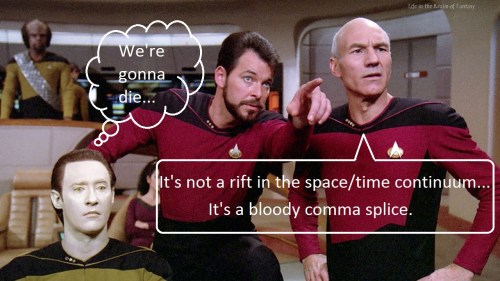
You do not join independent clauses with commas as that creates a rift in the space/time continuum: the Dreaded Comma Splice:

Comma Splice: My car is a blue Chevy Malibu and I like it, the dog likes to ride shotgun.

Same thought, written correctly: My car is a blue Chevy Malibu, and I like it. The dog likes to ride shotgun.

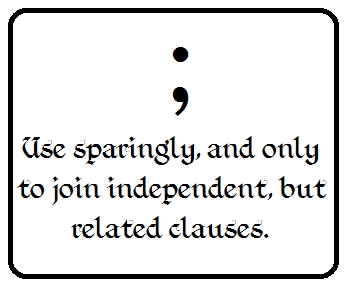
So when do we use a semicolon? Semicolons join independent clauses, which are clauses that can stand alone, and your best bet is to avoid using them except under extreme duress.

The two clauses that are joined together with a semicolon should be

  1. complete sentences that relate to each other
  2. if they don’t relate to each other, make them separate sentences and reword them so they are not choppy.

Two separate ideas done wrong: We should go to the Dairy Queen; it’s nearly half past five.

The first sentence is one whole idea—they want to go somewhere. The second sentence is a completely different idea—it’s telling you the time.

Two separate ideas done right, assuming the mention of time is important: We should go to the Dairy Queen soon. They close at eight, and it’s nearly half past five.

If time is the issue in both clauses, and you feel like you absolute MUST use a semicolon or you will explode, say, “The Dairy Queen is about to close; it’s nearly half past five.”

I generally try to find alternatives to semicolons, but I don’t dislike them, as some editors do. I think they are too easily abused and misused.

But what about exclamation points! I get so excited when I see a plethora of pointy exclamations! It makes me breathless! Too many, and your reader will be thrown out of the narrative and put the book down, never to pick it up again.

We shouldn’t resort to creating excitement with the overuse of exclamation points. I am just as guilty as anyone when it comes to peppering the first draft with exclamations, em dashes, and ellipses, because a little power is a dangerous thing, and certain punctuation has power:

em dash memeExclamation points!

Em dashes—

Ellipses…

Never underestimate the power of the “e-punctuation,” and never forget how easy it is to get carried away with them.

Exclamation points, em dashes, and ellipses should be used at important points. For the most part, the way you have set the scene combined with the dialogue itself will convey the tension without your having to sprinkle the narrative with ‘e’ punctuation.

Generally, dialogue worded powerfully, along with the way you show the attitude of the characters and their situation will serve to convey the emotions. Done right, you will only need one or two morsels of power punctuation. The common, garden-variety period or comma will usually serve the situation well, and won’t throw the reader out of the book.

Power punctuation can inadvertently become keyboard tics when we are laying down the first draft. They are road marks to show us how we felt when we first expressed that thought and want to just get it down on paper before we forgot it. The second draft requires us to step back and craft the narrative so that we are not relying on these signs to tell the story.

We want to show the story with mood, atmosphere, and setting the scene. The words we choose for each character’s conversation conveys their emotions, as does the way you have portrayed them. Thus, power punctuation should be used, but sparingly and for emphasis.

7 Comments

Filed under writer, writing

#amwriting: MS Office 365 Crash and Document Loss Workaround

windows-10-blue screen of deathThose of us who use Microsoft Office are familiar with both its versatility and its problems. In many ways, it is a great package of programs, but it has several major flaws.

The very annoying issue I never had with Office 2010, but now have with Office 365 (2016) is the program crashing right as I go to “save” a new document or spreadsheet. The program shuts down and the file vanishes, never to be found again, when the program reopens itself a minute later.

I will have the file library open, and the correct Master file open, and have correctly named the sub-file and then…just as I am about to click “save”…

Word (or Excel) shuts itself down. Any work that was done on that particular document or spreadsheet is GONE.

And no, kind sir, that document is not recoverable in my unsaved files as “Document 1.docx” nor is it listed anywhere as some gobbledygook file name with a .tmp extension. Even when you search the hard drive files by date, which should bring up anything you have done that day, the file is gone.

I’m actually quite Microsoft-savvy. When this first happened to me, I did the research and tried all the measures and remedies posted on the internet for recovering these lost files. Those remedies don’t work because the techs assume the machine’s default autosave function is working. The glitch is actually in that particular function, so it does not, and the file is not even stored in a temp file.

The program crashed, dumped the file into the ether and then said, “Oops! My bad.”

The tech support out there on the Microsoft boards seem as mystified as anyone else, and gives the same stock, canned answers. I feel bad for them–they want to help, but don’t know how.

Microsoft Office 365 Logo 1280px PNGI have an idea as to why these documents that were lost at the moment you tried to save them are unrecoverable.

The document is lost because the Windows autosave function does not always work properly, and it is the autosave glitch that causes the program to hang and then crash. Something about the  process of relabeling from the generic “Document 1” title that Word names all new documents, to whatever you need it to be,  seems to short circuit the program, causing it to shut down. 

And, the moment the unsaved document vanishes, it is as if it never existed. It was never autosaved to begin with, so there is no autosaved version to retrieve. I am sorry my friend, but that document is gone.

I have a simple workaround. It is old-school and dates back to the early days of Windows when everyone knew Word and Excel could crash at any moment. But unless you could afford Corel WordPerfect, which was horrifically expensive in those days, most businesses were stuck with Microsoft. We knew and used several workarounds which we have not had to do for many years. However, it’s time to pull them out and dust them off:

  • For every new document you create, I recommend that while the page or spreadsheet is still blank, before you do any work whatsoever on that document, you give the file a working name and save it to whatever folder you normally work out of. Do that immediately.

I work out of Dropbox, so my files look like this:

  1. Main Folder: Dropbox
  • Subfolder > cjjasperson
  • Subfolder> LIRFblogposts
    • >post_May_15_2016_microsoft_rant

However, it is when we get to the  subfolder folder and attempt to give our work a file name that Word/Excel crashes.

This is the problem scenario: I went to save the blank page on which I intended to write a post for this blog this morning and Word crashed. But, unlike several times previously, I had lost nothing as I hadn’t done any work at that point. The level of frustration is much lower when you’ve lost no work.

As long as I name my file first, before I do any work in the body of the document, I will never lose the beginnings of an entire project even if the program crashes, as it does periodically.

And once the file is renamed, autosave seems to work more efficiently.

This issue is not just with users of Dropbox.

I mentioned above that I have researched this extensively. The internet is rife with complaints that Office 365 crashes just as frequently when people are trying to save to the Documents file on their computer’s hard drive, and also occurs when saving to Microsoft’s own One Drive, and also Google Drive, and any other way people can save their files.

This means it is an issue inherent in the program itself, and not a compatibility issue. This is a problem with the software, and it needs to be addressed.

So, if you are using Office 365, name that file the minute you open a new document or spreadsheet. Once you have successfully saved your blank document/spreadsheet the first time, you will never completely lose it if Word or Excel crashes again while you are trying to save or are just working as sometimes happen.

However, if autosave hangs and fails, you will lose work you didn’t manually save prior to the crash.

But there is an old-school workaround to help with that too:

  • On the ribbon, open the File tab again and this time, scroll down to Options:
  • Click to open the Options menu and a large menu will open
  • In the left-hand menu underneath Word Options, scroll down and click on Save
  • This will open the menu to where you will reset your autosave options.
  • The default option for autosave is 10 minutes, and yours will likely say that.
  • I reset mine to 2 minutes.
  • When you are satisfied with your choices, click ‘OK.’

ms_word_rant_5-14-2015_LIRF

You can always change the working name of your document later, but once it has an official name and a place in your file directory, a temporary file will be saved should it crash again and all you will lose is what you did in the two minutes prior to the crash, assuming autosave worked at all.

Save manually and save regularly, because you never know when autosave will fail. Here we are, back to the mid 1990s, when the dreaded Blue Screen of Death owned you.

Some people use Open Office, or Google Documents quite successfully. They are free to the user and are ideal for some people. Google Docs even saves as you go, which is a really nice function. But while those two products are basically useful for simple projects, they are quite limited and don’t have the range of tools I need for my word-processing and spreadsheet programs.

I owned a Mac in the mid 1990s, and it was okay, and I’ve held jobs where my machine was a Mac, but I never really been a Mac devotee. I’m a PC person through and through. I need a program with all the features of Microsoft Office 365. All I ask is that it work reliably, the way Office 2010 did.

I confess, I’ve been checking into dumping this hinky, already-paid-for program and switching to Corel WordPerfect Office. I have used earlier versions in various work environments and absolutely loved the the program and what it offered. However, the reason I haven’t gone with it in my home office was cost–it was an extremely expensive program.

corel wordperfect office 8

Switching to Corel products is a real option for me now, as in recent years they have become competitively priced. Documents can be saved in .doc and .docx format which most publishers want, so the program will work just fine for my needs. It may be time to reconsider my loyalties.

Making the switch at the end of my subscription would require retraining myself, as there is a learning curve when you get a new program. Also, Office 365 is useful across all three of my electronic devices, which is the main reason I went with it.

But I can work out of Google docs when I am on the road, if I must.

This fall when my subscription is nearing the end, I will be weighing what my time spent learning how to use a new program is worth against how high my level of frustration with Microsoft’s lack of accountability is.

I will be watching the tech boards as always. The way Microsoft addresses this problem will determine if it is worth the time and effort for me to make that switch.

10 Comments

Filed under Technology and Software, writer, writing

#FlashFictionFriday: Scrofulous Mudd

The following bit of fluff and nonsense was prompted by the first line. Once I had that, the rest of the story sort of followed.


Scrofulous Mudd was a dirty old man.

By that I mean he was an elderly man who sorted through the leavings in ancient privies and wrote highly boring papers detailing the history of what he uncovered. He kept himself moderately clean, and took baths every Saturday unless an additional effort was required, such as for his mother’s funeral.

I suppose his fascination with filth began with his elegantly disease-ridden name. His was a difficult delivery, and when the elderly volunteer came around asking about the new baby’s name, Maude Mudd was still a little out of it. A scholar of Roman Literature, what she had actually said was “Rogellus.”

The volunteer, a retired nurse of infectious diseases, had misunderstood her mumbled words. Thus, Scrofulous, or Scroffy, as he was known at school, was given a name difficult to live up to.

Young Scroffy never knew his father, nor was any father named on his birth certificate. He assumed his had been a virgin birth, as his mother had never said otherwise and to his knowledge she never had gentlemen callers.

In truth, Maude’s single night of passion with the Professor of Antiquities had occurred after both had consumed far too much sherry at a faculty mixer at the at the beginning of fall semester. Hung-over, embarrassed, and terribly disappointed by sex in general, she immediately accepted the offer of a research position at a University far, far away, in Scotland to be exact.

It wasn’t until several months later that she realized she had a little Mudd in the oven. Things were different in those days, and rather than lose her position at the University for being morally unfit, she padded her chest, making herself appear to be merely stout. She hired a live-in housekeeper and continued with her work until the day of his delivery, which occurred just at the beginning of summer break. When the next term began, a much slimmer Professor Maude Mudd returned to school as if nothing had happened.

via wikimedia commons

Nanny MacDuff cared for young Scroffy as much as she was able, which was not a lot, as she had a pinched heart, but she did do her best by him. Many times Scroffy and his pram were left parked outside the post office, forgotten until Nanny arrived home and suddenly wondered where the washing powder she had tucked in his carriage was.

However, she saw to it he was as clean and well-fed as any other child. Both the infant Scroffy and Maude Mudd’s house were vigorously scrubbed daily, and both shone like polished chrome.

Never having been a maternal woman, Maude felt she had fulfilled her parental obligation, by hiring a nanny. While she did occasionally ask after his health in a general sort of way and whether he was doing well in school, she rarely had any reason to communicate with him.

As a small child, the books in his mother’s library fascinated him, but that room was strictly off limits. Nanny explained that little boys had dirty fingers, and so he should never touch the ancient, irreplaceable tomes. However, he often stood just outside the door, peering in, wondering what mysteries lay concealed within those pages.

Scroffy spent his childhood at boarding school. He did well in primary school and was a good student during his secondary years. It was there he discovered history could be uncovered by digging through the garbage left behind by our ancestors, and it was a science called Archaeology.

Perhaps it was his lifetime of rigorously enforced cleanliness at the hands of Nanny and the various Matrons, or perhaps it was the only rebellion he could think of, but dirt, and what it concealed, attracted him.

He was rarely invited home for holidays, and thus, Maude had nearly forgotten about her son when she was surprised to receive a letter from him thanking her for his education. He also explained he would be taking his newly earned Doctorate in Archaeology to London, and hoped she would understand.

In London, he indulged his passion for filth, digging up medieval midden heaps and privies, sifting the soil, and exclaiming over dubious treasures. Unlike his fellow scientists, he didn’t mind the filthy conditions, and relished a good, big find, feeling as if the night-soil of generations past somehow filled in the blank, far-too-clean slate of his childhood. He also began acquiring his own library of rare books, and manuscripts of historical significance, all of them shining a little light on the dark, dirty realities of medieval life.

It was said by his peers that Scrofulous Mudd knew more about the dark ages than the people who’d actually lived through those times. Had he been told that to his face, he would have agreed.

Forty years passed, during which time Maude Mudd rarely gave any thought to her absent son, although he thought of her at times. At first, he’d hoped for a letter or card, or an invitation to Christmas dinner but eventually gave up believing there was any connection there.

He had a brief, cordial conversation with his mother at Nanny’s funeral. Maude was heartbroken at Nanny’s loss, and terribly concerned she would never find a cleaner with as much respect for the many irreplaceable manuscripts in her library as Nanny had embodied. Scroffy had agreed it would be difficult. On the train back to London, he comforted himself with the thought his old nanny was in floor-polishing heaven.

He was a congenial, if obsessed, guest at faculty dinner parties, and was always willing to talk about his work. The more fastidious guests suspected he was invited as much for shock value as anything else. Conversations would stutter into pained silence when he began describing how the layers of earth and ancient human waste concealed the shards of history, things tossed into the privy or accidentally lost.

The arrival of the main course would inspire the observation that usually he found evidence of what people in various strata of society dined on, in their petrified dung. Then he would casually mention he didn’t watch the telly, as he spent his evenings with his microscope, puzzling over samples.

Time passed, the world changed, and having been born and raised in a life of academia, Scroffy evolved with it. He rose to a high post at his university. He had a team of several young women and men who were as intrigued by the waste and garbage of the past as he was. The BBC made several documentaries on what his work digging up medieval privies had unearthed, and how our ancestors had really lived.

When Scrofulous was sixty-five, he received a letter from Maude’s solicitor informing him of his mother’s passing. He had inherited the house and her library, which, as a child, he was never allowed to touch.

After the funeral, he walked through Maude’s house, looking into rooms that seemed so large when he was a child.

Walking through each room, he saw his mother had found another cleaning person as deeply offended by dust and dirt as Nanny MacDuff. Every room smelled of furniture polish and gleamed in the light shed by windows so clean he had to look twice to see they were there.

The ancient tomes that were his mother’s closest companions seemed as much a mystery to him as she had been.

Old Restored booksA book lay on Maude’s desk, with an envelope sticking out of the top as if marking a place. A pair of clean, white, cotton gloves lay beside it. He opened the book, seeing it was a first edition of a famous treatise on an archaeological dig in Mesopotamia. It was a book which he also had in his collection, albeit his was a later edition. Then he saw the envelope was addressed to him, from his mother.

“I never really knew you, as my work precluded everything else. Nevertheless, I have always been pleased you were successful in your career. But whatever you do, wear gloves when you handle the pages of these books.”

Scroffy reflected that even in death Maude cared more for her books than her son. Yet, the scientist in him realized she must have left something behind for him to dig up about his own history, and he intended to discover it.

He looked down at the book in which he had found the note. The author had been one of his professors, a solitary man obsessed with antiquities, and who only came to life when discussing some of his more obscure finds. He’d learned a great deal from him, finding a kindred spirit when it came to unearthing the past.

He wondered why Maude had chosen that book, when she had been a scholar of Roman literature, and inherently unable to discuss anything else. He sat down suddenly, his knees giving way under the realization she had chosen the only way she knew to tell him something important, something she had withheld from him for all those years.

Nanny’s words came back to him, about little boys having dirty fingers. He was aware of how little had changed, that he was in actuality a dirty old man, due in part to his advanced age, but mostly to his profession. Accordingly, he drew on the white gloves and opened his mother’s desk. He pored through his mother’s papers, physician’s instructions, tax returns, payroll receipts–being who she was, Maude had been unable to dispose of any. She had kept everything, but had filed them as neatly as she had kept her library. He searched and sorted until he came to the year prior to his birth.

The light had begun to fade when he refiled his mothers papers as neatly she had originally, and shut the drawer. For a long while, he sat in his late mother’s study, staring into the gloom, thinking.

Having met both his mother and his father, and found them to be exceptionally solitary people, he concluded that his existence could only be explained as a miracle. And while, as a boy, he’d often wished for a less arduous name to explain to new acquaintances, he was terribly glad his mother hadn’t named him after his father.

If ‘Scrofulous Mudd’ had been the cause of the occasional fist fight at school, he suspected Hamza Pigg Jr. wouldn’t have been any easier.


Scrofulous Mudd © Connie J. Jasperson 2016, All Rights Reserved

17 Comments

Filed under #FlashFictionFriday, writing

#amwriting: Thoughts on Italics

strange thoughts 2One of the virtues of being a part of a group of writers is that you can bounce questions and ideas off them. And, one thing the authors I hang out with all agree on is that italics are the devil.

We don’t like them because they are hard on the eyes, daunting, and difficult to read in large chunks when the main character is waxing internally poetic. Also, many readers subconsciously skip them, and so they have missed important information you may have imparted there. Having not read it, they may think your book is confusing and disjointed.

Yet the standard practice in genre fantasy is to set internal dialogue off in italics. For this reason, I no longer give my characters a lot of time to think, as such. In my more recent work, only rarely do my characters think in italics. I believe thoughts occur as an organic part of the narrative as a whole, and should be identified as if with a speech tag:

  • I wondered, why the red hat? Surely it meant something, as she was the second person I’d seen with a red hat. But perhaps I saw what I wanted, a conspiracy where none existed.
  • The flash of a purple stocking covering a shapely ankle, quickly hidden by her skirts, caught his attention. Was she a whore? He wondered. Some women working the streets wore red to advertise their profession, but she didn’t have the look of disillusionment the others wore beneath their masks of false desire. Why did she wear purple stockings?
  • His sword belt hung on the chair just as he’d left it the night before. But while the scabbard had been left behind, Caliburn was gone. His heart sank, and he cast his mind back, picturing his room before he’d gone down to breakfast. Nothing had seemed out of place, but had he seen the grip sticking out of sheath? He couldn’t recall.

Most thoughts don’t have to be italicized. My recommendation is to only voice the most important thoughts via an internal monologue, and in this way, you will retain the readers’ interest. The rest can be presented in images that build the world around the characters.

The exception to this is if the person who is thinking is also speaking with other people, and his thought could be mistaken as dialogue spoken aloud.

Many other, equally insidious reasons exist as to why authors may choose to use italics, most of which I think should be formatted in a better, easier to read style that still sets them off:

  • Mental telepathy, which is technically spoken dialogue
  • Letters, which are the written thoughts of people from far away
  • Emails, which are electronic letters
  • Text messages

Let’s consider correspondence between characters: some work is written in an epistolatory style. The entire narrative is told in the form of letters exchanged between the characters, as in the case of the brilliant steampunk Dawn of Steam series by Jeffrey Cook with Sarah Symonds. In that case, with each exchange of letters, the speaking character/author is made clear.

However, correspondences inserted into the body of a narrative should be formatted to set them apart, but not to throw the reader out of the story. For that passage, add an extra space both before and after, and inset both left and right margins by one-half inch (.5).

He looked at the missive from Father Rall, wondering how his day could get any worse.

Cayne,

I understand you are too unwell to duel lately. Your students’ health is at risk if you have a contagious disease. You must go to the infirmary today. If your illness is treatable, you should be back to dueling soon. If you are suffering from the prolonged use of magic, many treatments are now available that will help you live a long and productive life. Either way, Darlen is expecting to see you today.

Rall

Cursing, he wadded the note and threw it toward the wastebasket. 

To inset the margin in Microsoft Word: Highlight the section you want to inset. On the ribbon, go to the home tab. On the paragraph menu, click the little grey square on the lower right-hand corner to open the menu. Then on the indentation menu set both right and left to 1”. Click okay

inset_margin_how_to_printscreen_LIRF_cjj

Emails should also be represented this way, set in 1/2″ (.5), as they are the most common form of modern correspondence, but you want to show they are emails:

To: Ima.Fool@maildelivery.com

From:M.Jones@buenavuecorps.com

We regret to inform you that your manuscript “Under the Grandstand” is not what we are looking for at this time. 

Good luck in your future endeavors,

Maurice Jones

Editor, Buenavue Magazine

And what about text messages? They can be inset too.

Helen:

Hi. R U on ur way?

                 —-

Joe:

What? I only speak English. I’m on my way.

So that leaves us with mental telepathy. Mental telepathy is a commonly used trope in genre fantasy, and I have one series where it figures prominently. In writing groups you will hear of a variety of ways to deal with that.

Some authors will use italics.

  • I am always with you. Zan’s smile and supportive thought warmed her

Some authors use parentheses:

  • (I am always with you.) Zan’s smile and supportive thought warmed her.

Some authors will preface mental communication with a colon:

  • : I am always with you.: Zan’s smile and supportive thought warmed her.

When a story is mental-telepathy heavy, I personally will do anything to avoid throwing the reader out of the story.

  • Through their link, Zan said, “I am always with you.” His smile and supportive thought warmed her.

How you choose to portray thoughts and mental telepathy is purely your choice, and reflects what you see as your style. I was not always a purist—this lack of enthusiasm for italics has evolved along with other aspects of writing. But as an editor, when I am faced with large blocks of italics, I find them difficult to read. And frankly, some authors use internal monologues as a way to dump large amounts of background info.

When you have a thought-heavy narrative, I would suggest you find an alternative way to phrase your characters’ ruminations, making them an active part of the story. Avoiding italics will force you to write a stronger narrative, and your readers will thank you.

6 Comments

Filed under writing

#amwriting: Setting and keeping your preferred font in Microsoft Word

Fonts in all their gloryOkay. We all know that Microsoft Word is a hinky behemoth of a program, but it is what many of us are using. Publishers all want their manuscripts in a serif font, and will usually specify Times New Roman .12 or Courier .12 and want it double-spaced.

Microsoft Word comes with Calibri .11 as the default font, set at 1.5 spacing which is not wide enough for most editors and publisher’s purposes. Also, Calibri is a sans serif font and does not comply with the requirements of publishers and editors. Reading it large chunks is difficult as the spacing between the letters is identical and it is hard to distinguish some letters.

One major problem with Calibri font is a visible homoglyph, a pair of easily confused characters: the lowercase letter L and the uppercase letter i (l and I) are virtually indistinguishable.

Font differences in sentences

Publishers hate confusion.

If the manuscript is not formatted to their requirements as posted on their submissions page, your work will not be considered.

So to comply with their guidelines, we format the manuscript according to their needs. Most use what has become the industry standard fonts: Times New Roman or Courier in .12.

These are called ‘Serif’ fonts because they have little extensions that make them easier to read when in a wall of words.

209px-Serif_and_sans-serif_03.svg

To change your fonts, open your manuscript document, and Click on the tab marked ‘Home’.  In the upper right-hand corner of the ribbon across the top of the page in the editing group, click:

select> select all. This will highlight the entire manuscript.

Select all printscreen

With the ms still highlighted, go to the font group, on the left-hand end of the ribbon. The default font, or pre-designed value or setting, will probably say ‘Calibri (Body)’ and the size will be .11.

You can change this on the home tab by clicking on the little grey square in the right-hand corner of the font menu and accessing the drop-down menu. Scroll down to Times New Roman, and set it to .12 as that is easiest on the eyes. Click on that and the font for the entire ms will be that font. Follow these steps to reset your default formatting, but only click “set as default” if this is what you really want. You can reset it to what you you want if you find you don’t like your new settings. Once you are satisfied with your changes, click save.

Format paragraphs printscreenBut, you say, you have done that and every time you go to insert a word into the body of your document the font for what you are inserting has automatically gone back to Calibri size .10! And every new document is still formatted with Calibri.

On the home tab, in the Styles pane (click on the lower right-hand arrow of the styles box), click the Manage Styles button. In Word 2016 that is on the bottom of the list, the far right-hand button (just before the word options).

Word 2016 font change steps

On the Set Defaults tab, specify the settings that you want. The changes will apply to the current document, but if you select “New documents based on this template” before clicking OK, the settings will be transferred to the attached template. All your documents after that should have your preferred font as the default font. In my case, it is Times New Roman .12, double spaced, with a .03 indent. You may want a different font, single spaced and a different indent.

Word 2016 font change steps 2

But say you need to format your manuscript differently, for a unique purpose.

To change your fonts, open your manuscript document, and Click on the tab marked ‘Home’.  In the upper right-hand corner of the ribbon across the top of the page in the editing group, click:

select> select all. This will highlight the entire manuscript.

With the ms still highlighted, go to the font group on the left-hand end of the ribbon. The default font, or predesigned value or setting, will show up, and you will change this by clicking on the menu and accessing the menu.

Scroll down to the new font, and set it to the desired size. Click on that and the font for the entire ms will be that font. Again, any errors can be undone by clicking the back arrow. Once you are satisfied with your changes, click save.

Standard manuscript format means margins of 1 inch all the way around, indented paragraphs, and double-spaced text. For more on this subject, see my post of Feb. 27, 2015, Formatting a submission-ready manuscript.

Do not justify the text. In justified text, the spaces between words, and, to a far lesser extent, between glyphs or letters (known as “tracking”), are stretched or sometimes compressed to make the text align with both the left and right margins. Justifying gives you straight margins on both sides, but this is not the time or place for this type of alignment.

For my purposes, I have found it is easiest on my eyes to use Times New Roman .12, aligned left, double-spaced, with a 0.3 indent for all my work, so that is what my default settings are. I always reformat my manuscript to comply with whatever the requirements are for every magazine or publisher I submit my work to.

2 Comments

Filed under Publishing, Self Publishing, writer, writing

#amwriting: mathoms, the Room of Shame, and me

I am cleaning and redecorating my office. This brought to mind an article touching on this very subject, written a year ago for Edgewise Words Inn, which in turn was originally posted in a slightly different form here in Jan 2015. To reduce my carbon footprint, I even recycle my words.


My Coffee Cup © cjjasp 2013I’ve said this before and I’ll say it again—I have parties for the same reason I have editors.

Having a party forces me to

  1. Clean my dusty house and
  2. Get rid of the ‘fluff and nonsense’ that we acquire as part of modern living.

What sort of fluff and nonsense you ask?

Consider the plastic container. Why is the lower cupboard in my house a place where containers come home to die? They have their place but too many is just too many. And where are the lids?  I think the lids to plastic containers go to that pocket in the universe where random socks and spare pairs of reading glasses go.

Plastic containers are the devil. Despite my best efforts they enter the house in insidious ways.

  1. They arrive neatly wrapped around vegan margarine, or hummus.
  2. I pick up a few to use to send leftovers home with loved ones,
  3. But more containers arrive than are used—and the ones in the cupboard are never the size I need.

Then there are the glass jars—I go on binges of saving them because “I don’t like plastic containers.” (Did you note the sarcasm?)

  1. But pickle jars and spaghetti sauce jars are never the right size.
  2. And the lids get lost.
  3. And my favorite jar is always full.

If you think the plastic containers and the jars are out of control, let’s talk about coffee cups.

peacock tea cup - useless but I wish I owned it!

peacock tea cup – useless but I wish I owned it!

How many coffee cups do two old people need? And where do these things keep coming from? It’s a miracle the shelves aren’t bowing under the weight of them.

Some of these go with the two sets of dishes we need for when we have the family over. And remember this set of dishes? I thought we gave them away.  Oooh…this one was a gift…and this one fits perfectly in my minivan’s cup-holder….

At least maybe I can get rid of the chipped ones. But this is the one Mama liked…and this one was my father-in-law Ron’s favorite cup.

Sigh.

But at least I can declutter the spare room. Now that is an editing job worthy of a medal–the room has become my overflow room for stuff that won’t fit in the Room of Shame.

The Room of Shame is not what you might think–it is technically my office, but it is also a warehouse for ‘mathoms.’ (Bear with me—I am a Tolkien freak).

Mathom is a word invented by Tolkien, but every author needs a day job, and Tolkien’s was as a professor of Anglo-Saxon studies.  So his word “mathom”

  1. has a Frisian origin and
  2. was constructed from an obsolete Old English word máðm which means “treasure, precious thing.”

Oh dear. My whole house is a warehouse for mathoms.

Amaryllis Ultraviolet Vase, by Daum Studio (Valued at $5,500.00--NOT in my collection)

Amaryllis Ultraviolet Vase, by Daum Studio (Valued at $5,500.00–NOT in my collection)


I noticed last year that I have twenty vases–who needs twenty vases? And why am I driven to buy vases when I have more than funeral home could ever need? But they’re so pretty, sitting on this closet shelf where no one ever sees them….

Me on a house cleaning binge is a boon to the recycling community—a van full of fluff and nonsense will go to be recycled back into the community. And the house will look so good…until the next party starts. Once that next party starts, all bets are off as to how long it will take to clean up afterward.

Gosh, I hope someone brings me a new vase. There’s a corner in that closet where it would fit perfectly.


Originally published  August 26, 2015 on Edgewise Words Inn

6 Comments

Filed under writing

#amwriting: A Writer’s Armamentarium by Jennifer Vandenberg

armamentarium coverWe all have times when we are at a loss for an idea. I love books that will give the creative muse a little kick in the pants. An intriguing little book in the writer’s arsenal is available for pre-order now.  A Writer’s Armamentarium, by Jennifer Vandenberg is a nifty little compendium of lists and writing prompts–things to  nudge your muse when you are a little bit stalled and blocked.

I came to know Jennifer through the online community of the Lewis County Writers Guild, a wonderful group of people I met at the 2015 Southwest Washington Writers Conference

CJJ: A Writer’s Armamentarium is an awesome title for book. What exactly is an Armamentarium?

JV: An armamentarium is a collection of resources used for an activity. It is often used in a medical context, but I loved the idea of creating a collection of lists that writers could use when they needed a bit of inspiration.

CJJ: Who did you create this book for?

JV: At first I created it for me and all the varied topics I’m interested in. As I started getting remarks from beta readers I learned that writers were more interested in these lists than non-writers so I included the chapters that writers would find most interesting. I hope that all writers, from hobbyists to professionals, can find inspiration for their stories among these lists.

CJJ: What made you decide to embark on such an ambitious project?

JV: I had dreamed of creating this book from my personal lists for about four years. I finally felt I had collected enough knowledge to fill out a book and I was excited to get started. Cleaning up and fact checking these lists took longer than I expected, but I loved every minute. This book is definitely a passion project for me.

CJJ: I was fortunate to read an advanced copy of this book, and loved the list of unusual words. What is your favorite unusual word, and why?

JV: I have so many favorite words that it is hard to pick just one. My favorite word from the Writer’s Armamentarium is omnology, which means the study of everything. I consider myself an omnologist, which sounds better than “someone who can’t decide what to focus on.”

CJJ: Let’s talk about your other work. Tell us about your Travis Eldritch series of short stories. Who is Travis, and how did you come to write about him?

JV: I love my Travis Eldritch series. He’s a private detective living on a moon in a system that has thirteen moons. In this system everyone is given a Problem at birth by the gods. Travis’s Problem is that he turns into a statue at random moments. This Problem has both advantages and disadvantages. Travis follows his gut more than his brains, but he and his partners manage to stop the bad guys eventually.

Each story is about 9,000 words. Six books have been published so far as eBooks on Amazon and in total there will be twelve books. Each story stands on its own, but there is an overarching subplot that connects all the books.

I’m a discovery writer and sometimes I just sit down and start writing with no idea of what is going to happen. I had this Sam Spade-like character talking to me so I started writing down his thoughts. Travis was born and he continues to tell me about his adventures.

CJJ: You have also written a book, Goofy Tips for a Happy Disney Vacation. What inspired that book?

JV: For three years I wrote a Disney travel blog at www.agoofyidea.com. New posts came out on Monday, Wednesday, and Friday. At the end of each post I wrote a Goofy Tip, a quick suggestion to improve the reader’s Disney vacation. I put all of the tips from the first year of the blog into a book so people could access helpful tips in one source.

This July I will be overhauling A Goofy Idea. I am creating a serial that is part fantasy, part Disneyland travelogue, about a teenage girl who was born in a book, but now lives in our world, and her fight with story spirits that want to pull her into their worlds. This story will be published on the website one chapter a week. It will be free to anyone who loves Disneyland and great stories.

CJJ: I love serials–some of the best work out there began as a serialized novels. I look forward to reading this. But, what has been the largest hurdle for you as an indie author?

JV: I love to write but I don’t love to market. My largest hurdle is balancing my time between the creative end and the business end of indie publishing. If I could have someone else do my marketing I would, but instead I’m working at finding techniques that are both successful and enjoyable.

CJJ: It is indeed a business, whether you are indie or traditionally published. The indie has a more difficult path as they must finance the entire endeavor on their own, and nothing happens overnight. So what advice do you have for the author just embarking on the indie path to publishing?

JV: Join Facebook groups. Join both virtual and in-person writing groups. Sign up for helpful blogs. Writers love to talk about writing and you can learn so much, but more importantly you need to surround yourself with a group of people who will support you as you embark on this exciting and sometimes difficult path.

CJJ: If you had it all to do over again, what would you do differently?

JV: I’d write more. Every day I didn’t write set me back from achieving my publishing dreams.

CJJ: Finally, where can the reader find your books?

JV: All of my books are published as eBooks on Amazon. All my books are listed on my author page.

CJJ: Thank you, Jennifer, for taking the time to talk with me today about your forthcoming book, A Writer’s Armamentarium.

This intriguing little book is a fun and useful little guide for the author who may need a little jump-start to their creative muse. Once Jennifer has it in paperback form, it will also be a nifty little book to have on the coffee table as a conversation piece, or as a gift for anyone who likes odd little self-help books.

>>><<<

steampunk Jennifer - CopyGeology student, National Park ranger, secretary, tax preparer, swim instructor, Hallmark sales associate, school aide, library assistant, children’s bookseller, merchandise supervisor, property curator, volunteer, food service employee, farmer, and blogger. Jennifer has had all these jobs and she’s not even old enough to receive social security. However, no matter where she worked, Jennifer has always been a writer.

In 2014 she won the Short Fiction Writers Guild Flash Fiction award for her evil Christmas entry, Advice from Siblings. She was a panelist at 2015 Left Coast Crime and gives writing workshops around her southwest Washington community.

Check out her website www.jennifervandenberg.com to learn about all her various writing projects. She has turned her Mattie Garrets/Jackson Pierce mystery series into a podcast on iTunes and will be starting a YouTube channel in summer 2016. She also plans to publish her first non-fiction book in May and start a fantasy/Disney travelogue serial in July. There are no limits to Jennifer’s imagination.

You can find Jennifer at:

Jennifer’s Author Website:

2 Comments

Filed under Literature, Self Publishing, writing

#amreading: Working the Table: An Indie Author’s Guide to Conventions

IndieGuideCoverOne aspect of an author’s career that we are often temperamentally unsuited for, is the book signing event. Many of us are, by nature, not outgoing or able to sell our own work. But the book signing event is crucial–it is is a way for you to meet with potential readers in person, and for them to develop a sense of connection to you and your work.

A book every indie author should have in their arsenal is Working the Table, by authors Lee French and Jeffrey Cook.  The advice within those pages will pay for the book many times over, because whether you are an indie or traditionally published, most likely you will have to sell your book, and a way to generate a little bit of a buzz is the good, old-fashioned book signing. You will also attract readers at conventions, if you are careful to select cons that play to your genre and your style.

I had the chance to speak to Lee and Jeffrey over the weekend about their book.

CJJ: Working the Table is a useful book in the indie author’s arsenal. What made you decide to embark on such an ambitious project?

Jeffrey: Honestly? Other authors were responsible. Take a look at the dedication page — the people named there were some of the primary culprits, but not the only ones. We’d do shows; people would see us putting up the table, arranging it, putting out set deals, and then handling customers, and tell us we needed to write a book.

For quite a while, we laughed at the suggestion. Then we got an ultimatum at Orycon last year — “You guys write it, or I will.”

We still laughed. Then, that same night, staying with Madison Keller in Portland, I couldn’t sleep. I stayed up until 3:30 AM jotting down notes and ideas. I didn’t know it, but Lee would be up not long after I finally went to bed.

We compared notes on the drive home and got started.

Lee: Even at that point, though, it wasn’t a done deal. The speed with which the book came together is what really made it happen. This project could easily have been one that festers and simmers and takes a while, especially with the demanding publishing schedule both Jeff and I maintain. But it took almost no time to write the first draft between us, and we did a few shows in the middle of the revision process where we turned to each other and said, “The thing that just happened needs to be in the book.” Two days later, it was in the book.

CJJ: Authors are by nature rather introverted. But you two both have a strong presence when you are behind the table at an event. How did you develop the persona you have for events?

Jeffrey: Frankly, I’m not an introvert. I’m not an extrovert either. I like my space and quiet time, but in this job, I have a reasonable amount of it. When convention or activity time rolls around, I’m pretty happy to talk to people.

As it notes in the book, that’s part of what I bring to the partnership. I like talking to people. I’ve traveled all over the US and Canada between moving and a lot of road trips when I was younger, and I’m fairly good at dealing with new people.

Part of the presence you mention also has to do with developing a coordinated plan based around our soft-sell approach. When people come up to the table, our primary aims are to make them feel comfortable there and to match them up with the book or books they want, instead of trying to push any particular thing.

Lee: While I’m on the introvert side of the scale, and I have some moderate social anxieties, I’ve found that being behind the table is a relatively comfortable place. There’s an expectation for behavior and interactions not present in other types of people encounters.

My job at the table is a known quantity, both to myself and to people who approach. When you walk up, I want to help you find a book, and you know that’s what I’m going to try to do. That makes the interaction much easier to pursue. No one walks up to an author table expecting to talk about anything other than books, writing, publishing, the surrounding environment, and whatever fandom is dearest to them. With those boundaries pre-established, and the subjects (mostly) ones I can speak on with a certain amount of expertise, the anxieties inherent in relating to strangers are significantly lessened.

CJJ: How do you select the convention with the right buyers for your work?

Jeffrey: Right now, we’re doing a lot of different conventions. Comic-cons, scifi/fantasy cons, street fairs, literary events, etc. Next year, we’re hoping to narrow down the field from about 32 planned events this year (for me, anyway, though most of those are working with Lee) down to about 18 of the best. Then maybe 12-15 in years beyond that.

We know that we both primarily write science fiction and fantasy, so we definitely favor events with a strong scifi/fantasy convention audience and tend to do the best at those. Thankfully, that’s a big market in the Pacific Northwest.

Lee: When I first started looking at picking conventions, my first question was, “Which conventions would I like to attend?” Like most writers, the things that interest me wind up in my writing, making my audience people who are, at least generally, like me. That means gaming conventions are high on my list, as are general fantasy and science fictions shows of all types. Then it comes to subgenre niche conventions, so long as one of us has something in that subgenre, we’ll try it. I actually do well at steampunk conventions despite not having steampunk books because I share a table with Jeff, who has some high quality steampunk. But I wouldn’t go to a steampunk convention by myself.

CJJ: What has been the largest hurdle for you in most dealers’ rooms?

Jeffrey: The unpredictability of some of these shows can be frustrating. We’re pretty good at selling books as long as there’s an audience. Sometimes there’s just not. The long, slow periods can be kind of difficult too, especially because you at least need someone at the table looking engaged and interested, no matter how long it’s been since someone came by.

Lee: Getting into them in the first place. Some conventions are very popular and getting in requires sacrificing your first born child under the full moon with a sprig of fresh mistletoe… Once you’re in, you’re usually in as long as you want to be, but jamming your foot in the door can be challenging. The best bet is usually to keep submitting and when you do get into something, be excellent to the volunteers and staff. Word about vendor behavior gets around.

CJJ: What advice do you have for the author just embarking on the roller-coaster ride that is the dealers’ room?

Jeffrey: Keep your expectations reasonable. When you’re just starting out, conventions aren’t going to be a big money-maker. You’re trying to get your book out there, but also start connecting with fans and potential fans. The investment of time and money can still be worth it in the long run, but you need to look at it as exactly that: an investment.

Lee: That’s also my number one piece of advice. The goal of working conventions is to break even, not to have fabulous financial windfalls. It’s not an end-all, be-all marketing tactic, it’s a piece of a larger picture. One of the most important things we do at conventions is hand out business cards and meet people. Selling books matters, because we have to make enough to afford to do this. Making connections matters more for the long term.

CJJ: If you had it all to do over again, what would you do differently?

Jeffrey: In broad general terms, I’d have liked to have been better about listening to my editor and her general advice. She had a lot better perspective on some things early in my writing career, and I’d be better off and further ahead today if I’d been a better listener.

In terms of shows and conventions specifically: I’d have loved to have spent some serious time learning how to use media better. Press releases, getting newspaper attention, etc.  It’s important and helpful – and something I’m still not great at.

Lee: For the bigger picture of publishing, I’ve made a number of horrifying mistakes in my career that I wish I could go back and do right the first time. It would take to long to discuss them all. For those considering jumping into this madness that is writing novels, I definitely recommend getting your feet wet with short story publication before throwing your first novel out there. Short story writing teaches the art of brevity, a skill many novelists struggle with.

CJJ: Finally, where can the reader find you two this summer?

Jeffrey: In May, I’ll be at Lilac City Comiccon in Spokane with Lee (May 14th), then Gearcon Day Out in Portland (May 21).

In June, I’ll be at Oddmall in Everett from the 3rd through the 5th, working with Freevalley Publishing, then Maple Valley Days, all of 7 blocks from my home, from the 10th through the 12th. Our books will be at the Brass Screw Confederacy (also the 10th through the 12th), and then we’ll be at the Fremont Solstice Festival from the 17th through the 19th.

In July, we’ll be at Westercon in Portland from the 1st to the 4th. Then we’ll be running our own book fair at Evergreen State University in Olympia on the 16th. Then I’ll be on my own one more time at the Fairhaven Steampunk Festival in Bellingham on the 23rd as a guest of Village Books.

Finally, in August, we embark on the epic road trip — which we’ve kind of planned the year around. We’re still waiting on hearing about a show in Minnesota, but we’re confirmed for Gencon in Indianapolis from the 4th to the 7th, then Malcon in Denver from the 12th to the 14th, and finally, the long haul of Worldcon in Kansas City from the 17th to the 21st.

Lee: I don’t have any additional appearances beyond those Jeff listed scheduled at this point. I’ll just note the name of the book fair on July 16—CapitalIndieBookCon—for anyone interested in a book fair in Olympia.

CJJ: I will be at the CapitolIndieBookCon also, putting your wisdom to work! Thank you, Jeffrey and Lee, for taking the time to talk with me about Working the Table.  In my opinion, any author who intends to get out and do book signing events or work the dealer’s rooms at conventions should consider purchasing this book. The advice contained within was hard earned and is priceless. I have my copy and it is already looking a little well-used!

>>><<<

Jeff1Jeffrey Cook lives in Maple Valley, Washington, with his wife and three large dogs. He was born in Boulder, Colorado, but has lived all over the United States. He’s the author of the Dawn of Steam trilogy of alternate-history/emergent Steampunk epistolary novels, the YA Sci-fi thriller Mina Cortez: From Bouquets to Bullets, and the YA Fantasy novel Foul is Fair. He’s a founding contributing author of Writerpunk Press and has also contributed to a number of role-playing game books for Deep7 Press out of Seattle. He is part of a speculative-fiction authors’ co-op, Clockwork Dragon (www.clockworkdragon.net). When not reading, researching, or writing, Jeffrey enjoys role-playing games and watching football.

You can find Jeffrey Cook’s books by visiting his author page at Amazon.com:

Jeffrey Cook on Amazon.com:

  • Dawn of Steam: First Light
  • Dawn of Steam: Gods of the Sun
  • Dawn of Steam: Rising Suns
  • Foul is Fair
  • Street Fair
  • A Fair Fight
  • Sound & Fury: Shakespeare Goes Punk
  • Once More Unto the Breach: Shakespeare Goes Punk 2
  • Merely This and Nothing More: Poe Goes Punk
  • Mina Cortez: From Bouquets to Bullets
  • Airs & Graces (Angel’s Grace 1)
  • There But for the Grace (Angel’s Grace 2)
  • Working the Table: An Indie Author’s Guide to Conventions

www.Authorjeffreycook.com

www.Clockworkdragon.net

Jeffrey Cook on Facebook

Dawn of Steam Trilogy on Facebook

Follow Jeff on twitter: @jeffreycook74

>>><<<

Lee1Lee French lives in Olympia, WA with two kids, two bicycles, and too much stuff. She is an avid gamer and member of the Myth-Weavers online RPG community, where she is known for her fondness for Angry Ninja Squirrels of Doom. In addition to spending too much time there, she also trains year-round for the one-week of glorious madness that is RAGBRAI, has a nice flower garden with one dragon and absolutely no lawn gnomes, and tries in vain every year to grow vegetables that don’t get devoured by neighborhood wildlife.
You can find Lee French’s books by visiting her author page at Amazon.com:

Lee French on Amazon:

  • Maze Beset #1: Dragons In Pieces
  • Maze Beset #2: Dragons In Chains
  • Maze Beset #3: Dragons In Flight
  • The Greatest Sin #1: The Fallen
  • The Greatest Sin #2: Harbinger
  • The Greatest Sin #3: Moon Shades
  • The Greatest Sin #4: Illusive Echoes (coming soon)
  • Spirit Knights #1: Girls Can’t Be Knights
  • Spirit Knights #2: Backyard Dragons
  • Spirit Knights #3: Ethereal Entanglements (coming soon)
  • Damsel In Distress
  • Shadow & Spice (short story)
  • Al-Kabar
  • Working the Table: An Indie Author’s Guide to Conventions
  • Into the Woods: a fantasy anthology
  • Merely This and Nothing More: Poe Goes Punk
  • Missing Pieces VII: short stories from GenCon’s Author’s Avenue (coming in August)
  • Unnatural Dragons: a science fiction anthology (coming soon)

www.authorleefrench.com

www.Clockworkdragon.net

Lee French on Facebook

Clockwork Dragon on Facebook

Follow Lee on Twitter: @AuthorLeeFrench / @DragonClockwork

14 Comments

Filed under Books, Publishing, Self Publishing, writer, writing