
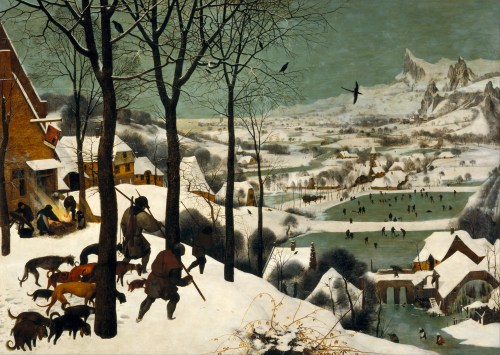
 Artist: Pieter Brueghel the Elder (1526/1530–1569)
Title: English: Hunters in the Snow (German: Jäger im Schnee) (Winter)
Date: 1565
Medium: oil on oak wood
Dimensions: height: 1,170 mm (46.06 in); width: 1,620 mm (63.77 in)
Collection: Kunsthistorisches Museum
What I love about this painting:
This is one of Pieter Brueghel the Elder’s most famous paintings and is a favorite of mine because of the rich societal commentary Brueghel painted into this scene.
Perhaps you have seen it at some point, on a calendar or a Christmas card, and after a cursory glance, you dismissed it as a bucolic illustration of a bygone era.
You fell for his trap. Bruegel the Elder was an observer of life and had a wide streak of sarcasm that emerged in his work. He lived in a time of extreme capitalism, where the nobility and the Church made the rules, with no regard for those whose labors had made them rich.
Brueghel was a master at slipping pointed observations into the scene in such a way that they go unnoticed if one can’t be bothered to look closely.
In his day, the fortunate few who were wealthy were gloriously, impossibly rich. Money was minted by the rulers in the form of coins, and trickle-down economics didn’t work then any better than it does now. The peasants struggled to find food and shelter, going underpaid and overworked.
The middle class hung on, doing comparatively well. However, all it took for the prosperous farmer to be reduced to starvation was one bad harvest. That bad harvest toppled the small traders and crafters as well. When the middle class can’t afford new shoes or garments, tailors and cobblers suffer as well.
Critics didn’t praise his work, as it is unabashedly primitive, created for the common person’s enjoyment, and art critics don’t care much about what the common folk like. Nonetheless, his work is still highly prized by collectors.
Brueghel had a sneaky sense of humor and employed it to show the truth about humanity and inhumanity in his work.
Even now, four centuries after his era, ordinary people can relate to his work because, underneath the technological advances that we will be remembered for, things haven’t changed that much. The uber-rich are still uber-rich, and the middle class is still footing the bill.
Brueghel lived during a time of religious revolution in the Netherlands, and walking the line between both factions must have been difficult. Some have said that Bruegel (and possibly his patron) were attempting to portray an ideal of what country life used to be or what they wished it to be.
That is because they didn’t look deeper, giving it a cursory glance and moving on. On the surface and from a distance, this is a bucolic scene depicting ordinary peasants enjoying the winter. But when you look deeper, really look at it, you can see the irony of it, the honesty that Brueghel hid in plain sight.
Brueghel used symbolism to convey an entire story by employing paradox and gallows humor in every painting. Here, he shows us that winter was harsh, and for the average person, survival required a lot of work, sometimes for nothing.
He shows us the hunters returning with empty game bags, the lone corpse of a skinny fox, and little else.
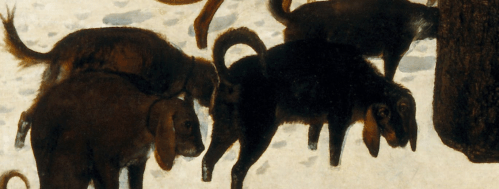
One dog looks at us with starving eyes, as if hoping for scraps.
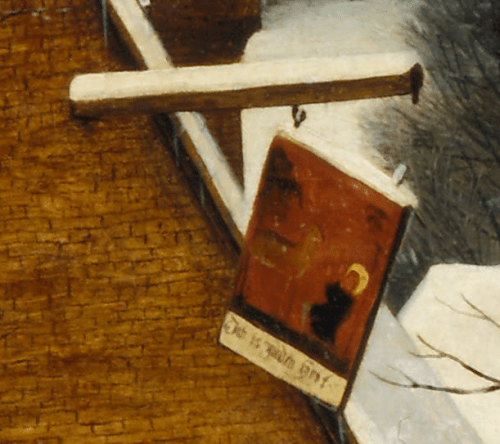
The tavern’s sign is about to fall down, a large hint that all is not well. That symbolic broken sign tells us the owners are bankrupt.
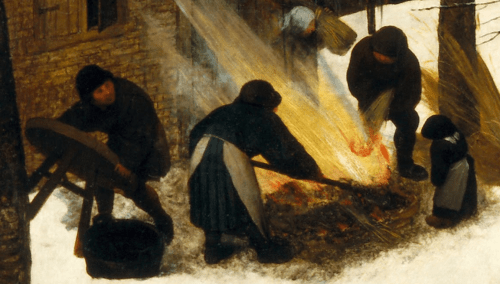
The owners are cooking outside, directly in front of the door, evicted from their home and business. A woman brings a bundle of straw out of the inn to use as fuel, while in the distance an ox-drawn wagon is heavily laden with firewood. Where is it going? Not to their inn, that is for sure.
And most intriguingly, a man is carrying a table away. He glances over his shoulder at the meager soup they are cooking, as if they had somehow gotten it away before he could take that, too. Is he the new owner, having acquired it for pennies from the city by paying the taxes at a forced bankruptcy sale? Or is he a hired thug employed by the new owner?
A rabbit has crossed the hunters’ path and evaded their snares.

Ravens, long considered birds of ill omen, roost in the trees above the inn and the hunters and fly above the revelers, a portent of worse days to come.
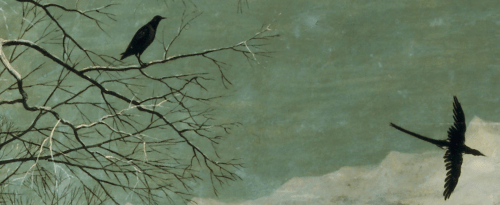
But in this story, Brueghel’s characters have hope and faith that things will improve. In the distance (the future) people are playing winter games.
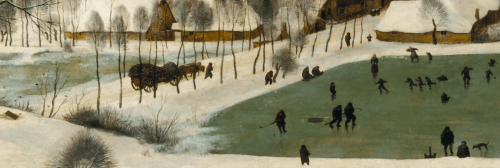 But they are indistinct and far away, shown in a fantastic, mountainous landscape rather than the flat terrain of the Netherlands. It is almost as if they are visions of what winter could be if only the harvest had been good rather than the truth of the lone fox, hounds with empty bellies, a bankrupt tavern, and the rabbit that got away.
About this painting, via Wikipedia, the Fount of All Knowledge:
The Hunters in the Snow (Dutch: Jagers in de Sneeuw), also known as The Return of the Hunters, is a 1565 oil-on-wood painting by Pieter Bruegel the Elder. The Northern Renaissance work is one of a series of works, five of which still survive, that depict different times of the year. The painting is in the collection of the Kunsthistorisches Museum in Vienna, Austria. This scene is set in the depths of winter during December/January.
The painting shows a wintry scene in which three hunters are returning from an expedition accompanied by their dogs. By appearances the outing was not successful; the hunters appear to trudge wearily, and the dogs appear downtrodden and miserable. One man carries the “meager corpse of a fox” illustrating the paucity of the hunt. In front of the hunters in the snow are the footprints of a rabbit or hare—which has escaped or been missed by the hunters. The overall visual impression is one of a calm, cold, overcast day; the colors are muted whites and grays, the trees are bare of leaves, and wood smoke hangs in the air. Several adults and a child prepare food at an inn with an outside fire. Of interest are the jagged mountain peaks which do not exist in Belgium or Holland. [1]
Credits and Attributions:
Wikimedia Commons contributors, “File:Pieter Bruegel the Elder – Hunters in the Snow (Winter) – Google Art Project.jpg,” Wikimedia Commons, https://commons.wikimedia.org/w/index.php?title=File:Pieter_Bruegel_the_Elder_-_Hunters_in_the_Snow_(Winter)_-_Google_Art_Project.jpg&oldid=898942431 (accessed December 18, 2024).
[1] Wikipedia contributors, “The Hunters in the Snow,” Wikipedia, The Free Encyclopedia, https://en.wikipedia.org/w/index.php?title=The_Hunters_in_the_Snow&oldid=1262746140 (accessed December 18, 2024).
 Directors will tell you they focus the scenery (set dressing) so it frames the action. The composition of props in that scene is finely focused world-building, and it draws the viewer’s attention to the subtext the director wants to convey.
 As I work my way through revisions, I struggle to find the right set dressing to underscore the drama. Each item mentioned in the scene must emphasize the characters’ moods and the overall atmosphere of that part of the story.
 We can bookend the event with “doorway” scenes. These scenes determine the narrative’s pacing, which is created by the rise and fall of action.
 The opening paragraph of a chapter and the ending paragraph are miniature scenes that bookend the central action scene. They are doors that lead us into the event and guide us on to the next hurdle the character must overcome.
 When the next chapter opens, he steps into an opening paragraph that leads into the next action sequence. We find out who and what new misery is waiting for him on the other side of that door.
 When you begin making revisions, take a look at the opening paragraph of each chapter. Ask yourself how it could be rewritten to convey information and lead the reader into the action. Then, look at the final paragraph and ask yourself the same question.
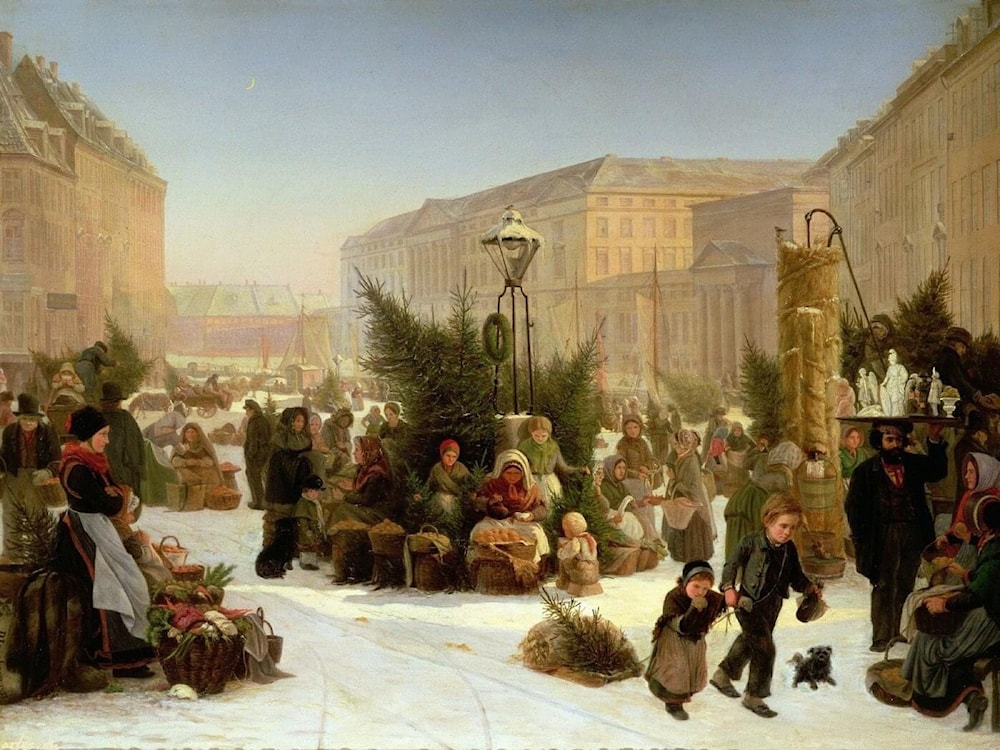 Title: Selling Christmas Trees
 These transitions are often small moments of conversation, italicized thoughts (internal dialogues), or contemplations written as free indirect speech. These moments are a form of action that can work well when a hard break, such as a new chapter, doesn’t feel right. The reader and the characters receive information simultaneously, but only when they need it.
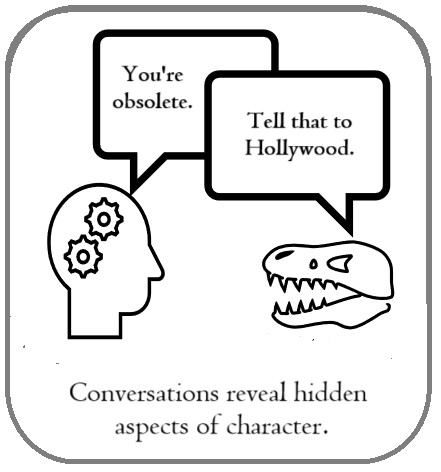 A character’s personal mood can be shown in many ways. A moment of
  Trim that back to
 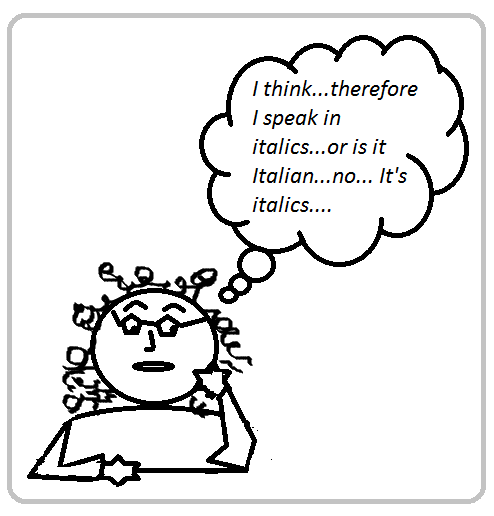 The main thing to watch for when employing indirect speech in a scene is to stay only in one person’s head. You can show different characters’ internal workings, provided you have a hard scene or chapter break between each character’s dialogue.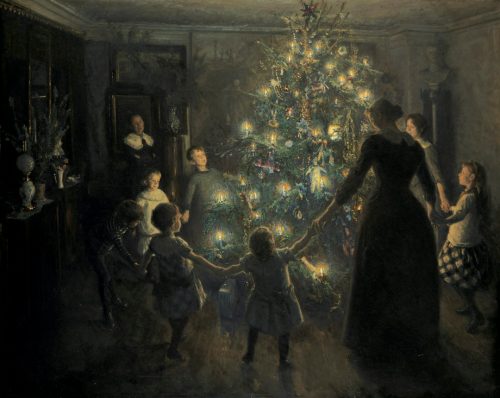
 As stories unfold on paper, new characters enter. They bring their dramas and the story goes in a different direction than was planned. When I meet these imaginary people, I assign their personalities a verb and a noun.
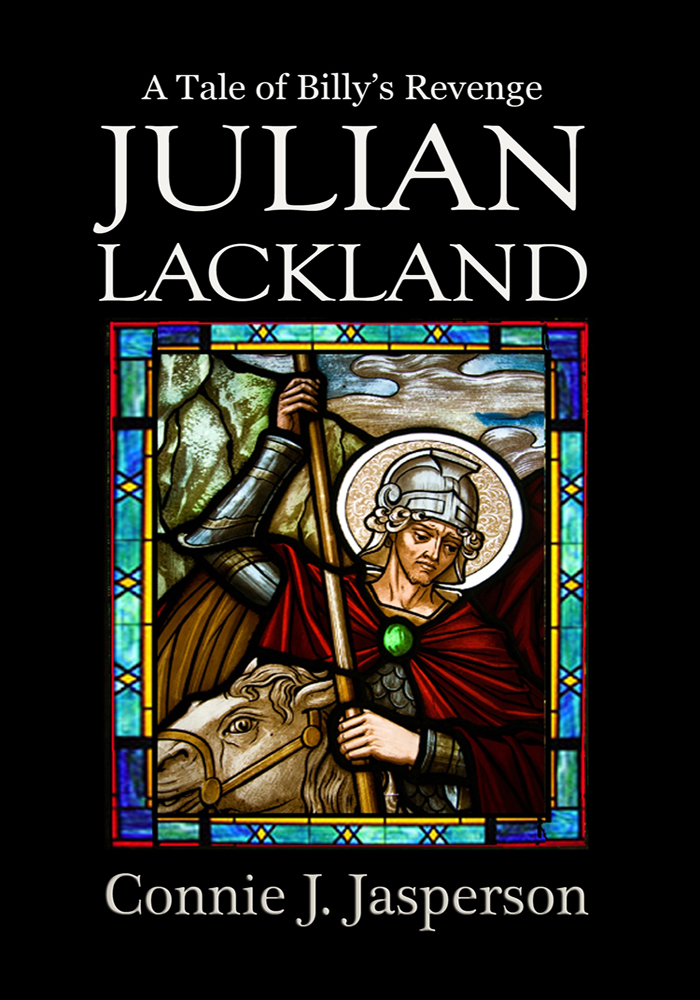 Julian’s noun is chivalry (Gallantry, Bravery, Daring, Courtliness, Valor, Love). He sees himself as a good knight and puts all his effort into being that person. He is in love with both Mags and Beau.
 Next, we assign a verb that describes their gut reactions, which will guide how they react to every situation. They might think one thing about themselves, but this verb is the truth. Again, we also look at sub-verbs and synonyms:
 Have you thought about the two words that describe the primary weaknesses of your characters, the thing that could be their ultimate ruin? In the case of Julian’s story, it was:
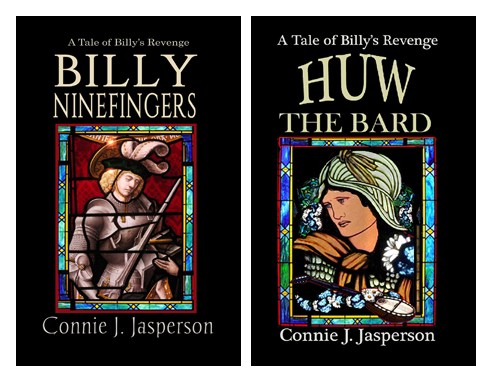 Julian Lackland took ten years to get from the 2010 NaNoWriMo novel to the finished product. He spawned the books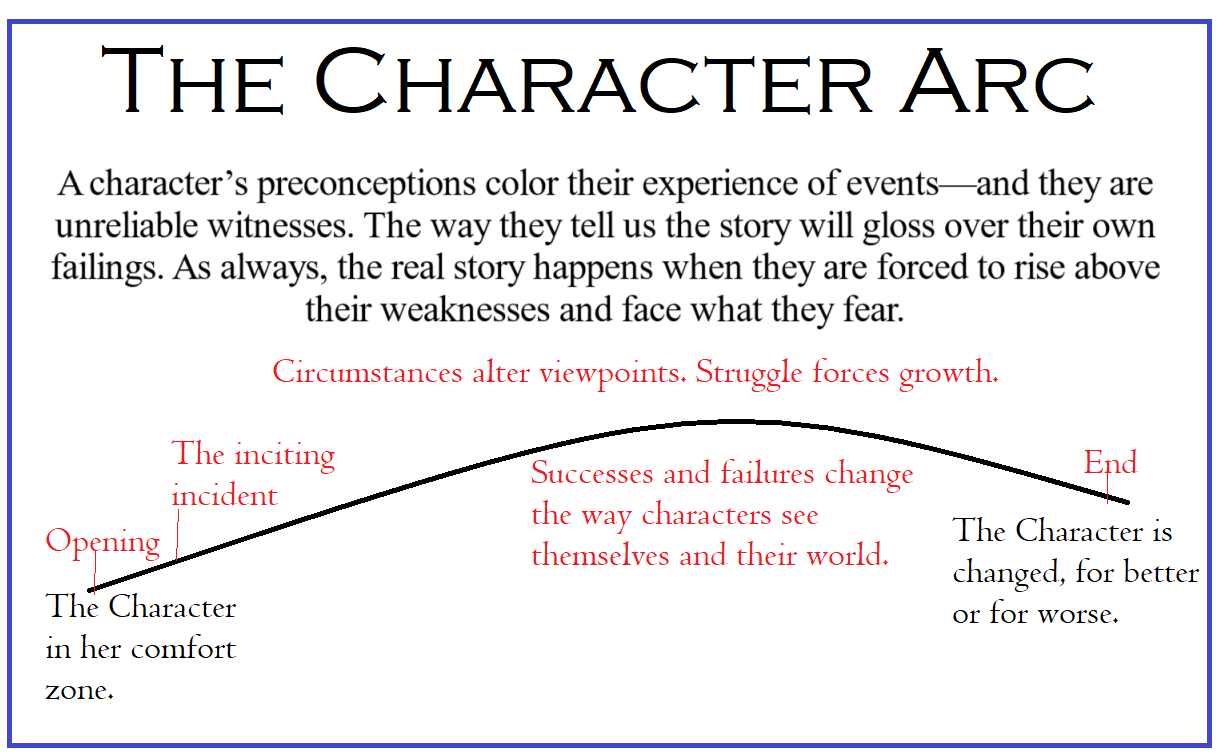
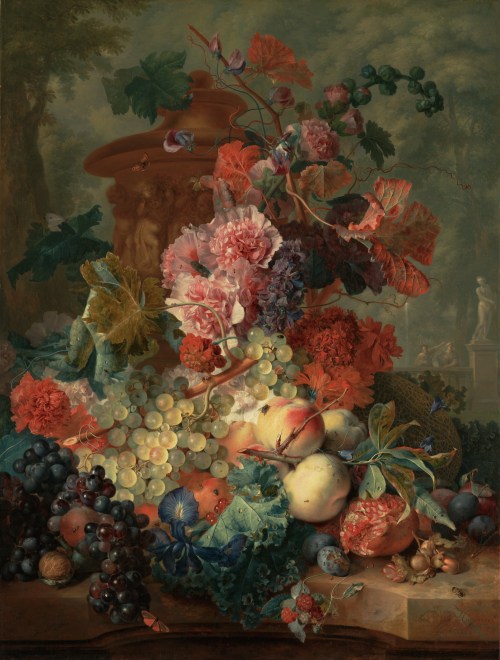
 I hate it when I find myself at the point where I am fighting the story, forcing it onto paper. It feels like admitting defeat to confess that my story has taken a wrong turn so early on, and I hate that feeling. Fortunately, I knew by the 40,000-word point that last year’s story arc had gone so far off the rails that there was no rescuing it.
 The sections I cut weren’t a waste, they were a detour. In so many ways, that sort of thing is why it takes me so long to write a book—each story contains the seeds of more stories.
 Sometimes, something different happens. In 2019, I realized the novel I was writing is actually two books worth of story. The first half is the protagonist’s personal quest and is finished. The second half resolves the unfinished thread of what happened to the antagonist and is what I am currently working on. Both halves of the story have finite endings, so for the paperback version, I will break it into two novels. That will keep my costs down.
 For those of you who are curious—I have the attention span of a sack full of squirrels. Proof of that can be found in the 4 novels currently in progress that are set in that world, each at different eras of the 3000-year timeline, each in various stages of completion.
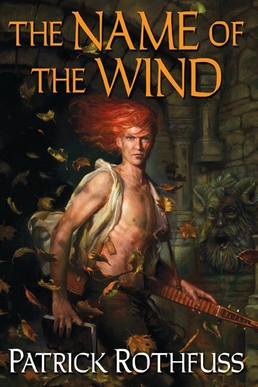 think of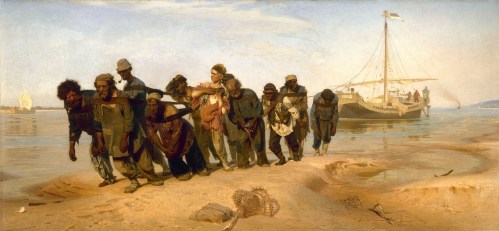
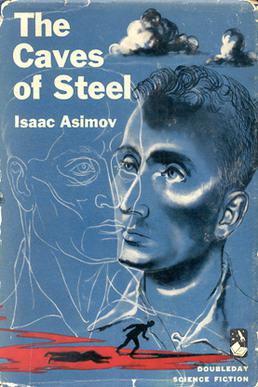 In 1953’s
 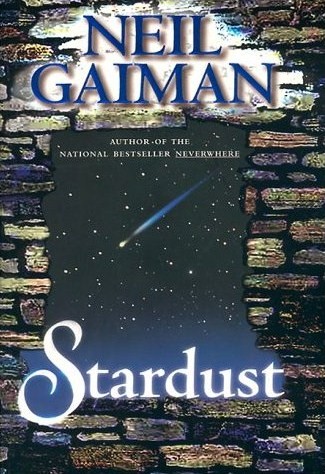 Neil Gaiman’s
 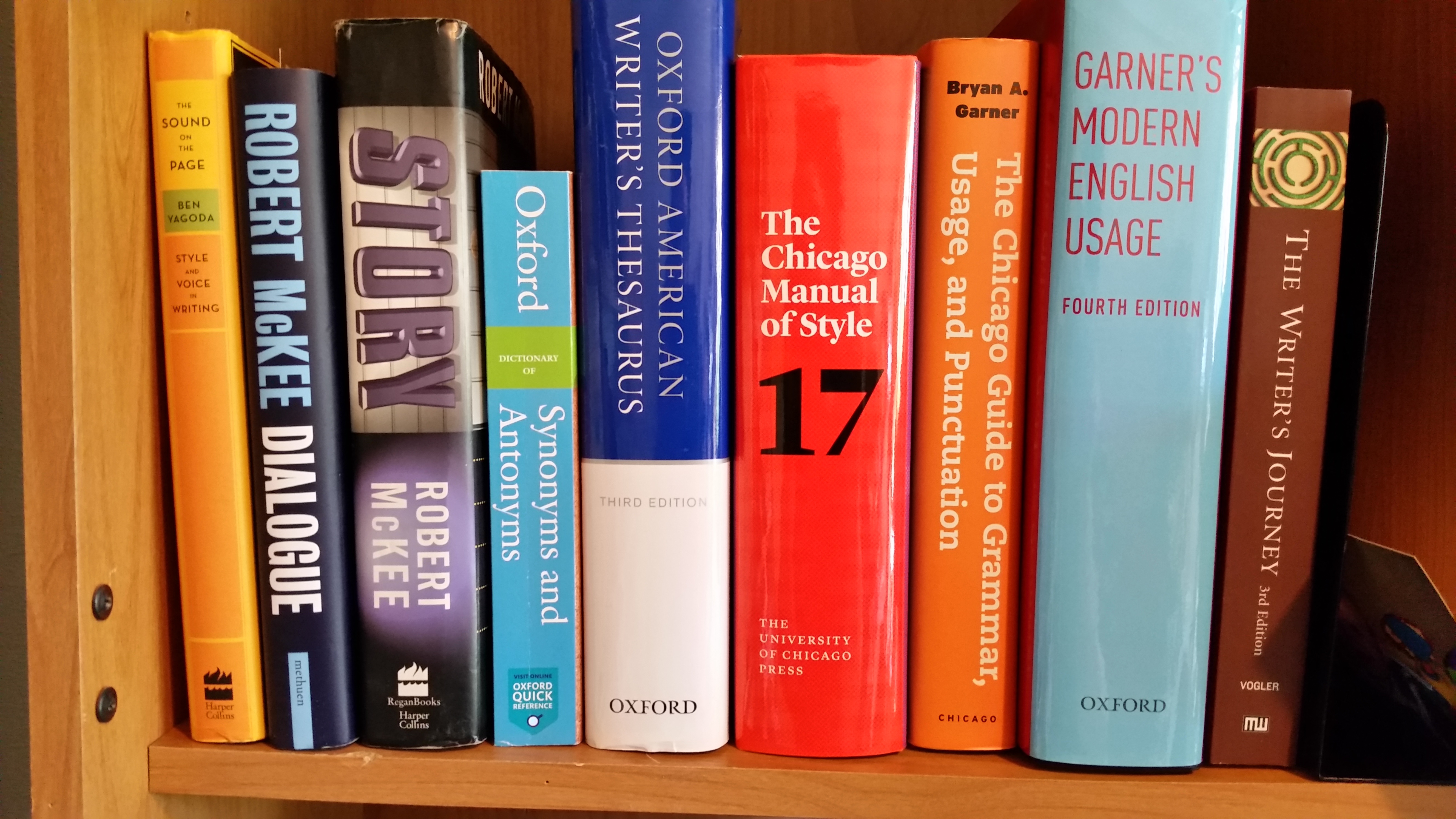 Dedicated authors are driven to learn the craft of writing, and it is a quest that can take a lifetime. It is a journey that involves more than just reading “How to Write This or That Aspect of a Novel” manuals. Those are important and my library is full of them. But how-to manuals only offer up a part of the picture. The rest of the education is within each of us, an amalgamation of our life experiences and what we have learned along the way.
 Authors write because we have a story to tell, one that might also embrace morality and the meaning of life. To that end, every word we put to the final product must count if our ideas are to be conveyed.


 Life in the Realm of Fantasy
