#NaNoPrep: write the novel first – worry about fine-tuning it later #amwriting

Over the next few months, authors embarking on their first NaNoWriMo will hear many rules about the craft of writing. Some will be good, and some will lead to later problems. I suggest you write the story as it falls out of your head during NaNoWriMo. Don’t worry too much about the rules until you get to the revision stage.

WritingCraft_NaNoPrep_101Getting those ideas out of your head now is what is important. The bloopers and grammar hiccups can all be ironed out in the second draft.

The common axioms of writing exist because writing a story that others can enjoy involves learning grammar rules, developing a broader vocabulary, developing characters, building worlds, etc.

However—some commonly repeated mantras of writing advice have the potential to backfire. An author with too rigid a view of these sayings will write lifeless prose, narratives an algorithm could produce.

The worst rules, in my opinion, are these three:

  • Remove all adverbs and adjectives. This advice is complete crap. Use common sense, and don’t use unnecessary modifiers.
  • Don’t use speech tags. What? Who said that, and why are there no speech tags in this nonsense?
  • Show, Don’t Tell. Don’t Ever Don’t do it! Oh, dear. What an amazing gymnastic routine your face is experiencing.

Nothing is more disgusting than a scene where a person’s facial expressions are described in minute detail.

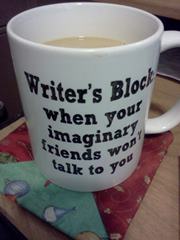
My Coffee Cup © cjjasp 2013Yes, we do need to show moods, and some physical description is necessary. Lips stretch into smiles, and eyebrows draw together. Still, they are not autonomous and don’t operate independently of the character’s emotional state. The musculature of the face is only part of the signals that reveal the character’s interior emotions.

Another extreme is when the author leans too heavily on the internal, describing the stomach-churning, gut-wrenching shock and wide-eyed trembling of hands in such detail the reader feels queasy and puts the book in the trash.

Which reminds me—don’t forget the weak-kneed nausea.

For me, the most challenging part of revising a manuscript is balancing the visual indicators of emotion with the more profound internal clues. This is something that really only takes shape to my satisfaction through multiple drafts.

  • Write what you know, and don’t dare to write something you don’t. In other words, what they’re saying is don’t use your imagination.

True, you should be careful when writing a real-world ethnicity you don’t have a personal experience of. If your heart is set on that story and only that story, you might want to consult someone from that culture. 5 Tips for Avoiding Cultural Appropriation in Fiction | Proofed’s Writing Tips

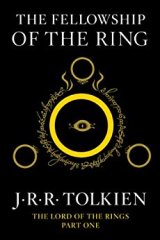
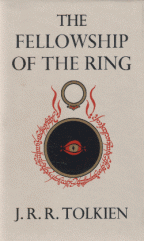
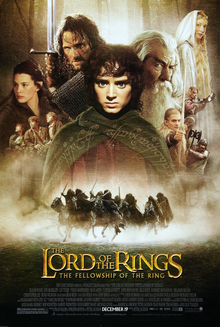
But in fantasy, while our life experiences shape our writing, our imagination is the story’s fuel and source. J.R.R. Tolkien understood senseless conflicts and total warfare—because he had experienced it. His books detail his view of the utter devastation of war but are set in a fantasy environment and feature elves and orcs. (Those are two races that don’t abound in England, at least not that I’ve heard.)

Another unreservedly silly mantra is this one:

  • If you’re bored with your story, your reader will be too.

That’s NOT true. You have spent months immersed in that story, years even. You know it inside and out, but your reader doesn’t. Set it aside and come back to it a month or more later. You’ll fall in love with it again.

Commonly discussed writing proverbs go on and on.

  • Kill your darlings.

Indeed, we shouldn’t be married to our favorite prose or characters. Sometimes, we must cut a sentence, a paragraph, a chapter, or even a character we love because it no longer fits the story. But have a care – people read for pleasure and because they love good prose. If it works, keep it.

  • Cut all exposition.

The timing of when we insert the exposition into the narrative is crucial. A story must be about the characters, the conflict, and the resolution. The reader wants to know what the characters know. But they only need that knowledge when it becomes necessary for the plot to move forward. They don’t want information dumped on them.

8ce052b8e7c8182a51dc4999859c1061Bad advice is good advice taken to an extreme. But all writing advice has roots in truth. So, when it comes to making revisions, consider these suggestions:

  • Overuse of adverbs fluffs up the prose and ruins the taste of an author’s work. Don’t get too artful.
  • Too many speech tags, especially odd and bizarre ones, can stop the eye. When the characters snort, hiss, and exclaim their dialogue, I will put the book down and never pick it up again. My favorite authors seem to stick to common tags like said and replied. Those tags blend into the background.
  • Too much telling takes the adventure out of the reading experience. Too much showing is tedious and can be disgusting. It takes effort to find that happy medium, but writing is work.
  • Know what you are writing about. Research your subject and, if necessary, interview people in that profession. Readers often know more than you do about certain things.

Education doesn’t happen overnight. I’ve been studying the craft for over twenty years and always learn something new. Unless an author is fortunate enough to have a formal education in the subject, we must rely on the internet and handy self-help guides to learn the many nuances of the writing craft.

I buy books about the craft of writing modern, 21st-century genre fiction and rely on the advice offered by the literary giants of the past. I seek a rounded view of crafting prose and look for other tools that I can use to improve my writing. I think this makes me a better, more informed reader. (My ego speaking.)

chicago guide to grammarI recommend investing in a grammar book, depending on whether you use American or UK English. These books will answer your questions, and you won’t be in doubt about how to use the standard punctuation readers expect to see.

The Chicago Guide to Grammar, Usage, and Punctuation (if you use American English)

OR

The Oxford A – Z of Grammar and Punctuation (if you use UK English)

Both American and UK writers should invest in:

The Oxford Dictionary of Synonyms and Antonyms (UK and American English). This will increase your vocabulary and help you avoid repetition and leaning on crutch words.

There are many other books on the craft of writing, but a grammar guide and a dictionary of synonyms will take you a long way.

oxford_synonym_antonymI recommend checking out the NaNoWriMo Store, which offers several books to help you get started. The books available there have good advice for beginners, whether you participate in November’s writing rumble or want to write at your own pace.

Other books on craft that I own and recommend:

  1. Damn Fine Storyby Chuck Wendig
  2. Dialogue, by Robert McKee
  3. Steering the Craft: A Twenty-First-Century Guide to Sailing the Sea of Story, by Ursula K. Le Guin
  4. Story, by Robert McKee
  5. The Emotion Thesaurusby Angela Ackerman and Becca Puglisi, and I also have all the companion books in that series.
  6. The Writer’s Journey, by Christopher Vogler
  7. VERBALIZE by Damon Suede and its companion book, Activate.

they're their there cupI study the craft of writing because I love it, and I apply the proverbs and rules of advice gently. Whether my work is good or bad—I don’t know. But I write the stories I want to read, so I am writing for a niche audience of one: me.

Be brave. Write your novel during NaNoWriMo and worry about fine-tuning it later. That’s what revisions are all about.

2 Comments

Filed under writing

#FineArtFriday: Mountain River Landscape, Jan Brueghel the younger and Joos de Momper the Younger (revisited)

A collaborative work by:

Jan Brueghel the Younger  (1601–1678)

Joos de Momper the Younger  (1564–1635)

Title:    An extensive mountainous river landscape with travellers near a village

Date:   by 1678

Medium: oil on panel

Dimensions: Height: 46.5 cm (18.3 in); Width: 66 cm (25.9 in)

Collection: Private collection

I first found this painting in November of 2020. Something about this image spawned a short story featuring the beggar, and also two (absurdly bucolic) poems about the countryside. But it was the pandemic, so there you go–I went a bit stir crazy.

Ah, those were the days, when the weekly masking up and going to pick up the groceries felt like a real day out.

What I like about this painting:

There is an intensity, a richness of color in the foreground, and a subtle chastisement the subject matter of this picture.

In the center we have a beggar on his knees and praying before a cross, with his worldly possessions stacked beside him and his dog patiently waiting. All around him, the world is going about its business. Shepherds are moving their flocks from one field to another, a merchant urges his horse-drawn cart down the hill. Further down the hill, another merchant unloads a wagon. At the right of the beggar, two travelers on horseback ignore the outstretched hand of yet another beggar, this one an old woman.

This painting is relatively less known, a scene composed and executed by two prolific artists, both of whom were the sons of two of the more famous artists of the 17th century.

At first glance this seems like an ordinary bucolic view of a village and surrounding countryside. Yet, I think the lesson they offer us is clear—we go through life relatively comfortably, unaware of the opportunities for charity that are all around us.

Both artists made their livings from their work so there was a market for what they produced. For both Brueghel and de Momper, their fathers (and in Brueghel’s case, his grandfather ) were hard acts to follow.

About the Artists, via Wikipedia:

Joos de Momper the Younger  primarily painted landscapes, the genre for which he was highly regarded during his lifetime. Only a small number of the 500 paintings attributed to de Momper are signed and just one is dated. The large output points to substantial workshop participation. He often collaborated with figure painters such as Frans Francken II, Peter Snayers, Jan Brueghel the Elder and Jan Brueghel the Younger, usually on large, mountainous landscapes, whereby the other painters painted the staffage (people) and de Momper the landscape. His works were often featured in the prestigious gallery paintings of collections (real and imagined) from the early seventeenth century.

Jan Brueghel the Younger was born and died in the 17th century in Antwerp. He was trained by his father and spent his career producing works in a similar style. Along with his brother Ambrosius, he produced landscapes, allegorical scenes and other works of meticulous detail. Brueghel also copied works by his father and sold them with his father’s signature. His work is distinguishable from that of his parent by being less well executed and lighter.

In an episode of BBC’s Britain’s Lost Masterpieces broadcast in November 2019, a very badly damaged picture of a village scene, whose panel has spilt into two pieces, was located at Birmingham Art Gallery. Following a complete restoration by Simon Gillespie, the landscape was attributed to Joos de Momper and the figures were attributed to Jan the Younger.


Credits and Attributions:

Wikimedia Commons contributors, “File:Jan Brueghel II and Joos de Momper II – An extensive mountainous river landscape with travellers near a village.jpg,” Wikimedia Commons, the free media repository, https://commons.wikimedia.org/w/index.php?title=File:Jan_Brueghel_II_and_Joos_de_Momper_II_-_An_extensive_mountainous_river_landscape_with_travellers_near_a_village.jpg&oldid=345270137 (accessed November 19, 2020).

Wikipedia contributors, “Jan Brueghel the Younger,” Wikipedia, The Free Encyclopedia, https://en.wikipedia.org/w/index.php?title=Jan_Brueghel_the_Younger&oldid=988772158 (accessed November 19, 2020).

Wikipedia contributors, “Joos de Momper,” Wikipedia, The Free Encyclopedia, https://en.wikipedia.org/w/index.php?title=Joos_de_Momper&oldid=988664019 (accessed November 19, 2020).

2 Comments

Filed under #FineArtFriday

#NaNoPrep: worldbuilding – war elephants, magic, and the paranormal #amwriting

Today in our NaNo Prep series, we’re looking at magic and the paranormal, two phenomena which fall into worldbuilding. Many first-time novelists in my region intend to write a fantasy of one sort or another. This post might interest you even if you aren’t writing a fantasy, because logic is a fundamental aspect of a narrative’s structure.

WritingCraft_NaNoPrep_101Magic or the supernatural are core plot elements in most of my work. I see them as part of the world, the way the Alps were a core plot element in the story of the Carthaginian general, Hannibal‘s crossing the Alps with North African war elephants. The mountains were there, they were difficult to cross, and combined with his elephants, the Alps made Hannibal’s story a legend.

War elephants … what a concept; and yet, it’s a true story. Can you imagine how terrifying that must have been to people who’d never heard of such immense creatures as elephants? If you’re stumped for ideas, go to history. It’s far more fantastic than any fantasy I could imagine.

When I write fantasy, I take something that gives a person an edge (war elephants) and make it a double-edged sword (taking the battle to the enemy by crossing impassable mountains, costing half the general’s men and many elephants).

Hannibal_crossing_the_AlpsHannibal paid a heavy price for bringing his superweapons (elephants) to the battle. The ability to use magic should come at some cost, either physical or emotional. Or it should require coins or theft to acquire magic artifacts.

There should be consequences for abusing magic.

The boundaries an author places on magic, science, or superpowers are good obstacles to success. Overcoming barriers is what the story is all about.

As a freelance editor, I saw some poorly constructed fantasies. The problem wasn’t with the characters or the quest—it was the magic. The authors had no purpose for it other than “magic!” and had created no science to rein it in, making it too random and convenient.

I returned those manuscripts, explaining why I couldn’t take their money just yet. Magic should have limits, and it should come at a cost. When they resubmitted the manuscripts, they had resolved those issues. I was impressed with how their solutions to the magic problem made their character’s journey memorable.

I’m a dedicated reader and have inadvertently purchased a few fantasies that looked promising from the blurb and the first few “look inside” pages but which turned out to be thinly disguised Harry Potter knockoffs.

Let’s don’t do that.

magic wandIt’s fair to write stories where magic is learned through spells if one has an inherent gift, and it’s also fair to require a wand. That is how magic was always done in traditional fairy tales and J.K. Rowling took those worn-out tropes and made them new and wonderful.

Rowling portrayed her magic right. She made it a natural part of the world and established limits, ensuring that even Voldemort had weaknesses. Also, she made magic a science that required proper education, something the fairy tales never addressed. Sorcerers and sorceresses just appeared out of nowhere with magic wands and unlimited capabilities.

If you intend your characters to have magic or paranormal abilities, it must be treated like a science in that it obeys fundamental laws.

If you’re like me, those laws will come to you when the protagonist needs to know them. That will create the tension your narrative needs but you must write those laws down so you don’t contradict yourself later.

I strongly feel the same rules should apply to the paranormal. Yes, some things have become canon regarding how we imagine vampires, werewolves, witches, and ghosts. But we all want to read a new take on these old stories which is why the Twilight series was so wildly popular when they first came out. My daughters loved that series, but here’s a secret—I never read them. So, I can’t give you an opinion of the logic of her portrayal of the paranormal. But they were very popular, so whatever she did, it struck a chord.

Lucky Coffee CupI can suspend my disbelief when magic and supernatural abilities are only possible if certain conditions have been met. The best tales featuring characters with paranormal skills occur when the author creates a system that regulates what the characters can NOT do.

Some things to think about if your stories involve ghosts, shapeshifters, and other undead:

  • Those rules should define the conditions under which a supernatural ability works.
  • The same physics should explain why it won’t work if those conditions are not met.
  • The number of entities able to use it is restricted to only a small group.
  • The range (area) at which a skill or ability is effective should be limited.

I think it’s more believable when our characters are constrained to one or two special abilities.

Expertise in any field requires practice and dedication, working on the most minor details of technique. Magicians and wizards should develop skills and abilities through training and perseverance, as musicians do.

If your characters have paranormal abilities, how did they learn to use them? Was it trial and error, or did they have a mentor?

scienceA crucial reason for establishing the science of magic and the paranormal before randomly casting spells or flinging fire is this: the use of these gifts impacts the wielder’s companions and influences the direction of the plot, creating tension.

What if our protagonist is unable to fully use their abilities? What is the cause of that disability?

How can they overcome this? How is their self-confidence affected by this inability? Do their companions also struggle to master their skills?

So, we know limitations can drive the plot. They make us work to resolve this problem.

The group will learn what has to happen before the hero can fully realize their abilities. They must be worried it won’t happen and they will fail. The companions must wonder if they have backed the wrong general, must have doubts. “How many soldiers and war elephants will we lose in conquering these mountains? Is the Golden McGuffin worth all this misery?”

People with nearly unlimited powers are gods, and while writing about gods is traditional in classical literature (and who doesn’t love Loki), we want to be original in our thinking. Give your gods a fatal flaw of some sort.

To wind up this rant: if you have decided to include gods, magic,crows-clip art clicker vector dot com or the paranormal in your NaNo novel, how can you take these common tropes in a new direction?

Write those ideas down now, while you’re thinking about it. I feel sure you will make your world different from the other fantasy worlds out there. The possibilities are endless.

The 2023 #NaNoPrep series to date:

  1. #NaNoPrep: creating the characters #amwriting | Life in the Realm of Fantasy (conniejjasperson.com)
  2. #NaNoPrep: The initial setting #amwriting | Life in the Realm of Fantasy (conniejjasperson.com)
  3. #NaNoPrep: What we think the story might be about #amwriting | Life in the Realm of Fantasy (conniejjasperson.com)
  4. #NaNoPrep: The Heart of the Story #amwriting. | Life in the Realm of Fantasy (conniejjasperson.com)
  5. #NaNoPrep: Signing up and getting started 2023 #amwriting | Life in the Realm of Fantasy (conniejjasperson.com)
  6. #NaNoPrep: How a strong theme will help you write that novel #amwriting | Life in the Realm of Fantasy (conniejjasperson.com)
  7. #NaNoPrep: worldbuilding – society and how we live #amwriting | Life in the Realm of Fantasy (conniejjasperson.com)

Credits and Attributions:

Image: Hannibal Crossing the Alps, James Baldwin (editor and author) (1841-1925), Public domain, via Wikimedia Commons

Comments Off on #NaNoPrep: worldbuilding – war elephants, magic, and the paranormal #amwriting

Filed under writing

#NaNoPrep: worldbuilding – society and how we live #amwriting

November is only a week away. If you are participating in NaNoWriMo and intending to begin writing on November 1st, this post is meant to help you lay the groundwork for the world in which your novel is set. This is definitely pre-writing, but you might want to describe this world in a separate document.

WritingCraft_NaNoPrep_Novel_in_a_monthFirst, what sort of world is your real life set in? When you look out the window, what do you see? Close your eyes and picture the place where you are at this moment. With your eyes still closed, tell me what it’s like. If you can describe the world around you, you can create a world for your characters.

So, in this fictional world, somebody is in charge of running things. We humans are tribal. We prefer an overarching power structure leading us because someone has to be the leader. We call that power structure a government.

As a society, the habits we develop, the gods we worship, the things we create and find beautiful, and the foods we eat are evidence of our culture.

If your society is set in modern suburbia, that culture and those values will affect your characters’ view of their world. As you write that first draft, the society will emerge onto the paper.

Maybe you are writing a sci-fi or fantasy novel. You will create the world as you write it. But do make a few notes as you go, or you may have trouble showing your world logically and without contradictions later in the narrative.

If that sounds like outlining, relax. You don’t have to call these notes an outline—after all, we don’t want to imply you aren’t a bona fide “pantser.” You can call them “notes.” No one will accuse you of outlining.

chicken clipartWhat does the outdoor world look and smell like? Is it damp and earthy, or dry and dusty? Is there the odor of fallen leaves moldering in the gutters? Or have we wandered too near the chicken coop? (Eeew … get it off my shoe!) If an author can inject enough sight, sound, and scent into a fantasy or sci-fi setting, the world will feel solid when I read it.

What about the weather? It can be shown in small, subtle ways, a background giving a sense of place to our characters’ interactions and the events they go through.

Once you have decided on your overall climate, consider your level of technology. Perhaps you are setting your story in a pre-industrial society. Do some research now on how the weather affects agriculture and animal husbandry. Bookmark the websites with the best information.

  • Overall, climate limits the variety of food crops that can be grown. Wet and rainy areas will grow vastly different crops from those in arid climates.

Maybe your novel’s setting is a low-tech civilization. If so, the weather will affect your characters differently than one set in a modern society. Also, the level of technology limits what tools and amenities are available to them.

Visualizing the scene and placing yourself there is the best way to make the fantasy world real. Blend what you know about the natural world into it. Consider writing several paragraphs describing all the details that will never make it into your story. Write them on a separate document, a list of things you, as the author, want to have firmly in your mind.

paul cornoyer rainy day in madison square

Paul Cornoyer: Rainy day in Madison Square

In any era, the weather affects the speed with which your characters can travel great distances and how they dress. Bad weather always has a detrimental effect on transportation, offering opportunities for conflict.

Society is the way people live in your world. While writing those first lines on November 1st, details about the society your characters inhabit will surface. They will continue to present themselves throughout the first draft and possibly the second.

Keep notes on the places and people you described. When you get to chapter 30 and need to know what you said in chapter 2, you will have the answer and won’t have to waste time searching the manuscript for it.

How is your society divided? Who has the wealth? Where do your characters fall in that spectrum?

How do we treat each other? Do we have a culture of revenge and aggression?

Who has the power, men or women—or is it a society based on mutual respect? Is there a cisgender bias or an acceptance of different gender identities?

As we said above, someone has to run things. If the politics are a part of your narrative, is the government run by tribal elders, or is it a monarchy, or a democracy, or a dictatorship, or a corporate oligarchy?

How does religion impact your story if it plays a role in your society?

Ferrari_AssetResizeImageWhat about transport? How do people and goods go from one place to another?

Many things about the world will emerge from your creative mind as you write those first pages and will continue to arise throughout the story’s arc.

Consider making a glossary as you go. If you are creating names for people or places, list them separately as they come to you. That way, their spelling won’t drift as the story progresses. It happened to me—the town of Mabry became Maury. I put it on the map as Maury, and it was only in the final proofing that I realized that the spelling of the town in chapter 11 was different from that of chapter 30.

Epic Fails meme2Names and directions might drift and change as you write your first draft. Also, if they’re invented words, consider writing them close to how they are pronounced.

(Sigh.) Some names that looked cool and sword-and-sorcery-like when I first put them on paper in 2007 have lost their charm. It never occurred to me that I would still be writing stories featuring them in 2023.

Oops.

Next up: worldbuilding – creating believable magic and the paranormal.

The #NaNoPrep series to date:

  1. #NaNoPrep: creating the characters #amwriting | Life in the Realm of Fantasy (conniejjasperson.com)
  2. #NaNoPrep: The initial setting #amwriting | Life in the Realm of Fantasy (conniejjasperson.com)
  3. #NaNoPrep: What we think the story might be about #amwriting | Life in the Realm of Fantasy (conniejjasperson.com)
  4. #NaNoPrep: The Heart of the Story #amwriting. | Life in the Realm of Fantasy (conniejjasperson.com)
  5. #NaNoPrep: Signing up and getting started 2023 #amwriting | Life in the Realm of Fantasy (conniejjasperson.com)
  6. #NaNoPrep: How a strong theme will help you write that novel #amwriting | Life in the Realm of Fantasy (conniejjasperson.com)

1 Comment

Filed under writing

#FineArtFriday: Cider Pressing by George Henry Durrie 1855 (revisited)

George_Henry_Durrie_-_Cider_PressingCider Pressing by George Henry Durrie 1855

Date: 1855

Medium: oil on canvas

Dimensions: Height: 22.2 in (56.5 cm); Width: 30.2 in (76.8 cm)

Collection: Private collection (Mr. & Mrs. Eugene Bugbee)

What I love about this painting:

We’re nearing the end of October, and autumn is fast sliding into the long dark of a northern November. Some trees are shedding their leaves here in the Pacific Northwest, but others are clinging to the last shreds of yellow and gold. Our native fall colors are less brilliant than those depicted in Durie’s work, but many non-native species have been introduced in the suburban landscape, offering bursts of scarlet and orange.

I love the simplicity of George Henry Durrie’s paintings. This one in particular deserves a second look. It first appeared here in September of 2021.

This is a quintessential, slightly romantic, view of history, a window into a New England day in autumn during the 19th century. A farmer leads his ox-drawn cart to the cider press. Is he selling them to the cider-man or just paying to have them juiced? Does he make his own apple jack, or is he a teamster, transporting goods for a fee?

A story can be found here, as in all Durrie’s paintings.

Juicing apples for unfermented ciders juices, jellies, and the highly fermented apple jack was an essential part of bringing in the harvest and preparing for winter, a part of the food chain we who get our food from the supermarket are disconnected from. But this was a scene that played out every fall, in every town and village.

Durrie’s colors are intensely vibrant, deep and rich, and each part of the scene is clear and placed with intent. The air is crisp and cool, but not yet cold. The leaves are turning all shades of red and gold, just as they are doing here today in the Pacific Northwest.

About the Artist, quoted from the National Gallery of Art:

Born in New Haven in 1820, the son of a Connecticut stationer, George Henry Durrie remained in that city virtually his entire life. Married to a choirmaster’s daughter, Sarah Perkins, in 1841, he immersed himself in the quiet pursuits of family and church. While he never achieved the fame of the most renowned nineteenth century American landscape painters, he appears to have had a fulfilling, productive career. His letters show that he never felt the need to move beyond his community, although he once briefly took a studio in New York and exhibited there regularly at the National Academy of Design.

Almost all of his compositions are relatively small in scale, few exceeding 18 x 24 inches, and his views are quiet and intimate. He knew and admired the works of Thomas Cole, and may have tried to emulate certain aspects of Cole’s style, yet he eschewed the Hudson River School’s compositional complexity and expansiveness. Because his paintings combined extensive genre elements with landscape they had a story-telling content that made them pleasant, accessible images to the average viewer.

The lithographic firm of Currier & Ives successfully reproduced ten of Durrie’s scenes and these, in turn, became popular calendar illustrations in the twentieth century. As a result, Durrie’s depictions of rural life in the mid-nineteenth century are now among the most familiar images in all of American art. As Martha Hutson has noted, however, these printed pictures do not convey the keen sensitivity to and understanding of conditions of atmosphere and light that are so pronounced in Durrie’s paintings. [1]

From Wikipedia:

In his teens the self-taught artist painted portraits in the New Haven area. In 1839 he received artistic instruction from Nathaniel Jocelyn, a local engraver and portrait painter. After 1842 he settled in New Haven, but made painting trips to New Jersey, New York, and Virginia. Around 1850, he began painting genre scenes of rural life, as well as the winter landscapes that became popular when Currier and Ives published them as lithographs. Four prints were published between 1860 and the artist’s death in New Haven in 1863; six additional prints were issued posthumously. The painter Jeanette Shepperd Harrison Loop studied with him. [2]


Credits and Attributions:

Wikimedia Commons contributors, “File:George Henry Durrie – Cider Pressing.JPG,” Wikimedia Commons, the free media repository, https://commons.wikimedia.org/w/index.php?title=File:George_Henry_Durrie_-_Cider_Pressing.JPG&oldid=369724230 (accessed September 15, 2021).

[1] National Gallery of Art contributors, “George Henry Durrie,” biography, © 2018 – 2021 National Gallery of Art, https://www.nga.gov/collection/artist-info.6397.html

[2] Wikipedia contributors, “George Henry Durrie,” Wikipedia, The Free Encyclopedia, https://en.wikipedia.org/w/index.php?title=George_Henry_Durrie&oldid=861433469 (accessed September 15, 2021).

2 Comments

Filed under #FineArtFriday, writing

#NaNoPrep: How a strong theme will help you write that novel #amwriting

We’re closing in on November 1st. We’ve done some pre-writing, looking at our characters and the world they inhabit. We may even have jotted down a loose outline of plot points to write to. Today, we’re going a little deeper into what our book may be about.

WritingCraft_NaNoPrep_101When someone asks me what a book I wrote is about, my mind grinds to a halt as I try to decide what to say. I could give them the rundown of the plot, which is the arc of events the characters experience.

Or, I can try to interest them in the characters and the struggles they overcome.

I have discovered that neither of those answers sells books.

I have only just recently discovered that what a prospective reader really wants to know is, “What themes are explored in this book?” People buy books that delve into subjects that resonate with their own lives. They want to read novels that shed light on the human condition, regardless of genre or the setting.

Readers read for the adventure, but the themes explored in that novel stay with them. Strong themes are as memorable as the characters we grow to love.  

plot is the frame upon which the themes of a story are supportedThe story writes itself when I begin with a strong theme and solid characters. A 19th-century writer many have heard of but never read, Henry James has a great deal to tell us about using a story’s themes to create memorable characters. You may be familiar with some of his works, such as The Turn of the Screw and The Golden Bowl. His novels are still being made into movies and adapted as plays.

His novels feature one common theme—lust. Lust for sex. Lust for money. Lust for control.

Lust for power.

The Golden Bowl is a story featuring the themes of deception, manipulation, lust for money, and lust for control. Many of James’s novels are contemporary to his world, featuring characters going through their lives the way they did in his era.

When James sat down to write The Golden Bowl, published in 1904, he knew that the theme, the subject, and the core of the story he intended to write was the overwhelming desire for something unobtainable. Henry James played upon the reader’s secret craving for those same things by taking his characters down to their fundamental emotional components.

His work shocked his contemporary society because he peeled back the veneer of civilization and exposed their motives for the world to see. He created novels pertinent to today’s world by writing the kind of characters he knew in real life and setting them in stories that featured themes everyone could recognize and relate to in either a good or bad way.

So now, let’s look at the themes in a novel that has become a foundation book of modern fantasy. The Hobbit, by J.R.R. Tolkien, was published in 1937 as a children’s book. (Apparently, children were better educated in those days.) Courage in the face of failure and personal redemption are unifying themes of the Lord of the Rings series, along with loyalty and honor.

the hobbitWhen Bilbo Baggins fights the giant spiders, he also faces his own cowardice and is amazed that he could do such a thing. This is only the first step in his personal arc. As the story progresses, he discovers that he has courage, which has nothing to do with the invisibility conferred on him by the ring he found earlier. Bilbo has courage, and yes, he is afraid. But he is not afraid to be courageous.

In the “Two Towers” Boromir must also have the courage to face his dishonor, move beyond his attempted theft of the ring, and find the courage to admit his shame. He then fights to protect Merry and Pippin. This is his personal redemption.

So, we know that theme illustrates a story’s central ideas. But maybe we don’t have a clue as to what theme might unify the events of our story arc.

Romantic love is a defining feature of the genre of Romance. But what different aspects of love can be found in every genre, from fantasy to sci-fi, horror, or crime fiction?

  • Brother/Sisterly love
  • Dangerous Attraction
  • Friendship
  • Love gained
  • Love lost
  • Parental love
  • Passion
  • Selfish love
  • Tragic love

Quill_pen smallLove is only one theme, yet it has so many facets. Other themes abound, large central concepts that build tension within the narrative.

Here is a brief list, just a small jumping-off point for your creative mind. Some are significant themes that entire genres have been built around, and others are good supporting themes:

  • Abuse
  • Alienation/loneliness
  • Ambition
  • Coming of age
  • Conspiracy
  • Crime and Justice
  • Fall from Grace
  • Good vs. Evil
  • Grief
  • Humanity in jeopardy
  • Midlife crisis
  • Nostalgia for the good old days
  • Plagues
  • Rebellion and revolution
  • Redemption
  • Religious intolerance
  • Separation and reunion
  • The fall of civilization
  • The hero’s journey
  • War

theme_meme_lirf06302020Sometimes, we can visualize a complex theme but can’t explain it. If we can’t explain it, how do we show it? Consider the theme of “grief.” It is a common theme that can play out against any backdrop, whether sci-fi or reality based, where humans interact on an emotional level.

A plan is not always required because, in some stories, the flash of inspiration we start with is a strong theme. The theme develops as you write, and immediately, you see what it is. In my case, I need a plan fifty percent of the time.

Whatever the case, once I have identified the main theme, the story begins to take shape in my head. I can show it through

  • Actions
  • Symbolic settings/places
  • Allegorical objects in the setting
  • Conversations

On the surface level, each literary genre looks widely different. But when we go deeper, we find that all literary genres have commonalities: protagonists and side characters who must deal with and react to the book’s underlying themes.

Next up: creating societies, science, magic, and the paranormal.

The #NaNoPrep series to date:

  1. #NaNoPrep: creating the characters #amwriting | Life in the Realm of Fantasy (conniejjasperson.com)
  2. #NaNoPrep: The initial setting #amwriting | Life in the Realm of Fantasy (conniejjasperson.com)
  3. #NaNoPrep: What we think the story might be about #amwriting | Life in the Realm of Fantasy (conniejjasperson.com)
  4. #NaNoPrep: The Heart of the Story #amwriting. | Life in the Realm of Fantasy (conniejjasperson.com)
  5. #NaNoPrep: Signing up and getting started 2023 #amwriting | Life in the Realm of Fantasy (conniejjasperson.com)

2 Comments

Filed under writing

#FineArtFriday: Calais Pier by J.M.W. Turner, 1803

Calais_pier_Joseph_Mallord_William_Turner_024

Artist: J. M. W. Turner (1775–1851)

Title: Calais Pier

Date: 1803

Medium: oil on canvas

Dimensions: height: 172 cm (67.7 in); width: 240 cm (94.4 in)

Collection: National Gallery

What I love about this painting:

This is an emotion-packed image, the scene of a near-tragedy. The packet boat has arrived at Calais with a full load of passengers. The storm dominates the scene with lowering clouds and a heavy swell, but the sun breaks through and lights on the sail. A shaft of light shines down to the sea illuminating the center of the composition.  The young artist put his experience and terror into the image, depicting the ferocity of the sea and the violence of the landing.

The National Gallery website says of this picture, “Although it had a mixed response when first exhibited at the Royal Academy in 1803, the critic John Ruskin declared it to be the first painting to show signs of ‘Turner’s colossal power’. Calais Pier is based upon an actual event. On 15 July 1802, Turner, aged 27, began his first trip abroad, travelling from Dover to Calais in a cross-channel ferry (a packet) of the type shown here. The weather was stormy, and Turner noted in his sketchbook: ‘Our landing at Calais. Nearly swampt.’” [1] Joseph Mallord William Turner | Calais Pier | NG472 | National Gallery, London

About the Artist, Via Wikipedia:

Joseph Mallord William Turner RA (23 April 1775 – 19 December 1851), known in his time as William Turner, was an English Romantic painter, printmaker and watercolorist. He is known for his expressive coloring, imaginative landscapes and turbulent, often violent marine paintings. He left behind more than 550 oil paintings, 2,000 watercolors, and 30,000 works on paper. He was championed by the leading English art critic John Ruskin from 1840 and is today regarded as having elevated landscape painting to an eminence rivalling history painting.

Turner was born in Maiden Lane, Covent Garden, London, to a modest lower-middle-class family and retained his lower class accent, while assiduously avoiding the trappings of success and fame. A child prodigy, Turner studied at the Royal Academy of Arts from 1789, enrolling when he was 14, and exhibited his first work there at 15. During this period, he also served as an architectural draftsman. He earned a steady income from commissions and sales, which due to his troubled, contrary nature, were often begrudgingly accepted. He opened his own gallery in 1804 and became professor of perspective at the academy in 1807, where he lectured until 1828. He travelled around Europe from 1802, typically returning with voluminous sketchbooks.

Intensely private, eccentric, and reclusive, Turner was a controversial figure throughout his career. He did not marry, but fathered two daughters, Evelina (1801–1874) and Georgiana (1811–1843), by his housekeeper Sarah Danby. He became more pessimistic and morose as he got older, especially after the death of his father in 1829; when his outlook deteriorated, his gallery fell into disrepair and neglect, and his art intensified. In 1841, Turner rowed a boat into the Thames so he could not be counted as present at any property in that year’s census. He lived in squalor and poor health from 1845, and died in London in 1851 aged 76. Turner is buried in St Paul’s Cathedral, London. [2]


Credits and Attributions:

“Calais Pier” by J.M.W. Turner, 1801. Wikimedia Commons contributors, “File:Joseph Mallord William Turner 024.jpg,” Wikimedia Commons, https://commons.wikimedia.org/w/index.php?title=File:Joseph_Mallord_William_Turner_024.jpg&oldid=618399843 (accessed October 7, 2023).

[1] National Gallery contributors, Calais Pier, Joseph Mallord William Turnerhttps://www.nationalgallery.org.uk/paintings/joseph-mallord-william-turner-calais-pier (accessed  October 11, 2023).

[2] Wikipedia contributors, “J. M. W. Turner,” Wikipedia, The Free Encyclopedia, https://en.wikipedia.org/w/index.php?title=J._M._W._Turner&oldid=1179617592 (accessed October 11, 2023).

Comments Off on #FineArtFriday: Calais Pier by J.M.W. Turner, 1803

Filed under #FineArtFriday

#NaNoPrep: The Heart of the Story #amwriting.

This is the fourth installment of our NaNoWriMo Prep series. (I’ve listed links to the previous posts down below.) We now have an idea of who our characters are. We also know a bit about the world in which our narrative will be set. We know the genre we’re writing in and what the story might be about. Now we’re going to take a closer look at the plot.

WritingCraft_NaNoPrep_101I am the queen of front-loading too much history in my first drafts. Fortunately, my writer’s group has an unerring eye for where the story really begins.

I have to remind myself that the first draft is the thinking draft. It’s where we build worlds and flesh out characters and relationships. It’s also where the story grows as we add to it.

Let’s write a medieval fantasy:

Act 1: the beginning:

Setting: London in the year 1430. The weather is unseasonably cold. A bard is concealed amongst the filth and shadows in a dark, narrow alley. Tam hides from the soldiers of a prince he has unwisely humiliated in a comic song.

Opening plot point: the soldiers surround and capture Tam, hauling him before the angry prince. The trial is brief and painful. Beaten and bloody, Tam is thrown into prison and sentenced to be beheaded at dawn.

That moment of despair is the end of chapter one.

lute-clip-artYou have done some prep work for character creation, so Tam is your friend. You know his backstory, who he is attracted to (men, women, none, or both), how handsome he is, and his personal history. But none of this matters to the reader in the opening pages. The reader only wants to know what will happen next.

You know who Tam will meet in prison, someone who will help him escape. Depending on Tam’s romantic preference, Dagger (an assassin’s professional name) will be male or female and will dislike the bard on sight. Still, Dagger needs Tam’s help to escape as they too are scheduled to die at dawn.

You have decided that the prince is a dark-path warlock. His close friend is a highly placed cardinal who uses his authority to conceal the prince’s nefarious deeds.

Now we will think about Tam and Dagger’s escape, the first pinch point. The information they learn from each other while quarrelling in prison fuels a quest: killing the Warlock Prince. Each will have different reasons for this, but despite their inability to get along, the enemy of my enemy is my friend and all that.

The escape is successful. Now they are on the run and have no idea how to accomplish their mutual goal. They don’t trust each other, but are forced to work together despite their clash of personalities.

And we all know how friction heats things up. Romance or no romance, this interpersonal tension is crucial.

We (the author) know the Warlock Prince must die if Tam and Dagger are to save London, but who will be willing to help them? What roadblocks stand in their way? The people you need to help them past these hurdles will emerge as you write the first draft.

You might have had an idea for the ending and may have written it down. If you did, you have a goal to write to. If not, perhaps the ending is beginning to show itself. Either way, at this point, the middle of the story is a work in progress.

crows-clip art clicker vector dot comTam and Dagger will tell you what events and roadblocks must happen to them between their arrests and the final victory. This knowledge will emerge from your imagination as you write your way through this first draft.

But the opening moment, the scene showing a lowly bard hiding behind a rubbish heap, is the moment in Tam’s life where the story the reader wants to hear starts.

That scene is where this story begins, regardless of how fascinating Tam’s backstory, London’s history, or the Warlock Prince’s backstory was before that day. It is the beginning because this is the point where all the essential characters are in one place and are introduced.

  • The reader meets the villain and sees him in all his power
  • Tam can sink no lower—he has hit bottom and can only go up from there.
  • Dagger is in the same low emotional place, but this mysterious character has an escape plan.

The story kicks into gear at this pinch point because the assassin is at risk on two fronts, which means Tam is, too. Dagger’s original task of killing the prince has failed, so now they must avoid both the prince’s soldiers and the mysterious employer’s goons.

For Dagger, the original commission must be fulfilled despite the fact there will be no payment.  It’s more than merely a matter of pride, but the secret that drives them will slowly emerge as we write the first draft.

Tam agrees to help ensure it happens because he has a conscience and wants to protect the people of London.

Attraction often grows in the most unlikely of places. Will it blossom into romance? It’s London, a city filled with romance and intrigue. But you’re the author, so only you know how their relationship grows as you write their adventure.

What will emerge in bits and pieces over the following 40,000 or more words?

  • We will learn who Dagger’s employer is.
  • We will learn who Dagger really is and how they became an assassin.

dump no infoTam will find this information out as the story progresses and we will learn it as he does. With that knowledge, he will realize his fate is sealed—he’s doomed no matter what. But it fires him with the determination that if he goes down, he will take the Warlock Prince and his corrupt Cardinal, with him.

The backstory behind the song that precipitated Tam’s arrest, the assassin’s employer, and the enraged prince who intends a lingering, painful death for him must come out gradually.

If we dump Tam and Dagger’s history at the beginning, the reader has no reason to go any further. We’ll have wasted words on something that doesn’t advance the plot.

The people who will help our hapless protagonist will enter the story as he needs them. Each person will add information the reader wants, but only when Tam requires it. Some characters who can offer the most help will be held back until the final half of the story.

By the end, the reader will know everything about the relationship between Dagger and the Warlock Prince. With that information, the final pieces of the puzzle will fall into place.

The reader will follow the breadcrumbs of information. That desire to know all the secrets will be the carrot that keeps the reader turning the pages.

And making that trail into a logical story arc is why I do a certain amount of prewriting and outlining.

storyArcLIRF10032021


PREVIOUS POSTS IN THIS SERIES:

#NaNoPrep: creating the characters #amwriting | Life in the Realm of Fantasy (conniejjasperson.com)

#NaNoPrep: The initial setting #amwriting | Life in the Realm of Fantasy (conniejjasperson.com)

#NaNoPrep: What we think the story might be about #amwriting | Life in the Realm of Fantasy (conniejjasperson.com)

6 Comments

Filed under writing

#NaNoPrep: What we think the story might be about #amwriting

This is the third installment of our NaNoWriMo Prep series. I’ve listed links to the previous posts at the end of this rant. We now have an idea of who our characters are. We also know a bit about the world in which our narrative will be set. We know the genre we’re writing in.

WritingCraft_NaNoPrep_101Now, we’re going to hear what our characters have to say about what their story might be.

Our characters step from our imagination and onto the first page. When we begin writing, we see them as people we are just getting to know. At first, our characters want us to think they’re unselfish. They desperately desire what they believe they deserve. They will evolve as we write because they will tell us their backstory. But we have an idea of their personality and how they might react.

In real life, people are a mix of good and bad at the same time. Some lean more to good, others to bad. Either way, most people have good, logical reasons for their decisions. How they deal with the hurdles you will present to them will show you who they are. By the end of November, you will know them well.

where-madness-lies-miguel-de-cervantesAn important point to remember is that no matter how decent they are, people lie to themselves about their motives. It’s human nature to obscure truths we don’t want to face behind other, more palatable truths. Those secrets will emerge as you write.

So, what is the story about at this early stage? Do you have an idea of the core conflict, the central problem that all the other events lead up to?

Sometimes, we have a banger of a plot, and the book writes itself. Other times, we have brilliant characters but only a vague idea of their conflict.

Consider the beginning: At the outset of any good story, we meet our protagonist and see them in their surroundings. An event occurs (the inciting incident), and the hero is thrown out of his comfort zone and into the situation, which is the core idea of your plot. 

This is the circumstance in which your protagonist finds himself at the story’s beginning. This is where I ask myself several questions.

  • How will the story start?
  • In the first paragraph on page one, what is the hero’s condition (strength, health, emotional state)?
  • What event could possibly entice her out of her comfort zone?
  • What is the core conflict?

If you know what the situation is, write it down:

  • Bleakbourne front Cover medallion and dragon copyIn my most recent book, Bleakbourne on Heath, Leryn the Bard hunts for strange folk tales and new songs (how it starts).
  • He wants to find a wife and have a normal life (what he wants).
  • But he has stopped in Bleakbourne on the river Heath and immediately becomes caught up in Merlin’s troubles (the conflict).
  • Leryn cares about the distinctly different people of Bleakbourne, who become his family. By the midpoint, he is driven to protect Bleakbourne and the people he loves no matter the cost (how far he will go to achieve his goal).

A few sentences detailing your flashes of inspiration will remind you of what you need when you begin writing. You don’t have to go into detail, just jot those ideas down and keep the list handy.

This kind of pre-writing serves an important purpose for novels I intend to begin in November.

I do it so I don’t become desperate and resort to off-the-wall events or killing off characters (ala G.R.R. Martin) just to stir things up.

route recalculatingI’m going off-topic here for a moment. While the death of a character stirs the emotions, it must be a crucial turning point in that story. It must be planned and be the impetus that changes everything. The death of a character must drive the remaining characters to achieve greatness.

Death for the shock value doesn’t help because you run out of characters. Readers don’t like it when you kill off someone they’ve become attached to, and you might wish you had that character later. Nothing says “oops!” more clearly than bringing a dead character back to life (Bobby Ewing).

Yeah, you can pretend the entire last year was all a dream as they did in the TV series Dallas. But I think keeping the characters I’ve invested so much time into creating alive is a lot easier than trying to bring them back from the dead.

But I'm not superstitious, LIRFUnless, of course, you are writing paranormal fantasy. Death and resurrection may be the whole point if that’s the case.

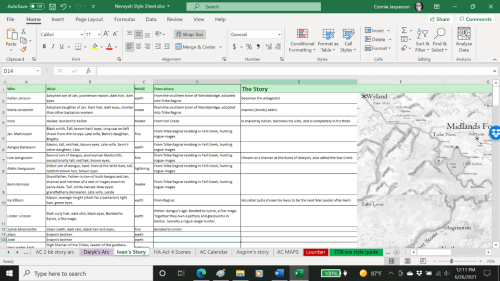
Once I begin work on my November novel, a more detailed outline of my story arc will evolve. As mentioned a gazillion times, I keep my notes in an Excel workbook. It contains maps, calendars, and everything about any novel set in that world, keeping it in one easy-to-find place.

As the writing progresses, the plot evolves and deviates from what I originally planned. It always does because nothing is engraved in stone. The characters themselves will drive the story in a different direction than was first imagined. I will note those changes on the outline and update my list of made-up words. Also, (if needed), I will edit my sketchy maps.

Many writers will fall by the way and never finish their novels, as they forget what they’re writing, don’t know how to go forward, and then lose momentum. I suggest you write those first ideas down when they occur to you, so when you begin writing the novel, you will have these keys to unlock the story.

800px-NotebooksIf your employment isn’t a work-from-home job, using the note-taking app on your cellphone to take notes during business hours will be frowned upon. I suggest keeping a pocket-sized notebook and pencil or pen to write those ideas down as they come to you.

That is an old-school solution but will enable you to discreetly make notes whenever you have an idea that would work well in your story. The best part is that you don’t appear distracted or off-task, and you will have those ideas in November when you need them.

Next up, we’ll look a little deeper into discovering what the core of the story might be.


Previous posts in this series:

#NaNoPrep: creating the characters #amwriting | Life in the Realm of Fantasy (conniejjasperson.com)

#NaNoPrep: The initial setting #amwriting | Life in the Realm of Fantasy (conniejjasperson.com)

5 Comments

Filed under writing