The Business Side of the Business: Publishing Industry News #amwriting

Autumn is arriving as we speak, and it’s a good time to look at how the publishing industry is doing.
publishingIndustryChatLIRF03162021Let’s have a look at how the Big 5 Publishers of literature did last year. You will note that the top players have changed since my last Big 5 article. Some of the big fish have been absorbed by the even bigger fish since we last looked at them.

#1 on the list is Penguin-Random House. They’re headquartered in Germany and are still the big kid in the schoolyard. Last year they reported earnings of 3.3 billion US dollars.

#2 is Hatchett Book Group. They are headquartered in France. Their reported earnings were 2.7 billion US dollars.

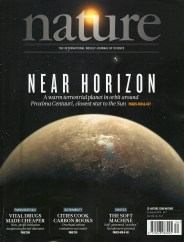
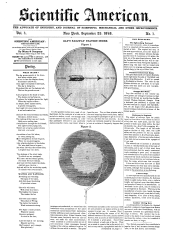
#3 of our top 5 is a corporation called Springer Nature. They publish periodicals and magazines like Nature and Scientific American. They’re headquartered in both the UK and Germany. Their reported earnings were 1.9 billion US dollars.

#4 is Wiley (John Wiley and Sons), a US company publishing academic and instructional materials. They reported revenue of 1.7 billion US dollars.

#5 is McGraw-Hill Education, with reported earnings of 1.7 billion US dollars.

So, did you notice the trend? Only two of the top five traditional publishers are focused on publishing fiction.
EPSON MFP image

EPSON MFP image

And what is affecting the profits for these companies? According to Publishers’ Weekly, supply chain issues combined with inflation and dropped earnings in the first quarter of 2022. However, strong backlist sales propped things up at Penguin-Random House, titles like Where the Crawdads Sing by Delia Owens and Atomic Habits by James Clear. They also report that the late Dr. Seuss’s titles sold more than 5.7 million copies in that period.

As always, audiobooks also performed well. Penguin-Random House’s global CEO Markus Dohle said the ever-expanding international audio business has become a strong growth pillar of their publishing efforts. He also noted a technology- and data-driven transformation of their sales, marketing, and publicity strategies.

This side note about the backlists propping up the Big 5 reminds us to be careful when we’re offered a contract. Legacy book contracts are a terrible danger zone for the author. A hastily signed contract means you might never receive back the rights to your intellectual property (your books), even if the publisher is no longer publishing it.

Quote from the Authors Guild post of July 28, 2015:

Diamonds may be forever, but book contracts should not be. There’s no good reason why a book should be held hostage by a publisher for the lifetime of the copyright, the life of the author plus seventy years—essentially forever. Yet that’s precisely what happens today. A publisher may go bankrupt or be bought by a conglomerate, the editors who championed the author may go on to other companies, the sales force may fail to establish the title in the marketplace and ignore it thereafter, but no matter how badly the publisher mishandles the book, the author’s agreement with the original publisher is likely to remain in effect for many decades.

Most of us are not attorneys. If we go the traditional route, we should consider hiring a lawyer specializing in literary contracts.

This is good advice, even if you are represented by an agent. The complexity of negotiating a literary contract is both confusing and intimidating. By not having the advice of a professional, you risk unwittingly signing away secondary and subsidiary rights to your own work forever.

Many well-known authors were smart or had good lawyers. They either weren’t offered or didn’t accept a legacy contract. These authors regained the rights to their work when the contract terms were fulfilled. They’re now self-publishing their backlists and earning more royalties even though they sell fewer books.

On the indie side of things, we’re in the same boat financially as the Big 5, but we’re better positioned in some ways. We’ve always relied more on digital sales, which have no upfront cost outlay. Many indies are moving to audiobooks too. However, we do need paper books.

Significant cost increases for paper and production (and for distribution and freight) will affect our costs and profit for the foreseeable future. Per an email I received from Draft2Digital, due to supply chain issues and the rise in material costs, their print partner will be increasing D2D’s costs. This means that effective October 1, 2022, the cost of author copies via D2D Print will increase.

I suspect the same will be true for Amazon KDP and IngramSpark.
Scientific American 1848For indies, our most reliable royalties have always come from digital sales, although we do sell some print books. But the best route to gaining loyal readers has been book fairs, conventions, and signings at bookstores.

We pay upfront for our stock of books and have to keep an eye on our inventory to ensure we have enough on hand for each event. So, with printing costs going up, we will either raise prices or see a drop in our already-slim profit.

So, that is the industry’s current state as of this week. The Big Traditional Publishers are still consuming each other as fast as possible. At some point, there will only be one Big Traditional Publisher owning thousands of popular imprints worldwide, and they will be based in Europe.

The publishing industry is currently in a downturn because of inflation and production costs, but little has changed for indies. We’ve always been at a disadvantage, so in some ways, we’re better equipped to deal with change. We adjust and go with the flow whenever the market goes up or down or moves in a new direction.


Credits and Attributions:

Wikimedia Commons contributors, “File:Nature volume 536 number 7617 cover displaying an artist’s impression of Proxima Centauri b.jpg,” Wikimedia Commons, the free media repository, https://commons.wikimedia.org/w/index.php?title=File:Nature_volume_536_number_7617_cover_displaying_an_artist%E2%80%99s_impression_of_Proxima_Centauri_b.jpg&oldid=675402098 (accessed September 20, 2022). ESO/M. Kornmesser (photo displayed on the magazine cover), CC BY 4.0 <https://creativecommons.org/licenses/by/4.0&gt;, via Wikimedia Commons.

Cover of Scientific American, the September 1848 issue Wikimedia Commons contributors, “File:SciAmer.gif,” Wikimedia Commons, the free media repository, https://commons.wikimedia.org/w/index.php?title=File:SciAmer.gif&oldid=655833071 (accessed September 20, 2022).
6 Comments

Filed under writing

Outlining is Pantsing it in Advance so you can Wing It Later #amwriting

Over the years, I have learned many tricks to help people get a jump on their NaNoWriMo project.

Most writers will start an entirely new story. Some have an outline, but others are flying blind, or in author speak, “pantsing it.” Other writers will continue writing the first draft of an unfinished work-in-progress.

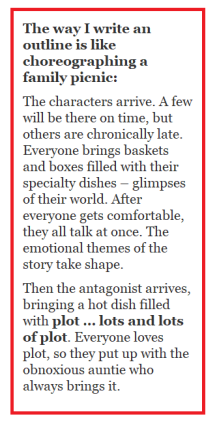
plotting as a family picnicI am a planner, but I’m also a pantser. I’m just writing to a loose outline. All I need is a little free time in advance of November to let my mind wander.
When I first began writing, I found Excel useful, but any document or spreadsheet program will work. The outline becomes my permanent stylesheet for that novel. I think of outlining as pantsing it in advance—a visual aid for winging it later.

Once I’m done winging it through the story and am in revisions, some scenes will make more sense when placed in a different order than originally planned. An outline allows me to view the arc of the story from a distance, so I can see where it might be flatlining. Perhaps an event should be cut completely as it no longer works. (I always save my outtakes in a separate file for later use.)

Over the years of editing and reviewing books, I’ve assembled a list of questions that help me nudge a novel from an idea into an outline. If I make notes as I think of things, I’ll never lose those characters or their story. Even if I can’t get to it right away, I’ll have all the essential stuff in a document and saved.

The first two questions I ask are what genre do I think I’m writing in, and what is the underlying theme? I prefer to write character-driven fantasy. A world will emerge with the characters, and I will make notes as bits and pieces of that environment occur to me. I have a deep streak of gallows humor in my personality, so humor in the face of disaster will be a theme. This theme comes out in most of my work.

Who are youNext, I ask the creative universe who the protagonist is. I create a brief personnel file, less than 100 words. It’s a paragraph with all the essential background information. Sometimes it takes a while to know what a character’s void is (a deep emotional wound), but it will emerge. I note the verbs, adjectives, and nouns the character embodies, as those give me all the necessary information.
Let’s create a protagonist. He doesn’t have a story yet, but that will come along once I have a few other people figured out.

Brand (MC) (Fire-mage, armsmaster, 36, divorced. Brown hair, brown eyes, suntanned.) Parents were mages, now deceased. VOID: Deep sense of failure. A convergence of personal tragedies led to a failed suicide attempt. VERBS: Act. Fight. Build. Repair. Protect. Create. ADJECTIVES: wary, sarcastic, hopeful, dedicated, considerate. NOUNS: sorrow, guilt, purpose, compassion, wit.

Does Brand have close friends? If not, will he gather companions? This question is important. If he doesn’t have friends at first, I will leave space on that page to add them when they emerge from my imagination. As I contemplate Brand’s story, perhaps a love interest will show up later, or maybe not.

What happens to take Brand out of his comfort zone? Sometimes I don’t have the answer to this for quite a while. Other times, it’s the spark that starts the story.

The entire arc of the story rests on how I answer the following question. What is Brand’s goal, his deepest desire? Currently, it looks like he’s hoping to regain his self-respect. That will become a secondary quest when a more immediate problem presents itself.

What stands in his way? Who or what is the Enemy?

Let’s name the enemy Silas. What is his deepest desire? How does Silas control the situation at the outset? Once I know who the antagonist is and what they want, I give them the same personnel file I give all the other characters—I identify a void, verbs, adjectives, and nouns for him.

Once I have Silas described in a paragraph, I can determine the quest. Silas is the key to what Brand must achieve. A believable villain is why Brand’s story will be fun to write.

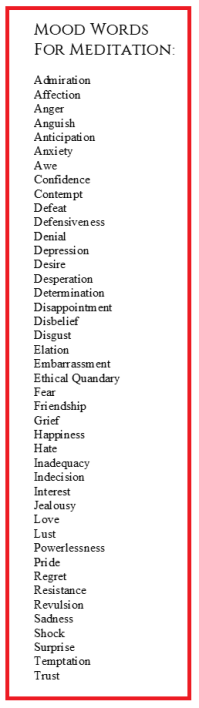
Now we come to creating the plot. I decide where the story begins, then list a few possible scenes, using keywords to show mood and intention.

Mood words for meditationMeditating on mood words often precipitates a flash of brilliance that has nothing to do with anything. What if …
Newly arrived in the border town of Axeton, Brand discovers an ancient gate sealed with a magic lock. Beyond it, a faint path leads into the Deadlands, but where does it go? No towns exist in the moors, and no country wants to claim the Deadlands. The elemental creatures are too dangerous. Could it be a beastmaster searching for rare elemental creatures to use as weapons? If so, who has that skill, and what could they intend to do with them?

This plot twist forces me to rearrange the outline, and now I have to change Silas’s paragraph to make him a beast master. He can’t be two-dimensional, a cartoon villain, so why does he do evil with this talent? Why does he think he is the hero? The answers to those questions should give Silas a personality. We should feel some empathy for him.

How does Brand react to the pressure Silas exerts? Side characters may emerge as Brand works his way through the problems, people who will influence the plot’s direction. As the outline evolves, I will see many places where the struggle can deepen the relationships between the protagonist and their cohorts/romantic interests.

Later, after I have the characters figured out, I will work on the plot outline and try to shape the story’s arc. This is where roadblocks and obstacles do the heavy lifting, and my outline will contain ideas I can riff on. Brand will have to work hard to achieve his goal, but so will Silas.

Information and the lack of it drive the plot. Brand can’t have all the information. Silas must have more answers than Brand and be ruthless in using that knowledge to achieve his goal. My outline will tell me when it’s time to dole out information. What complications arise from Brand’s lack of information? My outline will offer hints for what he can do to rescue the situation.

With each chapter, Brand and his companions acquire the necessary information, but each answer leads to more questions. Conflicts occur when Silas sets traps, and by surviving those encounters, Brand gains more information about Silas’s capabilities. He must persevere and use that knowledge to win the final battle.

I could actually use this example as the genesis of a story, but I have a different outline in progress. Having my characters in place and an outline on hand helps keep me on track when I am pantsing it through NaNoWriMo. New flashes of brilliance will occur as I am writing, and hopefully they will make the struggle real. But two fundamental things will remain constant:

Brand’s determination to block Silas and wreck the enemy’s plans is the plot.

Brand’s growth as a character as he works his way through the plot is the story.

17 Comments

Filed under writing

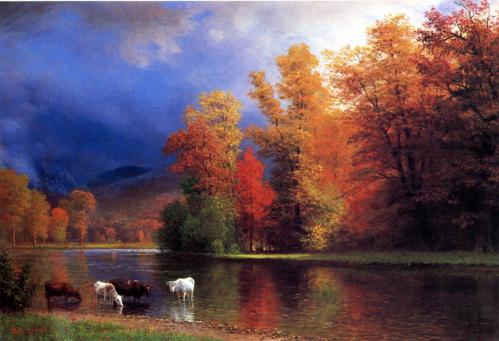
#FineArtFriday: On the Saco by Albert Bierstadt

Bierstadt_Albert_On_the_SacoArtist: Albert Bierstadt (1830–1902)

Title: “On the Saco”

Genre: landscape art

Description: Of the Saco River, Maine.

Date: Unknown date (19th century)

Medium: oil painting.

What I love about this image:

Bierstadt understood and respected the power of nature. The way he rendered the sky is wonderful. He captured that brilliant darkness of a distant storm against the bright sunshine of an autumn afternoon. I love contrasts in this painting, the bright foliage in every shade of red and yellow, the serenity of the cattle drinking in the shallows.

The heavy darkness of the storm in the hills seems to be pushed back by the serene glow of fall’s sunlight on the river. Will it rain itself out before it passes over the herd? Possibly.

About the Artist, via Wikipedia:

Albert Bierstadt (January 7, 1830 – February 18, 1902) was a German-American painter best known for his lavish, sweeping landscapes of the American West. He joined several journeys of the Westward Expansion to paint the scenes. He was not the first artist to record the sites, but he was the foremost painter of them for the remainder of the 19th century.

Bierstadt was born in Prussia, but his family moved to the United States when he was one year old. He returned to study painting for several years in Düsseldorf. He became part of the second generation of the Hudson River School in New York, an informal group of like-minded painters who started painting along the Hudson River. Their style was based on carefully detailed paintings with romantic, almost glowing lighting, sometimes called luminism. Bierstadt was an important interpreter of the western landscape, and he is also grouped with the Rocky Mountain School. [1]


Credits and Attributions:

Image: On the Saco by Albert Bierstadt, Wikimedia Commons contributors, “File:Bierstadt Albert On the Saco.jpg,” Wikimedia Commons, the free media repository, https://commons.wikimedia.org/w/index.php?title=File:Bierstadt_Albert_On_the_Saco.jpg&oldid=618723154 (accessed September 16, 2022).

[1] Wikipedia contributors, “Albert Bierstadt,” Wikipedia, The Free Encyclopedia, https://en.wikipedia.org/w/index.php?title=Albert_Bierstadt&oldid=1107140650 (accessed September 16, 2022).

5 Comments

Filed under #FineArtFriday

Questionable Physics, Plot Armor, and the Searchable File #amwriting

No matter their failings, our protagonist is always endowed with a special power not granted to ordinary mortals: plot armor. They alone are allowed to survive all manner of dangerous situations because they are needed for the plot to continue. 

And if the author has done their job, we believe it, and ask for more.

researchI just finished reading a sci-fi book set ten years from now, in 2032. It was a free Kindle book, but I felt overcharged.
One glaring issue, a blunder that outshone the obscenely poor editing, was this: The heroine’s amazing survivability was made possible by the author’s indulgence in Questionable Physics.

Via Wikipedia: Physics is the natural science that studies matter, its fundamental constituents, its motion and behavior through space and time, and the related entities of energy and force. [1]

The science seemed more like squishy magic. Once I realized that, the book veered into fantasy, which wasn’t what I was in the mood for.

Readers of hard science fiction are quite particular. They want ideas that inspire thought about large issues, such as the far-reaching impacts of scientific, social, and technological innovations.

Science, technology, and their possible consequences are the core of hard sci-fi, and this book had nothing to say to society other than many mentions of how brilliant the heroine was.

The author had marketed their novel in the wrong subgenre—it belonged in Narcissistic Self-gratification, not hard science fiction.

Alarm clock quote ray bradburyNever once did the super-heroic and uber-capable protagonist fear for her life no matter what ridiculously dangerous situation popped up.

Above all, a protagonist must deserve their plot armor.

But enough about that book—let’s talk about research.

Authors who write science fiction should learn what modern physicists are currently doing in the lab and what they’re theorizing on paper.

We must use that knowledge to extrapolate how societies will look in the future. Authors must do the research and take what we know is possible today and flavor it with a dash of what we wish for.

Therefore, research is needed. But if we aren’t physicists, how do we go about it?

First, we identify what we need to know, and keep a list as new questions crop up. Then, we hunt for information. We use the internet, ask an expert, and create a searchable file or database of material that backs up our assertions.

A searchable file is a document containing links to every website, book, or published paper where you have found information about your project.

Every book I write has a stylesheet, usually in the form of an Excel workbook. For instance, this is how some of the tabs on one of my stylesheets looks:

tabs of a stylesheet

That workbook has several pages: a glossary, a calendar, a sheet with the maps, the outline of the projected plot, and personnel files for each character. Also, it has a page with the technology that might be available in an agrarian society. It also has a page with all the links to the websites where I’ve found information, and what I found useful on that page.

But I love science and spend some of my non-writing time randomly watching science shows.

One of my regular bits of brain food is a daily science news report by Anton Petrov, What da Math? His YouTube channel focuses on up-to-the-minute advances in astronomy and physics.

For example, Anton’s report which aired on September 11, 2022, discussed the known dangers of space travel as we are currently capable of it and possible solutions based on our current capabilities.

And Anton’s is not the only hard science show out there.

If the book I am currently bashing had been researched at all, the author would have understood more about the hazards facing humans in the colonization of Mars.

What if you are writing something involving a common, well-understood physics problem—that of braking and docking with another vessel in space? That maneuver is complicated, and there are many reasons why. What you learn about velocity and inertia won’t make it into your story, but you will know what you are writing about. That confidence will emerge in the rest of the story.

But science fiction is not the only genre where magic bullets and impossible solutions ruin a story for me.

For example, I am also a history buff. I love historical fiction, but stories set in that genre must also be meticulously researched. History details events that occurred before the present time and accurate information is still available.

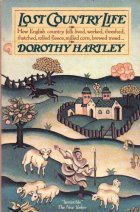
Lost_Country_Life_HartleyTake a look around in your local secondhand bookstore. A brilliant source of information on low-tech agricultural life and culture came in the form of a book I found at a second-hand bookstore in Olympia in the mid-to-late-1980s. It was called Lost Country Life and was written by the late historian, Dorothy Hartley. She details how every aspect of farming was done, the wide variety of tools and equipment that everyone knew how to make and use. If you need to know it, it’s in that book.

As far as I know, it’s still available as a second-hand book and can be found on Amazon.

But let’s go back to the future. If you are writing a contemporary sci-fi novel, you need to know what interests the people in the many different layers of our society. Go to the magazine rack at your grocery store or the local Big-Name Bookstore and look through the many publications available in their racks.

You can also find many scientific papers published online. But for non-scientists, sites like SpaceX, NASA, and Digital Trends will offer a wealth of information in bite-sized chunks and give you leads about where to look next.

Fairy of Eagle Nebula By NASA [Public domain], via Wikimedia Commons

Fairy of Eagle Nebula By NASA [Public domain], via Wikimedia Commons

Most importantly, if you hope to write hard sci-fi, you must read that genre. Examine their content. Much of what was considered highly futuristic in the era of classic science fiction is today’s current tech. See what other writers think will be the technology of our future.

Talk to scientists. Email them and tell them what you are writing and ask them questions. Many will help you because they don’t like mushy science.

We may be fiction writers, but we are also disseminators of information and dreams. No matter what genre we are writing in, we want the reader to suspend their disbelief and enjoy the story. If we do the proper research, we remove one barrier to the success of our work.


Credits and Attributions:

[1] Wikipedia contributors, “Physics,” Wikipedia, The Free Encyclopedia, https://en.wikipedia.org/w/index.php?title=Physics&oldid=1109211521 (accessed September 13, 2022).

Fairy of Eagle Nebula By NASA [Public domain], via Wikimedia Commons

17 Comments

Filed under writing

The Action Scene #amwriting

I attended the Southwest Washington Writers Conference this last weekend. On Friday, I attended two master classes offered by sci-fi/fantasy author Jeff Wheeler. The first class was on worldbuilding and writing the first chapter, and while I understand that aspect of our craft well, I enjoyed hearing his take on it.

action scenesThe second master class was on the how of creativity. Those of you who follow my blog know how the subject of creativity fascinates me. If you haven’t read any of Jeff Wheeler’s work, here is the link to my 2013 review of his first book, the Wretched of Muirwood. It’s book 1 of one of my favorite fantasy series of all time.
The next day, I was privileged to be on a panel, What I wish I had Known, Four Veterans of the Indie Trenches. We talked about the pitfalls and pratfalls of our early years in this business and what we could have done differently.

But that is life. You learn from your mistakes and grow in the craft.

One of the seminars I attended on Saturday was offered by Lindsay Schopfer, From Body Language to Brawls. Again, I have a method for fight scenes, but as he pointed out, action is about so much more than mere brawling. That concept lines up with my theory that every scene is an action scene, even the quieter moments. Tempo and how we pace the intensity is as important as the plot-arc of every scene.

But Lindsay offered five questions about planning the action in each scene. They were different from how I normally think. I found them pertinent to the plot outline I am currently building for this year’s foray into NaNoWriMo.

strange thoughtsFirst, Lindsay pointed out that thinking is an action scene, as are conversations. He asked what a character does while thinking. He pointed out that Humphrey Bogart had a way of tugging on his ear when thinking, a habit that carried over into his movies. A side character with a certain amount of screen time but isn’t the POV character can be shown as real when they have a small personal habit that appears from time to time.
Lindsay cautioned new writers to go lightly, and I agree. If you give one or two side characters an occasional personal habit, you won’t muck up the visuals with a barrage of personal tics.

Next, he asked what their body language betrayed about them when they were worried. I liked that he brought that up because if our characters aren’t worried, they should be. How do we show our characters’ individual ways of handling worry? We all exhibit signs of anxiety in different ways.

Lindsay asked three more questions: how do our characters look when they’re happy or excited? How do they look when angry? When depressed?

You can show these emotions with either a facial expression or a physical reaction, combined with internal dialogue or conversations.

For me, the most challenging part of writing is balancing the visual indicators of emotion with exposition showing the more profound, internal clues.

We need to offer the reader a hint, a gesture, or a fleeting expression. Their imagination will do the rest.

It takes work and practice to write a narrative so that we aren’t telling the reader what to experience. We allow the reader to infer what to feel. Remember, we are still in the inferential layer of the Word Pond, the layer in which readers draw conclusions from the clues we offer them.

I suggest the Emotion Thesaurus by Angela Ackerman and Becca Puglisi as a good affordable reference guide to showing these emotions. Sometimes we hit a spot where we know what we need to say but not how to phrase it. This guide offers good hints for how to show what a character is feeling, someone to point the way.

However, I must point out that discretion is a good thing when it comes to showing emotions.

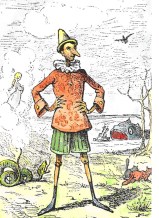
Enrico Mazzanti (1852-1910), Public domain, via Wikimedia CommonsWhen a character’s facial expressions take over the scene, they become cartoonish, two-dimensional displays of emotion with no substance. A landslide of microscopic showing can make your characters seem melodramatic. All that physical drama doesn’t show a character’s emotions. What is going on inside their heads?
You must relay the thought process that led to those physical reactions. You can lay the groundwork with some crucial bits of exposition. Just a bit, not too much.

The trick is to use words that offer the most information in the least amount of space. It’s a trick I’m still trying to master.

I will stop reading stories where the author leans too heavily on slowly painting visual descriptions of the characters’ internal struggles. Creased foreheads followed by stomach-churning, gut-wrenching shock and wide-eyed trembling of hands are a bit too in-depth for me. Pick one indicator and go with it.

Finally, Lindsay pointed out something I have also said before. Word count matters in a fight scene. When I write an action scene involving violence, I ask myself how long it will take a reader to read that blow-by-blow description of the melee.

A war is one thing – it takes up page after page because it is the driver of the story. But when a fistfight or sword fight takes up three pages of description, I can’t suspend my disbelief as a reader.

Physical fights in real life are fast, violent, and finished in a space of minutes. It’s not humanly possible to go on and on with no rest. That is why professional boxers have rounds – fight a while, rest a while, and so on for 15 rounds.

If it takes me forever to read that running commentary, I will skip forward, or worse, set the book aside.

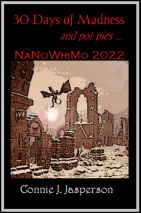
2022 cover mock-upAnd this brings me to the core of this post. During NaNoWriMo, when I write new words as quickly as possible, I lean too heavily on the external, relying on a lot of smiling and shrugging. Conversations are action scenes, but too much “face time” is too much.
Those facial expressions and gestures are markers for the second draft, words signifying places where more work will be required to flesh out the scene. This is where writing becomes work.

If you haven’t seen this before, here is my list of surface emotions, code words I use in my outline to remind me of what action I should portray in a given scene:

  • Admiration
  • Affection
  • Anger
  • Anguish
  • Anticipation
  • Anxiety
  • Awe
  • Confidence
  • Contempt
  • Defeat
  • Defensiveness
  • Denial
  • Depression
  • Desire
  • Desperation
  • Determination
  • Disappointment
  • Disbelief
  • Disgust
  • Elation
  • Embarrassment
  • Ethical Quandary
  • Fear
  • Friendship
  • Grief
  • Happiness
  • Hate
  • Inadequacy
  • Indecision
  • Interest
  • Jealousy
  • Love
  • Lust
  • Powerlessness
  • Pride
  • Regret
  • Resistance
  • Revulsion
  • Sadness
  • Shock
  • Surprise
  • Temptation
  • Trust
  • Unease
  • Weakness

8 Comments

Filed under writing

#FineArtFriday: Old Water Tank by Jaime Prosser

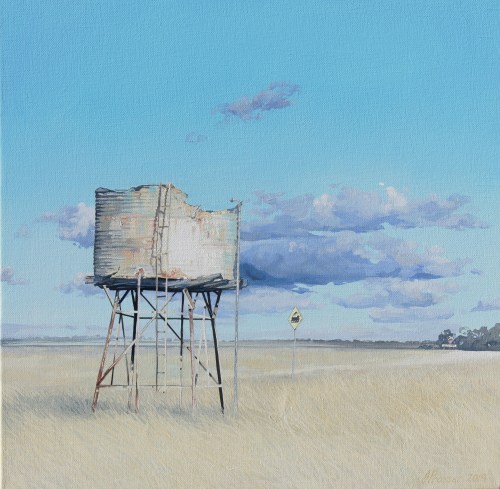
SONY DSC

Title: Old Water Tank

Medium: Oil Painting

Artist: Jaime Prosser

What I love about this painting:

I love the stark realism, the derelict water tower rising from the sea of grass, silhouetted against the blue Australian sky. Prosser’s brush captures the wildness of the scene. There is a serenity to this scene, the sureness of mankind’s creation crumbling, slowly giving way to the inevitable. Nature always wins.

About the Artist:

Jaime Prosser is an Australian artist. Her work can be found at her website, https://jaimeprosserart.com.


Credits and Attributions:

Wikimedia Commons contributors, “File:’OLD WATERTANK’ OIL PAINTING BY JAIME PROSSER.jpg,” Wikimedia Commons, the free media repository, https://commons.wikimedia.org/w/index.php?title=File:%27OLD_WATERTANK%27_OIL_PAINTING_BY_JAIME_PROSSER.jpg&oldid=535927333 (accessed September 9, 2022).

3 Comments

Filed under writing

When your novel is only a novella #amwriting

Sometimes we find that our work-in-progress is not a novel after all. We get to the finish point, and that place might be only at the 40,000-word mark (or less).

WritingCraft_short-storyIn some circles, 40,000 words is a novel, but in fantasy, it is less than half a book.
You could try to stretch the length, but why? If you have nothing of value to add to the tale, it’s better to be known for having written a strong novella than a weak novel.

I’m a wordy writer but sometimes the finished work is shorter than I’d planned–a lot shorter. Then I have to make a decision. I could choose to leave it at the length it is now and have it edited. Or I could try to expand it.

If my beta readers feel the plot lacks substance at that length, I let it rest for a while then come back to it. Then I can see where to add new scenes, events, and conversations to round out the story arc.

Other times, the story is complete, but only about half the length of a novel. Sometimes this happens in the revision process.

In the second draft of any manuscript, I weed out many words and hunt for unnecessary repetitions of information. At that stage, the manuscript will expand and contract. It hurts the novelist in my soul, but the story may only be 35,000 words long when the second draft is complete.

I do a lot of rambling when trying to visualize the story. While I usually do it in a separate document, it often bleeds over into my manuscript. During the editing process, I sometimes find that besides the four chapters that don’t fit the plot anymore, three more chapters mainly deal with background info, and can be condensed into one.

CAUTION INFO DUMP ZONE AHEADA detailed history of everyone’s background isn’t required. As a reader, all we need is a brief mention of historical information in conversation and delivered only when the protagonist needs to know it.
Unfortunately, I sometimes forget to write it out in a separate document.

Once I condense rambling passages, I end up with a scene that moves the story forward.

Some other things to watch for in the second draft are areas where I have repeated myself but with slightly different phrasing. These are hard for me to pick out, but they can be found. I decide which wording I like the best and go with that.

Also, in the first draft, I use a lot of “telling” words and phrases I will later change or cut. I look for active alternatives for words and phrases that weaken the narrative:

  • There was
  • To be

When I change these words to more active phrasing, I sometimes gain a few words in the process as showing requires more words than telling.

But then I lose words in other areas. Again, I’m speaking as a reader here, but when reading conversations especially, it’s good for an author to use contractions. It makes the conversations feel more natural and less formal. It shortens the word count because two words become one: was not becomes wasn’t, has not becomes hasn’t, etc.

Most times, I can cut some words, even entire paragraphs. Often the prose is stronger without them, and these words need no replacement.

In the first draft, I regularly employ what I think of as crutch words. I can lower my word count when I get rid of them. These are overused words that fall out of my head along with the good stuff as I’m sailing along:

  • So (my personal tic)
  • Very (Be wary if you do a global search – don’t press “replace all” as most short words are components of larger words, and ‘very’ is no exception.)
  • That
  • Just
  • Literally

I have learned to be ruthless. Yes, I might have spent three days or even weeks writing a chapter that now must be cut. But even though I try to plot an outline in advance, the arc might change as I write the first draft. New events emerge, and I find better ways to get to the end than what was first planned.

It hurts when a really good chapter no longer fits the story. But maybe it bogs things down when you see it in the overall context. It must go, but that chapter will be saved. With a name change and perhaps a few place-name changes it could be the genesis of a short story.

I save everything I cut in a separate file, as I guarantee I will find a use for it later. I always have a file folder inside each master file labeled “Outtakes.” Those cut pieces often become the core of a new story, a better use for those characters and events.

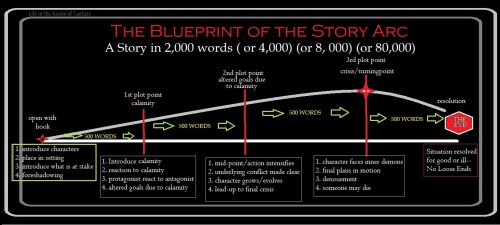
I have learned to pay close attention to the story arc. Once your first draft is complete, no matter how short or long, measure the story against the blueprint of the story arc.

blueprint-of-the-story-arc

  • How soon does my inciting incident occur? It should be near the front, as this will get the story going and keep the reader involved.
  • How soon does the first pinch point occur? This roadblock will set the tone for the rest of the story.
  • What is happening at the midpoint? Are the events of the middle section moving the protagonist toward their goal? Did the point of no return occur near or just after the midpoint?
  • Where does the third pinch point occur? This event is often a catastrophe, a hint that the protagonist might fail.
  • Is the ending finite, solid, and does it resolve the major problems? Even if this story is one part of a series, we who are passionate about the story we’re reading need firm endings.

Some people think they aren’t a real author if they don’t write a 900-page doorstop.

I tell them that it’s not important to have written a novel. Whether you write poems, short stories, novellas, or 700-page epic fantasies, you are an author.

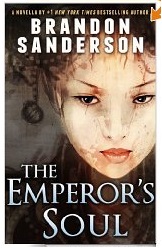
The Emperor's Soul - Brandon SandersonNovellas hold a special place in my heart. A powerful, well-written novella can be a reading experience that shakes the literary world:

  1. The Emperor’s Soul, by Brandon Sanderson
  2. A Christmas Carol, by Charles Dickens
  3. Breakfast at Tiffany’s, by Truman Capote
  4. Candide, by Voltaire
  5. Three Blind Mice, by Agatha Christie
  6. The Strange Case of Dr. Jekyll and Mr. Hyde, by Robert Louis Stevenson
  7. The Time Machine, by H.G, Wells
  8. Of Mice and Men, by John Steinbeck
  9. The Old Man and the Sea, by Ernest Hemingway
  10. Animal Farm, by George Orwell
  11. The Turn of the Screw, by Henry James

16 Comments

Filed under writing

The Plot Generator – a cure for boredom #amwriting

We all have moments where we can’t figure out what our characters need to do next. Sometimes, all we have is a character and a vague premise for the story. I’ve been invited to write a short story for a specific anthology, but all I have is the ghost of an idea.

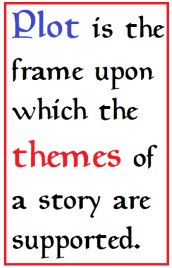
plot is the frame upon which the themes of a story are supportedRather than obsess about my lack of creativity, I decided to have fun with it. Several young writers in my NaNoWriMo region have said they used a plot generator to jumpstart their ideas, so I thought I’d give that a try.
The internet has a plethora of plot generators – who knew there was such a demand for plots? I chose the top one because of the algorithms. Or perhaps it was at the top for something even more sinister – corporate bribery.

Either way, no problem. No matter how it got there, if it’s at the top of page one, it must be good, right? I believe everything I’m told by the internet, so I went with it.

The website opens with a template. You plug in a few words that pertain to what you think your story is, and presto! The internet generates your plot.

I thought I’d try that and see what it came up with. I invented two characters, John Smith and Morris Jones.

When asked what sort of dwelling they inhabited, I decided they lived in an inn.

The next spot in the template wanted a word that described what the dwelling meant to my characters.

“Well,” I thought, “it’s probably cold and rainy out there in Fantasy World, so an inn means ….”

  • Shelter

After that, the plot generator asked me for a list of keywords.

Well, that was both unkind and unfair.

I’m horrible at thinking up keywords. If I could think up keywords, I wouldn’t be consulting a plot generator. I’d be looking up my horoscope instead.

But the template was staring at me, demanding answers. I had a teacher who always looked at me that way, making me nervous, expecting results ….

So, I fired off the first words that popped into my head, most of them aimed at the stupid plot generator:

  • Author-thoughtsCursed
  • Lying
  • Worrying
  • False
  • Deceitful
  • Frantic (my state of mind)
  • Charming (me, if you actually know me)
  • Passionate (me, when it comes to chocolate)
  • wicked
  • Fake
  • Violent
  • Cold (how the search for keywords left me)

Then I was asked for three professions. By now, I was getting into the swing of things and having a good time. I decided to give John and Morris honest occupations:

  • Blacksmith (definitely honest).
  • Loan shark (definitely dishonest, but it popped into my head, so …).
  • Pharmacist (fairly random, but we had to pick up a prescription later, so it was on my mind).

Who were their companions? I had no clue, so I opted for generic:

  • Men
  • Mages
  • People

The generator asked what they might be searching for. I didn’t know my two characters were searching for anything. “Well,” I thought, “this is a fantasy, so ….”

  • Spells
  • Swords

Then the generator asked me to name a big battle. That stumped me. I figured that Waterloo was already taken, and the Battle of Hastings was too. So I went with a made-up name:

  • Shallowford

This is what the plot generator gave me:

In an inn there lived a deceitful, frantic loan shark named John Smith. Not a cursed charming, passionate inn, filled with charms and a worrying smell, nor yet a wicked, violent, cold inn with nothing in it to sit down on or to eat: it was a loan shark-inn, and that means shelter.

One day, after a troubling visit from the pharmacist Morris Jones, John leaves his inn and sets out in search of three false spells. A quest undertaken in the company of people, mages and fake men.

In the search for the mage-guarded spells, John Smith surprises even himself with his loyalty and skill as a blacksmith.

During his travels, John rescues a sword, an heirloom belonging to Morris. But when Morris refuses to try lying, their friendship is over.

However, Morris is wounded at the Battle of Shallowford and the two reconcile just before John engages in some serious lying.

John accepts one of the three false spells and returns home to his inn a very wealthy loan shark.

By golly, I think that’s the perfect plot for a story in five paragraphs, including a happy ending. The prose is … (insert superlatives here).

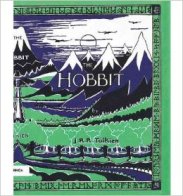
the hobbitThis plot generator has clearly been studying J.R.R. Tolkien, as it has managed to plagiarize the first paragraph of The Hobbit right down to the punctuation.
“In a hole in the ground, there lived a hobbit. Not a nasty, dirty, wet hole with ends of worms and an oozy smell, nor yet a dry bare sandy hole with nothing to sit on or eat: it was a hobbit-hole and that means comfort.”

J.R.R. Tolkien, The Hobbit, or There and Back Again, published 1937 by George Allen & Unwin.

Maybe I should write a Gothic romance next. I could probably use the same keywords.

18 Comments

Filed under writing

#FineArtFriday: The Munitions Girls by Stanhope Forbes,1918 #LaborDay

L0059548 'The Munitions Girls' oil painting, England, 1918

Artist: Stanhope Forbes (1857–1947)

Title: The Munitions Girls

Date: 1918

Medium: oil on canvas

Dimensions: height: 103 cm (40.5 in); width: 127 cm (50 in)

Collection: Science Museum

About this Image, via Wikimedia Commons:       

Commissioned by John Baker & Co, this famous oil painting, The Munitions Girls, shows women working at Kilnhurst Steelworks during the First World War. The artist was Alexander Stanhope Forbes (1857-1947). Like many other steelworks during the war, John Baker & Co’s Kilnhurst site was converted to make shells and ammunition. As men volunteered or were conscripted to fight in the British Army, women became the main work force in industry and farming. Munitions workers could often be picked out in a crowd because of the distinctive yellow coloring of their hair and skin caused by the sulfur used in production. They were nicknamed canaries. [1]

My Usual Fine Art Rant Goes in a Different Direction:

The women in this picture are shown doing dangerous, dirty work. They stepped up and did what they had to do to make sure their husbands and lovers had the weapons they needed to defend their country.

And they are doing it for very little money, less than men would have earned. While that is slowly changing, some things remain the same. It’s difficult to find people who want to do the “ordinary work,” jobs considered blue-collar, or manual labor.

Here in the US, it is Labor Day weekend, the last hurrah of summer, but more importantly, a day dedicated to appreciation of those who make up our labor force, the people who do the unglamorous work that keeps our world turning smoothly.

I’ve always been a writer, but I like to eat. I always held two and three part-time jobs just to keep the roof over my children’s heads and food on their table. I could make the food budget stretch like a politician’s idea of truth.

  • 1970s-80s – a field hand for a multi-national Christmas tree company, bookkeeper, photo lab tech, waitress in a bakery and also worked in a deli.
  • 1980s-90s – a hotel maid, a dark-room technician, a bookkeeper, and an office manager
  • 2000-13 – a bookkeeper, tax-preparer, data entry.

None of my work was glamorous but I always found something to enjoy in each job. By going to work every day I was able to pay my bills, which I did enjoy. Sometimes, especially during the Reagan years and into the 90s, wages were low, and jobs were scarce.

I worked every weekend and every holiday and yes it was not easy, but it was what it was. My kids knew I was doing my best for them, and they appreciated it.

During the late 70s and early 80s I was a field hand for the J. Hofert Company (Christmas trees) and absolutely loved the work. It was outdoors, paid $3.25 an hour and it was seasonal, but I was able to work a lot of overtime, as field hands were as hard to get then as they are now.

My favorite job was as a hotel maid at a large hotel in Olympia–the work was hard, but I enjoyed it for 12 years. For most of the 1990s it was my weekend job that I kept along with my bookkeeping job, because the hotel was a union shop.

As a bookkeeper/office manager for a charter bus company, I made $7.50 an hour (two dollars over minimum at the time). I worked four seven-hour shifts a week, Monday through Thursday, arriving at 06:00 AM to open the shop, ate lunch at my desk, and went home at 1:00 PM (13:00 military time). That job had no benefits whatsoever. However, I was home when my kids got off the school bus and could make sure they got to their after-school activities.

At my second job, 3 eight-hour shifts Friday through Sunday, I worked as a hotel housekeeper in a union shop. I made $8.50 an hour (three dollars over minimum).

I kept those two jobs all through the 1990s because I was home every night and earned enough to live decently and provide for my children.

No matter what other job I had, I kept my weekend job at the hotel, because it paid well and left my mind free to think about what I was writing. When other jobs went away, I always had that one to fall back on.

Because of the union, we who did the dirty work earned a little more than other women in that line of work, and had a few benefits, such as health insurance and a 401k. Without the union, we hotel maids would have had nothing more than minimum wage.

Not every union is good, and not every union is reasonable. But while I don’t agree with everything every union does and stands for, I do feel gratitude that I and my family was protected by a good, reasonable organization during those years of struggle.

I’m retired now and have the time to write all I want. The world is a different place in many ways, and workers are in short supply. Every place is short-staffed because there are more job openings than workers to fill them.

Someone must do the dirty jobs, the work that no one else wants. I have nothing but respect for those who work long hard hours in all areas of the service industry, struggling to support their families. Look around you, and see the people who make your life easier, by being there every day doing their job.

Every one of them is a person just like you, a living, caring human being with hopes, ambitions, triumphs, and tragedies. Every one of them has a story and a reason to be where they are, doing the task they have been given.

Say a little thank you to all those who take your unintentional abuse when you are stressed out and “don’t have time to wait,” or are upset by things you have no control over and need to vent at someone who can’t or won’t fight back.

The women in Stanhope Forbes’ painting are all gone now, memories of a moment in history. But what they did was important. Give a little thanks to those who do the dirty work and enable you to live a little easier.

About the Artist, via Wikipedia:

Forbes was born in Dublin, the son of Juliette de Guise Forbes, a French woman, and William Forbes, an English railway manager, who was later transferred to London. He had an older brother, Sir William Forbes, who was a railway manager for the London, Brighton, and South Coast Railway.

He was married in the summer of 1889 to fellow painter Elizabeth Armstrong at Newlyn’s St Peter’s Church. Their first home was at the “Cliffs Castle” cottage, which overlooked the sea. They had a son named Alexander (Alec). The couple had a home built for the family in Higher Faughan, Penzance. Elizabeth died in 1912.

Forbes generally painted genre scenes and landscapes en plein air.

Beyond his plein air painting, he also made interior scenes and was adept at capturing the “warm and charming” effects of lighting on a room and the people in it, such as The Lantern, made in 1897. More poignantly, Mrs. Lionel Birch writes of his style and particularly the painting The Health of the Bride: “[The painting depicts the] dominant note of his life’s message, his sense of sympathetic humanity. These people in their humble little parlour, are real and living. Intolerant of all shams and false sentiment, the painter has made himself one with the people he depicts; he has understood the humour which lies so close to tears.”

Of Forbes’s works, Norman Garstin said: “he is a good unsentimental painter, his work has a sense of sincerity that appeals to everyone”. [2]


Credits and Attributions:

[1] Wikimedia Commons contributors, “File:’The Munitions Girls’ oil painting, England, 1918 Wellcome L0059548.jpg,” Wikimedia Commons, the free media repository, https://commons.wikimedia.org/w/index.php?title=File:%27The_Munitions_Girls%27_oil_painting,_England,_1918_Wellcome_L0059548.jpg&oldid=667352991 (accessed September 1, 2022).

[2] Wikipedia contributors, “Stanhope Forbes,” Wikipedia, The Free Encyclopedia, https://en.wikipedia.org/w/index.php?title=Stanhope_Forbes&oldid=1089060843 (accessed September 1, 2022).

2 Comments

Filed under #FineArtFriday

Verbs and the Nouns that Love Them part 2 #amwriting

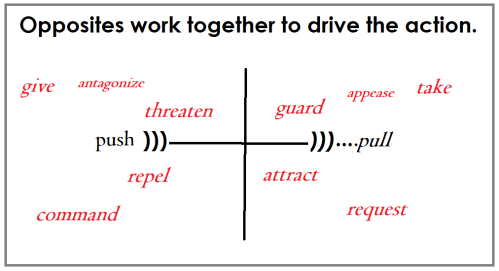
Verbs are the engine words of our prose. They show the action, but like all words, they have shades of mood, nuances that color the tone of my paragraphs. Verbs can either push the action outward from their partner nouns or pull it in.

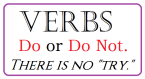
Verbs there is no tryWhen I write poetry, I look for words that contrast vividly against each other. I choose action words that begin with hard consonants, emotion words that begin with softer sounds.
If I can do this for poetry, I should be able to do this for narrative prose – but alas. For some reason, my poetic brain goes on vacation when I am trying to write a first draft. My work is filled with a bald telling of events.

But that’s okay. All I need at that point is to get the story written down.

But during revisions, when writing really becomes work, and I’m trying to turn that boring mess into something worth reading – that is when I need to use my words. Finding strong verbs and employing contrasts in my word choices becomes essential when embarking on the second draft.

I know that power verbs push action outward from a character. Other word choices pull the action inward, and contrasting the two creates a feeling of opposition and friction. This contrast of opposites injects dynamism into a passage, a sense of vitality, vigor, and energy.

Readers are attracted to dynamic prose.

Note to self: write dynamic prose.

Verbs that push the action outward from a character make them appear authoritative, competent, energetic, and decisive.

Verbs that pull the action in toward the character make them appear receptive, attentive, private, and flexible.

I want to make my characters well-rounded but not quite perfect. I hope they are relatable and human. The way I show their world and their place in it must convey who they are.

opposites work togetherConcise writing is difficult for me because I love descriptors. So, I have to make my action words set the mood. To do that, I must use contrasts.
  • Brood
  • Deny
  • Embrace
  • Escape
  • Consent
  • Refuse
  • Agony
  • Ecstasy

A part of my life was burned away. I was destroyed, but now I was reborn in ways I’d never foreseen.

My action words are burn, destroy, and birth. This character’s entire arc is encapsulated in those three words. The contrasting words I choose throughout their story will make or break that novel.

Can I do it? I don’t know, but I’ll have fun trying. In the beginning, this character’s verbs will be darker, their actions more inward and brooding.

At the end of the story, events and interactions will alter them despite their desire to remain safely static. They will experience a renaissance, a flowering of the spirit.

But verbs and nouns by themselves don’t make engaging prose. They need modifiers and connectors.

I will have to select modifiers and connecting verbs to enhance contrasts. Since I can’t go wild with them, the few I choose must be power words.

Many power words begin with hard consonants. The images they convey project a feeling of power:

  • Backlash
  • Beating
  • Beware
  • Blinded
  • Blood
  • Bloodbath
  • Bloodcurdling
  • Bloody
  • Blunder

When things get tricky and the characters are working their way through a problem, verbs like stumble and blunder offer a sense of chaos and don’t require a lot of modifiers to show the atmosphere. When you incorporate any of the above “B” words into your prose, you are posting a road sign for the reader, a notice that ahead lies danger.

Here are some words to create an atmosphere of anxiety – words that push the action outward:

  • Agony (noun)
  • Apocalypse (noun)
  • Armageddon (noun)
  • Assault (verb)
  • Backlash (noun)
  • Pale (modifier)
  • Panic (verb or noun)
  • Target (verb)
  • Teeter (verb)
  • Terrorize (verb)

Here are some words that draw us in:

  • Delirious (intransitive verb)
  • Depraved (modifier)
  • Desire (verb)
  • Dirty (modifier)
  • Divine (modifier)
  • Ecstatic (intransitive verb)
  • Embrace (verb)
  • Enchant (verb)
  • Engage (verb)
  • Entice (verb)
  • Enthrall (verb)

Writing is an adventure, and I learn something new every day. Some days I like what I write; other days, not so much.

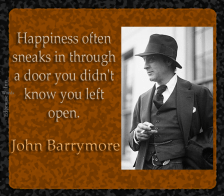
john barrymore memeThe drive to understand why some books enthrall me and others leave me cold keeps me reading and looking for new stories.

Life can be a bumpy road.

The key is to focus on the good things and laugh at the inconveniences. Make a little time to do something creative, and always make time for the people you love.

Comments Off on Verbs and the Nouns that Love Them part 2 #amwriting

Filed under writing