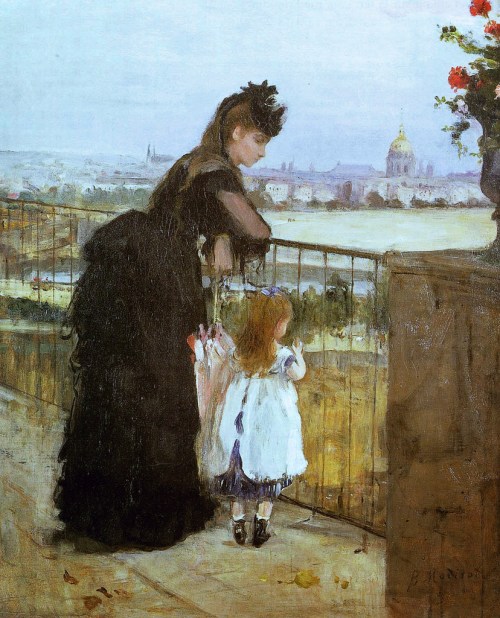
Woman and Child on a Balcony, Berthe Morisot ca. 1872

Title: Woman and Child on a Balcony

Artist: Berthe Morisot  (1841–1895)

Date: 1872

Medium: oil on canvas

Dimensions: Height: 61 cm (24 ″); Width: 50 cm (19.6 ″)

Today, Friday January 3, 2020, my hubby and I are visiting the Tacoma Art Museum, to see an exhibit of Impressionist paintings: Monet, Renoir, Degas, and Their Circle: French Impressionism and the Northwest. I will post about the experience next Friday, and hope to have photographs.

In the meantime, I present you with a female artist, Berthe Morisot, who was the sister-in-law to Eduard Manet. I hope to see her work represented there.

What I love about this painting:

It is only when you stand back from it that you realize how deftly Morisot conveyed the impressions of a pleasant day, a busy harbor, and a curious child. Up close, it is nearly indecipherable, but from a distance—which is how art in the impressionist style should be viewed—it is a delightful image. Is the  young woman a nanny or mother? The small girl seems happy in her company. The two take in the view on a hazy afternoon—there is a sense of affluence and harmony in moment captured by the artist.

About the Artist, vis Wikipedia

Berthe Morisot came from an eminent family, the daughter of a government official and the great-niece of a famous Rococo artist Jean-Honoré Fragonard.  She met her longtime friend and colleague, Édouard Manet, in 1868. Morisot was married to Édouard’s brother, Eugène Manet, in 1874.

Eugene was also a French painter but did not achieve the high reputation of his older brother, Édouard Manet, or his wife, Berthe. He devoted much of his efforts to supporting his wife’s career.

On November 14, 1878, she gave birth to her only child, Julie, who posed frequently for her mother and other Impressionist artists, including Renoir and her uncle Édouard.

It is hard to trace the stages of Morisot’s training and to tell the exact influence of her teachers because she was never pleased with her work and she destroyed nearly all of the artworks she produced before 1869.

Morisot’s mature career began in 1872. She found an audience for her work with Durand-Ruel, the private dealer, who bought twenty-two paintings. In 1877, she was described by the critic for Le Temps as the “one real Impressionist in this group.” She chose to exhibit under her full maiden name instead of using a pseudonym or her married name. As her skill and style improved, many began to rethink their opinion toward Morisot. In the 1880 exhibition, many reviews judged Morisot among the best, even including Le Figaro critic Albert Wolff.

Correspondence between Morisot and Édouard Manet shows warm affection, and Manet gave her an easel as a Christmas present. Morisot often posed for Manet and there are several portrait painting of Morisot such as Repose (Portrait of Berthe Morisot) and Berthe Morisot with a Bouquet. Morisot died on March 2, 1895, in Paris, of pneumonia contracted while attending to her daughter Julie’s similar illness, and thus making her an orphan at the age of 16.


Credits and Attributions:

Wikimedia Commons contributors, “File:Berthe Morisot 001.jpg,” Wikimedia Commons, the free media repository, https://commons.wikimedia.org/w/index.php?title=File:Berthe_Morisot_001.jpg&oldid=359873236 (accessed January 2, 2020).

Wikipedia contributors, “Berthe Morisot,” Wikipedia, The Free Encyclopedia, https://en.wikipedia.org/w/index.php?title=Berthe_Morisot&oldid=931800099 (accessed January 2, 2020).

Wikipedia contributors, “Eugène Manet,” Wikipedia, The Free Encyclopedia, https://en.wikipedia.org/w/index.php?title=Eug%C3%A8ne_Manet&oldid=895506929 (accessed January 2, 2020).

2 Comments

Filed under #FineArtFriday

Winter in the Northern Garden

Winter_berriesIn winter, my Northern garden

Languishes, ragged and shabby,

Unlovely, decaying, and

Uncomfortably aware she’s grown old.


The remains of Summer’s glory beckons,

Begging to be told she is still beautiful,

Still young and fascinating,

Still the object of desire.


Ever the gallant gentleman,

Winter obliges, and with a kiss

Ice crystals decorate each twig and branch

Gracing her with radiant beauty.


Ruby-red berries set against crystalline diamonds,

Ice catching the light, scattering it.

Jewels decorating decrepit limbs,

Dazzled, we bow to her wondrous splendor.


Beneath the litter of leaves dead and brown,

A new Spring waits,

Lurking in the wings, biding her time,

Politely allowing the old dame one last encore.


Credits and Attributions

Winter in the Northern Garden © Connie J. Jasperson 2017, first appeared here on February 17, 2017

Winter Berries, Nick Sarebi [CC BY 2.0 (https://creativecommons.org/licenses/by/2.0)%5D

4 Comments

Filed under #FlashFictionFriday, Poetry, writing

Muffins and Mayhem #amwriting

Friday morning, I took one of my current works in progress back to 12,000 words. (From 90,000.) I’ve been fighting this thing since that point. I hated to admit that I took a wrong turn so early on, but the story was going in completely the wrong direction.

Never one to quit as long as one foot remains un-shot, I still tried to force it, until Friday morning when I finally admitted I had written myself into a corner.

However, what I accomplished with the 3 months of work I just trashed is this: I have the world solidly built. I have the characters firmly in my head. Much of what was cut will be recycled back into the new version, but it is simply easier to begin at the place where it went awry.

I now know why the story arc was flatlined, AND I don’t need to murder anyone or add a dragon.

It feels like mayhem when it’s happening but it isn’t the end of the world. It’s just a detour.

This sort of thing happens to me all the time, which is why it takes me so long to write a novel.

For the coming year, I have one novel at the proofreading stage, one novel at the “needs two more chapters and then we’re done but first I have to think them up” stage, and two novels are at the beginning stage.

Short stories will continue to flow from my keyboard, although I haven’t had as much luck with selling them lately as I did last year. Some years are better for sales than others. I always think it’s a matter of the story hitting an editor’s inbox at the moment they are craving that sort of tale, so if your timing is off or you have sent it to the wrong magazine, it won’t sell.

Here on Life in the Realm of Fantasy, 2020 will find us delving into the depths of the Word-Pond again, focusing on specific aspects of storytelling. Exploring all the many nuances of writing craft is my hobby. I love it when I learn something new.

And as always, I will continue looking at Art History with my Fine Art Friday posts. I think Friday is my favorite day of the week—I’m a confirmed Rembrandt fangirl. I find inspiration and knowledge in the archives of Wikimedia Commons.

Since this is the final week of the year and we’re all busy going here and there, you probably aren’t into a long-winded blogpost. I leave you with a quote from L. E. Modesitt Jr., one that, in my mind, can be applied to writing and publishing novels:

“Everything takes longer than you’d think … except disaster and failure.”  ~~ L.E. Modesitt Jr. “The Mongrel Mage.”

And I will also leave you with this quote from Erin Morgenstern, one that applies to life in general:

“A quality muffin is just a cupcake without frosting.” ~~Erin Morgenstern, “The Starless Sea.”

2019 was a year blessed with an abundance of quality muffins, so no complaints there. My disasters were few, and each one resulted in a positive change of some sort, so perhaps they weren’t failures.

Perhaps they were opportunities for growth.


Credits and Attributions:

Blueberry Muffin, National Cancer Institute, Renee Comet (photographer) [Public domain]

NCI Visuals Food Muffins, Unknown photographer/artist [Public domain]

Comments Off on Muffins and Mayhem #amwriting

Filed under writing

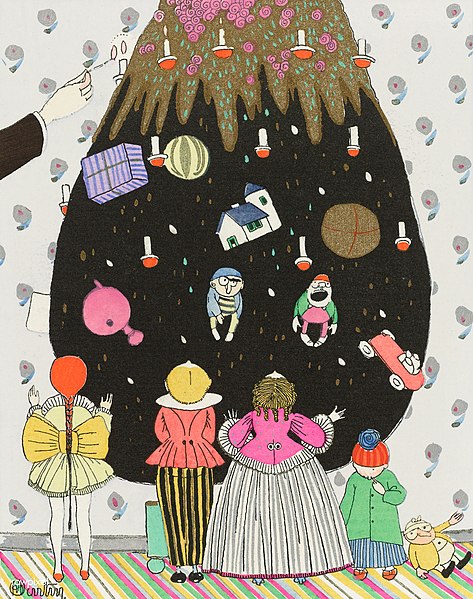
#FineArtFriday: The Wonderful Tree – Children’s costumes for Christmas by Charles Martin ca. 1913


About the Artist, via Wikipedia

Charles Martin (1884–1934) was a French artist and illustrator.

His illustrated books include Les Modes en 1912, a hat collection; the erotic Mascarades et Amusettes and Sports et divertissements (published 1923), a collaboration with composer Erik Satie.

(That is ALL I was able to find about this wonderful artist.)

What I love about this image:

I love the  sense of the grotesque embodied in this image. This cartoon was published at the time Europe was poised on the edge of World War I. In this image, I can see the beginnings of an evolution in art style, one that illustrated the passion for modernity in the first four decades of the 20th century.

The slightly macabre style of Charles Martin’s illustrations may have influenced the work of American cartoonist, Charles Addams. At least, in my untutored opinion, his iconic Addams Family, first published in The New Yorker in 1938, seems reminiscent in style and theme to that of this illustration.

This image was published in the French magazine, La Gazette du Bon Ton, issue no. 1, Christmas 1913—January 1914.


Credits and Attributions:

Wikipedia contributors, “Charles Martin (artist),” Wikipedia, The Free Encyclopedia, https://en.wikipedia.org/w/index.php?title=Charles_Martin_(artist)&oldid=837626027 (accessed December 27, 2019).

Wikimedia Commons contributors, “File:Vintage Christmas illustration digitally enhanced by rawpixel-com-25.jpg,” Wikimedia Commons, the free media repository, https://commons.wikimedia.org/w/index.php?title=File:Vintage_Christmas_illustration_digitally_enhanced_by_rawpixel-com-25.jpg&oldid=350923612 (accessed December 27, 2019).

2 Comments

Filed under writing

Christmas Greetings

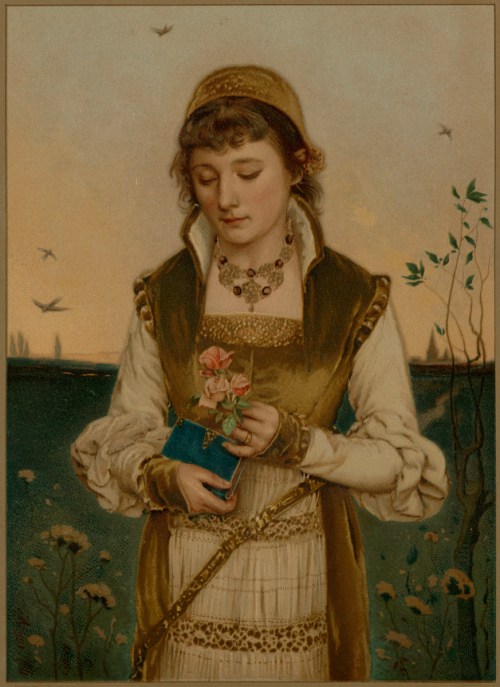
Title: Design for Christmas card, Boston Public Library

Creator/Contributor: Schachinger, Gabriel, 1850-1912 (artist); L. Prang & Co. (publisher)

Date issued: Before 1897

Genre: Chromolithographs; Portrait prints

Location: Boston Public Library, Print Department

The son of a gilder, Gabriel Schachinger studied at the Munich Art Academy and received his artistic training from Hermann Anschütz , Alexander von Wagner and Karl von Piloty . From 1876 to 1878 he was a Bavarian state scholarship holder in Italy. His most important works include a ceiling painting for the Kurhaus Wiesbaden and a curtain for the Hoftheater Munich . Otherwise he mainly created portraits , floral still lifes, and genre pictures.


Credits and Attributions:

Wikimedia Commons contributors, “File:Design for Christmas card by Boston Public Library.jpg,” Wikimedia Commons, the free media repository, https://commons.wikimedia.org/w/index.php?title=File:Design_for_Christmas_card_by_Boston_Public_Library.jpg&oldid=275940112 (accessed December 24, 2019).

Page “Gabriel Schachinger”. In: Wikipedia, The Free Encyclopedia. Processing status: September 27, 2019, 13:03 UTC. URL: https://de.wikipedia.org/w/index.php?title=Gabriel_Schachinger&oldid=192642484 (accessed: December 24, 2019, 13:42 UTC)


2 Comments

Filed under writing

Nothing says Christmas like Noah’s Ark #ChristmasMemories

I live in a small quarry town near our state capital. The city maintenance department decorates the main drag through our little town and it always looks amazing.

The efforts of these wonderful people make the long, dark, Northwestern nights feel so much kinder.

Some years the people here go all out decorating their yards, others not so much. This year, the neighbors’ homes are decorated for the season, but not as lavishly as in some years.

Our home is always quite simple in its holiday decorating–a tree, candles, a cute centerpiece for the table. Outside, my hubby puts up small lighted displays,  but nothing too fancy.

We keep it simple because we have to tear it down and put it all away over New Year’s day, and that rapidly becomes a bore. I don’t like anything that falls into the category of labor.

Two lighted wire Christmas trees (there used to be three), a string of ten lighted candy canes, a wreath and a porch ornament–that is the extent of our usual efforts at decorating the outside of Casa del Jasperson.

Unfortunately , this year our lighted display died right after it went up–so as of this writing we have a yard full of broken ornaments. I plan to replace them today or tomorrow with something new.

We’ve had no snow this year, but we have all the mud you could ever wish for.

Two days ago we received 3.3 inches of rain, so maybe we should switch to Noah’s Ark themed Christmas decorations.

One of my favorite Christmas memories is of 2008. My mother was in the final stages of lung cancer and was living with us in her final days. She was 82, and exceedingly independent. It it was a sign of just how ill she was that she allowed me to move her into my home so I could care for her.

My hubby had set up the lighted reindeer  display: three sweet reindeer made of wire and white lights. However, the snow that year was quite deep. All around their little electric feet, the heat of the lights would melt the snow.

But not evenly.

The littlest reindeer, which Mama named Rudolph even though his nose was not red, kept falling over. Our display looked awful as compared to the neighbors.

Every day, first thing in the morning, Mama went to the front window and checked on that reindeer. She grumbled and fidgeted, wanting to get out there and fix it herself. Unfortunately, chemo had taken its toll; she had no strength.

But nothing had stopped her sense of humor. Watching the neighbors negotiate the street in the deep snow offered hours of entertainment for her. She stood on the porch laughing and making ribald comments as she watched my hubby attempting to stand our rickety electric Rudolph back up.

No matter how we tried, our display that year was the lamest one on the street. Our neighbors pointed and laughed at the prone reindeer as they walked to the grocery store.

lighted-reindeerA few days before Christmas, I was in the kitchen making breakfast. Mama was looking out the front window, talking on the phone to my Aunt Lillian. “That littlest reindeer is a terrible influence. Usually he’s the only souse in the lot, but today we have a yard full of drunken reindeer.”

Aunt Lillian said something, and Mama replied, “I’m not joking. The whole herd is passed out in the snow. Either that, or we had a drive-by shooting and the reindeer were the casualties.”

Sure enough, when Greg went out to go to work, all three electric reindeer were laying on their sides.

That was Mama’s last Christmas. Those reindeer have long since gone to broken ornament heaven and the current broken things will join them.

This year my younger brother, who has a chronic illness, is living with us. Having an extra person in the home has been an adjustment, but not too difficult. The tree is up, and the family room is cheery. We will host a Christmas dinner for our friends and a few family members. I will make my usual dishes (vegan) and my friend will accommodate the carnivores.

At Christmas, I can’t help but think about Mama and good old Rickety Rudolph. For most of her life she had suffered from chronic depression, but as she drew toward the end of her life, she developed a positive outlook. She found humor in the smallest things, and when she passed away, I missed her wit and commentary.

I wish you and your family a Merry Christmas, whether it is snowy or the traditional mud-fest we usually have here. May the year ahead be filled with plenty of good things to balance the bad, and may you always find the humor in life.

2 Comments

Filed under #FlashFictionFriday

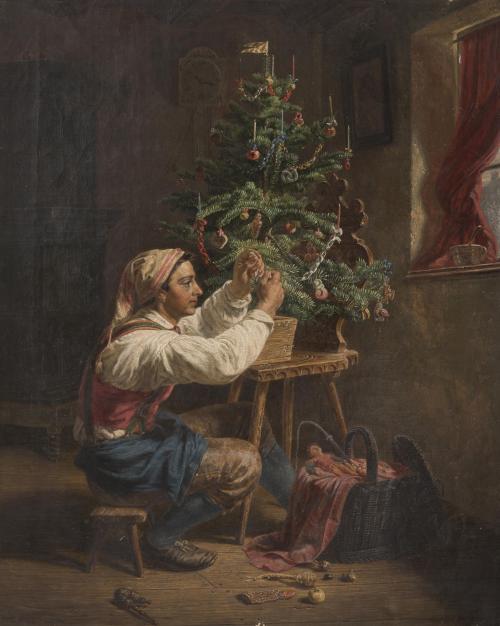
#FineArtFriday: Christmas Tree Decoration, artist unknown, 19th century

I finally got around to putting up our Christmas tree here at Casa del Jasperson, and I must say it looks rather gaudy as compared to the one in this painting.

I always dread the ordeal of moving furniture and getting all the decorations out of their hiding place in the garage. But once the tree is up and the work is out of the way, we love having it.

I say I enjoy it–until it’s time to take it down and figure out where to stash the boxes of ornaments in our overstuffed garage.

About this Picture:

  • Artist: Unknown
  • Title: Christmas Tree Decoration
  • Date: second half of the 19th century
  • Medium: oil on canvas
  • Dimensions : Height: 52.5 cm (20.6 ″); Width: 42 cm (16.5 ″)
  • Location: Private Collection (sold through Dorotheum Auction House)

What I love about this painting:

A young man sits on a low bench and decorates a small fir tree. The furnishings, other than the tree, all are painted in the shadows of the room. A doll lies in the basket at his feet, a toy for his daughter perhaps?

In the background is a beautiful white clock. It has been painted and finely crafted. Poor people would not have owned such an expensive clock.

That clock tells me that while this man may not be rich, he isn’t poor. Even the tree has nice glass ornaments along with decorations of cookies and plain paper.

Chains of colored paper, historically an expensive crafting commodity, also decorate it.

Most poor families didn’t have cut trees, or lavish presents. But the children might wake to find their stockings with an apple or nuts in them, special treats for families that were always on the edge of starvation.

Here in America, in less affluent homes during the early decades of the 20th century, paper chains might have been hung on the tree, along with ornaments made of baked salt-dough and cut-paper. A lot of work went into to creating these ornaments every year, which was part of the fun of getting ready for Christmas.

My maternal grandmother, who was born in 1909, always made paper snowflakes and angels, and strung popcorn and cranberries to decorate her tree.

The man in this painting is dressed in traditional well-made craftsman’s clothing—a simple shirt and vest, apron, leather breeches.

There are curtains of a heavy material at the window, and the tree is set on a beautifully carved table. Is he a woodworker or a clock maker? Who knows, but this man earns enough to live comfortably and celebrate modestly.

This is a quintessential image of old-fashioned Christmas in all its homey prosperity.

According to Wikimedia Commons, the artist who painted this picture is unknown. The Dorotheum Website attributes the painting to an unknown Central European artist.

To me, it is an example of the best of 19th Century European romantic art. It’s a perfect example of a subject near and dear to Victorian souls—that simple, romanticized version of Christmas that we still love today.

This painting makes me think of a Christmas card. Whoever the artist was, they were talented and trained in the craft of painting. They had the knack for conveying homey simplicity in their work.

About Dorotheum via Wikipedia:

The Dorotheum (German pronunciation: [ˌdoːʀoˈteːʊm] (listen)), established in 1707, is one of the world’s oldest auction houses.[1] It has its headquarters in Vienna on the Dorotheergasse and is the largest auction house in both Continental and German-speaking Europe.  Besides auctions, the retail sector also plays a major role in Dorotheum’s business.[3] In the Dorotheum, works of art, antiques, furniture, and jewelry from various centuries are put up for auction. The building is constructed in the neo-classical style.


Credits and Attributions:

Wikimedia Commons contributors, “File:Christmas Tree Decoration.jpg,” Wikimedia Commons, the free media repository, https://commons.wikimedia.org/w/index.php?title=File:Christmas_Tree_Decoration.jpg&oldid=378771434 (accessed December 20, 2019).

Wikipedia contributors, “Dorotheum,” Wikipedia, The Free Encyclopedia, https://en.wikipedia.org/w/index.php?title=Dorotheum&oldid=921309125 (accessed December 20, 2019).


Comments Off on #FineArtFriday: Christmas Tree Decoration, artist unknown, 19th century

Filed under #FineArtFriday

Writing Violence #amwriting

I don’t write horror, but some of my novels contain certain elements of that genre. These shocking, violent scenes were moments that changed my characters’ lives.

Violence is an aspect of depth that is difficult for some authors to write well.

I dislike graphic violence that is there for the shock value. If the violent events don’t somehow move the story forward, change the protagonist profoundly, or affect their view of the world, you have wasted the reader’s time.

Understanding how to design certain action scenes and where they fit into a narrative is a critical skill we must develop if we want our readers to love our work. When you raise the specter of failure, you also raise the emotional stakes and keep the reader turning the page.

Random carnage has no place in the well-crafted novel, no matter the genre. The key word here is random.

When it comes to writing scenes that involve violence, ask yourself three questions:

  1. Will this event profoundly change my protagonist’s life?
  2. What does this event accomplish that advances my plot?
  3. Why is this event unavoidable?

Blood and sex do have their place in some of the best stories I have read, and they were watershed moments in the protagonists’ lives. Those passages were difficult to read but were the events that changed everything.

When you read Stephen King’s work, you find shocking events and horror. But more importantly, you see a narrative that was carefully thought out. Every event pushes the protagonist’s story to its conclusion.

They were the moments that changed the protagonists for good or ill. These scenes were crafted seamlessly into the narrative.

Violence in the horror novel is all the more frightening when it is subtly foreshadowed and unavoidable and occurs at a surprising moment. It is not random, not inserted for shock value or just to liven things up.

This means you must plan your horror novel with an eye to ratcheting up the fear and tension in every scene. The threat and looming disaster must be shown, and the solution held just out of reach.

At first, emotions are high, and the situation sometimes chaotic, and often the protagonist believes he can resolve the situation if he can just achieve one thing.

In the process of experiencing these events, the protagonist suffers doubt, fear they may not have what it takes, and their quest won’t be fulfilled. From this point on, the forces driving the plot are a train on a downhill run, picking up speed, and there is no stopping it or turning back now.

Within the overall story arc, you must insert scenes that illuminate the motives of all the characters, including those of the antagonist. The characters continue to be put to the test, and the subplots kick into gear.

These scenes allow the reader to learn things as the protagonist does. They offer clues that the characters don’t know, information that will affect the plot.

Those clues are foreshadowing. Through the first half of the book, subtle foreshadowing is important, as it piques the reader’s interest and makes them want to know how the book will end.

  1. The first event, the inciting incident, is the one that changes everything and launches the story. Because the best stories are about good people solving terrible problems, this incident has a domino effect: more actions ensue that push the protagonist out of his comfortable life and into danger. This peril can be physical or emotional–after all, many things rock our world but don’t threaten our physical safety.
  2. At the midpoint, another serious incident occurs, launching the third act, and setting them back even further. Now the protagonist and allies are aware that they may not achieve their objectives after all. Bad things have happened, and the protagonists must get creative and work hard to acquire or accomplish their desired goals. They must overcome their own doubts and make themselves stronger.
  3. Just when the characters have recovered from the midpoint crisis, another crisis occurs, the event that launches the final act. This final event is where someone who was previously safe may die.
  4. Each violent event should be worse than the previous. They begin relatively minor as compared to the final event and grow progressively more difficult. As the narrative moves on, the reader must fear the protagonist will fail.

What are the consequences of failure? Fear is powerful motivator, so raise the stakes and the tension as the story progresses.

Scenes that involve violence are difficult to write well unless you know how the action will affect your protagonist. What will their long term reaction be?

Also, you must remember to give both the protagonist and the reader a small break between incidents for regrouping and planning.

Action, aftermath, action, aftermath—often compared to the way a skater crosses the ice: push, glide, push, glide.

Writing violence well requires planning on the part of the author. It requires us to sit back and consider what events will be unavoidable and will change the characters for good or ill.

Then we must insert them into the narrative in the right order, subtly foreshadowed, and all consequences must be both logical and advance the story.

THAT is where writing becomes work, but when done well, you can end up with a great novel.

A novel that I wish I had written is Dean Frank Lappi’s Black Numbers, the first novel in his Aleph Null series. This a deep, violent novel with great characters and intentional plotting, and kicks off a brilliant series. Nothing that happens in that novel is random. Every event serves a purpose, that of pushing the protagonist to his destiny.

We learn from the masters. If you must write violence into your work, you must study the works of other writers. Stephen King’s early work is an excellent place to start and is available in the public library.


Credits and Attributions:

Portions of this post were previously published on the Northwest Independent Writers Association blog as Crafting Violence, © Connie J. Jasperson, October 15, 2017.

3 Comments

Filed under writing

The pros and cons of using editing programs #amwriting

A number of people have asked me about editing programs, and if I use them in my own work. I do–but also, I don’t.

I rely on my knowledge of grammar and what I intend to convey more than I do editing programs, which are not as useful as we wish they were.

You may have found that your word processing program has spellcheck and some minor editing assists. Spellcheck is notorious for both helping and hindering you.

Spellcheck doesn’t understand context, so if a word is misused but spelled correctly, it may not alert you to an obvious error.

  • There, their, they’re.
  • To, too, two.
  • Its, it’s

Grammarly is an editing program I use for checking my own work, in tandem with Pro Writing Aid. I pay a monthly fee for the professional versions of these two programs. Each one has strengths and weaknesses.

For me, especially in my first draft, some words are like tics—they fall out of my fingers and into my keyboard randomly and out of my voluntary control. I don’t self-edit as I go because, at that point, I’m just trying to get the story down. The second and third drafts are where I shape my grammar and phrasing.

I want to write active prose, so I don’t want to use words with no power behind them.

Often removing an adjective or adverb strengthens the prose. They’re easy to find because these words frequently end with the letters ‘ly.’

You could do a global search for the letters ‘ly,’ and a list will pop up in the left margin of your manuscript.

It’s ridiculous to tell someone to remove all adverbs from a narrative. Words like “later,” or “everywhere,” or “never” or “alone” are also adverbs.

That sort of wrong-headed advice survives because it is based on a writing truth: unnecessary adverbs and adjectives fluff up the prose. Worse, they sometimes fail to tell us something that we need to know.

In other words, use adverbs and adjectives when they are necessary and cut them when they aren’t.

In my own work, I seek out adverbs, descriptors, qualifiers, and “weed words.” I look at how they are placed in the context of the sentence and decide if they will stay or go. Many will go, but some must stay.

A good program to help point out when certain passages are passive and need to be “made active” is Pro Writing Aid. I use the professional version for my own work, but they do have a free version that will show you some limited problems in your prose.

The BIG problem for those who don’t understand the basics of grammar is, these programs are unable to see the context of the work they are analyzing:

“The tea was cool and sweet, quenching her thirst.”

Grammarly suggested replacing quenching with quenched.

Pro Writing Aid made the same suggestion.

I have no idea why they make that suggestion, but you can see how a person blindly following mechanical advice could go wildly astray.

Context is defined as the parts of a written or spoken statement that precede or follow a specific word or passage, usually influencing its meaning or effect.

A person with no knowledge of grammar will not benefit from relying on Grammarly or any other editing program for advice. There is no way to bypass learning the craft of writing.

This is because these programs operate on algorithms defined by finite rules and will often strongly suggest you insert an unneeded article or change a word to one that is clearly not the right one for that situation.

New writers should invest in the Chicago Guide to Grammar, Usage, and Punctuation, and learn how grammar works. If you don’t understand grammar or how to construct a sentence, a paragraph, or write dialogue, editing programs will just confuse and mislead you.

To get the best out of editing software, you must know the basics of how to write.

Currently, at this stage in our technology, understanding context is solely a human function.

Because context is so important, I am wary of relying on these editing programs for anything other than alerting you to possible comma and spelling malfunctions.

You might not agree with the program’s suggestions. You, the author, have control and can disregard suggested changes if, as illustrated above, they make no sense. I regularly reject weird suggestions.

However, when the editing program highlights something, I look at the problem sentence carefully. Just knowing that the way I phrased a sentence tripped the program’s algorithms encourages me to look at that passage with a critical eye.

I may not use the program’s suggestion, but something triggered the algorithm. That means my phrasing might need work. I may need to find a better way to get my idea across.

Even editors must have their work seen by other eyes—my blog posts are proof of this. I am the only one who sees them, and even though I write them in advance and go over them with two editing programs, and then look at them again before each post goes live, I still find silly errors two or three days later.

A good editing program is not cheap, but I feel it is a worthwhile investment. If you don’t have an editing program, you can find these words on your own.

If you are hasty or impatient, a global search can be dangerous and can mess up an otherwise good manuscript. I warn you, this is a boring, time-consuming task, but it is a crucial part of the job.

You can’t take shortcuts. If you are too impatient and choose to “Replace All” without carefully thinking things through, you run the risk of making a gigantic mess of your work. Some weed words are parts of other words, for example:

  • very—every
  • has—hasten, chasten

If you have decided something is a “crutch word,” examine the context. Inadvertent repetitions of certain words are easy to eliminate once we see them with a fresh eye.

Context is everything.

I can’t stress this enough: take the time to look at each example of the offending words individually.

It’s unfortunate, but there is no speedy way to do this. Every aspect of getting your book ready for the reading public must be done with the human eye, patience, and attention to detail.

11 Comments

Filed under writing

#FineArtFriday: The Lacemaker by Nicolaes Maes ca. 1656

The Lacemaker

  • Artist   Nicolaes Maes
  • Year    c. 1656
  • Medium           oil paint, canvas
  • Dimensions     45 cm (18 in) × 53 cm (21 in)

About this image, via Wikipedia:

The Lacemaker (circa 1656) is an oil on canvas painting by the Dutch painter Nicolaes Maes. It is an example of Dutch Golden Age painting and is part of the collection of the Metropolitan Museum of Art.

This painting is typical of many paintings of women in interiors painted by Maes in the 1650s. The woman is making bobbin lace using a lace pillow that can be seen in other Maes paintings of lacemakers.

The child in a highchair was a popular subject for many Dutch genre painters, and this painting shows how it was used as a safe place to play as well as for eating. The empty bowl of porridge is on the floor along with some other items the boy has let fall. He is wearing a red valhoed or falling cap, which seems to indicate that confinement in the chair is necessary if any lacemaking is going to get done.

baby bumper headguard cap, also known as a falling cap, or pudding hat, is a protective hat worn by children learning to walk, to protect their heads in case of falls.

Known as a pudding or black pudding, a version used during the early 17th century until the late 18th century was usually open at the top and featured a sausage-shaped bumper roll that circled the head like a crown. It was fastened with straps under the chin.

About the Artist via Wikipedia

From Wikipedia: Nicolaes Maes, also known as Nicolaes Maas (January 1634 – November 24, 1693 (buried)) was a Dutch Golden Age painter of genre and portraits. In about 1648 he went to Amsterdam, where he entered Rembrandt‘s studio. Before his return to Dordrecht in 1653 Maes painted a few Rembrandtesque genre pictures, with life-size figures and in a deep glowing scheme of colour, like the Reverie at the Rijksmuseum in Amsterdam, the Card Players at the National Gallery, and the Children with a Goat Carriage. So closely did his early style resemble that of Rembrandt, that the last-named picture, and other canvases in the Leipzig and Budapest galleries and in the collection of Lord Radnor, were or are still ascribed to Rembrandt.

In his best period, from 1655 to 1665, Maes devoted himself to domestic genre on a smaller scale, retaining to a great extent the magic of colour he had learnt from Rembrandt. Only on rare occasions did he treat scriptural subjects, as in Hagar’s Departure, which has been ascribed to Rembrandt. His favorite subjects were women spinning, or reading the Bible, or preparing a meal. He had a particular fascination with the subject of lacemaking and made almost a dozen versions on this subject.

While he continued to reside in Dordrecht until 1673, when he settled in Amsterdam, he visited or even lived in Antwerp between 1665 and 1667. His Antwerp period coincides with a complete change in style and subject. He devoted himself almost exclusively to portraiture, and abandoned the intimacy and glowing color harmonies of his earlier work for a careless elegance which suggests the influence of Van Dyck. So great indeed was the change, that it gave rise to the theory of the existence of another Maes, of Brussels. His registered pupils were Justus de GelderMargaretha van GodewijkJacob Moelaert, and Johannes Vollevens.[1] Maes died in Amsterdam.


Credits and Attributions:

Wikipedia contributors, “The Lacemaker (Maes),” Wikipedia, The Free Encyclopedia, https://en.wikipedia.org/w/index.php?title=The_Lacemaker_(Maes)&oldid=799625637 (accessed December 12, 2019).

Wikipedia contributors, “Baby bumper headguard cap,” Wikipedia, The Free Encyclopedia, https://en.wikipedia.org/w/index.php?title=Baby_bumper_headguard_cap&oldid=914539353 (accessed December 12, 2019).

Wikipedia contributors, “Nicolaes Maes,” Wikipedia, The Free Encyclopedia, https://en.wikipedia.org/w/index.php?title=Nicolaes_Maes&oldid=815679835 (accessed July 12, 2018).

3 Comments

Filed under #FineArtFriday