#FineArtFriday: The Last Supper by Sister Plautilla Nelli (1524–1588)

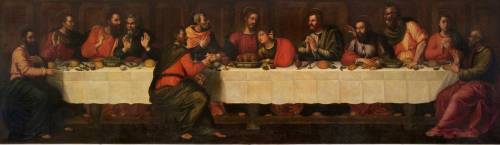
The Last Supper by Sister Plautilla Nelli  (1524–1588)

Date: 16th century

Medium: oil

Collection: Basilica of Santa Maria Novella

What I love about this painting:

The Last Supper, a 7×2-meter oil-on-canvas, preserved in the Basilica of Santa Maria Novella, is the only signed work by Plautilla Nelli known to survive. Her signature, in the upper left corner, reads S. Plavtil – La Ora Te Pro Pictora (Sister Plavtil, Pray for the Paintress).

I love the intimacy of this composition. Jesus hold bread in his left hand as he comforts Saint John.

According to Karen Chernick for her article of October 17, 2019 in Atlas Obscura:

Nelli didn’t paint her “Last Supper” background to look like the dining hall it was designed for, a trick other artists used to make the scene relatable. Instead, she showed Jesus and his apostles dining on the same food that Santa Caterina’s Domincan nuns ate: a whole roasted lamb, bread, wine, heads of lettuce, and fresh fava beans—the last two dishes unprecedented in any depiction of Christ’s last meal. The fava beans were a wink to local cuisine, a Florentine specialty normally eaten by peasants (and nuns).

“Pray for the Paintress,” is a thought I will keep in my heart.

About this painting, via Wikipedia:

Plautilla Nelli’s Last Supper is a first in the history of art rendered by a woman. Painted in the 1560’s, Last Supper was under restoration for four years.[11] The work went on exhibit in October 2019.[12] No female artist had ever painted this subject before Nelli. Florence has the richest tradition of paintings with the theme of last supper in the world. Nelli’s Last Supper, her most significant work because of its size and subject, is a seven-meter long, oil on canvas. After restoration her Last Supper will be exhibited at the Santa Maria Novella Museum in Florence across from Alessandro Allori’s painting with the same theme, also painted in the sixteenth century.

About the Artist (via Wikipedia)

Sister Plautilla Nelli (1524–1588) was a self-taught nun-artist and the first-known female Renaissance painter of Florence. She was a nun of the Dominican convent of St. Catherine of Siena located in Piazza San Marco, Florence, and was heavily influenced by the teachings of Savonarola and by the artwork of Fra Bartolomeo.

Pulisena Margherita Nelli was born into a wealthy family in the San Felice area of Florence. Her father, Piero di Luca Nelli, was a successful fabric merchant and her ancestors originated from the Tuscan valley area of Mugello, as did the Medici dynasty. There is a modern-day street in Florence, Via del Canto de’ Nelli, in the San Lorenzo district, named for her family, and the New Sacristy of the Church of San Lorenzo is the original site of her family homes.[1]

She became a nun at the age of fourteen, taking on the name Suor Plautilla, at the convent of Santa Caterina di Cafaggio; she would later be prioress on three occasions. The facility was managed by the Dominican friars of San Marco, led by Savonarola. About half of all educated girls in that era were placed into convents to avoid the cost of raising a dowry. Savonarola’s preachings promoted devotional painting and drawing by religious women to avoid sloth, thus the convent became a center for nun-artists. Her sister, also a nun, Costanza, (Suor Petronilla) wrote a life of Savonarola.


Credits and Attributions:

Quote from “A Nun’s 450-Year-Old ‘Last Supper’ Makes Its Museum Debut in Florence” by Karen Chernick © 2019 Atlas Obscura. All rights reserved. https://www.atlasobscura.com/articles/first-last-supper-woman-painter-florence

Wikimedia Commons contributors, “File:Plautilla Nelli – The Last Supper.jpg,” Wikimedia Commons, the free media repository, https://commons.wikimedia.org/w/index.php?title=File:Plautilla_Nelli_-_The_Last_Supper.jpg&oldid=371023591 (accessed October 24, 2019).

Wikipedia contributors, “Plautilla Nelli,” Wikipedia, The Free Encyclopedia, https://en.wikipedia.org/w/index.php?title=Plautilla_Nelli&oldid=922398829 (accessed October 24, 2019).
Comments Off on #FineArtFriday: The Last Supper by Sister Plautilla Nelli (1524–1588)

Filed under #FineArtFriday

Update on Work in Progress #amwriting

My works in progress are coming along as I hoped they would. The outline and character studies are finished for my November novel, so I should have no trouble getting that off the ground on November 1st.

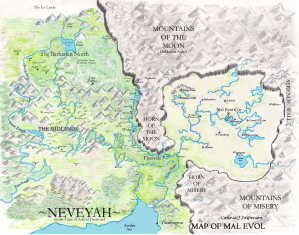
I am doing a major structural rewrite on Heaven’s Altar, a new novel set in Neveyah, and that is going well.

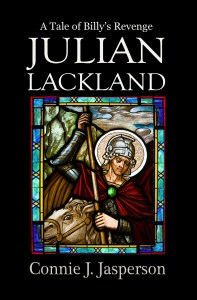
Julian Lackland is in the formatting stage at last. His story completes the 3-book Billy’s Revenge collection of stand-alone medieval fantasy novels.

I am looking forward to the great month of November, as I can hardly wait to get started on my project.

The short story mill in my head still seems to produce something every month or so. I like to think of them as “palate cleansers” since they are completely different from the main area of focus and sort of clear the cobwebs from my head.

I have a list of resources for beginners to bookmark that will make writing their NaNoWriMo novels easier. In my mind, any resource that is free is good.

  • Fantasy/Real Name Generator (some are unpronounceable, but all are fun)
  • Thesaurus.Com (quickly find words that mean the same as “sword” etc., so you don’t have too many “crutch” words.
  • Oxford Dictionary (Spell it right and use in the proper context!)
  • Wikipedia (research is a time sink to beat all time sinks, but if you’re in a hurry for quick info, you might find it here.)

Three websites a beginner should go to if they want instant answers about grammar in plain English:

Instant gratification is good when you are in the zone and short on time.

The rules I follow to both get my wordcount and enjoy NaNoWriMo:

    1. Write at least 1,670 words every day (three more than is required) This takes me about 2 hours – I’m not fast at this.
    2. Write every day, no matter if you have an idea worth writing about or not. If you are stuck, write about how your day went and how you are feeling about things that are happening in your life, or write that grocery list. Just write, and think about where you want to take your real story. Write about what you would like to see happen in that story.
    3. Check in at www.nanowrimo.org to see what’s happening in your region. Someone there will be able to answer any questions you may have, and the local threads will keep you in contact with other writers.
    4. Attend a write-in if your region is having any, or join a virtual write-in at NaNoWriMo on Facebook. This will keep you enthused about your project.
    5. Delete nothing. Passages you want to delete later can be highlighted, and the font turned to red or blue, so you can easily separate them out later.
    6. Remember, not every story is a novel. If your story comes to an end, draw a line at the bottom of the page and start a new story, in the same manuscript. You can always separate the stories later, and that way you won’t lose your word count.
    7. Validate your word count at www.nanowrimo.org every day. Your word processing program will sometimes count the words differently than the official validator. Validating daily will let you know if you are officially on track.

Why should you write in November?

Write because you have an idea that could make a good story. Write the book you want to read but no one else is writing.

Write fan-fiction.

Above all, have fun writing.

If you can’t write 1,667 words a day, write as much as you can and don’t feel guilty. The novel is the important thing and if you can’t get 50,000 words in 30 days, all is not lost. There are 320 more days in the year to come, so keep the habit of writing daily.

Stay in love with your characters and have fun writing your story.

In the end, the story is what counts.

2 Comments

Filed under writing

Time Management #NaNoWriMo2019 #amwriting

If you are planning to write a 50,000 word novel in the month of November, you will need to develop some time management skills.

Writing daily is easier once it becomes a behavioral habit. Making the best use of your time requires a little self-discipline.

Most of us have jobs and a family, so our time for personal projects can be limited.

First, you must give yourself permission to write.

Your perception that it is selfish will be your biggest hurdle. Trust me, it is not asking too much of your family for you to have some time every day that is sacred and dedicated to writing.

When I first began writing, I was in high school. I wrote some short stories, but mostly I wrote poetry and lyrics for songs. Later I married the bass player in a heavy metal band and began writing songs with him.

During the 1980s and 1990s, as the single mother of three children, I held down three part-time jobs. I couldn’t afford cable, so with only four channels via the antenna, TV was pretty minimal at our house. Card games, dominoes, books, and the library were our usual evening entertainment.

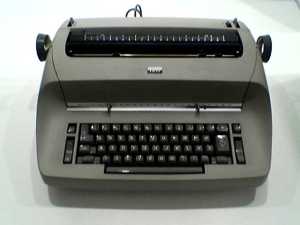
It was during this time that I began to write fiction seriously. We read books so quickly that the library couldn’t stock new ones in our areas of interest fast enough for us. So, when my children were doing their homework, I sat in front of my second-hand IBM Selectric typewriter and pecked out fairy tales to read to them.

In the summer, I did that while they watched videos or played Super Mario et al., on the old Super Nintendo.

That gave me at least one hour every night in which I could write, sometimes more. Yes, I did have to help with some of their homework but having me there, typing away next to the gerbil cage seemed to keep them on track, and I did get several pages written every night.

It was all crap, but I made it sound better when I read it aloud to them.

Although I didn’t know it at the time, I was developing discipline and a work ethic in myself as well as in my children.

Two of my daughters write fiction as well as holding down jobs and raising families. All five of our kids are hardworking adults who are raising families and who also have an artistic life in music or writing or both.

Having an artistic life means you allow yourself time to create something that is meaningful to you.

The following is a list of ideas to help you carve the time to write  and still be a full participant in your family’s life.

  1. You must decide what is more important, your dream of writing or watching a television show that is someone else’s dream. Do you want to create, or do you want to be entertained?

Personally, I would say that if you didn’t like the way Game of Thrones turned out, too bad.

It was George R.R. Martins creation, and he did it his way. He has written more than thirteen novels, numerous short stories, novellas, and too many screenplays for me to count.

GRRM did all that by sitting down and writing every day. He is an award-winning author because he makes the time to write despite his heavy schedule as a speaker, screenwriter, and editor.

So, don’t waste your time complaining about how George did it and don’t bother searching for a replacement show. Write your own Game of Thrones and do the way you think it should have been done. Writing fan fiction is a great, time-honored way to start your writing career.

  1. You have the right to take an hour in the morning and the evening to use for your own creative outlet. Get up an hour early and write until the time you would normally get up. That will be the quietest time you will have all day. Give up that 9:00 p.m. TV show and write for one more hour. There are your 2 precious hours.

If you use those two separate hours for your stream-of-consciousness writing, you could easily get your 1,667 words written every day, possibly more. I am a slow keyboard jockey, and I can do about 1,100 wonky, misspelled words an hour during NaNoWriMo.

But they ALL count, misspelled or not.

  1. Write for five minutes here and ten minutes there all day long if that is all you can do. Every word counts toward your finished manuscript.
  2. I took my lunch to work and wrote during my lunch half-hour whenever possible.
  3. I also wrote on the bus when I didn’t own a car.

You don’t have to announce you are writing a book if you don’t wish to—I certainly didn’t feel comfortable doing so. If you want to spend your lunch time writing, politely let people know you’re handling personal business and won’t have time to chat.

Some offices will allow you to use your workstation computer for personal business, but most of my places of employment frowned on that. I brought a notebook and pen as I didn’t own a good laptop. By writing down all the thoughts and ideas I had during the day, I had a great start when I finally did get a chance to write. If your work allows, bring your laptop or your iPad/Android. So you don’t get into trouble with the boss, sit in the lunchroom (if you have one).

You can also set aside a block of time on the weekend to write, though that can be difficult, as setting aside an uninfringeable time on a weekend can become a hardship, especially if you have a young family. This is where getting up early for that one quiet hour can really keep your story flowing out of your head and into the keyboard/notebook.

Writers and other artists do have to make sacrifices for their craft.

It’s just how things are. But you don’t have to sacrifice family for it. Sacrifice one hour of sleeping in, and sacrifice something ephemeral and unimportant like one hour of TV.

By  writing in short bursts whenever you have the opportunity, you might get your first draft finished, and get that certificate that says you completed 50,000 words in 30 days.

But more importantly than any winners certificate, you will have created something special, something unique that is a piece of your soul, your intellectual child, as it were.

A novel is nothing but an idea and the discipline to sit down and write it from start to finish.

Inspiration and self-discipline—that ability to start and finish a project that began as an idea, a “what if,” is what creative writing is all about.

You can achieve your goal of 50,000 words in 30 days if you give yourself permission to create and make the time to do so.

Comments Off on Time Management #NaNoWriMo2019 #amwriting

Filed under writing

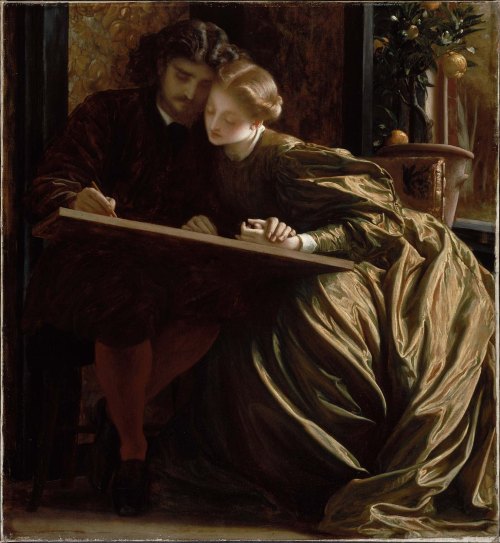
#FineArtFriday: The Painter’s Honeymoon by Frederic Leighton, 1st Baron Leighton ca. 1864

Artist: Frederic Leighton, 1st Baron Leighton: The Painter’s Honeymoon

Title: The Painter’s Honeymoon

Date: 1864

Medium: painting

Dimensions: 83.8 × 76.8 cm (32.9 × 30.2 ″)

What I like about this painting:

This is a real departure from Leighton’s usual precise nudes. There is a great deal of emotion and closeness depicted here. The folds of the wife’s skirt are shown with his usual vivid sharpness, as are the hands of both the painter and his wife. Their hands are portrayed as gentle and tender—and yet they are clearly defined, as they are the medium through which the painter expresses himself.

Their faces are not as distinct, as if they are still in the romantic haze of their new life together.

According to Wikipedia:

The Painter’s Honeymoon was first exhibited at the Royal Academy in 1866 – it appears that Leighton deliberately prevented it from being shown publicly in the years following its completion. As Leighton was renowned for his lack of confidence and shyness, many of his contemporaries believed he felt he had betrayed too much of his own emotion to feel comfortable exhibiting the picture.


Credits and Attributions:

The Painter’s Honeymoon by Frederic Leighton, 1st Baron Leighton [Public domain]

Wikipedia contributors, “The Painter’s Honeymoon,” Wikipedia, The Free Encyclopedia, https://en.wikipedia.org/w/index.php?title=The_Painter%27s_Honeymoon&oldid=902492011 (accessed October 18, 2019).

2 Comments

Filed under #FineArtFriday

#NaNoWriMo2019 Prepping: Setting #amwriting

If you follow this blog and you are planning to write a novel in November, you now have the first three key elements you will need to begin:

  1. Plot: Devising a Plot in 8 Questions
  2. Outline: The Outline for Pantsers
  3. Characters: Prepping your Characters

All you need now is a world to set this story in. Prepping now will save you time when you begin the 30-day challenge.

Worlds evolve as we write the first draft, but it helps to have a solid idea of where we are setting the story at the outset.

What follows is a plan to help you lay the groundwork for the world in which your novel is set.

Picture the opening scene.

Open a new document and give it a title, such as your_book_title_worldbuilding.docx

Simple and clear labels make a good file names. You want one that clearly says “this is world building” for whatever you have titled your novel, and if you put it in the same folder as your manuscript, you will be able to easily find it.

Here is a short list of questions to help you begin the process:

  1. What is the name of the world in which the story opens? What is the name of the town/village where the protagonists are living? Place names can give the reader an idea of the sort of town or village it is set in.
  2. Does it take place on earth in a real place? If so, do the research and use Google Earth and Google maps.
  3. On earth in an alternate time/place? Make that clear at the outset
  4. Is it set on some other world entirely? The best way to make the fantasy world real is to visualize the scene clearly. Blend the real world into it and write out all the details that will never make it into your story.
  5. Where is the protagonist, indoors or out? Is it a gentle or a hostile environment? Does the environment work for or against him/her?
  6. If the setting is indoors, is it home, an office, a shop, a smithy…etc. etc. How does the protagonist fit into this place? Are they visiting, or do they live/work there? List the furniture and other objects that the characters interact with and know where it’s placed.
  7. Looking through their eyes, what emotions do they feel about the world around them? THIS DOES NOT HAVE TO GO INTO THE NARRATIVE, as this is backstory for you. It will evolve into the story organically as you write.

Now we get to the tactile parts of the setting:

  1. How does the air feel, and what scents and odors are common to that place? The smells, the sounds, the way certain doors creak are all good things to know.
  2. What is the quality of the lighting both indoors and out? Is it dark, bright, subdued, glaring, etc.?
  3. If they are out of doors, what is the weather like? Weather is crucial and impacts your characters’ ability to easily go places.

On this world-building document, write every single detail the characters see and feel, from the largest down to the insects. Keep adding to it whenever you think of something new. The act of designing this scenery builds the world in your mind. For my own work, I stick with the familiar, with some unfamiliar creatures thrown in for fun. Use all the power words you can think of to build that world.

As you write the first draft of your novel, the world you are creating will grow and evolve. I highly recommend two things:

  1. Draw a quick, simple map, such as the sample map to the right, if your characters are traveling in a fantasy world—it doesn’t have to be fancy. This way your place names and directions won’t inadvertently shift as the book progresses.
  2. Make a list of character names and place names, and any words that are unique to your world and your story. This will be your reference manual for this novel and will keep the spelling from evolving as you get further into the story.

A world is more than the environment. You should have an idea of how your society works, to ensure your characters are firmly in your mind at the outset:

  • How is your society divided? Who has wealth?
  • Who has the power? Men, women—or is it a society based on mutual respect? Is one race more entitled than another?
  • What place does religion have in this society? Is it central to the governance of the society, or is it a peripheral, perhaps nonexistent thing?
  • What passes for morality? Is sex before marriage taboo? What constitutes murder, and how is it viewed? You only need to worry about the moral dilemmas that come into your story.
  • If a character goes against society’s unwritten or moral laws, what are the consequences?

This is atmosphere. This is knowledge the characters have, but the reader does not.  The way you convey this is to show how these larger societal influences affect your character and his/her ability to resolve their situation.

Fantasy worlds often involve magic. If magic is central to your story, it is essential that you have finite rules for limiting how magic works.

Unlimited power is completely unbelievable. If magic is part of your story, rules and limitations create the tension that moves the plot forward.

  • Who has the magic, and what social power does this give them?
  • What are the limitations of his/her powers? How does this hamper them?

Each time you make limits and frameworks for your magic, you make opportunities for conflict within your fantasy world. Conflict is what drives the plot. There can be an occasional exception to the rules, but there has to be a good reason for it, and it must be clear to the reader why that sole exception is acceptable.

Spending an evening working these details out before you sit down to write will make your work go faster. Many things will change as you go along, and better ideas emerge, but having the jumping off point will get you out of the gate with confidence.

3 Comments

Filed under NaNoWriMo

Prepping your Characters #NaNoWriMo2019 #amwriting

November and NaNoWriMo approaches. On November 1st thousands of authors will begin the 30 day challenge. Many will fall out of the game in first few days, but an amazing number of authors will finish their novels in those 30 days.

I see on the boards at www.nanowrimo.org  that a large number of people are drawing up personnel files for their characters. They are finding pictures of actors that might look most like their characters and writing short bios. I have done this in the past, and it worked well, as far as getting the obvious things down.

But I discovered that personnel files only show us the surface of these characters. Thanks to my obsession with learning new things and going to seminars, I do things a bit differently nowadays.

A seminar by Damon Suede triggered a cascade of ideas in my mind, the things I habitually did but didn’t realize I was doing it. These aspects of characterization were in my head but never written down, and as a consequence, things sometimes got muddied up in the writing.

We form our characters out of Action and Reaction. This happens in several ways. I will use the 3 main characters in my forthcoming novel, Julian Lackland, as my examples, as they are most firmly in my mind right now.

First, we  make a simple word picture of each character. The word picture is made of a verb (action) and a noun (person, place, or thing), the two words that best describe each person.

We want to know the good things about these characters, so we assign nouns that tell us how they see themselves at the outset of the story. We also look at sub-nouns and synonyms:

Julian’s Noun is: Chivalry (Gallantry, Bravery, Daring, Courtliness, Valor, Love)

Beau’s Noun is: Bravery (Courage, Loyalty, Daring, Gallantry, Passion)

Lady Mags’s Noun is: Audacity (Daring, Courage)

The way we see ourselves is the face we present to the world. These self-conceptions color how they react but aren’t engraved in stone. By the end of the story, the way they see themselves will change because circumstances will both break and remake them.

Next, we assign a verb that describes their gut reactions, which will guide the way they react to every situation that arises. They might think one thing about themselves, but this verb is the truth and while it may evolve, it does not completely change. Again, we also look at sub-verbs and synonyms:

Julian has 2 Verbs. They are: Defend, Fight, (Preserve, Uphold, Protect)

Beau’s 2 Verbs are: Protect, Fight (Defend, Shield, Combat, Dare)

Lady Mags’s 2 Verbs are : Fight, Defy (Compete, Combat, Resist)

When I write one of these three characters, I know how they believe they will react in a given situation. Why? Because I have drawn the portrait of their soul in words:

Julian must Fight for and Defend Chivalry. Julian’s commitment to defending innocents against inhumanity ultimately breaks his mind.

Beau must Fight for and Protect Bravery. Beau’s commitment to protecting Julian and concealing his madness consumes his life.

Lady Mags must Fight for and Defy Audacity. Mags is audacious–she is determined to remain a mercenary knight, no matter what the cost. She’s at war with herself in regard to her desire for a life with Julian and Beau. That war ruins her chance at happiness.

Do you see what happened? Placing the verb before the noun describes their core conflict. It lays bare their flaws and opens the way to building new strengths.

Who they are before we meet them is important, so go ahead and make that personnel file. But their story will be built upon who they think they are and what their gut reactions are.

Our characters’ preconceptions color their experience of events, which color the readers’ view. They are unreliable witnesses. It shades their reactions when they fail to live up to their own standards. These are the watershed moments when they must honestly examine their motives.

It adds to a scene where they triumph despite their flaws, succeeding against the odds.

What two words describe the primary weaknesses of your characters, the thing that could be their ultimate ruin?

Julian Lackland: Obsession and Honor

Beau Baker: Steadfast Loyalty

Lady Mags De Leon: Stubbornness and Fear

So, when you sit down to make a personnel file for your characters, you need more than a picture of your favorite actor and bio. You also need to decide the verb (action word) and the noun (object of the action) that best represents your characters.

For me, knowing these two words about my characters make writing the story easier. Their actions and reactions unfold as if the story writes itself.

I am in the process of assigning verbs and nouns to the characters in my own projected NaNoWriMo novel. Some of my characters are difficult to get a grip on, so this exercise will help me on November 1st when I begin to write their story.

1 Comment

Filed under NaNoWriMo, writing

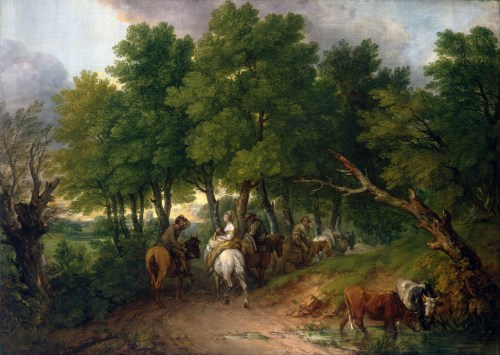
#FineArtFriday: Road from Market by Thomas Gainsborough ca. 1768


Title: Road from Market by Thomas Gainsborough  (1727–1788)

Date: between 1767 and 1768

Medium: oil on canvas

Dimensions: Height: 1,213 mm (47.75 ″); Width: 1,702 mm (67 ″

What I love about this painting:

Thomas Gainsborough is one of Great Britain’s most famous portrait artists. His best-known painting is the “Blue Boy.”  But while portraits may have paid his bills (handsomely), Thomas Gainsborough loved painting landscapes and did so whenever he was able.

This painting shows us a road, and while it looks to our modern eyes to be nothing more than a dirt track fading into the forest, it was typical of the main roads one had to travel in both Great Britain and America. They were dirt tracks, barely passable at certain times. Traveling these roads while riding in a carriage was both dangerous and arduous.

Four people are depicted in this painting, three men and a woman. All but one of the farmers is seated sideways on the horses. This tells us that side-saddle was a common way for all people to ride at the time of the American Revolution, not just women.

Gainsborough did manage to romanticize the bucolic countryside in this pleasant, homey painting.

His horses are heroic, the peasants look well-fed, and even the cattle look prosperous. The fields just beyond the trees are lush and green.

Thomas Gainsborough is credited, along with Richard Wilson, as one of the originators of the 18th-century British landscape school. Gainsborough was a founding member of the Royal Academy of Arts.


Credits and Attributions:

Wikimedia Commons contributors, “File:Thomas Gainsborough – Road from Market – Google Art Project.jpg,” Wikimedia Commons, the free media repository, https://commons.wikimedia.org/w/index.php?title=File:Thomas_Gainsborough_-_Road_from_Market_-_Google_Art_Project.jpg&oldid=354218025 (accessed October 11, 2019).

Comments Off on #FineArtFriday: Road from Market by Thomas Gainsborough ca. 1768

Filed under writing

The outline for pantsers #NaNoWriMo2019 amwriting

NaNoWriMo is prime “pantsing it” time. For those who don’t know that term, “pantsing” is writer-speak for “flying by the seat of your pants.” I always begin with an outline, but my story always goes in directions I never planned for.

Sill, the outline helps me stay on track.

I outline in advance because (when writing in any genre) if you are pantsing your way through a story that encompasses 75,000 to 100,000 words, it is easy to get involved in large info dumps and bunny trails to nowhere. A loose outline will tell you what must happen next to arrive at the end of the book with a logical story set in a solidly designed world.

Making an outline helps you keep your story arc moving forward.

Everything you write from the point of the inciting incident to the last page will detail that epic quest for the unobtainable something.

By the end of the book, the internal growth of the characters may have caused them to change their personal goals, but something big and important must be achieved in the final chapters.

As I said above, I’ve never yet written a story that stuck strictly to the original outline.

Characters develop lives and personalities of their own, and stuff happens that wasn’t planned for.

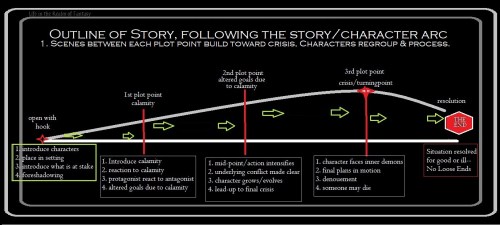
Screen writers have it right, so the layout of my outline is divided into acts and beats, with a brief description. So, how do we approach this little task? First, NaNoWriMo says 50,000 words is a novel. How long do you think yours might be? Divide it into manageable chunks.

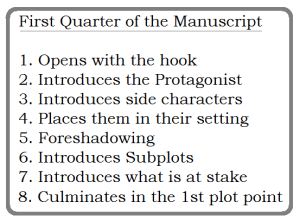
Act One – not more than 25% of total words: Where does the inciting incident occur?

  • Opening scene–characters in “normal” environment–/ Hook
  1. Introduce the characters. In your outline, ask, “What does each desire?” List each character and make a note of what they want at the beginning, what stands in their way at the middle, and what they get at the end.
  2. Foreshadow the incident that takes them out of their normal environment.
  • Inciting Incidentthe event that changes everything.
  1. characters are thrown out of “normal” and into new circumstances.
  • Things start to get crazy.
  1. Characters react to the inciting incident.
  2. Characters try to get control of the situation and fail.
  3. Characters regroup. They must continue, but what are they willing to risk?

Act Two takes up 50% of the novel—it is the second quarter and third quarter combined.

  • Pinch Point #1—a dangerous situation orchestrated by the antagonist.
  1. The antagonist applies pressure to your character. This demonstrates the threat presented by the antagonist and forces your character into action.
  • Midpoint
  1. Regroup, process what just happened, plan to achieve the goal. What is happening at the midpoint? Are the events of the middle section fraught with uncertainty but still moving the protagonist toward their goal? If not, cut them and insert events that propel the story forward.
  2. Move toward the next encounter.
  • Pinch Point #2—Calamity. When and where does this occur?
  1. The protagonist is thwarted and may not win the goal after all.
  2. How are their attempts to achieve the goal frustrated?
  3. Someone dear may die.
  • Crisis of faith
  1. The costs of the battle are weighed against what is gained.
  2. Faith is restored, plans are laid for next encounter

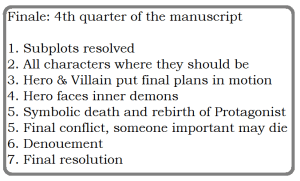
Act Three, the final 25% of the novel:

  • Climax
  1. The protagonist faces the antagonist, and the battle is on.
  • Final resolution
  1. The protagonist wins, but at what cost?
  2. Do they achieve the original goal in the end, or do their desires evolve away from that goal as the story progresses?
  3. All threads are wound up, and the book has a finite ending (NOT a cliff hanger if you are an unknown author, even if a book two is planned).

Sit down with a notebook (or if you’re like me, and Excel spreadsheet) and make a list of what events must happen in each “act.” In my outline, each chapter has a brief description of what I think will occur in each scene, such as:

Chapters 15 – 22

15 Aeddie sick – Mendric can’t heal his heart-take him to Hemsteck
16 Three days into the journey Elgar and Raj battle Thunder lizard
17 Star stone falls outside Waterston
18 Aeddie sick, nearly dies, Mendric nearly burns out gift keeping him alive
19 South of Kyran, water wraith
20 North of Kyran, a mob attack
21 Nola – inn
22 Maldon, highwaymen, and William

>>><<<

If I take the time to note all of my changes to the story line, I have a guide showing me what those changes were. I can make sure the events are foreshadowed logically and don’t appear to be a clumsy Deus Ex Machina. (Pronounced: Day-us ex Mah-kee-nah.) (God from the Machine.)

That means a plot twist that is pulled seemingly out of nowhere and used to miraculously resolve an issue. Miraculous is the key word. If you rely on this, your plot will be unbelievable.

What is the underlying theme? How does this theme affect every aspect of the protagonists’ evolution in this story? (See my post: The interpretive layer of the word-pond: Theme.)

When you assemble your outline, ask yourself these questions:

  • What will be your inciting incident? How does it relate to the theme?
  • What is the goal/objective? How does it relate to the theme?
  • At the beginning of the story, what could the hero possibly want to cause him to risk everything to acquire it?
  • How badly does he want it, and why?
  • Who is the antagonist?
  • What moral (or immoral) choice is the protagonist going to have to make in his attempt to gain that objective?
  • What happens at the first pinch point?
  • In what condition do we find the group at the midpoint?
  • Why does the antagonist have the upper hand? What happens at the turning point to change everything for the worse?
  • At the ¾ point, your protagonist should have gathered his resources and companions and should be ready to face the antagonist. How will you choreograph that meeting?

I always feel it’s necessary to have an outline of the story arc even if my novel has multiple possibilities for endings. Winging it in short bursts can be exhilarating, but my years of experience with NaNoWriMo have taught me that winging it for extended lengths of time means I might run out of fresh ideas of what to do next.

If you begin with a simple outline, you won’t become desperate at the halfway point and resort to killing off characters just to stir things up. Many times, someone must die to advance the plot or fire up the protagonist, but readers get angry with authors who kill off too many characters they have grown to like.

Besides, you might need that character later. Bringing them back from the dead is a whole different Deus Ex Machina.

3 Comments

Filed under writing

Devising a Plot in 8 Questions #NaNoWriMo2019 #amwriting

Sometimes I have these random ideas and think, “Wow! What a great idea for a story – if I had the time to write it.” I keep a document pinned to my desktop, one that I write down topics and ideas for stories on.

Good news! November is National Novel Writing Month, and that’s the time to pick one of those ideas and build the first draft of a novel.

Let’s say one of the plot ideas is for a pair of characters who are thieves-for-hire, set in an alternate renaissance reality.

I will list eight questions: the basic premise of the story will be answered in these eight questions.

Each answer is simply one or two lines, guideposts for when I draft the outline (next post).

1. Who are the players? Pip and Scuttle. Two orphaned brothers who grew up on the streets of Venetta, a medieval city, but who have a strong moral code. Now adults, they have become what is known as “Discreet Thieves,” professional retrievers-for-hire who reunite their clients with their lost or stolen valuables.

2. Who is the POV character? Scuttle, the older brother.

3. Where does the story open? In a pawn shop.

4. What does the protagonist have to say about their story? Scuttle swears they aren’t thieves. They are believers in God and the laws of the Church. They only retrieve items belonging to noble clients with impeccable reputations and do it with no fuss or drama.

5. How did they arrive at the point of no return? A highly placed Cardinal has hired them to retrieve an item, neglecting to tell them:

  • It is equipped with a curse that affects all who would steal it from the rightful owner. (Haven’t figured out what the curse is yet.)
  • It didn’t belong to him in the first place.
  • He intends to use it to depose the true Pope, and become the ruler of both the Church and Venetta.

6. What do they want and what are they willing to do to get it? They will do anything to get the curse removed from themselves and prevent the evil Cardinal from using the object against the Good Pope.

7. What hinders them? The Cardinal has kidnapped Mari, Scuttle’s lady, and holds her in his dungeon, forcing Scuttle to do his bidding.

8. How does the story end? Not sure. Is there more than one way this could go? Yes, so I’ll list them as they occur to me.

Even if I choose not to outline, the answers to those questions make writing a novel go faster because I know what happened, what the goal is, and why the goal is difficult to achieve. I may not know how the story ends exactly, but I will by the time I get there.

At the beginning of the story, what does our protagonist want that causes them to risk everything to acquire it? How badly do they want it, and why? The answer to that question must be that they want whatever it is desperately. In this case, Scuttle wants his lady released from the Cardinal’s dungeon. He’s terrified that she’s being abused, and fears she’ll die before he can rescue her.

Question number six is an important question to consider. What moral (or immoral) choice is the protagonist going to have to make in their attempt to overcome the odds and achieve their objective? Will Scuttle be forced to become a spy for the cardinal? Will he be pushed to sell out Pip? I don’t know yet, exactly. This is a spot where I can write the outcome in several different ways.

Many final objectives don’t concern issues of morality. However, if you are writing genre fiction, all final objectives should have consequences and should involve a struggle.

The answer to question number seven is vitally important because the story hinges on how the protagonist overcomes adversity. What hinders them? Is there an antagonist? If so, who are they, and why are they the villain of the piece?

Answering question eight is crucial if I want to have a complete novel with a beginning, middle and end by the 30th of November. Endings are frequently difficult to write because I can see so many different outcomes. Because it is NaNoWriMo, and every new word I write counts toward my goal, I write as many endings as I need to.

This is where making use of scene breaks can be your friend. In the NANoWriMo manuscript, I simply head that section (in bolded font) with the words Possible Ending 1 or 2, or however many endings I have come up with.

In the next blog post, we will take these eight questions and draft a loose outline for our novel. I say loose because nothing I write ever follows the original outline.

Writing is like the art of the sculptor; we sculpt and reshape the story as we go.

The finished piece looks nothing like the block of stone we carved it from.


Credits and Attributions:

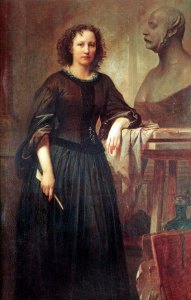
Portrait of German-American sculptor Elisabeth Ney with a bust of King George V of Hanover, 1860, by Friedrich Kaulbach. PD|100. Wikimedia Commons contributors, “File:Elisabeth Ney by Friedrich Kaulbach.jpg,” Wikimedia Commons, the free media repository, https://commons.wikimedia.org/w/index.php?title=File:Elisabeth_Ney_by_Friedrich_Kaulbach.jpg&oldid=286953027 (accessed November 27, 2018).


3 Comments

Filed under writing

#FineArtFriday: Portrait of a Lady by the workshop of Sandro Botticelli ca. 1480

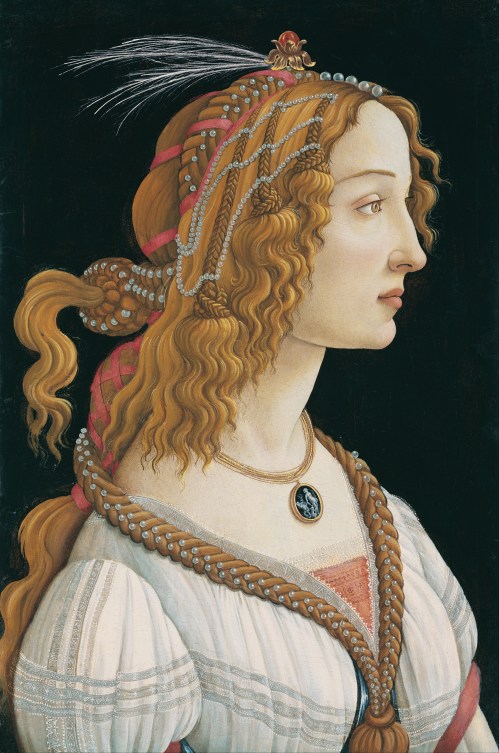
  • Artist: Workshop of Sandro Botticelli  (1445–1510)
  • Title: Idealized Portrait of a Lady (Portrait of Simonetta Vespucci as Nymph)
  • Genre: portrait
  • Date: circa 1480
  • Medium: tempera on wood
  • Dimensions: Height: 82 cm (32.2 ″); Width: 54 cm (21.2 ″)

About Portrait of a young woman, possibly Simonetta Vespucci, 1484:

The Roman engraved gem on her necklace was owned by Lorenzo de’ Medici. It is suggested that in Quatrocento paintings, hair and water are related. Certainly, the waves of her hair seem to suggest water.

Ronald Lightbown, author of Botticelli: Life and Works claims it is  a creation of Botticelli’s workshop and was likely neither drawn nor painted exclusively by Botticelli himself. He also reminds us that the model’s identity can’t be confirmed; that Botticell’s workshop most likely executed fancy portraits of idealized beauties, rather than real ladies.

About the Artist, via Wikipedia:

Alessandro di Mariano di Vanni Filipepi (c. 1445[1] – May 17, 1510), known as Sandro Botticelli (/ˌbɒtɪˈtʃɛli/, Italian: [ˈsandro bottiˈtʃɛlli]), was an Italian painter of the Early Renaissance. He belonged to the Florentine School under the patronage of Lorenzo de’ Medici, a movement that Giorgio Vasari would characterize less than a hundred years later in his Vita of Botticelli as a “golden age“. Botticelli’s posthumous reputation suffered until the late 19th century; since then, his work has been seen to represent the linear grace of Early Renaissance painting


Credits and Attributions:

Wikipedia contributors, “Sandro Botticelli,” Wikipedia, The Free Encyclopedia, https://en.wikipedia.org/w/index.php?title=Sandro_Botticelli&oldid=916319613 (accessed October 4, 2019).

1 Comment

Filed under #FineArtFriday