#FineArtFriday: Frost Fair on the River Thames near the Temple Stairs, by Thomas Wyke

Today I’m revisiting a painting, Frost Fair on the River Thames near the Temple Stairs. by Thomas Wijck (also Thomas Wijk, or Thomas Wyck; 1616–1677). He  was a Dutch painter of port views and genre paintings. This painting details a moment in history, the winter of 1686-1684, as seen though the eyes of one who lived it. I first published this post in January of 2018.

About the Artist, via Wikipedia:

Wijck was born into an artist family and received his training from his father. He journeyed to Italy, presumably by 1640, the year in which a ‘Tommaso fiammingo, pittore’ (Thomas the Fleming, painter) is documented as residing in Rome in the Via della Fontanella. Although this evidence of his residence in Rome around this time has been questioned,[1] a number of his pictures depict scenes in and around Rome which would indicate a visit to the city at some point.[2] He also resided in the environs of Naples, where he executed many sketches which he subsequently worked up into drawings of coast views.[3]

In 1642 Wijck returned to the northern Netherlands, where he became a member of the Haarlem Guild of St. Luke.[1] In 1660 he was appointed Dean of the Haarlem Guild.

He went to England about the time of the Restoration and was much employed. He was followed there by his son and pupil Jan Wyck, who remained in Britain for the rest of his career and played an important role in the development of English sporting painting. Thomas Wyck was also the teacher of the Haarlem painter Jan van der Vaart, who later also immigrated to England.

He died in Haarlem in August 1677. Pieter Mulier II was a follower of his style.

What I love about this painting:

Everywhere you look you see color. Red wheels on a cart, red tents, blue tents, and yellow–color is everywhere. We sometimes think of the 17th century as a dark colorless time, but clearly it was not. People were much the same then as they are today. We love to have fun and will find a way to enjoy ourselves even in the harshest conditions.

And winters during that time were harsh. Fuel for heating and cooking was expensive, food was expensive, and many people died from the cold and starvation.

Quoted from Wikipedia: During the Great Frost of 1683–84, the worst frost recorded in England, the Thames was completely frozen for two months, with the ice reaching a thickness of 11 inches (28 cm) in London. Solid ice was reported extending for miles off the coasts of the southern North Sea (England, France and the Low Countries), causing severe problems for shipping and preventing the use of many harbours. Near Manchester, the ground was frozen to 27 inches (69 cm), in Somerset, to more than 4 feet (1.2 m).

In the pedestrian tunnel under the south bank of Southwark Bridge, there is an engraving by Southwark sculptor Richard Kindersley, made of five slabs of grey slate, depicting the frost fair.[19]

The frieze contains an inscription that reads (two lines per slab):

Behold the Liquid Thames frozen o’re,
That lately Ships of mighty Burthen bore
The Watermen for want of Rowing Boats
Make use of Booths to get their Pence & Groats
Here you may see beef roasted on the spit
And for your money you may taste a bit
There you may print your name, tho cannot write
Cause num’d with cold: tis done with great delight
And lay it by that ages yet to come
May see what things upon the ice were done

The inscription is based on handbills,[20] printed on the Thames during the frost fairs.


Credits and Attributions:

Wikipedia contributors, “Thomas Wijck,” Wikipedia, The Free Encyclopedia, https://en.wikipedia.org/w/index.php?title=Thomas_Wijck&oldid=913753600 (accessed February 7, 2020).

#FineArtFriday: Frost Fair on the River Thames near the Temple Stairs, by Thomas Wyke was first published here on Life in the Realm of Fantasy on January 20, 2018.

Wikipedia contributors, “River Thames frost fairs,” Wikipedia, The Free Encyclopedia, https://en.wikipedia.org/w/index.php?title=River_Thames_frost_fairs&oldid=820904368 (accessed January 19, 2018).

Frost Fair on the River Thames near the Temple Stairs, by Thomas Wyke ca.1683-1684 via Wikimedia Commons (scan from FT magazine, 2007-09-30) [Public domain]

Comments Off on #FineArtFriday: Frost Fair on the River Thames near the Temple Stairs, by Thomas Wyke

Filed under #FineArtFriday

The Indie Cooperative #amwriting

In May of 2012, the indie publishing cooperative that I am a part of, Myrddin Publishing Group, was formed. As a group, we originally met through a now-defunct literary contest. We have members all across the US, the UK, and Australia.

The way we communicate is through a private group page on Facebook. We numbered twenty-five when we first began, and while we have lost a few members to traditional publishers, we have also gained a few.

Membership in our group is closed at this time. We don’t seek new authors, and as a company, we do not control any author’s royalties.

Each of us is an indie, in that all funds earned by our books go directly to the author from the point of sale.

That storefront could be Amazon, Kobo, Smashwords, Barnes & Noble, Books2Read (Draft2Digital’s storefront), or Ingram Sparks. The individual author uploads their books to the sales outlet of their choice.

I publish through both Amazon KDP and Draft2Digital. Amazon is the big kid on the block, and so far, I’m satisfied with their print book services. Some in my group use Amazon KDP for print, and others use Ingram Sparks for their print books.

Draft2Digital partners with a wide variety of digital storefronts, including Bibliotheca, which gets my books into libraries around the world.

Each member author has sole responsibility for their book. They must pay any local or federal taxes owed on their royalties and are responsible for marketing their own work.

The publishing co-op model we use is quite simple. We pay $25.00 a year to be a member.

One of our members lives in Wales, and her husband is employed in internet security. She manages the website and he is our IT man.

  • Each member author is each responsible for creating their own author page on the website, listing their books, and keeping their author page updated.

We have a nominal leader since every group needs a person in charge. She manages our tiny bank account and makes a full report of how the money was spent every year. Usually, our funds are spent on services the group can use and benefit from.

For us, the main benefit is low cost ISBNs that are not provided by Amazon KDP. Some people don’t mind using Amazon’s ISBNs, but we like having our own.

When we first started in 2012, we bought 1000 ISBNs. A member who is a retired bookkeeper in Essex, England, manages those for us.

In 2012 those ISBNs cost us $1000.00, and we divided up the costs ($40.00 for each of us). I believe the cost for ISBNs has doubled since then, but don’t quote me on that.

All our financial transactions are through the Myrddin PayPal account to our leader, and each Myrddin member can ransom back the  requisite number of ISBNs (Kindle, Draft2Digital, and Print, etc.) for $1.00 each.

We have enough ISBN’s for all of us to create books for many years to come.

  • We trade services within the group.

Several of us will edit or beta-read as needed. I and several other members do book covers, digital maps, banners, bookmarks, and logos as needed.

There are some things to consider before you start your own publishing cooperative:

  • Member participation is what makes the group functional.

Not every member will be an active participant. As time goes on, you may find yourself doing more work than you want and getting little in return from some.

  • At the outset, the group should develop and vote on a list of member responsibilities ( a group charter).

This list should detail what sort of behavior is expected or discouraged in online interactions.

That charter should also explain clearly what the group will do for its member authors, and how membership is obtained.

You will need two Facebook pages. One should be private for group discussions. The other should be public for posting entertainment pieces, such as memes that relate to writing and books.

  • The public page is where book launches can be advertised.
  • Also, the public FB page is where you publicize information about events individual member authors will be at or forthcoming book releases.

I suggest that you have two or three people in charge of posting things on the Public Facebook page and several other people in charge of your group’s Twitter and or Instagram account.

  • Someone with good bookkeeping skills should act as a financial officer.

This person manages any funds generated by member dues or anthologies and pays for the group’s website hosting.

  • The financial officer should have two assistants to review the financial records and ensure transparency.

Financial reports should be posted regularly, so the member authors know how the group is doing. The assistants should be authorized to step in if the financial officer is unable to fulfill their duties for any reason.

  • All decisions should be voted on by the group.

When things need to be discussed that affect the group as a whole, my co-op will hold a “meeting thread” over the course of a week on our private FB group page. That is where we decide what we want to do with the fee-money.

  • Google any publishing names you might want to use before you settle on one.

Don’t choose a name that is already in use as it may be trademarked. Be unique and be clever, but be careful.

Editing, beta reading, proofreading—these services are why a co-op is a good thing and should be traded freely.

Some members may have skills in graphic design and will design book covers, or logos.

  • You must be able to politely express that you can’t use a service, such as a cover design you don’t like. At that point, be prepared to quietly seek and pay for professional services outside the group.

Remember, all of these are time-consuming services. When you trade services, those who provide them for you are not earning money. Be gentle with those who are helping you.

I can’t stress this enough: Even if you don’t use a service that a fellow member offers to you, be a good friend. Give back to the group and help them when it’s their turn to seek services and help.

There will sometimes be rough patches in the group’s overall Zen.

I mentioned that each member of our co-op is responsible for listing their own books on the website and keeping their author page updated.

Sometimes we have problems with people who are less website savvy not being able to figure out how to update their books on the website.

Also, people get sidetracked by life and forget what they’re supposed to do for the group.

Those are minor irritations.

Overall, I have found this publishing model to be the best fit for me. I write short stories and submit to traditional publications, but I prefer to go indie for my novels.

As group, Myrddin certainly doesn’t have all the answers. We have evolved more independently than from where we began, but we are all still good friends. This is not a one-size-fits all kind of thing.

Use the internet and research other small press models.

If you are considering forming an indie publishing cooperative, I hope this has answered some questions you might have had.

Comments Off on The Indie Cooperative #amwriting

Filed under writing

The path to becoming an author #amwriting

People often say they want to write a book. I used to say that too.

In 1985 I came across my first stumbling block on my path to becoming a writer. I didn’t know it, but to go from dreamer to storyteller is easy. Anyone can do it.

But if we choose to become an author, we’re taking a walk through an unknown landscape.

And the place where we go from dreamer to storyteller to author is the hardest part.

At first the path is gentle and easy to walk. As children, we invent stories and tell them to ourselves. As adults, we daydream about the stories we want to read, and we tell them to ourselves.

That part of the walk is easy. At some point, we become brave enough to sit down and put the story on paper.

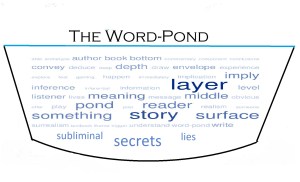
The blank screen or paper is like an empty pond. All we have to do is add words, and the story will tell itself.

The first impedance that would-be authors come to on their way to filling the word-pond with words is a wide, deep river. It’s running high and fast with a flood of “what ifs” and partially visualized ideas.

If you truly want to become a writer, you must cross this river. If you don’t, the path ends here. While this river flows into the word-pond, the real path that takes us to a finished story is on the other side of this stream.

Fortunately, the river has several widely spaced steppingstones. Landing squarely on each one requires effort and a leap of faith, but the determined writer can do it.

The last thing you do before you step off the bank and begin crossing that river is this: visualize what your story is about.

The first stone you must leap to is the most difficult to reach. It is the one most writers who remain only dreamers falter at:

  • You must give yourself permission to write.

We have this perception that it is selfish to spend a portion of our free time writing. It is not self-indulgent. We all must earn a living because very few writers are able to live on their royalties. If writing is your true craft, you must carve the time around your day job to do it. All you need is one undisturbed hour a day.

The second stone is an easy leap:

  • Become literate. Educate yourself.

Buy books on the craft of writing. Buy and use the Chicago Manual of Style. You can usually find used copies on Amazon for around $10 – $15, passed on by those who couldn’t quite make the first leap.

I freely admit to using the internet for research, often on a daily basis, and I buy eBooks. However, my office bookshelves are filled with reference books on the craft of writing. I buy them as paper books because I am always looking things up. The Chicago Manual of Style is one of the most well-worn there.

Most professional editors rely on the CMOS because it’s the most comprehensive style guide—it has the answer for whatever your grammar question is. Best of all, it’s geared for writers of all streaks: essays, novels, all varieties of fiction, and nonfiction.

The third stone is the reason we decided to write in the first place:

  • Good writers never stop reading for pleasure.

We begin as avid readers. A book resonates with us, makes us buy the whole series, and we never want to leave that world.

We soon learn that books like that are few and far between.

The fourth stone is an easy leap from that:

  • We realize that we must write the book we want to read.

As we reach the far bank, we climb up and across the final hurdle:

  • We finish the work, whether it’s a novel or short story.

Over the years since I first began writing, I’ve labored under many misconceptions. It was a shock to me when I discovered that we who write aren’t really special.

Who knew?

We’re extremely common, as ordinary as programmers and software engineers. Everyone either wants to be a writer, is a writer, has a writer in the the family, or knows one.

Even my literary idols aren’t superhuman.

Because there are so many of us, it’s difficult to stand out. We must be highly professional, easy to work with, and literate.

Filling the pond with words and creating a story that hooks a reader is as easy as daydreaming and as difficult as giving birth.

Because writers are so numerous, every idea has been done. Popular tropes soon become stale and fall out of fashion.

A study by the University of Vermont says there are “six core trajectories which form the building blocks of complex narratives.” These are:

  1. Rags to riches (protagonist starts low and rises in happiness)
  2. Tragedy, or riches to rags (protagonist starts high and falls in happiness)
  3. Man in a hole (fall–rise)
  4. Icarus (rise–fall)
  5. Cinderella (rise–fall–rise)
  6. Oedipus” (fall–rise–fall)

No stale idea has ever been done your way.

We give that idea some thought. We apply a thick layer of our own brand of “what if.”

It’s our different approaches to these stories that make us each unique.

Sure, we’re writing an old story. But with a fresh angle, perseverance, and sheer hard work, we might be able to sell it.

And that is what makes the effort and agony of getting that book published and into the hands of prospective readers worthwhile.

16 Comments

Filed under writing

#FineArtFriday: Belshazzar’s Feast by Rembrandt ca. 1635-1638

Artist:  Rembrandt  (1606–1669):Rembrandt Harmenszoon van Rijn

Title:   Belshazzar’s Feast

Genre: religious art (history painting)

Description: According to Daniel 5:1-31, King Belshazzar of Babylon takes sacred golden and silver vessels from the Jewish Temple in Jerusalem by his predecessor Nebuchadnezzar. Using these holy items, the King and his court praise ‘the gods of gold and silver, bronze, iron, wood, and stone’. Immediately, the disembodied fingers of a human hand appear and write on the wall of the royal palace the words “MENE”, “MENE”, “TEKEL”, “UPHARSIN”

Depicted people: Belshazzar

Date: circa 1635-1638

Medium: oil on canvas

Dimensions: Height: 167.6 cm (65.9″); Width: 209.2 cm (82.3″)

Collection: National Gallery


What I love about this painting:

Rembrandt went to a great deal of expense and trouble to paint what he hoped would be seen as a masterpiece. He wanted to be a history painter, as that is where the fame was in his time. While the money was in portraits, Rembrandt also wanted fame. We know this painting was painted before his wife Saskia’s illnesses  and death in 1642, because she was the model for woman behind Belshazzar. She is depicted as being terrified by what is being written on the wall.

Every detail is there, from the finely worked golden ornaments and crown in Belshazzar’s headdress to the king’s golden earring in the shape of a crescent moon. His garments are covered in delicate embroideries in gold thread and sewn with pearls and beads of jet. The garments and jewelry of all the diners are rich and sumptuous; they too wear golden jewelry, with pearls and beads of jet. The shock of the diners, the combination of fear and indignation of the king at the appearance of the hand—these emotions are depicted as perfectly as are the extravagant garments.

About this painting, Via Wikpedia:

Rembrandt’s handling of painting materials and his painting technique in Belshazzar’s Feast are both exceptional and do not compare to any of his other works. The palette of this painting is unusually rich encompassing such pigments as vermilionsmaltlead-tin-yellowyellow and red lakesochres and azurite.


About the story, via Wikipedia:

Belshazzar’s feast, or the story of the writing on the wall (chapter 5 in the Book of Daniel) The story of Belshazzar and the writing on the wall originates in the Old Testament Book of Daniel. The Babylonian king Nebuchadnezzar looted the Temple in Jerusalem and has stolen the sacred artefacts such as golden cups. His son Belshazzar used these cups for a great feast where the hand of God appeared and wrote the inscription on the wall prophesying the downfall of Belshazzar’s reign. The text on the wall says “mene, mene, tekel, upharsin“. Biblical scholars interpret this to mean “God has numbered the days of your kingdom and brought it to an end; you have been weighed in the balances and found wanting; your kingdom is given to the Medes and Persians”.

The inscription on the wall is an interesting element in this painting. Rembrandt lived in the Jewish Quarter of Amsterdam and “derived the form of Hebrew inscription from a book by his friend, the learned Rabbi and printer, Menasseh ben Israel, yet mis-transcribed one of the characters and arranged them in columns, rather than right to left, as Hebrew is written.” This last detail is essential as it relates to the question of why Belshazzar and his advisers were not able to decipher the inscription and had to send for Daniel to help them with it.

The biblical story does not identify the language of the cryptic message, but it is generally assumed to be Aramaic, which, like Hebrew, is written in right-to-left rows, and not in right-to-left columns as in the painting. Although there is no accepted explanation why the Babylonian priests were unable to decipher the writing, the point of this unconventional arrangement – reading the text in the painting in the conventional row-wise left-to-right order results in a garbled message – may be to suggest why the text proved incomprehensible to the Babylonian wise men; indeed, this explanation is in accordance with the opinion of the amora Shmuel, which is mentioned in the Babylonian TalmudTractate Sanhedrin, 22a, among various dissenting views.


Sources and Attributions:

Belshazzar’s Feast by Rembrandt PD|100 via Wikimedia Commons. Wikimedia Commons contributors, “File:Rembrandt-Belsazar.jpg,” Wikimedia Commons, the free media repository, https://commons.wikimedia.org/w/index.php?title=File:Rembrandt-Belsazar.jpg&oldid=363468240 (accessed January 31, 2020).

Wikipedia contributors, ‘Belshazzar’s Feast (Rembrandt)’, Wikipedia, The Free Encyclopedia, 17 January 2020, 09:24 UTC, <https://en.wikipedia.org/w/index.php?title=Belshazzar%27s_Feast_(Rembrandt)&oldid=936202396> [accessed 31 January 2020]

2 Comments

Filed under #FineArtFriday

Transitions and Point of View #amwriting

I had to quit reading a book published by a Big Six publisher last week, as the narrative was a little too confusing. The head-hopping was too much and I didn’t want to waste time trying to sort it out.

Head-hopping: an author switches point of view characters within a single scene or even a paragraph. This can be quite confusing, like watching an unbalanced tennis match.

The problem could have been resolved in the revision process if the author had an editor’s eye on their work prior to publication, which I doubt they did.

Point of view must be consistent throughout the narrative but doesn’t have to be solely that of one character. However, it should only be shown from one character at a time.

In my own work, each of the major players has a story. Sometimes they have something to say that advances the story, so yes, the narrative switches to a different character. I give them a separate chapter so there is no doubt about who is speaking.

Also, I limit the number of characters who are allowed to speak to the reader.

In many of my favorite novels, the aftermath of an action scene becomes an opportunity to show the antagonist’s story line through their eyes. That’s a good strategy, as we need to show why the enemy is the enemy.

When shifting point of view from one character to another, the points where you change from one scene to the next are crucial to the story.

These are transitions.

Good transitions make a well-paced narrative, a piece that has a kind of rhythm.

  1. processing the action,
  2. action again,
  3. another connecting/regrouping scene

Regrouping scenes make logical transition scenes. These are opportunities to move the plot forward through conversation or introspection.

These transitions allow the reader to process what just happened at the same time as the characters do. This is where we justify the events that just occurred, making them believable.

Transitions are also opportunities to ratchet up the tension.

Unfortunately, these are also places where it is easy to accidentally jump into the headspace of a  different point of view character.

For this reason, in the revision process, it’s important to pay attention to who is talking and make sure we are only in their head for the entire scene.

One useful kind of transition is introspection. It offers an opportunity, a brief segue in which new information important to the story can emerge.

  1. Introspection also allows the reader to see who the characters think they are. This is critical if you want the reader to bond with them.
  2. Introspection shows that the characters are self-aware.

I do suggest you keep the scenes of introspection brief. If you use italics to set thoughts off, I would consider not having your characters do too much “thinking.” A wall of italics is hard to read, and we want the reader to stay with the story.

Characters’ thoughts are like conversations. They must be purposeful and serve to illuminate motives at a particular moment in time. Idle thoughts waste time and bore readers.

So, in a conversation between two characters, introspection must offer information not previously discussed.

Something else to consider—internal monologues should not make our characters seem too wise and all knowing. If you show them as a bit clueless about their flaws, strengths, or even their deepest fears and goals, you make them seem more approachable, real, and human.

I do recommend that each character should speak uniquely. Small habits and things make them individuals. I’ve seen books were the author dumped the conversations into a blender and poured out a string of commentary that made everyone sound alike.

Without speech tags, it was impossible to tell who was talking.

In regard to speech tags—please don’t get fancy. It’s best for me as a reader when the author avoids obscure words that take me out of the narrative. You want them to blend in and go unnoticed because the information imparted in the conversation is the important thing.

We want to create a sense of intimacy, of being in the character’s head. One way to do that is to use stream of consciousness, a narrative mode that offers a first-person perspective by showing the thought processes of the narrative character, along with their actions and conversations.

Wikipedia says: Stream of consciousness is a narrative device that attempts to give the written equivalent of the character’s thought processes, either in a loose interior monologue or in connection to his or her actions. Stream-of-consciousness writing is usually regarded as a special form of interior monologue and is characterized by associative leaps in thought and lack of some or all punctuation.

This is a difficult device to do well. It is why James Joyce’s work is a difficult read for most people. The only time I have used it was in a writing class.

I sometimes use the first-person point of view to convey intimacy. With the first-person point of view, a story is revealed through the thoughts and actions of the protagonist within his or her own story.

I use this point of view most often in short stories and find it easy to write.

I usually write my longer work in a third person omniscient voice. In that mode, the  story is told from an outside, overarching point of view. The narrator sees and knows everything that happens within the world of the story, including what each of the characters is thinking and feeling.

A way to convey intimacy when writing in third person omniscient is to use the third-person subjective. This mode is also referred to as close 3rd person.

I like this mode and frequently use it. At its narrowest and most subjective, the story reads as though the viewpoint character were narrating it. This is comparable to the first person in that it allows an in-depth revelation of the protagonist’s personality but differs as it always uses third-person grammar.

It is easy for me as a reader to form a deep attachment to the protagonist when a story is written in this mode. This is also a good way to avoid the first draft curse of “head hopping.”

In the revision process, we work to ensure consistency in our narrative mode, especially in regard to point of view. Making good revisions can actually take longer to complete than writing the first draft did.

But the reward is a smooth narrative, which is worth putting out extra effort.


Credits and Attributions:

Wikipedia contributors, “Stream of consciousness,” Wikipedia, The Free Encyclopedia, https://en.wikipedia.org/w/index.php?title=Stream_of_consciousness&oldid=934342441 (accessed January 28, 2020).

5 Comments

Filed under writing

Hair and there #amwriting

I began reading a new book while I was traveling over the weekend. It came with a lot of hype from the big bookseller in the sky: “the book grown-up Harry Potter fans can’t put down.” So far, I’m not finding it anywhere near as engrossing as Harry Potter. What with all the propaganda, my expectations are probably too high. I’m going to keep reading because it’s not completely deadly—it’s just not “all that and more.”

Also, I am beta reading for a friend out in Wyoming, and I must say, his book is quite good.

Formatting on my new book has had some false starts and hiccups, but that’s the life of an indie. I’m going to go to Draft2Digital from now on for eBook and mobi formatting. I saw that they also offer paper book formatting (at no cost) in all the same sizes that Create Space used to offer, so I will let you know how that goes and how it looks.

Work continues on both novels and several short stories. My creative brain is working again, joy of joys. I think I had a hard case of the “Post NaNoWriMo Brain Freeze” that others have talked about, but I had never experienced before.

Last week was a busy week for me. I drove 3 hours north to Snohomish, where my oldest daughter lives. She is a hair stylist with her own business at Fresh Salon and Spa. Salons like that provide all the necessary furnishings and amenities for a high end salon, by renting space to several licensed cosmetologists who each own their own business.

Each stylist pays a monthly rent to the shop’s owner, which helps her cover the utilities and other onsite costs for owning and operating such a large, upscale salon. By leasing chairs, the owner has motivated stylists at her shop whose clients bring in many new customers.

Leah has all the normal costs of owning and operating a small business. She purchases her own supplies and is responsible for paying both state and federal taxes on her earnings, as does any small business owner. By “renting a chair” at Fresh, she has the benefit of a receptionist, a good location, high end décor, and a much lower overhead than if she bought her own building.

Plus, it’s an exceedingly pleasant place to work.

Now the reason I bring this up is … you guessed it: hair.

When I was a worker bee in Corporate America, I kept my hair short and businesslike. It grows so fast that I had to get it cut every six weeks to keep it in shape.

When I retired, I quit worrying about it. Now I only cut it when it is so long that it’s annoying.

Which it has been, lately.

The last time I cut my hair was in 2017, and we cut twelve inches off.

This time, we cut fourteen inches off. And this time, I donated my hair to Wigs for Kids, a non-profit organization that donates wigs to children who have lost their hair due to burns, or cancer, or any number of traumatic, life altering events.

It was an involved process, as the picture shows, but we followed the instructions exactly so that what we donate will be usable when it arrives there.

My head feels five pounds lighter, and my heart feels good because I know a child will have a better day when they receive their wig.

But enough about my hair—let’s talk babysitting!

On Friday, Leah and I dressed in full combat gear and took on the tribe while my youngest daughter and her husband had a well-deserved weekend away without their three, exceptionally creative, sons.

Leah’s 13-year-old son helped as much as he could by trying to get them tired out, but the 7-year-old, a 3-year-old, and a 1-year-old—let’s just say we had a wild time wrangling small, rambunctious boys.

My hearing is starting to return, so it’s all good.

I love babysitting, but it’s so much easier when Leah and Logan are there to do the real work. (I laugh, but it’s true—my best skills as a grandma are snuggling clean, well-fed children and watching cartoons.)

So, the weekend was spent lightening the load on my head, playing with grandchildren, and generally having a great time. I watched many episodes of Scooby-Doo! Mystery Incorporated and Oddbods. Nothing but fine arts and entertainment!

Overall, the high point of the weekend was waking up to having my nose “booped” at 3 a.m. by a wide-awake one-year old who wanted to play.

So we did.

Life doesn’t get any better than that.


2 Comments

Filed under writing

#FineArtFriday: Home, Sweet Home by Winslow Homer 1863 (reprise)

I’m out of town this week, listening to the radio in car, and to audio books. War and peace seem to be hot topics… That brings to mind this iconic painting by Winslow Homer, an image that evokes profound emotion in me, even though I am viewing it 157 years later. I first posted this article in January 2018. Every time I view this painting, I find something new in the details.

The mud on their ragged uniforms, the can heating food in the cookfire, the plate in front of the tent–they are living and fighting in hellish conditions, doing the best they can despite the struggle.


Home, Sweet Home is one of the most famous paintings of the American Civil War, depicting a moment in time, painted by Winslow Homer. On opposite shores of the Rappahannock River, opposing armies are caught up in an awareness of brotherhood, as music becomes the medium that lays bare the humanity of the soldiers on both sides.

Winslow Homer was best known for his landscapes featuring the many moods of the ocean, but he also painted many iconic images of that turbulent time before, during, and after the American Civil War. His art captures a sense of familiarity, a feeling that the viewer knows these people and their stories intimately.

Wikipedia says, “Harper’s (magazine) sent Homer to the front lines of the American Civil War (1861–1865), where he sketched battle scenes and camp life, the quiet moments as well as the chaotic ones. His initial sketches were of the camp, commanders, and army of the famous Union officer, Major General George B. McClellan, at the banks of the Potomac River in October 1861.

“Although the drawings did not get much attention at the time, they mark Homer’s expanding skills from illustrator to painter. Like with his urban scenes, Homer also illustrated women during wartime, and showed the effects of the war on the home front. The war work was dangerous and exhausting. Back at his studio, Homer would regain his strength and re-focus his artistic vision. He set to work on a series of war-related paintings based on his sketches, among them Sharpshooter on Picket Duty (1862), Home, Sweet Home (1863), and Prisoners from the Front (1866). He exhibited paintings of these subjects every year at the National Academy of Design from 1863 to 1866. Home, Sweet Home was shown at the National Academy to particular critical acclaim; it was quickly sold and the artist was consequently elected an Associate Academician, then a full Academician in 1865.[10]”

The story behind the painting, Home, Sweet Home, is told poignantly in the autobiography, Reminiscences of a Private, by Frank Mixson, who served in the Confederate Army.

“The Yankee band would play the popular airs of theirs amid much yelling and cheering; our bands would do the same with the same result. Towards the wind-up the Yankee band struck up “Yankee Doodle.” Cheers were immense. When they stopped our band struck up “Dixie,” and everything went wild. When they finished this, both bands, with one accord and simultaneously, struck up “Home, Sweet Home.” There was not a sound from anywhere until the tune was finished and it then seemed as if everybody had gone crazy. I never saw anything to compare with it. Both sides were cheering, jumping up and throwing up hats and doing everything which tended to show enthusiasm. This lasted for at least a half hour. I do believe that had we not had the river between us that the two armies would have gone together and settled the war right there and then.”

Quote from: Reminiscences of a Private, by Frank Mixson (1910)


Sources and Attributions:

Home Sweet Home by Winslow Homer, © Connie J. Jasperson,  first appeared here on Life in the Realm of Fantasy on January 5th 2018. It has been dusted off and reposted for your viewing pleasure.

Wikipedia contributors, “Winslow Homer,” Wikipedia, The Free Encyclopedia, https://en.wikipedia.org/w/index.php?title=Winslow_Homer&oldid=817253575 (accessed January 4, 2018).

Home, Sweet Home: “Had we not had the river between us,” posted by Marek,  https://civilwarfolkmusic.com/2013/12/15/1862-home-sweet-home/ accessed 04 January 2018.

Reminiscences of a Private, by Frank Mixson (published 1910 by Columbia, S.C., The State Company)

Home, Sweet Home (oil on canvas) by Winslow Homer – circa 1863 | Winslow Homer [Public domain], via Wikimedia Commons, accessed 04 January 2018.

2 Comments

Filed under #FineArtFriday, writing

The creative process #amwriting

My writing projects all begin with an idea, a flash of “what if….” Sometimes, that “what if” is inspired by an idea for a character, or perhaps a setting. Maybe it was the idea for the plot that had my wheels turning.

When I have that flash of brilliance, I don’t want to lose that thought. I carry a notebook and several pens at all times because the batteries never fail. I can write myself a note anywhere, anytime.

I developed the habit of keeping a small pocket notebook on hand when I worked at a daytime job. No one knew I was writing a book, but all day long, little ideas would pop into my head and I would jot them on a notepad.

Fortunately, bookkeepers keep a lot of notes, so my writing things down was not out of place. If a boss had looked at my notes, they would have seen something like “Put the bodies in the trunk of the Jaguar,” which might have raised an eyebrow or two.

A lot of people nowadays use a note-taking app on their cellphone to take notes. However, doing that at work might be frowned on, as some places limit the time you spend on your cell phone.

Note-taking by hand is old-school but will enable you to discreetly write your ideas down, and you won’t appear to be distracted or off-task.

In my last post, I mentioned that for me, a broad outline of my intended story arc keeps me on track toward arriving at a good ending. Experience has shown that I work best when I have a specific goal to write to. That way, the story flows smoothly to the best conclusion.

It’s okay to have several possible endings in mind, as long as each fits logically when viewed with the events that led up to them.

The list of ideas is important as it keeps me focused on connecting the beginning of the story to a proper ending. Even with the outline, I’ve been known to write several different endings before I find the one that works best.

When I try to “wing it” all the way through writing a book, I usually end up with a mushy plot that wanders all over the place and a story I can’t sell.

That’s why I make outlines even for short stories. I ask myself

  • What is the inciting incident?
  • What is the goal/objective?
  • At the beginning of the story, what could the hero possibly want that pushes them to risk everything to acquire it?
  • How badly do they want it, and why?
  • Who is the antagonist?
  • Why are they the enemy?
  • What ethical choices will the protagonist have to make in their attempt to gain their objective?
  • What happens at the first pinch point?
  • In what circumstances do we find the group at the midpoint?
  • What is their health like?
  • Why does the antagonist have the upper hand? What happens at the midpoint to change everything for the worse?
  • At the ¾ point, the protagonist should have gathered plenty of resources and companions and should be ready to face the antagonist. Do I have the story set up correctly to this point so I can choreograph that meeting?

All stories must have a logical arc, but each character should too. It’s my job to make sure that the characters evolve and grow over the course of the story. For me and my style of writing, the character arcs benefit most from the outline, even more than the overall story arc does.

When you are winging it through a story that encompasses 75,000 to 100,000 words, it is easy to get involved in large info dumps and bunny trails to nowhere when you begin fleshing out your characters.

With the loose outline, I’m more likely to avoid getting sidetracked by interesting but nonessential stuff.

I would suggest you don’t go into too much detail in that little framework because you might feel like you have written the story, and there’s nothing left for you to say. You might lose interest in it. But if you give yourself a general outline that has the highpoints listed, you can wing it to connect the dots and you won’t lose your way.

I’ve said this before, but when you have a simple outline, you’re less likely to become desperate and resort to killing off characters just to stir things up once the real work of writing starts.

And you won’t have to kill off random characters and hide their bodies in the Jaguar’s trunk.


Credits and Attributions:

Wikimedia Commons contributors, “File:Notebooks.jpg,” Wikimedia Commons, the free media repository, https://commons.wikimedia.org/w/index.php?title=File:Notebooks.jpg&oldid=366931573 (accessed January 22, 2020).


Comments Off on The creative process #amwriting

Filed under writing

My writing life: magic and mayhem #amwriting

This last week I managed to get quite a lot of writing done—just not on the projects I had planned. I seem to be more in short story mode right now.

I had an idea for a short fantasy involving Gods and mortals, and that one is finished.

Then I had an idea for a post-apocalyptic tale of madness and murder, which is about halfway to the conclusion.

I am still reworking and rewriting the first draft of a novel set in my Tower of Bones world whenever I have a flash of brilliance.

Also, I am still working on devising a shocking-but-logical finale for my alternate Arthurian novel, Bleakbourne on Heath.

Many of you know that Bleakbourne began life in serialized form in 2015 on a now-defunct site called Edgewise Words Inn. It was written and published one episode a week.  I began with writing and publishing the first chapter only, and no idea where it was going to go after that.

It was a challenge, writing it in serial form and trying to turn out one installment a week.

At first, it all went well. However, at what would be the midpoint of the novel, the well of creativity ran dry. I had no clue as to what to do next. When that happened, once a week became twice a month.

I managed to squeeze four more installments out and then couldn’t think of how to write the final stand against Evil. On my writing group’s advice, I ended the serial on a happy note with a wedding but left a major thread dangling.

Cliffhanger endings aggravate readers who don’t want to wait a year for the rest of the story. I had to give my readers a reward for their faithfulness, and resolve most of the subplots. This is why I wound up most of the side threads and ended the Bleakbourne serial with a wedding.

This last December, I went back to edit and flesh out the first chapters and add a few that weren’t included in the original serial. In that process, I discovered that my subconscious mind had left several important clues that point me in the direction for the final confrontation.

I need to do some serious mind-wandering, and let this magic-flinging shindig roll around in my head a bit before I can write it.

Writing Bleakbourne as a serial and publishing it almost as soon as it left my head was a good experience. I had great input from readers, which was something I hadn’t expected.

It was also terribly difficult to keep on task and meet the publishing deadline. Making each installment readable took up far more time than I expected it would. I had no time to write anything else.

I discovered that, while I can write quickly if I have to, I don’t write well under the pressure of a weekly deadline.

For me, writing good endings is the most difficult part of writing. And in Bleakbourne,  so many possibilities presented themselves that I had no idea which way to end that unwieldy, complicated storyline.

That experience reinforced my need to write from an outline as a way of not getting stuck without a good finish. I may not stick to the outline but having a list of ideas gives me a jumping off point. Even with an outline I struggle to make every story’s finish logical, yet unexpected and memorable.

The final cataclysmic event must be a powerful emotional thing for the reader. Therefore, I have gone back and put more pressure on Merlin and Leryn in the earlier chapters.

The higher the emotional stakes when they meet Mordred for the final showdown, the more emotionally satisfying the final resolution will be for the reader.

This resolution will be final, with no loose threads.

2 Comments

Filed under writing

#FineArtFriday: Irene (poem)and The Coffee House, by Rita Greer 2008

The Coffee House


Portions of this post first appeared on Life in the Realm of Fantasy in 2015, as Flash Fiction Friday offering. The poem that follows, Irene, was written for a writer friend, a woman who moved to my Northwest town from Texas.

She participated in NaNoWriMo 2012, and we discovered we lived only a mile apart. Over the years she  became like a sister to me. Now, in 2020, one of her grandchildren has been hit with cancer, and she is temporarily relocating back to Texas to help care for him.

Believe me, she will be missed, as a neighbor, a dear friend, and as the heart and soul of my writing posse. My forthcoming novel, Julian Lackland, would still be languishing in limbo without her determined efforts over the last six years.

She and her husband quickly became members of our family, and no holiday will be the same with out them.


About this painting (quoted from Wikimedia Commons)

The original is an oil painting on board by Rita Greer, history painter, 2008. This was digitized by Rita and sent via email to the Department of Engineering Science, Oxford University, where it was subsequently uploaded to Wikimedia.

Coffee Houses played an important part in the social life of Robert Hooke. Only coffee and chocolate were served (no alcohol). Here news could be had, conversation, arguments, meetings, card games, wagers made, workmen could be paid, etc. (Hooke would sometimes carry out a scientific experiment in front of a coffee house audience as witnesses.) Hooke is shown writing (bottom left) at a table with people waiting to talk to him.

About the artist:

Rita Greer is a history artist, goldsmith, graphic designer, food scientist and author/writer. On retirement in 2003 Rita began the Robert Hooke project, “to put him back into history.”

According to Wikipedia: Much has been written about the unpleasant side of Hooke’s personality, starting with comments by his first biographer, Richard Waller, that Hooke was “in person, but despicable” and “melancholy, mistrustful, and jealous.” Waller’s comments influenced other writers for well over two centuries, so that a picture of Hooke as a disgruntled, selfish, anti-social curmudgeon dominates many older books and articles. For example, Arthur Berry said that Hooke “claimed credit for most of the scientific discoveries of the time.” Sullivan wrote that Hooke was “positively unscrupulous” and possessing an “uneasy apprehensive vanity” in dealings with Newton. Manuel used the phrase “cantankerous, envious, vengeful” in his description. More described Hooke having both a “cynical temperament” and a “caustic tongue.” Andrade was more sympathetic, but still used the adjectives “difficult”, “suspicious”, and “irritable” in describing Hooke.

Back-biting and jostling for position was a hobby among the divas of 17th century science, apparently. Little has changed in the world of academics, it seems.

I spend a large portion of my life in coffee houses too, writing and meeting with other writers, and artists. The friend who inspired the poem today was introduced to me in a coffee house in Olympia, on a dark November night in 2012. It was the kick-off meeting for NaNoWriMo that year.


Irene

I met you in a coffee shop.

Knitters and authors vied for tables

In a dark, polished, coffee-scented room.

Texas wit met Northwest irreverence

And the world was never the same.

A sisterhood built on words

And books

And commonalities.

We met as old ladies, too wise to raise much hell.

We’d have been dangerous

Had Austin met Olympia in the young, wild days.

It must have been divine intent

That our lives converged in the quiet years.

Sisterhood binds and unites us

Because family is more

Than marriage or blood.


Irene © Connie J. Jasperson 2015, All Rights Reserved

Portions of this post first appeared here on Life in the Realm of Fantasy on December 12, 2015.

The Coffee House by Rita Greer, history painter, 2008. Wikimedia Commons contributors, “File:10 The Coffee House.JPG,” Wikimedia Commons, the free media repository, https://commons.wikimedia.org/w/index.php?title=File:10_The_Coffee_House.JPG&oldid=304207824 (accessed January 16, 2020).

3 Comments

Filed under #FineArtFriday, writing