Tag Archives: 16th-century Flemish art

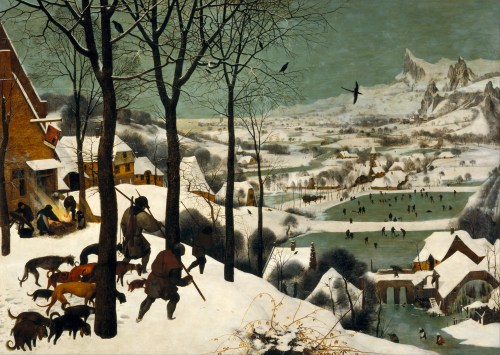
#FineArtFriday: allegory and symbolism in “Hunters in the Snow” by Pieter Brueghel the Elder 1565

Pieter_Bruegel_the_Elder_-_Hunters_in_the_Snow_(Winter)_-_Google_Art_ProjectArtist: Pieter Brueghel the Elder (1526/1530–1569)

Title: English: Hunters in the Snow (German: Jäger im Schnee) (Winter)

Date: 1565

Medium: oil on oak wood

Dimensions: height: 1,170 mm (46.06 in); width: 1,620 mm (63.77 in)

Collection: Kunsthistorisches Museum

What I love about this painting:

This is one of Pieter Brueghel the Elder’s most famous paintings and is a favorite of mine because of the rich societal commentary Brueghel painted into this scene.

Perhaps you have seen it at some point, on a calendar or a Christmas card, and after a cursory glance, you dismissed it as a bucolic illustration of a bygone era.

You fell for his trap. Bruegel the Elder was an observer of life and had a wide streak of sarcasm that emerged in his work. He lived in a time of extreme capitalism, where the nobility and the Church made the rules, with no regard for those whose labors had made them rich.

Brueghel was a master at slipping pointed observations into the scene in such a way that they go unnoticed if one can’t be bothered to look closely.

In his day, the fortunate few who were wealthy were gloriously, impossibly rich. Money was minted by the rulers in the form of coins, and trickle-down economics didn’t work then any better than it does now. The peasants struggled to find food and shelter, going underpaid and overworked.

The middle class hung on, doing comparatively well. However, all it took for the prosperous farmer to be reduced to starvation was one bad harvest. That bad harvest toppled the small traders and crafters as well. When the middle class can’t afford new shoes or garments, tailors and cobblers suffer as well.

Critics didn’t praise his work, as it is unabashedly primitive, created for the common person’s enjoyment, and art critics don’t care much about what the common folk like. Nonetheless, his work is still highly prized by collectors.

Brueghel had a sneaky sense of humor and employed it to show the truth about humanity and inhumanity in his work.

Even now, four centuries after his era, ordinary people can relate to his work because, underneath the technological advances that we will be remembered for, things haven’t changed that much. The uber-rich are still uber-rich, and the middle class is still footing the bill.

Brueghel lived during a time of religious revolution in the Netherlands, and walking the line between both factions must have been difficult. Some have said that Bruegel (and possibly his patron) were attempting to portray an ideal of what country life used to be or what they wished it to be.

That is because they didn’t look deeper, giving it a cursory glance and moving on. On the surface and from a distance, this is a bucolic scene depicting ordinary peasants enjoying the winter. But when you look deeper, really look at it, you can see the irony of it, the honesty that Brueghel hid in plain sight.

Brueghel used symbolism to convey an entire story by employing paradox and gallows humor in every painting. Here, he shows us that winter was harsh, and for the average person, survival required a lot of work, sometimes for nothing.

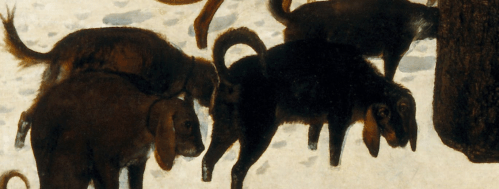
He shows us the hunters returning with empty game bags, the lone corpse of a skinny fox, and little else.

One dog looks at us with starving eyes, as if hoping for scraps.
detai_Dogs_hunters_in_the_snow_Brueghel

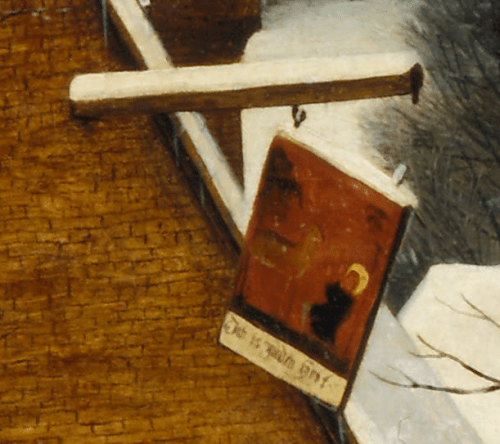
The tavern’s sign is about to fall down, a large hint that all is not well. That symbolic broken sign tells us the owners are bankrupt.
detai_sign_hunters_in_the_snow_Brueghel

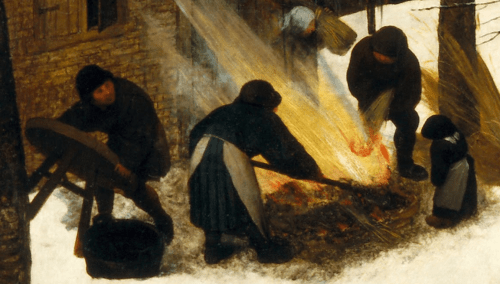
The owners are cooking outside, directly in front of the door, evicted from their home and business. A woman brings a bundle of straw out of the inn to use as fuel, while in the distance an ox-drawn wagon is heavily laden with firewood. Where is it going? Not to their inn, that is for sure.

And most intriguingly, a man is carrying a table away. He glances over his shoulder at the meager soup they are cooking, as if they had somehow gotten it away before he could take that, too. Is he the new owner, having acquired it for pennies from the city by paying the taxes at a forced bankruptcy sale? Or is he a hired thug employed by the new owner?
detai_innkeeprs_cooking_hunters_in_the_snow_Brueghel

A rabbit has crossed the hunters’ path and evaded their snares.

detai_rabbit_tracks_hunters_in_the_snow_Brueghel

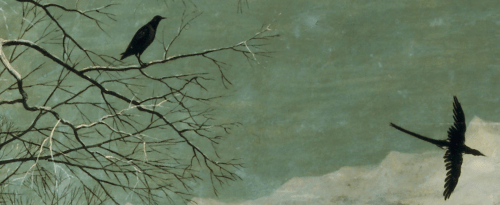
Ravens, long considered birds of ill omen, roost in the trees above the inn and the hunters and fly above the revelers, a portent of worse days to come.
detai_birds_hunters_in_the_snow_Brueghel

But in this story, Brueghel’s characters have hope and faith that things will improve. In the distance (the future) people are playing winter games.
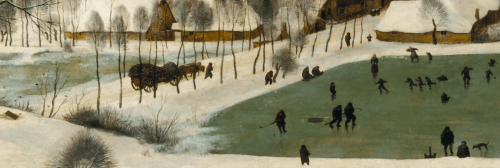
detai_skaters_hunters_in_the_snow_BrueghelBut they are indistinct and far away, shown in a fantastic, mountainous landscape rather than the flat terrain of the Netherlands. It is almost as if they are visions of what winter could be if only the harvest had been good rather than the truth of the lone fox, hounds with empty bellies, a bankrupt tavern, and the rabbit that got away.

About this painting, via Wikipedia, the Fount of All Knowledge:

The Hunters in the Snow (Dutch: Jagers in de Sneeuw), also known as The Return of the Hunters, is a 1565 oil-on-wood painting by Pieter Bruegel the Elder. The Northern Renaissance work is one of a series of works, five of which still survive, that depict different times of the year. The painting is in the collection of the Kunsthistorisches Museum in ViennaAustria. This scene is set in the depths of winter during December/January.

The painting shows a wintry scene in which three hunters are returning from an expedition accompanied by their dogs. By appearances the outing was not successful; the hunters appear to trudge wearily, and the dogs appear downtrodden and miserable. One man carries the “meager corpse of a fox” illustrating the paucity of the hunt. In front of the hunters in the snow are the footprints of a rabbit or hare—which has escaped or been missed by the hunters. The overall visual impression is one of a calm, cold, overcast day; the colors are muted whites and grays, the trees are bare of leaves, and wood smoke hangs in the air. Several adults and a child prepare food at an inn with an outside fire. Of interest are the jagged mountain peaks which do not exist in Belgium or Holland. [1]


Credits and Attributions:

Wikimedia Commons contributors, “File:Pieter Bruegel the Elder – Hunters in the Snow (Winter) – Google Art Project.jpg,” Wikimedia Commons, https://commons.wikimedia.org/w/index.php?title=File:Pieter_Bruegel_the_Elder_-_Hunters_in_the_Snow_(Winter)_-_Google_Art_Project.jpg&oldid=898942431 (accessed December 18, 2024).

[1] Wikipedia contributors, “The Hunters in the Snow,” Wikipedia, The Free Encyclopedia, https://en.wikipedia.org/w/index.php?title=The_Hunters_in_the_Snow&oldid=1262746140 (accessed December 18, 2024).
2 Comments

Filed under #FineArtFriday, writing

#FineArtFriday: Hunters in the Snow by Pieter Brueghel the Elder 1565

Pieter_Bruegel_the_Elder_-_Hunters_in_the_Snow_(Winter)_-_Google_Art_ProjectArtist: Pieter Brueghel the Elder (1526/1530–1569)

Title: English: Hunters in the Snow (German: Jäger im Schnee) (Winter)

Date: 1565

Medium: oil on oak wood

Dimensions: height: 1,170 mm (46.06 in); width: 1,620 mm (63.77 in)

Collection: Kunsthistorisches Museum

What I love about this painting:

This is one of Pieter Brueghel the Elder’s most famous paintings. Even if one doesn’t know who originally painted it, they have very likely seen it at some point, perhaps on a calendar or a Christmas card.

Critics didn’t praise his work, as it is unabashedly primitive, created for the common person’s enjoyment. Nonetheless, his work is still highly prized by collectors. Even now, four centuries after his era, ordinary people can relate to his work because he had such a sense of humor and the ability to show the truth about humanity and inhumanity in his work.

He lived during a time of religious revolution in the Netherlands, and walking the line between both factions must have been difficult. Some have said that Bruegel (and possibly his patron) were attempting to portray an ideal of what country life used to be or what they wish it to be.

I disagree. On the surface and from a distance, this is a bucolic scene depicting ordinary peasants enjoying the winter. But when you look deeper, really look at it, you can see the irony of it, the honesty that Brueghel hid in plain sight.

Brueghel used symbolism to convey paradox and gallows humor in every painting. Winter was harsh and for the average person, survival required a lot of work, sometimes for nothing.

He shows us the hunters returning with empty game bags, the lone corpse of a skinny fox, and little else. One dog looks at us with starving eyes, as if hoping for scraps.

detai_Dogs_hunters_in_the_snow_Brueghel

The tavern’s sign is about to fall down, a large hint that all is not well. That symbolic broken sign tells us the owners are bankrupt.

detai_sign_hunters_in_the_snow_Brueghel

The owners are cooking outside, directly in front of the door. A woman brings a bundle of straw out of the inn to use as fuel, while in the distance an ox-drawn wagon is heavily laden with firewood. Where is it going? Not to their inn, that is for sure. And most intriguingly, a man is carrying a table away. Is he the tax collector? A thief?

detai_innkeeprs_cooking_hunters_in_the_snow_Brueghel

A rabbit has crossed the hunters’ path and evaded their snares.

detai_rabbit_tracks_hunters_in_the_snow_Brueghel

Birds of ill omen roost in the trees above the inn and the hunters and fly above the revelers, a portent of worse days to come.

detai_birds_hunters_in_the_snow_Brueghel

But Brueghel’s people have hope and faith that things will improve. In the distance (the future) people are playing winter games.

detai_skaters_hunters_in_the_snow_BrueghelBut they are indistinct and far away, shown in a fantastic, mountainous landscape, rather than the flat terrain of the Netherlands. It is almost as if they are visions of what winter could be when the harvest had been good, rather than the truth of the lone fox, hounds with empty bellies, a bankrupt tavern, and the rabbit that got away.

About this painting, via Wikipedia, the Fount of All Knowledge:

The Hunters in the Snow (Dutch: Jagers in de Sneeuw), also known as The Return of the Hunters, is a 1565 oil-on-wood painting by Pieter Bruegel the Elder. The Northern Renaissance work is one of a series of works, five of which still survive, that depict different times of the year. The painting is in the collection of the Kunsthistorisches Museum in ViennaAustria. This scene is set in the depths of winter during December/January.

The painting shows a wintry scene in which three hunters are returning from an expedition accompanied by their dogs. By appearances the outing was not successful; the hunters appear to trudge wearily, and the dogs appear downtrodden and miserable. One man carries the “meager corpse of a fox” illustrating the paucity of the hunt. In front of the hunters in the snow are the footprints of a rabbit or hare—which has escaped or been missed by the hunters. The overall visual impression is one of a calm, cold, overcast day; the colors are muted whites and grays, the trees are bare of leaves, and wood smoke hangs in the air. Several adults and a child prepare food at an inn with an outside fire. Of interest are the jagged mountain peaks which do not exist in Belgium or Holland. [1]


Credits and Attributions:

Wikimedia Commons contributors, “File:Pieter Bruegel the Elder – Hunters in the Snow (Winter) – Google Art Project.jpg,” Wikimedia Commons, https://commons.wikimedia.org/w/index.php?title=File:Pieter_Bruegel_the_Elder_-_Hunters_in_the_Snow_(Winter)_-_Google_Art_Project.jpg&oldid=723208718 (accessed December 6, 2023).

[1] Wikipedia contributors, “The Hunters in the Snow,” Wikipedia, The Free Encyclopedia, https://en.wikipedia.org/w/index.php?title=The_Hunters_in_the_Snow&oldid=1186886152 (accessed December 6, 2023).

Comments Off on #FineArtFriday: Hunters in the Snow by Pieter Brueghel the Elder 1565

Filed under #FineArtFriday, writing

#FineArtFriday: Autumn Landscape (September) by Lucas van Valckenborch

GG_5684.tif

Artist: Lucas van Valckenborch  (1535–1597)

Title: Autumn Landscape (September)

Date: 1585

Medium: oil on canvas

Dimensions: 116 x 198 cm Rahmenmaße: 131,5 x 214 x 6,5 cm

Collection: Kunsthistorisches Museum

What I love about this painting:

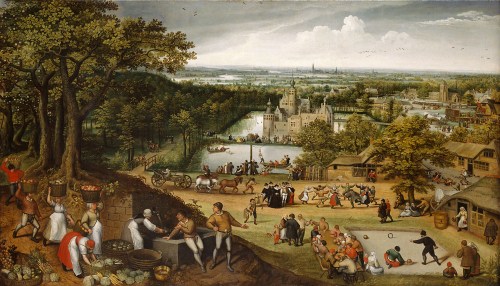
We see an entire view of ordinary autumn life in the 16th century, but better than that, Lucas van Valckenborch shows us the passage of time. He depicts the chronology of how people lived and celebrated each week of the changing season by showing us September in the Netherlands.

The way he shows us this chronology is ingenious and is a signature of his work. The early weeks of September are shown in the left foreground, with laborers bringing in the harvest. Others are working to dry and preserve foods. The colors he uses are vivid, the last shades of summer.

In the bottom to middle right, he shows us mid-September with people relaxing, feasting, bowling, and dancing. The harvest is in, and people have a little time to enjoy the last days of good weather. The colors he uses are more muted, with shades of brown dominating. The leaves are brown and falling. Yet, there is a vibrancy about it, a sense of life. People celebrate a successful harvest one last time before winter’s cold grip closes in.

In late September, people fish, and the market becomes the center of village life. People are less active, but the market draws customers. The end of September presages colder weather and hints at the beginning of winter. This is shown in cool shades of gray, as if in a black-and-white photograph.

He is known for using this trick of color to denote receding distances. But he deliberately places figures performing specific activities within those colors, showing us how people lived and the passage of their days as well as distance.

The first days of September are bright, days of plenty. Yes, we’re working hard, but we’ll be grateful for the bounty when winter comes.

We look forward to the middle of September, because once the rush of harvest is over we will party like it’s 1585.

In the distance, we know the cold dark days loom, but we are prepared. Our cellars will be full and we will hunt and fish while we can.

Lucas van Valckenborch’s body of work shows us that he was a brilliant storyteller as well as an artist. Many paintings of that time show us the poverty, but here we see the prosperity of a village during the early renaissance. It wasn’t all doom and gloom after all.

About the Artist and his work, via Wikipedia:

Lucas van Valckenborch or Lucas van Valckenborch the Elder (c. 1535 in Leuven – 2 February 1597 in Frankfurt am Main) was a Flemish painter, mainly known for his landscapes. He also made contributions to portrait painting, and allegorical and market scenes. Court painter to Archduke Matthias, the governor of the Spanish Netherlands in Brussels, he later migrated to Austria and then Germany where he joined members of his extended family of artists who had moved there for religious reasons.

In their mixture of fantasy and accurate topographical details, van Valckenborch’s landscape paintings offer a view of the world and man’s relationship to it. This is particularly clear in his rocky landscapes in which the diminutive people on the winding path are reduced by the monumental cliffs. An example is the Rocky Landscape with Travelers on a Path (c. 1570, Sotheby’s 6 July 2016, London lot 3) where the distant goatherd and the silhouettes of his charges seem ant-like in comparison to the vast distance, and the vertiginous perspective of the scene. This dramatic visual depiction is clearly intended as a commentary on man’s place within the universe.

He also painted, between 1584 and 1587, a series of large pictures depicting the labours of the months, probably on commission for Archduke Matthias. These compositions, of which seven survive (five of which are in the Kunsthistorische Museum), present the various months of the year by showing the changing landscape and the traditional activities of humans during each month. It is not clear whether the five missing paintings were never painted or are lost.[4] Due to their realistic setting these compositions carry a documentary interest. The work of Pieter Bruegel the elder, who had painted a series of 6 on the times of the year, was influential on van Valckenborch. Lucas van Valckenborch moved away from the tradition of painting the landscape in three cascading distances that were rendered in three different colours: brown, green and blue for each receding plane. Rather he often left out the green tone for the middle distance. He also innovated the thematic scenes by developing them into genre scenes with a stronger narrative depth. [1]


Credits and Attributions:

[1] Wikipedia contributors, “Lucas van Valckenborch,” Wikipedia, The Free Encyclopedia, https://en.wikipedia.org/w/index.php?title=Lucas_van_Valckenborch&oldid=1173224796 (accessed September 14, 2023).

IMAGE: Autumn Landscape (September) by Lucas van Valckenborch. Wikimedia Commons contributors, “File:Lucas van Valckenborch – Autumn landscape (September).jpg,” Wikimedia Commons, https://commons.wikimedia.org/w/index.php?title=File:Lucas_van_Valckenborch_-_Autumn_landscape_(September).jpg&oldid=618977280 (accessed September 14, 2023).

3 Comments

Filed under #FineArtFriday

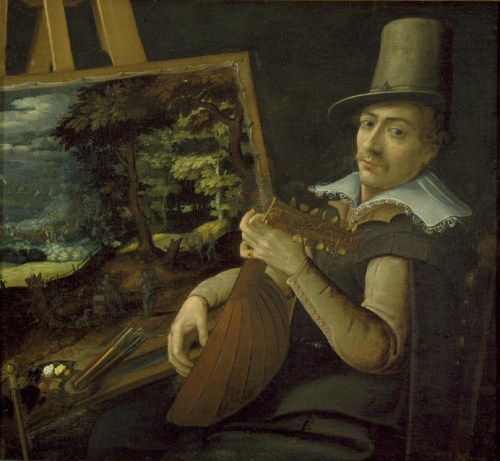
#FineArtFriday: Self-portrait, Paul Bril ca. 1595-1600

Artist: Paul Bril (circa 1553/1554–1626)

Title: Self-portrait

Genre: self-portrait

Date: between 1595 and 1600

Medium: oil on canvas

Dimensions: Height: 71 cm (27.9 in); Width: 78 cm (30.7 in)

About this painting, via Wikipedia:

The painting portrays the artist, elegantly dressed and holding a lute, sitting before his palette and easel, on which a landscape painting sits.

Bril is seen from the back, and is turning towards the viewer. He grasps the lute firmly, with active and jointed fingers. The landscape painting sitting on the easel is typical of Bril’s early work which is characterized by small figures, deep and shaded foregrounds and masses of silvery foliage, attributes that [Bril] shared with other Flemish painters. This has helped with the dating of the work to ca. 1595 – 1600. [1]

What I love about this image:

In this self-portrait Bril shows the viewer who he is and what he cares about, art and music. He is relaxed, at peace and sharing his two passions with us.


Credits and Attributions:

Paul Brill, Public domain, via Wikimedia Commons

[1] Wikipedia contributors, “Self-Portrait (Paul Bril),” Wikipedia, The Free Encyclopedia, https://en.wikipedia.org/w/index.php?title=Self-Portrait_(Paul_Bril)&oldid=1008810469 (accessed February 26, 2021).

Wikimedia Commons contributors, “File:Bril, Paul – Self-Portrait – 1595-1600.jpg,” Wikimedia Commons, the free media repository, https://commons.wikimedia.org/w/index.php?title=File:Bril,_Paul_-_Self-Portrait_-_1595-1600.jpg&oldid=527757876 (accessed February 26, 2021).

Comments Off on #FineArtFriday: Self-portrait, Paul Bril ca. 1595-1600

Filed under #FineArtFriday

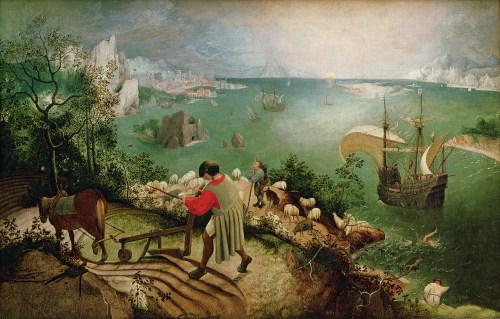
#FineArtFriday: Landscape with the Fall of Icarus, Pieter Bruegel the Elder, c. 1560

Artist: Pieter Bruegel the Elder

Year: c. 1560

Medium: oil on canvas

Dimensions: 73.5 cm × 112 cm (28.9 in × 44 in)

Location: Royal Museums of Fine Arts of Belgium, Brussels

The story depicted in this painting, via Wikipedia, The Free Encyclopedia:

In Greek mythologyIcarus succeeded in flying, with wings made by his father Daedalus, using feathers secured with beeswax. Ignoring his father’s warnings, Icarus chose to fly too close to the sun, melting the wax, and fell into the sea and drowned. His legs can be seen in the water just below the ship. The sun, already half-set on the horizon, is a long way away; the flight did not reach anywhere near it. Daedalus does not appear in this version of the painting.

The ploughman, shepherd and angler are mentioned in Ovid’s account of the legend; they are: “astonished and think to see gods approaching them through the aether”, which is not entirely the impression given in the painting. The shepherd gazing into the air, away from the ship, may be explained by another version of the composition. In the original work there was probably also a figure of Daedalus in the sky to the left, at which he stares.

There is also a Flemish proverb (of the sort imaged in other works by Bruegel): “And the farmer continued to plough…” The painting may, as Auden’s poem suggests, depict humankind’s indifference to suffering by highlighting the ordinary events which continue to occur, despite the unobserved death of Icarus.

What I love about this painting:

This is a wonderful painting, despite its disputed provenance. Pieter Bruegel the Elder tells us a story bluntly: Icarus flew too close to the sun and the wax holding his wings together melted. He fell into the sea and drowned.

Bruegel’s earthy sense of humor comes to the fore in this painting as it does in his other works depicting Flemish proverbs. Always ready to point out humanity’s failings, the artist makes him look ridiculous showing us only his pale, thrashing legs.

In saying that humankind shouldn’t try to fly too high, Bruegel tells us to stop trying to be what we aren’t. He says that one should be content with one’s place in life.

The controversy surrounding this painting, via Wikipedia, The Free Encyclopedia:

Landscape with the Fall of Icarus is a painting in oil on canvas measuring 73.5 by 112 centimetres (28.9 in × 44.1 in) in the Royal Museums of Fine Arts of Belgium in Brussels. It was long thought to be by the leading painter of Dutch and Flemish Renaissance paintingPieter Bruegel the Elder. However, following technical examinations in 1996 of the painting hanging in the Brussels museum, that attribution is regarded as very doubtful, and the painting, perhaps painted in the 1560s, is now usually seen as a good early copy by an unknown artist of Bruegel’s lost original, perhaps from about 1558. According to the museum: “It is doubtful the execution is by Bruegel the Elder, but the composition can be said with certainty to be his”, although recent technical research has re-opened the question.

Since its acquisition by the Royal Museums of Fine Arts of Belgium in 1912, its authenticity has been challenged by several specialists, mainly for two reasons: (i) the relatively weak quality of the painting compared to other Bruegels, although this question is complicated by later overpainting; (ii) it is an oil painting on canvas, an exception in the work of Peter Bruegel the Elder who made all his oil paintings on panel.

In 1963, Philippe Roberts-Jones, curator at the museum, and the Bruegel specialist Georges Marlier, hypothesized that an original panel painting had been later moved onto canvas, as was once common.

In 1998, a mixed team of scientists from the Belgian Royal Institute for Cultural Heritage and the University of Utrecht[7] attempted to solve the authenticity problem by a radiocarbon dating of the canvas that was supposed to be the original support. As mentioned here above, the conclusion of this dating was that P. Bruegel the Elder cannot have painted on this canvas. Later, in 2006, Prof. J. Reisse (Université libre de Bruxelles) challenged this dating on technical grounds.

A sample of blue paint taken from the right edge in 1973 was re-examined by performing analysis such as scanning electron microscopy (SEM) coupled to the energy dispersive X-ray spectroscopy (EDX), which in connection with optical microscopy revealed the following structure and composition. From bottom to top:

  1. Canvas (from transposition);
  2. Oily lead white (adhesive);
  3. Thick oily layer with azurite (repaint);
  4. Chalk ground;
  5. Oily lead white with scarce particles of charcoal;
  6. Oily blue with azurite;

with layers 4 to 6 being original.

The presence of chalk ground under the original blue proves that this is a panel painting transposed on a canvas. The original blue layer is lead white with azurite containing a few grains of ochre and charcoal. These structure and composition match perfectly those found on other certified panels of Peter Bruegel. Moreover, it is noticeable that the wood charcoal particles are very peculiar, being very long and acicular, exactly the same as those found only in The Census from the same Museum.

Recently, a study of the underdrawing using infrared reflectography has been published.

Reflectography is based on the fact that the infrared light penetrates all colors except black. As a result, the drawing, mostly black, can be made visible. The interpretation of these reflectograms is of course more subjective, but in a global way, the drawing from the Fall of Icarus is not really different from other certified works from Peter Bruegel the Elder. This drawing is generally limited to a layout of the elements. Probably because the thin, weakly covering paint on white ground would hide imperfectly a detailed graphism.

A re-interpretation of the reflectograms in agreement with the other analysis suggested the conclusion that the work in the Museum of Fine Arts in Brussels is a panel painting transferred to canvas. The paint layer and maybe also the underdrawing have been severely damaged by this intervention as well as by two more relinings, responsible for the heavy overpainting. In the paint sample remains a fragment with structure and composition matching perfectly the technique of the large panels attributed to Peter Bruegel the Elder. It is therefore unlikely that this version of the Fall of Icarus might be from the hand of a copyist, except perhaps from P. Bruegel the Younger. Conversely, the Van Buuren copy with a different technique cannot be attributed to either Peter Bruegel.


Transfer of panel paintings, via Wikipedia, The Free Encyclopedia:

The practice of conserving an unstable painting on panel by transferring it from its original decayed, worm-eaten, cracked, or distorted wood support to canvas or a new panel has been practised since the 18th century. It has now been largely superseded by improved methods of wood conservation.

The process is described by Henry Mogford in his Handbook for the Preservation of Pictures. Smooth sheets of paper were pasted over the painted surface of the panel, and a layer of muslin over that. The panel was then fixed, face down, to a table, and the wood planed away from the back until it was “as thin as a plane may safely go”, and the remainder scraped off with a sharp instrument such as a razor. The ground of the painting was then removed by solvents or scraping, until nothing remained but a thin skin of colour, pasted over with paper and held together by the muslin. A prepared canvas was then attached to the back of the paint layer, using the same method as was used for lining pictures. When the glue had dried, the paper and muslin were removed by careful damping.


Credits and Attributions:

“Landscape with the Fall of Icarus,” Pieter Brueghel the Elder ca.1558 / Public domain

Wikipedia contributors, “Landscape with the Fall of Icarus,” Wikipedia, The Free Encyclopedia, https://en.wikipedia.org/w/index.php?title=Landscape_with_the_Fall_of_Icarus&oldid=963660790 (accessed August 14, 2020).

Wikipedia contributors, “Transfer of panel paintings,” Wikipedia, The Free Encyclopedia, https://en.wikipedia.org/w/index.php?title=Transfer_of_panel_paintings&oldid=945009923 (accessed August 14, 2020).

2 Comments

Filed under #FineArtFriday

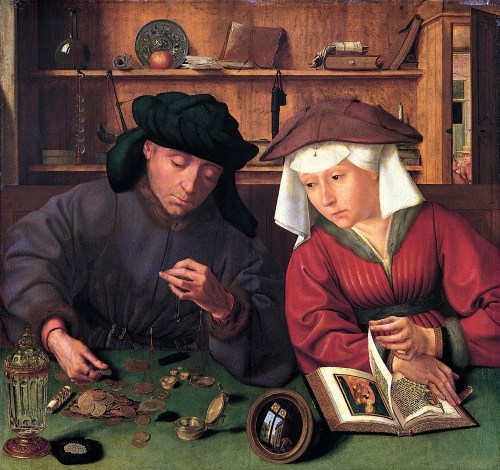
#FineArtFriday: The Money Changer and His Wife by Quentin Matsys, 1514

  • Artist: Quentin Matsys  (1456/1466–1530)
  • Title: The Moneylender and his Wife
  • Date: 1514
  • Medium: oil on panel
  • Dimensions: Height: 70.5 cm (27.7 in)
  • Current location: Louvre Museum
  • Inscriptions: Signature and date

The Money Changer and His Wife is a 1514 oil on panel painting by the Flemish renaissance artist Quentin Matsys.

What I love about this painting:

The colors are rich and vivid, and the lines sharp and clean. The artist included the smallest details in the prayer book, the pewter plate in the background, and the crystal jar by the man’s right hand, showing a prosperous, well-educated young couple. In some ways, Matsys’ style reminds me of the work of the lesser known Flemish painter, Pieter Brueghel the Younger, who was born long after Matsys’ death, but whose original works also leaned toward caricatures and grotesques.

About this painting, via Wikipedia:

A man, who is weighing the jewels and pieces of gold on the table in front of him, sits next to his wife who is reading a book of devotion with an illustration of the Virgin and Child. The couple is not dressed as members of nobility, but rather as well-to-do burghers of Antwerp, where the painting was made. At the time, Antwerp had grown with the influx of many southern immigrants fleeing the Spanish Inquisition. Among this international community there was a demand for money-changers and money-lenders, as international commerce was increasing in the port city.

About the Artist, via Wikipedia:

Most early accounts of Matsys’ life are composed primarily of legend and very little contemporary accounts exist of the nature of his activities or character. According to J. Molanus’ Historiae Lovaniensium, Matsys is known to be a native of Leuven with humble beginnings as an ironsmith. One of four children, Matsys was born to Joost Matsys (d. 1483) and Catherine van Kincken sometime between 4 April and 10 September 1466. Legend states that Matsys abandoned his career as a blacksmith to woo his wife, who found painting to be a more romantic profession, though Karel van Mander claimed this to be false, and the real reason was a sickness during which he was too weak to work at the smithy and instead decorated prints for the carnival celebrations.

Matsys work is considered to contain strong religious feeling—characteristic of traditional Flemish works—and is accompanied by a realism that often favored the grotesque. Matsys’ firmness of outline, clear modelling and thorough finish of detail stem from Van de Weyden’s influence; from the Van Eycks and Memling by way of Dirck Bouts, the glowing richness of transparent pigments. Matsys’ works generally reflect earnestness in expression, minutely detailed renderings, and subdued effects in light and shade. Like most Flemish artists of the time he paid a great deal of attention to jewelry, edging of garments, and ornamentation in general.


Credits and Attributions:

The Money Changer and His Wife by  Quentin Matsys, 1514 Public domain. The work of art depicted in this image and the reproduction thereof are in the public domain worldwide. The reproduction is part of a collection of reproductions compiled by The Yorck Project. The compilation copyright is held by Zenodot Verlagsgesellschaft mbH and licensed under the GNU Free Documentation License.

Wikipedia contributors, “The Money Changer and His Wife,” Wikipedia, The Free Encyclopedia, https://en.wikipedia.org/w/index.php?title=The_Money_Changer_and_His_Wife&oldid=937629150 (accessed June 26, 2020).

Wikipedia contributors, “Quentin Matsys,” Wikipedia, The Free Encyclopedia, https://en.wikipedia.org/w/index.php?title=Quentin_Matsys&oldid=960328863 (accessed June 26, 2020).


Comments Off on #FineArtFriday: The Money Changer and His Wife by Quentin Matsys, 1514

Filed under #FineArtFriday