
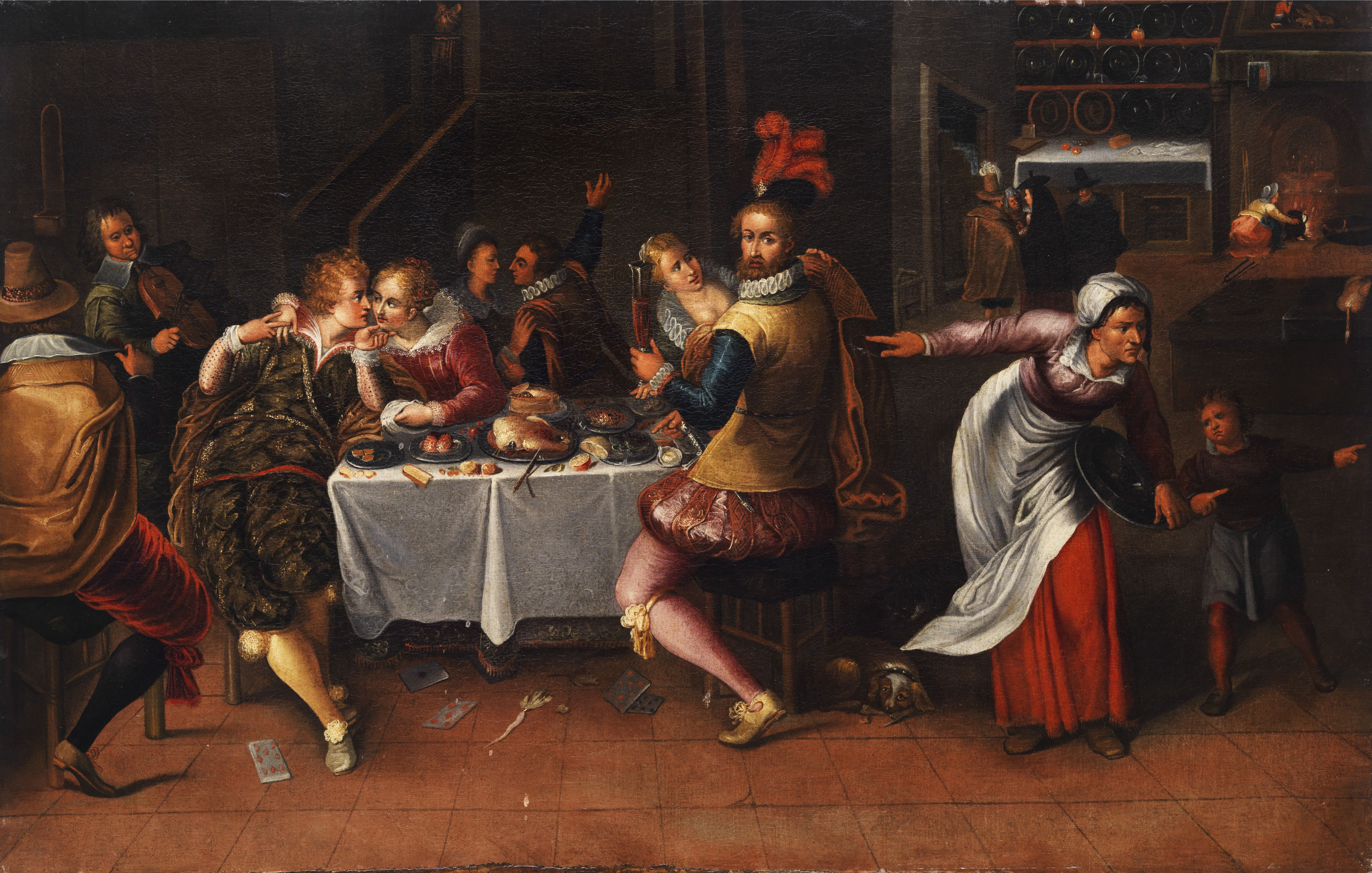
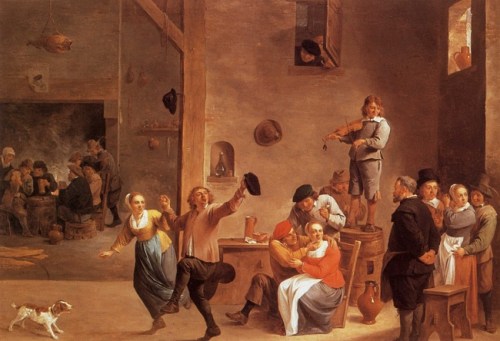
 Title: Feast in the Interior.
Artist: Unknown. Flemish School of the 17th century,
Medium: Oil on canvas.
Size: 57 x 89 cm.
What I love about this painting:
Based on the boy’s interactions with his mother, I would have titled this painting “It’s not my fault!” I assume she is his mother based on the level of frustration she is showing. (Speaking as a mother, frustrations do occasionally boil over.) This painting has been posted to Wikimedia Commons as a 17th-century Flemish painting possibly by the Circle of Frans Francken.
But the more I look at it, the more I wonder why an art historian came to that assessment. To me, this painting looks nothing like any of the paintings I have seen that are attributed to the Francken dynasty of painters. They were definitely active in Flanders during the 17th century, but to me, the composition and style are wrong, and honestly, the subject is a genre scene. The Franckens were more well-known for their excellent cabinet paintings, altar pieces, and religious subjects.
There is one wedding scene attributed to Frans Francken the Elder, which could be why this is attributed to a follower of his. But the people in that painting are quite stiff, a style more reminiscent of Pieter Brueghel the Younger. Frans Francken (I) – The Wedding Dance – Frans Francken the Elder – Wikipedia
These people have a sense of movement and life, the style I think of late 1600s rather than early. This is why I would think it the work of a follower of one of the later artists. An admirer of Jan Steen’s work comes to mind, but it could be a follower of any of the great later genre artist.
The clothing is definitely that of the early 17th century, which is in favor of Frans Francken. However, artists often dressed actors in costumes. Rembrandt most certainly did.
Also, composition of this painting, and certain style features (such as the shape of legs and how the garters are shown) shows us the kind of scene a follower of Dutch Golden Age painter Jan Steen, or a member of his workshop, might have painted.
This painting tells us a story. The tavern is full, the feast is on the table, and the innkeeper’s wife has had enough of Junior’s antics. A well-dressed man turns, ready to jump into the fray, and Junior deflects the blame, pointing to someone just out of the frame.
Beneath the table, several playing cards and a decoration from someone’s garment lie where they have fallen. The wine and ale flow, the ladies of dubious virtue are working the crowd, and the family that owns the tavern is struggling to serve their customers in the midst of the chaos.
This is a story with a moral wrapped in a sense of humor. The composition of this scene is full of symbolism. The positions of various hands, the bounty of oysters, and the clutter beneath the table are deliberately placed to convey subtext that a 17th-century viewer would immediately understand.
The symbolic gestures of the hands could reference tenets of one or the other of the two warring religious faiths, which might have influenced the attribution toward Frans Francken.
You can read about the Francken Dynasty here: Francken family – Wikipedia
And you can read about the brilliant Jan Steen and his merry, chaotic genre scenes here: Jan Steen – Wikipedia
And I wish I could tell you more about the painter who created this wonderful glimpse of tavern life in the 17th century.
Credits and Attributions:
IMAGE: Feast in the Interior, artist unknown. Wikimedia Commons contributors, “File:Flämisch 17 Jh Festmahl im Interieur.jpg,” Wikimedia Commons, https://commons.wikimedia.org/w/index.php?title=File:Fl%C3%A4misch_17_Jh_Festmahl_im_Interieur.jpg&oldid=1113684537 (accessed November 25, 2025).
 Artist: Jan Brueghel the Elder (1568–1625)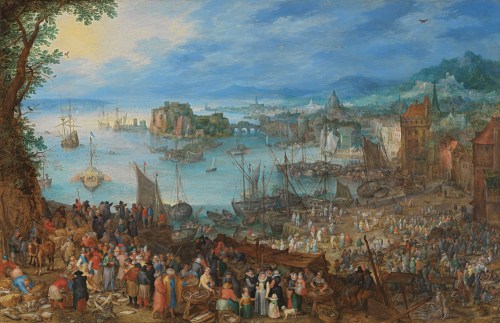


 Life in the Realm of Fantasy
.jpg&oldid=225700063)