Tag Archives: 17th century genre art

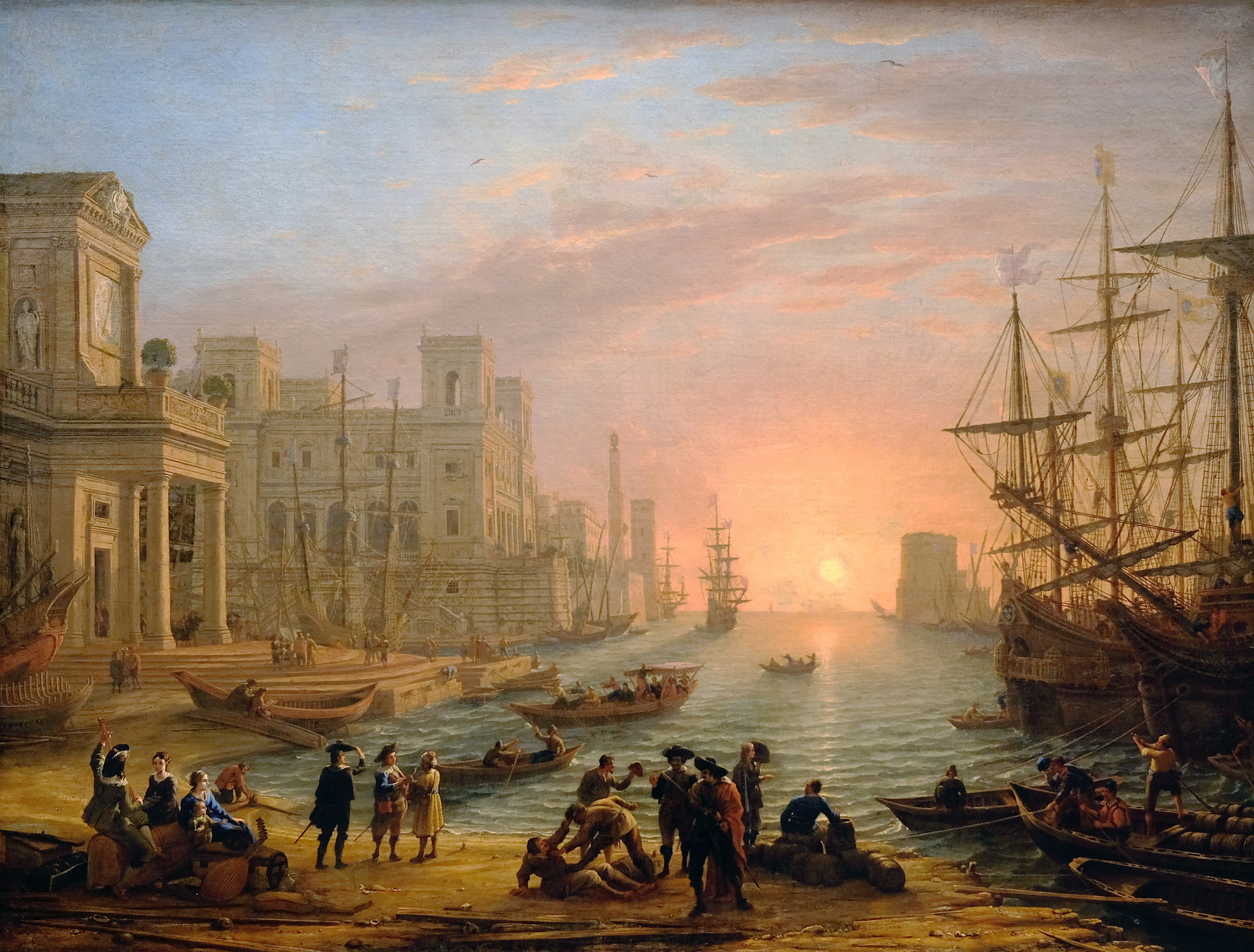
#FineArtFriday: Seaport at sunset by Claude Lorrain 1682

Artist: Claude Lorrain (1604/1605–1682)

Title:   Seaport at sunset

Genre: landscape painting

Date: 1639

Medium: oil on canvas

Dimensions: height: 1 m (40.5 in); width: 1.3 m (53.9 in)

What I love about this painting:

Wow! Where to start? This is what true genius looks like. The overall scene is masterfully done, one of the best seascapes I have seen. The waters are calm, allowing for goods and passengers to be transferred safely to shore. The sky is that incredible quality that nature sometimes offers us on a summer evening. A haze is rising, and ships are still entering the harbor, waiting for their turn to offload their cargoes and passengers. Waves lap softly at the shore, a gentle rhythm.

Claude shows us a thriving, prosperous seaport under a glorious sunset. In fact, the scenery is so beautiful, it’s easy to overlook the dramas playing out in the foreground. However, we shouldn’t, as that is where the real story he wanted to show us lies.

In the bottom left, a family is seated on an upturned boat. Are they waiting to board a ship? They seem to be musicians, as the man plays a cittern, and a lute rests beside the woman and child, along with a pile of baggage.

To their right, a pair of merchants discuss business with a foreign trader, whose clothing suggests he is from Persia. Are they negotiating the purchase of rare spices? Or are they attempting to sell him something?

In the bottom center, violence has erupted as a pair of ruffians have decided to settle their dispute the old-fashioned way. Sailors on shore leave? Too much to drink? Fighting over a woman? The onlookers are disgusted but do not step in to break it up. Apparently, someone “had it coming.”

To the right of the combatants and knot of friends, a pair of well-dressed men, one seated on an upturned boat and one standing, are clearly waiting for something. Perhaps these people are all waiting to board the same ship.

And finally, on the far right, we have several ships, accompanied by small boats called tenders, which are going to and from them. In the foreground, sailors row tenders to the strand. Will our passengers be rowed out to board their ship? This is a bustling harbor, and it’s clear that berths along the quayside are at a premium. Perhaps, rather than paying for a berth when his cargo consists of passengers rather than goods, this ship’s owner keeps his costs down by bringing supplies on board by tender and ferrying passengers to and from the shore.

Claude’s glorious sunset hints that hope lies beyond the horizon. Are the passengers embarking on a journey to the New World? Perhaps they are going to India, or even to the French colonies in the South Pacific. Wherever they are going, I hope their journey is peaceful and ends well.

About the artist, via Wikipedia:

Claude Lorrain (born Claude Gellée), called le Lorrain in French; traditionally just Claude in English; c. 1600 – 23 November 1682) was a painter, draughtsman and etcher of the Baroque era originally from the Duchy of Lorraine. He spent most of his life in Italy, and is one of the earliest significant artists, aside from his contemporaries in Dutch Golden Age painting, to concentrate on landscape painting. His landscapes often transitioned into the more prestigious genre of history paintings by addition of a few small figures, typically representing a scene from the Bible or classical mythology. [1]

To learn more about this artist go to Claude Lorrain – Wikipedia


Credits and Attributions:

IMAGE: Seaport at sunset by Claude Lorrain 1682. Wikimedia Commons contributors, “File:F0087 Louvre Gellee port au soleil couchant- INV4715 rwk.jpg,” Wikimedia Commons, https://commons.wikimedia.org/w/index.php?title=File:F0087_Louvre_Gellee_port_au_soleil_couchant-_INV4715_rwk.jpg&oldid=967103912 (accessed June 27, 2025).

[1] Wikipedia contributors, “Claude Lorrain,” Wikipedia, The Free Encyclopedia, https://en.wikipedia.org/w/index.php?title=Claude_Lorrain&oldid=1298367934 (accessed July 2, 2025).

2 Comments

Filed under #FineArtFriday, writing

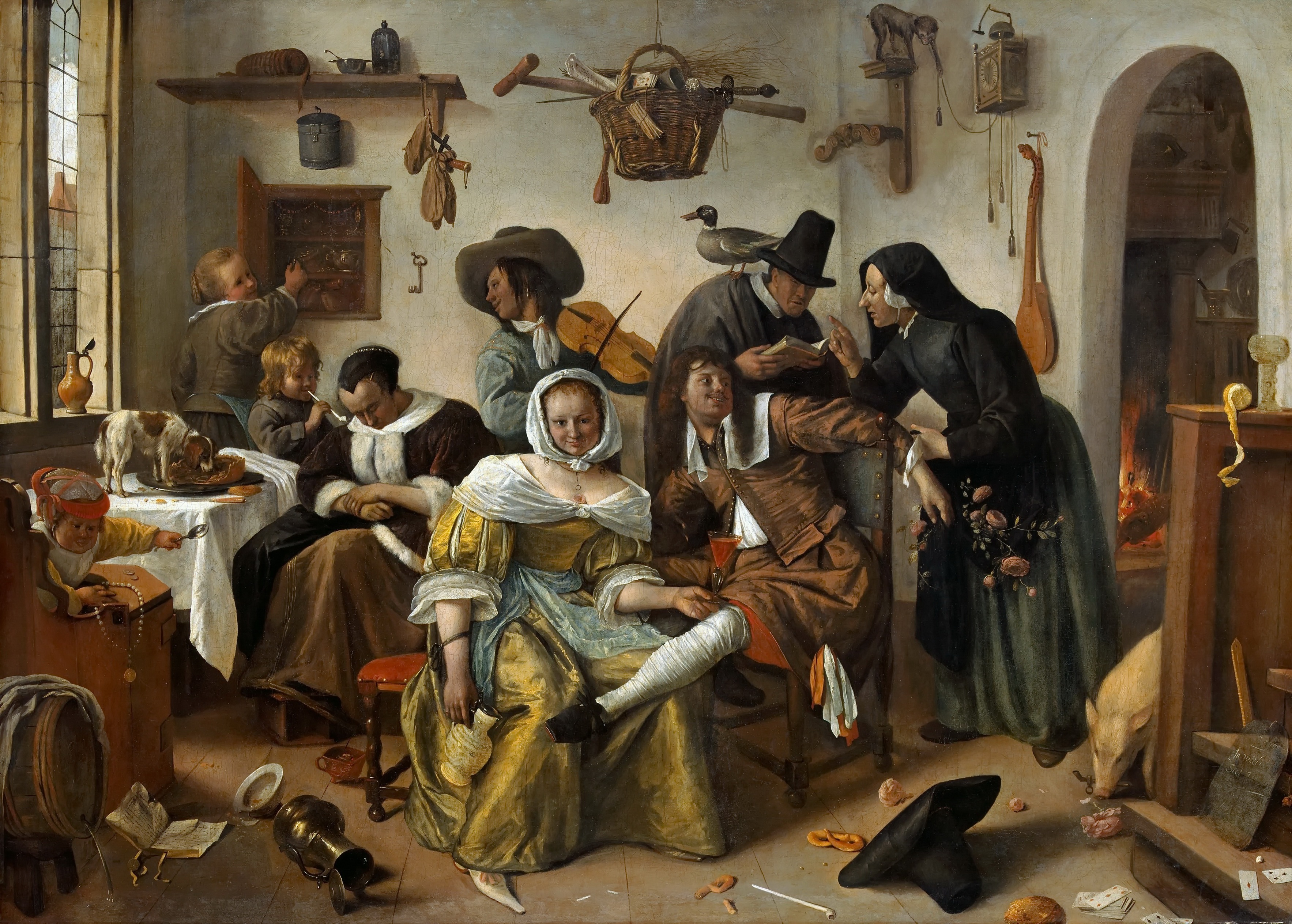
#FineArtFriday: Beware of Luxury by Jan Steen ca.1663 #prompt #NovemberWriter

Öèôðîâàÿ ðåïðîäóêöèÿ íàõîäèòñÿ â èíòåðíåò-ìóçåå Gallerix.ru

Artist: Jan Steen (1625/1626–1679)

Title: Beware of Luxury (“In Weelde Siet Toe”)

Date: circa 1663

Medium: oil on canvas

Dimensions: height: 105 cm (41.3 in); width: 145 cm (57 in)

Collection: Kunsthistorisches Museum

What I love about this painting:

Jan Steen lampoons family life in this riotous scene. Mother is taking a well-deserved nap, and the family is running wild, drinking to excess and partying like it was 1599. Grandma ignores the rumpus and instead, she is lecturing the Reverend on doctrine. The house is trashed, and the dog is on the table eating the pie. The baby is playing with the mother’s pearls. The oldest daughter’s suitor is sitting with his leg over her lap is a visual nod to promiscuity. “Getting his leg over her” was slang for premarital canoodling.

Although each of the many characters and every element of set dressing is realistically depicted, we know this is not a portrayal of a real moment in the artist’s life. We are presented with a theatrical drama here, a situation that is staged and satirized for our entertainment.

The Age of the Puritan had swept across Europe and while it was waning in the mid-seventeenth century, puritanism had a large influence on life in Holland as much as elsewhere.

This painting is a wonderful visual exhortation reminding the good people to live a sober life. Steen himself was not a puritan, as he was born into a family of brewers and ran taverns and breweries off and on throughout his life. But he did need to sell his paintings as he was never a successful businessman, and his allegorical paintings were quite popular.

About the Artist, via Wikipedia:

Jan Havickszoon Steen (c. 1626 – buried 3 February 1679) was a Dutch Golden Age painter, one of the leading genre painters of the 17th century. His works are known for their psychological insight, sense of humour and abundance of colour.

In 1648 Jan Steen and Gabriël Metsu founded the painters’ Guild of Saint Luke at Leiden. Soon after he became an assistant to the renowned landscape painter Jan van Goyen (1596–1656), and moved into his house on the Bierkade in The Hague. On 3 October 1649, he married van Goyen’s daughter Margriet, with whom he would have eight children. Steen worked with his father-in-law until 1654, when he moved to Delft, where he ran the brewery De Slang (“The Snake”) for three years without much success.  After the explosion in Delft in 1654 the art market was depressed, but Steen painted A Burgomaster of Delft and his daughter. It does not seem to be clear if this painting should be called a portrait or a genre work.

Steen lived in Warmond, just north of Leiden, from 1656 until 1660 and in Haarlem from 1660 until 1670 and in both periods he was especially productive. In 1670, after the death of his wife in 1669 and his father in 1670, Steen moved back to Leiden, where he stayed the rest of his life. When the art market collapsed in 1672, called the Year of Disaster, Steen opened a tavern. In April 1673 he married Maria van Egmont, who gave him another child. In 1674 he became president of the Saint Luke’s Guild. Frans van Mieris (1635–1681) became one of his drinking companions. He died in Leiden in 1679 and was interred in a family grave in the Pieterskerk. [1]


Credits and Attributions:

IMAGE: Beware of Luxury by Jan Steen, ca. 1663. Wikimedia Commons contributors, “File:Jan Steen 004b.jpg,” Wikimedia Commons, https://commons.wikimedia.org/w/index.php?title=File:Jan_Steen_004b.jpg&oldid=617576422 (accessed November 15, 2024)

[1] Wikipedia contributors, “Jan Steen,” Wikipedia, The Free Encyclopedia, https://en.wikipedia.org/w/index.php?title=Jan_Steen&oldid=1249713624 (accessed November 15, 2024).

Comments Off on #FineArtFriday: Beware of Luxury by Jan Steen ca.1663 #prompt #NovemberWriter

Filed under #FineArtFriday

#FineArtFriday: a second look at Merry Company by Dirck Hals 1635

Vrolijke gezelschap

Merry company *oil on panel *30 x 51 cm *signed : D Hals 1635

Artist: Dirck Hals (1591–1656)

Title: Merry Company

Date: 1635

Medium: oil on panel

Dimensions: height: 30 cm (11.8 in); width: 51.1 cm (20.1 in)

Collection: Mauritshuis

What I love about this painting:

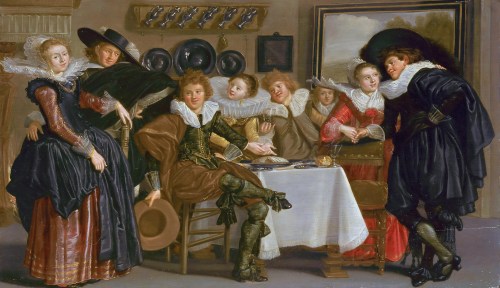
This group portrait tells us a story. Perhaps we are celebrating the engagement of the young couple on the far right—a fashionably, yet modestly, dressed young woman and a gallant young man holding hands and gazing at each other.

The hostess, in the center, looks up and greets her guests who have entered to the left of us. She gestures to the food on the table, inviting them to sit. Are they the future in-laws?

The host looks directly at us, the viewer. He greets us as his guests and he too gestures to the table—join us! Sit, eat, and we’ll have an evening to remember. A single crystal wine glass shows us that wine is being served but companionship and food are what the party is really about. We are here to meet and get to know each other.

An engagement is a reason to gather and celebrate—so let us join this merry company and spend an evening with friends, partying like it’s 1635.

About the setting of this painting:

Dirck Hals has given us the image of friends partying in someone’s home. This is clearly not set in a tavern, as the walls are clean, freshly plastered and painted, and the fireplace at the far left has an ornate mantel. It is for heating the room only, not for cooking. The mantel’s aesthetics are part of the room’s decor.

The scene is set in a dining room. We see six pewter tankards proudly displayed on the wall above a sideboard, along with large pewter platters, signs that this is an intimate family room. We know they are pewter because of the dark bluish color of the metal. These are serving vessels every home needed in the 17th century, but only the wealthier middle-class could afford pewter.

And if you could afford to have a separate room just for dining, you would have your drinking vessels and platters displayed above a sideboard in the manner we see here.

In the background to the right, a fine, large landscape painting also indicates a prosperous home.

Everyone is dressed in their best clothes. The modest yet stylish dress of the guests also point to a domestic scene rather than a tavern. Their garments are made from expensive fabrics, silks and satins, and they wear the immense ruffs of crisp white lace that only the upper classes could afford. These are prosperous people, traders in cloth perhaps—but no matter what they trade, they are gathered to celebrate something, and we have been invited to join them.

Taverns and the poorer classes had either wooden tankards and bowls or fired clay mugs and platters. If they had an object made of pewter, it would be put away for safekeeping. The innkeepers and owners of public houses wouldn’t keep tankards where they could be knocked down or stolen.

About the Artist, Via Wikipedia:

Dirck Hals (19 March 1591 – 17 May 1656), born at Haarlem, was a Dutch Golden Age painter of merry company scenes, festivals and ballroom scenes. He played a role in the development of these types of genre painting. He was somewhat influenced by his elder brother Frans Hals but painted few portraits.

The Haarlem writer Samuel Ampzing mentions both brothers in his Praise of Haarlem with a poem stating that both brothers were exceptional; Frans painting his portraits “awake”, and Dirck painting his figures “purely”. [1]

About pewter, via Wikipedia:

Lidless mugs and lidded tankards may be the most familiar pewter artifacts from the late 17th and 18th centuries, although the metal was also used for many other items including porringers (shallow bowls), plates, dishes, basins, spoons, measures, flagons, communion cups, teapots, sugar bowls, beer steins (tankards), and cream jugs. In the early 19th century, changes in fashion caused a decline in the use of pewter flatware. At the same time, production increased of both cast and spun pewter tea sets, whale-oil lamps, candlesticks, and so on. Later in the century, pewter alloys were often used as a base metal for silver-plated objects. [2]


Credits and Attributions:

IMAGE: Merry Company by Dirck Hals, Public domain, via Wikimedia Commons (accessed December 29, 2022).

[1] Wikipedia contributors, “Dirck Hals,” Wikipedia, The Free Encyclopedia, Dirck Hals  (accessed December 29, 2022).

[2] Wikipedia contributors, “Pewter,” Wikipedia, The Free Encyclopedia, https://en.wikipedia.org/w/index.php?title=Pewter&oldid=1129247091 (accessed December 29, 2022).

Comments Off on #FineArtFriday: a second look at Merry Company by Dirck Hals 1635

Filed under #FineArtFriday, writing

#FineArtFriday: Man in an Oriental Costume – Isaac de Jouderville

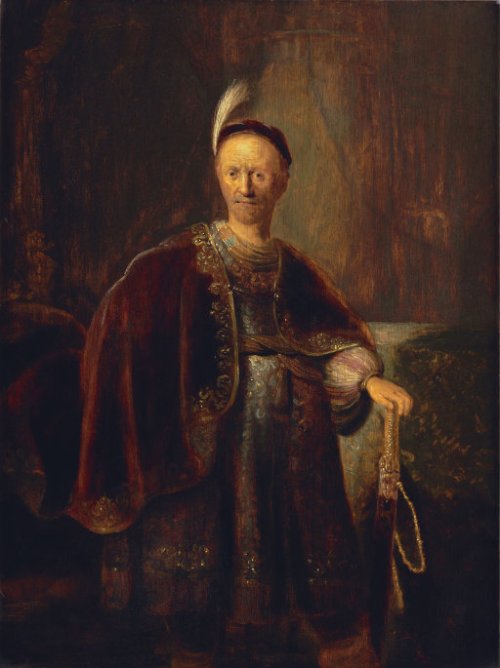
Man_in_an_Oriental_Costume_-_Isaac_de_JoudervilleArtist: Isaac de Jouderville  (1612–1645) Formerly attributed to Rembrandt (1606–1669)

Title: Man in an Oriental Costume

Description: English: Portrait shows Rembrandt’s father. The painting was identified by the BBC program Fake or Fortune? as a work looted by the Nazis and was reattributed to Isaac de Jouderville.

Date: 17th century before 1646

Medium: oil painting

About this painting, via Wikipedia:

Isaac de Jouderville’s painting Man in Oriental costume was featured in the fourth episode of the BBC TV programme, Fake or Fortune?. This painting was part of the stock of dealer’s Jakob and Rosa Oppenheimer that was seized by the Nazis and sold in 1935. It resurfaced at a Cape Town auction house in 2010. It was then, and still is today, listed in the Lost Art Database run by the Koordinierungsstelle für Kulturgutverluste in Magdeburg, Germany. It was subject to a long legal dispute as to whether the work was listed there legally. In February 2015 the Federal Administrative Court of Germany held that the Koordinierungsstelle did not have to delete it. [1]

Jouderville is known today for portraits and historical allegories.[1] Jouderville painted mainly Rembrandtesque heads or ‘tronies’. He was such a faithful follower of his master’s early work that several of his paintings were previously attributed to Rembrandt.[5]

If you are interested and have an hour to spare, here is the link to this exceptional story as told by Fiona Bruce and Phillip Mould. FAKE OR FORTUNE REMBRANDT SE1EO4 – YouTube

About the Artist, via Wikipedia:

Isaac de Jouderville (1612 in Leiden – 1645 in Amsterdam), was a Dutch Golden Age painter who was a pupil of Rembrandt.

De Jouderville was an orphan whose parents had come from Metz. He became a pupil of Rembrandt in November 1629 and traveled with him to Amsterdam in 1631. Documents concerning his apprenticeship drawn up by his guardians still exist.

He was back in Leiden to marry Maria le Febure (1619-1653) in 1636 and moved to Deventer in 1641. He lived in Deventer for a few years only; in 1643 he was back in Amsterdam, where he died young in 1645. His widow Maria married the glassmaker Pieter de Melder in 1648 and his daughter Mariecke, later married the painter Frederik de Moucheron.

After Maria le Febure died, her second husband claimed he was unable to support his wife’s three children by her first husband, along with his own two children, though he offered to raise Jacob Jouderville to the age of 18.[2] By that time De Melder was acting as art dealer, and the liquidation of his wife’s goods shows an interesting list of artists who were either owed money by her estate or who owed money to her estate. [1]


Credits and Attributions:

Image: Wikimedia Commons contributors, “File:Man in an Oriental Costume – Isaac de Jouderville.jpg,” Wikimedia Commons, https://commons.wikimedia.org/w/index.php?title=File:Man_in_an_Oriental_Costume_-_Isaac_de_Jouderville.jpg&oldid=527175855 (accessed May 26, 2023).

[1] Wikipedia contributors, “Isaac de Jouderville,” Wikipedia, The Free Encyclopedia, https://en.wikipedia.org/w/index.php?title=Isaac_de_Jouderville&oldid=1085547679 (accessed May 26, 2023).

Comments Off on #FineArtFriday: Man in an Oriental Costume – Isaac de Jouderville

Filed under #FineArtFriday

#FineArtFriday: Merry Company by Dirck Hals 1635

Vrolijke gezelschap

Merry company *oil on panel *30 x 51 cm *signed : D Hals 1635

Artist: Dirck Hals (1591–1656)

Title: Merry Company

Date: 1635

Medium: oil on panel

Dimensions: height: 30 cm (11.8 in); width: 51.1 cm (20.1 in)

Collection: Mauritshuis

What I love about this painting:

Perhaps we are celebrating the engagement of the young couple on the far right—a fashionably, yet modestly, dressed young woman and a gallant young man holding hands and gazing at each other.

The hostess, in the center, looks up and greets her guests who have entered to the left of us. She gestures to the food on the table, inviting them to sit. Are they the future in-laws?

The host looks directly at us, the viewer. He greets us as his guests and he too gestures to the table—join us! Sit, eat, and we’ll have an evening to remember. A single crystal wine glass shows us that wine is being served but companionship and food are what the party is really about. We are here to meet and get to know each other.

An engagement is a reason to gather and celebrate—so let us join this merry company and spend an evening with friends, partying like it’s 1635.

About the setting of this painting:

Dirck Hals has given us the image of friends partying in someone’s home. This is clearly not set in a tavern, as the walls are clean, freshly plastered and painted, and the fireplace at the far left has an ornate mantel. It is for heating the room only, not for cooking. The mantel’s aesthetics are part of the room’s decor.

The scene is set in a dining room. We see six pewter tankards proudly displayed on the wall above a sideboard, along with large pewter platters, signs that this is an intimate family room. We know they are pewter because of the dark bluish color of the metal. These are serving vessels every home needed in the 17th century, but only the wealthier middle-class could afford pewter.

And if you could afford to have a separate room just for dining, you would have your drinking vessels and platters displayed above a sideboard in the manner we see here.

In the background to the right, a fine, large landscape painting also indicates a prosperous home.

Everyone is dressed in their best clothes. The modest yet stylish dress of the guests also point to a domestic scene rather than a tavern. Their garments are made from expensive fabrics, silks and satins, and they wear the immense ruffs of crisp white lace that only the upper classes could afford. These are prosperous people, traders in cloth perhaps—but no matter what they trade, they are gathered to celebrate something, and we have been invited to join them.

Taverns and the poorer classes had either wooden tankards and bowls or fired clay mugs and platters. If they had an object made of pewter, it would be put away for safekeeping. The innkeepers and owners of public houses wouldn’t keep tankards where they could be knocked down or stolen.

About the Artist, Via Wikipedia:

Dirck Hals (19 March 1591 – 17 May 1656), born at Haarlem, was a Dutch Golden Age painter of merry company scenes, festivals and ballroom scenes. He played a role in the development of these types of genre painting. He was somewhat influenced by his elder brother Frans Hals but painted few portraits.

The Haarlem writer Samuel Ampzing mentions both brothers in his Praise of Haarlem with a poem stating that both brothers were exceptional; Frans painting his portraits “awake”, and Dirck painting his figures “purely”. [1]

About pewter, via Wikipedia:

Lidless mugs and lidded tankards may be the most familiar pewter artifacts from the late 17th and 18th centuries, although the metal was also used for many other items including porringers (shallow bowls), plates, dishes, basins, spoons, measures, flagons, communion cups, teapots, sugar bowls, beer steins (tankards), and cream jugs. In the early 19th century, changes in fashion caused a decline in the use of pewter flatware. At the same time, production increased of both cast and spun pewter tea sets, whale-oil lamps, candlesticks, and so on. Later in the century, pewter alloys were often used as a base metal for silver-plated objects. [2]


Credits and Attributions:

IMAGE: Merry Company by Dirck Hals, Public domain, via Wikimedia Commons (accessed December 29, 2022).

[1] Wikipedia contributors, “Dirck Hals,” Wikipedia, The Free Encyclopedia, Dirck Hals  (accessed December 29, 2022).

[2] Wikipedia contributors, “Pewter,” Wikipedia, The Free Encyclopedia, https://en.wikipedia.org/w/index.php?title=Pewter&oldid=1129247091 (accessed December 29, 2022).

4 Comments

Filed under #FineArtFriday, writing