Tag Archives: 17th century landscape paintings

#FineArtFriday: a closer look at “The Bird Concert” by Jan Brueghel the Younger ca. 1640 – 45

OLYMPUS DIGITAL CAMERA

Artist: Jan Brueghel the Younger (1601–1678)

Title: the Bird Concert

Date: between circa 1640 and circa 1645

Medium: oil on copper

Dimensions: height: 13.2 cm (5.1 in); width: 17.9 cm (7 in)

Collection: Herzog Anton Ulrich Museum

Today we are taking a second look at one of my favorite paintings of the 17th century.

What I love about this painting:

This is one of my all-time favorite paintings. Jan Brueghel the Younger was a master who stood out in a dynasty of masters. The Brueghel family descended from Pieter Brueghel the Elder, and each generation left behind works that enchant us to this day.

I love this fantasy of birds, a renaissance view of what true harmony could be.

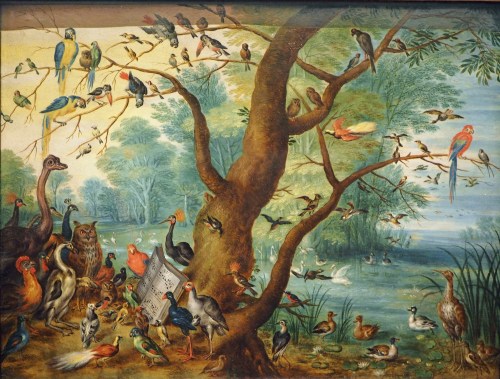
Brueghel gives us a joyous, surreal exploration of all the birds the artist had ever seen in his native Antwerp, and many rare birds that he could only imagine. He has gathered birds from all over the world into a mystical, fairytale glen, posing them around a songbook.

They are learning to sing a in a language they all can understand, a wonderful allegory of the aspirations of the artist for humanity in the turbulent times during which he lived.

This painting also celebrates the new discoveries made by European explorers, as Brueghel had only seen scientific drawings of many of these birds. Even though he hadn’t seen some of these birds personally, he paints them as if they are before him.

The amazing flock of birds gathered here gives us an insight into the mind and sense of humor of Jan Brueghel the Younger, a man not too different from us even though he lived over 300 years ago.

This composition must have been important to Brueghel and says something about him. He went to the expense of getting copper as the base upon which he painted this scene. He was comfortable but not rich, so that tells me he intended this painting to last, to be something he would be remembered for.

About the medium of Oil on Copper, via Wikipedia:

Oil on copper paintings were prevalent in the mid sixteenth century in Italy and Northern Europe. The use of copper as a substrate for an oil painting dates back to Medieval times. The Flemish masters and other artists including Jan Breughel the ElderClaudeEl GrecoGuido ReniGuercinoRembrandtCarlo SaraceniAmbrosius Bosschaert IICopley Fielding and Vernet painted on copper. They favored copper for its smooth surface which allowed fine detail, and its durability. Copper is more durable than canvas or wood panel as a support for oil painting, as it will not rot, mildew or be eaten by insects. Contemporary painters also use copper as a base for paintings, some of them allowing the metal or patina to show through.

The old masters prepared the copper for painting first by rubbing it with fine pumice abrasive. The copper surface was then treated with garlic juice which is believed to improve adhesion of the paint. Finally a white or grey ground layer of oil paint was applied as a primer. After drying the copper panel was ready for the artist to begin painting. Later artists used the patina process, in which the copper is oxidized with the use of various acidic solutions, as part of the art work itself. The resulting patina or verdigris includes darkening of the metal, green and blue tones, depending on the chemical solution used. Patina is characterized by beautiful, variated patterns and textures which occur on the metal’s surface. [1]

About the Artist, via Wikipedia:

Jan Brueghel the Younger was born in Antwerp on 13 September 1601 as the son of Jan Brueghel the Elder and Isabella de Jode. His mother was the daughter of the cartographer, engraver and publisher Gerard de Jode. He trained and collaborated with his father in his workshop. His father was a friend and close collaborator of Peter Paul Rubens. Brueghel likely assisted with his father’s large-scale commissions.

On the wishes of his father, he traveled around 1622 to Milan where he was welcomed by Cardinal Federico Borromeo. The cardinal was a patron and friend of his father who had met in Rome about 30 years earlier. In what was likely an act of rebellion against his father, he went to Genoa where he stayed with his cousins, the Antwerp painters and art dealers Lucas de Wael and Cornelis de Wael. Their mother was a sister of Brueghel’s mother. At the time his friend and fellow Antwerp artist Anthony van Dyck was also active in Genoa. He later worked in Valletta on Malta in 1623. From 1624 to 1625 he also resided in Palermo on Sicily at the time when van Dyck was also working there.

Brueghel learned that his father had died on 13 January 1625 from cholera only after his return to Northern Italy in Turin. Wanting to return to Antwerp immediately, he had to delay his departure for 16 days due to a severe fever. After recovering from his illness, he set off for his homeland by way of France. In Paris he met the Antwerp art dealer and painter Peter Goetkint the Younger, who was the son of Peter Goetkint the Elder, the master of Jan’s father. Goetkint was eager to return to Antwerp because his wife was expected to deliver a baby soon. The child was born on 25 August, the day on which Breughel arrived in Antwerp with his traveling companion who himself died a few days later.

Brueghel took over the management of his father’s workshop, sold the finished works of his father and finished some of his father’s unfinished paintings. In the Guild year 1624-1625, Brueghel became a master painter of the Guild of Saint Luke of Antwerp.

In 1626 he married Anna Maria Janssens, daughter of Abraham Janssens, a prominent history painter in Antwerp. He continued to operate the large workshop of his father. He became dean of the Guild of Saint Luke in 1630. That same year he was commissioned by the French court to paint a series of paintings on the life of Adam. It seems that his studio declined after this period and that he started to paint smaller scale paintings which commanded lower prices than those produced earlier.

In later years, he worked independently in Paris in the 1650s and produced paintings for the Austrian court in 1651. He is recorded again in Antwerp in 1657 where he remained until his death. [2]


Credits and Attributions:

[1] Wikipedia contributors, “Oil on copper,” Wikipedia, The Free Encyclopedia, https://en.wikipedia.org/w/index.php?title=Oil_on_copper&oldid=1060711380 (accessed JAug 7, 2025).

[2] Wikipedia contributors, “Jan Brueghel the Younger,” Wikipedia, The Free Encyclopedia, https://en.wikipedia.org/w/index.php?title=Jan_Brueghel_the_Younger&oldid=1086952033 (accessed Aug 7, 2025).

Image: The Bird Concert by Jan Brueghel the Younger ca. 1640 -1645, PD|100. Wikimedia Commons contributors, “File:Bruegel Vogelkonzert@Herzog Anton Ulrich Museum (1).JPG,” Wikimedia Commons, the free media
6 Comments

Filed under #FineArtFriday, writing

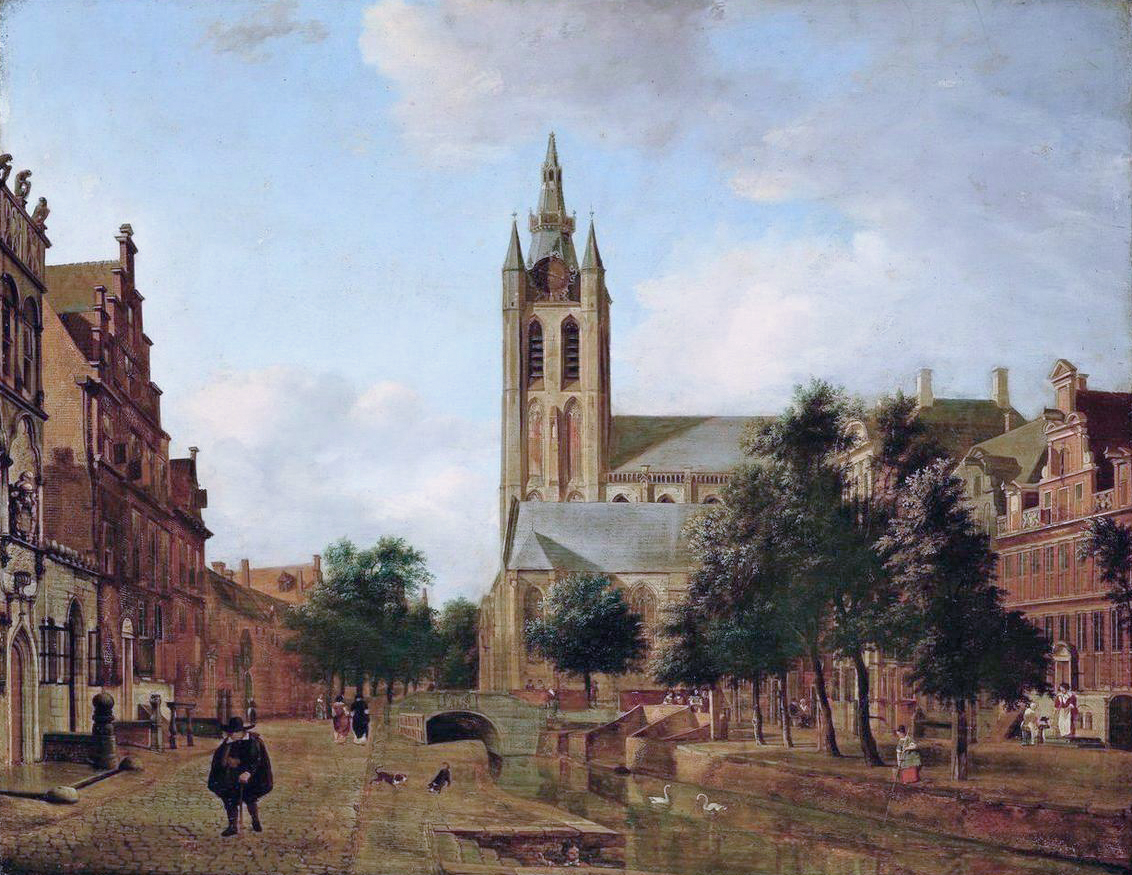
#FineArtFriday:The Oude Kerk on the Oude Delft in Delft by Jan van der Heyden 1675

Artist: Jan van der Heyden (1637–1712)

Title: The Oude Kerk on the Oude Delft in Delft

Genre: landscape painting

Date: 1675

Medium: oil on panel

Dimensions: height: 45 cm (17.7 in); width: 57 cm (22.4 in)

Collection: National Museum of Art, Architecture and Design

What I love about this painting:

This scene shows us a fine day in the city of Delft, on the Trekvliet, a shipping canal that has existed since the 13th century. This canal flows past the foundations of the Oude Kerk. Van der Heyden has painted the tower as leaning, which is an accurate depiction. It currently leans two meters from the vertical.

We see the clean and prosperous street, with special attention paid to the architecture. The staffage (people) in this painting were most likely painted by Adriaen van de Velde. He collaborated with Adriaen van de Velde more frequently than Johannes Lingelbach or Eglon van der Neer, although they did sometimes work with him.

Fluffy white clouds sail across the scene. The air is not too warm or too cool. Instead, it is just right. The sky is that lovely shade of blue, the color that says “summer is near and all will be well.”

As a writer of fantasy, I often go to Wikimedia Commons for worldbuilding ideas, depending on the kind of era in which a story is set. If your work is set in a post-renaissance era, this is the kind of street and architecture that will be featured in the richest town. The buildings will be good to look at, made of stone and wood. The street will be paved, and if there is a canal, there will be places for barges and small watercraft to tie up.

About the artist, via Wikipedia:

Jan van der Heyden (5 March 1637, Gorinchem – 28 March 1712, Amsterdam) was a Dutch Baroque-era painterglass painterdraughtsman and printmaker. Van der Heyden was one of the first Dutch painters to specialize in townscapes and became one of the leading architectural painters of the Dutch Golden Age. He painted a number of still lifes in the beginning and at the end of his career. 

Jan van der Heyden was also an engineer and inventor who made significant contributions to contemporary firefighting technology. Together with his brother Nicolaes, who was a hydraulic engineer, he invented an improvement of the fire hose in 1672.  He modified the manual fire engine, reorganized the volunteer fire brigade (1685) and wrote and illustrated the first firefighting manual (Brandspuiten-boek). A comprehensive street lighting scheme for Amsterdam, designed and implemented by van der Heyden, remained in operation from 1669 until 1840 and was adopted as a model by many other towns and abroad.

Painting was not the sole occupation and interest of van der Heyden. In fact he never joined Amsterdam’s painters’ guild. Even while his work was in great demand, he did not rely on his art to make a living. His principal source of income was, in fact, not painting. Rather he was employed as engineer, inventor and municipal official. He was clearly greatly preoccupied with the problem of how to fight fires effectively, and, with his brother Nicolaes, devoted much time between 1668 and 1671 to inventing a new, highly successful water pumping mechanism.

He devised streetlamps and the first street-lighting system for Amsterdam and was in 1669 appointed director of street lighting.

In 1673 the two brothers received official appointments to manage the city’s fire-fighting equipment and organisation. The two official appointments were sufficient to ensure the prosperity of the artist

Jan van der Heyden moved in 1680 to the Koestraat near the St. Anthonismarkt. Here he built a new family home and a factory for producing fire equipment. In collaboration with his eldest son Jan, he published in 1690 an illustrated book on firefighting, entitled ‘Beschrijving der nieuwlijks uitgevonden en geoctrojeerde Slangbrandspuiten’ (‘Description of the recently invented and patented hose fire engines’).

Jan van der Heyden died a wealthy man in 1712. His wife survived her husband by only a month. The inventory of the estate made soon after her death include more than 70 of his own paintings. [1]


Credits and Attributions:

IMAGE: Wikimedia Commons contributors, “File:Jan van der Heyden – The Oude Kerk on the Oude Delft in Delft.jpg,” Wikimedia Commons, https://commons.wikimedia.org/w/index.php?title=File:Jan_van_der_Heyden_-_The_Oude_Kerk_on_the_Oude_Delft_in_Delft.jpg&oldid=1035884888 (accessed June 12, 2025).

[1] Wikipedia contributors, “Jan van der Heyden,” Wikipedia, The Free Encyclopedia, https://en.wikipedia.org/w/index.php?title=Jan_van_der_Heyden&oldid=1293390184 (accessed June 12, 2025).

2 Comments

Filed under #FineArtFriday

#FineArtFriday: Two Watermills and an Open Sluice by Jacob van Ruisdael 1653 revisited

Jacob_Isaacksz._van_Ruisdael_-_Two_Watermills_and_an_Open_Sluice_-_WGA20479Artist: Jacob van Ruisdael  (1628/1629–1682)

Title: Two Watermills and an Open Sluice

Genre: landscape art

Date: 1653

Medium: oil on canvas

Dimensions: height: 664 mm (26.1 in)

Collection: Getty Center

What I Love about this painting:

This painting is the perfect writing prompt. Peaceful and serene, the scene shows us two watermills opposite each other on the stream, sharing the power of the water. These mills were examples of the highest technology of that time, and the families who owned them were prosperous middle-class people. Very likely they were literate, well-respected members of the local community.

Were these mills owned by the same family?

Or were they owned by rivals, competing to grind the grain produced by the local farmers? Is one a grist mill and the other a lumber mill? Or a weaver’s mill housing looms?

Was there a love story behind their being so close to each other, perhaps a Romeo and Juliet-style romance? (Tragedy averted, of course, or it wouldn’t be a romance.)

This is a wonderful painting, a window into the past.

About the artist, via Wikipedia, the free encyclopedia:

Jacob Isaackszoon van Ruisdael (Dutch pronunciation: [ˈjaːkɔp fɑn ˈrœyzˌdaːl] ; c. 1629 – 10 March 1682) was a Dutch painter, draughtsman, and etcher. He is generally considered the pre-eminent landscape painter of the Dutch Golden Age, a period of great wealth and cultural achievement when Dutch painting became highly popular.

Prolific and versatile, Ruisdael depicted a wide variety of landscape subjects. From 1646 he painted Dutch countryside scenes of remarkable quality for a young man. After a trip to Germany in 1650, his landscapes took on a more heroic character. In his late work, conducted when he lived and worked in Amsterdam, he added city panoramas and seascapes to his regular repertoire. In these, the sky often took up two-thirds of the canvas. In total he produced more than 150 Scandinavian views featuring waterfalls.

Ruisdael’s only registered pupil was Meindert Hobbema, one of several artists who painted figures in his landscapes. Hobbema’s work has at times been confused with Ruisdael’s. Ruisdael always spelt his name thus: Ruisdael, not Ruysdael.

Ruisdael’s work was in demand in the Dutch Republic during his lifetime. Today it is spread across private and institutional collections around the world; the National Gallery in London, the Rijksmuseum in Amsterdam, and the Hermitage Museum in St. Petersburg hold the largest collections. Ruisdael shaped landscape painting traditions worldwide, from the English Romantics to the Barbizon school in France, and the Hudson River School in the US, and influenced generations of Dutch landscape artists. [1]

To read more about this artist, go to Jacob van Ruisdael – Wikipedia

About this painting via Wikipedia, the free encyclopedia:

Two Water Mills with an Open Sluice, also known as Two Watermills and an Open SluiceTwo Undershot Water Mills with an Open Sluice is a 1653 painting by the Dutch Golden Age painter Jacob van Ruisdael. It is in the collection of the Getty Museum in Los Angeles.

The painting shows two working undershot water mills, with the major one being half-timbered with a cob-facade construction, tie beams, and vertical plank gable. This is characteristic of the water mills in the Bentheim area in Germany, to where Ruisdael had travelled in the early 1650s. This painting is one of six known variations on this theme and the only one that is dated.

Although other Western artists had depicted water mills before, Ruisdael was the first to make it the focal subject in a painting. Meindert Hobbema, Ruisdael’s pupil, started working on the water mills subject in the 1660s. Today Hobbema is more strongly associated with water mills than his teacher.

The painting is known by various names. The painting is called Two Water Mills with an Open Sluice in Seymour Slive‘s 2001 catalogue raisonné of Ruisdael, catalogue number 119. In his 2011 book on Ruisdael’s mills and water mills Slive calls it Two Undershot Water Mills with an Open Sluice. The Getty Museum calls it Two Watermills and an Open Sluice on their website, object number 82.PA.18. [2]


Credits and Attributions:

Wikipedia contributors, “Two Water Mills with an Open Sluice,” Wikipedia, The Free Encyclopedia, https://en.wikipedia.org/w/index.php?title=Two_Water_Mills_with_an_Open_Sluice&oldid=1160869306 (accessed November 16, 2023).

[2] Wikipedia contributors, “Jacob van Ruisdael,” Wikipedia, The Free Encyclopedia, https://en.wikipedia.org/w/index.php?title=Jacob_van_Ruisdael&oldid=1181677660 (accessed November 16, 2023).

9 Comments

Filed under #FineArtFriday

#FineArtFriday: Winter landscape with the Montelbaanstoren by Thomas Heeremans and Abraham Storck 1690

2560px-Thomas_Heeremans_and_Abraham_Storck_-_Winter_landscape_with_the_Montelbaanstoren,_AmsterdamArtists: Thomas Heeremans  (1641–1694) and Abraham Storck  

Title: English: Winter landscape with the Montelbaanstoren, Amsterdam

Genre: marine art

Date: 1690

Medium: oil on canvas

Dimensions: 29 7/8 x 42¾ in. (76 x 108.5 cm.)

What I love about this painting:

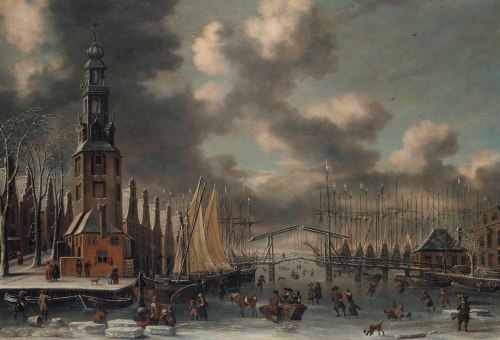
It is afternoon and the workday has ended. The people of Amsterdam are shown enjoying leisure activities on the Oudeschans canal, which they would not have done on a Sunday. Most people were Calvinists, and just as the Puritans did, they had a strict idea of what activities were permissible on Sundays.

This is partly a fantasy painting, as all really good paintings are. The intent of the composition is to show the wealth of Amsterdam and the vast fleet of merchant vessels that enable that prosperity. Some people are skating, some are fishing, and some are conducting business. Perhaps they are arranging for deliveries of goods to their warehouse. Or maybe they’re contracting for a ship to convey their goods to a distant market. Everyone looks busy and well fed.

While Abraham Storck’s staffage explores a conglomeration of the leisure activities enjoyed by the good and affluent people of Amsterdam, Thomas Heereman’s depiction of the landscape and weather is the truth of a particular winter day. I love the way the sky is shown, with the heavy clouds blowing across the blue sky.

Winter skies often look that way here in the Pacific Northwest.

About the Artists via Wikipedia:

Thomas Heeremans (1641–1694) was a Dutch painter and art dealer. He is known for his landscapes of winter scenes, cityscapes, harbor scenes, beach views, river views and village scenes. He was influenced by Klaes Molenaer, a slightly older painter also from Haarlem. Heeremans sometimes collaborated with specialist figure painters who would add the staffage in his landscapes. One of his collaborators was Abraham Storck, who painted the figures in the Winter landscape with the Montelbaanstoren, Amsterdam (Christie’s New York sale of 14 April 2016, lot 247). [1]

Abraham Storck (or Sturckenburch; bapt. 17 April 1644 in Amsterdam – buried 8 April 1708) was a Dutch painter, who enjoyed a reputation for his marine paintings, topographical views and Italianate harbour scenes. Storck was also an outstanding draughtsman. [2]

About the tower that is featured in this painting, via Wikipedia:

The Montelbaanstoren is a tower on bank of the Oudeschans – a canal in Amsterdam. The original tower was built in 1516 as part of the Walls of Amsterdam for the purpose of defending the city and the harbour. The top half, designed by Hendrick de Keyser, was extended to its current, decorative form in 1606. Since then the tower has been 48m tall.

Because the 3rd Duke of Alba proposed incorporating the tower into a castle (the Monte Albano) the tower became known in Dutch as the Monte Albano Toren. Over the years this became garbled to “Montelbaanstoren.” The castle was never built. [3]

Credits and attributions:

IMAGE: File:Thomas Heeremans and Abraham Storck – Winter landscape with the Montelbaanstoren, Amsterdam.jpg – Wikipedia (accessed January 24, 2024).

[1] Wikipedia contributors, ‘Thomas Heeremans’, Wikipedia, The Free Encyclopedia, 3 August 2023, 03:09 UTC, <https://en.wikipedia.org/w/index.php?title=Thomas_Heeremans&oldid=1168498581> [accessed 24 January 2024]

[2] Wikipedia contributors, “Abraham Storck,” Wikipedia, The Free Encyclopedia, https://en.wikipedia.org/w/index.php?title=Abraham_Storck&oldid=1164037737 (accessed January 24, 2024).

[3] Wikipedia contributors, “Montelbaanstoren,” Wikipedia, The Free Encyclopedia, https://en.wikipedia.org/w/index.php?title=Montelbaanstoren&oldid=1179532747 (accessed January 24, 2024).

2 Comments

Filed under writing

#FineArtFriday: Two Watermills and an Open Sluice by Jacob van Ruisdael 1653

Jacob_Isaacksz._van_Ruisdael_-_Two_Watermills_and_an_Open_Sluice_-_WGA20479Artist: Jacob van Ruisdael  (1628/1629–1682)

Title: Two Watermills and an Open Sluice

Genre: landscape art

Date: 1653

Medium: oil on canvas

Dimensions: height: 664 mm (26.1 in)

Collection: Getty Center

What I Love about this painting:

This painting is the perfect writing prompt. Peaceful and serene, the scene shows us two watermills opposite each other on the stream, sharing the power of the water. These mills were examples of the highest technology of that time, and the families who owned them were prosperous middle-class people. Very likely they were literate, well-respected members of the local community.

Were these mills owned by the same family?

Or were they owned by rivals, competing to grind the grain produced by the local farmers? Is one a grist mill and the other a lumber mill? Or a weaver’s mill housing looms?

Was there a love story behind their being so close to each other, perhaps a Romeo and Juliet-style romance? (Tragedy averted, of course, or it wouldn’t be a romance.)

This is a wonderful painting, a window into the past.

About the artist, via Wikipedia, the free encyclopedia:

Jacob Isaackszoon van Ruisdael (Dutch pronunciation: [ˈjaːkɔp fɑn ˈrœyzˌdaːl] ; c. 1629 – 10 March 1682) was a Dutch painter, draughtsman, and etcher. He is generally considered the pre-eminent landscape painter of the Dutch Golden Age, a period of great wealth and cultural achievement when Dutch painting became highly popular.

Prolific and versatile, Ruisdael depicted a wide variety of landscape subjects. From 1646 he painted Dutch countryside scenes of remarkable quality for a young man. After a trip to Germany in 1650, his landscapes took on a more heroic character. In his late work, conducted when he lived and worked in Amsterdam, he added city panoramas and seascapes to his regular repertoire. In these, the sky often took up two-thirds of the canvas. In total he produced more than 150 Scandinavian views featuring waterfalls.

Ruisdael’s only registered pupil was Meindert Hobbema, one of several artists who painted figures in his landscapes. Hobbema’s work has at times been confused with Ruisdael’s. Ruisdael always spelt his name thus: Ruisdael, not Ruysdael.

Ruisdael’s work was in demand in the Dutch Republic during his lifetime. Today it is spread across private and institutional collections around the world; the National Gallery in London, the Rijksmuseum in Amsterdam, and the Hermitage Museum in St. Petersburg hold the largest collections. Ruisdael shaped landscape painting traditions worldwide, from the English Romantics to the Barbizon school in France, and the Hudson River School in the US, and influenced generations of Dutch landscape artists. [1]

To read more about this artist, go to Jacob van Ruisdael – Wikipedia

About this painting via Wikipedia, the free encyclopedia:

Two Water Mills with an Open Sluice, also known as Two Watermills and an Open SluiceTwo Undershot Water Mills with an Open Sluice is a 1653 painting by the Dutch Golden Age painter Jacob van Ruisdael. It is in the collection of the Getty Museum in Los Angeles.

The painting shows two working undershot water mills, with the major one being half-timbered with a cob-facade construction, tie beams, and vertical plank gable. This is characteristic of the water mills in the Bentheim area in Germany, to where Ruisdael had travelled in the early 1650s. This painting is one of six known variations on this theme and the only one that is dated.

Although other Western artists had depicted water mills before, Ruisdael was the first to make it the focal subject in a painting. Meindert Hobbema, Ruisdael’s pupil, started working on the water mills subject in the 1660s. Today Hobbema is more strongly associated with water mills than his teacher.

The painting is known by various names. The painting is called Two Water Mills with an Open Sluice in Seymour Slive‘s 2001 catalogue raisonné of Ruisdael, catalogue number 119. In his 2011 book on Ruisdael’s mills and water mills Slive calls it Two Undershot Water Mills with an Open Sluice. The Getty Museum calls it Two Watermills and an Open Sluice on their website, object number 82.PA.18. [2]


Credits and Attributions:

Wikipedia contributors, “Two Water Mills with an Open Sluice,” Wikipedia, The Free Encyclopedia, https://en.wikipedia.org/w/index.php?title=Two_Water_Mills_with_an_Open_Sluice&oldid=1160869306 (accessed November 16, 2023).

[2] Wikipedia contributors, “Jacob van Ruisdael,” Wikipedia, The Free Encyclopedia, https://en.wikipedia.org/w/index.php?title=Jacob_van_Ruisdael&oldid=1181677660 (accessed November 16, 2023).

2 Comments

Filed under #FineArtFriday

#FineArtFriday: Dordrecht Harbor by Moonlight by Aelbert Cuyp 1643

Aelbert_Cuyp_-_Dordrecht_Harbor_by_Moonlight_4168Artist: Aelbert Cuyp (1620–1691)

Title: Dordrecht Harbor by Moonlight

Genre: landscape art

Date: 1643

Medium: oil on panel

Dimensions: height: 76.5 cm (30.1 in); width: 106.5 cm (41.9 in)

Collection: Wallraf–Richartz Museum 

What I like about this scene:

Aelbert Cuyp’s paintbrush tells a story. But what kind of story is he showing us?

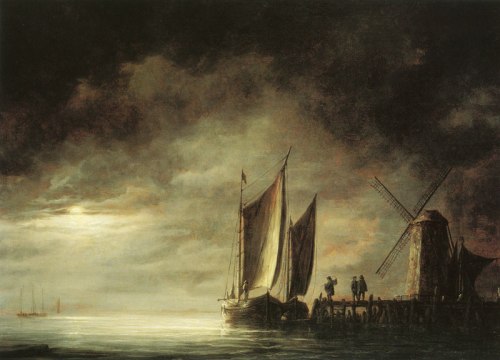
A ship is docked beside a mill at Dordrecht Harbor. Night has fallen, and a full moon, veiled by clouds, lights the scene. On the wharf, three figures stand, talking, perhaps making a deal. What could be so important that these men must discuss it in the dark?

The moonlight casts a pale glow over the scene, casting shadows and illuminating the mist rising in the distance. It adds to the mystery of the scene, conveying a feeling of clandestine conversations.

It’s 1643. The Eighty Years War, a revolution and quest for independence is still ongoing. It’s a battle for religious freedom as well as for the rights of the Dutch people to govern themselves.

Yes, indeed … some conversations by moonlight are best kept secret.

About Dordrecht in the 17th Century:

Dordrecht (Dutch: ) historically known in English as Dordt (still colloquially used in Dutch, pronounced) or Dort, is a city and municipality in the Western Netherlands, located in the province of South Holland.

During the Eighty Years’ War merchants from Dordrecht were involved in taking control and founding sugar cane plantations in the West Indies. At the end of the 17th century this led to a stable sugar refining industry in Dordrecht. This flourished in the 18th century, when Dordrecht had 16 sugar refineries, as opposed 120 in Amsterdam and 40 in Rotterdam. Dordrecht still has a few buildings purposely designed as a sugar refinery, e.g. the imposing Sugar Refinery Stokholm.

Overall, the economic importance of Dordrecht began to wane in the 18th century, and Rotterdam became the main city in the region. [1]

The Eighty Years’ War  or Dutch Revolt (Dutch: Nederlandse Opstand) (c. 1566/1568–1648) was an armed conflict in the Habsburg Netherlands between disparate groups of rebels and the Spanish government. The causes of the war included the Reformation, centralization, taxation, and the rights and privileges of the nobility and cities.

An end was reached in 1648 with the Peace of Münster (a treaty part of the Peace of Westphalia), when Spain retained Southern Netherlands and recognized the Dutch Republic as an independent country.[2]

About the Artist:

Aelbert Jacobszoon Cuyp or Cuijp (20 October 1620 – 15 November 1691) was one of the leading Dutch Golden Age painters, producing mainly landscapes. The most famous of a family of painters, the pupil of his father, Jacob Gerritszoon Cuyp (1594–1651/52), he is especially known for his large views of Dutch riverside scenes in a golden early morning or late afternoon light. He was born and died in Dordrecht.

Little is known about Aelbert Cuyp’s life. Even Arnold Houbraken, a noted historian of Dutch Golden Age paintings and the sole authority on Cuyp for the hundred years following his death, paints a very thin biographical picture.

His period of activity as a painter is traditionally limited to the two decades between 1639 and 1660, fitting within the generally accepted limits of the Dutch Golden Age’s most significant period, 1640–1665. He is known to have been married to Cornelia Bosman in 1658, a date coinciding so directly with the end of his productivity as a painter that it has been accepted that his marriage played a role in the end of his artistic career.

The year after his marriage, Cuyp became the deacon of the reformed church. Houbraken recalled that Cuyp was a devout Calvinist and the fact that when he died, there were no paintings of other artists found in his home. [3]

Credits and Attributions:

IMAGE:  Dordrecht Harbor by Moonlight by Aelbert Cuyp, 1643. Wikimedia Commons contributors, “File:Aelbert Cuyp – Dordrecht Harbor by Moonlight 4168.jpg,” Wikimedia Commons, https://commons.wikimedia.org/w/index.php?title=File:Aelbert_Cuyp_-_Dordrecht_Harbor_by_Moonlight_4168.jpg&oldid=782562344 (accessed September 28, 2023).

[1] Wikipedia contributors, “Dordrecht,” Wikipedia, The Free Encyclopedia, https://en.wikipedia.org/w/index.php?title=Dordrecht&oldid=1169436434 (accessed September 28, 2023).

[2] Wikipedia contributors, “Eighty Years’ War,” Wikipedia, The Free Encyclopedia, https://en.wikipedia.org/w/index.php?title=Eighty_Years%27_War&oldid=1177125376 (accessed September 28, 2023).

[3] Wikipedia contributors, “Aelbert Cuyp,” Wikipedia, The Free Encyclopedia, https://en.wikipedia.org/w/index.php?title=Aelbert_Cuyp&oldid=1177164314 (accessed September 28, 2023).

2 Comments

Filed under #FineArtFriday

#FineArtFriday: The Bird Concert by Jan Brueghel the Younger ca. 1640 – 45 (revisited)

OLYMPUS DIGITAL CAMERA

Artist: Jan Brueghel the Younger (1601–1678)

Title: the Bird Concert

Date: between circa 1640 and circa 1645

Medium: oil on copper

Dimensions: height: 13.2 cm (5.1 in); width: 17.9 cm (7 in)

Collection: Herzog Anton Ulrich Museum

Today we are taking a second look at one of my favorite paintings of the 17th century.

What I love about this painting:

This is a joyous, surreal exploration of all the birds the artist had ever seen in his native Antwerp, and many rare birds that he could only imagine. Brueghel has gathered birds from all over the world into a mystical, fairytale glen, posing them around a songbook.

They are learning to sing a in a language they all can understand, a wonderful allegory of the aspirations of the artist for humanity in the turbulent times during which he lived.

This painting also celebrates the new discoveries made by European explorers, as Brueghel had only seen scientific drawings of many of these birds. Even though he hadn’t seen some of these birds personally, he paints them as if they are before him.

The amazing flock of birds gathered here gives us an insight into the mind and sense of humor of Jan Brueghel the Younger, a man not too different from us even though he lived over 300 years ago.

This composition must have been important to Brueghel and says something about him. He went to the expense of getting copper as the base upon which he painted this scene. He was comfortable but not rich, so that tells me he intended this painting to last, to be something he would be remembered for.

About the medium of Oil on Copper, via Wikipedia:

Oil on copper paintings were prevalent in the mid sixteenth century in Italy and Northern Europe. The use of copper as a substrate for an oil painting dates back to Medieval times. The Flemish masters and other artists including Jan Breughel the ElderClaudeEl GrecoGuido ReniGuercinoRembrandtCarlo SaraceniAmbrosius Bosschaert IICopley Fielding and Vernet painted on copper. They favored copper for its smooth surface which allowed fine detail, and its durability. Copper is more durable than canvas or wood panel as a support for oil painting, as it will not rot, mildew or be eaten by insects. Contemporary painters also use copper as a base for paintings, some of them allowing the metal or patina to show through.

The old masters prepared the copper for painting first by rubbing it with fine pumice abrasive. The copper surface was then treated with garlic juice which is believed to improve adhesion of the paint. Finally a white or grey ground layer of oil paint was applied as a primer. After drying the copper panel was ready for the artist to begin painting. Later artists used the patina process, in which the copper is oxidized with the use of various acidic solutions, as part of the art work itself. The resulting patina or verdigris includes darkening of the metal, green and blue tones, depending on the chemical solution used. Patina is characterized by beautiful, variated patterns and textures which occur on the metal’s surface. [1]

About the Artist, via Wikipedia:

Jan Brueghel the Younger was born in Antwerp on 13 September 1601 as the son of Jan Brueghel the Elder and Isabella de Jode. His mother was the daughter of the cartographer, engraver and publisher Gerard de Jode. He trained and collaborated with his father in his workshop. His father was a friend and close collaborator of Peter Paul Rubens. Brueghel likely assisted with his father’s large-scale commissions.

On the wishes of his father he traveled around 1622 to Milan where he was welcomed by Cardinal Federico Borromeo. The cardinal was a patron and friend of his father who had met in Rome about 30 years earlier. In what was likely an act of rebellion against his father, he went to Genoa where he stayed with his cousins, the Antwerp painters and art dealers Lucas de Wael and Cornelis de Wael. Their mother was a sister of Brueghel’s mother. At the time his friend and fellow Antwerp artist Anthony van Dyck was also active in Genoa. He later worked in Valletta on Malta in 1623. From 1624 to 1625 he also resided in Palermo on Sicily at the time when van Dyck was also working there.

Brueghel learned that his father had died on 13 January 1625 from cholera only after his return to Northern Italy in Turin. Wanting to return to Antwerp immediately, he had to delay his departure for 16 days due to a severe fever. After recovering from his illness, he set off for his homeland by way of France. In Paris he met the Antwerp art dealer and painter Peter Goetkint the Younger, who was the son of Peter Goetkint the Elder, the master of Jan’s father. Goetkint was eager to return to Antwerp because his wife was expected to deliver a baby soon. The child was born on 25 August, the day on which Breughel arrived in Antwerp with his traveling companion who himself died a few days later.

Brueghel took over the management of his father’s workshop, sold the finished works of his father and finished some of his father’s unfinished paintings after completing them. In the Guild year 1624-1625, Brueghel became a master painter of the Guild of Saint Luke of Antwerp.

In 1626 he married Anna Maria Janssens, daughter of Abraham Janssens, a prominent history painter in Antwerp. He continued to operate the large workshop of his father. He became dean of the Guild of Saint Luke in 1630. That same year he was commissioned by the French court to paint a series of paintings on the life of Adam. It seems that his studio declined after this period and that he started to paint smaller scale paintings which commanded lower prices than those produced earlier.

In later years, he worked independently in Paris in the 1650s and produced paintings for the Austrian court in 1651. He is recorded again in Antwerp in 1657 where he remained until his death. [2]


Credits and Attributions:

[1] Wikipedia contributors, “Oil on copper,” Wikipedia, The Free Encyclopedia, https://en.wikipedia.org/w/index.php?title=Oil_on_copper&oldid=1060711380 (accessed June 9, 2022).

[2] Wikipedia contributors, “Jan Brueghel the Younger,” Wikipedia, The Free Encyclopedia, https://en.wikipedia.org/w/index.php?title=Jan_Brueghel_the_Younger&oldid=1086952033 (accessed June 9, 2022).

Image: The Bird Concert by Jan Brueghel the Younger ca. 1640 -1645, PD|100. Wikimedia Commons contributors, “File:Bruegel Vogelkonzert@Herzog Anton Ulrich Museum (1).JPG,” Wikimedia Commons, the free media

Comments Off on #FineArtFriday: The Bird Concert by Jan Brueghel the Younger ca. 1640 – 45 (revisited)

Filed under #FineArtFriday, writing

#FineArtFriday: River Landscape by Jan Brueghel the Elder 1614

A_Wooded_River_Landscape_with_a_Landing_Stage,_Boats…_by_Jan_Brueghel_the_ElderArtist: Jan Brueghel the Elder (1568–1625)
Title: River Landscape (Wooded river landscape with a landing stage, boats, various figures and a village beyond).

Date: 1614

Medium: oil on copper

Dimensions: height: 25.9 cm (10.1 in); width: 37 cm (14.5 in)

What I love about this painting:

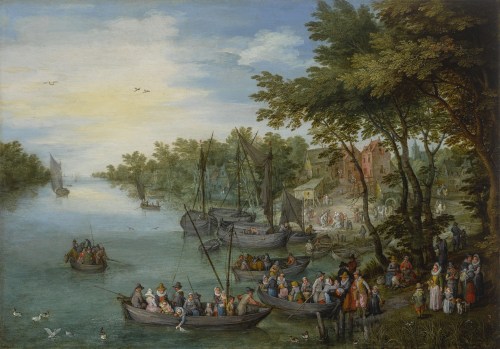
Men, women, and children fill the boats for a day on the river, dressed in colorful garb. Everyone is in good spirits, looking forward to a day of relaxing and perhaps a little fishing. Onshore, crews will fillet and smoke or salt whatever can’t be eaten right way. When weather is fine and the fish are plentiful, the party is on. Everyone will eat well for a few days.

About this painting, via Wikipedia:

Jan Brueghel’s father, Pieter Bruegel the Elder, is regarded as an important innovator of landscape art. By introducing greater naturalism in his Alpine mountain settings, his father had expanded on the world landscape tradition that had been founded mainly by Joachim Patinir. Some of Pieter the Elder’s works also foreshadowed the forest landscape that would start to dominate landscape painting around the turn of the 16th century. Pieter the Elder also developed the village and rural landscape, placing Flemish hamlets and farms in exotic prospects of mountains and river valleys.

Jan developed on the formula he learned from his father of arranging country figures traveling a road, which recedes into the distance. He emphasized the recession into space by carefully diminishing the scale of figures in the foreground, middle-ground, and far distance. To further the sense of atmospheric perspective, he used varying tones of brown, green, and blue progressively to characterize the recession of space. His landscapes with their vast depth are balanced through his attention to the peasant figures and their humble activities in the foreground.

Jan Brueghel’s landscape paintings with their strong narrative elements and attention to detail had a significant influence on Flemish and Dutch landscape artists in the second decade of the 17th century. His river views were certainly known to painters working in Haarlem, including Esaias van de Velde and Willem Buytewech, whom Brueghel may have met there when he accompanied Peter Paul Rubens on a diplomatic mission to the Dutch Republic in 1613. [1]

About the Artist, via Wikipedia:

Jan Brueghel (also Bruegel or Breughelthe Elder 1568 – 13 January 1625) was a Flemish painter and draughtsman. He was the son of the eminent Flemish Renaissance painter Pieter Bruegel the Elder. A close friend and frequent collaborator with Peter Paul Rubens, the two artists were the leading Flemish painters in the first three decades of the 17th century.

Brueghel worked in many genres including history paintings, flower still lifes, allegorical and mythological scenes, landscapes and seascapes, hunting pieces, village scenes, battle scenes and scenes of hellfire and the underworld. He was an important innovator who invented new types of paintings such as flower garland paintings, paradise landscapes, and gallery paintings in the first quarter of the 17th century. He further created genre paintings that were imitations, pastiches and reworkings of his father’s works, in particular his father’s genre scenes and landscapes with peasants. Brueghel represented the type of the pictor doctus, the erudite painter whose works are informed by the religious motifs and aspirations of the Catholic Counter-Reformation as well as the scientific revolution with its interest in accurate description and classification. He was court painter of the Archduke and Duchess Albrecht and Isabella, the governors of the Habsburg Netherlands.

The artist was nicknamed “Velvet” Brueghel, “Flower” Brueghel, and “Paradise” Brueghel. The first is believed to have been given him because of his mastery in the rendering of fabrics. The second nickname is a reference to his fame as a painter of (although not a specialist in) flower pieces and the last one to his invention of the genre of the paradise landscape. His brother Pieter Brueghel the Younger was traditionally nicknamed “de helse Brueghel” or “Hell Brueghel” because it was believed he was the author of a number of paintings with fantastic depictions of fire and grotesque imagery. These paintings have now been reattributed to Jan Brueghel the Elder. [1]


Credits and Attributions:

Image:  River Landscape by Jan Brueghel the Elder, 1614. Wikimedia Commons contributors, “File:A Wooded River Landscape with a Landing Stage, Boats… by Jan Brueghel the Elder.jpg,” Wikimedia Commons, the free media repository, https://commons.wikimedia.org/w/index.php?title=File:A_Wooded_River_Landscape_with_a_Landing_Stage,_Boats%E2%80%A6_by_Jan_Brueghel_the_Elder.jpg&oldid=358393285 (accessed June 17, 2022).

[1] Wikipedia contributors, “Jan Brueghel the Elder,” Wikipedia, The Free Encyclopedia, https://en.wikipedia.org/w/index.php?title=Jan_Brueghel_the_Elder&oldid=1082625249 (accessed June 17, 2022).

Comments Off on #FineArtFriday: River Landscape by Jan Brueghel the Elder 1614

Filed under #FineArtFriday

#FineArtFriday: The Bird Concert by Jan Brueghel the Younger ca. 1640 – 45

OLYMPUS DIGITAL CAMERA

Artist: Jan Brueghel the Younger (1601–1678)

Title: the Bird Concert

Date: between circa 1640 and circa 1645

Medium: oil on copper

Dimensions: height: 13.2 cm (5.1 in); width: 17.9 cm (7 in)

Collection: Herzog Anton Ulrich Museum

What I love about this painting:

This is a joyous, surreal exploration of all the birds the artist had ever seen in his native Antwerp, and many rare birds that he could only imagine. Brueghel has gathered birds from all over the world into a mystical, fairytale glen, posing them around a songbook.

They are learning to sing a in a language they all can understand, a wonderful allegory of the aspirations of the artist for humanity in the turbulent times during which he lived.

This painting also celebrates the new discoveries made by European explorers, as Brueghel had only seen scientific drawings of many of these birds. Even though he hadn’t seen some of these birds personally, he paints them as if they are before him.

The amazing flock of birds gathered here gives us an insight into the mind and sense of humor of Jan Brueghel the Younger, a man not too different from us even though he lived over 300 years ago.

This composition must have been important to Brueghel and says something about him. He went to the expense of getting copper as the base upon which he painted this scene. He was comfortable but not rich, so that tells me he intended this painting to last, to be something he would be remembered for.

About the medium of Oil on Copper, via Wikipedia:

Oil on copper paintings were prevalent in the mid sixteenth century in Italy and Northern Europe. The use of copper as a substrate for an oil painting dates back to Medieval times. The Flemish masters and other artists including Jan Breughel the ElderClaudeEl GrecoGuido ReniGuercinoRembrandtCarlo SaraceniAmbrosius Bosschaert IICopley Fielding and Vernet painted on copper. They favored copper for its smooth surface which allowed fine detail, and its durability. Copper is more durable than canvas or wood panel as a support for oil painting, as it will not rot, mildew or be eaten by insects. Contemporary painters also use copper as a base for paintings, some of them allowing the metal or patina to show through.

The old masters prepared the copper for painting first by rubbing it with fine pumice abrasive. The copper surface was then treated with garlic juice which is believed to improve adhesion of the paint. Finally a white or grey ground layer of oil paint was applied as a primer. After drying the copper panel was ready for the artist to begin painting. Later artists used the patina process, in which the copper is oxidized with the use of various acidic solutions, as part of the art work itself. The resulting patina or verdigris includes darkening of the metal, green and blue tones, depending on the chemical solution used. Patina is characterized by beautiful, variated patterns and textures which occur on the metal’s surface. [1]

About the Artist, via Wikipedia:

Jan Brueghel the Younger was born in Antwerp on 13 September 1601 as the son of Jan Brueghel the Elder and Isabella de Jode. His mother was the daughter of the cartographer, engraver and publisher Gerard de Jode. He trained and collaborated with his father in his workshop. His father was a friend and close collaborator of Peter Paul Rubens. Brueghel likely assisted with his father’s large-scale commissions.

On the wishes of his father he traveled around 1622 to Milan where he was welcomed by Cardinal Federico Borromeo. The cardinal was a patron and friend of his father who had met in Rome about 30 years earlier. In what was likely an act of rebellion against his father, he went to Genoa where he stayed with his cousins, the Antwerp painters and art dealers Lucas de Wael and Cornelis de Wael. Their mother was a sister of Brueghel’s mother. At the time his friend and fellow Antwerp artist Anthony van Dyck was also active in Genoa. He later worked in Valletta on Malta in 1623. From 1624 to 1625 he also resided in Palermo on Sicily at the time when van Dyck was also working there.

Brueghel learned that his father had died on 13 January 1625 from cholera only after his return to Northern Italy in Turin. Wanting to return to Antwerp immediately, he had to delay his departure for 16 days due to a severe fever. After recovering from his illness, he set off for his homeland by way of France. In Paris he met the Antwerp art dealer and painter Peter Goetkint the Younger, who was the son of Peter Goetkint the Elder, the master of Jan’s father. Goetkint was eager to return to Antwerp because his wife was expected to deliver a baby soon. The child was born on 25 August, the day on which Breughel arrived in Antwerp with his traveling companion who himself died a few days later.

Brueghel took over the management of his father’s workshop, sold the finished works of his father and finished some of his father’s unfinished paintings after completing them. In the Guild year 1624-1625, Brueghel became a master painter of the Guild of Saint Luke of Antwerp.

In 1626 he married Anna Maria Janssens, daughter of Abraham Janssens, a prominent history painter in Antwerp. He continued to operate the large workshop of his father. He became dean of the Guild of Saint Luke in 1630. That same year he was commissioned by the French court to paint a series of paintings on the life of Adam. It seems that his studio declined after this period and that he started to paint smaller scale paintings which commanded lower prices than those produced earlier.

In later years, he worked independently in Paris in the 1650s and produced paintings for the Austrian court in 1651. He is recorded again in Antwerp in 1657 where he remained until his death. [2]


Credits and Attributions:

[1] Wikipedia contributors, “Oil on copper,” Wikipedia, The Free Encyclopedia, https://en.wikipedia.org/w/index.php?title=Oil_on_copper&oldid=1060711380 (accessed June 9, 2022).

[2] Wikipedia contributors, “Jan Brueghel the Younger,” Wikipedia, The Free Encyclopedia, https://en.wikipedia.org/w/index.php?title=Jan_Brueghel_the_Younger&oldid=1086952033 (accessed June 9, 2022).

Image: The Bird Concert by Jan Brueghel the Younger ca. 1640 -1645, PD|100. Wikimedia Commons contributors, “File:Bruegel Vogelkonzert@Herzog Anton Ulrich Museum (1).JPG,” Wikimedia Commons, the free media

2 Comments

Filed under #FineArtFriday, writing

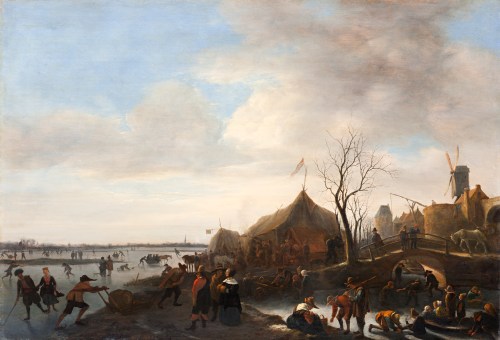
#FineArtFriday: Winter Scene by Jan Steen 1650

Inv.nr: 10032

Artist: Jan Steen (1625/1626–1679)

Title: Winter Scene

Date: circa 1650

Medium: oil on canvas

Dimensions: Height: 660 mm (25.98 in); Width: 960 mm (37.79 in)

About this painting, Via Wikimedia Commons:

[1] Winter Scene is one of the earliest known paintings by Steen. With its diagonal composition and silhouetted figures on the ice one can clearly see his early inspirations from paintings such as Isaac van Ostade’s Winter from 1645. Here, as often seen in other works by Steen and his contemporaries, the activities are being watched by a well-dressed couple who occupies a central position in the composition. [1]

About the Artist, via Wikipedia:

[2] Jan Havickszoon Steen (c. 1626 – buried 3 February 1679) was a Dutch Golden Age painter, one of the leading genre painters of the 17th century. His works are known for their psychological insight, sense of humour and abundance of colour.

Daily life was Jan Steen’s main pictorial theme. Many of the genre scenes he portrayed, as in The Feast of Saint Nicholas, are lively to the point of chaos and lustfulness, even so much that “a Jan Steen household,” meaning a messy scene, became a Dutch proverb (een huishouden van Jan Steen). Subtle hints in his paintings seem to suggest that Steen meant to warn the viewer rather than invite him to copy this behaviour. Many of Steen’s paintings bear references to old Dutch proverbs or literature. He often used members of his family as models, and painted quite a few self-portraits in which he showed no tendency of vanity.

Steen did not shy from other themes: he painted historical, mythological and religious scenes, portraits, still lifes and natural scenes. His portraits of children are famous. He is also well known for his mastery of light and attention to detail, most notably in Persian rugs and other textiles.

Steen was prolific, producing about 800 paintings, of which roughly 350 survive. His work was valued much by contemporaries and as a result he was reasonably well paid for his work. He did not have many students—only Richard Brakenburgh is recorded—but his work proved a source of inspiration for many painters. [2]


Credits and Attributions:

Wikimedia Commons contributors, “File:Måleri, landskapsbild, vinterlandskap. Jan Steen – Skoklosters slott – 88965.tif,” Wikimedia Commons, the free media repository, https://commons.wikimedia.org/w/index.php?title=File:M%C3%A5leri,_landskapsbild,_vinterlandskap._Jan_Steen_-_Skoklosters_slott_-_88965.tif&oldid=428348165 (accessed July 22, 2021). Photographer:  Jens Mohr.

Wikipedia contributors, “Jan Steen,” Wikipedia, The Free Encyclopedia, https://en.wikipedia.org/w/index.php?title=Jan_Steen&oldid=1022958604 (accessed July 22, 2021).

Comments Off on #FineArtFriday: Winter Scene by Jan Steen 1650

Filed under #FineArtFriday