Tag Archives: 19th century landscape paintings

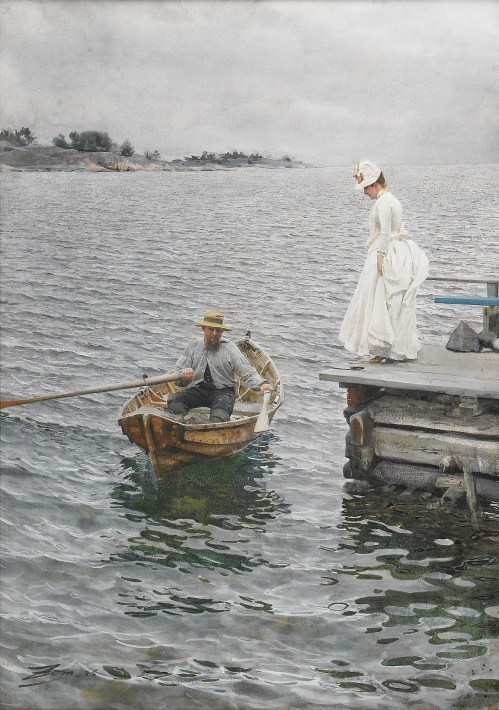
#FineArtFriday: Sommarnöje (Summer Fun) by Anders Zorn 1886

Sommarnöje_(1886),_akvarell_av_Anders_ZornArtist: Anders Zorn  (1860–1920)

Title: (Swedish: Sommarnöje)  (English: Summer Fun)

Genre: marine art

Date: 1886

Medium: watercolor paint on paper

Dimensions: height: 76 cm (29.9 in)

Collection: Private collection

Place of creation: Dalarö, Sweden

Inscriptions: Signature and date bottom left: Zorn -86

What I love about this painting:

This image, the way the lake is shown, took me back to my childhood. I grew up in a house that faced directly onto a large lake, with a wide beach for swimming, a wooden dock, and few neighbors. The southern Puget Sound area experiences more overcast days in June than most people like. Many days, the waters and the sky looked exactly as Anders Zorn has depicted them here.

Zorn’s brushwork is so meticulous, it is nearly photographic. He captures the feeling of the day, of the breeze, slightly sharp but not too cold, and the anticipation of going out on the water.

About this painting, via Wikipedia:

Zorn painted Sommarnöje in Dalarö in the early summer of 1886, after the couple had returned from honeymoon but before they settled in Mora. He made a smaller sketch first, which measures 30.2 by 18.8 centimeters (11.9 in × 7.4 in), now held by the Zorn Museum in Mora.

The completed watercolor captures a fleeting moment and shows influence from the works of the French Impressionists that Zorn had seen while in Paris, but with a distinctively austere Scandinavian palette.

The painting depicts the artist’s wife Emma Zorn standing in a white dress and hat, waiting on the edge of a wooden pier beside the water, as their friend Carl Gustav Dahlström approaches in a rowing boat.

The reflective glassy surface of the water is rippling in a breeze, under cloudy grey skies. The figures, pier, boat and sea are finely rendered, almost as if the work was made in oil paint, showing Zorn’s skill as a watercolorist. Less attention is paid to the other side of the lake, sketched roughly in the background. It is signed and dated in the lower left corner, “Zorn 86”.

It was acquired by Edvard Levisson of Gothenburg, and then descended through the Schollin-Borg family. The painting was sold at the Stockholms Auktionsverk in June 2010 for SEK 26 million, setting a record for a Swedish painting.

About the Artist, via Wikipedia:

Zorn was born in Mora, Sweden, between the lakes of Siljan and Orsasjön. He studied at the Royal Swedish Academy of Arts in Stockholm from 1875 to 1880, and then spent time travelling in Europe, painting watercolours and society portraits in London, Paris and Madrid.

He returned to Sweden in 1885, and on 16 October, he married Emma Zorn (née Lamm) (1860 – 1942). After spending their honeymoon abroad, in eastern Europe and Turkey, they returned to Sweden in 1886, spending time with Emma’s family at Dalarö, before settling near Mora, where their house, which is now the home of the Zorn Collections, is located.


Credits and Attributions:

IMAGE: Wikimedia Commons contributors, “File:Sommarnöje (1886), akvarell av Anders Zorn.jpg,” Wikimedia Commons, https://commons.wikimedia.org/w/index.php?title=File:Sommarn%C3%B6je_(1886),_akvarell_av_Anders_Zorn.jpg&oldid=842907051 (accessed February 29, 2024).

[1] Wikipedia contributors, “Sommarnöje,” Wikipedia, The Free Encyclopedia, https://en.wikipedia.org/w/index.php?title=Sommarn%C3%B6je&oldid=1149795747 (accessed February 29, 2024).

5 Comments

Filed under writing

#FineArtFriday: Wanderer in the Storm by Carl Julius von Leypold 1835 (a second look)

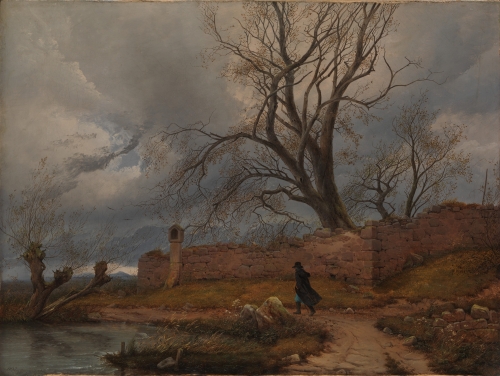
Karl_Julius_von_Leypold_-_Wanderer_im_SturmArtist: Carl Julius von Leypold  (1806–1874)
Title: Wanderer in the Storm

Date: 1835

Medium: oil on canvas

Dimensions: height: 42.5 cm (16.7 in); width: 56.5 cm (22.2 in)

Collection: Metropolitan Museum of Art

What I love about this painting:

This painting completely describes typical January weather in the cold, dark, and stormy Pacific Northwest—wind and rain and rain and wind. Winter is in full swing, a few degrees warmer this week than last, but dark, cold, and wet. Hopefully, we will avoid having more snow and ice, but it’s only January. Anything can be lurking around the corner.

I love the dark and moody sky that von Leypold paints for us. It has movement, a sense of life, of wind and rain gathering momentum, a small pause while it builds toward a tantrum of the wintery kind. It feels heavy and oppressive.

One can almost hear the water lapping at the shore. Beyond the muddy lane, the trees are like me, old but strong, holding their barren branches defiant before the storm. They seem to shout, “We will bend but never break!” and by bending with the winds, those trees will survive to see yet another blossoming of spring.

The ancient stone wall stands firm, still doing its duty despite being long neglected and left to ruin. It refuses to abandon its purpose, although it no longer remembers what that might be.

The man trudges purposefully, despite the wind that whips at his long coat. Does he feel the cold, or is he walking quickly enough that he is warm? And where is he going? Who is he so intent upon seeing that he would brave the storm on foot?

More importantly, does danger lurk around the corner? Will he be safe?

There is a story in this painting.

About the Artist, via Wikipedia:

Carl Julius von Leypold (1806–1874) was a German Romantic landscape painter known for his painting, “Wanderer in the Storm.”

Von Leypold studied landscape painting with Johan Christian Dahl at the Dresden Academy of Fine Arts between 1820 and 1829. From 1826 onwards, Caspar David Friedrich influenced his choice of subjects and painting style. His landscapes are characterized by “a painterly, but at the same time sharp-brushed style, in which high painting culture is combined with Biedermeier objectivity.”

On March 5, 1857, he became an honorary member of the Dresden Art Academy. [1]


Credits and Attributions:

Image: Wanderer in the Storm by Carl Julius von Leypold PD|100. Wikimedia Commons contributors, “File:Karl Julius von Leypold – Wanderer im Sturm.jpg,” Wikimedia Commons, the free media repository, https://commons.wikimedia.org/w/index.php?title=File:Karl_Julius_von_Leypold_-_Wanderer_im_Sturm.jpg&oldid=675091985 (accessed January 5, 2023).

[1] Wikipedia contributors, “Carl Julius von Leypold,” Wikipedia, The Free Encyclopedia, https://en.wikipedia.org/w/index.php?title=Carl_Julius_von_Leypold&oldid=1095364695 (accessed January 5, 2023).

Comments Off on #FineArtFriday: Wanderer in the Storm by Carl Julius von Leypold 1835 (a second look)

Filed under #FineArtFriday, writing

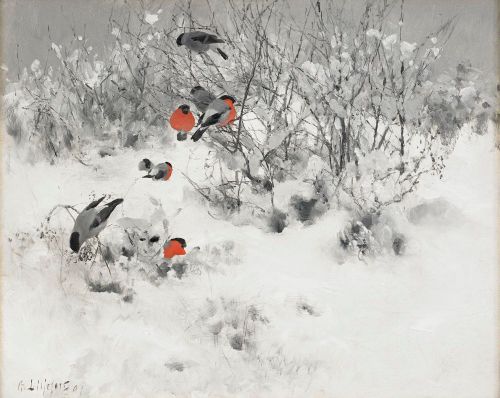
#FineArtFriday: Winter landscape with bullfinches by Bruno Liljefors 1891

Bruno_Liljefors_-_Winter_landscape_with_bullfinches_1891Artist: Bruno Liljefors  (1860–1939)

Title: English: Winter landscape with bullfinches

Date: 1891

Medium: oil on canvas

Dimensions: height: 40 cm (15.7 in); width: 50 cm (19.6 in)

What I love about this painting:

This is a Christmas card kind of scene, and I’m sure I have seen it featured on many cards over the years. However, the birds are what attracted me to this painting. Birds of all varieties enthrall me, and these birds are gorgeous.

I love the colors of these bullfinches, love the natural way they are shown roosting in the shrubbery. These birds are European and are different from the bright yellow goldfinches I know here in the Pacific Northwest.

My childhood home had begun its life as a one room hunting cabin that had been converted to a mid-century rambler and turned into a family home in the 1950s. It was situated on a large stretch of beach on the southeastern shore of Black Lake near Olympia, Washington. Our property was centered in a thick forest of Douglas fir, western red cedars, and hemlock trees.

My parents were avid gardeners, and besides the large veggie garden and flower beds, we had many ornamental shrubs. Native Oregon Grape, salmon berries, and salal bordered the edges of our property.

One of my earliest memories is that of watching the winter birds. First, they perched in shrubs, then they flew off, and then they were back again.

Dark-eyed juncos, sparrows, and chickadees gathered in the shrubs. Larger birds, such as crows, owls, and ospreys roosted in the trees. On the lake, ducks, Canada geese, and grebes swam along with the occasional swan or loon.

Birdwatching provided endless entertainment during a time when our television antenna only picked up the signals from two stations. While we did see shows like Star Trek, Batman, Get Smart, and the Addams Family in the evenings, TV overall was a wash, as storms had cut the power to our home many times. Some winters were worse than others, and sometimes, we were without power for several weeks, waiting for the linemen to hook us back up.

To this day, birdwatching is one of my family’s favorite things to do.

About the Artist, via Wikipedia:

Bruno Andreas Liljefors, 14 May 1860 – 18 December 1939) was a Swedish artist. He is perhaps best known for his nature and animal motifs, especially with dramatic situations. He was the most important and probably most influential Swedish wildlife painter of the late nineteenth and early twentieth century. He also drew some sequential picture stories, making him one of the early Swedish comic creators. [1]

To read more about the artist, go to Bruno Liljefors – Wikipedia.


Credits and Attributions:

IMAGE: Wikimedia Commons contributors, “File:Bruno Liljefors – Winter landscape with bullfinches 1891.jpg,” Wikimedia Commons, https://commons.wikimedia.org/w/index.php?title=File:Bruno_Liljefors_-_Winter_landscape_with_bullfinches_1891.jpg&oldid=812150991 (accessed December 14, 2023).

[1] Wikipedia contributors, “Bruno Liljefors,” Wikipedia, The Free Encyclopedia, https://en.wikipedia.org/w/index.php?title=Bruno_Liljefors&oldid=1170413866 (accessed December 14, 2023).

Comments Off on #FineArtFriday: Winter landscape with bullfinches by Bruno Liljefors 1891

Filed under #FineArtFriday

#FineArtFriday: Cider Pressing by George Henry Durrie 1855 (revisited)
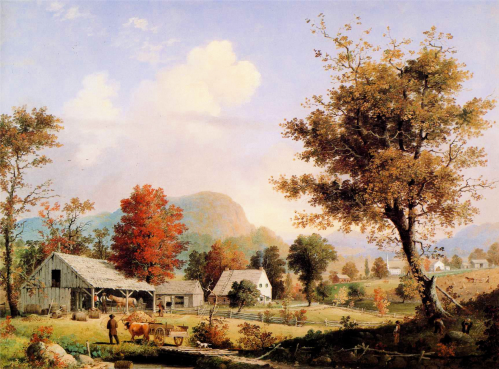
George_Henry_Durrie_-_Cider_PressingCider Pressing by George Henry Durrie 1855

Date: 1855

Medium: oil on canvas

Dimensions: Height: 22.2 in (56.5 cm); Width: 30.2 in (76.8 cm)

Collection: Private collection (Mr. & Mrs. Eugene Bugbee)

What I love about this painting:

We’re nearing the end of October, and autumn is fast sliding into the long dark of a northern November. Some trees are shedding their leaves here in the Pacific Northwest, but others are clinging to the last shreds of yellow and gold. Our native fall colors are less brilliant than those depicted in Durie’s work, but many non-native species have been introduced in the suburban landscape, offering bursts of scarlet and orange.

I love the simplicity of George Henry Durrie’s paintings. This one in particular deserves a second look. It first appeared here in September of 2021.

This is a quintessential, slightly romantic, view of history, a window into a New England day in autumn during the 19th century. A farmer leads his ox-drawn cart to the cider press. Is he selling them to the cider-man or just paying to have them juiced? Does he make his own apple jack, or is he a teamster, transporting goods for a fee?

A story can be found here, as in all Durrie’s paintings.

Juicing apples for unfermented ciders juices, jellies, and the highly fermented apple jack was an essential part of bringing in the harvest and preparing for winter, a part of the food chain we who get our food from the supermarket are disconnected from. But this was a scene that played out every fall, in every town and village.

Durrie’s colors are intensely vibrant, deep and rich, and each part of the scene is clear and placed with intent. The air is crisp and cool, but not yet cold. The leaves are turning all shades of red and gold, just as they are doing here today in the Pacific Northwest.

About the Artist, quoted from the National Gallery of Art:

Born in New Haven in 1820, the son of a Connecticut stationer, George Henry Durrie remained in that city virtually his entire life. Married to a choirmaster’s daughter, Sarah Perkins, in 1841, he immersed himself in the quiet pursuits of family and church. While he never achieved the fame of the most renowned nineteenth century American landscape painters, he appears to have had a fulfilling, productive career. His letters show that he never felt the need to move beyond his community, although he once briefly took a studio in New York and exhibited there regularly at the National Academy of Design.

Almost all of his compositions are relatively small in scale, few exceeding 18 x 24 inches, and his views are quiet and intimate. He knew and admired the works of Thomas Cole, and may have tried to emulate certain aspects of Cole’s style, yet he eschewed the Hudson River School’s compositional complexity and expansiveness. Because his paintings combined extensive genre elements with landscape they had a story-telling content that made them pleasant, accessible images to the average viewer.

The lithographic firm of Currier & Ives successfully reproduced ten of Durrie’s scenes and these, in turn, became popular calendar illustrations in the twentieth century. As a result, Durrie’s depictions of rural life in the mid-nineteenth century are now among the most familiar images in all of American art. As Martha Hutson has noted, however, these printed pictures do not convey the keen sensitivity to and understanding of conditions of atmosphere and light that are so pronounced in Durrie’s paintings. [1]

From Wikipedia:

In his teens the self-taught artist painted portraits in the New Haven area. In 1839 he received artistic instruction from Nathaniel Jocelyn, a local engraver and portrait painter. After 1842 he settled in New Haven, but made painting trips to New Jersey, New York, and Virginia. Around 1850, he began painting genre scenes of rural life, as well as the winter landscapes that became popular when Currier and Ives published them as lithographs. Four prints were published between 1860 and the artist’s death in New Haven in 1863; six additional prints were issued posthumously. The painter Jeanette Shepperd Harrison Loop studied with him. [2]


Credits and Attributions:

Wikimedia Commons contributors, “File:George Henry Durrie – Cider Pressing.JPG,” Wikimedia Commons, the free media repository, https://commons.wikimedia.org/w/index.php?title=File:George_Henry_Durrie_-_Cider_Pressing.JPG&oldid=369724230 (accessed September 15, 2021).

[1] National Gallery of Art contributors, “George Henry Durrie,” biography, © 2018 – 2021 National Gallery of Art, https://www.nga.gov/collection/artist-info.6397.html

[2] Wikipedia contributors, “George Henry Durrie,” Wikipedia, The Free Encyclopedia, https://en.wikipedia.org/w/index.php?title=George_Henry_Durrie&oldid=861433469 (accessed September 15, 2021).

2 Comments

Filed under #FineArtFriday, writing

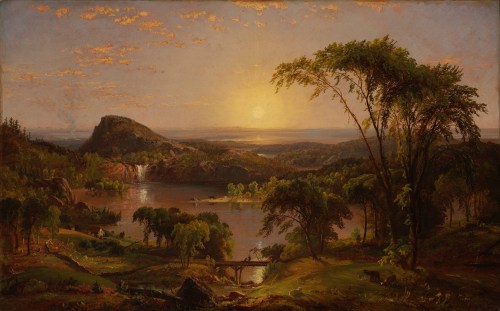
#FineArtFriday: Summer, Lake Ontario by Jasper Francis Cropsey 1857 (revisited)

Cropsey,_Jasper_Francis_-_Summer,_Lake_Ontario_-_Google_Art_ProjectTitle: Summer, Lake Ontario by Jasper Francis Cropsey (1823–1900)
Genre: landscape art

Date: 1857

Medium: oil on canvas

Collection: Indianapolis Museum of Art

What I love about this painting:

Cropsey paints a summer evening in New York State, along the shore of one of Lake Ontario’s bays. Near the bottom center, a pair of fishers are placed on the wooden bridge over a creek. This image has a fantasy quality, as if it depicts a dream or a fond memory.

Our point of view is from a hill, looking down to the creek, the bridge, and the bay shore, and then across low hills to the great lake beyond. Cropsey gives equal importance to the earth below and sky above.

Cropsey’s signature deep colors are featured in this panoramic view of a summer evening. Warm reds, browns, yellows, and dark greens are lightened by wispy mists rising in the early evening air, lit by the setting sun.

About the Artist, via Wikipedia:

Jasper Francis Cropsey (February 18, 1823 – June 22, 1900) was an important American landscape artist of the Hudson River School.

Cropsey was born on his father Jacob Rezeau Cropsey’s farm in Rossville on Staten Island, New York, the oldest of eight children. As a young boy, Cropsey had recurring periods of poor health. While absent from school, Cropsey taught himself to draw. His early drawings included architectural sketches and landscapes drawn on notepads and in the margins of his schoolbooks.

Trained as an architect, he set up his own office in 1843. Cropsey studied watercolor and life drawing at the National Academy of Design under the instruction of Edward Maury and first exhibited there in 1844. A year later he was elected an associate member and turned exclusively to landscape painting; shortly after he was featured in an exhibition entitled “Italian Compositions.”

Cropsey traveled in Europe from 1847–1849, visiting England, France, Switzerland, and Italy. He was elected a full member of the Academy in 1851. Cropsey was a personal friend of Henry Tappan, the president of the University of Michigan from 1852 to 1863. At Tappan’s invitation, he traveled to Ann Arbor in 1855 and produced two paintings, one of the Detroit Observatory, and a landscape of the campus. He went abroad again in 1856, and resided seven years in London, sending his pictures to the Royal Academy and to the International exhibition of 1862.

Returning home, he opened a studio in New York and specialized in autumnal landscape paintings of the northeastern United States, often idealized and with vivid colors. Cropsey co-founded, with ten fellow artists, the American Society of Painters in Watercolors in 1866. He also made the architectural designs for the stations of the elevated railways in New York. [1]


Credits and Attributions:

Image: Summer, Lake Ontario by Jasper Francis Cropsey 1857. Wikimedia Commons contributors, “File:Cropsey, Jasper Francis – Summer, Lake Ontario – Google Art Project.jpg,” Wikimedia Commons, the free media repository, https://commons.wikimedia.org/w/index.php?title=File:Cropsey,_Jasper_Francis_-_Summer,_Lake_Ontario_-_Google_Art_Project.jpg&oldid=618625179 (accessed June 30, 2022).

[1] Wikipedia contributors, “Jasper Francis Cropsey,” Wikipedia, The Free Encyclopedia, https://en.wikipedia.org/w/index.php?title=Jasper_Francis_Cropsey&oldid=1093620569 (accessed June 30, 2022).

2 Comments

Filed under #FineArtFriday, writing

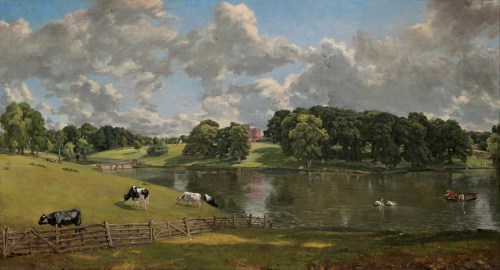
#FineArtFriday: Wivenhoe Park, Essex by John Constable 1816

John_Constable_-_Wivenhoe_Park,_Essex_-_Google_Art_ProjectArtist: John Constable  (1776–1837)

Title: Wivenhoe Park, Essex

Genre: landscape art

Date: 1816

Medium: oil on canvas oil on canvas

Dimensions: height: 56.1 cm (22 in); width: 101.2 cm (39.8 in)

Collection: National Gallery of Art

What I love about this image:

This is the painting that made John Constable’s name. It contains everything he idealized about his native country, England. He gives us a deceptively simple image of a summer’s day, with white clouds drifting above a peaceful scene.

So beautifully composed, and so relaxing. When life is crazy, a Zen picture as painted by a master reminds me to slow down and enjoy the scenery.

About this painting, via Wikipedia:

The National Gallery of Art holds this painting as one of its highlights:

A pleasant sense of ease and harmony pervades this landscape of almost photographic clarity. The large areas of brilliant sunshine and cool shade, the rambling line of the fence, and the beautiful balance of trees, meadow, and river are evidence of the artist’s creative synthesis of the actual site.

The painting was commissioned by the owner of Wivenhoe Park, Major General Francis Slater Rebow, who was among the artist’s first patrons, being a close friend of the artist’s father, Golding Constable. Wivenhoe Park is 200 acres (81 ha) of parkland, purchased by the Rebow family before 1734. Slater-Rebow commissioned several paintings from Constable, including a portrait of the general’s seven-year-old daughter in 1812. She also figures in this painting, in a donkey cart to the left. This painting, finished in September 1816, earned the artist enough money to allow him to marry his long-time love, Mary Bicknell. They married in October 1816.

Constable’s art is always penetrated by longing, melancholy and a yearning for the simple, natural life, for a bucolic, pastoral idyll, to rural subjects and aspects of life in the countryside, a “golden age” when people lived together in harmony with nature, a world on its way of disappearing when he painted his landscapes thanks to the beginning of the Industrial Revolution. He was aware of the issue of urban growth, of urban life’s unpleasantness, which he contrasted to life in the countryside. Constable’s art was rather unconventional for his time, and he loved simple things, a natural landscape without the ruins, dramatic effects or exalted, often excessive feelings, like the ones displayed in the paintings of his contemporary, J. M. W. Turner. His landscapes are flooded by a silvery brilliant light in the water and air and in the sky, and are characterised by a special intensity that is such an important feature of this artist’s works. [1]

About the Artist, via Wikipedia:

John Constable RA (11 June 1776 – 31 March 1837) was an English landscape painter in the Romantic tradition. Born in Suffolk, he is known principally for revolutionising the genre of landscape painting, with his pictures of Dedham Vale, the area surrounding his home – now known as “Constable Country” – which he invested with an intensity of affection. “I should paint my own places best”, he wrote to his friend John Fisher in 1821, “painting is but another word for feeling”.[3]

Constable’s most famous paintings include Wivenhoe Park (1816), Dedham Vale (1821) and The Hay Wain (1821). Although his paintings are now among the most popular and valuable in British art, he was never financially successful. He became a member of the establishment after he was elected to the Royal Academy of Arts at the age of 52. His work was embraced in France, where he sold more than in his native England and inspired the Barbizon school. [2]


Credits and Attributions:

[1] Image: Wikipedia contributors, “Wivenhoe Park (painting),” Wikipedia, The Free Encyclopedia, https://en.wikipedia.org/w/index.php?title=Wivenhoe_Park_(painting)&oldid=1163430201 (accessed July 20, 2023).

[2] Wikipedia contributors, “John Constable,” Wikipedia, The Free Encyclopedia, https://en.wikipedia.org/w/index.php?title=John_Constable&oldid=1162727967 (accessed July 20, 2023).

4 Comments

Filed under #FineArtFriday

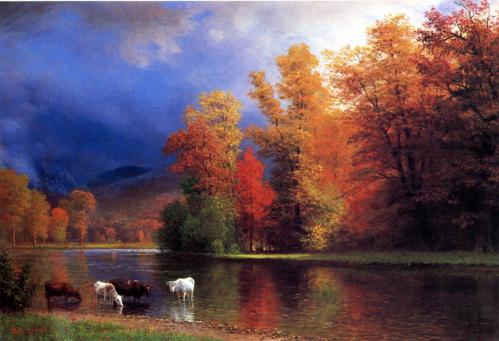
#FineArtFriday: On the Saco by Albert Bierstadt (revisited)

Bierstadt_Albert_On_the_SacoArtist: Albert Bierstadt (1830–1902)

Title: “On the Saco”

Genre: landscape art

Description: Of the Saco River, Maine.

Date: Unknown date (19th century)

Medium: oil painting.

What I love about this image:

Bierstadt understood and respected the power of nature. The way he rendered the sky is wonderful. He captured that brilliant darkness of a distant storm against the bright sunshine of an autumn afternoon. I love contrasts in this painting, the bright foliage in every shade of red and yellow, the serenity of the cattle drinking in the shallows.

The heavy darkness of the storm in the hills seems to be pushed back by the serene glow of fall’s sunlight on the river. Will it rain itself out before it passes over the herd? Possibly.

About the Artist, via Wikipedia:

Albert Bierstadt (January 7, 1830 – February 18, 1902) was a German-American painter best known for his lavish, sweeping landscapes of the American West. He joined several journeys of the Westward Expansion to paint the scenes. He was not the first artist to record the sites, but he was the foremost painter of them for the remainder of the 19th century.

Bierstadt was born in Prussia, but his family moved to the United States when he was one year old. He returned to study painting for several years in Düsseldorf. He became part of the second generation of the Hudson River School in New York, an informal group of like-minded painters who started painting along the Hudson River. Their style was based on carefully detailed paintings with romantic, almost glowing lighting, sometimes called luminism. Bierstadt was an important interpreter of the western landscape, and he is also grouped with the Rocky Mountain School. [1]


Credits and Attributions:

Image: On the Saco by Albert Bierstadt, Wikimedia Commons contributors, “File:Bierstadt Albert On the Saco.jpg,” Wikimedia Commons, the free media repository, https://commons.wikimedia.org/w/index.php?title=File:Bierstadt_Albert_On_the_Saco.jpg&oldid=618723154 (accessed September 16, 2022).

[1] Wikipedia contributors, “Albert Bierstadt,” Wikipedia, The Free Encyclopedia, https://en.wikipedia.org/w/index.php?title=Albert_Bierstadt&oldid=1107140650 (accessed September 16, 2022).

Comments Off on #FineArtFriday: On the Saco by Albert Bierstadt (revisited)

Filed under #FineArtFriday

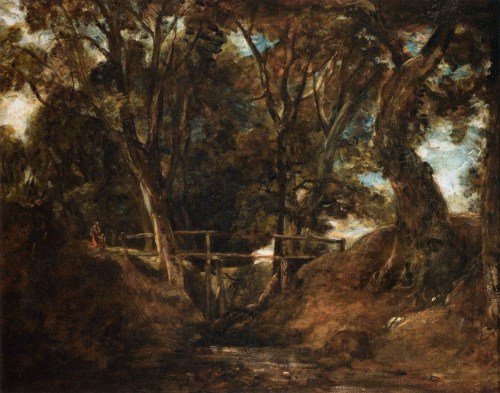
#FineArtFriday: John Constable – Helmingham Dell

John_Constable_-_Helmingham_Dell_-_WGA5193Artist: John Constable (1776–1837)

Title: Helmingham Dell

Genre: landscape art

Date: first half of 19th century

Medium: oil on canvas

Dimensions: height: 103 cm (40.5 in); width: 129 cm (50.7 in)

Collection: Louvre Museum

Current location: Department of Paintings of the Louvre

What I love about this image:

For those of us who write fantasy set in low-tech worlds, this is a view of how people bridged a creek for thousands of years, using the materials at hand. The scene is beautiful, cool and serene. One can hear the quiet murmur of the brook, the calls of different birds, and the chatter of squirrels arguing over their territories.

But at night, the silence is broken by the occasional hoot of an owl, and the rustle of underbrush as the small nocturnal creatures go about their business. A fox might wander through the dell, looking for a meal.

The amazing sky can be seen through the leaves and branches. John Constable gives us a lovely day, a moment of serenity to enjoy across the centuries.

About the Artist, via Wikipedia:

John Constable RA , 11 June 1776 – 31 March 1837) was an English landscape painter in the Romantic tradition. Born in Suffolk, he is known principally for revolutionising the genre of landscape painting with his pictures of Dedham Vale, the area surrounding his home – now known as “Constable Country” – which he invested with an intensity of affection. “I should paint my own places best”, he wrote to his friend John Fisher in 1821, “painting is but another word for feeling”.

Constable’s most famous paintings include Wivenhoe Park (1816), Dedham Vale (1821) and The Hay Wain (1821). Although his paintings are now among the most popular and valuable in British art, he was never financially successful. He became a member of the establishment after he was elected to the Royal Academy of Arts at the age of 52. His work was embraced in France, where he sold more than in his native England and inspired the Barbizon school. [1]


Credits and Attributions:

Image: Wikimedia Commons contributors, “File:John Constable – Helmingham Dell – WGA5193.jpg,” Wikimedia Commons, https://commons.wikimedia.org/w/index.php?title=File:John_Constable_-_Helmingham_Dell_-_WGA5193.jpg&oldid=723632044 (accessed May 25, 2023).

[1] Wikipedia contributors, “John Constable,” Wikipedia, The Free Encyclopedia, https://en.wikipedia.org/w/index.php?title=John_Constable&oldid=1152514837 (accessed May 25, 2023).

Comments Off on #FineArtFriday: John Constable – Helmingham Dell

Filed under #FineArtFriday

#FineArtFriday:The Alyscamps, or The Three Graces at the Temple of Venus by Paul Gauguin 1888

Paul_Gauguin_les_alyscamps085

Artist: Paul Gauguin (1848–1903)

Title:  (English)The Alyscamps, or The Three Graces at the Temple of Venus

French: French: Les Alyscamps, ou Les Trois grâces au temple de Venus

Date: 1888

Medium: oil on canvas

Dimensions: height: 91.6 cm (36 in); width: 72.5 cm (28.5 in)

Collection: Musée d’Orsay

What I love about this painting:

Color! I love the vivid colors contrasted against the pale sky. The Three Graces in classical mythology are the goddesses of charm, beauty, nature, human creativity, goodwill, and fertility. They have come to symbolize faith, hope, and charity.

The traditional mythology Paul Gauguin explores in this composition demonstrates his early education and his appreciation of classical art. Before he became an artist, he was both a stockbroker and an art dealer/collector.

Although he never trained formally, Gauguin is known for his use of bold colors, simplified forms, and strong lines. This painting is a prime example of his study of form and color.

The eye is drawn to the vertical lines of the temple standing tall on the hill behind the figures. They are also depicted with a sense of height, and the hills beyond are tall and narrow.

A calm stream flows from beneath the temple, the river of time. The three women stand almost in the background, yet impressive, observing as time passes them. They are as strong and unmovable as the rocky hills and the temple.

Gauguin tells us that time may pass, and things may change, but the Temple of Venus rises above it all. Does this Temple of Venus represent “agape,” a love that is selfless and unconditional? A kind of love that is spiritual in nature? Paul Gauguin was a complicated man, conflicted and tormented by the contrasts of morality and the realities of his life.

Who knows what that temple meant to him on the day he created it, but either way, Gauguin’s Three Graces, Faith, Hope, and Charity stand almost in the shadows, offering him comfort. They are as solid as the mountains and eternal as time. And who is the dark, mysterious fourth who peers over their shoulder?

Paul Gauguin lived an eventful life. For a wonderful documentary on the man and his life, go to:

Why Is Gauguin So Controversial? (Waldemar Januszczak Documentary) | Perspective – YouTube

Also, check out Paul Gauguin – Wikipedia.


Credits and Attributions:

Image: Wikimedia Commons contributors, “File:Paul Gauguin 085.jpg,” Wikimedia Commons, https://commons.wikimedia.org/w/index.php?title=File:Paul_Gauguin_085.jpg&oldid=710795058 (accessed April 6, 2023).

7 Comments

Filed under #FineArtFriday

#FineArtFriday: Under flowering trees by Adolf Kaufmann

Adolf_Kaufmann_Under_the_treesjpgArtist: Adolf Kaufmann (1848–1916)

Title: Under flowering trees

Date: before 1916

Medium: oil on canvas

Inscription: signed A. Kaufmann

What I love about this painting:

Kaufmann gives us a beautiful spring day with apple trees and cherry trees in full bloom. The weather is misty, cool and damp the way spring mornings often are here in the Pacific Northwest.

Chickens roam the orchard, and two women are digging, breaking the ground for a spring garden.

To the left is a weathered building. Is it a barn? Is it their home? It’s hidden behind the shrubbery so it’s difficult to tell, but it has no window, so I think it may be a barn.

Nothing is romanticized—we see it the way the artist did on that spring day over a century ago.

About the Artist, via Wikipedia:

Adolf Kaufmann (15 May 1848, in Troppau – 25 November 1916, in Vienna) was an Austrian landscape and marine artist.

He was initially self-taught, but completed his studies with the animal painter, Émile van Marcke, in Paris and undertook several study trips, throughout Europe and the Middle East. His residence alternated between Paris, Berlin, Düsseldorf and Munich.

In 1890, he decided to settle in Vienna and opened a studio in the Wieden district. In 1900, together with Carl von Merode [de] and Heinrich Lefler, he opened an “Art School for Ladies”. He continued to visit Paris frequently and, when he painted there, signed his works with the pseudonym “A. Guyot”. Other names he signed with include “A. Papouschek”, “G. Salvi”, “A. Jarptmann”, “R. Neiber”, “J. Rollin” and “M. Bandouch”. Why he did this is unclear, although his choice of signature often reflects stylistic differences.

His landscapes were influenced by the Barbizon school and the style known as “paysage intime,” both of which he was exposed to in France during the 1870s. (The paysage intimate, French for “familiar landscape,” was a style of painting that dealt with simple, simple landscapes and emerged in the mid-19th century. It was the predecessor of the Impressionist style.) [1]


Credits and Attributions:

IMAGE: Wikimedia Commons contributors, “File:Adolf Kaufmann Unter blühenden Bäumen.jpg,” Wikimedia Commons, the free media repository, https://commons.wikimedia.org/w/index.php?title=File:Adolf_Kaufmann_Unter_bl%C3%BChenden_B%C3%A4umen.jpg&oldid=623159308 (accessed March 23, 2023).

[1] Wikipedia contributors, “Adolf Kaufmann,” Wikipedia, The Free Encyclopedia, https://en.wikipedia.org/w/index.php?title=Adolf_Kaufmann&oldid=1094252143 (accessed March 23, 2023).

7 Comments

Filed under #FineArtFriday