Tag Archives: Anders Zorn

#FineArtFriday: Midsummer Dance by Anders Zorn 1897

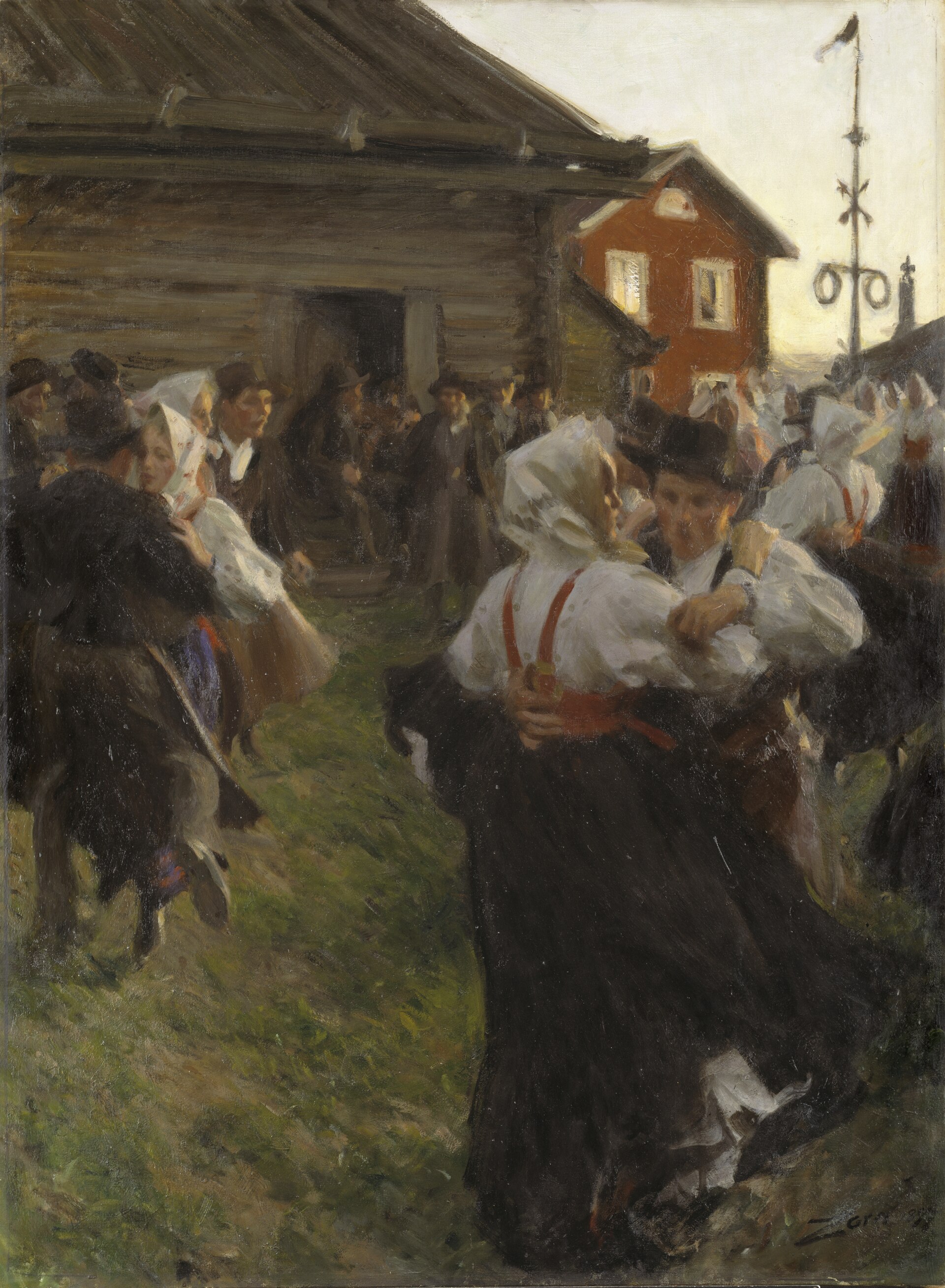
Anders Zorn: Midsommardans.

Artist: Anders Zorn (1860–1920)

Title: English: Midsummer Dance (Svenska: Midsommardans)

Date: 1897

Medium: oil on canvas

Dimensions: height: 140 cm (55.1 in); width: 98 cm (38.5 in)

What I love about this painting:

I enjoy paintings of ordinary people celebrating life, and in the northern countries, the return of sunlight and the longest day of the year is something to celebrate. The artist conveys the feeling of movement beautifully, depicting both the motion and emotion of the dancers.

I enjoy seeing the traditional dress, costumes women only wore for special events such as Midsummer’s celebration. Even in 1897, these costumes were relics of the past, cherished symbols of their nationality but rarely worn.

The maypole stands to the right of the scene. In the background, the older people watch from the sidelines, remembering the days when they danced.

Everyone is having fun, even the onlookers. I suspect the cleanup was a chore the next day, as next days always are, but it looks like it was a party to remember.

About this painting, via Wikimedia Commons:
English: In his autobiographical notes, Anders Zorn writes about how the idea for the painting was born:

“This work was painted in June and part of July after sunset and I am pleased to have done it. I had just given Morkarlby a new maypole. It was painted red every Midsummer and I realized and still realize that it is my solemn duty to be present and to lead the dressing of said pole. My farmhand, dear Verner, was in charge of raising the maypole on the stroke of midnight on Midsummer night. Once it was up, a reel was played and people danced hand-in-hand around the maypole and the yards in an endless snake of youngsters. Then there was dancing in one of the yards until sunrise. This is what my painting portrays.”

Zorn does not put the maypole at the center of his Midsummer Dance. His message is all about the experience of the dance, the scents of a summer night and the light. He completed this painting in 1897. [1]

File:Midsummer Dance (Anders Zorn) – Nationalmuseum – 18607.tif – Wikipedia

About Midsummer, via Wikipedia:

Midsummer or Midsommar (Swedish: [ˈmɪ̌ˌsɔmːar] or [ˈmǐːdˌsɔmːar]) is a celebration of the season of summer, taking place on or near the date of the summer solstice in the Northern Hemisphere, the longest day of the year. The name midsummer mainly refers to summer solstice festivals of European origin. These cultures traditionally regard it as the middle of summer, with the season beginning on May Day. Although the summer solstice falls on 20, 21 or 22 June in the Northern Hemisphere, it was traditionally reckoned to fall on 23–24 June in much of Europe. These dates were Christianized as Saint John’s Eve and Saint John’s Day. It is usually celebrated with outdoor gatherings that include bonfires, maypole dancing and feasting. [2]

About the Artist, via Wikipedia:

Zorn was born in Mora, Sweden, between the lakes of Siljan and Orsasjön. He studied at the Royal Swedish Academy of Arts in Stockholm from 1875 to 1880, and then spent time travelling in Europe, painting watercolors and society portraits in London, Paris and Madrid.

He returned to Sweden in 1885, and on 16 October, he married Emma Zorn (née Lamm) (1860 – 1942). After spending their honeymoon abroad, in eastern Europe and Turkey, they returned to Sweden in 1886, spending time with Emma’s family at Dalarö, before settling near Mora, where their house, which is now the home of the Zorn Collections, is located. [3]

To read more about the life of this artist, go to: Anders Zorn – Wikipedia


Credits and Attributions:

IMAGE: Wikipedia contributors, “Midsummer Dance,” Wikipedia, The Free Encyclopedia, https://en.wikipedia.org/w/index.php?title=Midsummer_Dance&oldid=1361282744 (accessed October 1, 2026).

[1] Wikipedia contributors, “Midsummer,” Wikipedia, The Free Encyclopedia, https://en.wikipedia.org/w/index.php?title=Midsummer&oldid=1374492604 (accessed October 1, 2026).

[2] Wikimedia Commons Contributors, File:Midsummer Dance (Anders Zorn) – Nationalmuseum – 18607.tif – Wikipedia (Accessed October 1, 2026).

[3] Wikipedia contributors, “Anders Zorn,” Wikipedia, The Free Encyclopedia, https://en.wikipedia.org/w/index.php?title=Anders_Zorn&oldid=1366818498 (accessed October 1, 2026).
Leave a comment

Filed under #FineArtFriday

#FineArtFriday: a second look at “Sommarnöje (Summer Fun)” by Anders Zorn 1886

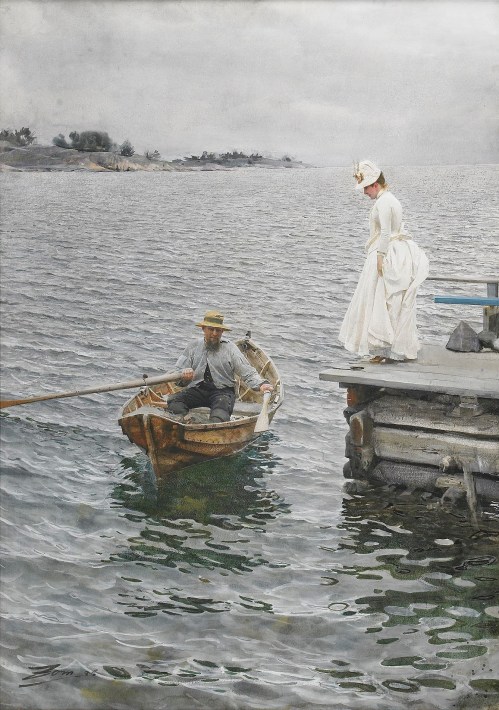
Sommarnöje_(1886),_akvarell_av_Anders_ZornArtist: Anders Zorn  (1860–1920)

Title: (Swedish: Sommarnöje)  (English: Summer Fun)

Genre: marine art

Date: 1886

Medium: watercolor paint on paper

Dimensions: height: 76 cm (29.9 in)

Collection: Private collection

Place of creation: Dalarö, Sweden

Inscriptions: Signature and date bottom left: Zorn -86

What I love about this painting:

I first featured this painting in February of 2024. I really like this image.

The way the lake is shown took me back to my childhood. I grew up in a house that faced directly onto a large lake, with a wide beach for swimming, a wooden dock, and few neighbors. It was a peaceful place in summer, although it could be dreary in winter.

The southern Puget Sound area usually experiences more overcast days in June than most people like. Many days, the waters and the sky look exactly as Anders Zorn has depicted them here.

Zorn’s brushwork is so meticulous, it is nearly photographic. He captures the feeling of the day, of the breeze, slightly sharp but not too cold, and the anticipation of going out on the water.

I like the story Anders Zorn is painting for us. I like that the male subject is maneuvering the small boat closer to the pier so she can jump in.

She is adventurous woman. Her skits are gathered and she’s prepared to make that leap.

About this painting, via Wikipedia:

Zorn painted Sommarnöje in Dalarö in the early summer of 1886, after the couple had returned from honeymoon but before they settled in Mora. He made a smaller sketch first, which measures 30.2 by 18.8 centimeters (11.9 in × 7.4 in), now held by the Zorn Museum in Mora.

The completed watercolor captures a fleeting moment and shows influence from the works of the French Impressionists that Zorn had seen while in Paris, but with a distinctively austere Scandinavian palette.

The painting depicts the artist’s wife Emma Zorn standing in a white dress and hat, waiting on the edge of a wooden pier beside the water, as their friend Carl Gustav Dahlström approaches in a rowing boat.

The reflective glassy surface of the water is rippling in a breeze, under cloudy grey skies. The figures, pier, boat and sea are finely rendered, almost as if the work was made in oil paint, showing Zorn’s skill as a watercolorist. Less attention is paid to the other side of the lake, sketched roughly in the background. It is signed and dated in the lower left corner, “Zorn 86”.

It was acquired by Edvard Levisson of Gothenburg, and then descended through the Schollin-Borg family. The painting was sold at the Stockholms Auktionsverk in June 2010 for SEK 26 million, setting a record for a Swedish painting.

About the Artist, via Wikipedia:

Zorn was born in Mora, Sweden, between the lakes of Siljan and Orsasjön. He studied at the Royal Swedish Academy of Arts in Stockholm from 1875 to 1880, and then spent time travelling in Europe, painting watercolours and society portraits in London, Paris and Madrid.

He returned to Sweden in 1885, and on 16 October, he married Emma Zorn (née Lamm) (1860 – 1942). After spending their honeymoon abroad, in eastern Europe and Turkey, they returned to Sweden in 1886, spending time with Emma’s family at Dalarö, before settling near Mora, where their house, which is now the home of the Zorn Collections, is located.


Credits and Attributions:

IMAGE: Wikimedia Commons contributors, “File:Sommarnöje (1886), akvarell av Anders Zorn.jpg,” Wikimedia Commons, https://commons.wikimedia.org/w/index.php?title=File:Sommarn%C3%B6je_(1886),_akvarell_av_Anders_Zorn.jpg&oldid=842907051 (accessed February 29, 2024).

[1] Wikipedia contributors, “Sommarnöje,” Wikipedia, The Free Encyclopedia, https://en.wikipedia.org/w/index.php?title=Sommarn%C3%B6je&oldid=1149795747 (accessed February 29, 2024).

Comments Off on #FineArtFriday: a second look at “Sommarnöje (Summer Fun)” by Anders Zorn 1886

Filed under writing

#FineArtFriday: Sommarnöje (Summer Fun) by Anders Zorn 1886

Sommarnöje_(1886),_akvarell_av_Anders_ZornArtist: Anders Zorn  (1860–1920)

Title: (Swedish: Sommarnöje)  (English: Summer Fun)

Genre: marine art

Date: 1886

Medium: watercolor paint on paper

Dimensions: height: 76 cm (29.9 in)

Collection: Private collection

Place of creation: Dalarö, Sweden

Inscriptions: Signature and date bottom left: Zorn -86

What I love about this painting:

This image, the way the lake is shown, took me back to my childhood. I grew up in a house that faced directly onto a large lake, with a wide beach for swimming, a wooden dock, and few neighbors. The southern Puget Sound area experiences more overcast days in June than most people like. Many days, the waters and the sky looked exactly as Anders Zorn has depicted them here.

Zorn’s brushwork is so meticulous, it is nearly photographic. He captures the feeling of the day, of the breeze, slightly sharp but not too cold, and the anticipation of going out on the water.

About this painting, via Wikipedia:

Zorn painted Sommarnöje in Dalarö in the early summer of 1886, after the couple had returned from honeymoon but before they settled in Mora. He made a smaller sketch first, which measures 30.2 by 18.8 centimeters (11.9 in × 7.4 in), now held by the Zorn Museum in Mora.

The completed watercolor captures a fleeting moment and shows influence from the works of the French Impressionists that Zorn had seen while in Paris, but with a distinctively austere Scandinavian palette.

The painting depicts the artist’s wife Emma Zorn standing in a white dress and hat, waiting on the edge of a wooden pier beside the water, as their friend Carl Gustav Dahlström approaches in a rowing boat.

The reflective glassy surface of the water is rippling in a breeze, under cloudy grey skies. The figures, pier, boat and sea are finely rendered, almost as if the work was made in oil paint, showing Zorn’s skill as a watercolorist. Less attention is paid to the other side of the lake, sketched roughly in the background. It is signed and dated in the lower left corner, “Zorn 86”.

It was acquired by Edvard Levisson of Gothenburg, and then descended through the Schollin-Borg family. The painting was sold at the Stockholms Auktionsverk in June 2010 for SEK 26 million, setting a record for a Swedish painting.

About the Artist, via Wikipedia:

Zorn was born in Mora, Sweden, between the lakes of Siljan and Orsasjön. He studied at the Royal Swedish Academy of Arts in Stockholm from 1875 to 1880, and then spent time travelling in Europe, painting watercolours and society portraits in London, Paris and Madrid.

He returned to Sweden in 1885, and on 16 October, he married Emma Zorn (née Lamm) (1860 – 1942). After spending their honeymoon abroad, in eastern Europe and Turkey, they returned to Sweden in 1886, spending time with Emma’s family at Dalarö, before settling near Mora, where their house, which is now the home of the Zorn Collections, is located.


Credits and Attributions:

IMAGE: Wikimedia Commons contributors, “File:Sommarnöje (1886), akvarell av Anders Zorn.jpg,” Wikimedia Commons, https://commons.wikimedia.org/w/index.php?title=File:Sommarn%C3%B6je_(1886),_akvarell_av_Anders_Zorn.jpg&oldid=842907051 (accessed February 29, 2024).

[1] Wikipedia contributors, “Sommarnöje,” Wikipedia, The Free Encyclopedia, https://en.wikipedia.org/w/index.php?title=Sommarn%C3%B6je&oldid=1149795747 (accessed February 29, 2024).

5 Comments

Filed under writing