
 Artist: Vincent van Gogh (1853–1890)
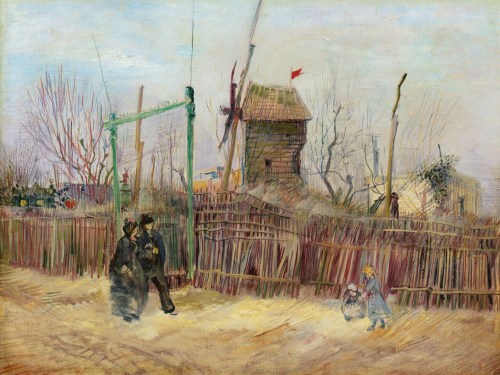
Title: Street Scene in Montmartre
Genre: landscape art
Date: 1887
Medium: oil on canvas
Dimensions: height: 46.1 cm (18.1 in); width: 61.3 cm (24.1 in)
Collection: Private collection
What I love about this painting:
Street Scene in Montmartre is a relatively unknown painting by Vincent van Gogh, unknown because it has been held in private collections and not exhibited to the public. It was auctioned by Sotheby’s in 2021, and the image was posted to Wikimedia Commons courtesy of that auction.
The scene feels like an afternoon scene in winter, with a man and woman walking, and two children playing.
Vincent paid particular attention to the visual construction and texture of the fence, and also to the tangle of garden behind. This is the smaller of two windmills featured in several more well-known paintings in the subset of paintings from Van Gogh’s Montmartre series.
While there are people walking down the dirt lane in this scene, they aren’t the focus. Instead, our eye is directed to the way the windmill rises over the ramshackle fence, neglected garden, and above it all, the flag bravely flying.
The dirt lane, the fence, the winter-barren garden, and the windmill falling to ruin beneath the cold sky offer us a glimpse into Vincent’s mood. He finds beauty in the textures of life, both visual and metaphysical – in the cycle of growth aging to ruin. The flag flying in the breeze and the children playing offer us the hope of brighter days and new possibilities.
About this painting, via Wikipedia:
The Montmartre paintings are a group of works that Vincent van Gogh created in 1886 and 1887 of the Paris district of Montmartre while living there, at 54 Rue Lepic, with his brother Theo. Rather than capture urban settings in Paris, van Gogh preferred pastoral scenes, such as Montmartre and Asnières in the northwest suburbs. Of the two years in Paris, the work from 1886 often has the dark, somber tones of his early works from the Netherlands and Brussels. By the spring of 1887, van Gogh embraced use of color and light and created his own brushstroke techniques based upon Impressionism and Pointillism. The works in the series provide examples of his work during that period of time and the progression he made as an artist.
In van Gogh’s first year in Paris he painted rural areas around Montmartre, such as the butte and its windmills. The colors are somber and evoke a sense of his anxiety and loneliness.
The landscape and windmills around Montmartre were the source of inspiration for a number of van Gogh’s paintings. The Moulin de la Galette, still standing, is located near the apartment he shared with his brother. Built in 1622, it was originally called Blute-Fin and belonged to the Debray family in the 19th century. Van Gogh met artists such as Toulouse-Lautrec, Paul Signac and Paul Gauguin who inspired him to incorporate Impressionism into his artwork resulting in lighter, more colorful paintings.
Windmills also featured in some of van Gogh’s landscape paintings of Montmartre.
Montmartre, sitting on a butte overlooking Paris, was known for its bars, cafes, and dance-hall. It was also located on the edge of countryside that afforded Van Gogh the opportunity to work on paintings of rural settings while living in Paris.
When Van Gogh painted he intended not just to capture the subject, but to express a message or meaning. It was through his paintings of nature that he was most successful at accomplishing his goal. It also created a great challenge: how to portray the subject and create a work that would resonate with the audience. [1]
About the Artist, via Wikipedia:
Vincent Willem van Gogh, 30 March 1853 – 29 July 1890) was a Dutch Post-Impressionist painter who posthumously became one of the most famous and influential figures in Western art history. In a decade, he created about 2,100 artworks, including around 860 oil paintings, most of which date from the last two years of his life. They include landscapes, still lifes, portraits, and self-portraits, and are characterised by bold colours and dramatic, impulsive and expressive brushwork that contributed to the foundations of modern art. He was not commercially successful, struggled with severe depression and poverty, and committed suicide at the age of 37.
Van Gogh was born into an upper-middle-class family, While a child he drew and was serious, quiet and thoughtful. As a young man he worked as an art dealer, often traveling, but became depressed after he was transferred to London. He turned to religion and spent time as a Protestant missionary in southern Belgium. He drifted in ill health and solitude before taking up painting in 1881, having moved back home with his parents. His younger brother Theo supported him financially; the two kept a long correspondence by letter. His early works, mostly still lifes and depictions of peasant labourers, contain few signs of the vivid colour that distinguished his later work. In 1886, he moved to Paris, where he met members of the avant-garde, including Émile Bernard and Paul Gauguin, who were reacting against the Impressionist sensibility. As his work developed he created a new approach to still lifes and local landscapes. His paintings grew brighter as he developed a style that became fully realised during his stay in Arles in the South of France in 1888. During this period he broadened his subject matter to include series of olive trees, wheat fields and sunflowers.
Van Gogh suffered from psychotic episodes and delusions, and though he worried about his mental stability, he often neglected his physical health, did not eat properly and drank heavily. His friendship with Gauguin ended after a confrontation between the two when, in a rage, Van Gogh severed a part of his own left ear with a razor. He spent time in psychiatric hospitals, including a period at Saint-Rémy. After he discharged himself and moved to the Auberge Ravoux in Auvers-sur-Oise near Paris, he came under the care of the homeopathic doctor Paul Gachet. His depression persisted, and on 27 July 1890, Van Gogh is believed to have shot himself in the chest with a revolver, dying from his injuries two days later. [2]
Credits and Attributions:
Image: Scène de Rue à Montmartre, Vincent van Gogh PD|100, Wikimedia Commons contributors, “File:Scène de Rue à Montmartre.jpg,” Wikimedia Commons, the free media repository, https://commons.wikimedia.org/w/index.php?title=File:Sc%C3%A8ne_de_Rue_%C3%A0_Montmartre.jpg&oldid=617922499 (accessed May 19, 2022).
[1] Wikipedia contributors, “Montmartre (Van Gogh series),” Wikipedia, The Free Encyclopedia, https://en.wikipedia.org/w/index.php?title=Montmartre_(Van_Gogh_series)&oldid=1086671125 (accessed May 19, 2022).
[2] Wikipedia contributors, “Vincent van Gogh,” Wikipedia, The Free Encyclopedia, https://en.wikipedia.org/w/index.php?title=Vincent_van_Gogh&oldid=1087073450 (accessed May 19, 2022).
 Artist:
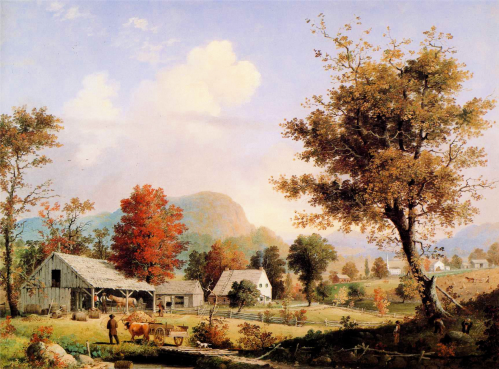 Cider Pressing by George Henry Durrie 1855
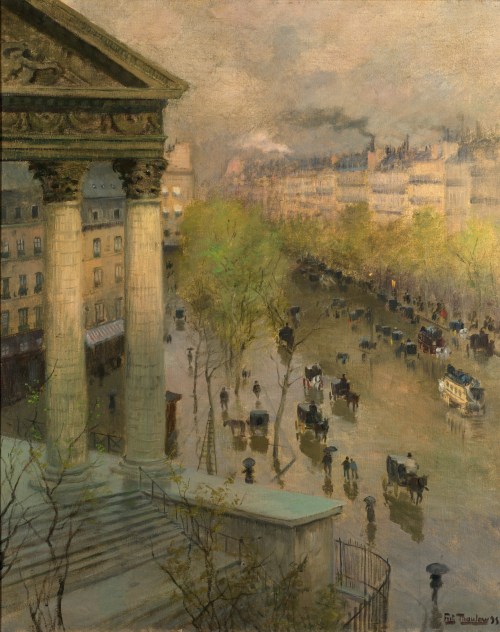 Title: Boulevard de la Madeleine in Paris by Frits Thaulow


.jpg)