Tag Archives: 19th century seascapes

#FineArtFriday – a second look at “Fishing for Oysters at Cancale” by John Singer Sargent 1878

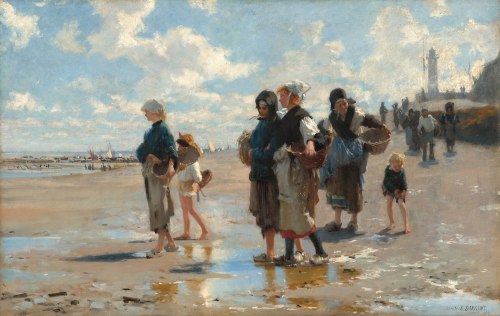
2560px-John_Singer_Sargent_-_CancaleArtist: John Singer Sargent (1856–1925)

Title: En route pour la pêche (Setting Out to Fish) Fishing for Oysters at Cancale

Date: 1878

Medium: oil on canvas

Dimensions: height: 77 cm (30.3 in); width: 121.6 cm (47.8 in)

Inscription: Signed and Dated: John S. Sargent Paris 1878

Collection: National Gallery of Art

What I love about this picture:

Every time I see a painting by John Singer Sargent, I love him more. He is rapidly becoming one of my favorite artists of all time. (Don’t be jealous, Rembrandt. You are still number one in my heart.)

Sargent paints a perfect summer day for us, a good day to be out near the water. John Singer Sargent was a complicated man, as most artists are. Famous as a portrait artist, he painted landscapes that conveyed a sense of mood and emotion that few of his contemporaries could match. One of Sargent’s great skills was the ability to convey the sensory impressions of an environment.

He found beauty and drama in the lives of ordinary people and showed his characters outdoors in all the seasons. His paintings of working-class people didn’t romanticize how they dressed, conveyed their moods. Sargent showed the environment they lived and worked in, no matter how good or bad the weather.

Sargent had a gift for painting rare and expensive fabrics, yet no one is dressed in finery in this painting. On the contrary, the women are dressed in shabby clothes that protect them from the sun and salty wind, garments that have seen a great deal of wear. The children are bare-legged and barefoot, while the fishers wear clogs. These women carry baskets and the hope that they will find enough oysters and other shellfish to not only feed their family but have plenty to sell to the fishmonger.

About this picture via MFA Boston: Sargent’s choice of subject was not revolutionary – a similar scene of oyster harvesters had previously won a medal at the Salon. However, his ability to paint the reflections in the tidal pools and the light sparkling on the figures and clouds dazzled viewers, clearly demonstrating that his talents extended beyond portraiture. [1]

About the artist, via Wikipedia:

John Singer Sargent (January 12, 1856 – April 14, 1925) was an American expatriate artist, considered the “leading portrait painter of his generation” for his evocations of Edwardian-era luxury. He created roughly 900 oil paintings and more than 2,000 watercolors, as well as countless sketches and charcoal drawings. His oeuvre documents worldwide travel, from Venice to the TyrolCorfu, Spain, the Middle East, MontanaMaine, and Florida.

Born in Florence to American parents, he was trained in Paris before moving to London, living most of his life in Europe. He enjoyed international acclaim as a portrait painter. An early submission to the Paris Salon in the 1880s, his Portrait of Madame X, was intended to consolidate his position as a society painter in Paris but instead resulted in scandal. During the year following the scandal, Sargent departed for England, where he continued a successful career as a portrait artist.

From the beginning, Sargent’s work is characterized by remarkable technical facility, particularly in his ability to draw with a brush, which in later years inspired admiration as well as criticism for its supposed superficiality. His commissioned works were consistent with the grand manner of portraiture, while his informal studies and landscape paintings displayed a familiarity with Impressionism. In later life, Sargent expressed ambivalence about the restrictions of formal portrait work and devoted much of his energy to mural painting and working en plein air. Art historians generally ignored society artists such as Sargent until the late 20th century.

The exhibition in the 1980s of Sargent’s previously hidden male nudes served to spark a reevaluation of his life and work, and its psychological complexity. In addition to the beauty, sensation and innovation of his oeuvre, his same-sex interests, unconventional friendships with women and engagement with race, gender nonconformity and emerging globalism are now viewed as socially and aesthetically progressive and radical.


Credits and Attributions:

IMAGE: Wikimedia Commons contributors, “File:John Singer Sargent – Cancale.jpg,” Wikimedia Commons, https://commons.wikimedia.org/w/index.php?title=File:John_Singer_Sargent_-_Cancale.jpg&oldid=745727074 (accessed April 25, 2025).

[1] Quote: MFABoston contributors, Fishing for Oysters at Cancale – Works – Museum of Fine Arts, Boston (mfa.org) (accessed April 25,2025).

[2] Wikipedia contributors, “John Singer Sargent,” Wikipedia, The Free Encyclopedia, https://en.wikipedia.org/w/index.php?title=John_Singer_Sargent&oldid=1223506386 (accessed April 25, 2025).

Comments Off on #FineArtFriday – a second look at “Fishing for Oysters at Cancale” by John Singer Sargent 1878

Filed under #FineArtFriday

#FineArtFriday: Morning at Grand Manan by Alfred Thompson Bricher 1878

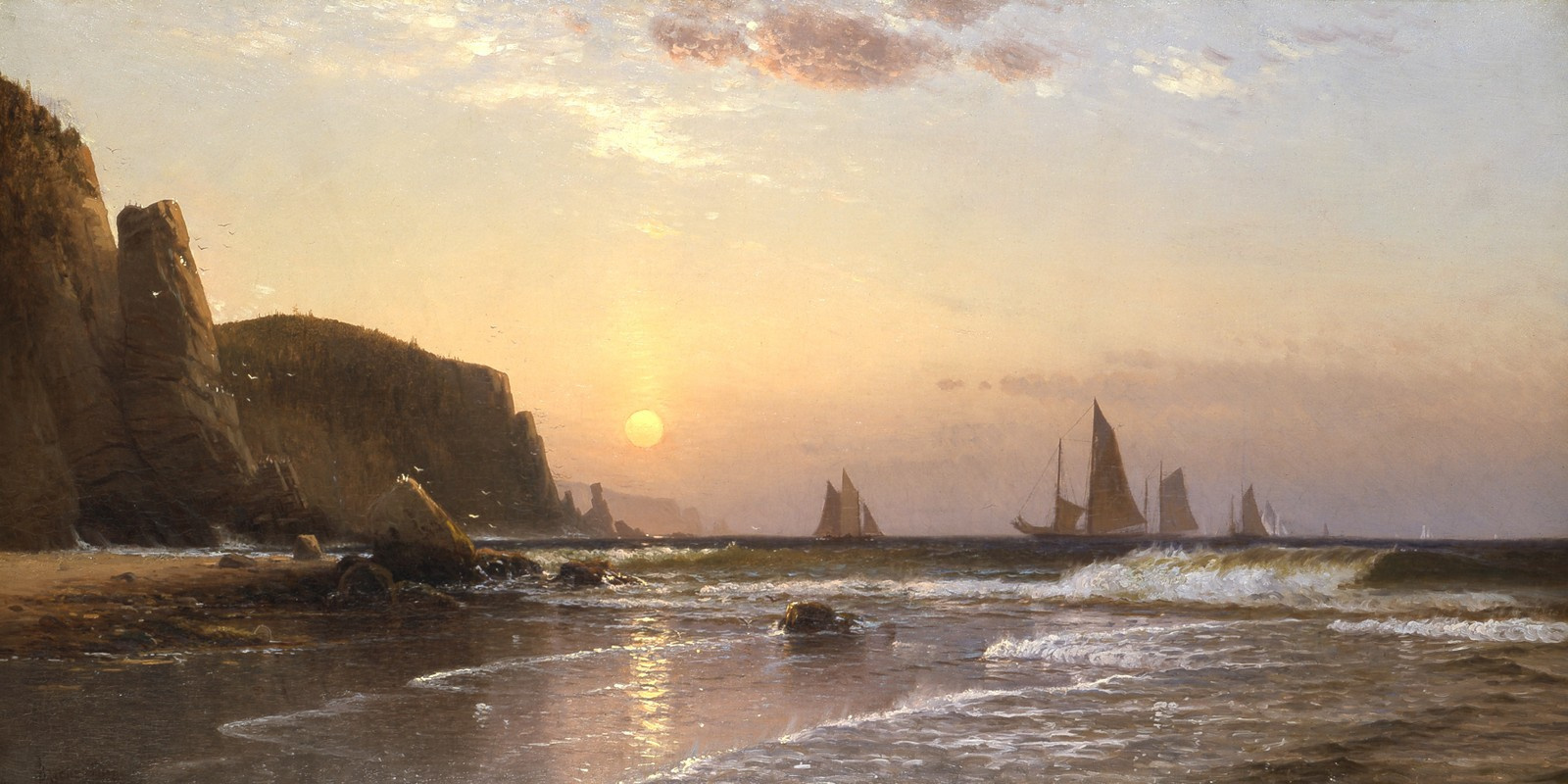
Morning_at_Grand_Manan_by_Alfred_Thompson_BricherArtist: Alfred Thompson Bricher (1837–1908)
Title: Morning at Grand Manan

Date: 1878

Medium: oil on canvas

Dimensions: height: 25 in (63.5 cm); width: 50 in (127 cm).

Collection: Indianapolis Museum of Art

Current location: Paine Early American Painting Gallery

What I Love about this painting:

This is a satisfying scene capturing the best moments of a morning at the shore. The light falls on the water with an almost photographic sheen. Fishing vessels leave the harbor, heading out to sea. The sea is calm, and the waves roll up to embrace the shore. One could wade in the shallows and search the tidal pools for starfish or crabs and other creatures in safety.

The sun is up and the few clouds in the sky are dissipating. This will be a good day, perhaps the best day of the summer.

About this painting via Wikipedia:

Morning at Grand Manan is an 1878 oil painting by Alfred Thompson Bricher. It is part of the permanent collection at the Indianapolis Museum of Art, and is currently on view in the Paine Early American Painting Gallery.

Painted along Grand Manan Island, a favorite vacation spot of the artist in New Brunswick, Canada, Bricher painted the sunrise coming above the Atlantic Ocean in a tiny inlet on the coast. Four sailing ships are clearly visible against the pink sky. On the left of the canvas, a sharp, rocky cliff face is seen, breaking up the composition. Bricher clearly depicts each wave rolling onto the beach in minute detail. The sun is positioned a little left of center of the canvas, but is the major focal point, drawing the eye in. Just like other Hudson River School painters, Bricher hides his brushstrokes as if to make the canvas disappear.

Alfred Thompson Bricher was part of the American Luminist movement, coming out of the Hudson River School. Much like the Impressionists, they were interested in the play of light in landscapes, with Bricher himself being particularly interested in how light played against the ocean. Bricher, in particular, became famous for his seascapes and depicting the North Atlantic seaboard. Bricher is considered the last important luminist painter. Morning at Grand Manan came at the height of his career, and displayed Bricher’s acquisition of European aesthetics into his own paintings.

About the Artist via Wikipedia:

Alfred Thompson Bricher (April 10, 1837 – September 30, 1908) was an American painter associated with White Mountain art and the Hudson River School.

Bricher was born in Portsmouth, New Hampshire. He was educated in an academy at Newburyport, Massachusetts. He began his career as a businessman in Boston, Massachusetts. When not working, he studied at the Lowell Institute. He also studied with Albert BierstadtWilliam Morris Hunt, and others. He attained noteworthy skill in making landscape studies from nature, and after 1858 devoted himself to the art as a profession. He opened a studio in Boston, and met with some success there. In 1868 he moved to New York City, and at the National Academy of Design that year he exhibited “Mill-Stream at Newburyport.” Soon afterward he began to use watercolors in preference to oils, and in 1873 was chosen a member of the American Watercolor Society. In the 1870s, he primarily did maritime themed paintings, with attention to watercolor paintings of landscape, marine, and coastwise scenery. He often spent summers in Grand Manan, where he produced such notable works as Morning at Grand Manan (1878). In 1879, Bricher was elected into the National Academy of Design as an Associate member.


Credits and Attributions

IMAGE: Wikimedia Commons contributors, “File:Morning at Grand Manan by Alfred Thompson Bricher.jpg,” Wikimedia Commons, https://commons.wikimedia.org/w/index.php?title=File:Morning_at_Grand_Manan_by_Alfred_Thompson_Bricher.jpg&oldid=872660352 (accessed September 5, 2024).

[1] ABOUT THE  IMAGE: Wikipedia contributors, “Morning at Grand Manan,” Wikipedia, The Free Encyclopedia, https://en.wikipedia.org/w/index.php?title=Morning_at_Grand_Manan&oldid=1192844232 (accessed September 5, 2024).

[2] BIO: Wikipedia contributors, “Alfred Thompson Bricher,” Wikipedia, The Free Encyclopedia, https://en.wikipedia.org/w/index.php?title=Alfred_Thompson_Bricher&oldid=1229486559 (accessed September 5, 2024).

4 Comments

Filed under #FineArtFriday

#FineArtFriday – Fishing for Oysters at Cancale by John Singer Sargent 1878

2560px-John_Singer_Sargent_-_CancaleArtist: John Singer Sargent (1856–1925)

Title: En route pour la pêche (Setting Out to Fish) Fishing for Oysters at Cancale

Date: 1878

Medium: oil on canvas

Dimensions: height: 77 cm (30.3 in); width: 121.6 cm (47.8 in)

Inscription: Signed and Dated: John S. Sargent Paris 1878

Collection: National Gallery of Art

What I love about this picture:

This is a perfect summer day, a good day to be out near the water. John Singer Sargent was a complicated man, as most artists are. Famous as a portrait artist, he painted landscapes that conveyed a sense of mood and emotion that few of his contemporaries could match. One of Sargent’s great skills was the ability to convey the sensory impressions of an environment.

He found beauty and drama in the lives of ordinary people and showed his characters outdoors in all the seasons. His paintings of working-class people didn’t romanticize how they dressed, conveyed their moods. Sargent showed the environment they lived and worked in, no matter how good or bad the weather.

Sargent had a gift for painting rare and expensive fabrics, yet no one is dressed in finery in this painting. On the contrary, the women are dressed in shabby clothes that protect them from the sun and salty wind, garments that have seen a great deal of wear. The children are bare-legged and barefoot, while the fishers wear clogs. These women carry baskets and the hope that they will find enough oysters and other shellfish to not only feed their family but have plenty to sell to the fishmonger.

About this picture via MFA Boston: Sargent’s choice of subject was not revolutionary – a similar scene of oyster harvesters had previously won a medal at the Salon. However, his ability to paint the reflections in the tidal pools and the light sparkling on the figures and clouds dazzled viewers, clearly demonstrating that his talents extended beyond portraiture. [1]

About the artist, via Wikipedia:

John Singer Sargent (January 12, 1856 – April 14, 1925) was an American expatriate artist, considered the “leading portrait painter of his generation” for his evocations of Edwardian-era luxury. He created roughly 900 oil paintings and more than 2,000 watercolors, as well as countless sketches and charcoal drawings. His oeuvre documents worldwide travel, from Venice to the TyrolCorfu, Spain, the Middle East, MontanaMaine, and Florida.

Born in Florence to American parents, he was trained in Paris before moving to London, living most of his life in Europe. He enjoyed international acclaim as a portrait painter. An early submission to the Paris Salon in the 1880s, his Portrait of Madame X, was intended to consolidate his position as a society painter in Paris but instead resulted in scandal. During the year following the scandal, Sargent departed for England, where he continued a successful career as a portrait artist.

From the beginning, Sargent’s work is characterized by remarkable technical facility, particularly in his ability to draw with a brush, which in later years inspired admiration as well as criticism for its supposed superficiality. His commissioned works were consistent with the grand manner of portraiture, while his informal studies and landscape paintings displayed a familiarity with Impressionism. In later life, Sargent expressed ambivalence about the restrictions of formal portrait work and devoted much of his energy to mural painting and working en plein air. Art historians generally ignored society artists such as Sargent until the late 20th century.

The exhibition in the 1980s of Sargent’s previously hidden male nudes served to spark a reevaluation of his life and work, and its psychological complexity. In addition to the beauty, sensation and innovation of his oeuvre, his same-sex interests, unconventional friendships with women and engagement with race, gender nonconformity and emerging globalism are now viewed as socially and aesthetically progressive and radical.


Credits and Attributions:

[1] Quote: MFABoston contributors, Fishing for Oysters at Cancale – Works – Museum of Fine Arts, Boston (mfa.org) (accessed May 12, 2024).

[2] Wikipedia contributors, “John Singer Sargent,” Wikipedia, The Free Encyclopedia, https://en.wikipedia.org/w/index.php?title=John_Singer_Sargent&oldid=1223504088 (accessed May 12, 2024).

Comments Off on #FineArtFriday – Fishing for Oysters at Cancale by John Singer Sargent 1878

Filed under #FineArtFriday

#FineArtFriday: The Ninth Wave by Ivan Aivazovsky 1850

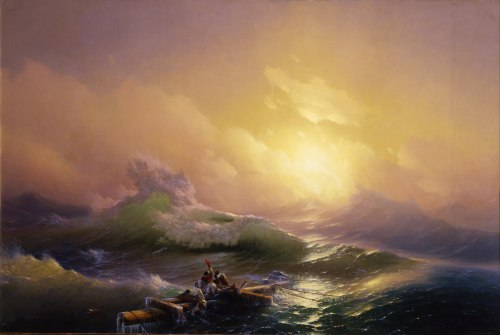
Hovhannes_Aivazovsky_-_The_Ninth_Wave_-_Google_Art_ProjectArtist: Ivan Aivazovsky (baptized Hovhannes Aivazovsky) (1817 – 1900)

Title: The Ninth Wave

Genre: marine art

Date: 1850

Medium: oil on canvas oil on canvas

Dimensions: height: 2,210 mm (87 in); width: 3,320 mm (10.89 ft)

Collection: Russian Museum

What I love about this painting:

Aivazovsky tells a story here, an epic tale showing the power and emotion of the situation. These sailors are lost at sea; their ship has gone down in a storm and even though the sun is shining in the distance, a wave of catastrophic proportions is bearing down on them.

It’s not the first such wave they’ve survived, and it won’t be the last. But that sun shining in the distances is a beacon, and they cling to hope as desperately as they do their broken mast.

About this painting via Wikipedia:

The title refers to an old sailing expression referring to a wave of incredible size that comes after a succession of incrementally larger waves.

It depicts a sea after a night storm and people facing death attempting to save themselves by clinging to debris from a wrecked ship. The debris, in the shape of the cross, appears to be a Christian metaphor for salvation from the earthly sin. The painting has warm tones, which reduce the sea’s apparent menacing overtones and a chance for the people to survive seems plausible. This painting shows both the destructiveness and beauty of nature. [1]

About the Artist via Wikipedia:

Ivan Aivazovsky was born on 29 July [O.S. 17 July] 1817 in the city of Feodosia (Theodosia), Crimea, Russian Empire. In the baptismal records of the local St. Sargis Armenian Apostolic Church, Aivazovsky was listed as Hovhannes, son of Gevorg Aivazian. He became known as Aivazovsky since c. 1840, while in Italy. He signed an 1844 letter with an Italianized rendition of his name: “Giovani Aivazovsky”.

After meeting Aivazovsky in person, Anton Chekhov wrote a letter to his wife on 22 July 1888 describing him as follows:

Aivazovsky himself is a hale and hearty old man of about seventy-five, looking like an insignificant Armenian and a bishop; he is full of a sense of his own importance, has soft hands and shakes your hand like a general. He’s not very bright, but he is a complex personality, worthy of a further study. In him alone there are combined a general, a bishop, an artist, an Armenian, an naive old peasant, and an Othello.

The house in Feodosia, where Aivazovsky lived between 1845 and 1892. It is now an art gallery.

After traveling to Paris with his wife, in 1892 he made a trip to the United States, visiting Niagara Falls in New York and Washington D.C. In 1896, at 79, Aivazovsky was promoted to the rank of full privy councillor.

Aivazovsky was deeply affected by the Hamidian massacres that took place in the Armenian-inhabited areas of the Ottoman Empire between 1894 and 1896. He painted a number of works on the subject such as The Expulsion of the Turkish Ship, and The Armenian Massacres at Trebizond (1895). He threw the medals given to him by the Ottoman Sultan into the sea and told the Turkish consul in Feodosia: “Tell your bloodthirsty master that I’ve thrown away all the medals given to me, here are their ribbons, send it to him and if he wants, he can throw them into the seas painted by me.”  He created several other paintings capturing the events, such as Lonely Ship and Night. Tragedy in the Sea of Marmara (1897).

He spent his final years in Feodosia. In the 1890s, thanks to his efforts a commercial port (ru) was established in Feodosia and linked to the railway network of the Russian Empire. The railway station, opened in 1892, is now called Ayvazovskaya [ru] and is one of the two stations within the city of Feodosia.

Aivazovsky also supplied Feodosia with drinking water. [2]


Credits and Attributions:

IMAGE: File: Hovhannes Aivazovsky – The Ninth Wave – Google Art Project.jpg Hovhannes Aivazovsky – The Ninth Wave – Google Art Project – The Ninth Wave – Wikipedia (accessed January 10, 2024).

[1]Wikipedia contributors, “The Ninth Wave,” Wikipedia, The Free Encyclopedia, https://en.wikipedia.org/w/index.php?title=The_Ninth_Wave&oldid=1160319059 (accessed January 10, 2024).

[2] Wikipedia contributors, “Ivan Aivazovsky,” Wikipedia, The Free Encyclopedia, https://en.wikipedia.org/w/index.php?title=Ivan_Aivazovsky&oldid=1194332468 (accessed January 10, 2024).

4 Comments

Filed under #FineArtFriday