Tag Archives: 20th century art

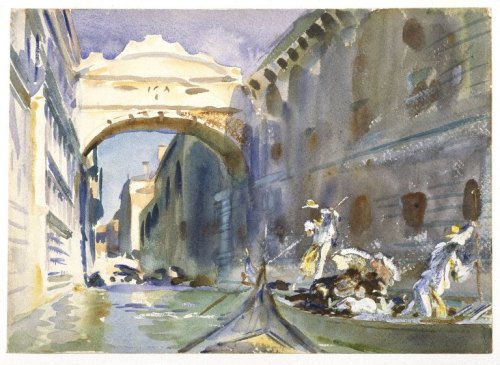
#FineArtFriday: a closer look at “The Bridge of Sighs” by John Singer Sargent ca,1905 – 1908

John_Singer_Sargent_-_The_bridge_of_sighsArtist: John Singer Sargent (1856–1925)

Title: The Bridge of Sighs

Date: between 1905 and 1908

Medium: watercolor on paper

Dimensions: height: 25.4 cm (10 in); width: 35.6 cm (14 in)

Collection: Brooklyn Museum

Current location: American Art collection

What I love about this picture:

I love the work of John Singer Sargent. He was known for his portraits and the scandals that sometimes followed him, but it is his watercolors that fascinate me.

This painting of Venice’s Bridge of Sighs is one of my favorites. Done in every shade of blue and brown, Sargent conveys the heat of afternoons in Venice. He shows us the bridge as a passenger sees it from a gondola, with a view of well-heeled ladies sheltered beneath parasols and passing in the opposite direction.

I especially like the way he shows us the gondoliers as they labor, how their bodies move as they work to propel their passengers to whatever place they are going. Sargent made several watercolors depicting gondoliers while he was in Venice.

The bridge is the true center of the piece. By his choice of colors, Sargent paints the atmosphere of a poignant, tragic place and contrasts it with the freedom and wealth of the sightseers.

They are like me, people with an interest in history but who have no true concept of the reality, the tragedy of the famous place they have come to see.

About this picture, via Wikipedia:

The Bridge of Sighs (Italian: Ponte dei Sospiri, Venetian: Ponte de i Sospiri) is a bridge in Venice, Italy. The enclosed bridge is made of white limestone, has windows with stone bars, passes over the Rio di Palazzo, and connects the New Prison (Prigioni Nuove) to the interrogation rooms in the Doge’s Palace.

The view from the Bridge of Sighs was the last view of Venice that convicts saw before their imprisonment. The bridge’s English name was bequeathed by Lord Byron in the 19th century as a translation from the Italian “Ponte dei sospiri”, from the suggestion that prisoners would sigh at their final view of beautiful Venice through the window before being taken down to their cells. [1]

About The Artist via Wikipedia:

John Singer Sargent (January 12, 1856 – April 14, 1925) was an American expatriate artist, considered the “leading portrait painter of his generation” for his evocations of Edwardian-era luxury. He created roughly 900 oil paintings and more than 2,000 watercolors, as well as countless sketches and charcoal drawings. His oeuvre documents worldwide travel, from Venice to the TyrolCorfu, the Middle East, Montana, Maine, and Florida.

Born in Florence to American parents, he was trained in Paris before moving to London, living most of his life in Europe. He enjoyed international acclaim as a portrait painter. An early submission to the Paris Salon in the 1880s, his Portrait of Madame X, was intended to consolidate his position as a society painter in Paris, but instead resulted in scandal. During the next year following the scandal, Sargent departed for England where he continued a successful career as a portrait artist.

From the beginning, Sargent’s work is characterized by remarkable technical facility, particularly in his ability to draw with a brush, which in later years inspired admiration as well as criticism for a supposed superficiality. His commissioned works were consistent with the grand manner of portraiture, while his informal studies and landscape paintings displayed a familiarity with Impressionism. In later life Sargent expressed ambivalence about the restrictions of formal portrait work and devoted much of his energy to mural painting and working en plein air. Art historians generally ignored society artists such as Sargent until the late 20th century.

With his watercolors, Sargent was able to indulge his earliest artistic inclinations for nature, architecture, exotic peoples, and noble mountain landscapes. And it is in some of his late works where one senses Sargent painting most purely for himself. His watercolors were executed with a joyful fluidness. He also painted extensively family, friends, gardens, and fountains. In watercolors, he playfully portrayed his friends and family dressed in Orientalist costume, relaxing in brightly lit landscapes that allowed for a more vivid palette and experimental handling than did his commissions (The Chess Game, 1906). His first major solo exhibit of watercolor works was at the Carfax Gallery in London in 1905. In 1909, he exhibited eighty-six watercolors in New York City, eighty-three of which were bought by the Brooklyn MuseumEvan Charteris wrote in 1927:

To live with Sargent’s water-colours is to live with sunshine captured and held, with the luster of a bright and legible world, ‘the refluent shade’ and ‘the Ambient ardours of the noon.’

Although not generally accorded the critical respect given Winslow Homer, perhaps America’s greatest watercolorist, scholarship has revealed that Sargent was fluent in the entire range of opaque and transparent watercolor technique, including the methods used by Homer. [2]


Credits and Attributions:

[1] Wikipedia contributors, “Bridge of Sighs,” Wikipedia, The Free Encyclopedia, https://en.wikipedia.org/w/index.php?title=Bridge_of_Sighs&oldid=1096829521 (accessed November 13, 2025).

[2] Wikipedia contributors, “John Singer Sargent,” Wikipedia, The Free Encyclopedia, https://en.wikipedia.org/w/index.php?title=John_Singer_Sargent&oldid=1099859237 (accessed November 13, 2025).

[Image] Wikimedia Commons contributors, “File:John Singer Sargent – The bridge of sighs.jpg,” Wikimedia Commons, the free media repository, https://commons.wikimedia.org/w/index.php?title=File:John_Singer_Sargent_-_The_bridge_of_sighs.jpg&oldid=660236372 (accessed November 13, 2025).
Comments Off on #FineArtFriday: a closer look at “The Bridge of Sighs” by John Singer Sargent ca,1905 – 1908

Filed under #FineArtFriday

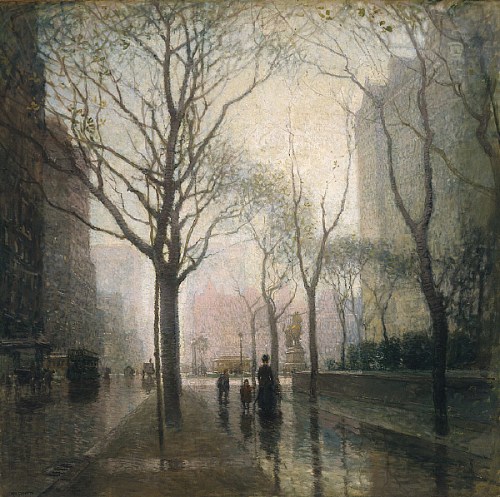
#FineArtFriday: A second look at “The Plaza After the Rain” by Paul Cornoyer

Paul_Cornoyer_-_The_Plaza_After_RainArtist: Paul Cornoyer  (1864–1923)

Title: The Plaza After Rain

Date: Before 1910

Medium: oil on canvas

Dimensions: 59 1/4 x 59 1/4 in. (150.5 x 150.5 cm)

Collection: Saint Louis Art Museum, Saint Louis, Missouri, United States

What I love about this painting:

This painting appeared here in January of 2024. Paul Cornoyer was a master at painting the way wet pavement looks, the reflections and the sheen. Rain is a near-constant companion during a Pacific Northwest winter and while it is now May, today is no exception.

Paul Cornoyer’s The Plaza After Rain depicts New York City, which is on the other side of the continent from me, and it takes place in a different era. But he shows the way rain is in early spring no matter where in the northern US you reside.

The sky is dark, but the trees are just beginning to leaf out. The rain is passing, and the streets are wet, but a hint of blue is showing through the dark sky. When you see this painting, you see the story of a cold spring day. Yet, one has the feeling that sunshine could happen any minute.

Impressionism is flash fiction on a canvas. All the important things are there, everything the eye needs to have a perfect vision of the mood, the setting, and characters at that moment in time. The important things at that moment are depicted within the piece, but with economy.

The St. Louis Art Museum says this about The Plaza After the Rain:

A drizzling rain creates watery reflections on the streets and sidewalks along the Grand Army Plaza in Manhattan. The rain hampers our view down the vista, though the moody tones of pinks, grays, and blues make up for this loss. The light in the distance offers a hazy glimpse of the southeast corner of Central Park, with its beloved bronze statue of Civil War general William Tecumseh Sherman. [2]

About the Author, via Wikipedia:

Paul Cornoyer (1864–1923) was an American painter, currently best known for his popularly reproduced painting in an Impressionisttonalist, and sometimes pointillist style.

Born in St. Louis, Missouri, Cornoyer began painting in Barbizon style and first exhibited in 1887. In 1889, He moved to Paris, where he studied at the Académie Julian alongside Jules Lefebvre and Jean-Joseph Benjamin-Constant. After returning from his studies in Paris in 1894, Cornoyer was heavily influenced by the American tonalists. At the urging of William Merritt Chase, he moved to New York City in 1899. In 1908, the Albright–Knox Art Gallery (formerly the Albright Gallery) hosted a show of his work. In 1909, he was elected into the National Academy of Design as an Associate Academician. He taught at Mechanics Institute of New York and in 1917, he moved to Massachusetts, where he continued to teach and paint.

Cornoyer received a retrospective exhibition entitled Paul Cornoyer: American Impressionist at the Lakeview Center for the Arts and Sciences in Peoria, Illinois in 1973. The exhibit drew heavily from the collection of Dr. and Mrs. Lawrence Ashby, who loaned multiple paintings to the exhibit, as well as over 20 works on paper. [1]


Credits and Attributions:

IMAGE: The Plaza After the Rain by Paul Cornoyer PD|100, Wikimedia Commons contributors, “File:Paul Cornoyer – The Plaza After Rain.jpg,” Wikimedia Commons, https://commons.wikimedia.org/w/index.php?title=File:Paul_Cornoyer_-_The_Plaza_After_Rain.jpg&oldid=345336218 (accessed January 18, 2024).

[1] Wikipedia contributors, “Paul Cornoyer,” Wikipedia, The Free Encyclopedia, https://en.wikipedia.org/w/index.php?title=Paul_Cornoyer&oldid=1118249028 (accessed January 18, 2024).

[2] St. Louis Art Museum contributors, the Plaza After the Rain by Paul Cornoyer, The Plaza after the Rain – Saint Louis Art Museum (slam.org) (accessed January 18, 2024).

2 Comments

Filed under #FineArtFriday, writing

FineArtFriday: Holiday on the Hudson by George Luks ca. 1912

George_Luks_(American,_1866–1933)_-_Holiday_on_the_Hudson_-_1933.2291_-_Cleveland_Museum_of_ArtArtist: George Luks  (1867–1933)

Title: Holiday on the Hudson

Date: circa 1912

Collection: Cleveland Museum of Art

What I love about this painting:

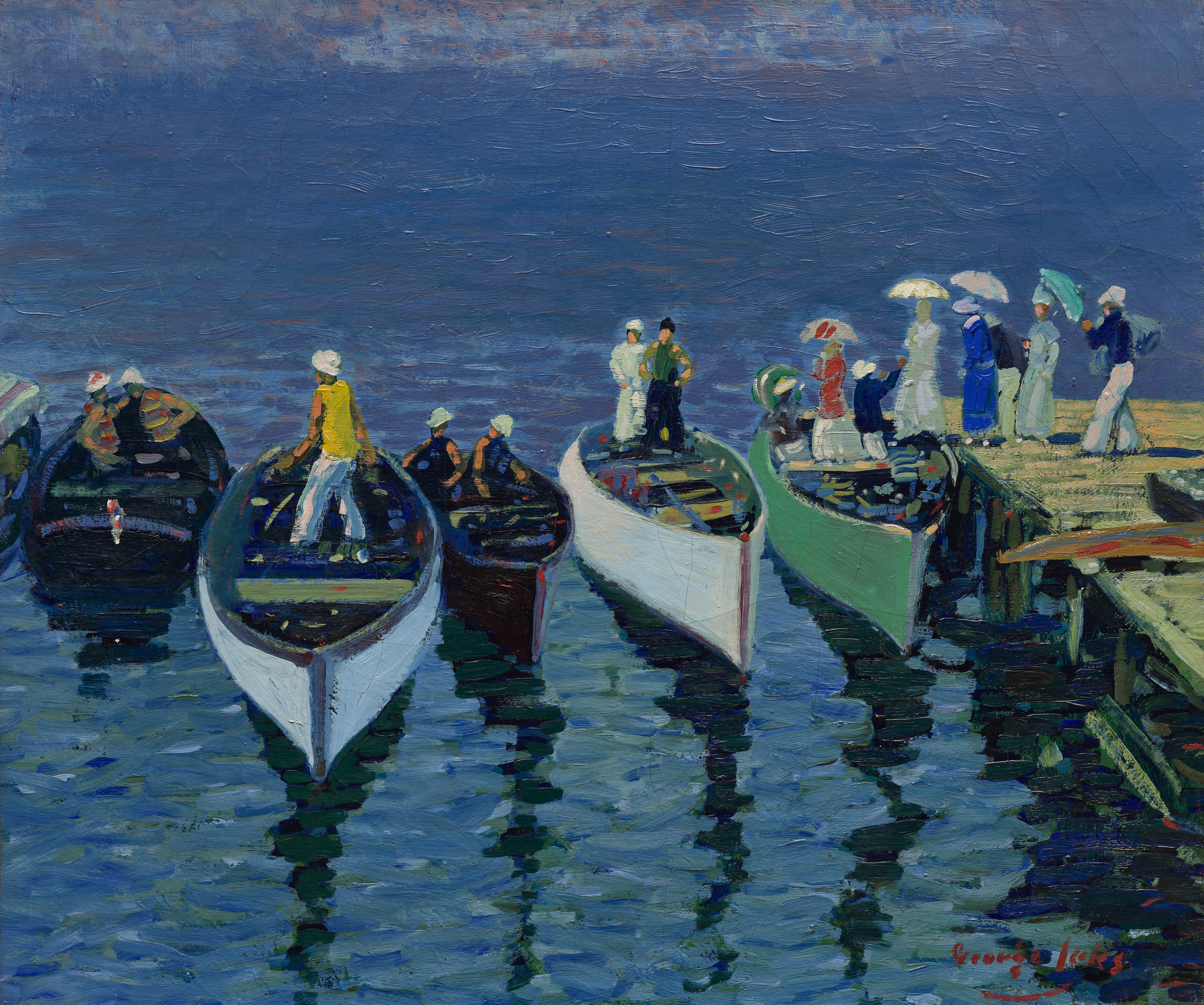
These are the working-class people of New York on a sunny Sunday in high summer. Fishing has been good, and while the oyster boats and small fishing dories have seen heavy use, they’ve been tidied up a bit, and everyone is looking forward to a carefree day on the water. The fishermen in their sleeveless shirts are quickly moving ropes and gear around to make room for the ladies.

I love the life instilled in the painting, the action, the colors, the intensity, and the way it shouts, “Freedom beckons,” even if that freedom is only temporary.

I see a story here, a historical romance. I imagine that some of this group of friends are the servants of the rich enjoying their half-day off. Besides the fishermen, we have footmen, maids, cooks, and housekeepers. I like to think they’re heading to a favorite beach for a clambake, that time-honored seaside picnic that even the poor working-class could afford.

Who is courting whom? Will they get married?

About the artist, via Wikipedia:

George Benjamin Luks (August 13, 1867 – October 29, 1933) was an American artist, identified with the aggressively realistic Ashcan School of American painting.

After travelling and studying in Europe, Luks worked as a newspaper illustrator and cartoonist in Philadelphia, where he became part of a close-knit group, led by Robert Henri, that set out to defy the genteel values imposed by the influential National Academy of Design. His best-known paintings reflect the life of the poor and hard-pressed on Manhattan’s Lower East Side. [1]

For more about George Luks, I highly recommend continuing to read his biography here: George Luks – Wikipedia


Credits and Attributions:

IMAGE: Wikimedia Commons contributors, “File:George Luks (American, 1866–1933) – Holiday on the Hudson – 1933.2291 – Cleveland Museum of Art.jpg,” Wikimedia Commons, https://commons.wikimedia.org/w/index.php?title=File:George_Luks_(American,_1866%E2%80%931933)_-_Holiday_on_the_Hudson_-_1933.2291_-_Cleveland_Museum_of_Art.jpg&oldid=779825858 (accessed June 27, 2024).

[1]Wikipedia contributors, “George Luks,” Wikipedia, The Free Encyclopedia, https://en.wikipedia.org/w/index.php?title=George_Luks&oldid=1217710156 (accessed June 27, 2024).

Comments Off on FineArtFriday: Holiday on the Hudson by George Luks ca. 1912

Filed under #FineArtFriday

#FineArtFriday: A second look at “Harvesters” by Anna Ancher, 1905

Anna_Ancher_-_Harvesters_-_Google_Art_ProjectArtist: Anna Ancher  (1859–1935)

Title: Harvesters

Date: 1905

Medium: oil on canvas

Dimensions: w56.2 x h43.4 cm (Without frame)

Collection: Skagens Museum

What I love about this painting:

While she normally painted interiors, Anna Ancher captured a perfect late summer morning beneath blue skies in this painting. One can almost hear the rustling of ripe grain moving with the breeze.

I like the placement of the three figures, two women and a man. Are they husband, wife, and daughter? There is a sense of movement in this painting. They enter the scene from the right, and you feel sure they will exit to the left, where the field that is to be cut that day is.

The man will scythe, the woman who follows third will rake, and the woman in the middle will stack the sheaves.

These are not poor people. These farmers are dressed modestly in clean work clothes that aren’t tattered and patched. They are doing well; the grain is high, and life is good in these years of plenty before the outbreak of WWI.

About the Artist, via Wikipedia:

Anna Ancher (18 August 1859 – 15 April 1935), born Anna Kirstine Brøndum, was born in Skagen, Denmark, was the only one of the Skagen Painters who was born and grew up in Skagen, where her father owned the Brøndums Hotel. The artistic talent of Anna Ancher became obvious at an early age and she became acquainted with pictorial art via the many artists who settled to paint in Skagen, in the north of Jylland.

While she studied drawing for three years at the Vilhelm Kyhn College of Painting in Copenhagen, she developed her own style and was a pioneer in observing the interplay of different colors in natural light. She also studied drawing in Paris at the atelier of Pierre Puvis de Chavannes along with Marie Triepcke, who would marry Peder Severin Krøyer, another Skagen painter.

In 1880 she married fellow painter Michael Ancher, whom she met in Skagen. They had one child, daughter Helga Ancher. Despite pressure from society that married women should devote themselves to household duties, she continued painting after marriage.

Anna Ancher was considered to be one of the great Danish pictorial artists by virtue of her abilities as a character painter and colorist. Her art found its expression in Nordic art’s modern breakthrough toward a more truthful depiction of reality, e.g. in Blue Ane (1882) and The Girl in the Kitchen (1883–1886).

Ancher preferred to paint interiors and simple themes from the everyday lives of the Skagen people, especially fishermen, women, and children. She was intensely preoccupied with exploring light and color, as in Interior with Clematis (1913). She also created more complex compositions such as A Funeral (1891). Anna Ancher’s works often represented Danish art abroad. Ancher has been known for portraying similar civilians from the Skagen art colony in her works, including an old blind woman.


Credits and Attributions:

Harvesters, Anna Ancher, Public domain, via Wikimedia CommonsWikimedia Commons contributors, “File:Anna Ancher – Harvesters – Google Art Project.jpg,” Wikimedia Commons, the free media repository, https://commons.wikimedia.org/w/index.php?title=File:Anna_Ancher_-_Harvesters_-_Google_Art_Project.jpg&oldid=371900766 (accessed October 14, 2021).

Wikipedia contributors, “Harvesters (Ancher),” Wikipedia, The Free Encyclopedia, https://en.wikipedia.org/w/index.php?title=Harvesters_(Ancher)&oldid=1047378795 (accessed October 14, 2021).

5 Comments

Filed under #FineArtFriday

#FineArtFriday:Porto de Leixões by Mário Navarro da Costa 1901

602px-Mário_Navarro_da_Costa_-_Porto_de_Leixões,_1901Artist: Mário Navarro da Costa (1883-1931)
Description: Português: Porto de Leixões (English: Port of Leixões)

Dimensions: 81 x 100 cm

Date: 1901

Source/Photographer: Collection of the Pinacoteca do Estado de São Paulo

What I love about this painting:

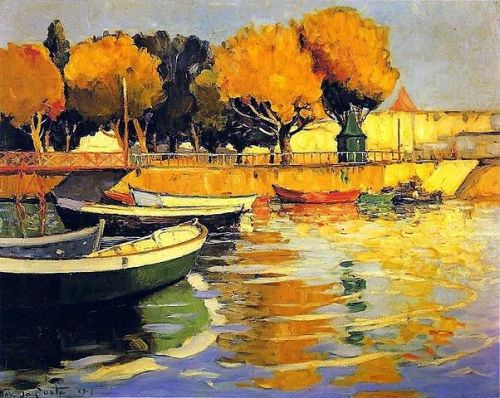
I love the intensity of this scene. One can feel the heat of a Portuguese day at the end of summer, a moment lingering on the edge of autumn. He brings his native Brazilian passion for color to the composition, with vibrant hues and strong visual texture.

More than a century after da Costa painted these humble fishing boats, Porto de Leixões is the largest port city in northern Portugal handling giant cargo vessels. The port boasts a 21st century  cruise ship terminal that is a visually stunning structure.

About the artist, via CoPilot GPT (source links included):

Mário Navarro da Costa (1883–1931) was a Brazilian painter and diplomat. He dedicated himself primarily to marine art and received private lessons from José Maria de Medeiros (1849–1925) and Rodolfo Amoedo (1857–1941) 1. His work falls within the realm of Impressionist and Modern painting. Over the years, his pieces have been offered at auction multiple times, with realized prices ranging from $596 to $2,630, depending on the size and medium of the artwork 2One notable work is “Barreiro Old Mills”, which achieved a record price of $2,630 at auction in 2019 2.


Credits and Attributions:

IMAGE: Wikimedia Commons contributors, “File:Mário Navarro da Costa – Porto de Leixões, 1901.jpg,” Wikimedia Commons, https://commons.wikimedia.org/w/index.php?title=File:M%C3%A1rio_Navarro_da_Costa_-_Porto_de_Leix%C3%B5es,_1901.jpg&oldid=841285378 (accessed April 11, 2024).

Comments Off on #FineArtFriday:Porto de Leixões by Mário Navarro da Costa 1901

Filed under #FineArtFriday

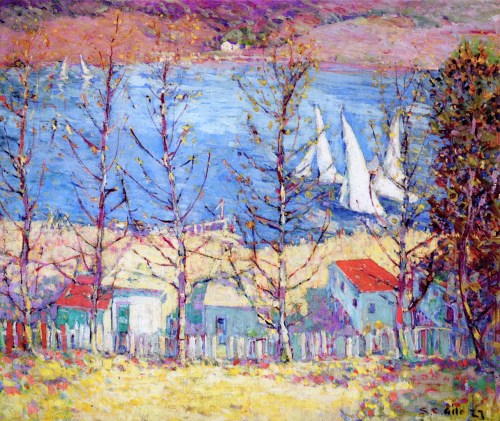
#FineArtFriday: Belvedere 1927 Seldon Connor Gile (a second look)

Title: Belvedere

Artist: Seldon Connor Gile

Medium: Oil on Canvas

Date: 1927

Inscription: signed and dated by Artist: Gile 27


What I love about this painting:

This is a view of San Francisco Bay from a hill in the town of Belvedere, California. Belvedere is located on the San Francisco Bay in Marin CountyCalifornia. Consisting of two islands and a lagoon, it is connected to the Tiburon Peninsula by two causeways.

It is a place the artist clearly loved, and he had his home nearby in Tiburon.

The intensity of color as one looks down the hill toward the shanties lends an atmosphere of purity, of fresh air, and approaching springtime to the painting.

Bold strokes of red and blue convey the atmosphere that is quintessential to Northern California. He offers us a sense of wonder, of peace, of modest post-WWI prosperity in this painting. We are shown the depth of color and vibrancy of a time and sense of place that has long vanished.

This is an era we usually see through old black-and-white photographs and jerky, scratchy newsreels.

Even rundown and undeveloped properties in Tiburon and Belvedere now sell in the high millions. Starving artists and middle-class workers can rarely acquire vacation shanties in that area.

About the Artist, Via Wikipedia:

Selden Connor Gile (20 March 1877 – 8 June 1947) was an American painter who was mainly active in northern California between the early-1910s and the mid-1930s. He was the founder and leader of the Society of Six, a Bay Area group of artists known for their plein-air paintings and rich use of color, a quality that would later figure into the work of Bay Area figurative expressionists.

Though Gile was steadily employed at jobs other than art until the age of 50, his artistic output, primarily from marathon weekends spent painting, was considerable. 1915, the year of the Panama–Pacific International Exposition, marked the beginning of his maturation as an artist, despite that fact that Gile and the Society of Six would not exhibit their art beyond a few occasional paintings until 1923. From their first exhibition at the Oakland Art Gallery on March 11, 1923 to the sixth and final show as a group in 1928, Gile and the Society of Six were generally well received by critics. In the spring of 1927, Gile quit his job as an office manager for Gladding, McBean and Company and moved from his cabin on Chabot Road in Oakland (also known as the “Chow House” where the Society of Six would meet on weekends), into a cottage he had kept since the early 1920s on San Francisco Bay in TiburonMarin County to paint full-time.

Selden Gile continued to paint and exhibited in various group shows every year until 1937. During the 1930s, the number of his oil paintings declined in favor of watercolors. Another change likely brought on by the mood around the Great Depression was to include more people, particularly workers, in his paintings. Despite his discomfort with larger formats, Gile took on the town of Belvedere’s only WPA mural commission, painting a mural for the public library, where he served as a part-time librarian. Towards the end of his life, unable to pay his rent, Gile took on another mural commission, this time for a railroad office in San Francisco. He is remembered from his time in the Tiburon/Belvedere area:

“…as a loner, independent, and very proud. [Gile] enjoyed cordial relationships with some of his neighbors, often chatting with them on the street or in doorways, but he consistently refused their hospitality…In the end Gile was a sick, alcoholic old man surrounded by paintings he never sold, lonely, and not painting. The process of painting and camaraderie that he had enjoyed were past now.”

A few months before he died, Selden Gile checked himself into the Marin County Hospital and Farm, where he spent the rest of his life. On June 8, 1947, Gile died of cirrhosis of the liver.


Credits and Attributions:

Belvedere, California 1927 by Selden Connor Gile, Public domain, via Wikimedia Commons

Wikimedia Commons contributors, “File:Selden Connor Gile Belvedere 1927.jpg,” Wikimedia Commons, the free media repository, https://commons.wikimedia.org/w/index.php?title=File:Selden_Connor_Gile_Belvedere_1927.jpg&oldid=525009834 (accessed March 11, 2021).

2 Comments

Filed under #FineArtFriday

#FineArtFriday: A second look at two paintings by H. A. Brendekilde

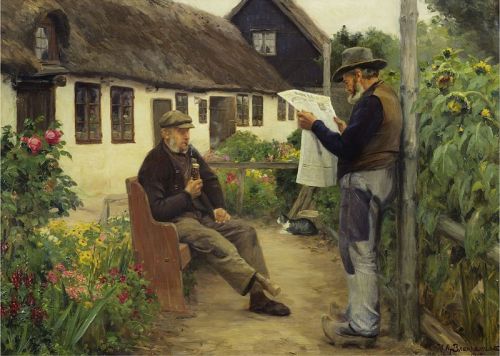
H. A. Brendekilde is one of my favorite artists, which is why I wanted to revisit these two paintings. There is a story in the above painting. I love the details—the patched trousers of the gardener, the mud on his clogs, the other man’s wooden leg—juxtaposed against the lush spring garden and prosperous village life of Denmark in 1912. Their hands and clothes indicate they have stopped work to read the newspaper. Both men seem stunned. Are they perhaps reading of the death of King Frederick VIII, who died on 14 May 1912?

Whatever they are reading, the cat remains undisturbed by the news. Even in 1912, cats were notoriously unconcerned about the life or death of kings.

The next painting also tells a powerful story.

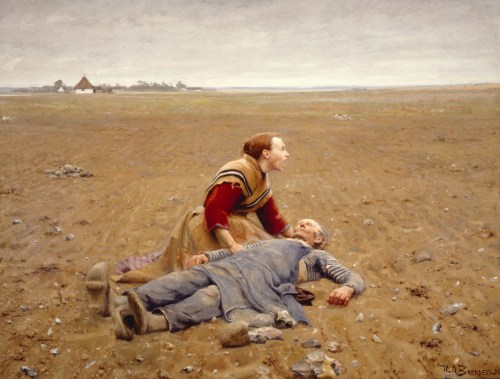
H. A. Brendekilde was a forerunner of the social realist style, embraced by Diego Rivera. His early work often depicted the daily lives of the rural working class. One of his most famous paintings, “Worn Out” (1889) shows an elderly man lying fallen on his back in the plowed field. He has collapsed while picking stones, preparing a field for planting. The stones he had gathered have scattered across the ground, and one of his clogs has fallen off his foot.

Has he worked himself to death? Will he recover? His entire world is this rocky barren field.  A story is in this stark painting.


About the Artist via Wikipedia (be patient–this was written by a non-native English-speaker. We should all speak a foreign language so well!)

[1] Hans Andersen Brendekilde (7 April 1857 – 30 March 1942) was a Danish painter.

Brendekilde’s influence was great not only on society, but also on his many friends among painters and potters. Among the painters especially on L.A. Ring. During their young and poor years they were sharing room and studio in Copenhagen for periods. They painted similar themes, both had the family name Andersen and they were therefore often confused with one another. So in 1884 they changed their family names Andersen to the names of their native villages instead, Brendekilde and Ring. Brendekilde was always in a good mood, was deeply committed to paint life in the small villages, and furthermore was an ardent socialist. Ring was of a more depressive disposition and Brendekilde encouraged him to continue painting and join exhibitions. Brendekilde also introduced Ring to Lars Ebbesen, who had a farm “Petersminde” in “Raagelund” close to Odense. In 1883, Ring was living in extreme poverty in Copenhagen, but the introduction to Lars Ebbesen meant that he could live and paint without worrying about the cost of rent and food for long periods. Both Brendekilde and Ring remained lifelong friends with farm owner Ebbesen. Several of Brendekilde’s paintings became very famous and won medals e.g. at the World Expositions in Paris 1889, in Chicago 1893 and at the “Jahresausstellung” im Glaspalast in München 1891. He also inspired painters like his friends Julius PaulsenPeder MønstedHans Smidth, Paul FischerSøren Lund [da] and H. P. Carlsen.

Brendekilde was the first painter bringing the arts and crafts movement to Denmark when from about 1884 he designed and made integrated frames around his paintings, the frames being part of the paintings and their story. Some frames were symbolistic and others more ornamental.

Many of his paintings are obviously related to those by Anna and Michael AncherP.S. Krøyer and the Swedish painters Carl Larsson and Anders Zorn. All of these displayed their paintings at the international exhibitions in Copenhagen 1888, Paris 1889, Munich 1891 and Chicago 1893. [1]


Credits and Attributions:

[1] Wikipedia contributors, “H. A. Brendekilde,” Wikipedia, The Free Encyclopedia, https://en.wikipedia.org/w/index.php?title=H._A._Brendekilde&oldid=1019433991 (accessed March 11, 2022). Translated from Dutch.

While reading the newspaper news by H. A. Brendekilde 1912 [Public domain], via Wikimedia Commons

Worn Out by H. A. Brendekilde [Public domain], via Wikimedia Commons

2 Comments

Filed under #FineArtFriday

#FineArtFriday: Evening Street by Jakub Schikaneder, 1906

Jakub_Schikaneder_-_Evening_Street_-_Google_Art_ProjectArtist: Jakub Schikaneder (1855–1924)

Title: Evening Street

Date: 1906

Medium: oil on canvas

Inscriptions: signed and dated

Collection: National Gallery Prague

About this Painting, via Copilot GPT (sources listed in the footnotes below):

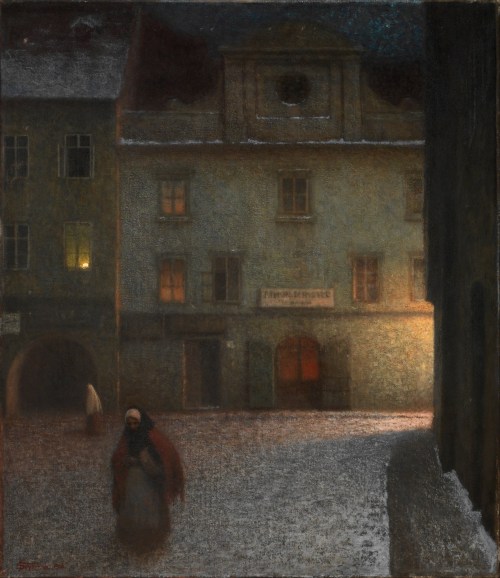
Evening Street by Jakub Schikaneder is done in the Romanticism style, characterized by its blend of realism and melancholy. In this enchanting cityscape, Schikaneder masterfully captures the quietude of an evening street in Prague. The scene exudes a sense of solitude and nostalgia, as if time has slowed down. The play of light and shadow adds depth to the composition, emphasizing the architectural details and the cobblestone pavement.

The painting invites us to wander through the narrow streets, perhaps imagining the footsteps of passersby and the whispers of history. The subdued palette, with hints of warm tones, evokes the fading light of day. It’s a moment frozen in time—a glimpse into the soul of the city.

Schikaneder often depicted lower-class people in his works, and Evening Street is no exception. The figures, though not prominent, contribute to the overall atmosphere. Their silhouettes blend seamlessly with the surroundings, emphasizing the quiet beauty of everyday life. [1]

About the Artist, via Wikipedia:

Jakub (or Jakob) Schikaneder (February 27, 1855 in Prague – November 15, 1924 in Prague) was a painter from Bohemia.

Jakub (or Jakob) Schikaneder was born to a family of a German customs office clerk in Prague. The family’s love of art enabled him to pursue his studies, despite bad economic circumstances. The aspiring painter was a descendant of Urban Schikaneder, the elder brother of librettist Emanuel Schikaneder.

Following his work in the National Theatre, Schikaneder traveled through Europe, visiting Germany, England, Scotland, The Netherlands, Switzerland, Italy and France. From 1891 until 1923 he taught in Prague’s Art College. Schikaneder counted amongst those who admired the Munich School of the end of the 19th century.

Schikaneder is known for his soft paintings of the outdoors, often lonely in mood. His paintings often feature poor and outcast figures and “combined neoromantic and naturalist impulses.” Other motifs favored by Schikaneder were autumn and winter, corners and alleyways in the city of Prague and the banks of the Vltava – often in the early evening light or cloaked in mist. His first well-known work was the monumental painting Repentance of the Lollards (2.5m × 4m, lost). The National Gallery in Prague held an exhibition of his paintings from May 1998 until January 1999. [2]


Credits and Attributions:

IMAGE: Wikimedia Commons contributors, “File:Jakub Schikaneder – Evening Street – Google Art Project.jpg,” Wikimedia Commons, https://commons.wikimedia.org/w/index.php?title=File:Jakub_Schikaneder_-_Evening_Street_-_Google_Art_Project.jpg&oldid=844404638 (accessed February 22, 2024).

[1] Copilot GPT drew information and quotes from these sources (accessed February 22, 2024):

  1. https://www.wikiart.org/en/jakub-schikaneder/evening-street |
  2. https://www.artrenewal.org/artworks/street-in-the-evening-prague/jakub-schikaneder/100011 |
  3. https://fineartamerica.com/featured/5-evening-street-jakub-schikaneder.html |
  4. https://www.wikiart.org/en/jakub-schikaneder

[2] Wikipedia contributors, “Jakub Schikaneder,” Wikipedia, The Free Encyclopedia, https://en.wikipedia.org/w/index.php?title=Jakub_Schikaneder&oldid=1188016975 (accessed February 22, 2024).

Comments Off on #FineArtFriday: Evening Street by Jakub Schikaneder, 1906

Filed under #FineArtFriday

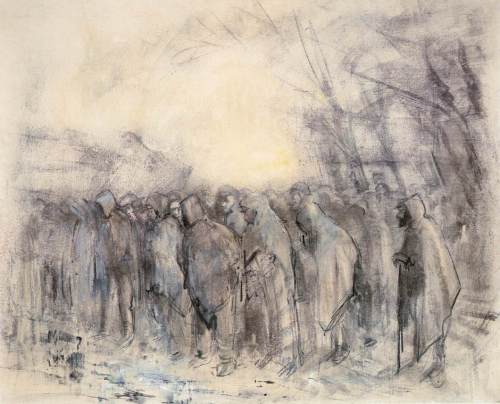
#FineArtFriday: Prisoners Marching Off by László Mednyánszky (1914)

László_Mednyánszky_Prisoners_Marching_Off_1914-18Author: László Mednyánszky (1852–1919)

Description: English: Prisoners Marching Off

Magyar: Vonuló foglyok

Date: 1914

Today’s image is by the Slovak–Hungarian painter, László Mednyánszky. Despite his age (62), he was a war correspondent on the front-lines from 1914 when WWI broke out, until his death from wounds he received in 1918. He chronicled the chaos, the living conditions, and the tragedy of it all.

I think the fact he did this one in shades of black and gray (possibly mixed media, charcoal and oils) emphasizes the grimness of the scene. He shows us the hopelessness these prisoners feel, how they are just faceless playing pieces in a game they can’t even comprehend.

About the artist, via Wikipedia:

Baron László Mednyánszky, also known by his Latinized name Ladislaus Josephus Balthasar Eustachius Mednyánszky (SlovakLadislav Medňanský; 23 April 1852 – 17 April 1919), was a SlovakHungarian painter and philosopher, considered one of the most enigmatic figures in the history of Hungarian art

Mednyánszky’s works were largely in the Impressionist tradition, with influences from Symbolism and Art Nouveau. His works depict landscape scenes of nature, the weather and everyday, poor people such as peasants and workmen. The region of his birth, the northeastern part of the Kingdom of Hungary, part of Austria-Hungary, was the site and subject of many of his paintings; scenes from the Carpathian Mountains and the Hungarian Plains are numerous. He also painted portraits of his friends and family, and images of soldiers during the First World War whilst working as a war correspondent.

When the First World War broke out in 1914, Mednyánszky was in Budapest again. He worked as a war correspondent on the Austro-Hungarian frontlines in Galicia, Serbia, and the southern Tirol. In the spring of 1918, he returned to Nagyőr (Strážky) to recover from war wounds. After spending some time working in Budapest, Mednyánszky died in poor health in the spring of 1919, in Vienna. He was homosexual, having had several relationships with men throughout his life. The longest and most important one, with Bálint Kurdi of Vác, lasted for decades.

His works are currently displayed in the Slovak National Gallery in Bratislava and Strážky chateau, which was donated to SNG by his niece Margit Czóbel in 1972.  Many of his works are displayed in the Hungarian National Gallery in Budapest as well. A large number of his works were destroyed during the Second World War.

In 2004 a New York gallery was host to a show of about seventy 19th- and early 20th-century Hungarian paintings, and a few works on paper, from the collection of Nicholas Salgo, a former United States ambassador to Hungary. The exhibition’s title, Everywhere a Foreigner and Yet Nowhere a Stranger, was drawn from Mednyánszky’s diary. [1]


Credits and Attributions:

IMAGE: Wikimedia Commons contributors, “File:László Mednyánszky Prisoners Marching Off 1914-18.jpg,” Wikimedia Commons, https://commons.wikimedia.org/w/index.php?title=File:L%C3%A1szl%C3%B3_Medny%C3%A1nszky_Prisoners_Marching_Off_1914-18.jpg&oldid=227591696 (accessed February 8, 2024).

[1] Wikipedia contributors, “László Mednyánszky,” Wikipedia, The Free Encyclopedia, https://en.wikipedia.org/w/index.php?title=L%C3%A1szl%C3%B3_Medny%C3%A1nszky&oldid=1197892373 (accessed February 8, 2024).

5 Comments

Filed under #FineArtFriday

#FineArtFriday: The Plaza After the Rain by Paul Cornoyer

Paul_Cornoyer_-_The_Plaza_After_RainArtist: Paul Cornoyer  (1864–1923)

Title: The Plaza After Rain

Date: Before 1910

Medium: oil on canvas

Dimensions: 59 1/4 x 59 1/4 in. (150.5 x 150.5 cm)

Collection: Saint Louis Art Museum, Saint Louis, Missouri, United States

What I love about this painting:

Rain is a near-constant companion during a Pacific Northwest winter. Paul Cornoyer’s The Plaza After Rain depicts New York City, which is on the other side of the continent from me, and it takes place in a different era. But he shows the way rain is in early spring no matter where in the northern US you reside.

The sky is dark, but the trees are just beginning to leaf out. The rain is passing and the streets are wet, but a hint of blue is showing through the dark sky. When you see this painting, you see the story of a cold spring day. Yet, one has the feeling that sunshine could happen any minute.

Impressionism is flash fiction on a canvas. All the important things are there, everything the eye needs to have a perfect vision of the mood, the setting, and characters at that moment in time. The important things at that moment are depicted within the piece, but with economy.

The St. Louis Art Museum says this about The Plaza After the Rain:

A drizzling rain creates watery reflections on the streets and sidewalks along the Grand Army Plaza in Manhattan. The rain hampers our view down the vista, though the moody tones of pinks, grays, and blues make up for this loss. The light in the distance offers a hazy glimpse of the southeast corner of Central Park, with its beloved bronze statue of Civil War general William Tecumseh Sherman. [2]

About the Author, via Wikipedia:

Paul Cornoyer (1864–1923) was an American painter, currently best known for his popularly reproduced painting in an Impressionisttonalist, and sometimes pointillist style.

Born in St. Louis, Missouri, Cornoyer began painting in Barbizon style and first exhibited in 1887. In 1889, He moved to Paris, where he studied at the Académie Julian alongside Jules Lefebvre and Jean-Joseph Benjamin-Constant. After returning from his studies in Paris in 1894, Cornoyer was heavily influenced by the American tonalists. At the urging of William Merritt Chase, he moved to New York City in 1899. In 1908, the Albright–Knox Art Gallery (formerly the Albright Gallery) hosted a show of his work. In 1909, he was elected into the National Academy of Design as an Associate Academician. He taught at Mechanics Institute of New York and in 1917, he moved to Massachusetts, where he continued to teach and paint.

Cornoyer received a retrospective exhibition entitled Paul Cornoyer: American Impressionist at the Lakeview Center for the Arts and Sciences in Peoria, Illinois in 1973. The exhibit drew heavily from the collection of Dr. and Mrs. Lawrence Ashby, who loaned multiple paintings to the exhibit, as well as over 20 works on paper. [1]


Credits and Attributions:

IMAGE: The Plaza After the Rain by Paul Cornoyer PD|100, Wikimedia Commons contributors, “File:Paul Cornoyer – The Plaza After Rain.jpg,” Wikimedia Commons, https://commons.wikimedia.org/w/index.php?title=File:Paul_Cornoyer_-_The_Plaza_After_Rain.jpg&oldid=345336218 (accessed January 18, 2024).

[1] Wikipedia contributors, “Paul Cornoyer,” Wikipedia, The Free Encyclopedia, https://en.wikipedia.org/w/index.php?title=Paul_Cornoyer&oldid=1118249028 (accessed January 18, 2024).

[2] St. Louis Art Museum contributors, the Plaza After the Rain by Paul Cornoyer, The Plaza after the Rain – Saint Louis Art Museum (slam.org) (accessed January 18, 2024).

Comments Off on #FineArtFriday: The Plaza After the Rain by Paul Cornoyer

Filed under #FineArtFriday, writing