Tag Archives: 20th century landscape paintings

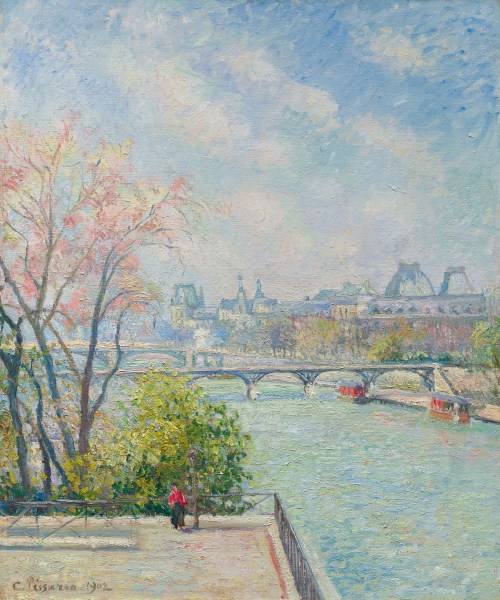
#FineArtFriday: a second look at ‘The Louvre, Morning, Spring’ by Camille Pissarro 1902

1902_Camille_Pissarro_Le_Louvre,_matin,_printempsArtist: Camille Pissarro  (1830–1903)

Title: French: Le Louvre, Matin, Printemps (English: the Louvre, morning, spring)

Date:1902

Medium: oil on canvas

Dimensions: height: 54 cm (21.2 in), width: 64.8 cm (25.5 in)

References: https://www.sothebys.com/en/buy/auction/2023/modern-evening-auction-5/le-louvre-matin-printemps

I first featured this painting last year, when I was desperate for a glimpse of spring. I’m feeling the same wish for color in the gray outdoor world, feeling as if spring can’t come too soon.

What I love about this picture:

This is the way spring begins, tentative and holding back as if gauging the audience before leaping to center stage. The style of brushwork lends itself to the misty quality of the pastels of March and early April.

This was one of Pissarro’s final works. It is a pretty picture, a simple scene not unlike one I might see here in the Pacific Northwest this weekend. We are supposed to see a sunny stretch tomorrow through Tuesday, a few days of warmth without rain. The flowering plum trees in my town are poised to burst forth, and we will take a long drive, soaking up the sunlight while we can.

As I said above, this is a pretty picture, not profound or revolutionary, not highbrow in any way. But sometimes, what the soul needs is a pretty picture featuring the beauty and serenity of a sunny day.

About the artist, via Wikipedia:

Jacob Abraham Camille Pissarro (10 July 1830 – 13 November 1903) was a Danish-French Impressionist and Neo-Impressionist painter born on the island of St Thomas (now in the US Virgin Islands, but then in the Danish West Indies). His importance resides in his contributions to both Impressionism and Post-Impressionism. Pissarro studied from great forerunners, including Gustave Courbet and Jean-Baptiste-Camille Corot. He later studied and worked alongside Georges Seurat and Paul Signac when he took on the Neo-Impressionist style at the age of 54.

In 1873 he helped establish a collective society of fifteen aspiring artists, becoming the “pivotal” figure in holding the group together and encouraging the other members. Art historian John Rewald called Pissarro the “dean of the Impressionist painters”, not only because he was the oldest of the group, but also “by virtue of his wisdom and his balanced, kind, and warmhearted personality”. Paul Cézanne said “he was a father for me. A man to consult and a little like the good Lord”, and he was also one of Paul Gauguin‘s masters. Pierre-Auguste Renoir referred to his work as “revolutionary”, through his artistic portrayals of the “common man”, as Pissarro insisted on painting individuals in natural settings without “artifice or grandeur”.

Pissarro is the only artist to have shown his work at all eight Paris Impressionist exhibitions, from 1874 to 1886. He “acted as a father figure not only to the Impressionists” but to all four of the major Post-Impressionists, Cézanne, Seurat, Gauguin, and van Gogh.

Founder of a Dynasty:

Camille’s son Lucien was an Impressionist and Neo-impressionist painter as were his second and third sons Georges Henri Manzana Pissarro and Félix Pissarro. Lucien’s daughter Orovida Pissarro was also a painter. Camille’s great-grandson, Joachim Pissarro, became Head Curator of Drawing and Painting at the Museum of Modern Art in New York City and a professor in Hunter College’s Art Department. Camille’s great-granddaughter, Lélia Pissarro, has had her work exhibited alongside her great-grandfather. Another great-granddaughter, Julia Pissarro, a Barnard College graduate, is also active in the art scene. From the only daughter of Camille, Jeanne Pissarro, other painters include Henri Bonin-Pissarro (1918–2003) and Claude Bonin-Pissarro (born 1921), who is the father of the Abstract artist Frédéric Bonin-Pissarro (born 1964).

The grandson of Camille Pissarro, Hugues Claude Pissarro (dit Pomié), was born in 1935 in the western section of Paris, Neuilly-sur-Seine, and began to draw and paint as a young child under his father’s tutelage. During his adolescence and early twenties he studied the works of the great masters at the Louvre. His work has been featured in exhibitions in Europe and the United States, and he was commissioned by the White House in 1959 to paint a portrait of U.S. President Dwight Eisenhower. He now lives and paints in Donegal, Ireland, with his wife Corinne also an accomplished artist and their children. [1]


Credits and Attributions:

IMAGE: Wikimedia Commons contributors, “File:1902 Camille Pissarro Le Louvre, matin, printemps.jpeg,” Wikimedia Commons, https://commons.wikimedia.org/w/index.php?title=File:1902_Camille_Pissarro_Le_Louvre,_matin,_printemps.jpeg&oldid=948378278 (accessed March 7, 2025).

[1] Wikipedia contributors, “Camille Pissarro,” Wikipedia, The Free Encyclopedia, https://en.wikipedia.org/w/index.php?title=Camille_Pissarro&oldid=1278793537 (accessed March 7, 2025).

3 Comments

Filed under #FineArtFriday

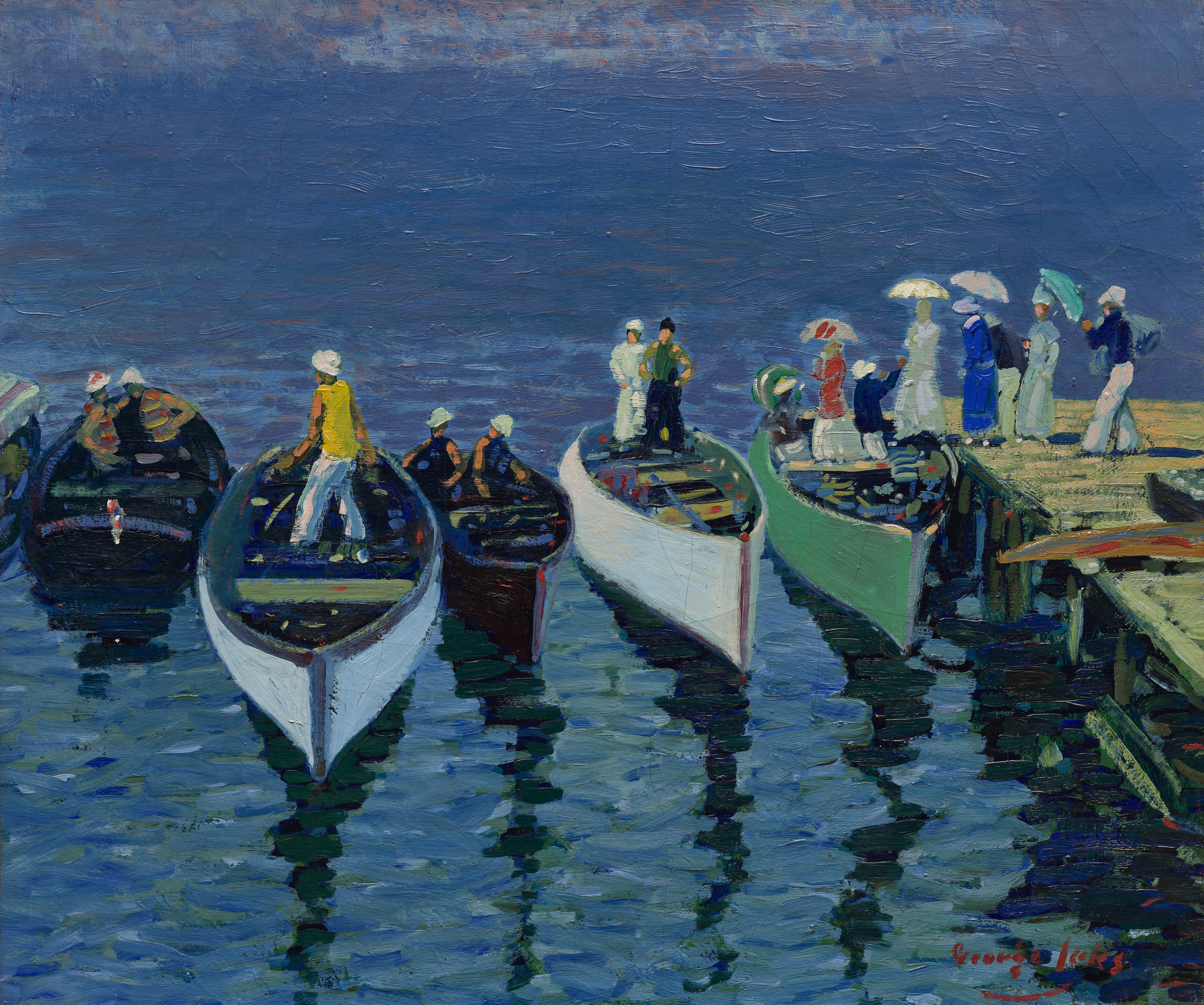
FineArtFriday: Holiday on the Hudson by George Luks ca. 1912

George_Luks_(American,_1866–1933)_-_Holiday_on_the_Hudson_-_1933.2291_-_Cleveland_Museum_of_ArtArtist: George Luks  (1867–1933)

Title: Holiday on the Hudson

Date: circa 1912

Collection: Cleveland Museum of Art

What I love about this painting:

These are the working-class people of New York on a sunny Sunday in high summer. Fishing has been good, and while the oyster boats and small fishing dories have seen heavy use, they’ve been tidied up a bit, and everyone is looking forward to a carefree day on the water. The fishermen in their sleeveless shirts are quickly moving ropes and gear around to make room for the ladies.

I love the life instilled in the painting, the action, the colors, the intensity, and the way it shouts, “Freedom beckons,” even if that freedom is only temporary.

I see a story here, a historical romance. I imagine that some of this group of friends are the servants of the rich enjoying their half-day off. Besides the fishermen, we have footmen, maids, cooks, and housekeepers. I like to think they’re heading to a favorite beach for a clambake, that time-honored seaside picnic that even the poor working-class could afford.

Who is courting whom? Will they get married?

About the artist, via Wikipedia:

George Benjamin Luks (August 13, 1867 – October 29, 1933) was an American artist, identified with the aggressively realistic Ashcan School of American painting.

After travelling and studying in Europe, Luks worked as a newspaper illustrator and cartoonist in Philadelphia, where he became part of a close-knit group, led by Robert Henri, that set out to defy the genteel values imposed by the influential National Academy of Design. His best-known paintings reflect the life of the poor and hard-pressed on Manhattan’s Lower East Side. [1]

For more about George Luks, I highly recommend continuing to read his biography here: George Luks – Wikipedia


Credits and Attributions:

IMAGE: Wikimedia Commons contributors, “File:George Luks (American, 1866–1933) – Holiday on the Hudson – 1933.2291 – Cleveland Museum of Art.jpg,” Wikimedia Commons, https://commons.wikimedia.org/w/index.php?title=File:George_Luks_(American,_1866%E2%80%931933)_-_Holiday_on_the_Hudson_-_1933.2291_-_Cleveland_Museum_of_Art.jpg&oldid=779825858 (accessed June 27, 2024).

[1]Wikipedia contributors, “George Luks,” Wikipedia, The Free Encyclopedia, https://en.wikipedia.org/w/index.php?title=George_Luks&oldid=1217710156 (accessed June 27, 2024).

Comments Off on FineArtFriday: Holiday on the Hudson by George Luks ca. 1912

Filed under #FineArtFriday

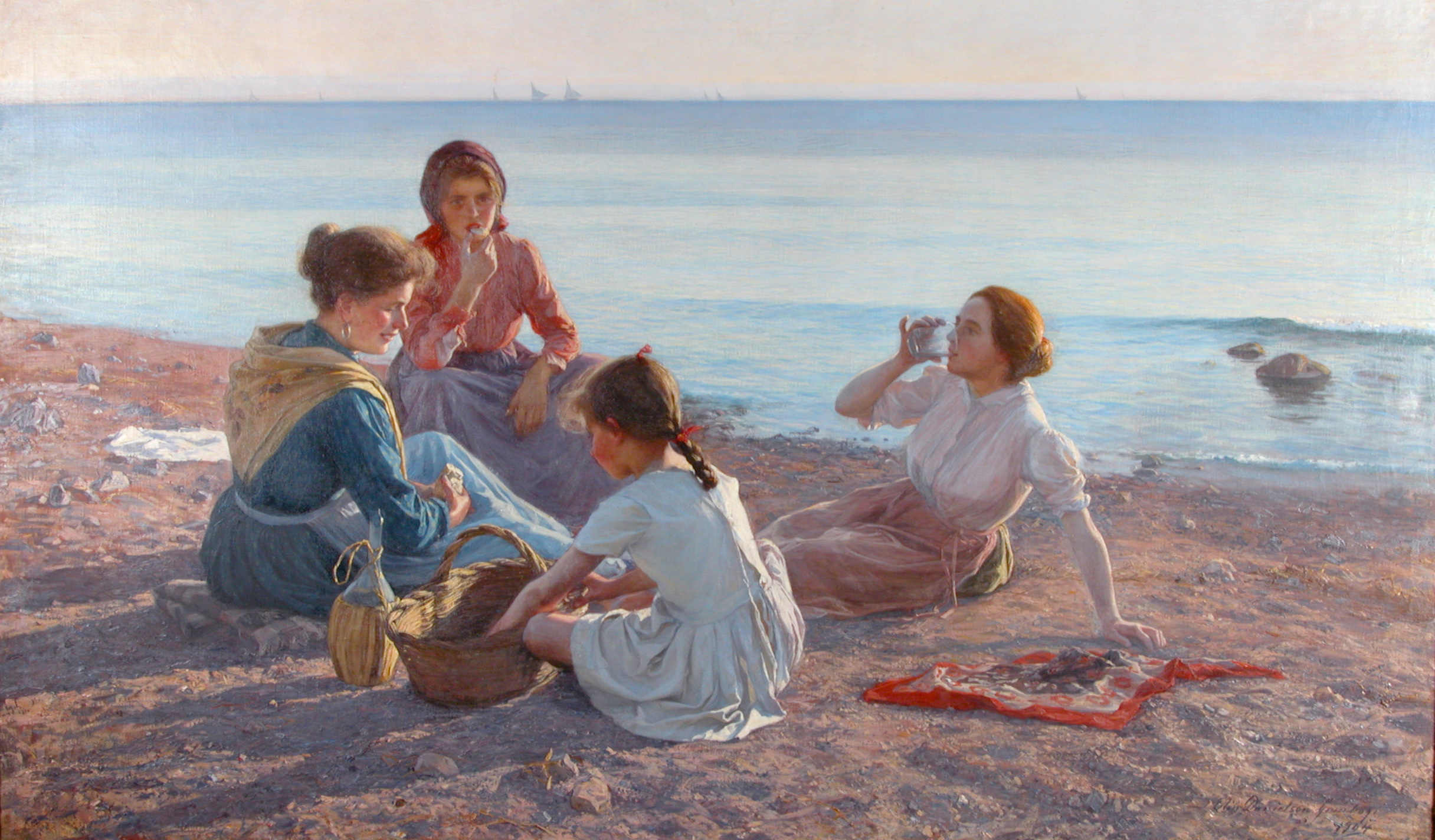
#FineArtFriday: La Mirenda (The Snack) by Elin Danielson-Gambogi 1904

Elin_Danielson-Gambogi_-_La_Merenda_(1904)Artist: Elin Danielson-Gambogi  (1861–1919)
Title: By the Sea – The Snack (La Merenda)

Date: 1904

Medium: oil on canvas

Dimensions: height: 102 cm (40.1 in)

Collection: K. H. Renlund art collection

What I love about this painting:

Elin Danielson-Gambogi gives us a perfect afternoon for an afternoon picnic by the sea with friends. An afternoon beside the surf and the company of friends—it doesn’t get any better.

The good years just prior to the outbreak of WWI seem golden in many ways. Women’s work was never done but they have the luxury of a little leisure time, and they are enjoying it. Two women have removed their headscarves as if they don’t care if they get a little sun-browned. The cast-off squares of cloth lie on the rocky beach as if blown by the wind.

The girl is very likely the artist’s niece, as she and her mother figure prominently in many of Elin’s paintings. I like to think she is pleased to have been included in the picnic, proud to be serving the snacks.

There is a pleasant warmth to this image, the peace of a Goldilocks day, that rare summer’s afternoon that is just right.

About the Artist, via Wikipedia:

Elin Kleopatra Danielson-Gambogi (3 September 1861 – 31 December 1919) was a Finnish painter best known for her realist works and portraits. Danielson-Gambogi was part of the first generation of Finnish women artists who received professional education in art, the so-called “painter sisters’ generation”. The group also included Helene Schjerfbeck (1862–1946), Helena Westermarck (1857-1938), and Maria Wiik (1853-1928).

In 1883 Danielson received a grant and moved to Paris. While there, she took lessons at the Académie Colarossi under Gustave Courtois and painted in Brittany during the summertime. A few years later she returned to Finland and lived with her relatives in Noormarkku and Pori. In 1888 she opened an atelier in Noormarkku. During the 1880s and 1890s she worked as a teacher in several art schools around Finland.  She also attended the artists’ colony Önningeby in Ålands.

In 1895, she received a scholarship and traveled to Florence, Italy. A year later she moved to the village of Antignano in Livorno where she met an Italian painter 13 years younger than herself, Raffaello Gambogi (1874–1943). They began working together and got married on February 27, 1898.  They held exhibitions in Paris, Florence (where she was awarded an art prize by the city) and Milan, and in many Finnish cities, and their paintings were also included in the 1900 World’s Fair in Paris, where she again won bronze medal. She also got to second place in the 1901 national portrait painting competition organized by the Finnish state.  In 1899, King Umberto purchased a painting from her. That same year, she participated in the Venice Biennale.

Their marriage was strained when Raffaello had an affair with Danielson’s Finnish friend Dora Wahlroos.  While the affair quickly ended, it had a lasting impact on the Gambogis’ marriage.  She moved to Finland for a while but returned to Antignano in 1903.  Because of World War I, her connection to her homeland was cut, and by the time she died, of pneumonia, at Antignano in 1919, she had been mostly forgotten in Finland.

Because of her choice of rare subject matters that often even caused some offence, Danielson is now seen as one of the central artists of the Golden Age of Finnish Art. Danielson-Gambogi was included in the 2018 exhibit Women in Paris 1850-1900. [1]


Credits and Attributions:

IMAGE: Wikimedia Commons contributors, “File:Elin Danielson-Gambogi – La Merenda (1904).jpg,” Wikimedia Commons, https://commons.wikimedia.org/w/index.php?title=File:Elin_Danielson-Gambogi_-_La_Merenda_(1904).jpg&oldid=848460780 (accessed June 20, 2024).

[1] Wikipedia contributors, “Elin Danielson-Gambogi,” Wikipedia, The Free Encyclopedia, https://en.wikipedia.org/w/index.php?title=Elin_Danielson-Gambogi&oldid=1203975014 (accessed June 20, 2024).

5 Comments

Filed under #FineArtFriday, writing

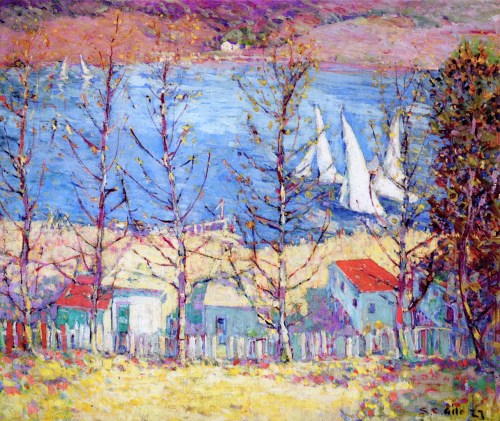
#FineArtFriday: Belvedere 1927 Seldon Connor Gile (a second look)

Title: Belvedere

Artist: Seldon Connor Gile

Medium: Oil on Canvas

Date: 1927

Inscription: signed and dated by Artist: Gile 27


What I love about this painting:

This is a view of San Francisco Bay from a hill in the town of Belvedere, California. Belvedere is located on the San Francisco Bay in Marin CountyCalifornia. Consisting of two islands and a lagoon, it is connected to the Tiburon Peninsula by two causeways.

It is a place the artist clearly loved, and he had his home nearby in Tiburon.

The intensity of color as one looks down the hill toward the shanties lends an atmosphere of purity, of fresh air, and approaching springtime to the painting.

Bold strokes of red and blue convey the atmosphere that is quintessential to Northern California. He offers us a sense of wonder, of peace, of modest post-WWI prosperity in this painting. We are shown the depth of color and vibrancy of a time and sense of place that has long vanished.

This is an era we usually see through old black-and-white photographs and jerky, scratchy newsreels.

Even rundown and undeveloped properties in Tiburon and Belvedere now sell in the high millions. Starving artists and middle-class workers can rarely acquire vacation shanties in that area.

About the Artist, Via Wikipedia:

Selden Connor Gile (20 March 1877 – 8 June 1947) was an American painter who was mainly active in northern California between the early-1910s and the mid-1930s. He was the founder and leader of the Society of Six, a Bay Area group of artists known for their plein-air paintings and rich use of color, a quality that would later figure into the work of Bay Area figurative expressionists.

Though Gile was steadily employed at jobs other than art until the age of 50, his artistic output, primarily from marathon weekends spent painting, was considerable. 1915, the year of the Panama–Pacific International Exposition, marked the beginning of his maturation as an artist, despite that fact that Gile and the Society of Six would not exhibit their art beyond a few occasional paintings until 1923. From their first exhibition at the Oakland Art Gallery on March 11, 1923 to the sixth and final show as a group in 1928, Gile and the Society of Six were generally well received by critics. In the spring of 1927, Gile quit his job as an office manager for Gladding, McBean and Company and moved from his cabin on Chabot Road in Oakland (also known as the “Chow House” where the Society of Six would meet on weekends), into a cottage he had kept since the early 1920s on San Francisco Bay in TiburonMarin County to paint full-time.

Selden Gile continued to paint and exhibited in various group shows every year until 1937. During the 1930s, the number of his oil paintings declined in favor of watercolors. Another change likely brought on by the mood around the Great Depression was to include more people, particularly workers, in his paintings. Despite his discomfort with larger formats, Gile took on the town of Belvedere’s only WPA mural commission, painting a mural for the public library, where he served as a part-time librarian. Towards the end of his life, unable to pay his rent, Gile took on another mural commission, this time for a railroad office in San Francisco. He is remembered from his time in the Tiburon/Belvedere area:

“…as a loner, independent, and very proud. [Gile] enjoyed cordial relationships with some of his neighbors, often chatting with them on the street or in doorways, but he consistently refused their hospitality…In the end Gile was a sick, alcoholic old man surrounded by paintings he never sold, lonely, and not painting. The process of painting and camaraderie that he had enjoyed were past now.”

A few months before he died, Selden Gile checked himself into the Marin County Hospital and Farm, where he spent the rest of his life. On June 8, 1947, Gile died of cirrhosis of the liver.


Credits and Attributions:

Belvedere, California 1927 by Selden Connor Gile, Public domain, via Wikimedia Commons

Wikimedia Commons contributors, “File:Selden Connor Gile Belvedere 1927.jpg,” Wikimedia Commons, the free media repository, https://commons.wikimedia.org/w/index.php?title=File:Selden_Connor_Gile_Belvedere_1927.jpg&oldid=525009834 (accessed March 11, 2021).

2 Comments

Filed under #FineArtFriday

#FineArtFriday: The Louvre, Morning, Spring by Camille Pissarro 1902

1902_Camille_Pissarro_Le_Louvre,_matin,_printempsArtist: Camille Pissarro  (1830–1903)

Title: French: Le Louvre, Matin, Printemps (English: the Louvre, morning, spring)

Date:1902

Medium: oil on canvas

Dimensions: height: 54 cm (21.2 in), width: 64.8 cm (25.5 in)

References: https://www.sothebys.com/en/buy/auction/2023/modern-evening-auction-5/le-louvre-matin-printemps

What I love about this picture:

This is the way spring begins, tentative and holding back as if gauging the audience before leaping to center stage. The style of brushwork lends itself to the misty quality of the pastels of March and early April.

This was one of Pissarro’s final works. It is a pretty picture, a simple scene not unlike one I might see here in the Pacific Northwest this weekend. We are supposed to see a sunny stretch tomorrow through Tuesday, a few days of warmth without rain. The flowering plum trees in my town are poised to burst forth, and we will take a long drive, soaking up the sunlight while we can.

As I said above, this is a pretty picture, not profound or revolutionary, not highbrow in any way. But sometimes, what the soul needs is a pretty picture featuring the beauty and serenity of a sunny day.

About the artist, via Wikipedia:

Jacob Abraham Camille Pissarro (10 July 1830 – 13 November 1903) was a Danish-French Impressionist and Neo-Impressionist painter born on the island of St Thomas (now in the US Virgin Islands, but then in the Danish West Indies). His importance resides in his contributions to both Impressionism and Post-Impressionism. Pissarro studied from great forerunners, including Gustave Courbet and Jean-Baptiste-Camille Corot. He later studied and worked alongside Georges Seurat and Paul Signac when he took on the Neo-Impressionist style at the age of 54.

In 1873 he helped establish a collective society of fifteen aspiring artists, becoming the “pivotal” figure in holding the group together and encouraging the other members. Art historian John Rewald called Pissarro the “dean of the Impressionist painters”, not only because he was the oldest of the group, but also “by virtue of his wisdom and his balanced, kind, and warmhearted personality”. Paul Cézanne said “he was a father for me. A man to consult and a little like the good Lord”, and he was also one of Paul Gauguin‘s masters. Pierre-Auguste Renoir referred to his work as “revolutionary”, through his artistic portrayals of the “common man”, as Pissarro insisted on painting individuals in natural settings without “artifice or grandeur”.

Pissarro is the only artist to have shown his work at all eight Paris Impressionist exhibitions, from 1874 to 1886. He “acted as a father figure not only to the Impressionists” but to all four of the major Post-Impressionists, Cézanne, Seurat, Gauguin, and van Gogh.

Founder of a Dynasty:

Camille’s son Lucien was an Impressionist and Neo-impressionist painter as were his second and third sons Georges Henri Manzana Pissarro and Félix Pissarro. Lucien’s daughter Orovida Pissarro was also a painter. Camille’s great-grandson, Joachim Pissarro, became Head Curator of Drawing and Painting at the Museum of Modern Art in New York City and a professor in Hunter College’s Art Department. Camille’s great-granddaughter, Lélia Pissarro, has had her work exhibited alongside her great-grandfather. Another great-granddaughter, Julia Pissarro, a Barnard College graduate, is also active in the art scene. From the only daughter of Camille, Jeanne Pissarro, other painters include Henri Bonin-Pissarro (1918–2003) and Claude Bonin-Pissarro (born 1921), who is the father of the Abstract artist Frédéric Bonin-Pissarro (born 1964).

The grandson of Camille Pissarro, Hugues Claude Pissarro (dit Pomié), was born in 1935 in the western section of Paris, Neuilly-sur-Seine, and began to draw and paint as a young child under his father’s tutelage. During his adolescence and early twenties he studied the works of the great masters at the Louvre. His work has been featured in exhibitions in Europe and the United States, and he was commissioned by the White House in 1959 to paint a portrait of U.S. President Dwight Eisenhower. He now lives and paints in Donegal, Ireland, with his wife Corinne also an accomplished artist and their children. [1]


Credits and Attributions:

IMAGE: Wikimedia Commons contributors. File:1902 Camille Pissarro Le Louvre, matin, printemps.jpeg [Internet]. Wikimedia Commons; 2024 Feb 20, 05:48 UTC [cited 2024 Mar 13]. Available from: https://commons.wikimedia.org/w/index.php?title=File:1902_Camille_Pissarro_Le_Louvre,_matin,_printemps.jpeg&oldid=853770801.

[1] Wikipedia contributors. Camille Pissarro [Internet]. Wikipedia, The Free Encyclopedia; 2024 Feb 12, 07:32 UTC [cited 2024 Mar 13]. Available from: https://en.wikipedia.org/w/index.php?title=Camille_Pissarro&oldid=1206477040.

2 Comments

Filed under #FineArtFriday

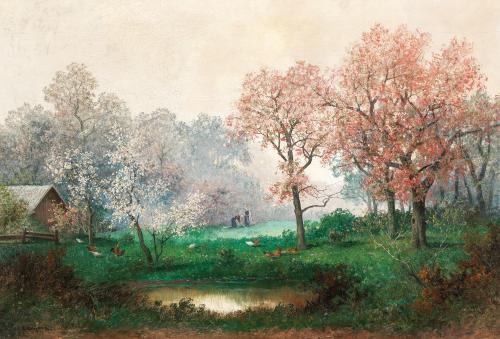
#FineArtFriday: Under flowering trees by Adolf Kaufmann

Adolf_Kaufmann_Under_the_treesjpgArtist: Adolf Kaufmann (1848–1916)

Title: Under flowering trees

Date: before 1916

Medium: oil on canvas

Inscription: signed A. Kaufmann

What I love about this painting:

Kaufmann gives us a beautiful spring day with apple trees and cherry trees in full bloom. The weather is misty, cool and damp the way spring mornings often are here in the Pacific Northwest.

Chickens roam the orchard, and two women are digging, breaking the ground for a spring garden.

To the left is a weathered building. Is it a barn? Is it their home? It’s hidden behind the shrubbery so it’s difficult to tell, but it has no window, so I think it may be a barn.

Nothing is romanticized—we see it the way the artist did on that spring day over a century ago.

About the Artist, via Wikipedia:

Adolf Kaufmann (15 May 1848, in Troppau – 25 November 1916, in Vienna) was an Austrian landscape and marine artist.

He was initially self-taught, but completed his studies with the animal painter, Émile van Marcke, in Paris and undertook several study trips, throughout Europe and the Middle East. His residence alternated between Paris, Berlin, Düsseldorf and Munich.

In 1890, he decided to settle in Vienna and opened a studio in the Wieden district. In 1900, together with Carl von Merode [de] and Heinrich Lefler, he opened an “Art School for Ladies”. He continued to visit Paris frequently and, when he painted there, signed his works with the pseudonym “A. Guyot”. Other names he signed with include “A. Papouschek”, “G. Salvi”, “A. Jarptmann”, “R. Neiber”, “J. Rollin” and “M. Bandouch”. Why he did this is unclear, although his choice of signature often reflects stylistic differences.

His landscapes were influenced by the Barbizon school and the style known as “paysage intime,” both of which he was exposed to in France during the 1870s. (The paysage intimate, French for “familiar landscape,” was a style of painting that dealt with simple, simple landscapes and emerged in the mid-19th century. It was the predecessor of the Impressionist style.) [1]


Credits and Attributions:

IMAGE: Wikimedia Commons contributors, “File:Adolf Kaufmann Unter blühenden Bäumen.jpg,” Wikimedia Commons, the free media repository, https://commons.wikimedia.org/w/index.php?title=File:Adolf_Kaufmann_Unter_bl%C3%BChenden_B%C3%A4umen.jpg&oldid=623159308 (accessed March 23, 2023).

[1] Wikipedia contributors, “Adolf Kaufmann,” Wikipedia, The Free Encyclopedia, https://en.wikipedia.org/w/index.php?title=Adolf_Kaufmann&oldid=1094252143 (accessed March 23, 2023).

7 Comments

Filed under #FineArtFriday

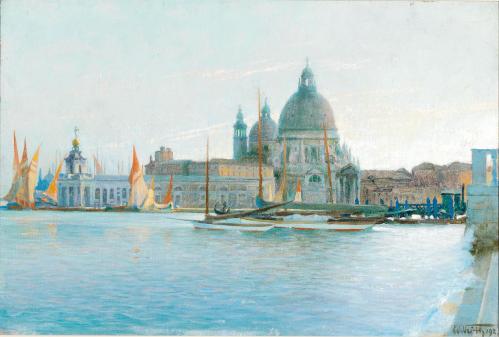
#FineArtFriday: Santa Maria della Salute by Eduard Veith

Eduard_Veith_-_Venezia-Santa_Maria_della_Salute

Artist: Eduard Veith  (1858–1925)

Title: Italian: Venezia: Santa Maria della Salute

Date: by 1925

Medium: oil on canvas

Dimensions: height: 39.5 cm (15.5 in); width: 58 cm (22.8 in)

Collection: Private collection

What I love about this painting:

Veith has captured Venice on a beautiful morning. The sun is shining, the sky is blue and the waters of the canal are calm. Colorful sails are being raised as the fishers prepare to head out to San Marco basin for the day.

In the center is the domed basilica of Santa Maria della Salute (in English, Saint Mary of Health).

This is the sort of morning that makes one feel that all is right in the world.

About the Santa Maria della Salute, via Wikipedia:

Santa Maria della Salute (English: Saint Mary of Health), commonly known simply as the Salute, is a Roman Catholic church and minor basilica located at Punta della Dogana in the Dorsoduro sestiere of the city of VeniceItaly.

It stands on the narrow finger of Punta della Dogana, between the Grand Canal and the Giudecca Canal, at the Bacino di San Marco, making the church visible when entering the Piazza San Marco from the water. The Salute is part of the parish of the Gesuati and is the most recent of the so-called plague churches.

In 1630, Venice experienced an unusually devastating outbreak of the plague. As a votive offering for the city’s deliverance from the pestilence, the Republic of Venice vowed to build and dedicate a church to Our Lady of Health. The church was designed in the then fashionable Baroque style by Baldassare Longhena, who studied under the architect Vincenzo Scamozzi. Construction began in 1631. Most of the objects of art housed in the church bear references to the Black Death. [1]

About the artist, via Wikipedia:

Eduard Veith (30 March 1858, Neutitschein – 18 March 1925, Vienna) was an Austrian portrait painter and stage designer. Many of his works were influenced by Symbolism. He was born to the decorative painter, Julius Veith (1820–1887), and his wife Susanna, née Schleif (1827–1883).

At first, he received training to follow in his father’s profession. Later, he went to Vienna, where he took classes at the Museum of Applied Arts from Professor Ferdinand Laufberger. He capped off his studies by creating sgraffito for exhibition buildings at the Exposition Universelle in Paris.

He then returned home, where he assisted his father with painting churches, synagogues and other ceremonial buildings. This was followed by several study trips to Italy, Belgium and Tunisia. He finally settled in Vienna; becoming a free-lance artist and working mostly by commission.

From 1890, he was a member of the Vienna Künstlerhaus. In 1896, he received a gold medal at the Große Berliner Kunstausstellung. In 1905, he was appointed a Professor at the University of Technology.  In 1911, he married Bertha Griesbeck (1872–1952), from Augsburg. He later taught at the University of Applied Arts Museum of Applied Arts and became a professor there in 1920. During his years in Vienna, he maintained contact with his home town, and held exhibitions there.

He died shortly before his sixty-seventh birthday. [2]


Credits and Attributions:

Image: Wikimedia Commons contributors, “File:Eduard Veith – Venezia-Santa Maria della Salute.jpg,” Wikimedia Commons, the free media repository, https://commons.wikimedia.org/w/index.php?title=File:Eduard_Veith_-_Venezia-Santa_Maria_della_Salute.jpg&oldid=627297217 (accessed March 16, 2023).

[1] Wikipedia contributors, “Santa Maria della Salute,” Wikipedia, The Free Encyclopedia, https://en.wikipedia.org/w/index.php?title=Santa_Maria_della_Salute&oldid=1134116004 (accessed March 16, 2023).

[2] Wikipedia contributors, “Eduard Veith,” Wikipedia, The Free Encyclopedia, https://en.wikipedia.org/w/index.php?title=Eduard_Veith&oldid=1133038416 (accessed March 16, 2023).

5 Comments

Filed under #FineArtFriday

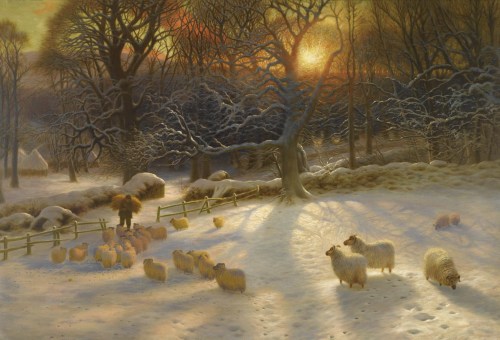
#FineArtFriday: Beneath the Snow Encumbered Branches by Joseph Farquharson 1903 (revisited)

Title: Beneath the Snow Encumbered Branches

Artist: Joseph Farquharson

Publisher: Hallmark Cards

Genre: landscape art

Date: Circa 1903

Medium: oil on canvas

Dimensions: 82 x 119.25 cm. (32 5/16 x 46 15/16 in.

What I love about this painting:

I first shared this painting in January of 2021. I found a haunting kind of nostalgia in it, an echo of times long gone. Joseph Farquharson perfectly captures the way the setting sun’s rays fall across the snow-covered landscape.

The snow is thick and heavy, and the sheep are fluffy in their long coats. Winter has come and the shadows are long, but the conical haystacks across the lane contain plenty to last through the harshest season.

I love how the afternoon light is reflected on the snowy landscape and in the branches. He shows it with a perfect golden luminosity, the hue that presages imminent dusk. 

About the Artist, via Wikipedia:

Joseph Farquharson DL RA (4 May 1846 – 15 April 1935) was a Scottish painter, chiefly of landscapes, mostly in Scotland and very often including animals. He is most famous for his snowy winter landscapes, often featuring sheep and often depicting dawn or dusk. The unusual titles of many of Farquharson’s paintings stand out and are sometimes long. Many of them were taken from poems by Burns, Milton, Shakespeare, and Gray. Farquharson was very patriotic and well versed in Scottish literature.

The remarkable realism of Farquharson’s work can be attributed to his desire to work en plein air. This had to be carried out in a unique way which was adapted to the harsh Scottish climate. Farquharson had constructed a painting hut on wheels, complete with a stove and large glass window for observing the landscape. Likewise to achieve as realistic a result as possible when painting the sheep which frequently appear in his snowscapes, he used a flock of “imitation” sheep which could be placed as required in the landscape of his choice. Farquharson painted so many scenes of cattle and sheep in snow he was nicknamed ‘Frozen Mutton Farquharson’.

Farquharson inherited the title of Laird in 1918 after the death of his elder brother Robert, a doctor and MP for West Aberdeenshire.

In 2008 the original of the 1901 painting Beneath the Snow Encumbered Branches came to light, for the first time in 40 years, when the lady owner put her house up for sale. The painting, which she had bought from a Bond Street dealer in the 1960s for £1,450, was expected to fetch up to £70,000 when it was offered for sale by auction at Lyon and Turnbull in Edinburgh. Nick Carnow, a director at the auctioneers, form said that the unnamed seller was moving to a smaller house and would not have room for the painting. In fact it sold for more than twice that estimate to another private collector in Scotland for £147,600.


Credits and Attributions:

Beneath the Snow Encumbered Branches Joseph Farquharson, Public domain, via Wikimedia Commons

Wikipedia contributors, “Joseph Farquharson,” Wikipedia, The Free Encyclopedia, https://en.wikipedia.org/w/index.php?title=Joseph_Farquharson&oldid=982764133 (accessed January 1, 2021).

Wikimedia Commons contributors, “File:The shortening winter’s day is near a close Farquharson.jpg,” Wikimedia Commons, the free media repository, https://commons.wikimedia.org/w/index.php?title=File:The_shortening_winter%27s_day_is_near_a_close_Farquharson.jpg&oldid=354603464 (accessed January 1, 2021).

2 Comments

Filed under #FineArtFriday

#FineArtFriday: Dawn In The Hills by Julian Onderdonk 1922 (revisited)

Julian_Onderdonk_(1882-1922)_-_Dawn_In_The_Hills_(1922)

Artist: Julian Onderdonk  (1882–1922)

Title: Dawn In The Hills

Date    1922

Medium: oil on canvas

Dimensions: Height: 76.2 cm (30″); Width: 101.6 cm (40″)

Collection: Private collection

What I love about this painting:

Onderdonk captured the surreal essence of early morning near San Antonio, Texas. The mists are rising in the hills, slowly revealing the riotous splendor of deep blue wildflowers. It is a rolling sea of bluebonnets, with the occasional white of the blackfoot or fleabane daisy mingled in.

The artist perfectly conveyed the mystical quality of that singular moment of the morning when the air is still and golden, and the day ahead is full of possibilities.

I could spend hours in this place.

About this painting:

Art historian Jeffrey Morseburg writes, “In the fall of 1922, as he was just entering his prime, Onderdonk was rushed to the hospital with an intestinal blockage. He failed to recover from the emergency surgery and died on October 27, 1922. His sudden death created an outpouring of emotion for the man who had become “The Dean of Texas Painters.” Just before he died, Onderdonk had finished a beautiful early morning view of a Texas hillside carpeted with Bluebonnets titled ‘Dawn in the Hills’ and another work, a bold fall scene titled ‘Autumn Tapestry.’” [1]

About the Artist, Via Wikipedia:

Julian Onderdonk was born in San Antonio, Texas, to Robert Jenkins Onderdonk, a painter, and Emily Gould Onderdonk. He was raised in South Texas and was an enthusiastic sketcher and painter. As a teenager Onderdonk was influenced and received some training from the prominent Texas artist Verner Moore White who also lived in San Antonio at the time. He attended the West Texas Military Academy, now the Episcopal School of Texas, graduating in 1900. His grandfather Henry Onderdonk was the Headmaster of Saint James School in Maryland, from which Julian’s father Robert graduated.

At 19, with the help of a generous neighbor, Julian left Texas in order to study with the renowned American Impressionist William Merritt Chase. Julian’s father, Robert, had also once studied with Chase. Julian spent the summer of 1901 on Long Island at Chase’s Shinnecock Hills Summer School of Art. He studied with Chase for a couple of years and then moved to New York City to attempt to make a living as an en plein air artist. While in New York he met and married Gertrude Shipman and they soon had a son.

Onderdonk returned to San Antonio in 1909, where he produced his best work. His most popular subjects were bluebonnet landscapes. Onderdonk died on October 27, 1922 in San Antonio.

President George W. Bush decorated the Oval Office with three of Onderdonk’s paintings. The Dallas Museum of Art has several rooms dedicated exclusively to Onderdonk’s work.

His art studio currently resides on the grounds of the Witte Museum.


Credits and Attributions:

[1] Julian Onderdonk, An Illustrated Biography by Jeffrey Morseburg, © 2011 https://julianonderdonk.wordpress.com/tag/julian-onderdonk-biography/  (accessed March 4, 2020).

Wikimedia Commons contributors, “File:Julian Onderdonk (1882-1922) – Dawn In The Hills (1922).jpg,” Wikimedia Commons, the free media repository, https://commons.wikimedia.org/w/index.php?title=File:Julian_Onderdonk_(1882-1922)_-_Dawn_In_The_Hills_(1922).jpg&oldid=278966540 (accessed March 4, 2020).

Wikipedia contributors, “Julian Onderdonk,” Wikipedia, The Free Encyclopedia, https://en.wikipedia.org/w/index.php?title=Julian_Onderdonk&oldid=882101452 (accessed March 4, 2020).

6 Comments

Filed under #FineArtFriday

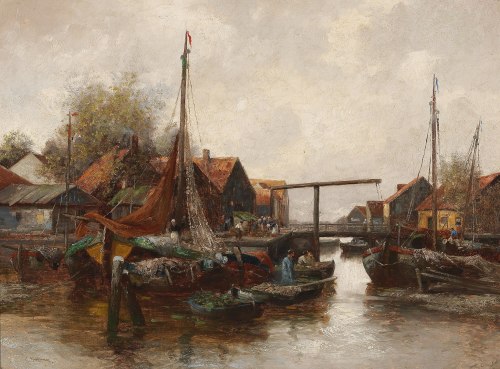
#FineArtFriday: In the Harbor by Adolf Kaufmann

Adolf_Kaufmann_-_In_the_HarbourArtist: Adolf Kaufmann (1848–1916)

Adolf Kaufmann: In the Harbor

Date: by 1916

Medium: oil on canvas

Dimensions: Height: 75 cm (29.5 in); Width: 102 cm (40.1 in)

What I love about this painting:

This shows us the working harbor in a fishing village, with men and women unloading the catch and selling it on the docks. The day is gray, as days by the sea often are, but it’s warm enough for the workers to labor without coats. This was, and still is, dirty, smelly work, but a good catch meant food on the table and coins in their pockets.

The colors are muted, with rusts and browns predominant. It’s a messy scene, with sails and nets piled everywhere and teeming with people.

This is how harbors really were, and still are.

About the artist, via Wikipedia:

Adolph Kaufmann (15 May 1848, in Troppau – 25 November 1916, in Vienna) was an Austrian landscape and marine artist. In 1890, he decided to settle in Vienna and opened a studio in the Wieden district. In 1900, together with Carl von Merode [de] and Heinrich Lefler, he opened an “Art School for Ladies.” He continued to visit Paris frequently and, when he painted there, signed his works with the pseudonym “A. Guyot”. Other names he signed with include “A. Papouschek”, “G. Salvi”, “A. Jarptmann”, “R. Neiber”, “J. Rollin” and “M. Bandouch”. Why he did this is unclear, although his choice of signature often reflects stylistic differences.

His landscapes were influenced by the Barbizon school and the style known as “paysage intime” (French for “familiar landscape”), both of which he was exposed to in France during the 1870s.

He was a frequent exhibitor and won numerous awards; notably at the Exposition Universelle (1900). From 1890 to 1913, he was a member of the Vienna Academy of Fine Arts; representing them at exhibitions at the Glaspalast in Munich and the Große Berliner Kunstausstellung. He became a full member of the Vienna Künstlerhaus in 1909. His travels continued until they were cut short by the beginning of World War I.


Credits and Attributions:

Wikimedia Commons contributors, “File:Adolf Kaufmann – In the Harbour.jpg,” Wikimedia Commons, the free media repository, https://commons.wikimedia.org/w/index.php?title=File:Adolf_Kaufmann_-_In_the_Harbour.jpg&oldid=586204225 (accessed October 22, 2021).

Wikipedia contributors, “Adolf Kaufmann,” Wikipedia, The Free Encyclopedia, https://en.wikipedia.org/w/index.php?title=Adolf_Kaufmann&oldid=1039803125 (accessed October 22, 2021).

4 Comments

Filed under #FineArtFriday, writing