Tag Archives: 20th century women artists

#FineArtFriday: Twilight Confidences by Cecilia Beaux 1888 #prompt #

Twilight_Confidences_by_Cecilia_BeauxTwilight Confidences by Cecilia Beaux  (1855–1942)

Date: 1888

Medium:  oil on canvas

Dimensions: 23 1/2 x 28 inches, 59.7 x 71.1 cm

Inscriptions: Signed and dated: Cecilia Beaux

What I love about this painting:

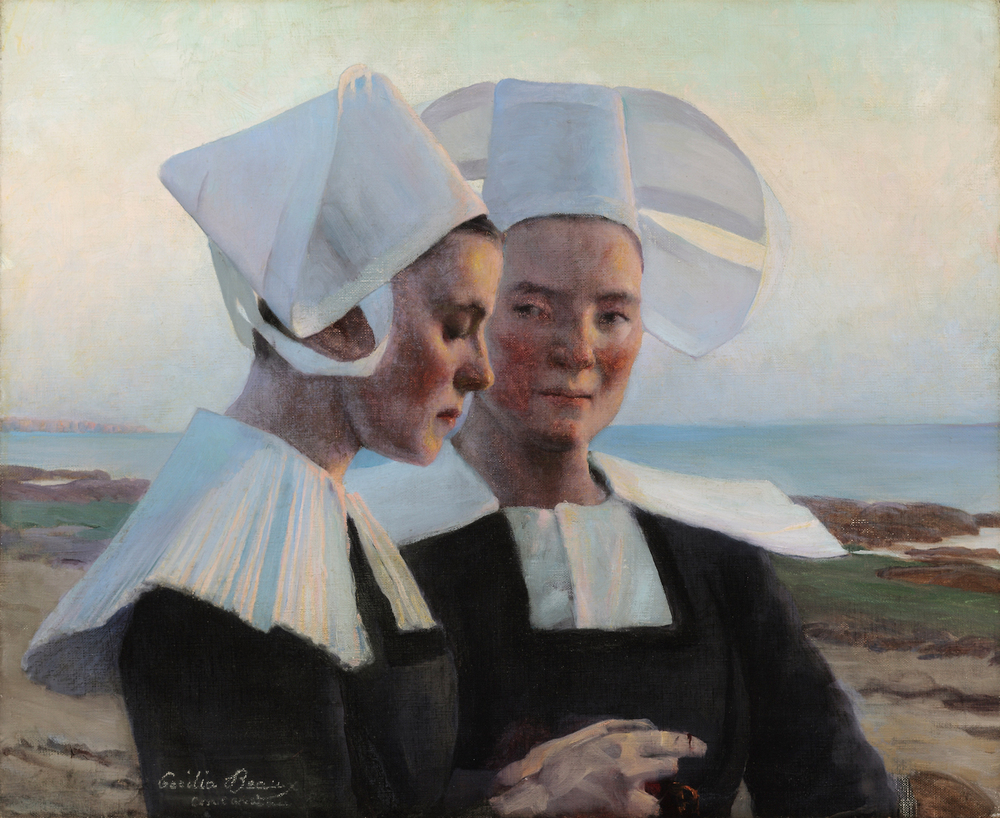
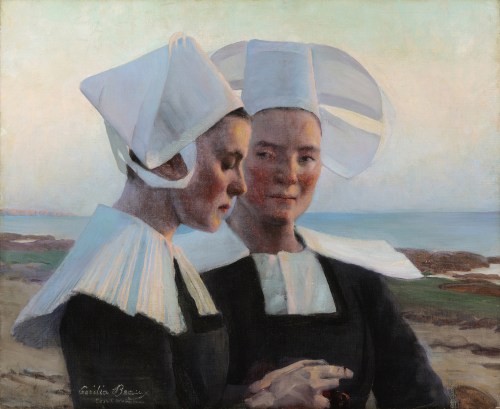
This is one of my all-time favorite paintings. It is not merely a portrait of how two women looked on a summer’s day; it tells us a story. What that story is will be up to you, but in this very simple scene, two women beside the sea, Cecelia Beaux tells us many things.

First, we see brilliant world building in what Beaux has chosen to focus on: their expressive features, and the lonely stretch of beach where they can talk and not be overheard. The artist hasn’t cluttered it up with anything that is not necessary.

We know this was painted toward the end of Beaux’s time in France. The two women may be nurses, or they may be sisters of a religious order. Or, their dress and headwear may be a fashion of their local area, but I’m leaning toward young nurses.

There is an honesty, a real sense of intimacy depicted here. The feeling of sisterhood between the two women is conveyed across the years–they find it safe to confide in each other.

One holds an object with a personal meaning, perhaps a gift from a young man who is absent. She tells the other something about that object, a secret she feels she may be judged for. The other takes in what she has been told and accepts it for what it is.

About this painting via Wikimedia Commons:  

Cecilia Beaux was a leading figure and portrait painter and one of the few distinguished and highly recognized women artists of her time in America. Her figures are frequently compared to Sargent’s, but her style relates also to other international leaders of late-19th Century portraiture, including Anders Zorn, Giuseppe Boldini, Carolus-Duran and William Merritt Chase. She was born and lived mostly in Philadelphia, traveling frequently to Europe, especially France from a young age, and exhibited widely in Paris, Philadelphia, New York and elsewhere. Her first acclaimed work, Les Derniers jours d’enfance, a mother and child composition, was exhibited at the Paris Salon in 1887, and Beaux followed it there the next year, spending the summer of 1888 at the art colony at Concarneau in Brittany. Here she painted her remarkable Twilight Confidences of 1888, preceded by numerous studies, which are in the collection of the Pennsylvania Academy of the Fine Arts. Lost for many years, this much admired canvas is Beaux’s first major exercise in plein-air painting, in which the figures and the seascape are artfully and exquisitely juxtaposed, and sunlight permeates the whole composition. [1]

Beaux was highly educated and had a brilliant career as one of the most respected portrait artists of her time. To read about this amazing woman’s life, go to Cecilia Beaux – Wikipedia.


Credits and Attributions:

IMAGE: Twilight Confidences, Cecilia Beaux, Public domain, via Wikimedia Commons

[1] Wikimedia Commons contributors, “File:Twilight Confidences by Cecilia Beaux.jpg,” Wikimedia Commons, https://commons.wikimedia.org/w/index.php?title=File:Twilight_Confidences_by_Cecilia_Beaux.jpg&oldid=355146645 (accessed October 30, 2025).
 

2 Comments

Filed under #FineArtFriday

#FineArtFriday: La Mirenda (The Snack) by Elin Danielson-Gambogi 1904

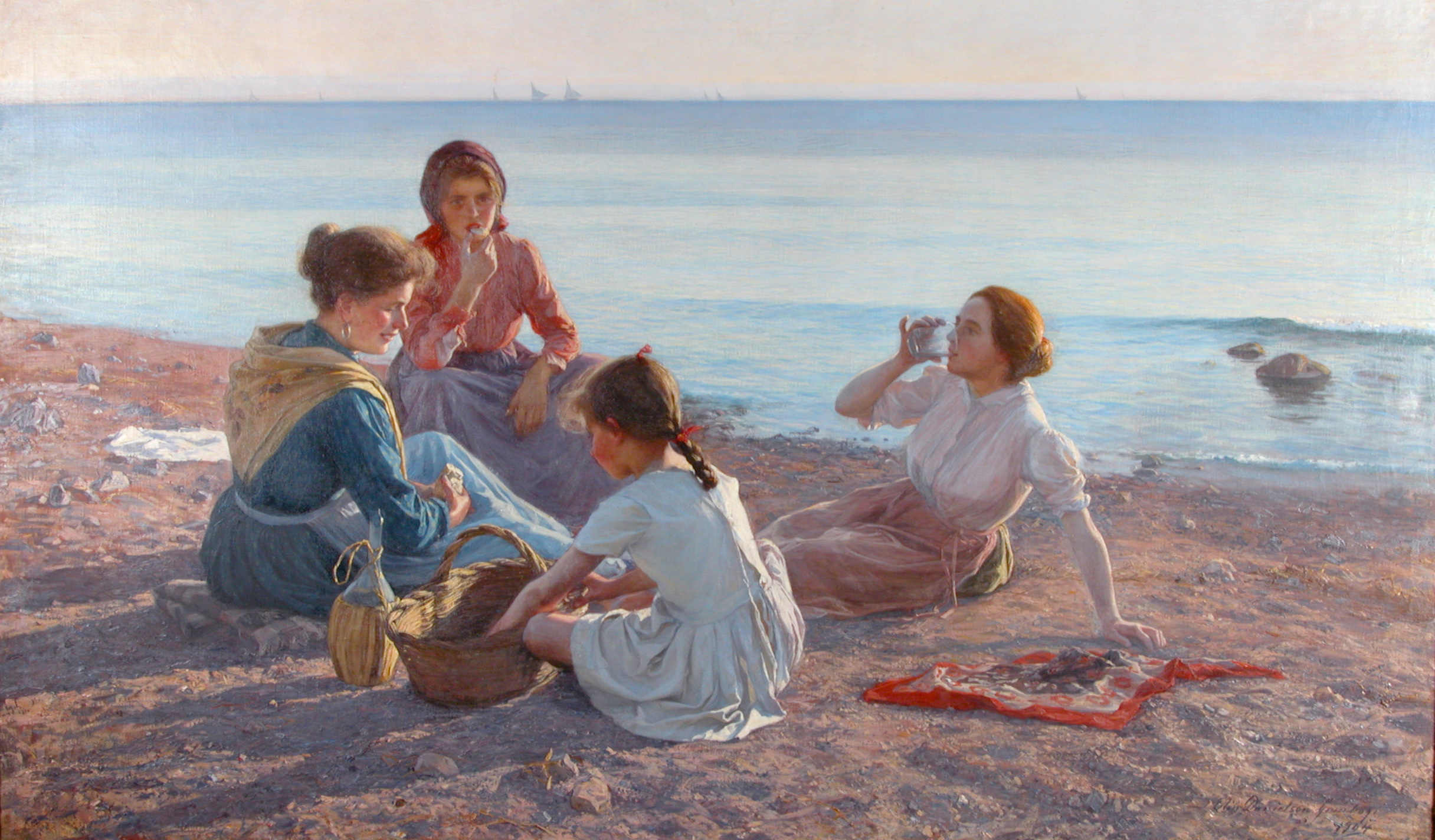
Elin_Danielson-Gambogi_-_La_Merenda_(1904)Artist: Elin Danielson-Gambogi  (1861–1919)

Title: By the Sea – The Snack (La Merenda)

Date: 1904

Medium: oil on canvas

Dimensions: height: 102 cm (40.1 in)

Collection: K. H. Renlund art collection

What I love about this painting:

Elin Danielson-Gambogi gives us a perfect afternoon for an afternoon picnic by the sea with friends. An afternoon beside the surf and the company of friends—it doesn’t get any better.

The good years just prior to the outbreak of WWI seem golden in many ways. Women’s work was never done but they have the luxury of a little leisure time, and they are enjoying it. Two women have removed their headscarves as if they don’t care if they get a little sun-browned. The cast-off squares of cloth lie on the rocky beach as if blown by the wind.

The girl is very likely the artist’s niece, as she and her mother figure prominently in many of Elin’s paintings. I like to think she is pleased to have been included in the picnic, proud to be serving the snacks.

There is a pleasant warmth to this image, the peace of a Goldilocks day, that rare summer’s afternoon that is just right.

About the Artist, via Wikipedia:

Elin Kleopatra Danielson-Gambogi (3 September 1861 – 31 December 1919) was a Finnish painter best known for her realist works and portraits. Danielson-Gambogi was part of the first generation of Finnish women artists who received professional education in art, the so-called “painter sisters’ generation”. The group also included Helene Schjerfbeck (1862–1946), Helena Westermarck (1857-1938), and Maria Wiik (1853-1928).

In 1883 Danielson received a grant and moved to Paris. While there, she took lessons at the Académie Colarossi under Gustave Courtois and painted in Brittany during the summertime. A few years later she returned to Finland and lived with her relatives in Noormarkku and Pori. In 1888 she opened an atelier in Noormarkku. During the 1880s and 1890s she worked as a teacher in several art schools around Finland.  She also attended the artists’ colony Önningeby in Ålands.

In 1895, she received a scholarship and traveled to Florence, Italy. A year later she moved to the village of Antignano in Livorno where she met an Italian painter 13 years younger than herself, Raffaello Gambogi (1874–1943). They began working together and got married on February 27, 1898.  They held exhibitions in Paris, Florence (where she was awarded an art prize by the city) and Milan, and in many Finnish cities, and their paintings were also included in the 1900 World’s Fair in Paris, where she again won bronze medal. She also got to second place in the 1901 national portrait painting competition organized by the Finnish state.  In 1899, King Umberto purchased a painting from her. That same year, she participated in the Venice Biennale.

Their marriage was strained when Raffaello had an affair with Danielson’s Finnish friend Dora Wahlroos.  While the affair quickly ended, it had a lasting impact on the Gambogis’ marriage.  She moved to Finland for a while but returned to Antignano in 1903.  Because of World War I, her connection to her homeland was cut, and by the time she died, of pneumonia, at Antignano in 1919, she had been mostly forgotten in Finland.

Because of her choice of rare subject matters that often even caused some offence, Danielson is now seen as one of the central artists of the Golden Age of Finnish Art. Danielson-Gambogi was included in the 2018 exhibit Women in Paris 1850-1900. [1]


Credits and Attributions:

IMAGE: Wikimedia Commons contributors, “File:Elin Danielson-Gambogi – La Merenda (1904).jpg,” Wikimedia Commons, https://commons.wikimedia.org/w/index.php?title=File:Elin_Danielson-Gambogi_-_La_Merenda_(1904).jpg&oldid=848460780 (accessed June 20, 2024).

[1] Wikipedia contributors, “Elin Danielson-Gambogi,” Wikipedia, The Free Encyclopedia, https://en.wikipedia.org/w/index.php?title=Elin_Danielson-Gambogi&oldid=1203975014 (accessed June 20, 2024).

5 Comments

Filed under #FineArtFriday, writing

#FineArtFriday: A second look at “Harvesters” by Anna Ancher, 1905

Anna_Ancher_-_Harvesters_-_Google_Art_ProjectArtist: Anna Ancher  (1859–1935)

Title: Harvesters

Date: 1905

Medium: oil on canvas

Dimensions: w56.2 x h43.4 cm (Without frame)

Collection: Skagens Museum

What I love about this painting:

While she normally painted interiors, Anna Ancher captured a perfect late summer morning beneath blue skies in this painting. One can almost hear the rustling of ripe grain moving with the breeze.

I like the placement of the three figures, two women and a man. Are they husband, wife, and daughter? There is a sense of movement in this painting. They enter the scene from the right, and you feel sure they will exit to the left, where the field that is to be cut that day is.

The man will scythe, the woman who follows third will rake, and the woman in the middle will stack the sheaves.

These are not poor people. These farmers are dressed modestly in clean work clothes that aren’t tattered and patched. They are doing well; the grain is high, and life is good in these years of plenty before the outbreak of WWI.

About the Artist, via Wikipedia:

Anna Ancher (18 August 1859 – 15 April 1935), born Anna Kirstine Brøndum, was born in Skagen, Denmark, was the only one of the Skagen Painters who was born and grew up in Skagen, where her father owned the Brøndums Hotel. The artistic talent of Anna Ancher became obvious at an early age and she became acquainted with pictorial art via the many artists who settled to paint in Skagen, in the north of Jylland.

While she studied drawing for three years at the Vilhelm Kyhn College of Painting in Copenhagen, she developed her own style and was a pioneer in observing the interplay of different colors in natural light. She also studied drawing in Paris at the atelier of Pierre Puvis de Chavannes along with Marie Triepcke, who would marry Peder Severin Krøyer, another Skagen painter.

In 1880 she married fellow painter Michael Ancher, whom she met in Skagen. They had one child, daughter Helga Ancher. Despite pressure from society that married women should devote themselves to household duties, she continued painting after marriage.

Anna Ancher was considered to be one of the great Danish pictorial artists by virtue of her abilities as a character painter and colorist. Her art found its expression in Nordic art’s modern breakthrough toward a more truthful depiction of reality, e.g. in Blue Ane (1882) and The Girl in the Kitchen (1883–1886).

Ancher preferred to paint interiors and simple themes from the everyday lives of the Skagen people, especially fishermen, women, and children. She was intensely preoccupied with exploring light and color, as in Interior with Clematis (1913). She also created more complex compositions such as A Funeral (1891). Anna Ancher’s works often represented Danish art abroad. Ancher has been known for portraying similar civilians from the Skagen art colony in her works, including an old blind woman.


Credits and Attributions:

Harvesters, Anna Ancher, Public domain, via Wikimedia CommonsWikimedia Commons contributors, “File:Anna Ancher – Harvesters – Google Art Project.jpg,” Wikimedia Commons, the free media repository, https://commons.wikimedia.org/w/index.php?title=File:Anna_Ancher_-_Harvesters_-_Google_Art_Project.jpg&oldid=371900766 (accessed October 14, 2021).

Wikipedia contributors, “Harvesters (Ancher),” Wikipedia, The Free Encyclopedia, https://en.wikipedia.org/w/index.php?title=Harvesters_(Ancher)&oldid=1047378795 (accessed October 14, 2021).

5 Comments

Filed under #FineArtFriday

#FineArtFriday: Red hollyhocks in the garden of the Ancher family at Markvej in Skagen by Anna Ancher ca. 1916 (revisited)

Anna_Ancher_-_Røde_stokroser_i_haven_ved_Ancher-familiens_hus_på_Markvej_i_SkagenArtist: Anna Ancher  (1859–1935)

Title: English: Red hollyhocks in the garden of the Ancher family at Markvej in Skagen.

Date: circa 1916

Medium: oil on canvas

Dimensions: Height: 63 cm (24.8 in); Width: 47 cm (18.5 in)

Collection: Unknown

Inscriptions: Signature bottom right: A. Ancher

What I love about this painting:

Winters tends to be dark and rainy here in the Pacific Northwest. Sunshine is brief and gloomy skies seem eternal. I need a summer day! I found us this gorgeous painting last year and loved it so much. One of my favorite artists, Anna Ancher gives us a perfect day in Skagen a century ago.

She is mostly known for her interiors, but Anna Ancher captured the essence of summer in this painting. Along with foxgloves, hollyhocks are my favorite summer flowers. Anna’s are beautiful, contrasted against the blue sky. Her eye for color was amazing. The yellow and red flowers perfectly complement the color of the building behind the garden.

I feel so much better for having had this glorious day in Anna’s serene garden.

About the Artist via Wikimedia: Anna Ancher preferred to paint interiors and simple themes from the everyday lives of the Skagen people, especially fishermen, women, and children. She was intensely preoccupied with exploring light and color, as in Interior with Clematis (1913). She also created more complex compositions such as A Funeral (1891). Anna Ancher’s works often represented Danish art abroad. Ancher has been known for portraying similar civilians from the Skagen art colony in her works, including an old blind woman.

While she studied drawing for three years at the Vilhelm Kyhn College of Painting in Copenhagen, she developed her own style and was a pioneer in observing the interplay of different colors in natural light. She also studied drawing in Paris at the atelier of Pierre Puvis de Chavannes along with Marie Triepcke, who would marry Peder Severin Krøyer, another Skagen painter.

In 1880 she married fellow painter Michael Ancher, whom she met in Skagen. They had one child, daughter Helga Ancher. Despite pressure from society that married women should devote themselves to household duties, she continued painting after marriage. [1]


Credits and Attributions:

Anna Ancher, Public domain, via Wikimedia Commons. Wikimedia Commons contributors, “File:Anna Ancher – Røde stokroser i haven ved Ancher-familiens hus på Markvej i Skagen.jpg,” Wikimedia Commons, the free media repository, https://commons.wikimedia.org/w/index.php?title=File:Anna_Ancher_-_R%C3%B8de_stokroser_i_haven_ved_Ancher-familiens_hus_p%C3%A5_Markvej_i_Skagen.jpg&oldid=616771666 (accessed January 14, 2022).

[1] Wikipedia contributors, “Anna Ancher,” Wikipedia, The Free Encyclopedia, https://en.wikipedia.org/w/index.php?title=Anna_Ancher&oldid=1041257716 (accessed January 14, 2022).

5 Comments

Filed under #FineArtFriday, writing

#FineArtFriday: Twilight Confidences by Cecilia Beaux 1888 (revisited)

Twilight_Confidences_by_Cecilia_BeauxTwilight Confidences by Cecilia Beaux  (1855–1942)

Date: 1888

Medium:  oil on canvas

Dimensions: 23 1/2 x 28 inches, 59.7 x 71.1 cm

Inscriptions: Signed and dated: Cecilia Beaux

What I love about this painting:

There is an honesty, a real sense of intimacy depicted here. The feeling of sisterhood between the two women is conveyed across the years. One holds an object with a personal meaning. She tells the other something about that object, something she feels she may be judged for. The other takes in what she has been told and accepts it for what it is.

About this painting via Wikimedia Commons:  

Cecilia Beaux was a leading figure and portrait painter and one of the few distinguished and highly recognized women artists of her time in America. Her figures are frequently compared to Sargent’s, but her style relates also to other international leaders of late-19th Century portraiture, including Anders Zorn, Giuseppe Boldini, Carolus-Duran and William Merritt Chase. She was born and lived mostly in Philadelphia, traveling frequently to Europe, especially France from a young age, and exhibited widely in Paris, Philadelphia, New York and elsewhere. Her first acclaimed work, Les Derniers jours d’enfance, a mother and child composition, was exhibited at the Paris Salon in 1887, and Beaux followed it there the next year, spending the summer of 1888 at the art colony at Concarneau in Brittany. Here she painted her remarkable Twilight Confidences of 1888, preceded by numerous studies, which are in the collection of the Pennsylvania Academy of the Fine Arts. Lost for many years, this much admired canvas is Beaux’s first major exercise in plein-air painting, in which the figures and the seascape are artfully and exquisitely juxtaposed, and sunlight permeates the whole composition.


Credits and Attributions:

Twilight Confidences, Cecilia Beaux, Public domain, via Wikimedia Commons

Wikimedia Commons contributors, “File:Twilight Confidences by Cecilia Beaux.jpg,” Wikimedia Commons, the free media repository, https://commons.wikimedia.org/w/index.php?title=File:Twilight_Confidences_by_Cecilia_Beaux.jpg&oldid=355146645 (accessed April 16, 2021).

Comments Off on #FineArtFriday: Twilight Confidences by Cecilia Beaux 1888 (revisited)

Filed under #FineArtFriday

#FineArtFriday: Sailboats by Jacoba van Heemskerck

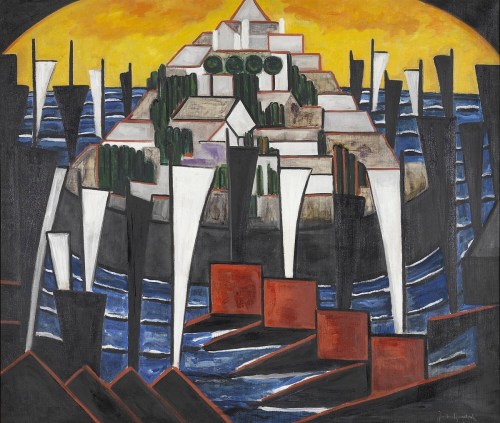
Sailboats by Jacoba van HeemskerckArtist: Jacoba van Heemskerck (1876–1923)

Title: Bild no. 15 (Segelboote) (English: Painting no, 15 – Sailboats)

Date: Circa 1914

Medium: oil on canvas

Dimensions: height: 97.5 cm (38.3 in); width: 113.5 cm (44.6 in)

Collection: Museum Boijmans Van Beuningen

What I love about this painting:

The sharp corners and geometry of this composition raises the viewer’s eye toward the horizon. It feels cubist, is abstract, and reflects a spiritual connection to her subject. I love the symbolism in this image. The sailboats are souls sailing toward the next life across a deep blue sea and beneath a golden sky. The island temple toward which the boats sail is shaped like a pyramid. The elongated sails of the many boats direct the eye up. Everything, including the island temple, points toward heaven.

In this painting, it is easy to see how she would later become involved in creating stained glass—the sharp black outlines and vivid colors of her paintings are perfect for that medium.

According to the Kunstmuseum Den Haag’s website:

“But whereas Mondrian’s artistic approach eventually became austerely geometrical, Van Heemskerck’s developed as a result of a variety of influences (including anthroposophy) into an open, unconstrained and intuitive style. Throughout her life, she would seek – like Kandinsky – to express spiritual experience. The recurring subjects in her oeuvre are therefore invariably symbolic in nature: sailing ships, bridges and trees, depicted in clear, vibrant colours and with firm outlines. Although she was never to abandon the representation of the real world, Van Heemskerck’s style was eventually so abstract that her subjects became virtually unrecognisable. This approach won her great success, especially in Germany, where she exhibited at the Berlin Expressionist gallery Der Sturm every year from 1913 until her death.” [1]

About the Artist, Via Wikipedia:

Jkvr. Jacoba Berendina van Heemskerck van Beest (1876-1923) was a Dutch painter, stained glass designer and graphic artist who worked in several modern genres. She specialized in landscapes and still-lifes.

Her first contact with Modern art came in Paris, where she took lessons from Eugène Carrière.[2][3] She remained in France until 1904, then went to live with her sister, Lucie, and was introduced to the art collector, Marie Tak van Poortvliet, who became her lifelong friend and later built a studio for her in the garden of her home.[1] After 1906, she spent her Summers in Domburg, where she came into contact with avant-garde painters such as Piet Mondrian[4] and Jan Toorop, who offered her advice. Around 1911, she was briefly interested in Cubism.

Shortly after, she became involved in Anthroposophy, possibly through the influence of her former teacher, Nibbrig, who was a Theosophist. She then became an avid follower of Der Sturm, an avant-garde art magazine founded by Herwarth Walden, and turned increasingly to Abstraction.[1] In 1913, she attended the Erster Deutscher Herbstsalon in Berlin, where she met Walden and started what would be a lifelong correspondence.[3] Thanks to his efforts, her work was popular in Germany, while it remained somewhat ignored in her home country.

After 1916, she developed an interest in stained glass windows, designing them for the naval barracks and the Municipal Health Department building in Amsterdam, as well as private residences.[1] From 1922, she lived in Domburg with her old friend and patron, Tak van Poortvliet.

She died suddenly, from an attack of angina.[3] Both Tak van Poortvliet and Walden mounted exhibitions of her work, in Amsterdam and Berlin respectively. In 2005, a major retrospective was held at the Gemeentemuseum Den Haag. [2]


Credits and Attributions:

[1] Kunstmuseum Den Haag contributors, “Jacoba van Heemskerck,” Jacoba van Heemskerck A REDISCOVERY, Jacoba van Heemskerck | Kunstmuseum Den Haag (accessed March 31, 2022).

[2]Wikipedia contributors, “Jacoba van Heemskerck,” Wikipedia, The Free Encyclopedia, https://en.wikipedia.org/w/index.php?title=Jacoba_van_Heemskerck&oldid=1078279427 (accessed March 31, 2022).

Comments Off on #FineArtFriday: Sailboats by Jacoba van Heemskerck

Filed under #FineArtFriday, writing

#FineArtFriday: Red hollyhocks in the garden of the Ancher family at Markvej in Skagen by Anna Ancher ca. 1916

Anna_Ancher_-_Røde_stokroser_i_haven_ved_Ancher-familiens_hus_på_Markvej_i_SkagenArtist: Anna Ancher  (1859–1935)

Title: English: Red hollyhocks in the garden of the Ancher family at Markvej in Skagen.

Date: circa 1916

Medium: oil on canvas

Dimensions: Height: 63 cm (24.8 in); Width: 47 cm (18.5 in)

Collection: Unknown

Inscriptions: Signature bottom right: A. Ancher

What I love about this painting:

January tends to be dark and rainy here in the Pacific Northwest. We were snowed and iced in for two weeks, and then four inches of rain fell in one day and the floods came—boy, do I need a summer day! So, I found us this one—a perfect day in Skagen a century ago.

She is mostly known for her interiors, but Anna Ancher captured the essence of summer in this painting. Along with foxgloves, hollyhocks are my favorite summer flowers. Hers are beautiful, juxtaposed against the blue sky. Her eye for color was amazing. The yellow and red flowers perfectly complement the color of the building behind the garden.

I feel so much better for having had this glorious day in Anna’s serene garden.

About the Artist via Wikimedia: Anna Ancher preferred to paint interiors and simple themes from the everyday lives of the Skagen people, especially fishermen, women, and children. She was intensely preoccupied with exploring light and color, as in Interior with Clematis (1913). She also created more complex compositions such as A Funeral (1891). Anna Ancher’s works often represented Danish art abroad. Ancher has been known for portraying similar civilians from the Skagen art colony in her works, including an old blind woman.

While she studied drawing for three years at the Vilhelm Kyhn College of Painting in Copenhagen, she developed her own style and was a pioneer in observing the interplay of different colors in natural light. She also studied drawing in Paris at the atelier of Pierre Puvis de Chavannes along with Marie Triepcke, who would marry Peder Severin Krøyer, another Skagen painter.

In 1880 she married fellow painter Michael Ancher, whom she met in Skagen. They had one child, daughter Helga Ancher. Despite pressure from society that married women should devote themselves to household duties, she continued painting after marriage. [1]


Credits and Attributions:

Anna Ancher, Public domain, via Wikimedia Commons. Wikimedia Commons contributors, “File:Anna Ancher – Røde stokroser i haven ved Ancher-familiens hus på Markvej i Skagen.jpg,” Wikimedia Commons, the free media repository, https://commons.wikimedia.org/w/index.php?title=File:Anna_Ancher_-_R%C3%B8de_stokroser_i_haven_ved_Ancher-familiens_hus_p%C3%A5_Markvej_i_Skagen.jpg&oldid=616771666 (accessed January 14, 2022).

[1] Wikipedia contributors, “Anna Ancher,” Wikipedia, The Free Encyclopedia, https://en.wikipedia.org/w/index.php?title=Anna_Ancher&oldid=1041257716 (accessed January 14, 2022).

Comments Off on #FineArtFriday: Red hollyhocks in the garden of the Ancher family at Markvej in Skagen by Anna Ancher ca. 1916

Filed under #FineArtFriday, writing

#FineArtFriday: Harvesters by Anna Ancher, 1905

Anna_Ancher_-_Harvesters_-_Google_Art_ProjectArtist: Anna Ancher  (1859–1935)

Title: Harvesters

Date: 1905

Medium: oil on canvas

Dimensions: w56.2 x h43.4 cm (Without frame)

Collection: Skagens Museum

What I love about this painting:

While she normally painted interiors, Anna Ancher captured a perfect late summer morning beneath blue skies in this painting. One can almost hear the rustling of ripe grain moving with the breeze.

I like the placement of the three figures, two women and a man. Are they husband, wife, and daughter? There is a sense of movement in this painting. They enter the scene from the right, and you feel sure they will exit to the left, where the field that is to be cut that day is.

The man will scythe, the woman who follows third will rake, and the woman in the middle will stack the sheaves.

These are not poor people. These farmers are dressed modestly in clean work clothes that aren’t tattered and patched. They are doing well; the grain is high, and life is good in these years of plenty before the outbreak of WWI.

About the Artist, via Wikipedia:

Anna Ancher (18 August 1859 – 15 April 1935), born Anna Kirstine Brøndum, was born in Skagen, Denmark, was the only one of the Skagen Painters who was born and grew up in Skagen, where her father owned the Brøndums Hotel. The artistic talent of Anna Ancher became obvious at an early age and she became acquainted with pictorial art via the many artists who settled to paint in Skagen, in the north of Jylland.

While she studied drawing for three years at the Vilhelm Kyhn College of Painting in Copenhagen, she developed her own style and was a pioneer in observing the interplay of different colors in natural light. She also studied drawing in Paris at the atelier of Pierre Puvis de Chavannes along with Marie Triepcke, who would marry Peder Severin Krøyer, another Skagen painter.

In 1880 she married fellow painter Michael Ancher, whom she met in Skagen. They had one child, daughter Helga Ancher. Despite pressure from society that married women should devote themselves to household duties, she continued painting after marriage.

Anna Ancher was considered to be one of the great Danish pictorial artists by virtue of her abilities as a character painter and colorist. Her art found its expression in Nordic art’s modern breakthrough toward a more truthful depiction of reality, e.g. in Blue Ane (1882) and The Girl in the Kitchen (1883–1886).

Ancher preferred to paint interiors and simple themes from the everyday lives of the Skagen people, especially fishermen, women, and children. She was intensely preoccupied with exploring light and color, as in Interior with Clematis (1913). She also created more complex compositions such as A Funeral (1891). Anna Ancher’s works often represented Danish art abroad. Ancher has been known for portraying similar civilians from the Skagen art colony in her works, including an old blind woman.


Credits and Attributions:

Harvesters, Anna Ancher, Public domain, via Wikimedia CommonsWikimedia Commons contributors, “File:Anna Ancher – Harvesters – Google Art Project.jpg,” Wikimedia Commons, the free media repository, https://commons.wikimedia.org/w/index.php?title=File:Anna_Ancher_-_Harvesters_-_Google_Art_Project.jpg&oldid=371900766 (accessed October 14, 2021).

Wikipedia contributors, “Harvesters (Ancher),” Wikipedia, The Free Encyclopedia, https://en.wikipedia.org/w/index.php?title=Harvesters_(Ancher)&oldid=1047378795 (accessed October 14, 2021).

3 Comments

Filed under #FineArtFriday

#FineArtFriday: Corporal J.D.M Pearson GC (WAAF) by Dame Laura Knight 1940

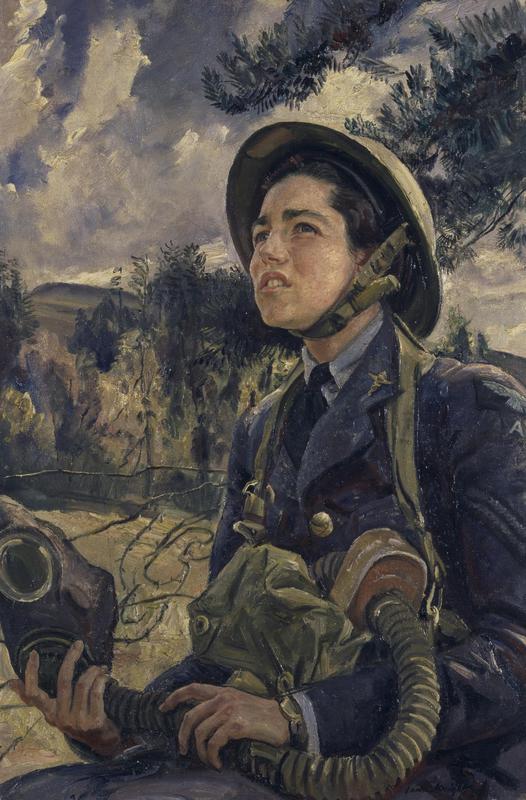
Corporal_J.D.M_Pearson,_GC,_WAAF_(1940)_(Art._IWM_ART_LD_626)About this image via Wikipedia:

A three- quarters length portrait of Corporal J. D. M. Pearson, GC, WAAF (1940) – shows Corporal Daphne Pearson of the Women’s Auxiliary Air Force, WAAF, a recipient of the Empire Gallantry Medal, later exchanged for the George Cross. Although Pearson, at Knight’s insistence, sat for the portrait holding a rifle, the finished painting shows her holding a respirator. As WAAF personal were not allowed to carry arms on duty, Knight had to paint over the rifle. [1]

Joan Daphne Mary PearsonGC (25 May 1911 – 25 July 2000) was a Women’s Auxiliary Air Force officer during the Second World War and one of only thirteen women recipients of the George Cross, the highest decoration for gallantry not in the face of an enemy that can, or could, be awarded to a citizen of the United Kingdom or commonwealth.

Pearson joined the Women’s Auxiliary Air Force (WAAF) as a medical orderly shortly after the outbreak of the Second World War in 1939.

In the early hours of the morning on 31 May 1940, Avro Anson bomber R3389 of No. 500 Squadron RAF undershot on approach to an airstrip near the WAAF quarters in DetlingKent, crashing into a field. Upon landing, a bomb exploded, killing the navigator instantly, and leaving the pilot seriously injured. Corporal Pearson entered the burning fuselage, released the pilot from his harness and removed him from the immediate area around the aircraft. After she was 27 metres (30 yards) from the aircraft, a bomb exploded. She flung herself on top of the pilot to protect him. After medical staff had removed the pilot, she went back to the plane to look for the fourth crew member, the radio operator. She found him dead. For her deeds, Pearson was awarded the Empire Gallantry Medal (EGM). [2]

About the Artist, via Wikipedia:

Dame Laura Knight, (née Johnson), DBE RA RWS (4 August 1877 – 7 July 1970) was an English artist who worked in oils, watercolors, etching, engraving and drypoint. Knight was a painter in the figurative, realist tradition, who embraced English Impressionism. In her long career, Knight was among the most successful and popular painters in Britain. Her success in the male-dominated British art establishment paved the way for greater status and recognition for women artists.

In 1929 she was created a Dame, and in 1936 became the first woman elected to full membership of the Royal Academy. Her large retrospective exhibition at the Royal Academy in 1965 was the first for a woman. Knight was known for painting amidst the world of the theatre and ballet in London, and for being a war artist during the Second World War. She was also greatly interested in, and inspired by, marginalized communities and individuals, including Gypsies and circus performers. [1]


Credits and Attributions:

File:Corporal J.D.M Pearson, GC, WAAF (1940) (Art. IWM ART LD 626).jpg|

[1] Wikipedia contributors, “Laura Knight,” Wikipedia, The Free Encyclopedia, https://en.wikipedia.org/w/index.php?title=Laura_Knight&oldid=1019091508 (accessed April 29, 2021).

[2] Wikipedia contributors, “Daphne Pearson,” Wikipedia, The Free Encyclopedia, https://en.wikipedia.org/w/index.php?title=Daphne_Pearson&oldid=1000936279 (accessed April 29, 2021).

Comments Off on #FineArtFriday: Corporal J.D.M Pearson GC (WAAF) by Dame Laura Knight 1940

Filed under #FineArtFriday

#FineArtFriday: Twilight Confidences by Cecilia Beaux 1888

Twilight_Confidences_by_Cecilia_BeauxTwilight Confidences by Cecilia Beaux  (1855–1942)

Date: 1888

Medium:  oil on canvas

Dimensions: 23 1/2 x 28 inches, 59.7 x 71.1 cm

Inscriptions: Signed and dated: Cecilia Beaux

About this painting via Wikimedia Commons:  

Cecilia Beaux was a leading figure and portrait painter and one of the few distinguished and highly recognized women artists of her time in America. Her figures are frequently compared to Sargent’s, but her style relates also to other international leaders of late-19th Century portraiture, including Anders Zorn, Giuseppe Boldini, Carolus-Duran and William Merritt Chase. She was born and lived mostly in Philadelphia, traveling frequently to Europe, especially France from a young age, and exhibited widely in Paris, Philadelphia, New York and elsewhere. Her first acclaimed work, Les Derniers jours d’enfance, a mother and child composition, was exhibited at the Paris Salon in 1887, and Beaux followed it there the next year, spending the summer of 1888 at the art colony at Concarneau in Brittany. Here she painted her remarkable Twilight Confidences of 1888, preceded by numerous studies, which are in the collection of the Pennsylvania Academy of the Fine Arts. Lost for many years, this much admired canvas is Beaux’s first major exercise in plein-air painting, in which the figures and the seascape are artfully and exquisitely juxtaposed, and sunlight permeates the whole composition.


Credits and Attributions:

Twilight Confidences, Cecilia Beaux, Public domain, via Wikimedia Commons

Wikimedia Commons contributors, “File:Twilight Confidences by Cecilia Beaux.jpg,” Wikimedia Commons, the free media repository, https://commons.wikimedia.org/w/index.php?title=File:Twilight_Confidences_by_Cecilia_Beaux.jpg&oldid=355146645 (accessed April 16, 2021).

Comments Off on #FineArtFriday: Twilight Confidences by Cecilia Beaux 1888

Filed under #FineArtFriday